
Generative AI In Personalized Marketing Content and Campaign Automation Market Size and Share
Market Overview
| Study Period | 2020 - 2031 |
|---|---|
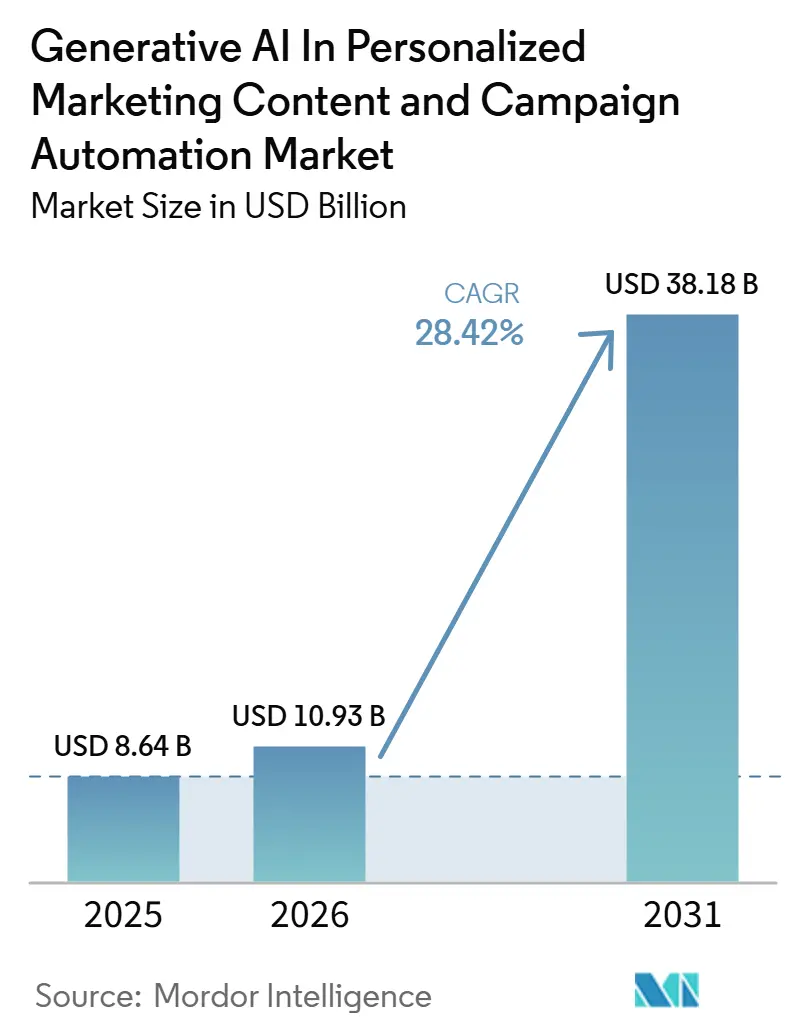
| Market Size (2026) | USD 10.93 Billion |
| Market Size (2031) | USD 38.18 Billion |
| Growth Rate (2026 - 2031) | 28.42 % |
| Fastest Growing Market | Asia-Pacific |
| Largest Market | North America |
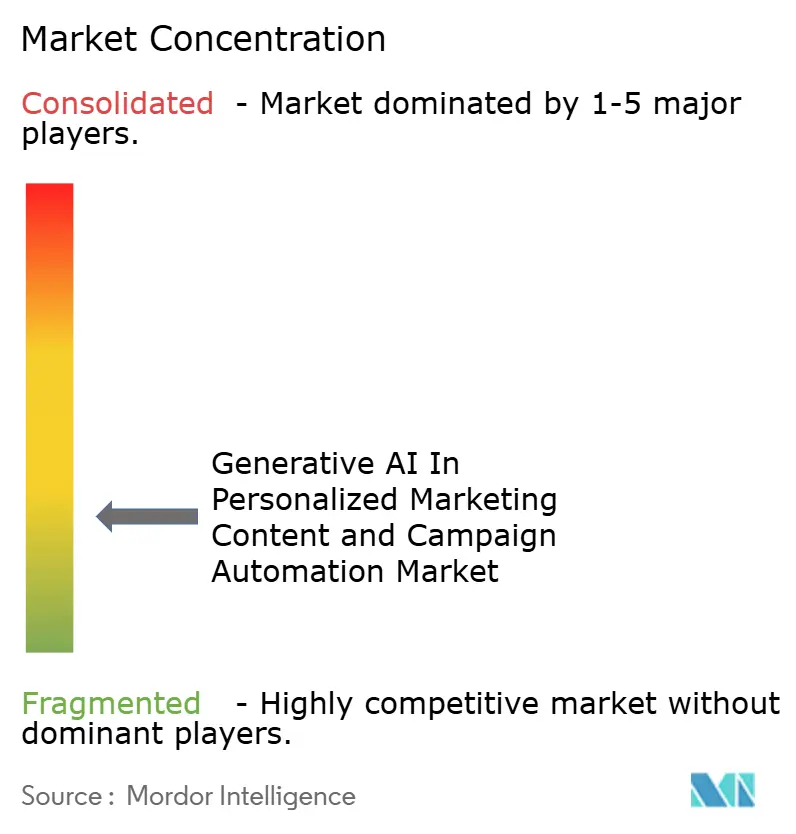
| Market Concentration | Low |
Major Players *Disclaimer: Major Players sorted in no particular order Image © Mordor Intelligence. Reuse requires attribution under CC BY 4.0. | |
Generative AI In Personalized Marketing Content and Campaign Automation Market Analysis by Mordor Intelligence
The Generative AI in Personalized Marketing Content and Campaign Automation Market size is expected to increase from USD 8.64 billion in 2025 to USD 10.93 billion in 2026 and reach USD 38.18 billion by 2031, growing at a CAGR of 28.42% over 2026-2031. The generative AI in personalized marketing content and campaign automation market is moving beyond trial use, as enterprises now expect personalization tools to support live customer journeys, content generation, and decisioning at scale. The market is also benefiting from a broader shift toward always-on engagement, where brands want faster responses, greater contextual relevance, and shorter content turnaround across channels. The generative AI in personalized marketing content and campaign automation market is gaining momentum as vendors fold personalization features into larger customer engagement platforms, making adoption easier for enterprises that already use those systems. Compliance, governance, and output control are shaping purchase decisions more directly, which is pushing the market toward platforms that can support both creativity and accountability. This leaves room for growth in workflow integration, privacy-aware architecture, multilingual execution, and regulated customer environments that still remain underpenetrated.
Key Report Takeaways
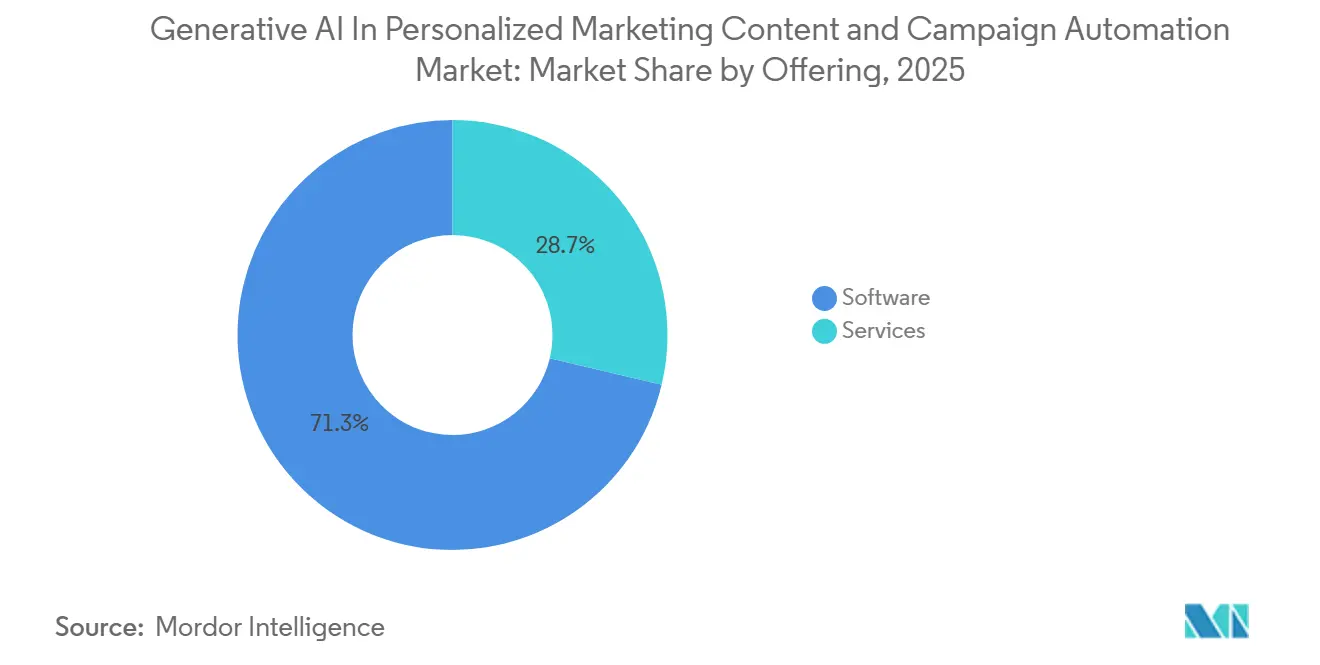
- By offering, software held 71.28% share of the generative AI in personalized marketing content and campaign automation market in 2025, while services are projected to expand at 29.24% CAGR through 2031.
- By deployment mode, cloud accounted for 77.34% of the generative AI in personalized marketing content and campaign automation market in 2025, while hybrid is projected to expand at 29.88% CAGR through 2031.
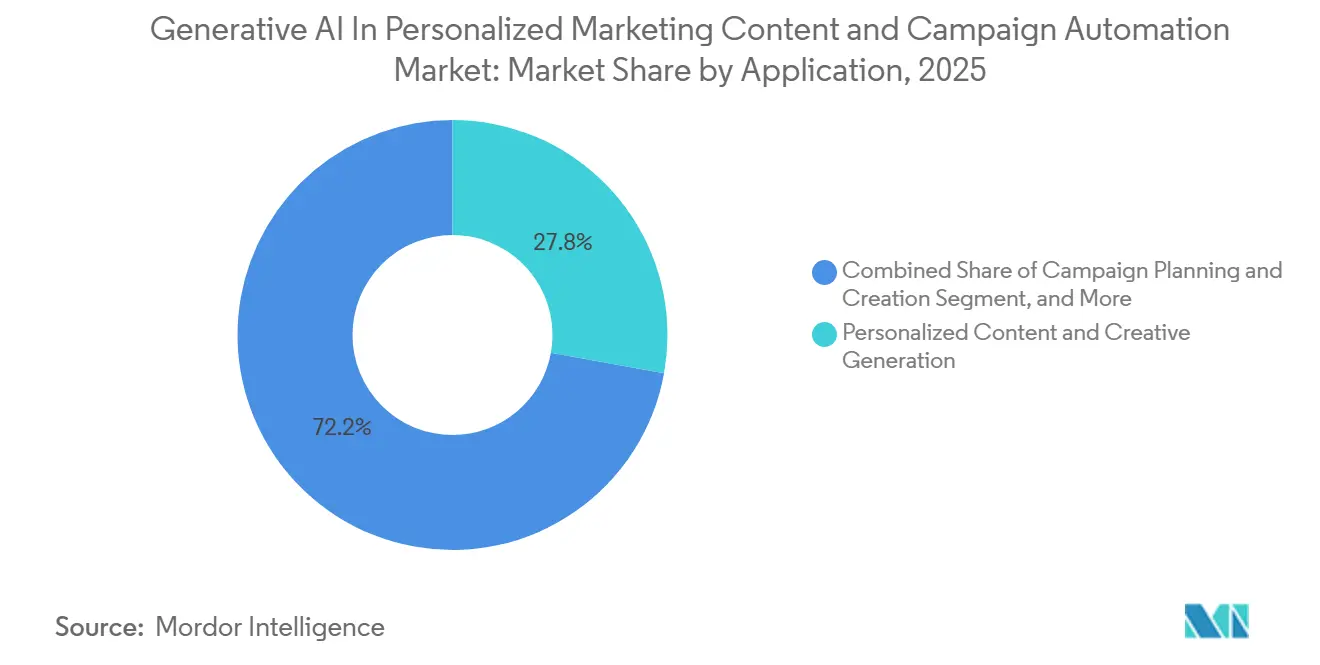
- By application, personalized content and creative generation accounted for 27.84% of the generative AI in personalized marketing content and campaign automation market in 2025, while marketing copilots and assistants are projected to expand at 31.46% CAGR through 2031.
- By end user, e-commerce and retail held 29.36% of the generative AI in personalized marketing content and campaign automation market share in 2025, while healthcare is projected to expand at a 30.37% CAGR through 2031.
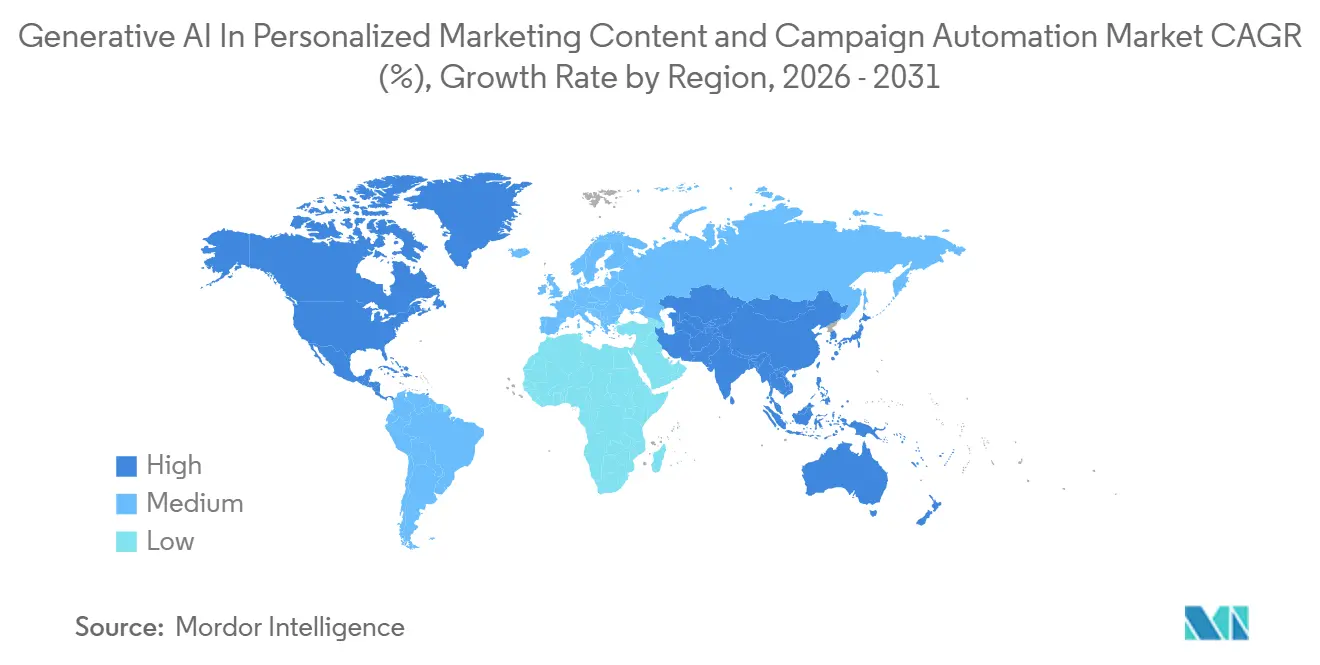
- By geography, North America held 40.18% of the generative AI in personalized marketing content and campaign automation market share in 2025, while Asia-Pacific is projected to expand at 30.94% CAGR through 2031.
Note: Market size and forecast figures in this report are generated using Mordor Intelligence’s proprietary estimation framework, updated with the latest available data and insights as of January 2026.
Market Trends and Insights
Drivers Impact Analysis of Generative AI In Personalized Marketing Content and Campaign Automation Market*
| Driver | (~) % Impact on CAGR Forecast | Geographic Relevance | Impact Timeline |
|---|---|---|---|
| Growing Demand for Agentic Personalization at Scale | +8.5% | Global, led by North America and Asia-Pacific | Short term (≤ 2 years) |
| GenAI Reduces Content Production Costs | +6.5% | Global, concentrated in North America and Europe | Short term (≤ 2 years) |
| Shift Toward Real-Time Customer Personalization | +5.0% | Global, led by North America and Europe | Short term (≤ 2 years) |
| Expanding Multimodal AI Capabilities | +3.5% | North America and Asia-Pacific, with spillover to Europe | Medium term (2-4 years) |
| Integration With Enterprise CRM and Marketing Platforms | +2.5% | North America and Europe | Medium term (2-4 years) |
| Pressure to Improve Customer Experience | +1.5% | Global | Long term (≥ 4 years) |
| Source: Mordor Intelligence | |||
Growing Demand for AI-Driven, Agentic Personalization at Scale
The generative AI in personalized marketing content and campaign automation market is being pushed forward by a clear move from isolated tools toward agent-based execution inside daily customer operations. Product launches in 2026 show that vendors are no longer presenting AI solely as a writing aid, but are positioning it as a system that can plan, recommend, and act across customer workflows. Salesforce expanded its partnership with OpenAI in October 2025 and embedded reasoning, voice, and multimodal capabilities into Agentforce 360, which shows how major platform vendors are bringing agentic personalization into broader enterprise stacks.[1] Insider One also announced a June 2026 partnership with Google that lets brands activate live BigQuery data within AI-orchestrated journeys across web, mobile, email, SMS, RCS, and WhatsApp, signaling that real-time orchestration is moving closer to core production environments. As more enterprises seek fewer handoffs between audience insight, content creation, and campaign action, the preference is shifting toward platforms that can coordinate those functions within a single operating layer. This is strengthening demand for integrated suites and raising the value of vendors that can combine orchestration, data access, and governance in a single solution.
GenAI Significantly Reduces Content Production Costs
The generative AI in personalized marketing content and campaign automation market is also expanding because brands can now create more tailored content without relying on the same level of manual effort that older workflows required. This changes the economics of personalization because a campaign can now support more audience variants, more formats, and more frequent updates inside the same operating cycle. Google Cloud and OTB Group launched an AI-powered, hyper-personalized shopping experience in May 2026 using virtual try-on, demonstrating that personalized creative output is scaling beyond static text into richer visual commerce experiences.[2] Visa introduced an AI Financial Assistant in July 2026 as a service that combines cardholder behavior, transaction intelligence, and institutional data to deliver personalized guidance under bank branding, reflecting the same pattern of higher personalization across recurring customer interactions. When content creation and decision support are easier to scale, brands tend to expand coverage rather than limit it to premium audiences. This supports stronger adoption in the generative AI in personalized marketing content and campaign automation market, because value comes from broader campaign reach as much as from lower unit effort.
Rapid Shift Toward Real-Time Customer Personalization
The generative AI in personalized marketing content and campaign automation market is benefiting from a faster shift toward live personalization, where customer context is expected to update continuously rather than in fixed campaign cycles. This matters because customer journeys now span several channels, and delayed responses diminish the relevance of recommendations, messages, and offers. Insider One’s June 2026 partnership with Google was built around the direct activation of live BigQuery data into AI-led customer journeys, underscoring the need for systems that can work with current signals rather than stale audience lists. OCBC Bank also unveiled OCBC WoW in July 2026, featuring AI avatars that provide 24/7 wealth guidance, portfolio updates, and personalized investment ideas, demonstrating how real-time interaction is becoming part of customer-facing service design.[3] Visa’s AI Financial Assistant follows a similar approach by tying transaction intelligence to customer guidance in an always-on format. As a result, the generative AI in personalized marketing content and campaign automation market is increasingly tied to response speed, data freshness, and the ability to turn live context into action inside normal customer touchpoints.
Expanding Multimodal AI Capabilities Broaden Application Range
The generative AI in personalized marketing content and campaign automation market is expanding its user base because personalization is no longer limited to text, product copy, or basic message variants. Multimodal capability enables vendors and enterprise buyers to connect language, images, visual fit, voice, and transactional data within a single user journey. The OTB Group and Google Cloud rollout in May 2026 showed this clearly, because the experience lets customers visualize apparel on their own body and moves personalization closer to the point of purchase. OCBC WoW added another example in July 2026 by using AI avatars for personalized wealth engagement in mobile banking, bringing conversational and advisory layers together. Visa also moved in this direction with AI Financial Assistant, which is designed to combine data interpretation and personalized financial guidance into a single branded customer service layer. As these formats mature, the generative AI in personalized marketing content and campaign automation market is likely to draw demand from more customer-facing functions that need visual, conversational, and behavioral signals simultaneously.
Restraints Impact Analysis of Generative AI In Personalized Marketing Content and Campaign Automation Market*
| Restraint | (~) % Impact on CAGR Forecast | Geographic Relevance | Impact Timeline |
|---|---|---|---|
| Brand Safety Risks, AI Hallucinations, and Output Quality Concerns | -4.8% | Global | Short term (≤ 2 years) |
| Consumer Data Privacy Concerns and Regulatory Compliance Complexity | -3.8% | Europe, with spillover to North America | Medium term (2-4 years) |
| Integration Complexity and High Implementation Costs | -2.5% | Global, acute in Asia-Pacific and emerging markets | Medium term (2-4 years) |
| Copyright, IP, and Regulatory Ambiguity Around AI-Generated Content | -1.8% | Global, led by the United States and Europe | Long term (≥ 4 years) |
| Source: Mordor Intelligence | |||
Brand Safety Risks, AI Hallucinations, and Output Quality Concerns
The generative AI in personalized marketing content and campaign automation market still faces a major restraint in the form of unreliable output, because personalization loses value quickly when the message is inaccurate, biased, or off-brand. The issue is not theoretical, as IAB reported that 70% of marketers had experienced at least 1 AI incident involving hallucinated outputs, biased creative, or compliance failures in campaigns.[4] The risk becomes more serious when content, decisioning, and delivery are linked together in automated workflows, because one flawed output can spread across several channels before review. Academic work published in 2026 framed AI hallucinations as an enterprise governance problem that calls for audit trails, accountability, and active monitoring rather than simple creative review. This means vendors in the generative AI in personalized marketing content and campaign automation market need to show not only content speed, but also measurable control over brand safety and factual consistency. Enterprises that cannot validate output quality before deployment are likely to move more slowly, which lengthens procurement and implementation cycles.
Consumer Data Privacy Concerns and Regulatory Compliance Complexity
The generative AI in personalized marketing content and campaign automation market is also constrained by tighter rules on personal data, profiling, and human oversight. The European Commission’s regulatory framework shows that the EU AI Act entered into force in August 2024 and that obligations for AI systems are being phased in over time, which raises the compliance burden for data-intensive personalization use cases. These rules matter because personalization systems depend on behavioral and transactional information, and that makes consent handling, documentation, and governance central to deployment. A September 2025 SAP Emarsys study found that 48% of German marketing leaders had made fundamental changes to their AI personalization approach after the EU AI Act’s passage, which shows that regulation is already influencing commercial practice. The practical result is that larger enterprises with stronger data governance can move ahead faster, while mid-sized firms face more friction in proving that their personalization architecture is compliant. This creates a clear compliance divide in the generative AI in personalized marketing content and campaign automation market, where trust architecture becomes part of the product value rather than a separate operational concern.
*Our forecasts treat driver/restraint impacts as directional, not additive. The impact forecasts reflect baseline growth, mix effects, and variable interactions.
Generative AI In Personalized Marketing Content and Campaign Automation Market Segment Analysis
By Offering:
Software Dominates While Services AccelerateSoftware held a 71.28% share of the generative AI in personalized marketing content and campaign automation market in 2025, which reflects the depth of personalization functions now built into enterprise platforms. Buyers often prefer software-led deployments because they can combine audience data, content generation, journey orchestration, and analytics in one environment. That breadth supports higher switching costs and gives incumbent vendors an advantage when enterprises want to expand from single-use deployments into broader customer engagement programs. Salesforce’s October 2025 partnership expansion with OpenAI showed how established platforms are embedding more reasoning, voice, and multimodal capability directly into customer-facing workflows instead of leaving those functions to separate tools.
Services are projected to expand at a 29.24% CAGR through 2031, which makes them the faster-growing offering in the generative AI in personalized marketing content and campaign automation market. This pattern shows that adoption still depends heavily on implementation work, integration support, model tuning, and operating guidance after the initial purchase. The generative AI in personalized marketing content and campaign automation market is still in a phase where many enterprises are moving from acquisition to production, and that creates a steady need for deployment support around data architecture and workflow design. It also suggests that service partners remain important in helping enterprises connect personalization tools to CRM systems, governance processes, and customer experience targets.
By Deployment Mode:
Cloud Leads as Hybrid Captures Regulated IndustriesCloud accounted for 77.34% of the generative AI in personalized marketing content and campaign automation market in 2025, which reflects the appeal of managed infrastructure, faster updates, and easier integration with enterprise software. Cloud deployment also gives customers quicker access to new model capabilities without the same internal infrastructure burden. This model fits especially well where personalization programs need to scale across multiple channels and operating regions. The direction of vendor launches supports this pattern, because Google Cloud, Salesforce, and Insider One each tied recent personalization capabilities to cloud-connected data and orchestration environments.
Hybrid deployment is projected to expand at a 29.88% CAGR through 2031, which makes it the fastest-growing deployment mode in the generative AI in personalized marketing content and campaign automation market. The main driver is compliance, because many enterprises want cloud-based AI capability while keeping sensitive customer data and audit records under tighter control. This is especially important in regulated sectors such as banking and healthcare, where data residency and oversight affect both vendor selection and system design. The European regulatory landscape reinforces this trend, as compliance obligations push enterprises toward deployment models that separate inference convenience from data control.
By Application:
Personalized Content Generation Anchors Revenue as Copilots SurgePersonalized content and creative generation held 27.84% of the generative AI in personalized marketing content and campaign automation market in 2025, which made it the largest application area by revenue. This lead came from the relative maturity of use cases such as product copy, triggered messaging, and customer-specific creative variations. Enterprises already understand how to budget for these tasks, because they connect directly to campaign execution and can be inserted into existing workflows with less disruption than more autonomous applications. The OTB Group and Google Cloud virtual try-on launch also shows how the content layer is expanding from text into interactive visual commerce, which strengthens the role of personalized creative in customer conversion paths.
Marketing copilots and assistants are projected to expand at a 31.46% CAGR through 2031, which makes them the fastest-growing application in the generative AI in personalized marketing content and campaign automation market. Their rise reflects a shift from support tools toward systems that can recommend, coordinate, and trigger actions inside campaign workflows. Salesforce’s ongoing Agentforce expansion and Insider One’s live data activation partnership both point to the same change, where the interface is becoming a working layer for decisioning rather than just a prompt window. As these tools become more central to execution, the boundary between analytics, content, and orchestration is narrowing inside the generative AI in personalized marketing content and campaign automation market.

By End User:
E-Commerce and Retail Leads While Healthcare Posts the Steepest TrajectoryE-commerce and retail held 29.36% share in the generative AI in personalized marketing content and campaign automation market in 2025, which made it the largest end user segment. The sector benefits from high signal density, frequent customer interactions, and direct links between personalization actions and conversion outcomes. That combination allows enterprises to test, refine, and scale customer-specific recommendations faster than many other verticals. Banking and financial services also remain important, and HSBC described hyper-personalization as critical for banks of all sizes, underscoring how customer expectations are pushing financial institutions toward more adaptive engagement models.
Healthcare is projected to expand at a 30.37% CAGR through 2031, which makes it the fastest-growing end user segment in the generative AI in personalized marketing content and campaign automation market. Growth is supported by the fact that clinical and administrative personalization are becoming more feasible within structured care programs. A 2026 pilot published in npj Digital Medicine examined agentic large language models that delivered individualized health plans within Singapore’s Healthier SG program, and residents gave the personalization experience a satisfaction score of 3.8 out of 5 in early testing. The generative AI in personalized marketing content and campaign automation market is therefore moving into healthcare through use cases where compliance and relevance matter at the same time. Vendors that already support regulated environments are likely to hold an advantage here, because qualification requirements are harder to meet than in many commercial consumer settings.
Geography Analysis
The Americas Generative AI in Personalized Marketing Content and Campaign Automation Market
North America held a 40.18% share of the generative AI in personalized marketing content and campaign automation market in 2025, maintaining its leading regional position. The region benefits from mature cloud infrastructure, strong enterprise software penetration, and a high concentration of platform vendors and large buyers. The generative AI in personalized marketing content and campaign automation market is also stronger in North America because many enterprises already have first-party data systems and customer engagement stacks that can support deployment at scale. Visa introduced an AI Financial Assistant in July 2026 for financial institutions, with a pilot rollout to U.S. banks planned for August 2026, a move that reflects active investment in production-grade personalization within mainstream financial services. South America remains earlier in the adoption cycle, with Brazil standing out as the main near-term entry point for broader regional growth.
APAC Generative AI in Personalized Marketing Content and Campaign Automation Market
Asia-Pacific is projected to expand at a 30.94% CAGR through 2031, which makes it the fastest-growing geography in the generative AI in personalized marketing content and campaign automation market. Growth is being driven by expanding digital commerce, strong enterprise adoption in large consumer economies, and public support for AI development across several markets. Singapore’s role is visible through OCBC WoW, which brought AI-avatar wealth engagement into mobile banking in July 2026 and showed how customer-facing personalization is moving into daily financial use. Japan also presents latent headroom, because the 2025 White Paper on Information and Communications reported that 55.2% of Japanese businesses used generative AI for work, a lower level than China, the United States, and Germany.
EMEA Generative AI in Personalized Marketing Content and Campaign Automation Market
Europe remains a meaningful part of the generative AI in personalized marketing content and campaign automation market, although compliance demands are shaping its pace and architecture more heavily than in some other regions. The EU AI Act and the wider European regulatory setting are pushing vendors and buyers to focus more closely on documentation, oversight, and data handling before scaling deployments. This influence is already visible in enterprise behavior, because SAP Emarsys reported in 2025 that 48% of German marketing leaders had fundamentally changed their AI personalization approach after the EU AI Act’s passage. The Middle East is expanding through digital transformation programs in Saudi Arabia and the UAE, while Africa remains at an early stage with South Africa and Egypt as the main initial deployment markets.
Competitive Landscape
The generative AI in personalized marketing content and campaign automation market is moderately fragmented, with competition spread across large customer engagement platforms and focused specialists. Vendors are separating themselves through vertical depth, compliance readiness, orchestration capability, and access to useful customer data rather than through base model performance alone. The generative AI in personalized marketing content and campaign automation market is favoring platforms that can connect audience data, content generation, and customer action without forcing enterprises to stitch together too many tools. Salesforce’s October 2025 partnership expansion with OpenAI is a good example, because it added reasoning, voice, and multimodal capabilities to Agentforce 360 and strengthened its position inside existing enterprise workflows. This supports larger suite vendors, as customers often prefer to add new personalization features within familiar operating systems.
The generative AI in personalized marketing content and campaign automation market still leaves room for specialists who can prove stronger performance in targeted use cases. Dynamic Yield by Mastercard, Insider, Klaviyo, Persado, Anyword, and Writer remain relevant because many buyers still want sharper capability in areas such as recommendation logic, multi-channel engagement, or enterprise content control. Dynamic Yield’s 2026 recognition as a Leader in Gartner’s Magic Quadrant for Personalization Engines, highlighted on Mastercard Dynamic Yield’s own platform, reflects how data-enriched personalization remains a durable source of differentiation. Best-of-breed demand persists where enterprises want measurable gains in a narrow workflow without replacing their entire customer engagement stack.
The generative AI in personalized marketing content and campaign automation market is also being shaped by visible strategic moves from adjacent leaders in commerce, cloud, and banking. Visa’s July 2026 AI Financial Assistant launch shows how payment and banking ecosystems are turning transaction data into branded guidance services for financial institutions. Google Cloud and OTB Group used virtual try-on to bring hyper-personalized visual shopping into branded retail experiences, which points to stronger overlap between personalization and immersive commerce. OCBC’s AI-avatar banking launch adds another example from wealth management, and together these moves suggest that future whitespace remains strongest in regulated personalization, multilingual execution, and privacy-aware customer interaction design.
Generative AI In Personalized Marketing Content and Campaign Automation Industry Leaders
-
OpenAI
-
Adobe Inc.
-
Salesforce, Inc.
-
Microsoft Corporation
-
Google LLC
- *Disclaimer: Major Players sorted in no particular order
Generative AI In Personalized Marketing Content and Campaign Automation Market Companies Covered in this Report
- OpenAI
- Adobe Inc.
- Salesforce, Inc.
- Microsoft Corporation
- Google LLC
- Anthropic
- Klaviyo
- Oracle Corporation
- Braze
- HubSpot, Inc.
- Jasper AI, Inc.
- Writer, Inc.
- Copy.ai, Inc.
- Anyword Inc.
- Persado, Inc.
- Blueshift, Inc.
- Zeta Global Holdings Corp.
- Dynamic Yield by Mastercard
- Optimove Inc.
Recent Industry Developments in Generative AI In Personalized Marketing Content and Campaign Automation Market
- July 2026: Visa introduced AI Financial Assistant, a new value-added service for financial institutions that combines cardholder behavioral data, real-time transaction intelligence, and institutional data to deliver hyper-personalized financial guidance under banks' own branding. A pilot rollout to U.S. financial institutions is planned for August 2026, followed by global expansion.
- July 2026: OCBC Bank unveiled OCBC WoW, described as Southeast Asia's first AI avatar-based mobile banking app, featuring 2 AI avatars delivering 24/7 hyper-personalized wealth management services, including real-time portfolio tracking, personalized market news, and investment ideas based on individual risk profiles and the bank's proprietary research.
- June 2026: Insider One announced a strategic partnership with Google, enabling brands to activate live Google BigQuery data directly into AI-orchestrated personalized customer journeys across web, mobile, email, SMS, RCS, and WhatsApp without custom engineering; the partnership serves Insider One's 2,000-plus global brand clients, including Samsung, L'Oréal, and Singapore Airlines.
- May 2026: OTB Group, parent of Diesel, Maison Margiela, Marni, and Viktor and Rolf, and Google Cloud, launched an AI-powered, hyper-personalized shopping experience using Google Cloud's Virtual Try-On API on the Gemini Enterprise Agent Platform, allowing customers to visualize specific apparel items on their own bodies at scale across OTB brands.
Global Generative AI In Personalized Marketing Content and Campaign Automation Market Report Scope
The Generative AI in Personalized Marketing Content and Campaign Automation Market Report is Segmented by Offering (Software and Services), Deployment Mode (Cloud, On-Premise, and Hybrid), Application (Personalized Content and Creative Generation, Campaign Planning and Creation, Campaign Automation and Journey Orchestration, Dynamic Creative Optimization and Personalization, Marketing Copilots and AI Agents, and Campaign Analytics, Insights, and Optimization), End User (E-Commerce and Retail, BFSI, Media and Entertainment, Travel and Hospitality, Healthcare, and IT and Telecom), Geography (North America, South America, Europe, Asia-Pacific, Middle East, and Africa). The Market Forecasts are Provided in Terms of Value (USD).
Segmentation Overview
| Software |
| Services |
| Cloud |
| On-Premise |
| Hybrid |
| Personalized Content and Creative Generation |
| Campaign Planning and Creation |
| Campaign Automation and Journey Orchestration |
| Dynamic Creative Optimization and Personalization |
| Marketing Copilots and AI Agents |
| Campaign Analytics, Insights, and Optimization |
| E-Commerce and Retail |
| BFSI |
| Media and Entertainment |
| Travel and Hospitality |
| Healthcare |
| IT and Telecom |
| North America | United States |
| Canada | |
| Mexico | |
| South America | Brazil |
| Argentina | |
| Rest of South America | |
| Europe | Germany |
| United Kingdom | |
| France | |
| Italy | |
| Spain | |
| Russia | |
| Rest of Europe | |
| Asia-Pacific | China |
| Japan | |
| India | |
| South Korea | |
| Australia | |
| Rest of Asia-Pacific | |
| Middle East | Saudi Arabia |
| United Arab Emirates | |
| Turkey | |
| Rest of Middle East | |
| Africa | South Africa |
| Egypt | |
| Rest of Africa |
| By Offering | Software | |
| Services | ||
| By Deployment Mode | Cloud | |
| On-Premise | ||
| Hybrid | ||
| By Application | Personalized Content and Creative Generation | |
| Campaign Planning and Creation | ||
| Campaign Automation and Journey Orchestration | ||
| Dynamic Creative Optimization and Personalization | ||
| Marketing Copilots and AI Agents | ||
| Campaign Analytics, Insights, and Optimization | ||
| By End User | E-Commerce and Retail | |
| BFSI | ||
| Media and Entertainment | ||
| Travel and Hospitality | ||
| Healthcare | ||
| IT and Telecom | ||
| By Geography | North America | United States |
| Canada | ||
| Mexico | ||
| South America | Brazil | |
| Argentina | ||
| Rest of South America | ||
| Europe | Germany | |
| United Kingdom | ||
| France | ||
| Italy | ||
| Spain | ||
| Russia | ||
| Rest of Europe | ||
| Asia-Pacific | China | |
| Japan | ||
| India | ||
| South Korea | ||
| Australia | ||
| Rest of Asia-Pacific | ||
| Middle East | Saudi Arabia | |
| United Arab Emirates | ||
| Turkey | ||
| Rest of Middle East | ||
| Africa | South Africa | |
| Egypt | ||
| Rest of Africa | ||
Key Questions Answered in the Report
What is the current and forecast size of the generative AI in personalized marketing content and campaign automation market space?
It stood at USD 8.64 billion in 2025, reached USD 10.93 billion in 2026, and is forecast to reach USD 38.18 billion by 2031 at a 28.42% CAGR.
Which region leads revenue today?
North America led with a 40.18% share in 2025, supported by mature enterprise software use, strong cloud infrastructure, and a dense vendor base.
Which region is growing the fastest through 2031?
Asia-Pacific is projected to record the fastest growth, with a 30.94% CAGR through 2031, supported by digital commerce expansion and rising enterprise adoption.
Which application area is expanding the quickest?
Marketing copilots and assistants are projected to grow at a 31.46% CAGR through 2031, ahead of other application areas in this space.
Which end user group creates the largest revenue base?
E-commerce and retail held the largest end user share at 29.36% in 2025 because customer data, conversion tracking, and testing cycles are especially strong in that segment.
What is the main risk that could slow adoption?
Output quality and governance remain the main hurdles, because hallucinations, off-brand content, and stricter privacy rules can delay deployment and extend buying cycles.