
Generative AI In Legal Contract Drafting and Review Market Size and Share
Market Overview
| Study Period | 2020 - 2031 |
|---|---|
| Market Size (2026) | USD 4.21 Billion |
| Market Size (2031) | USD 14.76 Billion |
| Growth Rate (2026 - 2031) | 28.52 % |
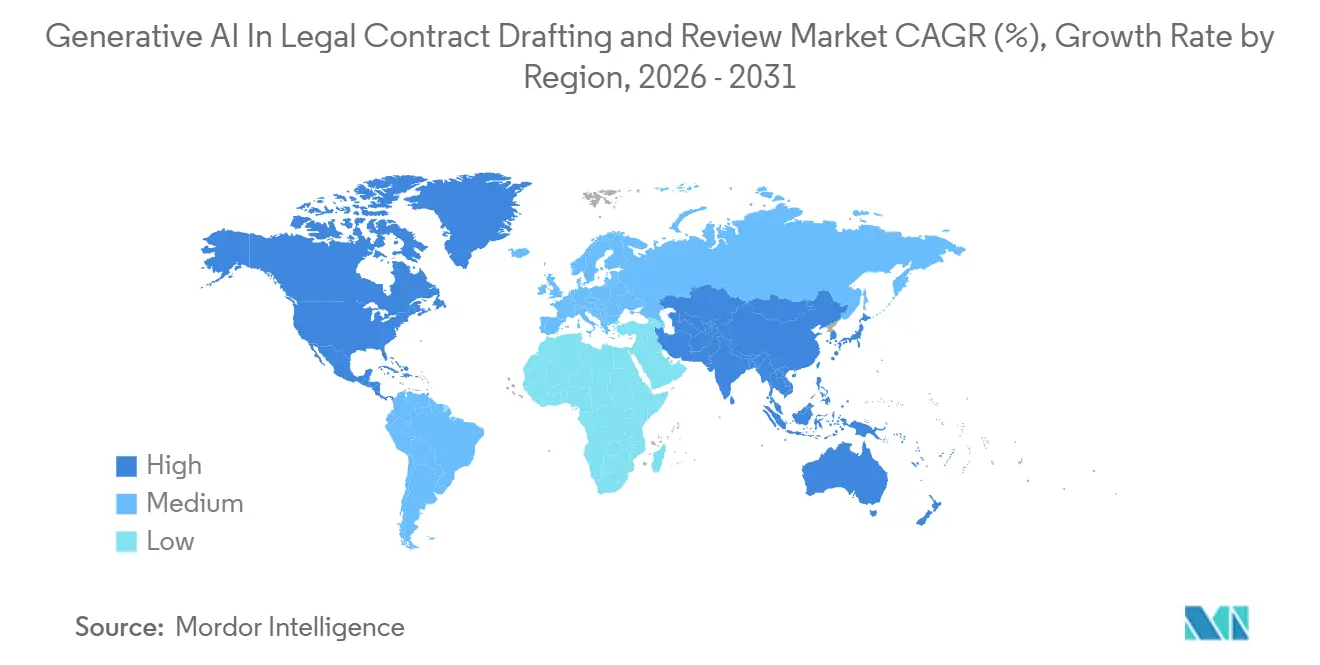
| Fastest Growing Market | Asia-Pacific |
| Largest Market | North America |
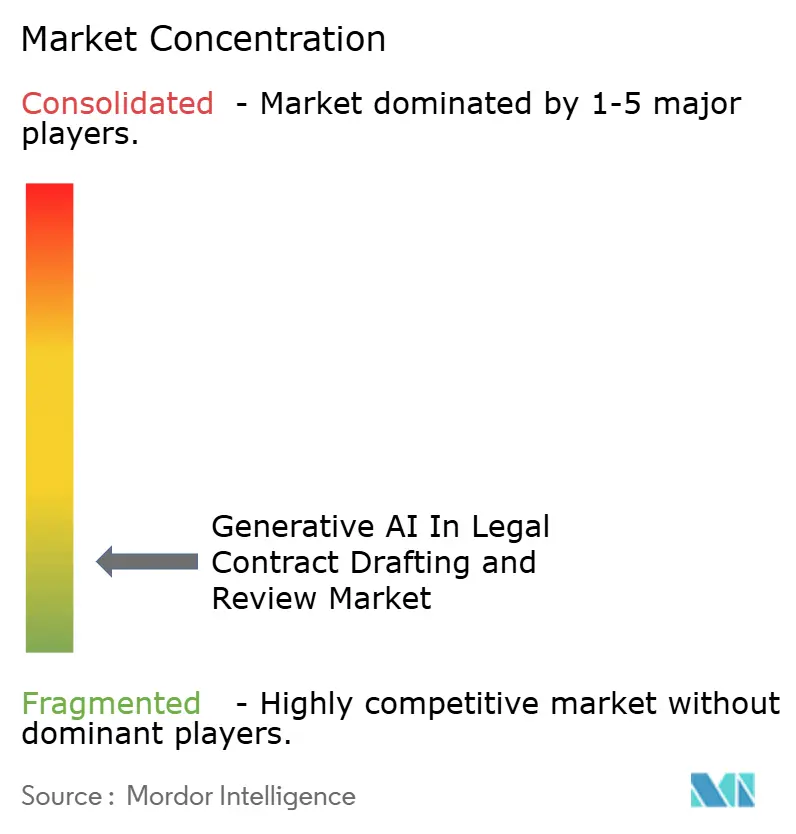
| Market Concentration | Low |
Major Players *Disclaimer: Major Players sorted in no particular order Image © Mordor Intelligence. Reuse requires attribution under CC BY 4.0. | |
Generative AI In Legal Contract Drafting and Review Market Analysis by Mordor Intelligence
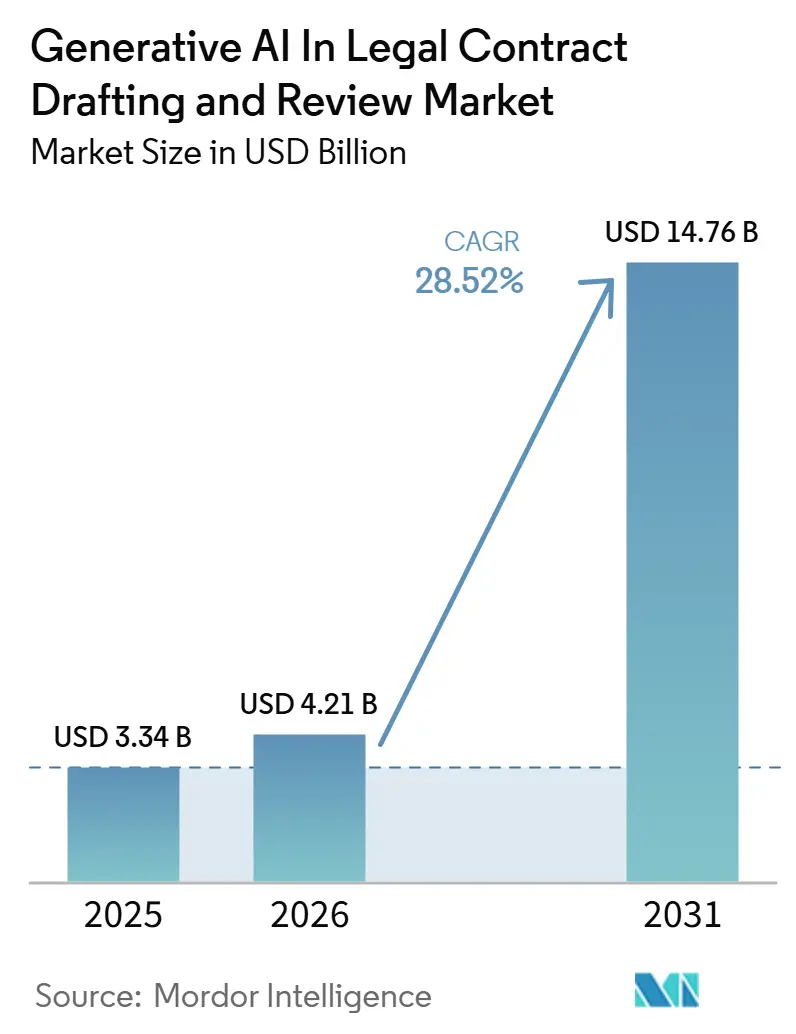
The generative AI in legal contract drafting and review market size is projected to expand from USD 3.34 billion in 2025 and USD 4.21 billion in 2026 to USD 14.76 billion by 2031, registering a CAGR of 28.52% between 2026 and 2031. Growth reflects wider use by law firms, corporate legal departments, and technology-enabled legal service providers. Legal teams are managing rising compliance and cybersecurity work while attorney hiring remains limited, making workflow automation even more important. The 2026 CLOC report found that 32% of legal departments expected attorney headcount growth, while 63% cited regulatory compliance demand and 58% cited cybersecurity demand. AI adoption is moving beyond trials because contract review, drafting, and clause management are repeatable tasks with measurable workloads. Competition is centered on legal content, contract data, model quality, workflow integration, and controls that support review by qualified legal professionals.
Key Report Takeaways
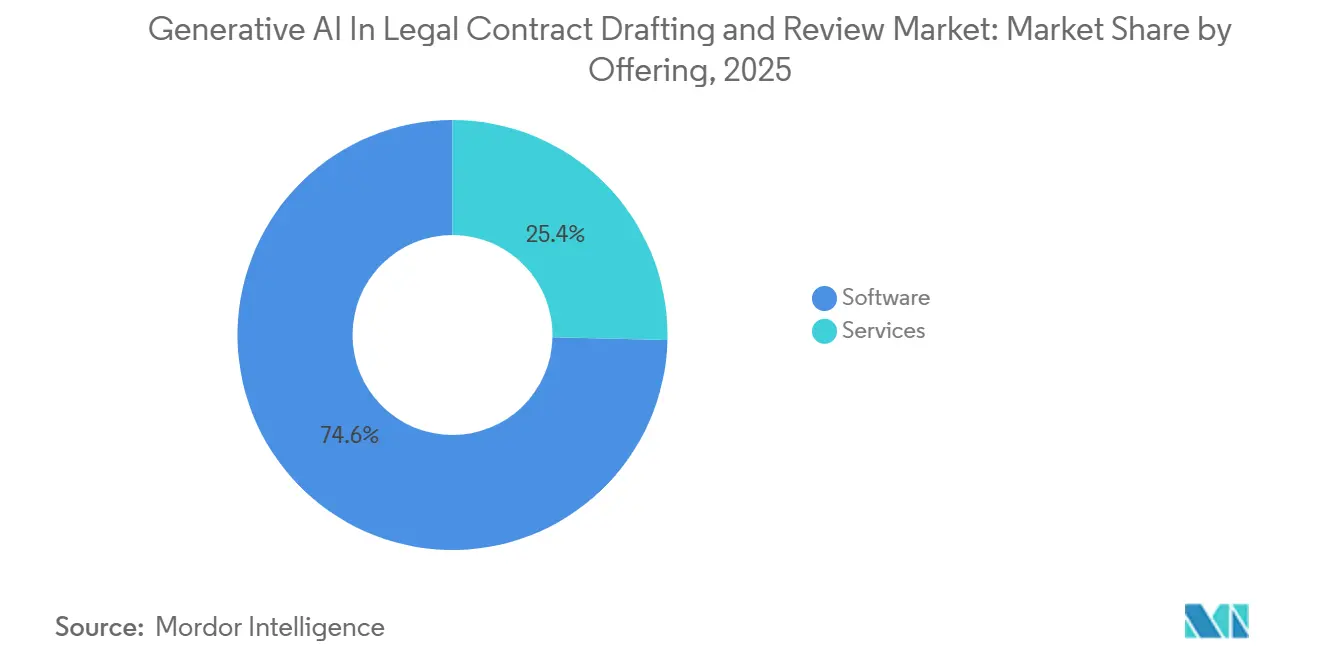
- By offering, software held 74.63% of the generative AI in legal contract drafting and review market share in 2025, while services are projected to expand at a 29.18% CAGR through 2031.
- By deployment mode, cloud held 73.58% of 2025 revenue, while hybrid deployment is projected to expand at a 29.81% CAGR through 2031.
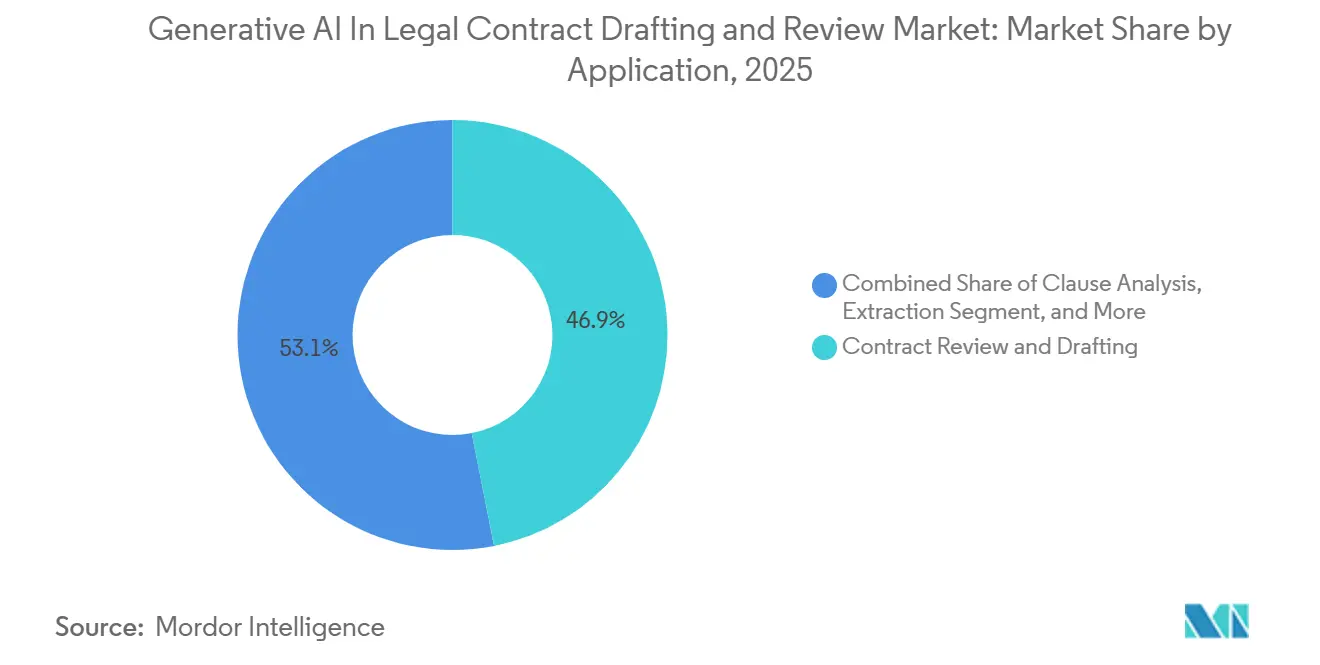
- By application, contract review and drafting accounted for 46.91% of 2025 revenue, while compliance, policy, and regulatory alignment are projected to expand at a 30.74% CAGR through 2031.
- By end user, corporate legal departments represented 42.16% of 2025 revenue, while ALSPs and LPOs are projected to expand at a 30.53% CAGR through 2031.
- By geography, North America held 41.24% of 2025 revenue, while Asia-Pacific is projected to expand at a 30.68% CAGR through 2031.
Note: Market size and forecast figures in this report are generated using Mordor Intelligence’s proprietary estimation framework, updated with the latest available data and insights as of January 2026.
Market Trends and Insights
Drivers Impact Analysis of Generative AI In Legal Contract Drafting and Review Market*
| Driver | (~) % Impact on CAGR Forecast | Geographic Relevance | Impact Timeline |
|---|---|---|---|
| Pressure to Reduce Contract Review Costs and Manual Work | +7.5% | Global, with early concentration in North America and Western Europe | Short term (≤ 2 years) |
| Demand for Faster First Drafts and Contract Turnaround | +5.8% | Global, strongest in high-volume contract environments in North America, the United Kingdom, and Australia | Short term (≤ 2 years) |
| Growing Volume and Complexity of Enterprise Contracts | +5.2% | Global, most acute in North America, Europe, and Asia-Pacific manufacturing and technology sectors | Medium term (2-4 years) |
| Domain-Tuned Legal Copilots in Contract Lifecycle Management Platforms | +4.5% | North America and Europe, with rapid spillover to Asia-Pacific and the Middle East | Medium term (2-4 years) |
| Need for Consistent Clauses Across Jurisdictions and Business Units | +3.2% | Global, particularly across Europe and cross-border contract-intensive sectors | Medium term (2-4 years) |
| GenAI Integration Into Contract Lifecycle Management and Legal Workflow Platforms | +2.8% | North America, Europe, and Asia-Pacific | Long term (≥ 4 years) |
| Source: Mordor Intelligence | |||
Growing Pressure to Reduce Contract Review Costs and Dependence on Manual Workflows
Cost control is a central reason corporate legal teams are adopting AI contract tools. Deloitte's July 2026 survey found that 78% of corporate legal buyers named cost reduction as the main expected benefit from AI use by outside providers. Some general counsels sought legal cost reductions of 20-40% over 2-3 years, and 66% of departments expected AI to support greater insourcing. Hourly billing represented 72% of corporate legal arrangements in 2025, but Deloitte expected that share to fall to 44% within 2-3 years. A C3 AI deployment at a global law firm reduced contract-analysis time by 80% and achieved 95% extraction accuracy on structured tabular data across more than 2,000 contracts.[1]C3 AI, “Law Firm Accelerates Legal Reviews and Contract Analyses with Generative AI,” C3 AI The generative AI in legal contract drafting and review market therefore supports legal operations teams that measure capacity through completed work rather than headcount alone.
Rising Demand to Accelerate First-Draft Generation and Contract Turnaround Times
Contract cycle times continued to slow commercial work, with WorldCC benchmark data showing average durations of 4.4-6.5 weeks by contract complexity and sector. The same data indicated that 49% of organizations reported higher contract volumes in the prior year. Harvey reported that more than 4,000 lawyers across 43 jurisdictions reduced contract review time by 30% in AI-primary workflows and saved an average of 7 hours on complex document analysis. Faster first drafts can affect negotiations because the party preparing the initial document may shape the initial terms. McKinsey found total legal cost reductions of 15-50% for targeted contract workflows after accounting for AI tool costs. The generative AI in legal contract drafting and review market is benefiting where legal departments need faster reviews without reducing control over negotiated terms.
Growing Volumes and Complexity of Enterprise Contracts
Contract volume and complexity are making manual clause tracking less practical for large enterprises. Icertis reported that 95% of legal operations departments track contracts on third-party paper, 90% track contract value, and 83% track obligation performance by counterparty. The same report found that 47% of contract professionals saw negotiations become more difficult than 2 years earlier, while 57% of organizations faced disputes at least once a year. Static clause libraries and manual redlining are less effective when terms, obligations, and counterparties must be reviewed across large repositories. Nearly 90% of legal teams used foundational AI models, but only 40% used models designed for legal or contract work.[2]Icertis, “2026 State of Contracting Report Highlights Key Trends Shaping the Year Ahead,” Icertis This gap gives specialized vendors room to improve accuracy and usability in the generative AI in legal contract drafting and review market.
Growth in Domain-Tuned Legal Copilots Integrated Into Contract Lifecycle Management Platforms
Legal teams are moving from general large language models toward contract-focused models embedded in contract lifecycle management systems. Luminance launched Luna Crescent in June 2026 after training it on more than 220 million verified legal documents. The company stated that the model processes contract analysis tasks nearly 4 times faster than general-purpose models and records 5% higher accuracy on contractual language interpretation benchmarks.[3]Luminance, “Luminance Unveils Luna Crescent, the Vertical AI Model Powering Contract Intelligence with Market-Leading Accuracy and Speed,” Luminance Icertis expanded its Microsoft partnership in May 2026 to embed Vera in Microsoft 365 Copilot, Microsoft Fabric, and Microsoft Copilot Studio. More than 50% of C-suite executives expected AI agents to support contract negotiations within 12 months, although 44% cited trust in autonomous agents as a main barrier. Domain-tuned tools address both output quality and the difficulty of fitting new software into established legal work across the generative AI in legal contract drafting and review market.
Restraints Impact Analysis of Generative AI In Legal Contract Drafting and Review Market*
| Restraint | (~) % Impact on CAGR Forecast | Geographic Relevance | Impact Timeline |
|---|---|---|---|
| Hallucinations, Inaccurate Legal Outputs, and Human Review Needs | -0.9% | Global, most acute in the United States, the United Kingdom, Europe, and Australia | Short term (≤ 2 years) |
| Data Privacy, Privilege, and Cross-Border Confidentiality Constraints | -0.7% | Europe, North America, and Asia-Pacific jurisdictions with strict data localization or privilege frameworks | Short term (≤ 2 years) |
| Legacy Repositories and Fragmented Clause Libraries | -0.5% | Global, most acute in large enterprises with distributed legal functions | Medium term (2-4 years) |
| Integration Complexity With Legacy Contract and Document Systems | -0.4% | Global, highest in sectors with long-standing custom document management infrastructure | Medium term (2-4 years) |
| Source: Mordor Intelligence | |||
Risk of Hallucinations, Inaccurate Legal Outputs, and Human-in-the-Loop Validation Requirements
Accuracy concerns remain a major barrier because contract errors can create professional liability and commercial risk. Stanford NLP researchers found that legal research tools from LexisNexis and Thomson Reuters hallucinated 17-33% of the time, including when retrieval-augmented generation was used. Sidley Austin noted in November 2025 that AI-generated provisions can appear polished but may lack the legal judgment, context, and client knowledge of experienced attorneys.[4]Sidley Austin, “AI Can Draft Contracts but Can You Trust Them,” Sidley Austin Deloitte found that only 24% of corporate legal departments had formal AI quality-assurance frameworks in place as of 2025. Human review remains necessary for high-stakes drafting and review, which adds time and cost to AI-assisted workflows. This limitation can slow purchasing decisions in the generative AI in legal contract drafting and review market.
Data Privacy, Privilege, and Cross-Border Confidentiality Constraints
Attorney-client privilege and cross-border data rules limit cloud-first deployment for sensitive contract work. Clifford Chance noted that European authorities took high-profile action against AI data processors in 2024 and 2025, including a EUR 15 million (USD 16.95 million) fine by an Italian data protection authority against OpenAI. Uploading draft agreements to third-party models can raise concerns over inadvertent waiver when professional guidance is still developing. These concerns help explain why hybrid deployment is projected to grow at a 29.81% CAGR from 2026 to 2031. Organizations can keep highly sensitive documents on-premise while using cloud inference for lower-risk tasks. That architecture protects sensitive data but increases implementation work and can lengthen vendor evaluations in the generative AI in legal contract drafting and review market.
*Our forecasts treat driver/restraint impacts as directional, not additive. The impact forecasts reflect baseline growth, mix effects, and variable interactions.
Generative AI In Legal Contract Drafting and Review Market Segment Analysis
By Offering:
Software Leads While Services Demand ExpandsSoftware held 74.63% of 2025 revenue, supported by standalone contract intelligence platforms and embedded AI modules in established contract lifecycle management systems. Vendors won early enterprise attention through trial deployments, rapid feature iteration, and per-seat pricing structures that reduced procurement friction. The segment remains central because drafting, redlining, and risk identification are commonly delivered through software products. Its scale also reflects the adoption of standalone tools before broader workflow redesign. Software providers now face closer assessment of implementation support and measurable legal operations outcomes.
Services are projected to expand at a 29.18% CAGR from 2026 to 2031, covering implementation, customization, managed review, and AI-enabled legal process outsourcing. The generative AI in legal contract drafting and review market size for services grows as enterprises that adopted software from 2023 to 2025 need help training models on internal clause libraries, connecting outputs to ERP and risk systems, and building prompt governance. PwC's 2025 collaboration with Integreon and ContractPodAI combined advisory support, purpose-built AI, and managed legal services. This model can convert software subscriptions into multi-year service relationships. Vendors without internal service capacity or partner networks may lose procurement opportunities where implementation risk carries substantial weight.


By Deployment Mode:
Cloud Leads While Hybrid Adoption RisesCloud deployment held 73.58% of 2025 revenue because vendors can update models quickly and buyers can avoid large upfront infrastructure costs. Continuous access to updated models reduces internal maintenance work for legal teams. On-premise deployments remain relevant for banks, insurance carriers, and government contractors with local data-residency requirements. These buyers may require contract content to remain within controlled technology environments. Cloud leadership does not remove the need for flexible deployment options.
Hybrid deployment is projected to expand at a 29.81% CAGR from 2026 to 2031 because it combines cloud scalability with stronger controls for privileged and sensitive documents. Icertis positioned Vera with Microsoft Azure and the Microsoft Defender AI Security Posture Management tooling through its May 2026 Microsoft partnership. Such designs can leverage cloud inference for routine drafting while retaining secure, auditable data grounding for sensitive commercial terms. Cloud-only vendors may miss out on opportunities in Europe and Asia-Pacific as data localization requirements increase. Architecture flexibility has become a basic procurement requirement for the generative AI in legal contract drafting and review market.
By Application:
Contract Review Anchors Revenue While Compliance ScalesContract review and drafting accounted for 46.91% of the generative AI in legal contract drafting and review market size in 2025, supported by direct productivity measures that simplify purchasing decisions. Legal teams can compare review time, drafting time, and clause extraction performance before and after implementation. Clause analysis, extraction, and risk identification form another application layer. These tools identify non-standard terms, expiration dates, and liability caps in legacy repositories. Their value rises when contract volume exceeds what manual tracking can manage.
Compliance, policy, and regulatory alignment are projected to expand at a 30.74% CAGR from 2026 to 2031. The EU AI Act creates recurring work involving clause screening, supplier risk classification, and regulatory mapping across member states. AI systems can organize this work across large sets of contracts and policy documents. Thomson Reuters reported that 1 in 6 law firms planned to provide generative AI-enabled compliance services in 2025. The application is becoming an internal efficiency tool and a potential billable service, which supports more revenue models in the generative AI in legal contract drafting and review market.

By End User:
Corporate Legal Teams Lead While ALSPs and LPOs Grow FasterCorporate legal departments accounted for 42.16% of 2025 revenue because in-house teams face rising workloads, hiring limits, and pressure to control outside-counsel spending. This combination supports spending on contract automation and review tools. Law firms are the second-largest end user group, but adoption differs by firm size and implementation capacity. Large AmLaw 200 firms can deploy enterprise platforms across practice groups, while smaller practices often select per-document tools with shorter implementation periods. Harvey served more than 1,500 customers in more than 60 countries by May 2026.
ALSPs and LPOs are projected to expand at a 30.53% CAGR from 2026 to 2031. Thomson Reuters reported that 57% of corporate law departments relied on ALSPs in 2025, and that AI enables these providers to price some work on a per-contract basis rather than by the hour. This creates capacity without equivalent increases in legal headcount. Integreon's use of ContractPodAI's Leah platform for redlines, fallback language, and playbook enforcement shows how AI supports this operating model, while government and public-sector legal departments adopt more slowly because procurement cycles, data classifications, and older document systems complicate integration. The generative AI in legal contract drafting and review market gives service providers a route to change how contract work is priced and delivered.
Geography Analysis
North America Generative AI in Legal Contract Drafting and Review Market
North America held 41.24% of the generative AI in legal contract drafting and review market share in 2025. The region combines early-adopter law firms, a developed legal technology investment base, and large corporate legal departments with legal operations teams. The United States hosts Harvey, Ironclad, Icertis, DocuSign, LinkSquares, and Spellbook, and these vendors often use domestic enterprise deployments as a base for international expansion. CLOC reported that 85% of North American legal departments maintained dedicated AI oversight resources in 2026, which supports readiness for procurement and governance. Canada benefits from cross-border parent-company deployments, while Mexico is gaining interest through nearshore legal outsourcing and manufacturing contract activity.
Europe Generative AI in Legal Contract Drafting and Review Market
Europe has a measured adoption pattern shaped by GDPR enforcement and phased EU AI Act obligations. Germany, the United Kingdom, and France are the region's higher-adoption areas, while the United Kingdom Magic Circle and Silver Circle firms deployed Harvey and Luminance across their firms through 2025. German companies developed a contract lifecycle management infrastructure that supports the EU AI Act Article 25 value-chain documentation. High-risk AI system provisions taking effect in August 2026 increase demand for compliant vendors while raising barriers for providers without documented accuracy and bias-audit processes. Italy, Spain, and other European markets face language coverage gaps for non-English contract collections in the generative AI in legal contract drafting and review market, while Russia has negligible current participation because geopolitical conditions restrict technology access.
APAC, South America and MEA Generative AI in Legal Contract Drafting and Review Market
Asia-Pacific is projected to expand at a 30.68% CAGR from 2026 to 2031. India recorded a 781% increase in legal technology funding in 2025, and in-house legal AI adoption among Asia-Pacific counsel rose from 23% to 52% in the 2025-2026 ACC and Everlaw survey. China deploys domestic models for compliance and contract lifecycle management, Japan is liberalizing its legal market, and Singapore remains a hub for cross-border contract administration. South America is at an earlier stage with Brazil leading agribusiness and commodities use, while Saudi Arabia, the UAE, South Africa, and Egypt are emerging in the generative AI in legal contract drafting and review market through government digital programs, multinational law firms, and bank legal operations.

Competitive Landscape
The generative AI in legal contract drafting and review market is fragmented, with no vendor holding a dominant position across every offering, deployment model, application, and region. Thomson Reuters has structural advantages through CoCounsel, Westlaw, and Practical Law content, while LexisNexis has a comparable position through Lexis+ AI and its legal information resources. Specialized providers, including Harvey, Luminance, Robin AI, and DraftWise, compete through model development, legal corpus quality, and integration into lawyer workflows. In March 2026, Harvey raised USD 200 million at an USD 11 billion valuation in a round co-led by GIC and Sequoia. The company is expanding more than 25,000 custom AI agents and embedded legal engineering teams for enterprise clients.
Strategy in the generative AI in legal contract drafting and review market centers on platform depth and ecosystem links rather than broad point-solution coverage. Icertis expanded its Microsoft partnership in May 2026 to embed Vera into Microsoft 365 Copilot and Microsoft Fabric. In the same month, DocuSign and Harvey connected legal reasoning with agreement execution, linking AI-supported drafting with digital signing workflows. Luminance launched Luna Crescent in June 2026 to strengthen its contract-focused model capabilities. Thomson Reuters opened early access to the next generation of CoCounsel Legal in June 2026, adding agentic deep research, a drafting agent, and citation integrity tools.
Opportunities remain among mid-market law firms and regional ALSPs outside North America and the United Kingdom, where readiness is rising but localized coverage and language support are uneven. Smaller providers such as Paxton AI, SpotDraft, and ClauseBase compete on vertical focus, lower implementation requirements, and pricing suited to firms without enterprise-scale commitments. Accuracy verification is becoming an important basis of competition, and Thomson Reuters introduced 3 agentic CoCounsel Legal capabilities in November 2025, including workflow plans and bulk document review for up to 10,000 documents in a session.
Generative AI In Legal Contract Drafting and Review Industry Leaders
Thomson Reuters Corporation
LexisNexis Risk Solutions Group Ltd.
Harvey AI Inc.
Icertis, Inc.
Paxton AI, Inc.
- *Disclaimer: Major Players sorted in no particular order
Generative AI In Legal Contract Drafting and Review Market Companies Covered in this Report
- Thomson Reuters Corporation
- LexisNexis Risk Solutions Group Ltd.
- Harvey AI Inc.
- Paxton AI, Inc.
- Icertis, Inc.
- DocuSign, Inc.
- ContractPod Technologies Limited
- Evisort, Inc.
- LinkSquares, Inc.
- Luminance Technologies Ltd.
- Robin AI Ltd.
- DraftWise, Inc.
- Spellbook Legal Technologies Inc.
- Juro Limited
- LegalSifter, Inc.
- LawGeex, Inc.
- ClauseBase NV
- SirionLabs Pte. Ltd.
- Ironclad Inc.
- SpotDraft, Inc.

Recent Industry Developments in Generative AI In Legal Contract Drafting and Review Market
- June 2026: Thomson Reuters opened early access to the next generation of CoCounsel Legal, described as a complete rebuild featuring agentic AI deep research, a Brief Builder drafting agent for complex documents, and patent-pending citation integrity tools grounded in Westlaw and Practical Law; full general availability in the United States is planned for August 2026, with Canada, United Kingdom, and Australia rollouts to follow.
- June 2026: Luminance launched Luna Crescent, the first model in its proprietary Luna vertical AI series, trained on over 220 million verified legal documents; Luna Crescent processes contract tasks nearly 4 times faster than general-purpose models and achieves 5% higher accuracy on contractual language interpretation benchmarks, and is embedded across Luminance's platform serving over 1,000 enterprises in 70+ countries.
- May 2026: Icertis expanded its strategic partnership with Microsoft through a new multi-year agreement embedding Icertis Vera into Microsoft 365 Copilot, Microsoft Fabric, and Microsoft Copilot Studio; reported customer outcomes include ALPLA achieving a 60% reduction in external legal spend through AI-driven NDA review and a European telecom identifying USD 35 million in post-merger savings through supplier contract rationalization powered by Vera.
- March 2026: Harvey raised USD 200 million in a round co-led by GIC and Sequoia at an USD 11 billion valuation, bringing total fundraising to over USD 1 billion; the capital is deployed to expand the 25,000+ custom AI agents run by customers on the platform and grow embedded legal engineering teams inside top law firms and corporate legal departments across 60+ countries.


Global Generative AI In Legal Contract Drafting and Review Market Report Scope
The Generative AI in Legal Contract Drafting and Review Market Report is Segmented by Offering (Software and Services), Deployment Mode (Cloud, On-Premise, and Hybrid), Application (Contract Review and Drafting, Clause Analysis, Extraction, and Risk Identification, Compliance, Policy, and Regulatory Alignment, and Other Applications), End User (Law Firms, Corporate Legal Departments, Alternative Legal Service Providers and LPOs, and Government and Public-Sector Legal Departments), and Geography (North America, South America, Europe, Asia-Pacific, Middle East, and Africa). The Market Forecasts are Provided in Terms of Value (USD).
| Software |
| Services |
| Cloud |
| On-Premise |
| Hybrid |
| Contract Review and Drafting |
| Clause Analysis, Extraction, and Risk Identification |
| Compliance, Policy, and Regulatory Alignment |
| Other Applications |
| Law Firms |
| Corporate Legal Departments |
| Alternative Legal Service Providers and LPOs |
| Government and Public-Sector Legal Departments |
| North America | United States |
| Canada | |
| Mexico | |
| South America | Brazil |
| Argentina | |
| Rest of South America | |
| Europe | Germany |
| United Kingdom | |
| France | |
| Italy | |
| Spain | |
| Russia | |
| Rest of Europe | |
| Asia-Pacific | China |
| Japan | |
| India | |
| South Korea | |
| Australia | |
| Rest of Asia-Pacific | |
| Middle East | Saudi Arabia |
| United Arab Emirates | |
| Turkey | |
| Rest of Middle East | |
| Africa | South Africa |
| Egypt | |
| Rest of Africa |
| By Offering | Software | |
| Services | ||
| By Deployment Mode | Cloud | |
| On-Premise | ||
| Hybrid | ||
| By Application | Contract Review and Drafting | |
| Clause Analysis, Extraction, and Risk Identification | ||
| Compliance, Policy, and Regulatory Alignment | ||
| Other Applications | ||
| By End User | Law Firms | |
| Corporate Legal Departments | ||
| Alternative Legal Service Providers and LPOs | ||
| Government and Public-Sector Legal Departments | ||
| By Geography | North America | United States |
| Canada | ||
| Mexico | ||
| South America | Brazil | |
| Argentina | ||
| Rest of South America | ||
| Europe | Germany | |
| United Kingdom | ||
| France | ||
| Italy | ||
| Spain | ||
| Russia | ||
| Rest of Europe | ||
| Asia-Pacific | China | |
| Japan | ||
| India | ||
| South Korea | ||
| Australia | ||
| Rest of Asia-Pacific | ||
| Middle East | Saudi Arabia | |
| United Arab Emirates | ||
| Turkey | ||
| Rest of Middle East | ||
| Africa | South Africa | |
| Egypt | ||
| Rest of Africa | ||


Key Questions Answered in the Report
What is the size of the generative AI in legal contract drafting and review market?
The generative AI in legal contract drafting and review market size is USD 4.21 billion in 2026 and is projected to reach USD 14.76 billion by 2031 at a 28.52% CAGR.
What is driving adoption of generative AI for legal contracts?
Legal teams need to manage higher contract, compliance, and cybersecurity workloads while controlling hiring and outside-counsel costs.
Which offering held the largest share in 2025?
Software held 74.63% of 2025 revenue, supported by contract intelligence platforms and embedded AI modules.
Which deployment mode is growing fastest?
Hybrid deployment is projected to grow at a 29.81% CAGR through 2031 because it combines cloud scalability with controls for sensitive documents.
Which application is projected to grow fastest?
Compliance, policy, and regulatory alignment is projected to expand at a 30.74% CAGR from 2026 to 2031.
What is the main risk when using AI for contract work?
Hallucinations and inaccurate output require human validation, especially for high-stakes legal drafting and review.
Page last updated on:


 Your data is secure and never sold or shared.


