
Generative AI In Automation Market Size and Share
Market Overview
| Study Period | 2020 - 2031 |
|---|---|
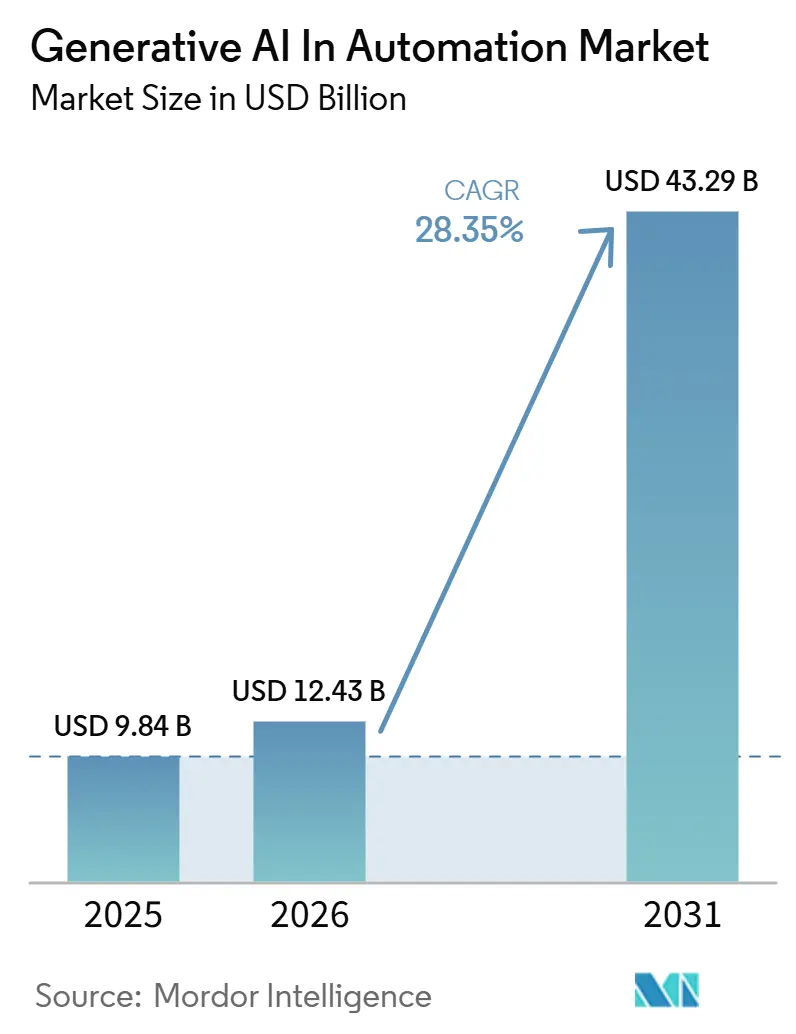
| Market Size (2026) | USD 12.43 Billion |
| Market Size (2031) | USD 43.29 Billion |
| Growth Rate (2026 - 2031) | 28.35 % |
| Fastest Growing Market | Asia-Pacific |
| Largest Market | North America |
| Market Concentration | Medium |
Major Players *Disclaimer: Major Players sorted in no particular order Image © Mordor Intelligence. Reuse requires attribution under CC BY 4.0. | |
Generative AI In Automation Market Analysis by Mordor Intelligence
The generative AI in automation market size is projected to expand from USD 9.84 billion in 2025 and USD 12.43 billion in 2026 to USD 43.29 billion by 2031, registering a CAGR of 28.35% between 2026 and 2031. Enterprises are moving from fixed, rules-based automation toward tools that can interpret context and respond to exceptions. This change broadens the scope of automation, especially in document-heavy, multi-system processes. Foundation-model APIs also let more teams build automation using natural-language instructions rather than extensive coding. Vendors are responding by combining agents, workflow tools, and governance features in broader platforms. The opportunity is strongest where firms can connect AI tools to established enterprise systems while maintaining reliable oversight.
Key Report Takeaways
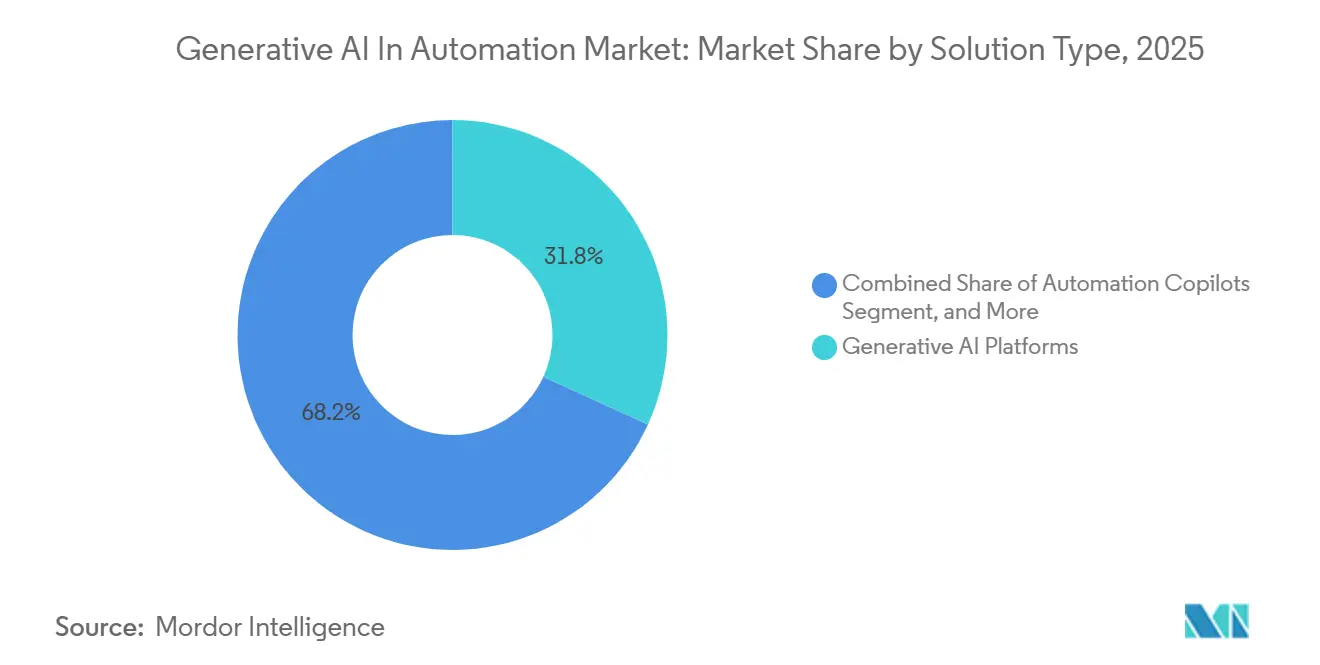
- By solution type, Generative AI Platforms held 31.84% of the generative AI in automation market share in 2025, while AI Agents and Agentic Automation Platforms are projected to expand at a CAGR of 31.08% through 2031.
- By deployment mode, cloud commanded 75.42% share in 2025, while hybrid deployment is expected to expand at a CAGR of 29.76% through 2031.
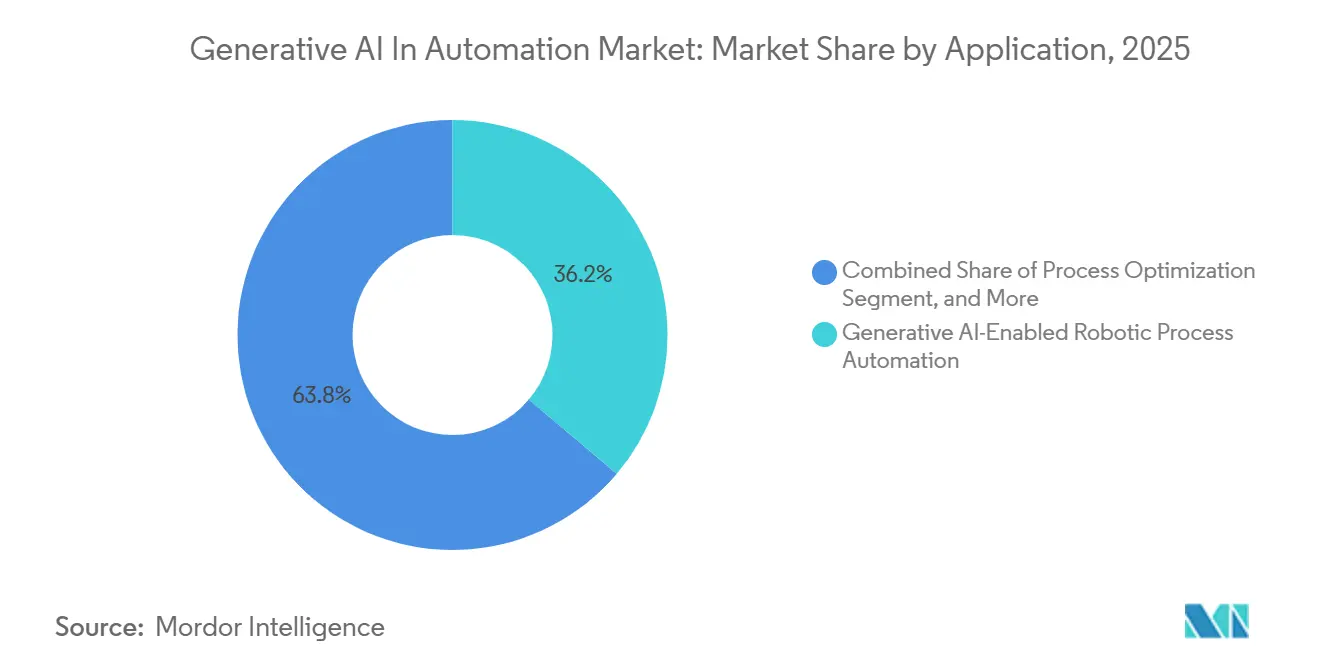
- By application, Generative AI-Enabled Robotic Process Automation accounted for 36.17% share in 2025, while Conversational and Natural-Language Automation is projected to grow at a CAGR of 31.42% through 2031.
- By end user, BFSI held 22.84% share in 2025, while manufacturing is expected to grow at a CAGR of 30.58% through 2031.
- By geography, North America held 40.52% share in 2025, while the Asia-Pacific is projected to expand at a CAGR of 30.83% through 2031.
Note: Market size and forecast figures in this report are generated using Mordor Intelligence’s proprietary estimation framework, updated with the latest available data and insights as of January 2026.
Market Trends and Insights
Drivers Impact Analysis of Generative AI In Automation Market*
| Driver | (~) % Impact on CAGR Forecast | Geographic Relevance | Impact Timeline |
|---|---|---|---|
| Rapid Shift From Rule-Based Automation to Generative Copilots | +7.5% | Global, with highest intensity in North America and Western Europe | Short term (≤ 2 years) |
| Rising Demand for Process Efficiency and Workflow Orchestration | +6.2% | Global, with early enterprise scaling in North America and Asia-Pacific | Short term (≤ 2 years) |
| Generative AI for Automation Development, Troubleshooting, and Maintenance | +5.1% | North America, Europe, and Asia-Pacific manufacturing hubs | Medium term (2-4 years) |
| Intelligent RPA Across Back-Office and Shop-Floor Workflows | +4.3% | Global, with deepest penetration in BFSI-heavy North America and Europe | Medium term (2-4 years) |
| Enterprise Demand for AI-Powered Process Discovery and Automation Creation | +3.4% | North America and Europe, with growing uptake across Asia-Pacific | Medium term (2-4 years) |
| Human-in-the-Loop Auditability in Regulated Automation | +2.1% | Global, shaped by regulatory compliance requirements across the EU, North America, and Asia-Pacific | Long term (≥ 4 years) |
| Source: Mordor Intelligence | |||
Rapid Shift From Rule-Based Automation to Generative Copilots
The generative AI in automation market is benefiting as enterprises replace rigid logic engines with copilots that can work with contextual information. Older automation systems often required specialists to script, test, and maintain each process path. Agentic AI reached 35% enterprise adoption within 2 years, while traditional AI reached 72% over 8 years, according to MIT Sloan Management Review.[1]UiPath Inc., “UiPath Becomes First Business Orchestration and Automation Platform With Native Integration for Coding Agents, Unlocking Enterprise Transformation at Scale,” UiPath Newsroom This adoption pattern supports demand for tools that simplify process design and reduce specialist bottlenecks. UiPath released UiPath for Coding Agents in May 2026, enabling enterprise coding agents to generate, test, deploy, and govern automations through natural-language conversation. The change can shorten the time required to place new processes into operation and make automation creation accessible to a wider group of employees.
Rising Demand for Process Efficiency and Workflow Orchestration
Organizations increasingly need automation that coordinates agents, bots, and employees across several business systems. Isolated bots can complete routine tasks, but they do not manage the handoffs, exceptions, and approvals within broader workflows. Salesforce launched Agentforce Operations in April 2026 for back-office process agents used across procurement, compliance, and approval workflows.[2]Salesforce Inc., “Salesforce Launches Agentforce Operations,” Salesforce News The company reported that early adopters reduced cycle times by 50-70% and manual data-entry errors by 80%. These results explain why buyers are looking for orchestration layers rather than adding separate automation products for each task. The generative AI in automation market, therefore, favors platforms that can work across business applications while retaining process visibility and human review.
Generative AI for Automation Development, Troubleshooting, and Maintenance
Generative AI is entering the tools used to build, troubleshoot, and maintain automation systems. Teams can use model gateways, code support, and diagnostic tools to support technical work within a common environment. IBM released Cloud Pak for Business Automation 26.0 in June 2026, including IBM Model Gateway, which connects OpenAI, Google Gemini, and AWS Bedrock within a single automation environment.[3]IBM Corporation, “Announcing IBM Cloud Pak for Business Automation 26.0: Powering the Next Era of AI-Driven Automation,” IBM Community This approach can help organizations select a model for a given task without redesigning the full automation stack. Complex industrial and IT environments may benefit most because their systems have many established connections and maintenance requirements. Regulatory requirements for safety-related operational technology can also influence which development tools buyers approve for use.
Intelligent RPA Across Back-Office and Shop-Floor Workflows
Intelligent RPA combines language models with established bot frameworks and extends automation into work that includes exceptions and judgment. This capability matters in financial operations, shared-services processes, and production settings where employees still manage many process variations. UiPath introduced Maestro Case in June 2026 to bring AI agents, robots, and human oversight into one orchestration layer. The company stated that early adopters reduced average case-handling time by 60-80% and improved SLA compliance by more than 25 percentage points. China’s Ministry of Industry and Information Technology issued an AI+Manufacturing action plan in January 2026 that calls for 1,000 high-level industrial AI agents by 2027. The policy supports demand for intelligent automation across manufacturing and the back office.
Restraints Impact Analysis of Generative AI In Automation Market*
| Restraint | (~) % Impact on CAGR Forecast | Geographic Relevance | Impact Timeline |
|---|---|---|---|
| Integration Complexity Across Legacy OT, IT, and Edge Systems | -4.6% | Global, most acute in Europe and North America with large installed bases of legacy industrial infrastructure | Medium term (2-4 years) |
| Data Privacy, IP Leakage, and Hallucination Risk in Operational Environments | -3.7% | Global, with regulatory amplification under EU AI Act, GDPR, and Asia-Pacific data sovereignty frameworks | Long term (≥ 4 years) |
| Unclear Return on Investment for Small and Mid-Sized Plants | -2.1% | Global, with highest concentration among mid-market manufacturers in Asia-Pacific and South America | Medium term (2-4 years) |
| Compute, Latency, Scalability, and Model Deployment Constraints | -1.4% | Global, with acute pressure in edge-compute-dependent manufacturing and energy sectors | Short term (≤ 2 years) |
| Source: Mordor Intelligence | |||
Integration Complexity Across Legacy OT, IT, and Edge Systems
Legacy operational technology often uses industrial communication protocols that predate current API designs. This makes it more difficult to connect to newer generative AI tools in production environments. UiPath found that 52% of nearly 600 C-suite and IT practitioners at organizations with more than USD 1 billion in revenue operated hybrid process environments that mixed static and dynamic processes across disconnected systems. Organizations may need middleware, protocol translators, and custom connectors to bridge these environments. These additions can raise project costs, increase latency, and introduce additional operational risks. Buyers with extensive ERP and operational technology stacks may favor established providers with pre-built connectors and deeper implementation support.
Data Privacy, IP Leakage, and Hallucination Risk in Operational Environments
Generative AI can create reliability concerns that were less common in traditional RPA. Probabilistic responses, prompt-injection risks, and exposure of proprietary process information can limit enterprise deployment. These issues are most significant in financial services, healthcare, defense supply chains, and other settings with sensitive data. Automation Anywhere announced Context Intelligence Graph in May 2026, which uses a local context layer to retrieve enterprise knowledge without sending raw process data to external APIs. The company reported more than a 30% increase in agent accuracy in its internal evaluations.[4]Automation Anywhere Inc., “Automation Anywhere Unveils 2026 Platform Enhancements to Run AI-Driven Processes,” Automation Anywhere Press Room Requirements associated with AI management systems and SOC 2 Type II can add audit, documentation, and implementation work for cautious buyers.
*Our forecasts treat driver/restraint impacts as directional, not additive. The impact forecasts reflect baseline growth, mix effects, and variable interactions.
Generative AI In Automation Market Segment Analysis
By Solution Type:
Platforms Lead Current Spending While Agents Drive Future DemandGenerative AI Platforms held 31.84% of the generative AI in automation market share in 2025. Enterprises used orchestration-layer APIs from hyperscalers and independent software vendors as a common foundation for automation programs. Their early position reflects the value of having model APIs already embedded in enterprise stacks. Services formed the next large category because implementation, customization, and managed automation needs rise with platform complexity. Automation Copilots also retained an important role for buyers who wanted to extend familiar workflow products with limited disruption. Other solution types, including process mining and discovery tools, supported upstream work to identify suitable processes before deployment.
AI Agents and Agentic Automation Platforms are projected to expand at a CAGR of 31.08% through 2031. The segment’s generative AI in automation market size is supported by the move from assistive tools to systems that can perform multi-step work across applications. Copilots generally recommend actions, while agents can complete actions under defined controls. IBM presented the next generation of watsonx Orchestrate in May 2026 as an agentic control plane that can deploy agents from different sources with consistent policy enforcement. This design addresses the need to govern agents that come from several technology suppliers. Demand for governance, monitoring, and interoperability should rise as enterprises place agents in more business processes. Providers with policy controls and integration capabilities are better positioned to serve this requirement. The generative AI in automation market is therefore shifting toward platforms that balance autonomous work with accountable management.



By Deployment Mode:
Cloud Holds the Largest Position While Hybrid Use BroadensCloud deployment commanded 75.42% of the generative AI in automation market share in 2025. Enterprises used hyperscaler infrastructure to access advanced models, elastic compute capacity, and frequent product updates without incurring capital costs for local infrastructure. Cloud services also reduced the time needed to begin a pilot or add new users. The on-premises segment was smaller, but it remained important for organizations that could not move workflow data outside controlled environments. Government agencies and regulated businesses often require stronger control over data location and system access. These needs kept on-premises deployment relevant even as cloud services remained the main delivery model.
Hybrid deployment is projected to grow at a CAGR of 29.76% from 2026 to 2031. Organizations are using hybrid designs to keep sensitive training data and fine-tuning work in controlled environments while using public endpoints for general inference. This structure does not represent a broad withdrawal from cloud services. Instead, it allows firms to separate workloads according to data sensitivity and operational requirements. UiPath updated Automation Suite in May 2026 to provide on-premises agentic AI capabilities across AWS, Azure, and OpenShift environments. The product targets public-sector and regulated users that cannot route workflow data through external cloud APIs. Asia-Pacific and Middle East buyers may place more weight on hybrid and on-premises deployments where data-sovereignty policies are more directive. The generative AI in automation market will continue to use cloud infrastructure widely, while hybrid systems address security and compliance needs.
By Application:
RPA Leads Adoption While Conversational Automation Expands AccessGenerative AI-Enabled Robotic Process Automation held 36.17% share of the generative AI in automation market size in 2025. Its position reflected deep use of language-model-enhanced bots across financial services, insurance, public-sector back offices, and shared services. These organizations operate high volumes of documents, transactions, and compliance activities. Bots can support KYC, AML monitoring, regulatory reporting, and dispute handling when deployed with clear controls. IBM reported in its 2025 banking outlook that 60% of banking CEOs viewed accepting significant risk as essential to realizing automation benefits and improving competitiveness. Other applications included quality inspection, predictive-maintenance triggers, and supply-chain event automation. These uses extend adoption toward operational settings as sector-specific models and process tools mature.
Conversational and Natural-Language Automation is projected to grow at a CAGR of 31.42% through 2031. The segment expands access because employees can describe a process in plain language rather than write code. Microsoft released a rebuilt agentic orchestrator for Copilot Studio, generally available in June 2026, for more complex, multi-step work. This approach can allow a broader range of analysts and business users to create or refine automation. MIT Sloan Management Review found that 44% of organizations that had not deployed agentic AI planned to do so soon. Lower skill requirements position conversational interfaces to serve part of that pipeline. Process Optimization and Workflow Orchestration remained another large application area because companies need systems that identify inefficiencies, sequence work, and route exceptions. The generative AI in automation market benefits when natural-language interfaces are paired with testing, governance, and employee review.
By End User:
BFSI Holds the Largest Position While Manufacturing Grows FasterBFSI accounted for 22.84% of the generative AI in automation market share in 2025. High transaction volumes and intensive documentation created a substantial base for automating banking, insurance, and financial services operations. Regulatory requirements also make auditable process execution important across KYC, AML, trade settlement, and reporting activities. IBM’s 2025 banking outlook stated that 60% of banking CEOs considered significant risk-taking essential to automation competitiveness. This position supports the sector’s continued investment in intelligent automation. Healthcare and life sciences, energy and utilities, transportation and logistics, and media and entertainment were growth-stage verticals. Their use cases included clinical workflow support, grid asset performance, freight visibility, and content-personalization processes.
Manufacturing is projected to expand at a CAGR of 30.58% through 2031. Engineering-assist agents can support design, PLC programming, predictive maintenance, and other tasks that have traditionally depended on specialized personnel. China’s January 2026 AI+Manufacturing plan calls for 1,000 high-level industrial AI agents by 2027. This policy creates a direct source of demand in the world’s largest manufacturing economy. IT and telecommunications, government and public sector, and retail and e-commerce are also applying conversational and RPA-led systems to service resolution, public service delivery, and pricing processes. The range of end users requires vendors to support different data environments and workflow structures. No single vertical can alone support the projected 28.35% CAGR of the generative AI in automation market. Broad platform reach and domain features that are suitable remain important to supplier positioning.
Geography Analysis
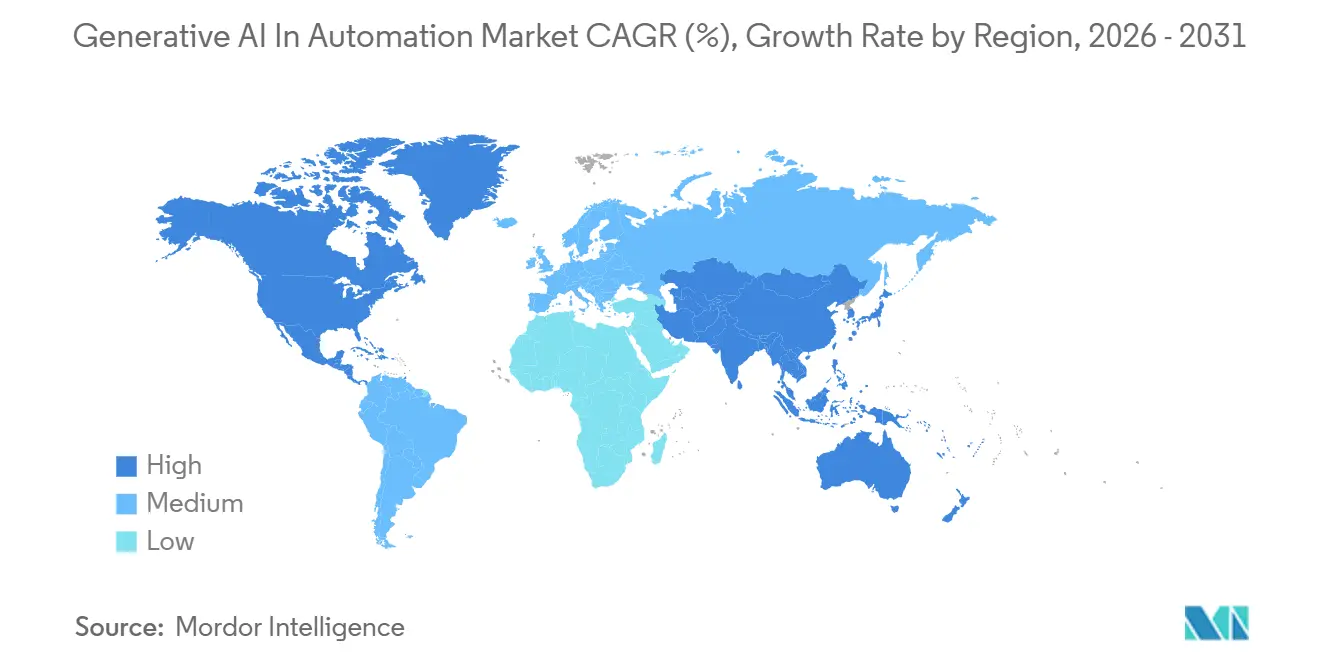
North America Generative AI in Automation Market
North America held 40.52% of the generative AI in automation market share in 2025, supported by its concentration of hyperscale computing infrastructure, enterprise software suppliers, and early adopters in BFSI and technology. The United States remains the region’s main demand center because financial services, technology, and government organizations can use AI automation through established enterprise platforms. Microsoft announced native Windows Agent Framework support for desktop AI orchestration and expanded Copilot Studio connectors during Build 2026, which broadens the generative AI in automation market across enterprise worker tools. Canada and Mexico contribute through IT modernization and nearshore service delivery, including cost-sensitive back-office automation. These conditions preserve the region’s leading position while creating a large installed base for newer agentic capabilities.
APAC Generative AI in Automation Market
Asia-Pacific is projected to grow at a CAGR of 30.83% between 2026 and 2031, with government-led industrial AI plans, growing digital infrastructure, and uneven automation maturity shaping demand. China’s AI+Manufacturing action plan directs the development of 1,000 high-level industrial AI agents by 2027 and gives the generative AI in automation market a policy-led source of manufacturing demand. Japan is applying generative AI to quality management, predictive maintenance, and supply-chain coordination, while India combines a growing user base with a technology-services sector that deploys and delivers automation solutions. National differences in implementation capacity, data rules, and industrial structures will determine how quickly individual countries convert interest into scaled use. Asia-Pacific therefore has a wider range of growth conditions than North America, but a strong outlook for both industrial and enterprise applications.
EMEA and South America Generative AI in Automation Market
Europe retained a significant regional position, with Germany, the United Kingdom, and France supporting adoption across manufacturing, financial services, and public-sector applications, while high-risk AI requirements can lengthen procurement and increase demand for governance automation. Middle East markets, especially Saudi Arabia and the United Arab Emirates, are expanding through sovereign AI programs, smart-government projects, and industrial diversification, which adds new deployment settings for the generative AI in automation market. Africa remains at an earlier stage, led by financial-services and telecommunications applications in South Africa and Egypt, as infrastructure gaps and readiness constraints limit wider uptake. South America, led by Brazil and Argentina, is seeing demand in BFSI and e-commerce automation, although limited high-performance computing access and developing regulatory frameworks may slow adoption compared with other emerging regions.

Competitive Landscape
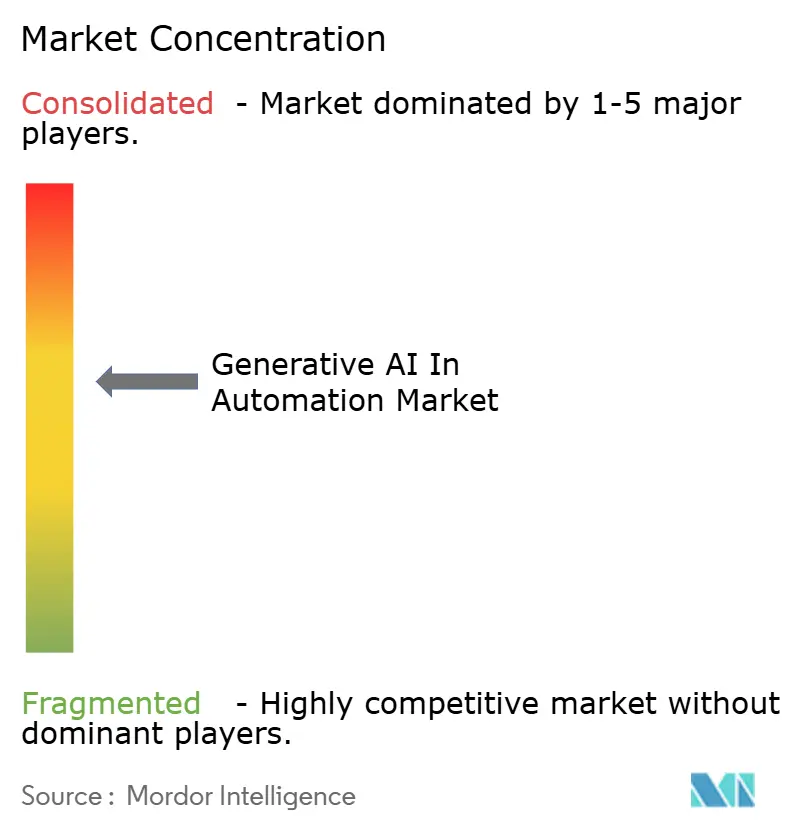
The generative AI in automation market is moderately concentrated at the platform layer and fragmented across application-specific and vertical-specialist providers. Microsoft, AWS, Google DeepMind, and IBM seek to gain orchestration-layer control by adding generative AI to the workflow tools already used by enterprise customers. UiPath and Automation Anywhere are expanding RPA-based products into agentic orchestration, while Siemens, Honeywell, Rockwell Automation, and Schneider Electric combine operational technology connectivity with industrial domain knowledge. SAP and Oracle can embed agents in transaction systems that provide direct enterprise data access, and Salesforce, Pegasystems, and ServiceNow serve CRM and workflow use cases. This supplier mix keeps the generative AI in automation market competitive across both horizontal platforms and specialized deployment environments.
Competition centers on interoperability, governance, and the ability to operate inside existing customer systems. UiPath launched the Coding Agents integration in May 2026, enabling coding agents to generate, test, deploy, and govern automations through natural-language interaction, extending their role beyond conventional bot deployment. IBM introduced watsonx Orchestrate as a control plane for agents from different sources with common policy enforcement, addressing the need to govern multi-vendor deployments. Buyers in regulated sectors will evaluate audit documentation, human oversight, and observable agent behavior alongside model and integration capabilities. Providers that cannot meet these requirements may encounter longer sales cycles in the generative AI in automation market.
Smaller RPA vendors and vertical AI startups face pressure as larger providers buy or build specialized capabilities, but mid-market customers may still seek packaged, API-first, and low-code systems that avoid a full platform replacement. The competitive field remains broad because customer-service, finance, manufacturing, public administration, and energy operations require different data connections and workflow controls. This diversity supports demand for both platform providers and domain-focused suppliers. It also means that the available company information does not identify a combined leading-player share that would support a more concentrated classification.
Generative AI In Automation Industry Leaders
Microsoft Corporation
Amazon Web Services, Inc.
UiPath Inc.
International Business Machines Corporation
Google DeepMind Technologies Limited
- *Disclaimer: Major Players sorted in no particular order
Generative AI In Automation Market Companies Covered in this Report
- Microsoft Corporation
- Amazon Web Services, Inc.
- UiPath Inc.
- International Business Machines Corporation
- Google DeepMind Technologies Limited
- Oracle Corporation
- Salesforce, Inc.
- Siemens AG
- Automation Anywhere, Inc.
- C3.ai, Inc.
- SAP SE
- Schneider Electric SE
- Rockwell Automation, Inc.
- Honeywell International Inc.
- GE Vernova Inc.
- ServiceNow, Inc.
- Pegasystems Inc.
- Databricks, Inc.
- OpenAI, L.L.C.
- NVIDIA Corporation

Recent Industry Developments in Generative AI In Automation Market
- July 2026: Automation Anywhere reported its largest outcome-based transaction in company history and disclosed that its Agentic Process Automation platform had fulfilled over 1 billion IT service requests, signaling the commercial transition from platform licensing to outcome-based business models across enterprise automation.
- June 2026: UiPath launched Maestro Case on June 16, an AI-native agentic case management capability that combines robots, AI agents, and human oversight in a single orchestrated workflow, a financial services early adopter projects USD 12 million in annual savings from KYC and dispute resolution automation.
- June 2026: IBM released Cloud Pak for Business Automation 26.0 on June 26, embedding a unified model gateway, IBM Model Gateway, connecting OpenAI, Google Gemini, and AWS Bedrock within a single enterprise automation environment, reducing multi-model integration complexity for large organizations.
- May 2026: ServiceNow introduced ServiceNow Otto at Knowledge 2026 on May 5, a unified AI experience combining Now Assist, Moveworks, and AI Experience across all departments, ServiceNow EmployeeWorks, the first Otto-integrated product, generated 6 deals exceeding USD 1 million in net new annual contract value within 1 month of launch.


Global Generative AI In Automation Market Report Scope
The Generative AI in Automation Market Report is Segmented by Solution (Generative AI Platforms, Automation Copilots, AI Agents and Agentic Automation Platforms, Services, and Other Solution Types), Deployment (Cloud, On-premises, and Hybrid), Application (Gen AI RPA, Process Optimization, Conversational, Other Applications), End User (BFSI, Manufacturing, IT and Telecom, Healthcare, Retail, Government, Energy, Transport, Media, and Other End User), and Geography. The Market Forecasts are Provided in Terms of Value (USD).
| Generative AI Platforms |
| Automation Copilots |
| AI Agents and Agentic Automation Platforms |
| Services |
| Other Solution Types |
| Cloud |
| On-premises |
| Hybrid |
| Generative AI-Enabled Robotic Process Automation |
| Process Optimization and Workflow Orchestration |
| Conversational and Natural-Language Automation |
| Other Applications |
| BFSI |
| Manufacturing |
| IT and Telecommunications |
| Healthcare and Life Sciences |
| Retail and E-commerce |
| Government and Public Sector |
| Energy and Utilities |
| Transportation and Logistics |
| Media and Entertainment |
| Other End users |
| North America | United States |
| Canada | |
| Mexico | |
| South America | Brazil |
| Argentina | |
| Rest of South America | |
| Europe | Germany |
| United Kingdom | |
| France | |
| Italy | |
| Spain | |
| Russia | |
| Rest of Europe | |
| Asia-Pacific | China |
| Japan | |
| India | |
| South Korea | |
| Australia | |
| Rest of Asia-Pacific | |
| Middle East | Saudi Arabia |
| United Arab Emirates | |
| Turkey | |
| Rest of Middle East | |
| Africa | South Africa |
| Egypt | |
| Rest of Africa |
| By Solution Type | Generative AI Platforms | |
| Automation Copilots | ||
| AI Agents and Agentic Automation Platforms | ||
| Services | ||
| Other Solution Types | ||
| By Deployment | Cloud | |
| On-premises | ||
| Hybrid | ||
| By Application | Generative AI-Enabled Robotic Process Automation | |
| Process Optimization and Workflow Orchestration | ||
| Conversational and Natural-Language Automation | ||
| Other Applications | ||
| By End User | BFSI | |
| Manufacturing | ||
| IT and Telecommunications | ||
| Healthcare and Life Sciences | ||
| Retail and E-commerce | ||
| Government and Public Sector | ||
| Energy and Utilities | ||
| Transportation and Logistics | ||
| Media and Entertainment | ||
| Other End users | ||
| By Geography | North America | United States |
| Canada | ||
| Mexico | ||
| South America | Brazil | |
| Argentina | ||
| Rest of South America | ||
| Europe | Germany | |
| United Kingdom | ||
| France | ||
| Italy | ||
| Spain | ||
| Russia | ||
| Rest of Europe | ||
| Asia-Pacific | China | |
| Japan | ||
| India | ||
| South Korea | ||
| Australia | ||
| Rest of Asia-Pacific | ||
| Middle East | Saudi Arabia | |
| United Arab Emirates | ||
| Turkey | ||
| Rest of Middle East | ||
| Africa | South Africa | |
| Egypt | ||
| Rest of Africa | ||


Key Questions Answered in the Report
What is the generative AI in automation market size?
The generative AI in automation market was USD 12.43 billion in 2026 and is projected to reach USD 43.29 billion by 2031 at a CAGR of 28.35%.
What is driving adoption of generative AI for enterprise automation?
Enterprises are adopting contextual automation, agent orchestration, and natural-language tools that reduce reliance on specialist coding and support multi-system workflows.
Which solution segment is growing fastest?
AI Agents and Agentic Automation Platforms are projected to grow at a CAGR of 31.08% through 2031 as organizations move from assistive copilots to multi-step autonomous workflows.
Why is hybrid deployment expanding?
Hybrid deployment is projected to grow at a CAGR of 29.76% because it helps organizations keep sensitive workloads in controlled environments while using cloud services for general inference.
Which end user sector leads adoption?
BFSI held 22.84% share in 2025 because its transaction volumes, documentation needs, and audit requirements are well suited to intelligent automation.
Which region is expected to grow fastest?
Asia-Pacific is projected to expand at a CAGR of 30.83% through 2031, supported by industrial AI programs, growing digital infrastructure, and technology-services delivery capacity.
Page last updated on:





