
GCC Smart Faucets Market Size and Share
Market Overview
| Study Period | 2021 - 2032 |
|---|---|
| Forecast Data Period | 2027 - 2032 |
| Base Year Market Size (2026) | USD 189.86 Million |
| Market Size (2027) | USD 206.95 Million |
| Market Size (2032) | USD 318.42 Million |
| Growth Rate (2027 - 2032) | 9.00 % |
| Market Concentration | Medium |
Major Players *Disclaimer: Major Players sorted in no particular order Image © Mordor Intelligence. Reuse requires attribution under CC BY 4.0. | |
GCC Smart Faucets Market Analysis by Mordor Intelligence
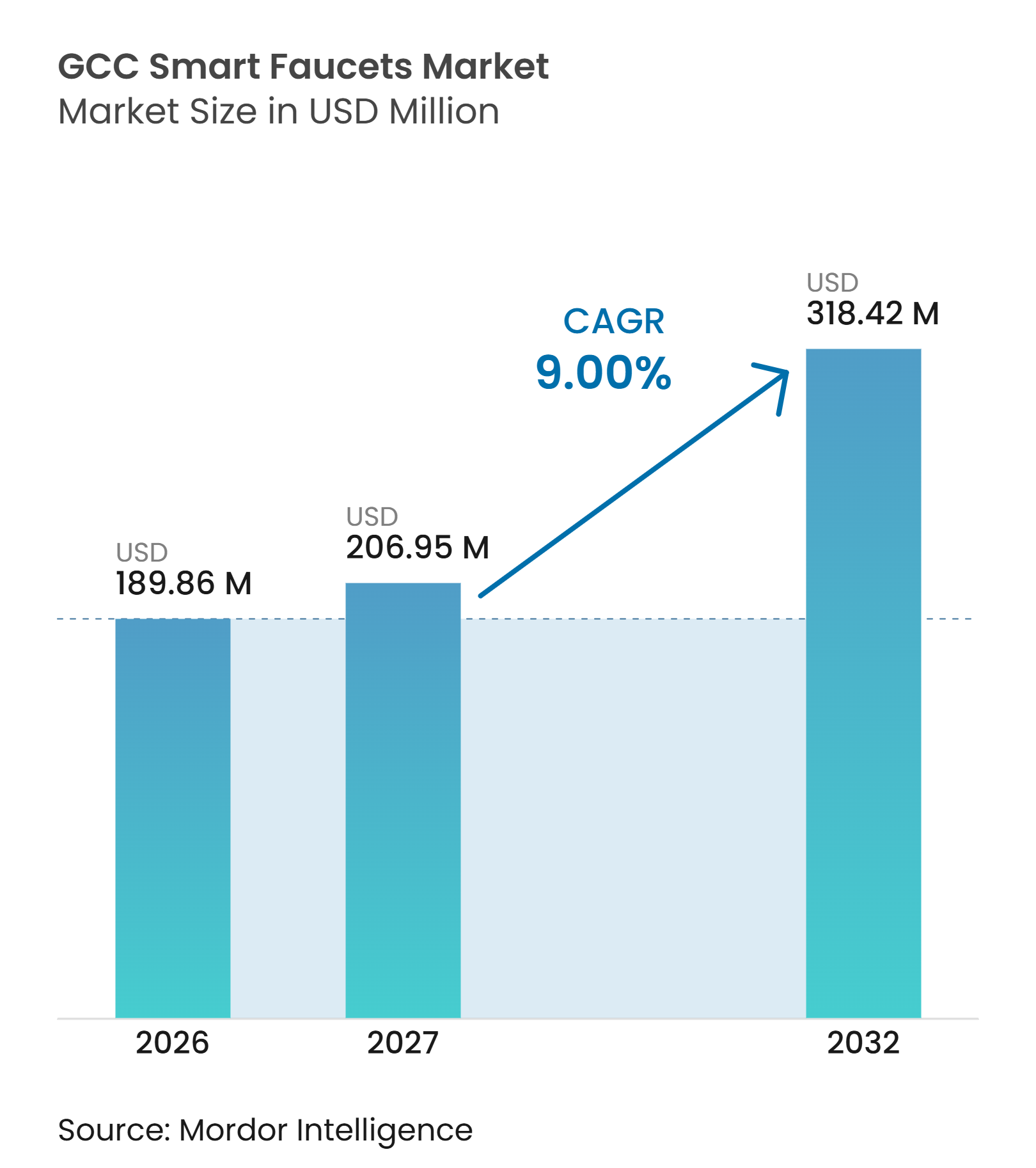
The GCC smart faucets market was valued at USD 189.86 million in 2026, is estimated at USD 206.95 million in 2027, and is forecast to reach USD 318.42 million by 2032, growing at a CAGR of 9.00% during 2027–2032. Water-efficiency requirements in Saudi Arabia and Qatar are moving touchless faucets from a sustainability feature toward a compliance requirement for specified buildings. Commercial projects continue to support demand because hotels, airports, malls, and public facilities require durable fixtures with hygiene and water-control functions. The GCC smart faucets market also benefits from green-building programs that connect fixture efficiency with wider building performance standards. Product suppliers are responding through water-saving designs, connected controls, and materials that can better withstand mineralized water. The main constraints remain the higher purchase and service cost of sensor fixtures, variable project schedules, and harsh operating conditions in coastal and desalinated-water environments.
Key Report Takeaways
-
By material, brass held 44.68% of the GCC smart faucets market share in 2026, while engineering plastics and polymer composites are forecast to grow at a 10.58% CAGR during 2027–2032.
-
By installation type, deck-mount systems accounted for 60.06% of the GCC smart faucets market share in 2026, while wall-mount systems are projected to expand at a 10.26% CAGR during 2027–2032.
-
By application, bathroom sink faucets held 68.32% of the GCC smart faucets market share in 2026, while kitchen sink faucets are projected to expand at a 9.87% CAGR during 2027–2032.
-
By construction type, replacement, renovation, and retrofit installations accounted for 53.41% of the GCC smart faucets market share in 2026 and are forecast to grow at a 9.74% CAGR during 2027–2032.
-
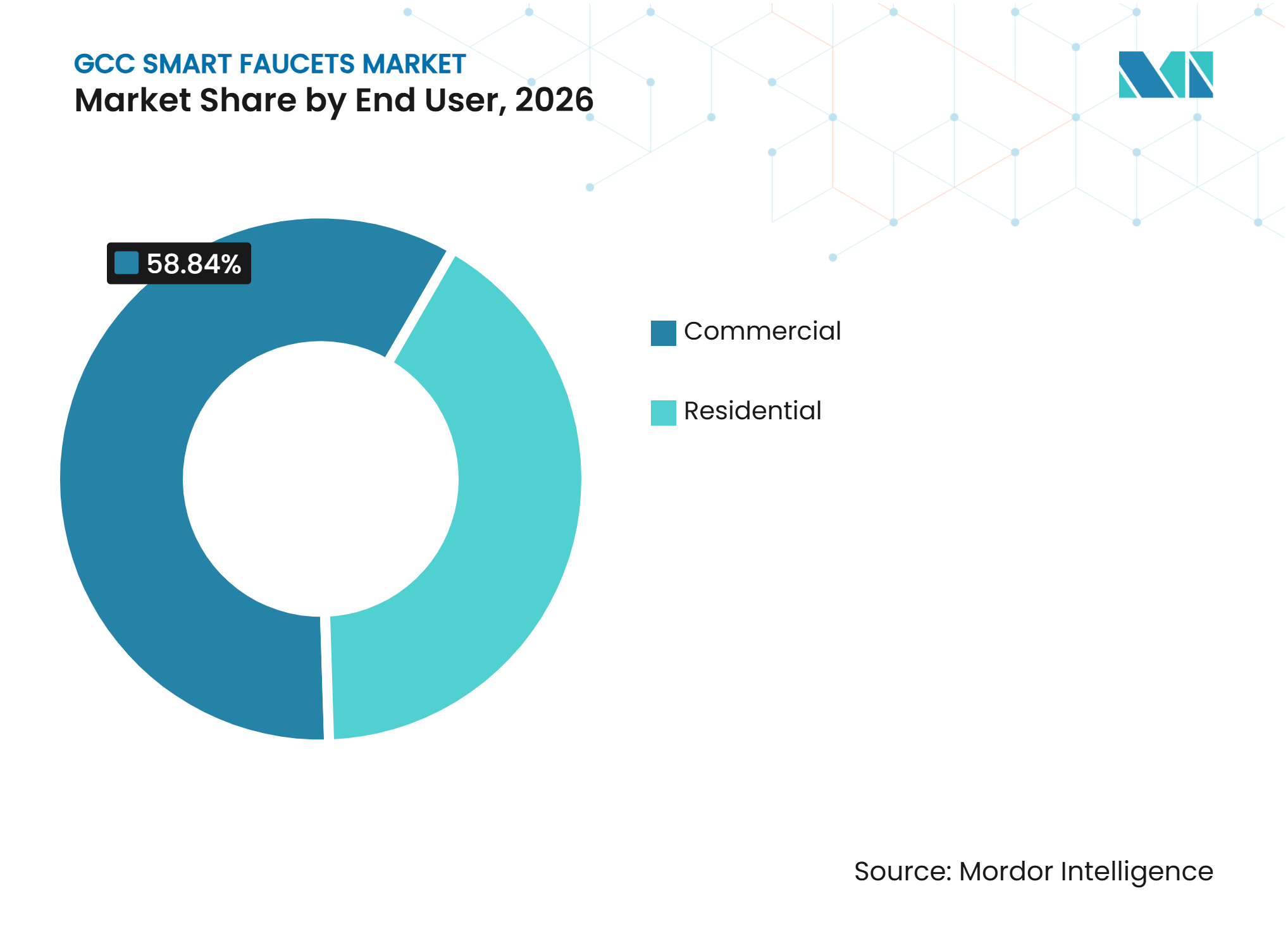
By end user, commercial users held 58.84% of the GCC smart faucets market share in 2026, while residential users are projected to expand at an 11.63% CAGR during 2027–2032.
-
By distribution channel, B2C and retail accounted for 75.77% of the GCC smart faucets market share in 2026 and are forecast to grow at a 9.91% CAGR during 2027–2032.
-
By geography, Saudi Arabia held 38.13% of the GCC smart faucets market share in 2026 and is projected to expand at an 11.52% CAGR during 2027–2032.
Note: Market numbers in this report are based on Mordor Intelligence's proprietary estimation framework, which combines nine months of actuals with Q4 projections for base year 2026.
Market Trends and Insights
Drivers Impact Analysis of GCC Smart Faucets Market of GCC Smart Faucets Market*
| Driver | (~) % Impact on CAGR Forecast | Geographic Relevance | Impact Timeline |
|---|---|---|---|
| Water Scarcity and Water-Efficiency Requirements | +2.5% | GCC-wide, with highest enforcement intensity in Saudi Arabia and Qatar | Medium term (2-4 years) |
| Luxury Hospitality, Airports, Malls, and Mixed-Use Development | +2.0% | Saudi Arabia and UAE, with spillover to Qatar and Oman | Short term (≤ 2 years) |
| Smart-City and Sustainable-Building Programs | +1.5% | UAE and Saudi Arabia | Medium term (2-4 years) |
| High-End Residential Automation and Connected Bathrooms | +1.0% | UAE and Saudi Arabia, with emerging demand in Qatar | Medium term (2-4 years) |
| IoT Monitoring, Leak Detection, and Flow Optimization | +0.8% | UAE and Saudi Arabia, with early adoption in Kuwait and Oman | Long term (≥ 4 years) |
| Developer and Contractor Specification in Large Projects | +0.6% | Saudi Arabia giga-projects and UAE master-planned communities | Short term (≤ 2 years) |
| Source: Mordor Intelligence | |||
Water Scarcity and Water-Efficiency Requirements
Al-Muaili and coauthors, writing in the 2025 Arabian Journal of Geosciences, identified a structural freshwater deficit across the Arabian Peninsula. Their assessment reported average GCC per-capita consumption of 463 cubic meters annually and found that agriculture accounted for 76% of water use. Saudi Arabia’s Executive Regulations for Monitoring and Compliance with Water Efficiency and Conservation Standards became mandatory on March 21, 2026. A separate penalty framework, finalized in August 2026, will apply from March 21, 2027. It will fine urban users SAR 1,000, (USD 266), for a first offense involving noncompliant sanitary fixtures, SAR 2,000, (USD 533), for a second offense, and SAR 10,000, (USD 2,665), for a third offense. Qatar’s GCC Green Label requirements also bring faucets and mixers within a formal conformity process. The UAE Water Security Strategy 2036 targets a 21% reduction in water demand, supporting long-term institutional interest in efficient fixtures[1].
Luxury Hospitality Construction Sustains Premium Touchless Procurement
Premium hotels, airports, malls, and mixed-use properties prioritize hygiene, design consistency, and lower water use in restroom specifications. This preference supports touchless and digitally controlled products where the initial cost can be absorbed within larger project budgets. Luxury hotel projects also tend to use coordinated bathroom packages, which helps suppliers offer faucets alongside showers, sanitaryware, and connected controls. High-end hospitality openings in Riyadh and Dubai can establish design benchmarks that influence nearby commercial projects. The GCC smart faucets market benefits when developers adopt premium fixtures early in the design process because retrofitting later often requires additional plumbing and power work. Large developments also give suppliers opportunities to provide installation guidance, maintenance support, and replacement parts through one contract.
Smart-City and Sustainable-Building Programs
Green-building programs increasingly link water efficiency to building approvals and project performance requirements. Abu Dhabi’s Estidama framework requires government-funded projects to meet at least a two-pearl standard, and water-fixture efficiency is part of the required assessment. In January 2025, Abu Dhabi City Municipality reported 304 projects were in design and 81 were in construction under Estidama standards[1]. Saudi Arabia’s Mostadam program issued sustainability assessment certificates to 6 projects in the first half of 2025, a 200% increase from the same period in 2024[2]. These programs encourage project teams to specify faucets with verified flow performance, dependable controls, and suitable technical documentation. The GCC smart faucets market is supported when building ratings turn water efficiency into a procurement criterion rather than an optional feature.
IoT Monitoring, Leak Detection, and Flow Optimization
Smart faucet functions are expanding beyond touchless activation toward building-level monitoring and water control. Connected systems can provide usage information that helps facility managers identify abnormal consumption and schedule maintenance. In March 2024, WINT completed deployment of an artificial intelligence water-management system across 104 apartments at W The Palm Residences. The company’s case study reported that the system identified multiple leaks and could prevent 9 million liters of water waste annually. The same case study estimated recurring annual savings of USD 25,000. These applications strengthen the value of fittings that can work with broader building-management systems.
Restraints Impact Analysis of GCC Smart Faucets Market of GCC Smart Faucets Market*
| Restraint | (~) % Impact on CAGR Forecast | Geographic Relevance | Impact Timeline |
|---|---|---|---|
| Higher Cost Premium Over Manual Fixtures | -1.5% | GCC-wide, particularly residential and sub-premium commercial segments | Short term (≤ 2 years) |
| Project-Cycle Dependence and Contractor Concentration | -0.8% | Saudi Arabia giga-project phasing and UAE construction cycles | Short term (≤ 2 years) |
| Hard-Water, Salinity, Humidity, and Sensor-Service Conditions | -0.7% | Coastal GCC markets and desalinated supply zones | Long term (≥ 4 years) |
| Imported Electronics, Battery Replacement, and After-Sales Constraints | -0.5% | GCC-wide, especially Oman, Kuwait, and Bahrain | Medium term (2-4 years) |
| Source: Mordor Intelligence | |||
Higher Cost Premium Over Manual Fixtures
Commercial-grade sensor faucets from premium suppliers can cost three to five times more than manual alternatives. The installed cost rises further when projects use hardwired power connections instead of battery-powered products. Battery replacement, sensor recalibration, and solenoid valve servicing also create recurring costs after installation. These expenses can discourage adoption in standard residential projects and mid-market hospitality properties. Manual products can remain the preferred choice where a project does not require a green-building rating or formal water-efficiency documentation. The GCC smart faucets market is therefore more exposed to price sensitivity in developments where lifecycle savings are not measured during procurement.
Hard-Water and Coastal Conditions Degrade Sensor Performance and Lifespan
Mineralized desalinated water, elevated coastal chloride exposure, and humidity changes can complicate the operation of sensor faucets. A 2025 scientific review (Journal of Water Process Engineering) found that corrosion and scale formation in water networks intensify with temperature cycling. Scale on infrared and Time-of-Flight sensor windows can reduce signal accuracy. Mineral accumulation in solenoid valve openings can also create irregular water flow. Stainless steel housings may face pitting corrosion in high-chloride coastal environments. These conditions increase the value of corrosion-resistant internals and regular maintenance, but they also raise the total cost of ownership for buyers.
*Our forecasts treat driver/restraint impacts as directional, not additive. The impact forecasts reflect baseline growth, mix effects, and variable interactions.
GCC Smart Faucets Market Segment Analysis
By Material:
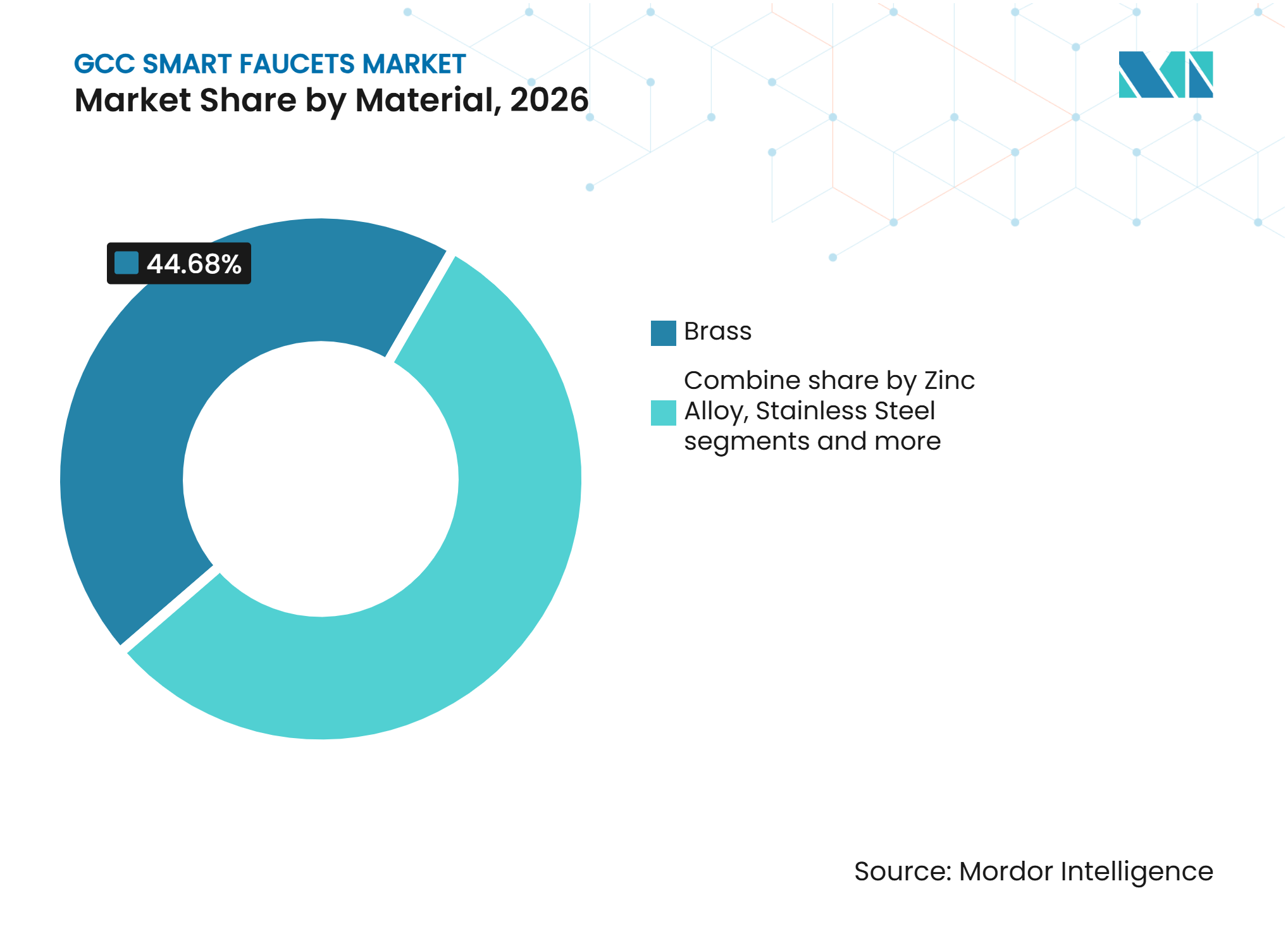
Brass Retains Its Position While Polymer Composites Gain GroundBrass held 44.68% of the GCC smart faucets market size by material in 2026. Its established position reflects its machinability for precision faucet bodies and its familiarity among luxury-hospitality project specifiers. Brass remains suitable for many premium applications that require a durable, finished exterior. Stainless steel continues to serve high-traffic restrooms where hygiene and surface durability influence product selection. Zinc alloy remains relevant in lower-cost products, where purchase price is a stronger consideration.
Engineering plastics and polymer composites are expected to record the fastest material CAGR of 10.58% through 2032. Their growth is linked to corrosion resistance in high-chloride water environments and concern over lead exposure from metal components. Syensqo launched AvaSpire PAEK compounds for flexible plumbing tubes used in GROHE faucet systems in October 2025[4]. The company stated that the material can eliminate lead contamination risk compared with brass and deliver improved creep resistance. Polymer components can therefore offer a practical route to improve durability where scale and salinity increase maintenance requirements.



By Installation Type:
Deck-Mount Systems Lead While Wall-Mount Designs GrowDeck-mount installations accounted for 60.06% of the GCC smart faucets market size in 2026. They fit countertop basins and vessel sinks commonly used in luxury hotels and residential bathrooms. This format also aligns with existing plumbing layouts in many renovation projects. Its broad installed base supports replacement demand because users can change fixtures without redesigning the full washroom. Deck-mounted products remain relevant across commercial and residential settings because they are familiar to installers and buyers.
Wall-mount systems are expected to record the fastest CAGR of 10.26% through 2032. They are used in public restrooms where keeping fixtures away from counter surfaces can support cleaning and hygiene routines. Wall-mounted layouts can also support space-efficient designs in new residential projects. Other configurations, including concealed and surface-integrated systems, serve airports and high-end hospitality projects where visual continuity is important. Saudi water-efficiency requirements apply across installation types, supporting the replacement of older manual fixtures with flow-controlled alternatives. The GCC smart faucets market consequently accommodates several installation formats rather than relying on one configuration.
By Application:
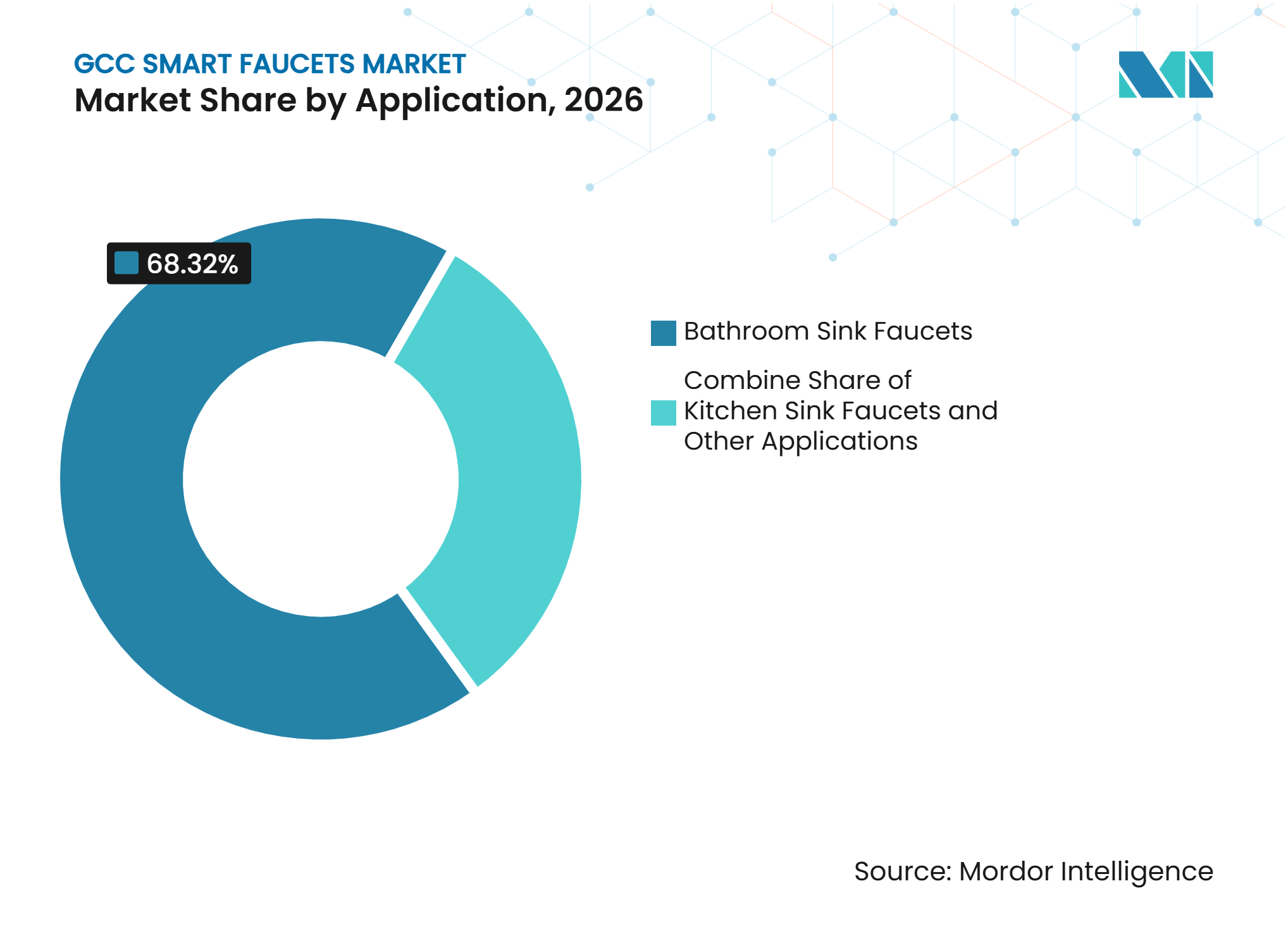
Bathroom Sink Faucets Support Volume While Kitchen Products ExpandBathroom sink faucets accounted for 68.32% of the GCC smart faucets market share by application in 2026. High-footfall commercial restrooms need fixtures that support touch-free use and controlled water delivery. Water-efficiency requirements in rated buildings also reinforce bathroom demand. Hotels, malls, airports, and public facilities create repeat procurement opportunities for these products. Bathroom installations remain the largest application because they combine hygiene expectations with frequent daily use.
Kitchen sink faucets are projected to grow at a 9.87% CAGR through 2032. Food and beverage facilities within large hospitality projects require practical fixtures that can support frequent cleaning and controlled operation. Connected kitchen products also appeal to homeowners investing in integrated home systems. Other applications, including laboratory, laundry, and ablution faucets, remain smaller but can be sensitive to water-efficiency and conformity requirements. Product selection in these applications depends on duty cycle, cleaning needs, sensor reliability, and local compliance requirements. Brands need broad product portfolios to address these different environments across the GCC smart faucets market.

By Construction and Project Type:
Retrofit Activity Combines Scale With GrowthReplacement, renovation, and retrofit installations held 53.41% of the GCC smart faucets market size in 2026. The same segment is forecast to grow at a 9.74% CAGR through 2032. Its dual position reflects a sizeable installed base of hotels, malls, airports, and other commercial facilities that require fixture upgrades. Regulatory attention to water efficiency increases the need to replace older manual fittings. Retrofits can also allow owners to improve hygiene and water control without rebuilding the full property.
Hospitality properties constructed between 2000 and 2015 form an important source of replacement demand. Renovations can require fixtures that meet current water-efficiency expectations while fitting existing plumbing layouts. New construction and first-installation projects accounted for 46.59% of demand in 2026. These projects remain supported by large Saudi and UAE developments, but their timing can vary with project phases. Retrofit demand is comparatively linked to maintenance and compliance schedules, which can provide a steadier source of procurement. This balance gives suppliers opportunities in both large project specifications and recurring replacement cycles.
By End User:
Commercial Users Lead While Residential Adoption AcceleratesCommercial end users held 58.84% of the GCC smart faucets market share in 2026. Hotels, malls, airports, hospitals, and public facilities require fixtures that support hygiene, water control, and frequent use. Commercial projects are generally purchased against formal specifications, although those specifications can be fulfilled through direct sales, distributors, and retail-backed trade accounts. This favors suppliers that provide technical documentation, service capacity, and a full sanitaryware offering. Larger projects can also create repeat orders across multiple buildings or development phases.
Residential users are forecast to record the fastest CAGR of 11.63% during 2027–2032. Growth reflects increasing interest in connected-home products and premium bathroom renovations. Aqara reported in a company case study that it deployed more than 10,000 smart-home devices across more than 500 apartments at Riyadh’s KAFD development. This deployment indicates that connected-device integration is moving beyond small pilots in major residential developments. The GCC smart faucets market benefits when developers incorporate smart fixtures within wider residential automation packages.
By Distribution Channel:
Retail Holds the Largest Position and Direct Sales Remain ImportantB2C and retail channels accounted for 75.77% of the GCC smart faucets market share in 2026. The channel is also forecast to grow at a 9.91% CAGR during 2027–2032. Showrooms and online platforms allow homeowners, designers, and installers to compare product finishes, controls, and water-saving features. Retail suppliers can use branded displays to explain the value of touchless operation and connected controls. This approach is especially relevant for renovation buyers who make product choices after a property is completed.
B2B and direct sales represented 24.23% of demand in 2026. Although smaller by value, the channel is relevant for higher-value procurement by hotels, airports, malls, and giga-projects. Direct supply arrangements can improve delivery coordination, technical support, and spare-parts planning for contractors. Retail-backed trade accounts and distributors can also fulfill project specifications, which helps explain the larger retail-channel value. Retail and direct sales therefore serve overlapping procurement needs within the GCC smart faucets market. Suppliers that operate across both channels can address consumer demand while maintaining access to project-led contracts.
Geography Analysis
Saudi Arabia
Saudi Arabia accounted for 38.13% of the GCC smart faucets market size in 2026 and is forecast to expand at an 11.52% CAGR during 2027–2032. Water-efficiency monitoring, compliance requirements, and large-scale construction support its position. Saudi Arabia’s Executive Regulations for Monitoring and Compliance with Water Efficiency and Conservation Standards became mandatory on March 21, 2026. A separate penalty framework, finalized in August 2026, will fine urban users SAR 1,000, (USD 266), to SAR 10,000, (USD 2,665), for noncompliant sanitary fixtures from March 21, 2027. The Mostadam rating program issued sustainability assessment certificates to 6 projects in the first half of 2025, a 200% increase from the same period in 2024. Geberit signed a memorandum of understanding with ROSHN Group in November 2025 to supply sustainable sanitary technology and explore local manufacturing. The agreement demonstrates how suppliers seek long-term relationships with major Saudi developers.
United Arab Emirates
The UAE has an established framework for green building and water management. Estidama requires government-funded buildings to meet at least a two-pearl rating, and water-fixture efficiency is a required credit. Abu Dhabi City Municipality recorded 385 Estidama-compliant projects in design or construction in early 2025. This project base supports demand for products with verified flow performance. DEWA continued to invest in smart water-network monitoring during 2025, which strengthens the wider environment for digital water-management solutions. The UAE Water Security Strategy 2036 also targets a 21% reduction in water demand, reinforcing the long-term relevance of efficient fixtures.
Qatar, Oman, Kuwait, and Bahrain
Qatar’s GCC Green Label requirement for faucets and mixers became mandatory from February 24, 2026. The requirement brings restroom, kitchen, ablution, and bidet fixtures within a defined compliance structure. Oman’s wider water-service digitization and Kuwait’s smart-meter procurement indicate growing interest in connected water management, although these programs do not directly measure faucet demand. Bahrain’s water scarcity also maintains policy attention on reducing municipal water consumption. Across these markets, water infrastructure modernization can raise awareness of conservation at the building level. Suppliers that offer documented efficiency, reliable service, and products suited to local water conditions can strengthen their position across these smaller GCC markets.
Competitive Landscape
Market Concentration
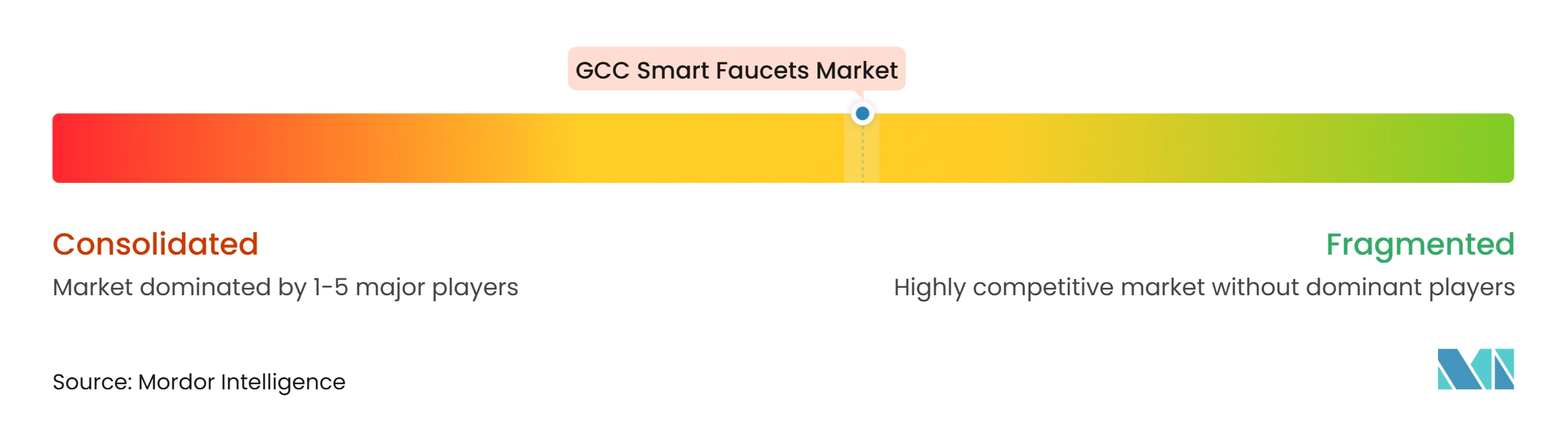
The GCC smart faucets market is moderately concentrated in premium commercial specifications. GROHE, Hansgrohe, Kohler, and Geberit have strong visibility in high-value projects because of their design portfolios, water-efficiency credentials, and established specification support. Jaquar and regional suppliers such as RAK Ceramics compete for mid-market and design-led demand. LIXIL presented connected bathroom innovations for its GROHE brand at ISH 2025. Its approach reflects the importance of connected controls within premium bathroom product portfolios. Suppliers also compete on their ability to provide technical documents needed for Green Label and other conformity processes.
Developer partnerships are becoming more important in the GCC smart faucets market. Geberit’s November 2025 agreement with ROSHN covers sustainable sanitary technology and the exploration of local manufacturing in Saudi Arabia. This type of arrangement can help a supplier maintain specification visibility across multiple development phases. Material innovation is another area of competition because high-chloride and mineralized water can shorten the life of conventional components. In October 2025, Uniwell adopted Syensqo’s AvaSpire PAEK polymer compounds for corrugated flexible plumbing tubes used in GROHE faucet systems.
RAK Ceramics signed an exclusive multiyear licensing agreement with Roberto Cavalli in June 2026 for bathroom collections, including faucets, in the UAE, Saudi Arabia, Bahrain, Oman, Kuwait, Jordan, Lebanon, Egypt, Iraq, Turkey, Morocco, and India. Qatar is not included in the announced territories. The agreement adds a design-led luxury option in the residential and hospitality segments. The competitive balance will depend on design, regulatory readiness, product durability, and service support.
GCC Smart Faucets Industry Leaders
-
Grohe AG
-
Kohler Co.
-
Jaquar Group
-
LIXIL Corporation
-
TOTO Ltd.
- *Disclaimer: Major Players sorted in no particular order
GCC Smart Faucets Market Companies Covered in this Report
- Kohler Co.
- Jaquar Group
- Delta Faucet Company
- Hansgrohe SE
- LIXIL Corporation
- TOTO Ltd.
- Moen Incorporated
- Sloan Valve Company
- Roca Sanitario, S.A.
- Geberit International AG
- Villeroy & Boch AG
- Duravit AG
- Dornbracht AG & Co. KG
- GESSI S.p.A.
- RAK Ceramics PJSC
- Bravat GmbH
- Franke Group
- PRESTO Group
- Zurn Elkay Water Solutions
- Oras Ltd.
Recent Industry Developments in GCC Smart Faucets Market
- June 2026: RAK Ceramics PJSC signed an exclusive multi-year licensing agreement with Roberto Cavalli to develop and distribute branded ceramic tiles, sanitaryware, and faucets in the UAE, Saudi Arabia, Bahrain, Oman, Kuwait, Jordan, Lebanon, Egypt, Iraq, Turkey, Morocco, and India.
- February 2026: Qatar made GCC Green Label compliance mandatory for covered faucets, mixers, and other water-conservation devices from February 24, 2026.
- November 2025: Geberit International Sales signed a memorandum of understanding with ROSHN Group to supply sustainable sanitary technology and explore local manufacturing in Saudi Arabia.
- October 2025: Uniwell adopted Syensqo’s AvaSpire PAEK polymer compounds for corrugated flexible plumbing tubes used in GROHE bathroom and kitchen faucet systems.
GCC Smart Faucets Market Report Scope
Segmentation Overview
| Zinc Alloy |
| Stainless Steel |
| Brass |
| Engineering plastics / polymer composites |
| Other Materials |
| Deck-Mount |
| Wall-Mount |
| Other Installations |
| Kitchen Sink Faucets |
| Bathroom Sink Faucets |
| Other Applications |
| New Construction / First Installation |
| Replacement / Renovation |
| Residential |
| Commercial |
| B2C / Retail | Multi-Brand Stores/Home-improvement retailers |
| Specialist plumbing and kitchen/bath showrooms (including Exclusive Brand Outlets (EBOs)) | |
| Online | |
| Local Hardware Stores / Unorganized Retail | |
| B2B / Direct Sales |
| Saudi Arabia |
| United Arab Emirates |
| Qatar |
| Kuwait |
| Bahrain |
| Oman |
| By Material | Zinc Alloy | |
| Stainless Steel | ||
| Brass | ||
| Engineering plastics / polymer composites | ||
| Other Materials | ||
| By Installation Type | Deck-Mount | |
| Wall-Mount | ||
| Other Installations | ||
| By Application | Kitchen Sink Faucets | |
| Bathroom Sink Faucets | ||
| Other Applications | ||
| By Construction/Project Type | New Construction / First Installation | |
| Replacement / Renovation | ||
| By End-User | Residential | |
| Commercial | ||
| By Distribution Channel | B2C / Retail | Multi-Brand Stores/Home-improvement retailers |
| Specialist plumbing and kitchen/bath showrooms (including Exclusive Brand Outlets (EBOs)) | ||
| Online | ||
| Local Hardware Stores / Unorganized Retail | ||
| B2B / Direct Sales | ||
| By Geography | Saudi Arabia | |
| United Arab Emirates | ||
| Qatar | ||
| Kuwait | ||
| Bahrain | ||
| Oman | ||
Key Questions Answered in the Report
What is the projected value of the GCC smart faucets sector by 2032?
It is projected to reach USD 318.42 million by 2032, expanding at a 9.00% CAGR during 2027–2032.
Which material leads smart faucet demand in the GCC?
Brass led with 44.68% share in 2026, while engineering plastics and polymer composites are expected to grow fastest at a 10.58% CAGR.
Why are touchless faucets gaining adoption in Saudi Arabia?
Monitoring requirements became mandatory on March 21, 2026, and a separate penalty framework will apply from March 21, 2027.
Which end-user group is growing fastest for GCC smart faucets?
Residential users are projected to grow at an 11.63% CAGR during 2027–2032, supported by connected-home adoption.