
GCC Microgreens Market Size and Share
Market Overview
| Study Period | 2021 - 2031 |
|---|---|
| Forecast Data Period | 2026 - 2031 |
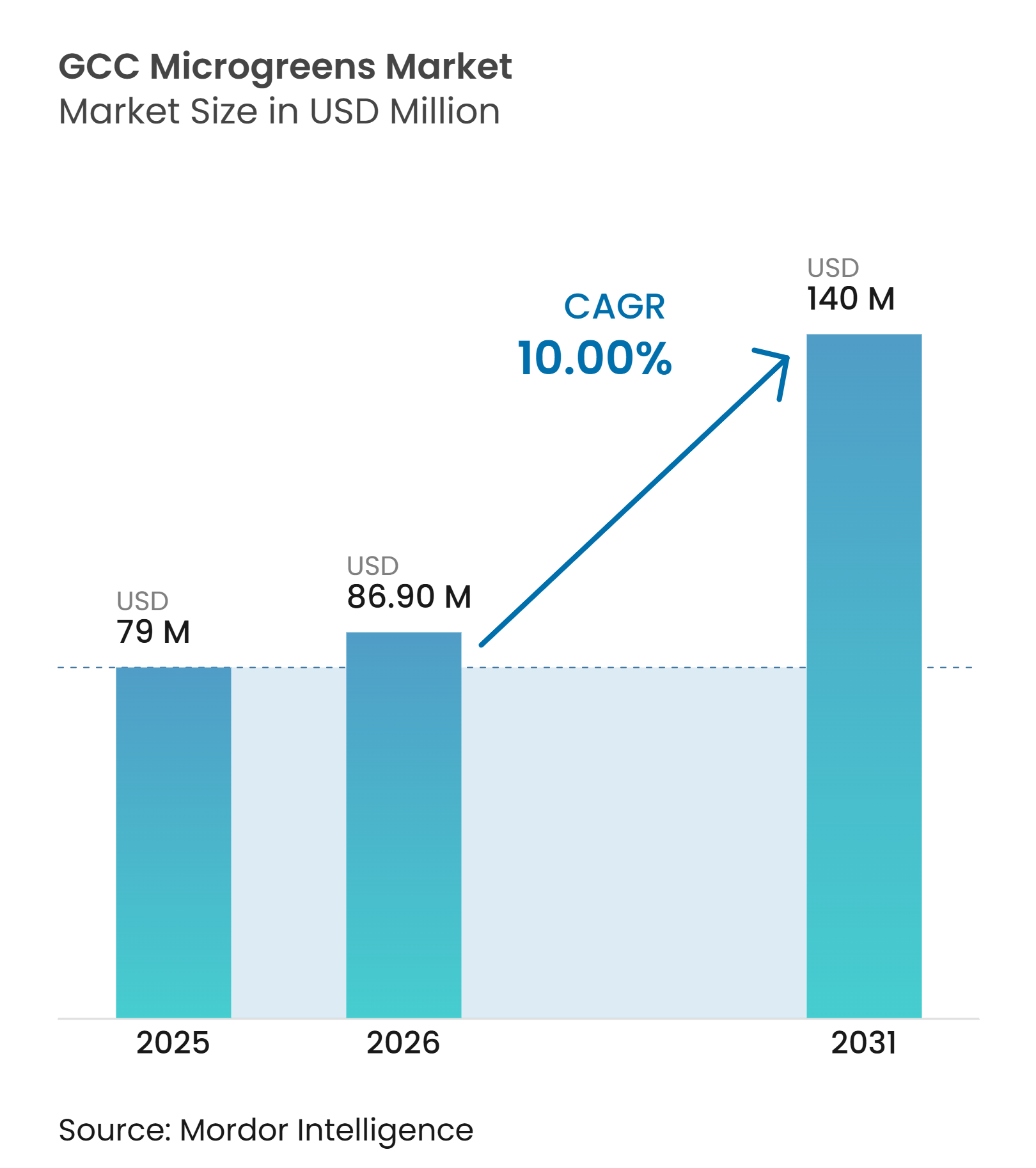
| Base Year Market Size (2025) | USD 79 Million |
| Market Size (2026) | USD 86.90 Million |
| Market Size (2031) | USD 140 Million |
| Growth Rate (2026 - 2031) | 10.00 % |
| Market Concentration | Low |
Major Players *Disclaimer: Major Players sorted in no particular order Image © Mordor Intelligence. Reuse requires attribution under CC BY 4.0. | |
GCC Microgreens Market Analysis by Mordor Intelligence
The GCC microgreens market size was valued at USD 79 million in 2025 and is estimated to grow from USD 86.9 million in 2026 to reach USD 140 million by 2031, at a CAGR of 10% during the forecast period (2026-2031). Food-security programs that favor locally controlled-environment production over imported fresh produce support market growth. Water scarcity further drives the adoption of hydroponic and vertical systems, which consume less water than open-field farming. Hospitality buyers remain an important demand source, as chefs use microgreens as a recurring menu ingredient rather than an occasional purchase. Retail, quick-commerce, and direct delivery channels have the potential to broaden demand, although inconsistent shelf availability continues to limit household adoption. Investment capacity, electricity consumption, and reliable cold chain infrastructure will determine which operators can expand the market beyond premium urban centers.
Key Report Takeaways
- By type, Broccoli accounted for 27.5% of the GCC microgreens market share in 2025, while Basil is forecast to grow at a CAGR of 14.6% from 2026 to 2031.
- By farming method, Indoor Farming accounted for 45.3% of the GCC microgreens market share in 2025, while Vertical Farming is forecast to grow at a CAGR of 19.7% from 2026 to 2031.
- By growth medium, Peat Moss accounted for 33.2% of the market share in 2025, while Coconut Coir is forecast to grow at a CAGR of 15.5% from 2026 to 2031.
- By distribution channel, Restaurants accounted for 51.1% of the market share in 2025 and are forecast to grow at the fastest CAGR of 12.0% from 2026 to 2031.
- By geography, Saudi Arabia held 47% of the market share in 2025, while the UAE segment is forecast to grow at a CAGR of 11.2% from 2026 to 2031.
Note: Market size and forecast figures in this report are generated using Mordor Intelligence’s proprietary estimation framework, updated with the latest available data and insights as of January 2026.
Market Trends and Insights
Drivers Impact Analysis of GCC Microgreens Market*
| Driver | (~) % Impact on CAGR Forecast | Geographic Relevance | Impact Timeline |
|---|---|---|---|
| Food security and import substitution programs | +2.5% | Saudi Arabia, UAE, Qatar | Medium term (2-4 years) |
| Premium hospitality and chef-led menu adoption | +2% | UAE, Saudi Arabia, Qatar | Short term (≤ 2 years) |
| Water scarcity favoring closed-loop controlled-environment production | +1.8% | All GCC countries | Long term (≥ 4 years) |
| Consumer interest in nutrient-dense, locally grown foods | +1.5% | UAE, Saudi Arabia, Kuwait | Short term (≤ 2 years) |
| Rapid grocery delivery and direct-to-consumer availability | +1.2% | UAE, Bahrain | Short term (≤ 2 years) |
| Cross-border freshness from regional hubs | +0.8% | UAE, Kuwait, Saudi Arabia, Bahrain | Medium term (2-4 years) |
| Source: Mordor Intelligence | |||
Food Security and Import Substitution Programs
Government programs across the GCC support local food production and make microgreens relevant to controlled-environment agriculture plans. The GCC microgreens market is supported by the region’s dependence on imported food, which accounts for up to 85% of caloric supply across the six member states. A regional food-security strategy identifies USD 30.5 billion in potential economic contribution and USD 3.8 billion in food-technology investment.[1]Saudi Arabia’s Agricultural Development Fund approved SAR 6.5 billion (USD 1.73 billion) in agricultural financing during 2025 for greenhouse farming and supply-chain infrastructure. These programs can give growers better access to financing and reduce dependence on a narrow set of hospitality buyers.
Premium Hospitality and Chef-Led Menu Adoption
Restaurants and hotels give the GCC microgreens market a dependable base for premium products. Greeneration supplied more than 350 restaurants and hotels in the UAE during 2025, including Atlantis, and had invested more than USD 5 million in its farms. Restaurant specifications can link variety and volume to seasonal menus, which helps growers plan harvests. Bustanica installed a vertical farm unit in the Bull and Bear kitchen at Waldorf Astoria DIFC, reducing the time between harvest and use.[2] Tourism projects in Saudi Arabia and the continued expansion of hospitality in Qatar create additional opportunities for business-to-business supply. Chef collaboration also helps growers demonstrate product quality and develop repeat restaurant accounts.
Water Scarcity Favoring Closed-Loop Controlled-Environment Production
Water constraints make closed-loop systems relevant to the GCC microgreens market. Hydroponic and vertical farms can use up to 90% less water per unit of edible biomass than conventional field farming. Bustanica’s Dubai facility uses a closed-loop irrigation system that saves 95% of water and produces more than 1 million kilograms of fresh produce each year. Oman’s Agricultural City project includes hydroponics, aeroponics, and automated farming, demonstrating that water-efficient production is moving beyond small urban farms. A 2026 study published in Plant Growth Regulation found that moderate light intensities and balanced blue-red LED spectra can improve biomass accumulation and the production of bioactive compounds in microgreens.[3] Better lighting practices can help farms limit electricity waste while maintaining quality in high-temperature climates.
Consumer Interest in Nutrient-Dense, Locally Grown Foods
Health positioning is expanding the GCC microgreens market among consumers who recognize locally grown produce. A 2025 study published in Scientific Reports found that broccoli microgreens had the highest total phenolic content among the tested varieties, at 825.53 mg GAE per 100 g fresh weight. The same research found pea microgreens contained up to 80.45 mg of ascorbic acid per 100 g fresh weight. A UAE consumer study published in 2026 in Frontiers in Sustainable Food Systems found that 74.7% of respondents were willing to accept a price premium for locally grown organic microgreens. Health-benefit awareness and retail visibility were identified as predictors of consumption intention in that study. Farms with consistent production methods can use these product differences to support premium positioning.
Restraints Impact Analysis of GCC Microgreens Market*
| Restraint | (~) % Impact on CAGR Forecast | Geographic Relevance | Impact Timeline |
|---|---|---|---|
| High controlled-environment capital and electricity costs | -2.5% | All GCC countries | Long term (≥ 4 years) |
| Short shelf life and cold-chain sensitivity | -1.8% | Saudi Arabia, Oman, Qatar | Medium term (2-4 years) |
| Uneven consumer awareness and inconsistent retail availability | -1.2% | UAE, Bahrain, Oman | Short term (≤ 2 years) |
| Limited GCC-wide safety and labeling standards | -0.8% | All GCC countries | Long term (≥ 4 years) |
| Source: Mordor Intelligence | |||
High Controlled-Environment Capital and Electricity Costs
Climate-controlled production requires substantial capital investment, which limits market entry in the GCC microgreens market. Farms require continuous cooling, lighting, refrigeration, and monitoring when temperatures exceed 45°C. Greeneration's two UAE farms represented an investment of more than USD 5 million, while Bustanica was established with a reported USD 40 million investment. Smaller operators need premium prices, adequate volume, and reliable buyer agreements to recover these costs. Longer payback periods can make fundraising difficult when investors expect returns within three to five years. Larger operators can absorb early losses more easily, which may encourage market consolidation.
Short Shelf Life and Cold-Chain Sensitivity
Microgreens require strict cold-chain handling throughout harvesting, transport, and retail display. Their usable life ranges from 7 to 14 days when stored at 2°C to 4°C. A 2025 study published in Italus Hortus found that micro-perforated polypropylene packaging limited chlorophyll loss in arugula microgreens to 15% over 14 days. While packaging improves performance, it does not replace temperature control. Temperature fluctuations at remote production sites can reduce shelf life by two to three days before a product reaches stores. Border inspections and loading events pose additional risks for cross-border shipments.
*Our forecasts treat driver/restraint impacts as directional, not additive. The impact forecasts reflect baseline growth, mix effects, and variable interactions.
GCC Microgreens Market Segment Analysis
By Type:
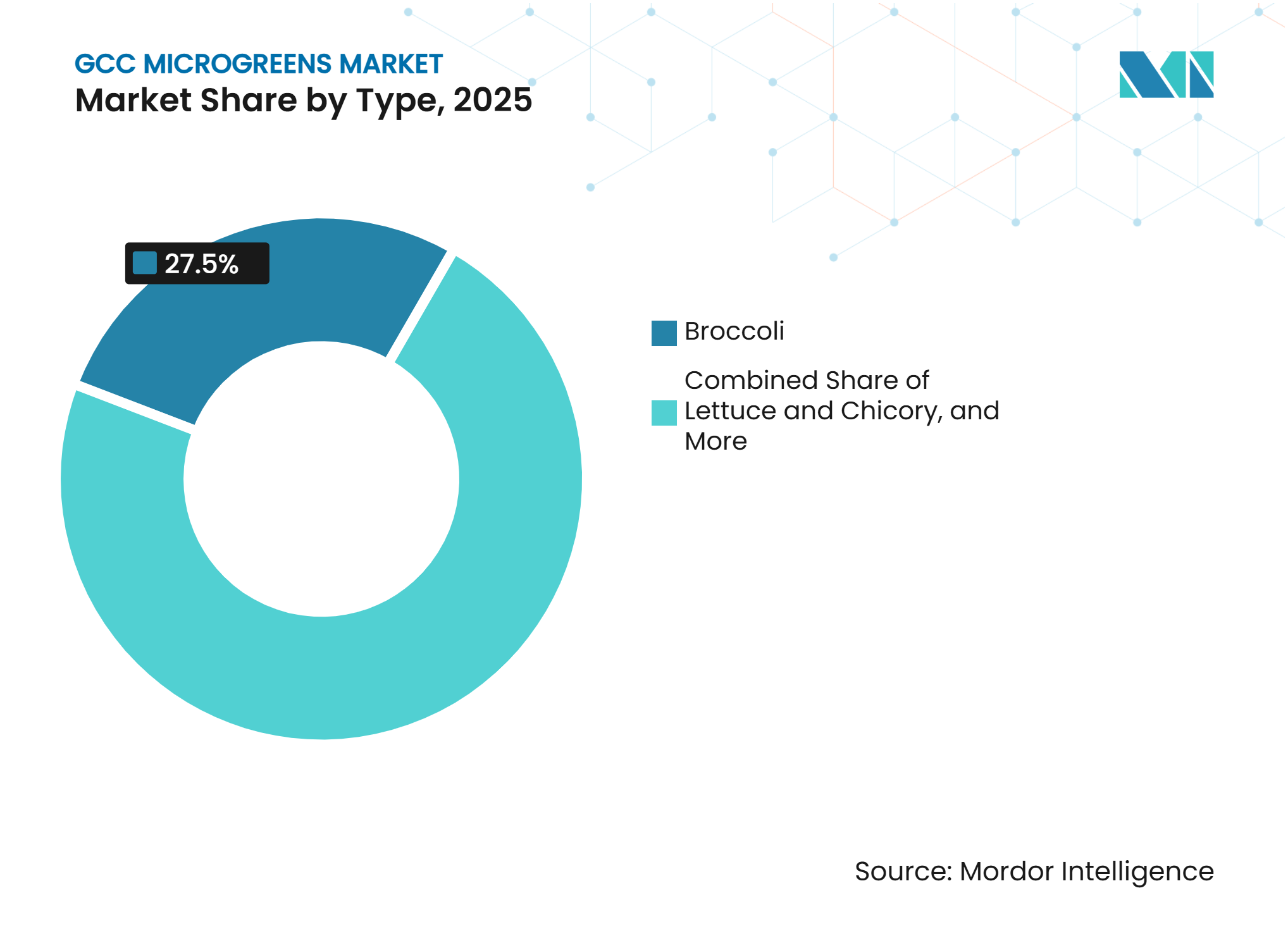
Broccoli Supports Premium Demand While Basil Grows FastestBroccoli accounted for 27.5% of the GCC microgreens market share in 2025, making it the largest segment by type. Its functional-food profile supports demand among health-focused consumers and professional kitchens. A 2025 study published in Scientific Reports found that broccoli microgreens had the highest total phenolic content among the tested varieties, at 825.53 mg GAE per 100 g fresh weight. Lettuce and Chicory remained important in institutional catering and airline meal kits. Arugula is supported by its flavor profile and use in fine dining, while Sunflower gained interest in health-food retail.
Basil is forecast to grow at the fastest CAGR of 14.6% from 2026 to 2031. Its use in herb-led dishes supports demand in Mediterranean and Southeast Asian foodservice concepts. Radish microgreens are gaining visibility through household subscriptions and direct sales. Pea Shoots are used in catering due to their mild flavor and ascorbic acid content. Mixed blends and specialty cultivars account for the remaining demand. Quick-commerce platforms can help these smaller types reach consumers through curated produce boxes.



By Farming Method:
Indoor Farming Leads Revenue While Vertical Farms Add CapacityIndoor Farming accounted for 45.3% of the GCC microgreens market size in 2025. Established farms in Dubai, Abu Dhabi, and Riyadh benefit from proximity to hospitality customers. Vertical Farming is forecast to grow at a CAGR of 19.7% from 2026 to 2031, supported by investments in high-density production systems and urban food supply. Bustanica operates a 330,000-square-foot facility near Al Maktoum International Airport. UNS Farms operates an eight-level facility in Al Quoz with an output of up to 1,500 kilograms of mixed produce each day. These formats allow farms to manage harvest timing and urban delivery more closely.
Commercial Greenhouses are expanding in Oman and Bahrain, where lower land costs reduce capital intensity compared with fully vertical designs. The Mowreq and YesHealth project in Riyadh produces 2 tonnes of fresh produce daily. Container farms and rooftop systems offer lower-capital entry formats. In June 2026, Dubai Municipality inspected a vertical farm within a residential tower in Habtoor City. This model could support farms integrated with hospitality and residential properties.
By Growth Medium:
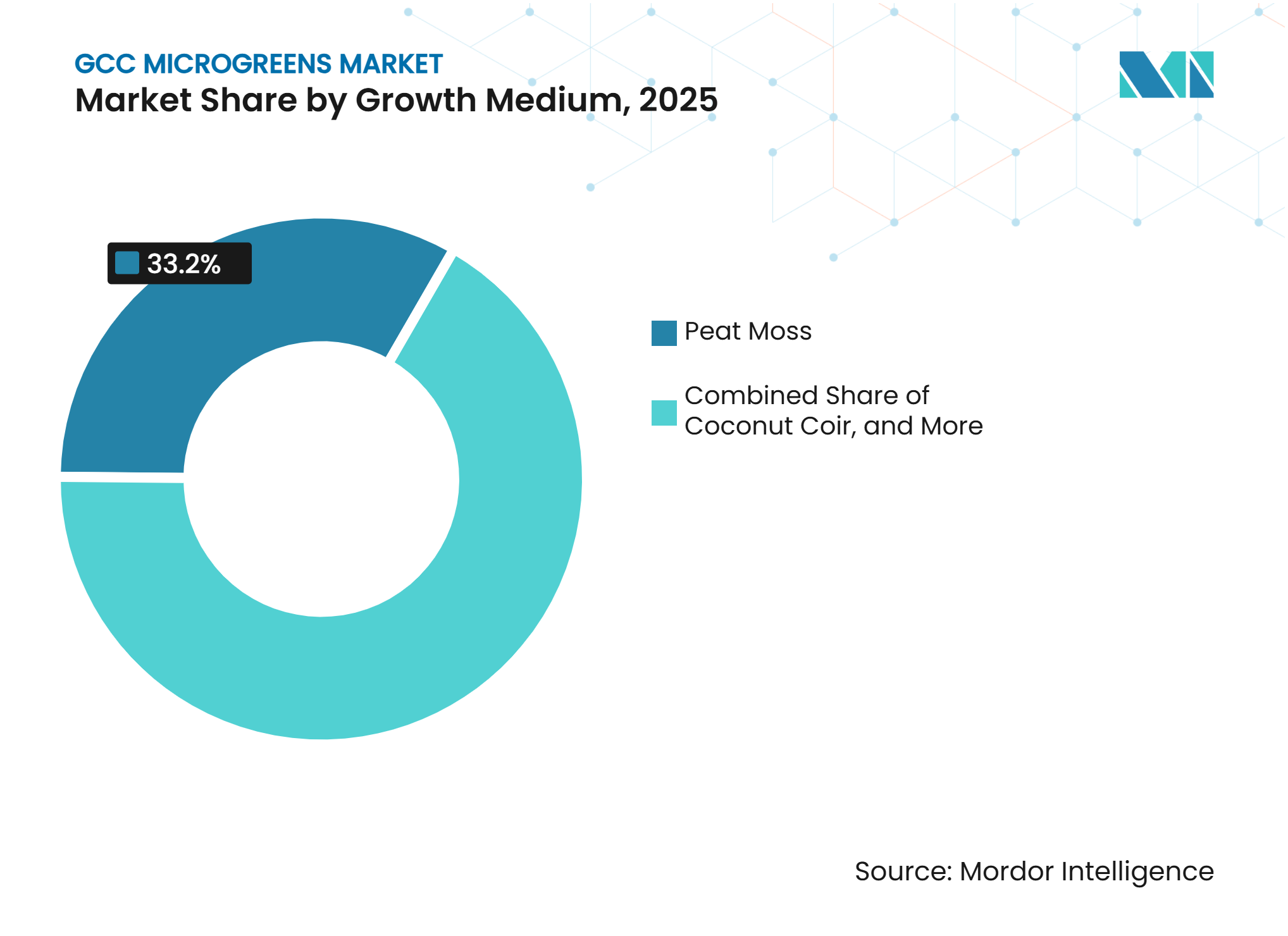
Peat Moss Remains Established While Coconut Coir Gains GroundPeat Moss held 33.2% of the GCC microgreens market share in 2025. Its moisture retention and operational familiarity support its use in established facilities in the UAE and Saudi Arabia. Soil-based production remains relevant to smaller growers. New Leaf in Dubai grows more than 60 microgreen varieties in soil-based systems. These farms can use soil-grown positioning to support flavor and artisan product claims. Tissue Paper is mainly used for specialty crops and short production cycles.
Coconut Coir is forecast to grow at a CAGR of 15.5% from 2026 to 2031, supported by its renewable characteristics and strong drainage properties in hydroponic and aeroponic systems. It is a renewable byproduct of the region’s coconut import trade and provides strong drainage in hydroponic and aeroponic systems. Buyers in hospitality and retail are increasingly attentive to supply-chain credentials. A 2026 study published in Frontiers in Plant Science showed that LED treatments can materially influence polyphenols, flavonoids, and antioxidant activity in pea microgreens. Farms can combine light and substrate choices to develop distinct product lines. Hemp mats and mineral wool serve the remaining demand in research-oriented and automated systems.

By Distribution Channel:
Restaurants Lead Demand While Direct Sales Expand AccessRestaurants accounted for 51.1% of the GCC microgreens market in 2025 and are forecast to grow at the fastest CAGR of 12.0% from 2026 to 2031. Dubai’s foodservice base includes more than 13,000 outlets, supporting repeat demand for premium ingredients. Chef adoption is spreading from UAE fine dining to Saudi tourism projects and Qatar’s hospitality sector. Restaurants provide growers with a direct route to menu planning and recurring orders and also help introduce unfamiliar varieties to consumers.
Hypermarkets and Supermarkets remain important retail channels for microgreens. Carrefour, Spinneys, LuLu Hypermarket, and Nesto are established UAE outlets for microgreens. Retail availability remains uneven, and 46.3% of UAE survey respondents had not noticed microgreens in stores in 2026. Direct-to-consumer subscriptions and quick-commerce apps form part of the other channel group. KASO connects suppliers such as Greeneration with restaurant ordering systems KASO. Affordable household packs remain underserved across the GCC microgreens market.
Geography Analysis
Saudi Arabia held 47% of the GCC microgreens market share in 2025, the largest share among GCC countries. This position is supported by government financing and growing demand across Riyadh, the Western Region, and the Eastern Region. The Agricultural Development Fund approved SAR 6.5 billion (USD 1.73 billion) in financing in 2025. The Mowreq and YesHealth farm in Riyadh supplies Panda and produces 2 tonnes of fresh produce per day. A Madinah hydroponic facility reported annual production above 2,015,000 kilograms in 2025.
The UAE is forecast to grow at the fastest CAGR of 11.2% from 2026 to 2031, supported by hospitality density, logistics capacity, digital commerce, and urban-farming policies. Greeneration, Bustanica, UNS Farms, Badia Farms, and GreenVita supply hotels and restaurants from UAE production hubs. Bustanica expanded its retail and catering portfolio at Gulfood 2026. UAE regulators administer licensing through the Abu Dhabi Agriculture and Food Safety Authority and the Dubai Municipality. The Habtoor City inspection indicates support for urban-integrated production.
Kuwait, Qatar, Oman, and Bahrain represent the remaining GCC markets. Qatar benefits from hospitality demand and consumer interest in healthy foods, while Oman’s Food Security Lab 2025 and import-substitution policies support hydroponics and aeroponics. Bahrain offers a short transit route to nearby customers. Badia Farms partnered with Edamah on a 50,000-square-meter Agricultural Oasis in Hamala during 2024.
Competitive Landscape
Market Concentration
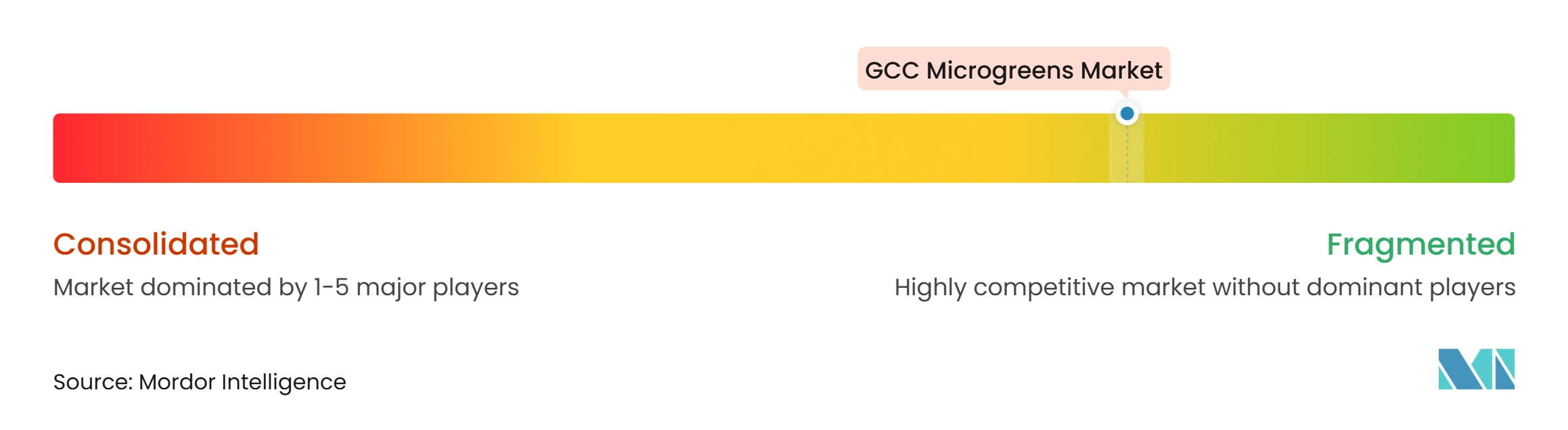
The GCC microgreens market is fragmented, with established players such as Greeneration, UNS Farms, Greenia Farms, Badia Farms, New Leaf, and Bustanica competing alongside local specialty farms, small indoor growers, and direct-to-consumer operators. Hospitality relationships are a central competitive capability, while reliable production quality and fast delivery are also important for winning restaurant accounts.
Bustanica has adopted a distinct approach by combining vertical farming, retail expansion, and food-service supply. Its Dubai facility uses data-driven crop optimization and closed-loop water management. The Mowreq and YesHealth joint venture uses a modular vertical farm platform in Riyadh. Badia Farms expanded its geographic reach through the Agricultural Oasis partnership in Bahrain. Greenia Farms supports a cross-border model from Kuwait through its regional delivery catalog. These developments indicate that scale, location, and delivery access can each serve as sources of differentiation.
GCC-wide cold-chain and demand-planning networks could also reduce unsold harvest volumes. GreenVita, Go Fresh, and Hygrow Farms target niche restaurant and direct-consumer demand. NADEC agreed to acquire Pure Harvest’s six-hectare Haradh greenhouse facility for SAR 85 million, USD 22.67 million, with handover planned for the fourth quarter of 2026 and operations expected in the first quarter of 2027. KASO and QuicKart demonstrate how digital procurement and delivery services can affect competition beyond farm capacity. These channels favor transparent supply information and same-day product availability.
GCC Microgreens Industry Leaders
-
Greeneration
-
UNS Farms (Speedex Group)
-
Greenia Farms
-
Badia Farms
-
New Leaf
- *Disclaimer: Major Players sorted in no particular order
GCC Microgreens Market Companies Covered in this Report
- UNS Farms (Speedex Group)
- Greenia Farms
- Badia Farms
- Greeneration
- New Leaf
- Green Farm L.L.C.
- Dubai Microgreens (JH Lifestyle)
- Hygrow Farms (Trovec)
- Bather Smart Farm
- Bustanica (Emirates Flight Catering)
- GreenVita
- Go Fresh
- 99 General Trading LLC
- Trufud Farm (Al Adrak Trading and Contracting)
- Pure Harvest Smart Farms Holding Limited
Recent Industry Developments in GCC Microgreens Market
- June 2026: Dubai Municipality conducted an official inspection of the GCC's first vertical farm installed inside a residential tower at the Mira building in Habtoor City. The facility operates as a microgreens and leafy green production unit within an active residential development, indicating growing regulatory accommodation for urban-integrated food production models.
- January 2026: Bustanica, owned by Emirates Flight Catering, presented an expanded portfolio of retail and catering products at Gulfood 2026, including microgreens, ready-to-eat salads, soups, and juices. This marks a commercial shift from exclusive airline supply to multi-channel food service and retail distribution.
- October 2024: KASO partnered with Greeneration to connect restaurants directly with fresh microgreens and edible flowers supply, reducing intermediary costs and integrating UAE vertical farm output into digital business-to-business ordering workflows.
GCC Microgreens Market Report Scope
Microgreens are young, edible plants harvested shortly after germination and valued for their flavor, appearance, and nutritional properties. The report analyzes the GCC microgreens market and provides an overview of its key market segments.
The GCC Microgreens Market Report is Segmented by Type (Broccoli, Lettuce and Chicory, Arugula, Basil, Sunflower, Radish, Pea Shoots, and Other Types), by Farming Method (Indoor Farming, Vertical Farming, Commercial Greenhouses, and Other Farming Methods), by Growth Medium (Peat Moss, Soil, Coconut Coir, Tissue Paper, and Other Growth Media), by Distribution Channel (Hypermarkets and Supermarkets, Restaurants, and Other Channels), and by Geography (Saudi Arabia, UAE, Qatar, Kuwait, Oman, Bahrain). The Market Forecasts are provided in Terms of Value (USD).
Segmentation Overview
| Broccoli |
| Lettuce and Chicory |
| Arugula |
| Basil |
| Sunflower |
| Radish |
| Pea Shoots |
| Other Types |
| Indoor Farming |
| Vertical Farming |
| Commercial Greenhouses |
| Other Farming Methods |
| Peat Moss |
| Soil |
| Coconut Coir |
| Tissue Paper |
| Other Growth Media |
| Hypermarkets and Supermarkets |
| Restaurants |
| Other Channels |
| Saudi Arabia |
| United Arab Emirates |
| Qatar |
| Kuwait |
| Oman |
| Bahrain |
| By Type | Broccoli |
| Lettuce and Chicory | |
| Arugula | |
| Basil | |
| Sunflower | |
| Radish | |
| Pea Shoots | |
| Other Types | |
| By Farming Method | Indoor Farming |
| Vertical Farming | |
| Commercial Greenhouses | |
| Other Farming Methods | |
| By Growth Medium | Peat Moss |
| Soil | |
| Coconut Coir | |
| Tissue Paper | |
| Other Growth Media | |
| By Distribution Channel | Hypermarkets and Supermarkets |
| Restaurants | |
| Other Channels | |
| By Geography | Saudi Arabia |
| United Arab Emirates | |
| Qatar | |
| Kuwait | |
| Oman | |
| Bahrain |
Key Questions Answered in the Report
What is the GCC microgreens market size?
The GCC microgreens market size is USD 86.9 million in 2026 and is forecast to reach USD 140 million by 2031 at a 10% CAGR.
Which GCC country has the largest microgreens sector?
Saudi Arabia led the region with a 47% share in 2025, supported by agricultural financing and controlled-environment investment.
Which farming method is growing fastest for GCC microgreens?
Vertical Farming is forecast to grow at a CAGR of 19.7% from 2026 to 2031, supported by new capacity in Saudi Arabia and the UAE.
What is the leading distribution route for microgreens in the GCC?
Restaurants accounted for 51.1% of the market in 2025 and are forecast to grow at a CAGR of 12.0% from 2026 to 2031.
What limits wider household adoption of microgreens?
Uneven retail availability, low consumer awareness, and the need for reliable cold-chain handling remain important constraints.