
GCC Diving Tourism Market Size and Share
Market Overview
| Study Period | 2022 - 2031 |
|---|---|
| Forecast Data Period | 2026 - 2031 |
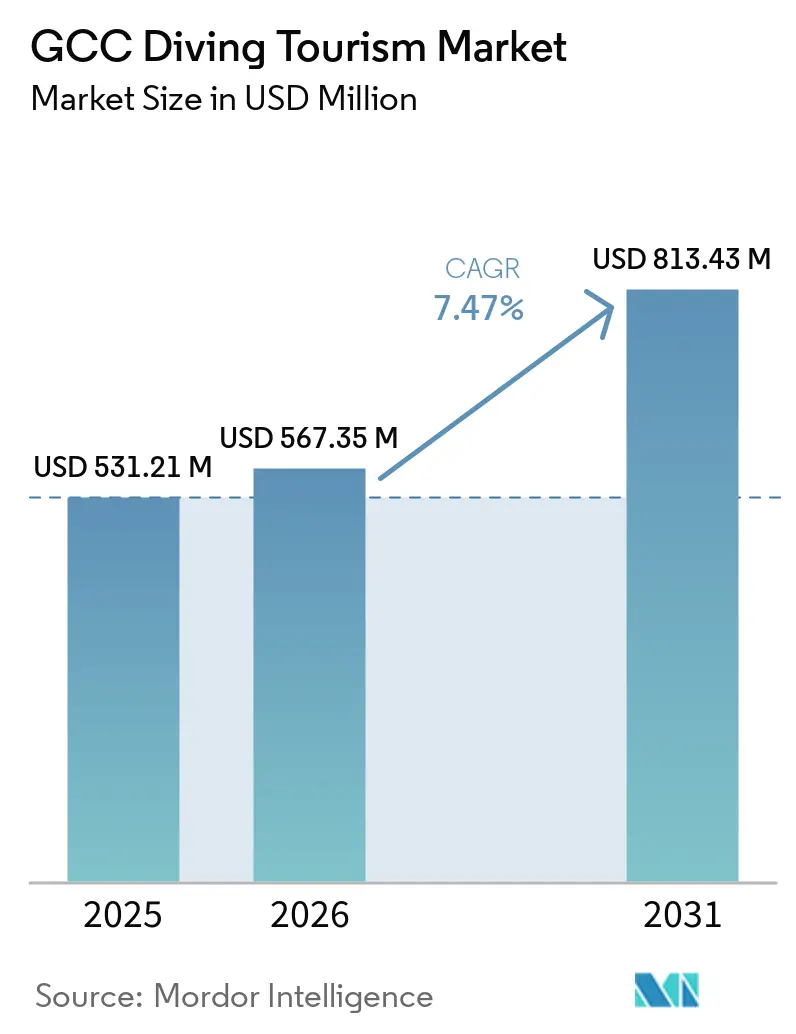
| Base Year Market Size (2025) | USD 531.21 Million |
| Market Size (2026) | USD 567.35 Million |
| Market Size (2031) | USD 813.43 Million |
| Growth Rate (2026 - 2031) | 7.47 % |
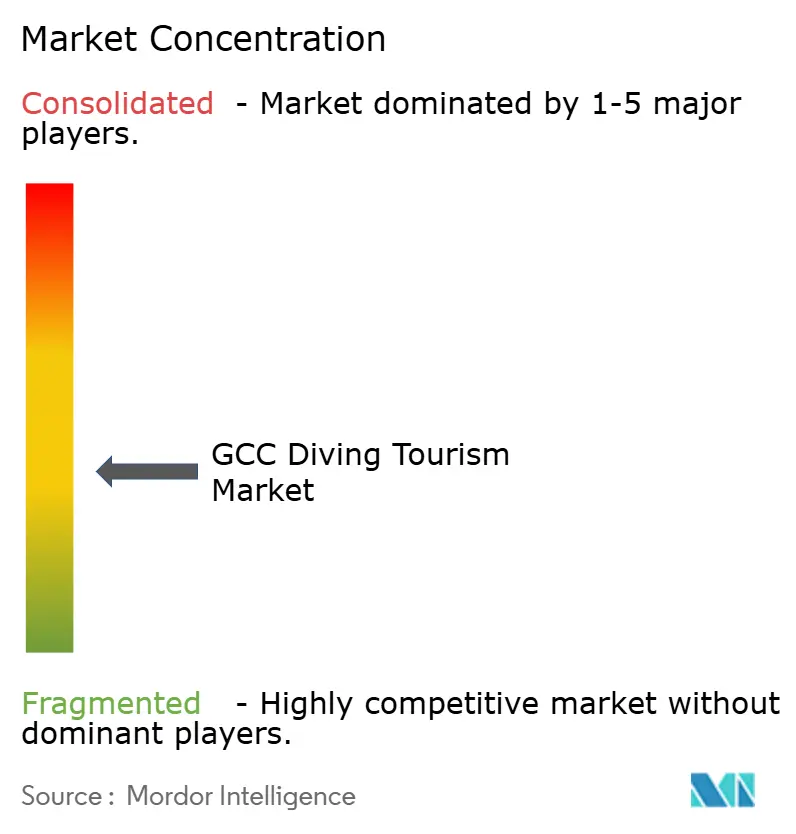
| Market Concentration | Low |
Major Players *Disclaimer: Major Players sorted in no particular order Image © Mordor Intelligence. Reuse requires attribution under CC BY 4.0. | |
GCC Diving Tourism Market Analysis by Mordor Intelligence
The GCC Diving Tourism Market was valued at USD 531.21 million in 2025 and estimated to grow from USD 567.35 million in 2026 to reach USD 813.43 million by 2031, at a CAGR of 7.47% during the forecast period (2026-2031). Growth is driven by tourism policies, coastal developments, and expanded marine leisure activities. Saudi Arabia plays a significant role due to its Red Sea coastline, featuring extensive reefs, low historical diver density, and government-backed tourism projects[1]Saudi Red Sea Authority, “Redefining the Sea Scene in Saudi Arabia,” Saudi Red Sea Authority, redefiningtheseascene.redsea.gov.sa. International travelers currently account for most spending, but domestic participation is increasing in several GCC countries. The fragmented competitive landscape provides opportunities for destination developers, certification-linked operators, and digital booking platforms to strengthen their positions through conservation efforts and underwater experiences. Pricing is influenced by site quality and uniqueness, particularly in Saudi Arabia and Oman, where lower historical diver traffic has helped maintain reef appeal compared to more crowded global dive destinations.
Key Report Takeaways
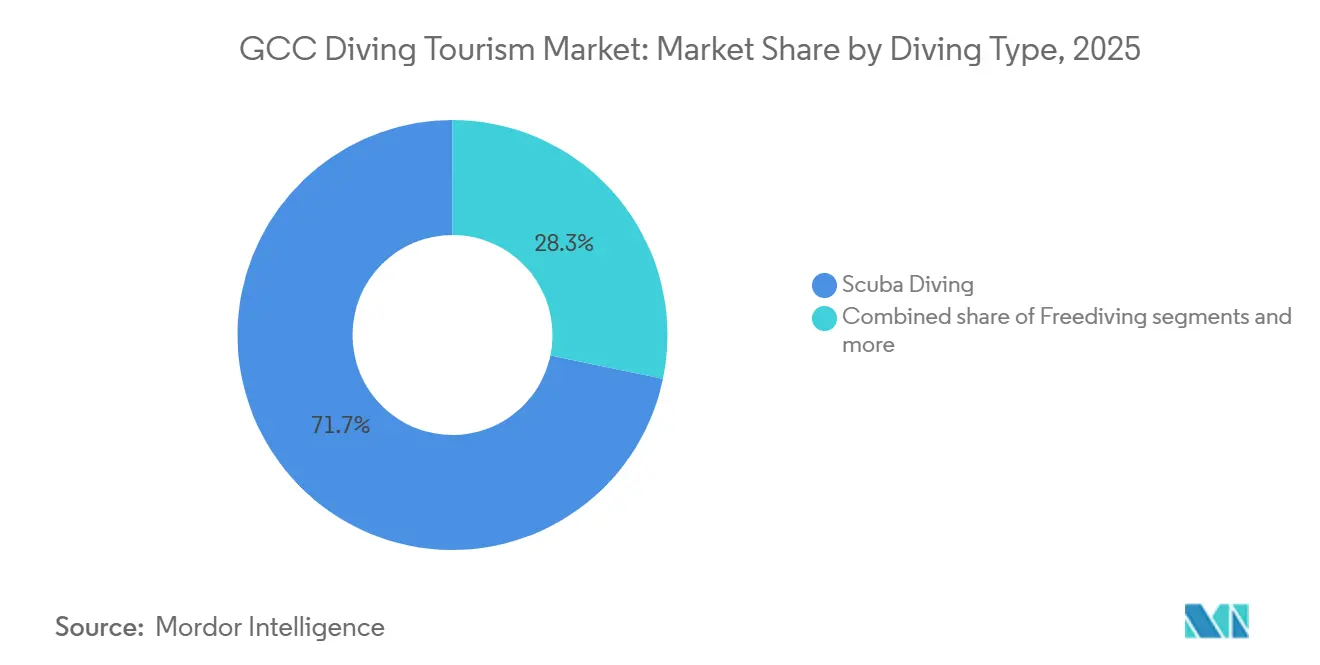
- By diving type, Scuba Diving commanded a 71.73% share of the GCC Diving Tourism Market in 2025, while Freediving is projected to grow at the highest CAGR of 7.85% in the GCC Diving Tourism Market by 2031.
- By revenue source, Dive Excursions & Guided Trips commanded a 40.45% share of the GCC Diving Tourism Market in 2025, while Dive Travel Packages are projected to grow at the highest CAGR of 7.93% in the GCC Diving Tourism Market by 2031.
- By tourist type, International Divers commanded a 65.51% share of the GCC Diving Tourism Market in 2025, while Domestic Divers are projected to grow at the highest CAGR of 8.12% in the GCC Diving Tourism Market by 2031.
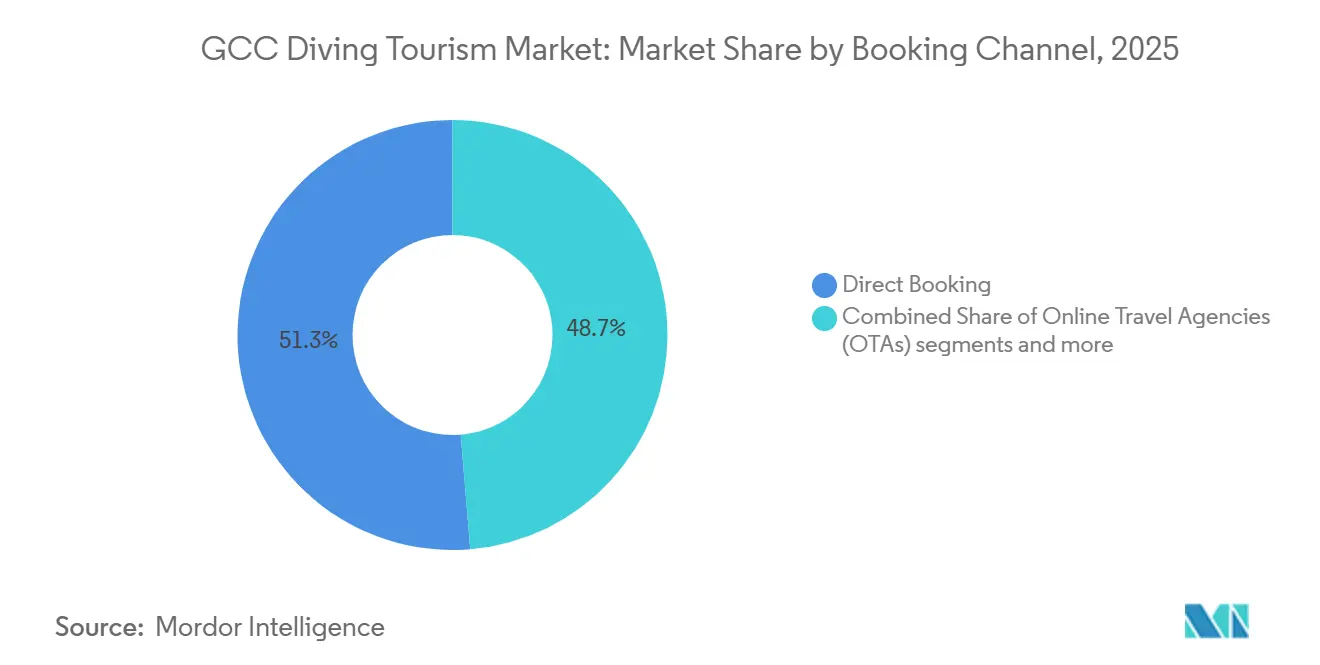
- By booking channel, Direct Booking commanded a 51.32% share of the GCC Diving Tourism Market in 2025, while Online Travel Agencies are projected to grow at the highest CAGR of 8.34% in the GCC Diving Tourism Market by 2031.
- By geography, the United Arab Emirates commanded a 33.56% share of the GCC Diving Tourism Market in 2025, while Saudi Arabia is projected to grow at the highest CAGR of 8.57% in the GCC Diving Tourism Market by 2031.
Note: Market size and forecast figures in this report are generated using Mordor Intelligence’s proprietary estimation framework, updated with the latest available data and insights as of January 2026.
GCC Diving Tourism Market Trends and Insights
Drivers Impact Analysis*
| Driver | (~) % Impact on CAGR Forecast | Geographic Relevance | Impact Timeline |
|---|---|---|---|
| Red Sea and Gulf of Oman Marine Asset Advantage | +1.8% | Saudi Arabia, Oman (core), United Arab Emirates east coast | Long term (≥ 4 years) |
| Tourism Liberalization and Visa Simplification Across GCC | +1.5% | Saudi Arabia (primary), United Arab Emirates, Qatar (secondary) | Short term (≤ 2 years) |
| Rising Demand for Experiential and Eco-Adventures | +1.2% | United Arab Emirates and Saudi Arabia as primary recipient markets | Medium term (2-4 years) |
| Growth of Women-Led and Inclusive Dive Programs | +0.6% | Saudi Arabia, United Arab Emirates, Kuwait | Medium term (2-4 years) |
| Expansion of Regenerative Tourism and Marine Conservation Brands | +0.7% | Saudi Arabia, Oman | Long term (≥ 4 years) |
| Digital Discovery, Booking, and Creator-Led Destination Marketing | +0.9% | United Arab Emirates as aggregator hub | Short term (≤ 2 years) |
| Source: Mordor Intelligence | |||
Red Sea and Gulf of Oman Marine Asset Advantage
The Red Sea serves as a key natural foundation for the GCC tourism market, supported by Saudi Arabia's extensive dive sites, coral reefs, diverse marine species, and sea turtle populations. The Gulf of Aqaba gained attention during the 2024 marine heat wave for its thermally resilient coral populations, which demonstrated better recovery potential after bleaching stress compared to other reef systems[2]Mongabay, “Even the Gulf of Aqaba’s ‘supercorals’ bleached during 2024 heat wave,” Mongabay, news.mongabay.com. Oman contributes to the market through Musandam, where operators promote encounters with marine species such as whale sharks, manta rays, and barracuda across multiple dive sites. Lower diver traffic at many reef sites in Saudi Arabia and Oman has helped maintain reef structures and visual quality, offering an alternative to more crowded locations. Saudi Arabia's Vision 2030 framework identifies Red Sea dive tourism, liveaboards, and freediving experiences at Farasan Island as focus areas for adventure tourism growth.
Tourism Liberalization and Visa Simplification Across GCC
The GCC diving tourism market benefits from improved cross-border access, driven by Saudi Arabia's simplified digital travel entry for more nationalities. The KSA Visa platform consolidates e-visa applications, processing, and approvals into a single digital system, expanding access to citizens of numerous countries. The planned Unified GCC Tourist Visa enhances multi-country itineraries, appealing to dive travelers who combine flights, coastal stays, and dive days across destinations. Saudi Arabia’s tourism policy changes have translated into increased visitor flows and spending, reflecting the effectiveness of these measures. Certified divers, who plan trips well in advance and spend more per trip than casual visitors, gain significantly from streamlined visa processes[3]Emerging Travel News, “Saudi Arabia tourism 2025 Vision 2030: hits 123mn tourists and $81bn spend,” Emerging Travel News, emergingtravel.news. This supports guided excursions, liveaboards, and bundled dive holidays, offering more value to the diving tourism market compared to low-value day tourism.
Rising Demand for Experiential and Eco-Adventures
The GCC diving tourism market is growing as demand shifts from basic diving to curated underwater experiences. PADI-affiliated dive centers have shown higher revenue and productivity compared to non-affiliated operators, highlighting the importance of brand trust and structured experiences alongside site quality. Deep Dive Dubai's Sunken City Walk, launched in September 2025, introduced underwater activities for non-certified visitors, connecting diving with the broader experience economy. PADI reported a significant increase in female participation, with women accounting for a notable share of global certifications in 2024, indicating a shift beyond the traditional male-dominated demographic. Liveaboard operators in the Saudi Red Sea are enhancing trips by adding reef-cleaning dives, coral observation protocols, and citizen-science activities, offering visitors more engaging and meaningful itineraries.
Growth of Women-Led and Inclusive Dive Programs
Women are emerging as a significant driver in the GCC diving tourism market, particularly in freediving and training. Arab women have shown notable growth in AIDA certifications across several Arab nations, with strong participation from the United Arab Emirates, Saudi Arabia, and Kuwait. DiveCampus in Dubai introduced the United Arab Emirates's first all-women PADI Instructor Development Course, advancing women into instructor and leadership roles. A milestone achievement by Ghaida Al-Hamad, who became the deepest-recorded Saudi woman with a Red Sea descent, has increased domestic visibility for advanced female participation. Operators are now treating women-focused training and instruction programs as consistent revenue-generating offerings, supporting stable demand throughout the year.
Restraints Impact Analysis*
| Restraint | (~) % Impact on CAGR Forecast | Geographic Relevance | Impact Timeline |
|---|---|---|---|
| High Cost of Certified Diving, Equipment, and Coastal Logistics | -1.2% | GCC-wide, most acute in Bahrain, Kuwait, Qatar | Short term (≤ 2 years) |
| Seasonality and Weather-Driven Visibility Fluctuations | -0.8% | Oman (southwest monsoon), Saudi Arabia (Shamal winds), Kuwait and Qatar (summer heat) | Medium term (2-4 years) |
| Reef Sensitivity, Conservation Limits, and Access Restrictions | -0.7% | Saudi Arabia, United Arab Emirates east coast, Oman | Long term (≥ 4 years) |
| Shortage of Deeply Localized Dive Infrastructure in Smaller GCC Markets | -0.6% | Qatar, Bahrain, Kuwait | Medium term (2-4 years) |
| Source: Mordor Intelligence | |||
High Cost of Certified Diving, Equipment, and Coastal Logistics
Entry-level diving remains costly in the GCC diving tourism market, limiting participation from first-time divers. Certification courses in the Red Sea region are priced higher compared to other regions, and liveaboard berths also add significant expenses[4]PADI Travel, “Scuba Diving Vacations, Middle East and Red Sea,” PADI Travel, travel.padi.com. Equipment rental and accessing remote sites such as the Farasan Islands or Al Hallaniyat further increase costs due to additional charges for transfers or charters. Operators in the GCC face challenges with training scale and cost structures, unlike regions such as Egypt or Thailand, where similar courses are more affordable. High trip costs are driven by factors including imported diving gear, limited regional distribution, and logistical challenges in remote coastal areas. This has shifted the focus of the market toward experienced divers rather than attracting entry-level participants.
Seasonality and Weather-Driven Visibility Fluctuations
Weather conditions limit operations in the GCC diving tourism market, even in high-potential coastal zones. Oman’s southwest monsoon reduces site accessibility and visibility at Arabian Sea-facing locations during upwelling periods. Saudi Arabia’s Red Sea experiences stronger Shamal winds, restricting embarkation flexibility for northern liveaboards. Extreme summer heat in Qatar and Kuwait raises sea surface temperatures, shortening the dive season. These factors narrow the booking window in several submarkets and make operators cautious about high fixed-cost investments, including purpose-built centers, technical gas facilities, and recompression infrastructure.
*Our forecasts treat driver/restraint impacts as directional, not additive. The impact forecasts reflect baseline growth, mix effects, and variable interactions.
Segment Analysis
By Diving Type: Scuba Diving's Dominance Masks a Freediving Inflection Point
Scuba Diving accounted for 71.73% of the GCC diving tourism market in 2025, driven by a strong training base, extensive equipment availability, and a network of PADI and SSI-certified dive centers. Established compressed air and Nitrox supply chains across all six GCC countries make scuba diving more scalable than niche categories. Red Sea Global’s Galaxea brand operates a PADI 5-Star Dive Center at Nujuma in the Al Wajh Lagoon, reflecting investments in in-house scuba infrastructure by destination operators. The segment attracts a broad customer base, including resort guests, club divers, certification seekers, and luxury liveaboard travelers. Although Technical Diving has a smaller volume, it holds commercial importance as rebreather, trimix, and deep-penetration divers spend 2 to 4 times more per day than recreational scuba customers.
Freediving is projected to grow at a 7.85% CAGR through 2031, making it the fastest-growing segment in the GCC diving tourism market. Its growth is linked to lower equipment requirements, lifestyle appeal, and increased participation from women and younger demographics. AIDA certifications among Arab women rose by 61% between 2023 and 2025, providing a measurable boost to the segment. Competitive events like the AIDA United Arab Emirates National Open Freediving Championship and Dubai’s Apnea Pirates have helped establish freediving as a structured activity. AIDA certification pathways support monetization by offering progression from beginner sessions to advanced training, extending beyond basic snorkeling or introductory ocean experiences.



By Revenue Source: Guided Excursions Lead, but Travel Packages Rewrite the Value Chain
Dive Excursions & Guided Trips accounted for 40.45% of the GCC diving tourism market size in 2025, highlighting the dominance of single-day and short-format experiences. This trend is evident in the United Arab Emirates, where expatriate residents, hotel guests, and weekend travelers drive demand for half-day and full-day trips. Dive Training & Certifications and Equipment Rental remain key secondary revenue streams, fostering repeat engagement and converting casual interest into recurring spending. PADI reported 220 new dive operations and over 100 store conversions across 47 countries in 2025, reflecting the sustained growth of organized training networks relevant to the GCC. Guided excursions are popular due to their ease of scheduling, straightforward sales, and accessibility for travelers seeking flexible options.
Dive Travel Packages are projected to grow at a 7.93% CAGR through 2031, attracting higher-value travelers. International divers often prefer comprehensive packages that include flights, accommodation, guided diving, and equipment, as regional logistics can be challenging for first-time visitors. A Saudi Red Sea liveaboard package generates 6 to 8 times the revenue of a single guided dive, making even small shifts toward packages impactful for revenue growth. AMAALA’s Phase One opening in 2025 introduced 6 resorts, a yacht club, a marine life institute, and a marina, designed to cater to this travel format. The SAR 51.04 billion investment in Phase One demonstrates the region’s focus on bundled marine travel rather than relying solely on local excursions.
By Booking Channel: Direct Booking's Majority Hides an OTA Acceleration
Direct booking accounted for 51.32% of the market share in 2025, reflecting strong relationships between repeat divers, instructors, and membership-based sales among established operators. Many United Arab Emirates dive centers rely on direct communication, club affiliations, and returning customers to maintain higher margins compared to third-party distribution. This model works well in areas with a loyal local base where customers are familiar with the destination, center, or instructor. However, specialized Online Travel Agencies (OTAs) are becoming increasingly relevant by aggregating verified dive inventories, enabling operator comparisons, and simplifying decisions for inbound travelers. PADI Travel’s recognition in the 2026 Scuba Diving Magazine Readers’ Choice awards highlights divers’ growing trust in specialist travel platforms.
OTAs are projected to grow at an 8.34% CAGR through 2031, making them the fastest-growing booking channel in the GCC diving tourism market. Their strength lies in destinations where travelers seek multi-stop itineraries, vessel comparisons, or verified package support. Tour operators and specialist travel agencies remain important for complex inbound itineraries, particularly in Saudi Arabia, where local permits, site access, and marine compliance require specialized handling. A 2025 dive industry study found that system support, trust signals, and standardized product presentation now play a greater role in booking conversions. The market is expected to shift toward a mix of channels, with OTAs attracting more first-time and long-haul customers, while direct bookings continue to serve repeat and locally anchored divers.
By Tourist Type: International Dominance Masked by Domestic Structural Momentum
International divers represented 65.51% of the GCC diving tourism market in 2025, highlighting the region's reliance on cross-border travel. Strong air connectivity supports this trend, with Dubai International Airport handling 92 million passengers in 2024 and Red Sea International Airport adding direct links to Gulf cities and Europe. Visitors from Europe, South Asia, and East Asia are drawn by high-quality reefs, lower crowd density, and emerging GCC marine destinations. The United Arab Emirates ranked first in Middle East and North Africa and 18th globally in the 2024 Travel and Tourism Development Index, reinforcing its role as a key tourism hub. International visitors remain the largest revenue source for the GCC diving tourism market, particularly in resort and package-driven segments.
Domestic divers are expected to grow at 8.12% CAGR through 2031, making them the fastest-growing segment in the GCC diving tourism market. Saudi Arabia’s social reforms, increased youth participation in adventure sports, and a growing resident diving community are driving this growth, aligning with VISION 2030. Domestic demand is less affected by long-haul marketing, air connectivity disruptions, and international seasonality. Smaller GCC markets like Bahrain, Qatar, and Kuwait can benefit from recurring business through resident divers, even with limited international tourism. This shift is expected to create a more balanced demand mix and reduce dependence on a narrow set of international markets.
Geography Analysis
The United Arab Emirates (UAE) held 33.56% of the GCC diving tourism market in 2025, making it the largest national market in the region. Its extensive tourism infrastructure supports both certified and non-certified divers through diverse entry, training, and experience options. Deep Dive Dubai, the world’s deepest pool at 60.02 meters, attracted over 100,000 visitors by 2024 and expanded access with the Sunken City Walk in September 2025. Fujairah and the east coast enhance open-water offerings with artificial reefs created from sunken vessels. Initiatives like Abu Dhabi’s Coral Gardens and the United Arab Emirates’s national tourism strategy provide long-term support for the market.
Saudi Arabia is projected to grow at an 8.57% CAGR through 2031, driven by Red Sea destination developments and a growing domestic adventure tourism base. Shura Island added three resorts in 2025, while ADRENA, launched in 2026, features a diving pool, snorkel trails, cliff diving, and a saltwater surf pool. AMAALA Phase One, opened in 2025, includes six resorts, a yacht club, and a marine life institute. Regulatory efforts by the Saudi Red Sea Authority and conservation initiatives by Red Sea Global align growth with ecological management.
Oman’s Musandam region offers a distinct marine profile, highlighted by the 2025 Musandam International Diving Festival, which featured PADI-certified training and reef conservation workshops. Bahrain focuses on heritage with pearl diving and the UNESCO-listed Pearling Path. Qatar emphasizes underwater heritage at Al Zubarah and rig-to-reef research, while Kuwait benefits from SSI-certified training programs. These markets diversify the GCC diving tourism landscape, reducing reliance on the United Arab Emirates and Saudi Arabia.
Competitive Landscape
The GCC diving tourism market is fragmented, with players including destination developers, dive brands, training operators, and independent dive centers. Red Sea Global maintains a strong position by controlling destination supply, resort integration, and the Galaxea underwater experience platform. In March 2026, the company introduced a science-based model aiming for 30% Net Conservation Gain by 2040, setting a high standard for smaller operators. Deep Dive Dubai also plays a significant role by attracting non-certified divers and connecting diving to Dubai’s broader experience economy. This diversity shows the market is shaped by a mix of destination-scale players and local dive businesses. Competition focuses on instructor quality, customer loyalty, local site knowledge, training partnerships, and combining diving with coastal leisure activities.
Future shifts are expected through stronger affiliations, broader distribution, and selective growth rather than dominance by a single operator. Saudi Arabia’s projects, such as AMAALA and Shura Island, demonstrate how integrated marine tourism platforms enhance competitiveness by combining accommodation, transport, and underwater experiences. Operators will differentiate through training credibility, experience design, and digital visibility, enabling local players to compete effectively despite pricing advantages held by larger brands.
GCC Diving Tourism Industry Leaders
Deep Dive Dubai
Al Boom Diving
Emperor Divers
SeaOman
Freestyle Divers
- *Disclaimer: Major Players sorted in no particular order

Recent Industry Developments
- September 2025: Deep Dive Dubai introduced the Sunken City Walk, a 4-meter underwater experience requiring no scuba certification. This initiative aligns with Dubai’s experience-economy strategy and its 9.88 million international visitors in H1 2025, highlighting the rising demand for non-certified underwater activities in the region.
- August 2025: The inaugural Musandam International Diving Festival took place in Khasab, Oman, from August 25 to 28, featuring PADI-certified training, coral reef conservation workshops, and a freediving competition. Attendance exceeded expectations, and organizers plan an expanded annual edition, positioning Oman as a structured dive destination beyond a niche coastal option.
- May 2025: Oman signed OMR 56 million (USD 145.6 million) in tourism agreements for projects near dive zones in Khasab, Nakhal, and Sur. Additionally, over USD 600 million was allocated for resorts and adventure parks, including Wadi Shab, strengthening dive tourism infrastructure and supporting regional marine tourism diversification.
- May 2025: UNESCO, Qatar Museums, Seashore, and Poseidon Dive Center launched “Dive Into Al Zubarah’s Past” at Qatar’s Al Zubarah Archaeological Site. This first-of-its-kind program integrated certified divers into underwater cultural heritage documentation and included workshops for 23 divers, enhancing Qatar’s heritage-linked marine tourism offerings.


GCC Diving Tourism Market Report Scope
| Scuba Diving |
| Freediving |
| Technical Diving |
| International Tourists |
| Domestic Tourists |
| Direct Booking |
| Online Travel Agencies (OTAs) |
| Dive Tour Operators & Travel Agencies |
| Dive Excursions & Guided Trips |
| Dive Training & Certifications |
| Equipment Rental |
| Dive Travel Packages |
| Saudi Arabia |
| United Arab Emirates |
| Oman |
| Qatar |
| Bahrain |
| Kuwait |
| By Diving Type | Scuba Diving |
| Freediving | |
| Technical Diving | |
| By Tourist Type | International Tourists |
| Domestic Tourists | |
| By Booking Channel | Direct Booking |
| Online Travel Agencies (OTAs) | |
| Dive Tour Operators & Travel Agencies | |
| By Revenue Source | Dive Excursions & Guided Trips |
| Dive Training & Certifications | |
| Equipment Rental | |
| Dive Travel Packages | |
| By Country | Saudi Arabia |
| United Arab Emirates | |
| Oman | |
| Qatar | |
| Bahrain | |
| Kuwait |


Key Questions Answered in the Report
What is the projected size of the GCC diving tourism market by 2031?
The GCC diving tourism market is projected to reach USD 813.43 million by 2031, up from USD 567.35 million in 2026, at a 7.5% CAGR over 2026-2031.
Which country leads regional demand for diving tourism in the GCC?
The United Arab Emirates led the region in 2025 with a 33.56% share, supported by strong tourism infrastructure, Deep Dive Dubai, and a broader range of entry-level and advanced diving products.
Which GCC country is growing the fastest for diving tourism?
Saudi Arabia is the fastest-growing national market, with an expected 8.57% CAGR through 2031, supported by Red Sea resort expansion, ADRENA, AMAALA, and stronger domestic adventure travel demand.
Which diving segment is growing the fastest in the GCC?
Free Diving is the fastest-growing diving type, with a projected 7.85% CAGR through 2031, helped by rising female participation, AIDA-led credentialing, and broader lifestyle appeal.
Why are travel packages gaining importance in GCC dive travel?
Dive Travel Packages are expected to grow at a 7.93% CAGR because many international divers prefer bundled flights, stays, equipment, and guided diving, especially for first-time GCC trips.
What is the main cost barrier for new divers in the region?
Entry costs remain high, with PADI Open Water certification priced at USD 350 to USD 500 and liveaboard rates on the Saudi Red Sea at USD 266 to USD 407 per day, which limits the first-time diver funnel.
Page last updated on:


 Your data is secure and never sold or shared.


