
Gallium-68 Market Size and Share
Market Overview
| Study Period | 2020 - 2031 |
|---|---|
| Market Size (2026) | USD 0.97 Billion |
| Market Size (2031) | USD 2.11 Billion |
| Growth Rate (2026 - 2031) | 16.59 % |
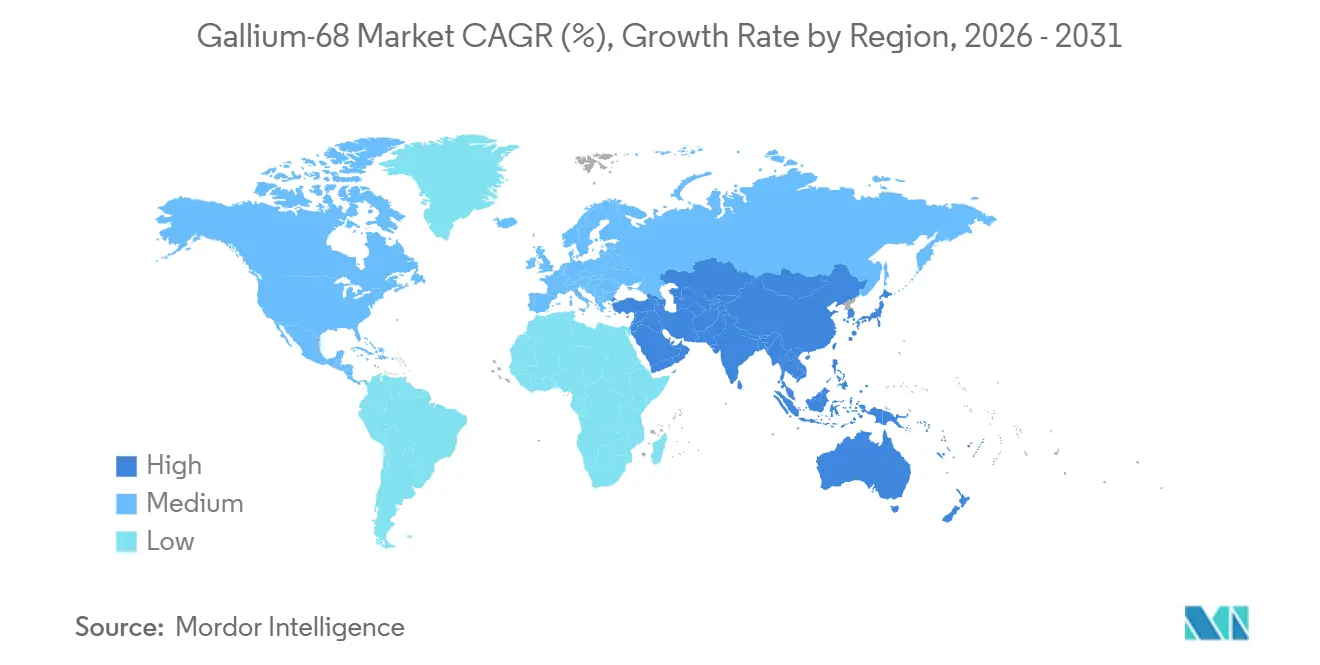
| Fastest Growing Market | Asia-Pacific |
| Largest Market | North America |
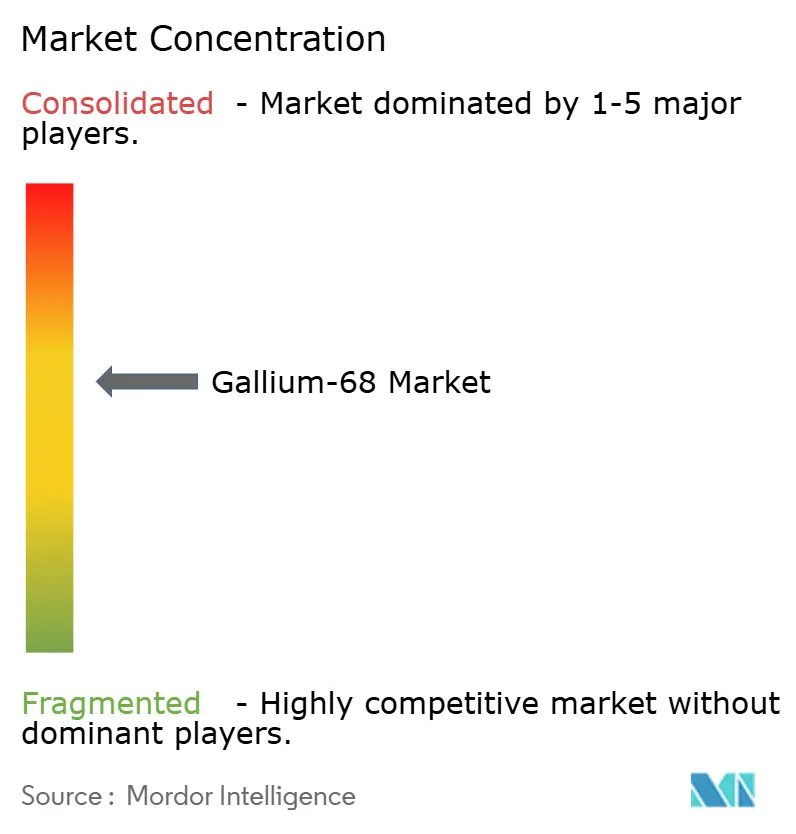
| Market Concentration | Medium |
Major Players *Disclaimer: Major Players sorted in no particular order Image © Mordor Intelligence. Reuse requires attribution under CC BY 4.0. | |
Gallium-68 Market Analysis by Mordor Intelligence
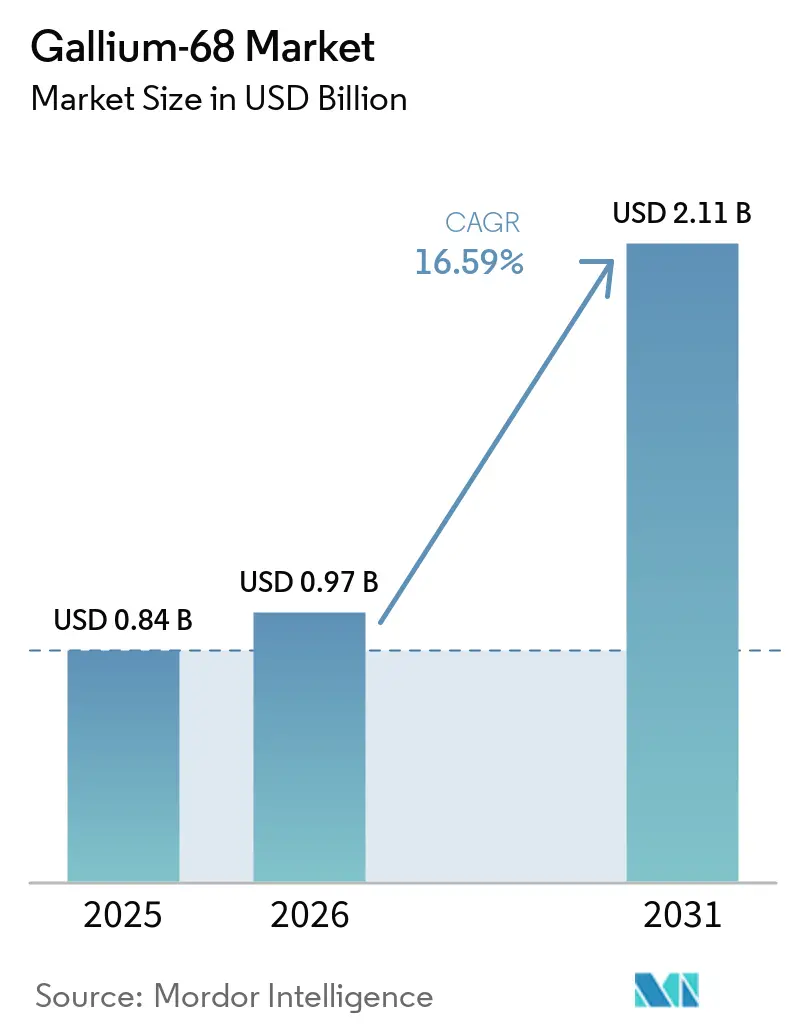
The Gallium-68 Market size is expected to grow from USD 0.84 billion in 2025 to USD 0.97 billion in 2026 and is forecast to reach USD 2.11 billion by 2031 at 16.59% CAGR over 2026-2031.
Strong clinical-guideline endorsements, rapid scaling of cyclotron production, and new tracer classes such as fibroblast activation protein (FAPI) imaging are driving sustained double-digit growth. Generator systems still dominate procurement budgets, yet radiopharmacy networks that deploy high-activity cyclotrons now deliver multi-dose batches that undercut generator cost curves and extend geographic reach. Competitive intensity is rising as F-18 PSMA agents, notably Lantheus’ Pylarify TruVu, leverage longer half-lives to penetrate satellite imaging centers. Meanwhile, higher-activity 100 mCi GalliaPharm generators approved in Europe and Japan double daily elutions and reduce ready-to-use intervals, strengthening the incumbent supplier base.
Key Report Takeaways
- By production route, generator-produced isotopes held 82.18% of the Gallium-68 market share in 2025, while cyclotron routes are projected to grow at an 18.76% CAGR to 2031.
- By product, PSMA-11 cold kits captured 44.38% revenue in 2025; ready-to-use patient doses are expected to expand at a 19.15% CAGR through 2031.
- By radiopharmaceutical/ indication, prostate-cancer imaging led with 61.39% of the Gallium-68 market size in 2025; FAPI imaging is forecast to post a 19.66% CAGR into 2031.
- By end user, hospitals and academic medical centers accounted for 58.59% demand in 2025, while centralized radiopharmacies record the fastest growth at 19.34% a year.
- By geography, North America contributed 48.19% revenue in 2025, whereas Asia-Pacific is the fastest-growing region, advancing at 21.65% through 2031.
Note: Market size and forecast figures in this report are generated using Mordor Intelligence’s proprietary estimation framework, updated with the latest available data and insights as of January 2026.
Market Trends and Insights
Drivers Impact Analysis of Gallium-68 Market*
| Driver | (~) % Impact on CAGR Forecast | Geographic Relevance | Impact Timeline |
|---|---|---|---|
| PSMA PET adoption accelerated by approvals and guideline endorsements | +4.2% | Global, led by North America, Europe, Japan | Short term (≤ 2 years) |
| Sustained demand from SSTR imaging in NETs (DOTATATE/DOTATOC) | +2.1% | Global, strong in Europe and North America | Medium term (2-4 years) |
| Greater availability of higher-activity Ga-68 generators expands access | +2.8% | North America, Europe, Asia-Pacific | Medium term (2-4 years) |
| Cyclotron-produced Ga-68 scaling augments supply capacity | +3.5% | North America core, expanding to Asia-Pacific | Medium term (2-4 years) |
| Emerging FAPI tracers broaden Ga-68 use across tumor types | +2.9% | Global, early adoption in Europe and North America | Long term (≥ 4 years) |
| Radiopharmacy network expansion enabling national Ga-68 kit labeling | +2.3% | North America, Australia, select European markets | Short term (≤ 2 years) |
| Source: Mordor Intelligence | |||
PSMA PET Adoption Accelerated by Approvals and Guideline Endorsements
Multiple 2025 regulatory milestones converted PSMA PET from optional to standard practice in staging and recurrence assessment. Telix’s Gozellix gained FDA clearance in March 2025 with a six-hour shelf life that lets radiopharmacies batch morning syntheses for afternoon scans, trimming labor costs 15-20%. NCCN Prostate Cancer Guidelines v1.2025 elevated PSMA PET to Category 1 evidence for high-risk disease, expanding eligible U.S. patients by roughly 40%[1]NCCN, “NCCN Clinical Practice Guidelines in Oncology: Prostate Cancer, Version 1.2025,” NCCN.ORG. Japan’s simultaneous approval of Locametz, GalliaPharm, and Pluvicto created a reimbursed theranostic pathway priced at JPY 550,000 (USD 3,700) per scan. China accepted the Illuccix NDA in January 2026 on the strength of a 94.8% positive-predictive study in more than 134,000 annual cases, setting the stage for a late-2026 launch. U.S. procedure volumes topped 350,000 in 2024, a 30% jump that underscores payer adoption.
Sustained Demand from SSTR Imaging in NETs
Ga-68 DOTATATE and DOTATOC maintain a stable revenue base because neuroendocrine tumor (NET) incidence continues to rise in aging populations and because Lu-177 DOTATATE therapy requires serial diagnostic scans before and during treatment. A 2025 Chinese comparative study confirmed that Ga-68 DOTATATE outperforms F-18 FDG for well-differentiated NET detection, reinforcing physician preference for somatostatin-receptor tracers[2]Jianwei Li, “Ga-68 DOTATATE Outperforms F-18 FDG in Well-Differentiated NETs,” Frontiers in Oncology, frontiersin.org. Longitudinal operating data from the University of Parma show roughly 610 DOTATOC batches through 2024, proving that SSTR use remains robust even as PSMA volumes surge. The isotope’s 68-minute half-life aligns with somatostatin analog pharmacokinetics, yielding high lesion-to-background ratios within an hour of injection. That clinical efficiency anchors shipments when PSMA supply is disrupted, cushioning overall market revenue during competitive cycles.
Greater Availability of Higher-Activity Generators Expands Access
Eckert & Ziegler’s 100 mCi GalliaPharm generator, cleared in the European Economic Area in August 2024 and in Japan in September 2025, more than triples daily elutions compared with legacy 50 mCi units and cuts the ready-to-use interval to under one hour. Validation at the University of Michigan confirmed that Locametz kits tolerate up to 3.16 GBq per synthesis, enabling four to five patient doses per run and reducing reagent cost 20-25%. Sichuan University’s TiO₂ column produced 3.26 GBq with 79.8% efficiency, indicating that academic labs are pushing generator ceilings and decreasing reliance on imported cores. Higher activity extends reach: a single 100 mCi generator can serve several satellite hospitals via courier, lowering capital outlays for facilities that lack a cyclotron. These improvements maintain generator relevance even as cyclotron supply ramps.
Cyclotron-Produced Ga-68 Scaling Augments Supply Capacity
ARTMS Quantitative Isotope Separation (QIS) technology yields up to 5,000 mCi from a two-hour liquid Zn-68 irradiation, roughly 60-times a single generator elution, letting radiopharmacies batch 40-50 patient doses overnight. Cardinal Health has integrated QIS at more than 110 licensed sites, enabling next-day delivery within 200 miles and removing the need for hospitals to manage generators or hot-lab staff. University of Michigan analytics show cyclotron-produced Ga-68 meets FDA and European Pharmacopoeia specifications across PSMA-11, DOTATOC, and FAPI kits, dispelling earlier purity concerns. Jubilant Radiopharma is adding five IBA Cyclone KIUBE 180 units, signaling that mid-tier chains see value in dual-isotope lines that co-produce FDG and Ga-68 at scale. This bulk activity buffers the Gallium-68 supply chain against Ge-68 shortages and supports national distribution strategies that mirror FDG logistics.
Restraints Impact Analysis of Gallium-68 Market*
| Restraint | (~) % Impact on CAGR Forecast | Geographic Relevance | Impact Timeline |
|---|---|---|---|
| Competition from F-18 PSMA agents with wider distribution | -3.1% | North America, Europe | Short term (≤ 2 years) |
| Short half-life and generator logistics/QC constraints | -1.8% | Global, acute in regions lacking radiopharmacy networks | Medium term (2-4 years) |
| Concentrated Ge-68 supply and cost pressures | -1.4% | Global | Medium term (2-4 years) |
| GMP/aseptic and QC complexity for Ga-68 kit labeling | -1.2% | Global, higher impact in emerging markets | Long term (≥ 4 years) |
| Source: Mordor Intelligence | |||
Competition from F-18 PSMA Agents with Wider Distribution
Lantheus’ Pylarify TruVu, approved in March 2026, exploits F-18’s 110-minute half-life to supply imaging centers up to 500 miles away, creating a structural cost and reach advantage over Ga-68 kits. U.S. uptake exceeded 760,000 scans by 2024, and larger 20-dose syntheses lower per-patient costs roughly 25-30%. Installed F-18 cyclotrons already outnumber Ga-68 generators four-to-one, letting hospitals add PSMA labeling with little incremental capital[3]FDA, “Drug Approval Package: Locametz,” FDA.GOV. Switzerland’s 2025 approval of Pylclari signals a pending wave of European entrants. As more F-18 competitors secure reimbursement, Ga-68 conversion in rural areas may plateau near 60-70% of the PSMA opportunity.
Short Half-Life and Generator Logistics/Quality-Control Constraints
Ga-68’s 68-minute half-life compresses the window for elution, labeling, QC testing, and injection to about six hours, capping feasible courier radii at roughly 200 miles, whereas F-18’s 110-minute half-life supports 500-mile routes. Quality-control steps, pH, radionuclidic purity, Ge-68 breakthrough, and sterility, consume 30-45 minutes, shortening the imaging window if patient flow is delayed. Generator activity decays daily; a 100 mCi unit yields near 80 mCi on day 1 but only 40 mCi by day 7, forcing tight scheduling to avoid isotope wastage. Rural sites without a local radiopharmacy cannot rely on same-day delivery, leaving them dependent on F-18 agents or foregoing advanced imaging.
*Our forecasts treat driver/restraint impacts as directional, not additive. The impact forecasts reflect baseline growth, mix effects, and variable interactions.
Gallium-68 Market Segment Analysis
By Production Route:
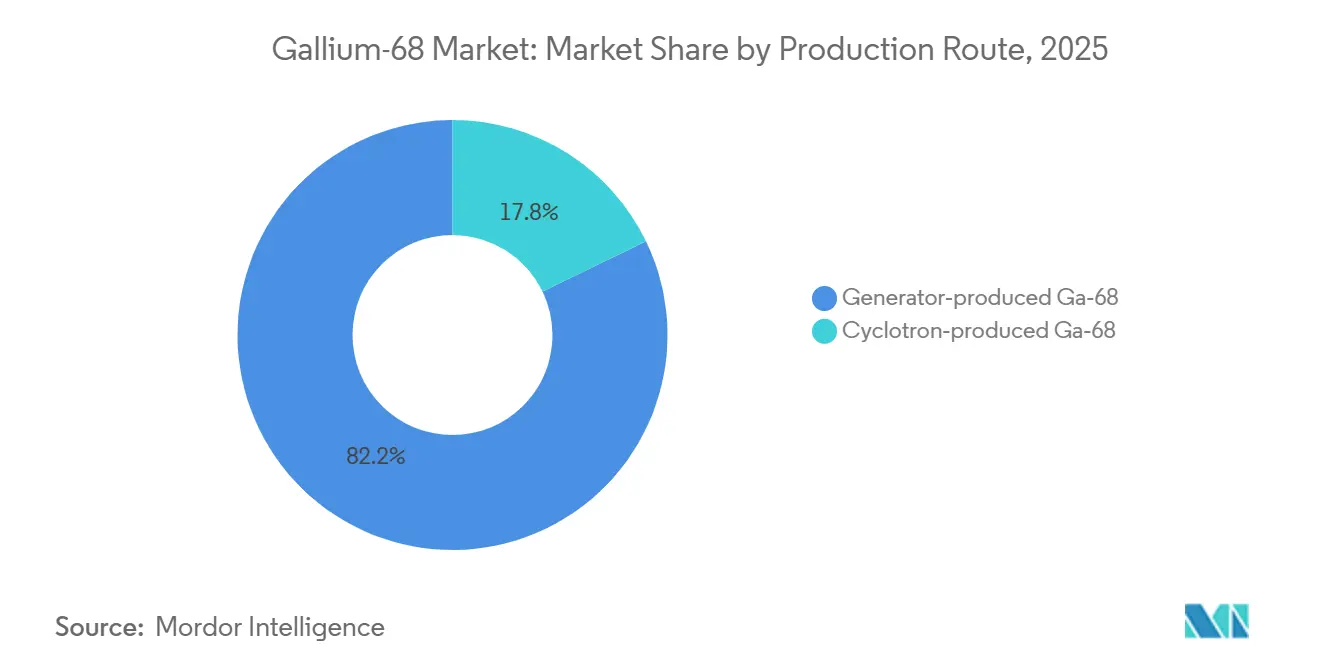
Cyclotron Gains Share Despite Generator DominanceGenerator-based supply retained 82.18% of the Gallium-68 market in 2025, but cyclotron activity is rising at an 18.76% CAGR as networks deploy ARTMS QIS and IBA Cyclone platforms capable of over 5,000 mCi per two-hour run. That scale supports 40-50 patient doses, driving down per-dose costs and expanding the practical service radius to 200 miles. Generator lines still suit academic centers managing 2-4 daily scans; the recently approved 100 mCi GalliaPharm unit lifts daily elutions from three to ten, preserving relevance where on-site throughput matters. Sichuan University’s 3.26 GBq TiO₂ generator prototype shows that academic R&D continues to push generator ceilings.
The cyclotron build-out also diversifies supply risk that once hinged on three German-designed generator brands, a vulnerability exposed by Eckert & Ziegler’s 2025 cyberattack. Radiopharmacies view dual-isotope production as a hedge: a single facility can mint both FDG and Ga-68 doses, amortizing capital faster than single-nuclide sites. Hospitals, meanwhile, gain flexibility, generators for low-volume days, cyclotron deliveries for peak PSMA clinics, without breaching radiation licensing caps. Overall, increasing route optionality underpins resilience in the Gallium-68 market.


By Product:
Ready-to-Use Doses Gain as Radiopharmacies Absorb LabelingPSMA-11 cold kits accounted for 44.38% of 2025 revenue, but the shipment of radiopharmacy-prepared doses is escalating 19.15% annually as facilities outsource labeling to specialized compounders. Telix’s purchase of RLS added 31 pharmacies and vertically integrated everything from eluate to courier van, capturing both kit and service margin. Six-hour shelf-life Gozellix further supports morning synthesis for afternoon deliveries, smoothing courier logistics across multi-state regions. In contrast, hospitals that keep generators in-house shoulder USP 825/797 sterility workflows, daily Ge-68 breakthrough checks, and media-fill validations, burdens that radiopharmacies spread across high volume.
SSTR cold kits for neuroendocrine tumors remain a resilient niche; NETSPOT and DOTATOC enjoy stable reimbursement and continue to anchor demand where PSMA volumes have yet to dominate. The near-term pipeline suggests a similar adoption curve for FAPI kits: academic hospitals will label in-house through Phase III trials, then migrate to outsourced doses once payers codify procedure codes. This gradual pivot toward service-based delivery reinforces the service revenue stream inside the Gallium-68 market.
By Radiopharmaceutical / Indication:
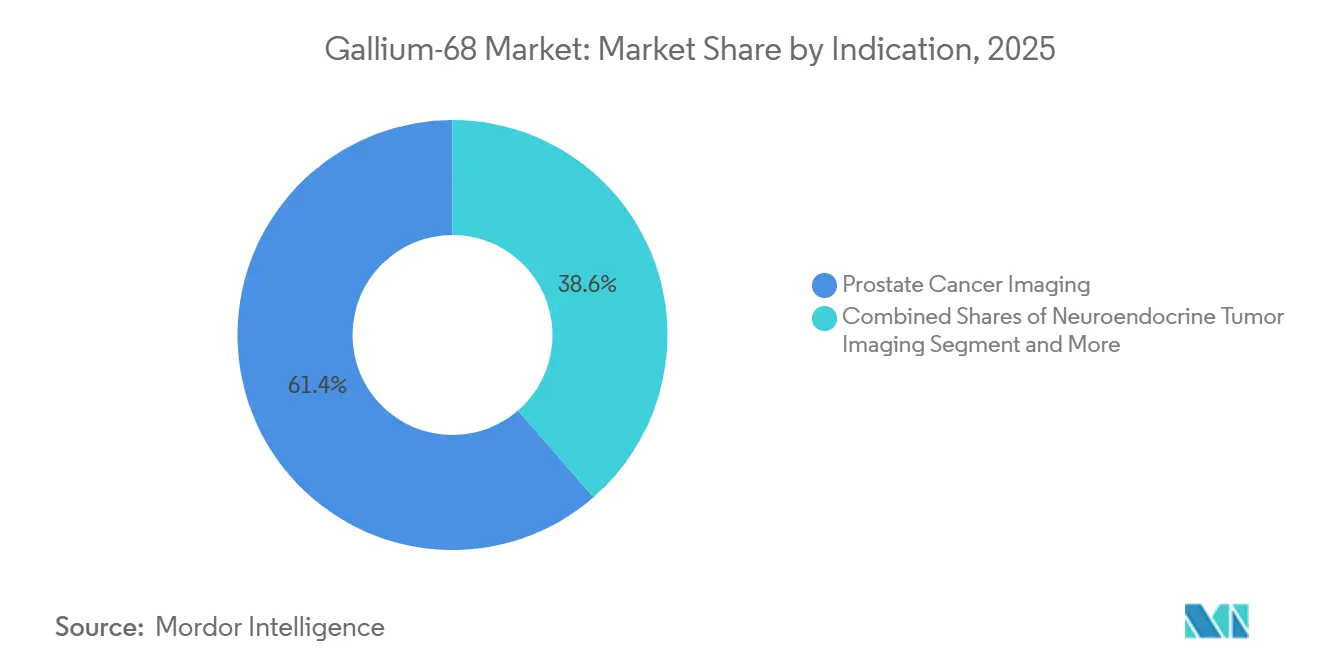
PSMA Leads, FAPI SurgesProstate-cancer imaging commanded 61.39% of the Gallium-68 market share in 2025 on the back of more than 350,000 U.S. scans and NCCN Category 1 endorsement for high-risk staging and low-PSA recurrence. Japan’s reimbursement listing at JPY 550,000 (USD 3,700) per procedure and China’s NDA acceptance promise to lift regional volumes in 2026–2027. Neuroendocrine-tumor imaging remains a dependable second line; Ga-68 DOTATATE outperformed FDG for well-differentiated lesions in a 2025 Chinese study, preserving physician loyalty.
FAPI imaging is on a 19.66% CAGR trajectory as Phase I/II data across 500-plus patients show positive-predictive values above 90% in pancreatic, breast and sarcoma cohorts. SOFIE’s licensing of FAPI-46 and FAPI-74 and Philogen’s OncoFAP results (SUVmax ≈ 9.4) position first movers for 2027 submissions. Pan-cancer flexibility lets radiopharmacies run PSMA, SSTR and FAPI from one generator cycle, improving labor utilization and diluting inventory risk.

By End User:
Radiopharmacies Capture Outsourcing WaveHospitals and academic centers generated 58.59% of 2025 demand, reflecting legacy generator ownership and established hot-lab teams. Yet centralized radiopharmacies recorded 19.34% annual growth after Telix bought RLS’s 31 sites and Siemens Healthineers folded 60 PETNET locations into its modality business, creating a combined footprint exceeding 190 facilities with Ga-68 licenses. These hubs amortize USP 825/797 sterility protocols and FDA 21 CFR 212 compliance across hundreds of daily doses, bringing per-scan costs down 15-20% for community hospitals that cannot justify ISO Class 5 clean-rooms.
As bulk cyclotron supply and six-hour shelf-life kits broaden 200-mile courier zones, smaller imaging centers increasingly opt for delivered doses rather than managing Ge-68 breakthrough testing on site. The Gallium-68 market is expected to grow in North America and Australia where network density already supports same-day fulfillment. Europe and parts of Asia will shift more gradually because reimbursement still favors on-site preparation, but tightening EMA Annex 3 GMP rules should accelerate outsourcing mid-forecast.
Geography Analysis
North America Gallium-68 Market
North America generated 48.19% of 2025 revenue as hospitals executed more than 350,000 PSMA PET scans and as the NCCN upgrade boosted guideline-driven demand. Telix strengthened vertical control by acquiring RLS Radiopharmacy Solutions, adding 31 sites that synchronize generator elution, cyclotron output, and last-mile couriers. Cardinal Health operates more than 130 nuclear pharmacies, 110 of which hold Ga-68 licenses, underpinning same-day delivery across most U.S. metropolitan clusters. Canada added Locametz in 2023, while Mexico’s PET/CT fleet exceeded 50 cameras by 2025, although limited radiopharmacy density tempers penetration outside primary cities. Lantheus’ Pylarify TruVu approval now provides an F-18 alternative that may capture rural demand where Gallium-68 logistics remain challenging.
APAC Gallium-68 Market
Asia-Pacific advances at a 21.65% CAGR as Japan approved Locametz, Pluvicto, and 100 mCi generators in September 2025 and set reimbursement at JPY 550,000 (USD 3,700) per scan across 108 hospitals. China’s NMPA accepted the Illuccix NDA in January 2026, backed by a pivotal trial showing 94.8% positive predictive value in over 134,000 annual prostate-cancer cases, and the country’s PET/CT install base passed 1,600 cameras in 2025, positioning it for rapid uptake.
Europe, Middle East and South America Gallium-68 Market
Europe retains a generator-centric model anchored by university hospitals; Eckert & Ziegler’s 100 mCi GalliaPharm approval doubled daily elutions and mitigated backlog risk after its 2025 cyberattack disrupted shipments for several weeks. Although GCC states and Brazil invest in PET infrastructure, limited radiopharmacy networks restrict Gallium-68 to urban hubs; in these regions, F-18’s longer half-life currently offers broader coverage.

Competitive Landscape
The Gallium-68 sector is moderately concentrated: three generator manufacturers and five cold-kit suppliers together account for a significant share of 2025 revenue, giving them scale advantages while leaving room for tracer innovators. Telix has executed a dual-integration play, first acquiring ARTMS to secure high-activity cyclotron technology, then buying RLS to control retail radiopharmacies, creating an end-to-end chain from isotope production to courier delivery. Siemens Healthineers followed suit by purchasing PETNET and ADACAP, aligning radiopharmacy services with its PET/CT scanner pipeline and deepening customer lock-in across hardware and consumables.
Technology capability now defines competitive edge. The ARTMS QIS platform delivers 5,000 mCi per irradiation, letting Cardinal Health bottle 40-50 patient doses in one run, driving unit costs below USD 900 per PSMA scan in high-volume states. Eckert & Ziegler’s 2025 cyberattack exposed single-source risk and accelerated IRE ELiT’s decision to bring Ge-68 production in-house via a 30 MeV cyclotron partnership with IBA, illustrating that supply-chain resilience can influence purchasing contracts. SOFIE and Philogen, both licensing first-in-class FAPI tracers, could disrupt incumbents by unlocking multi-cancer workflows that raise consumables pull-through per generator set.
Gallium-68 Industry Leaders
Siemens Healthineers
Cardinal Health
Eckert & Ziegler Radiopharma GmbH
GE HealthCare
SOFIE Biosciences
- *Disclaimer: Major Players sorted in no particular order
Gallium-68 Market Companies Covered in this Report
- ABX advanced biochemical compounds GmbH
- ARTMS
- Cardinal Health
- COMECER
- Curium Pharma
- Eckert & Ziegler Radiopharma GmbH
- Elysia‑Raytest
- GE Healthcare
- IBA Radiopharma Solutions
- IRE ELiT
- Isologic Radiopharm
- Isotope Technologies Garching
- Jubilant Radiopharma
- NovartisAG
- PharmaLogic
- RLS Radiopharmacies
- SCINTOMICS
- Siemens Healthineers
- SOFIE Biosciences
- Telix Pharmaceuticals Limited

Recent Industry Developments in Gallium-68 Market
- April 2026: Telix Pharmaceuticals Limited announced that safety and tolerability data from the ProstACT Global Phase 3 study (Part 1) will be presented as a late-breaking oral presentation at the 2026 American Society of Clinical Oncology (ASCO) Annual Meeting. Eligible patients must have confirmed progressive mCRPC assessed with the 68Ga-PSMA-11 PET imaging agent, such as Illuccix or Gozellix (kits for preparing gallium-68 (68Ga) gozetotide injection), following prior treatment with one androgen receptor pathway inhibitor (ARPI).
- January 2026: China’s NMPA accepted Telix’s Illuccix NDA following a 94.8% positive-predictive Phase III study across 134,000 incident cases.
- December 2025: Telix and Varian, a Siemens Healthineers company announced a strategic collaboration to integrate Ga-68 imaging (Illuccix/Gozellix) with External Beam Radiation Therapy (EBRT).


Global Gallium-68 Market Report Scope
As per the scope of the report, gallium-68 is ideally suited for diagnostic procedures involving low-molecular-weight radiopharmaceuticals, such as peptides and small organic molecules, which exhibit fast target localization and blood clearance.
The gallium-68 market is segmented by production rate, product, radiopharmaceutical/indication, end users, and geography. Based on production rate, the market is segmented into generator‑produced Ga‑68, and cyclotron‑produced Ga‑68. By product, the market is segmented into Ge‑68/Ga‑68 generators, PSMA‑11 cold kits (Ga‑68 gozetotide), SSTR cold kits (Ga‑68 DOTATATE/DOTATOC), and ready‑to‑use patient doses (radiopharmacy prepared). By radiopharmaceutical/indication, the market is segmented into prostate cancer imaging (Ga‑68 PSMA‑11), neuroendocrine tumor imaging (Ga‑68 SSTR), and fibroblast activation protein imaging (Ga‑68 FAPI). By end users, the market is segmented into hospitals & academic medical centers, independent imaging centers, and centralized radiopharmacies. By geography, the market is segmented into North America, Europe, Asia-Pacific, the Middle East & Africa, and South America. The market report also covers the estimated market sizes and trends for 17 countries across major regions globally. For each segment, the market size and forecast are provided in terms of value (USD).
| Generator‑produced Ga‑68 |
| Cyclotron‑produced Ga‑68 |
| Ge‑68/Ga‑68 Generators |
| PSMA‑11 Cold Kits (Ga‑68 gozetotide) |
| SSTR Cold Kits (Ga‑68 DOTATATE/DOTATOC) |
| Ready‑to‑use Patient Doses (radiopharmacy prepared) |
| Prostate Cancer Imaging (Ga‑68 PSMA‑11) |
| Neuroendocrine Tumor Imaging (Ga‑68 SSTR) |
| Fibroblast Activation Protein Imaging (Ga‑68 FAPI) |
| Hospitals & Academic Medical Centers |
| Independent Imaging Centers |
| Centralized Radiopharmacies |
| North America | United States |
| Canada | |
| Mexico | |
| Europe | Germany |
| United Kingdom | |
| France | |
| Italy | |
| Spain | |
| Rest of Europe | |
| Asia-Pacific | China |
| India | |
| Japan | |
| South Korea | |
| Australia | |
| Rest of Asia-Pacific | |
| Middle East and Africa | GCC |
| South Africa | |
| Rest of Middle East and Africa | |
| South America | Brazil |
| Argentina | |
| Rest of South America |
| By Production Route | Generator‑produced Ga‑68 | |
| Cyclotron‑produced Ga‑68 | ||
| By Product | Ge‑68/Ga‑68 Generators | |
| PSMA‑11 Cold Kits (Ga‑68 gozetotide) | ||
| SSTR Cold Kits (Ga‑68 DOTATATE/DOTATOC) | ||
| Ready‑to‑use Patient Doses (radiopharmacy prepared) | ||
| By Radiopharmaceutical / Indication | Prostate Cancer Imaging (Ga‑68 PSMA‑11) | |
| Neuroendocrine Tumor Imaging (Ga‑68 SSTR) | ||
| Fibroblast Activation Protein Imaging (Ga‑68 FAPI) | ||
| By End User | Hospitals & Academic Medical Centers | |
| Independent Imaging Centers | ||
| Centralized Radiopharmacies | ||
| By Geography | North America | United States |
| Canada | ||
| Mexico | ||
| Europe | Germany | |
| United Kingdom | ||
| France | ||
| Italy | ||
| Spain | ||
| Rest of Europe | ||
| Asia-Pacific | China | |
| India | ||
| Japan | ||
| South Korea | ||
| Australia | ||
| Rest of Asia-Pacific | ||
| Middle East and Africa | GCC | |
| South Africa | ||
| Rest of Middle East and Africa | ||
| South America | Brazil | |
| Argentina | ||
| Rest of South America | ||


Key Questions Answered in the Report
How large is the Gallium-68 market in 2026?
The Gallium-68 market size is USD 1.0 billion in 2026 and is projected to reach USD 2.1 billion by 2031, implying a 16.6% CAGR over the forecast period .
Which production route is growing fastest?
Cyclotron-produced Ga-68 is expanding at an 18.76% CAGR because multi-GBq runs reduce per-dose costs and support regional distribution.
What share do generator systems hold today?
Generator-produced isotopes accounted for 82.18% of Gallium-68 market share in 2025, although their dominance is gradually eroding.
Why are radiopharmacies gaining importance?
Centralized radiopharmacies absorb USP 825 compliance, offer ready-to-use doses, and recorded 19.34% annual growth as hospitals outsource labeling.
Page last updated on:





