
Functional Tea Market Size and Share
Market Overview
| Study Period | 2022 - 2032 |
|---|---|
| Market Size (2027) | USD 9.19 Billion |
| Market Size (2032) | USD 12.70 Billion |
| Fastest Growing Market | Middle East and Africa |
| Largest Market | Asia-Pacific |
| Market Concentration | Low |
Major Players *Disclaimer: Major Players sorted in no particular order Image © Mordor Intelligence. Reuse requires attribution under CC BY 4.0. | |
Functional Tea Market Analysis by Mordor Intelligence
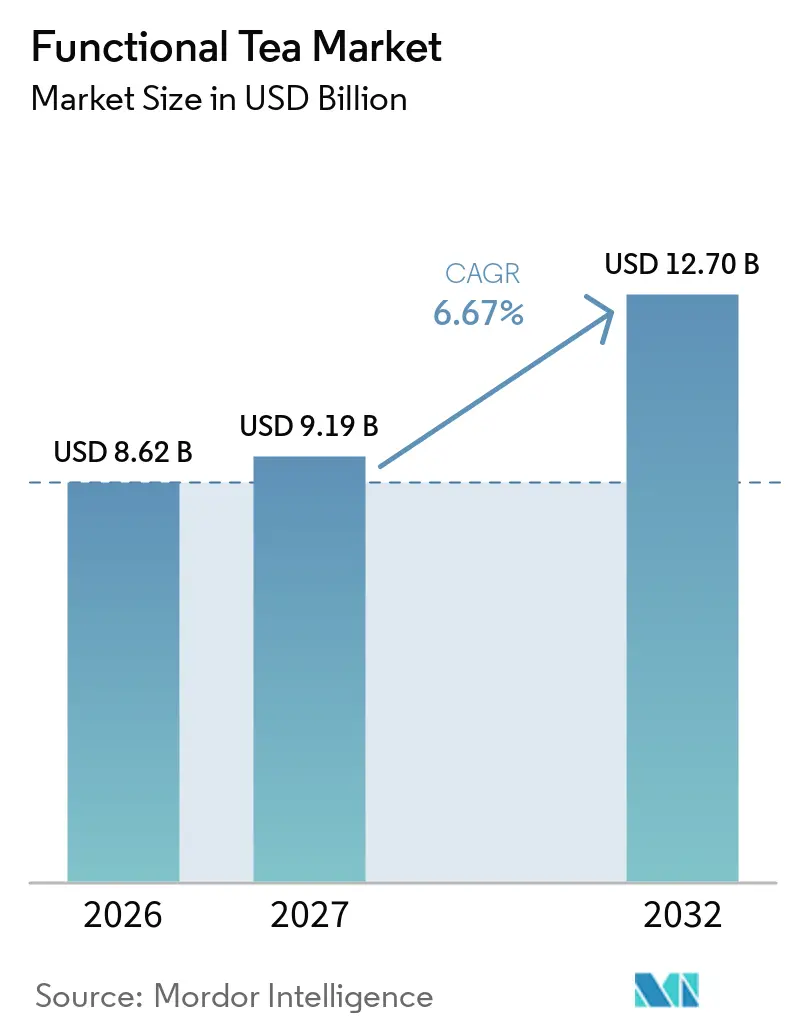
The Functional Tea Market size is expected to increase from USD 8.62 billion in 2026 to USD 9.19 billion in 2027 and reach USD 12.70 billion by 2032, growing at a CAGR of 6.67% over 2027-2032. Consumers increasingly choose daily beverages that address immunity, digestion, sleep, stress, and focus, rather than choosing tea only for refreshment. The functional tea market benefits from tea's established role in routine consumption and from its naturally low-calorie profile. Tea also contains flavan-3-ols, which the Tea Council of the USA identifies as being present in tea at higher concentrations than in other food and beverage sources. This combination gives brands a practical base for benefit-led innovation, although claims need to remain consistent with local food labeling rules. The functional tea market also faces pressure from higher botanical costs, stricter claim requirements, and price differences from conventional tea, which favor companies with clear formulations, established sourcing, and broad retail access.
Key Report Takeaways
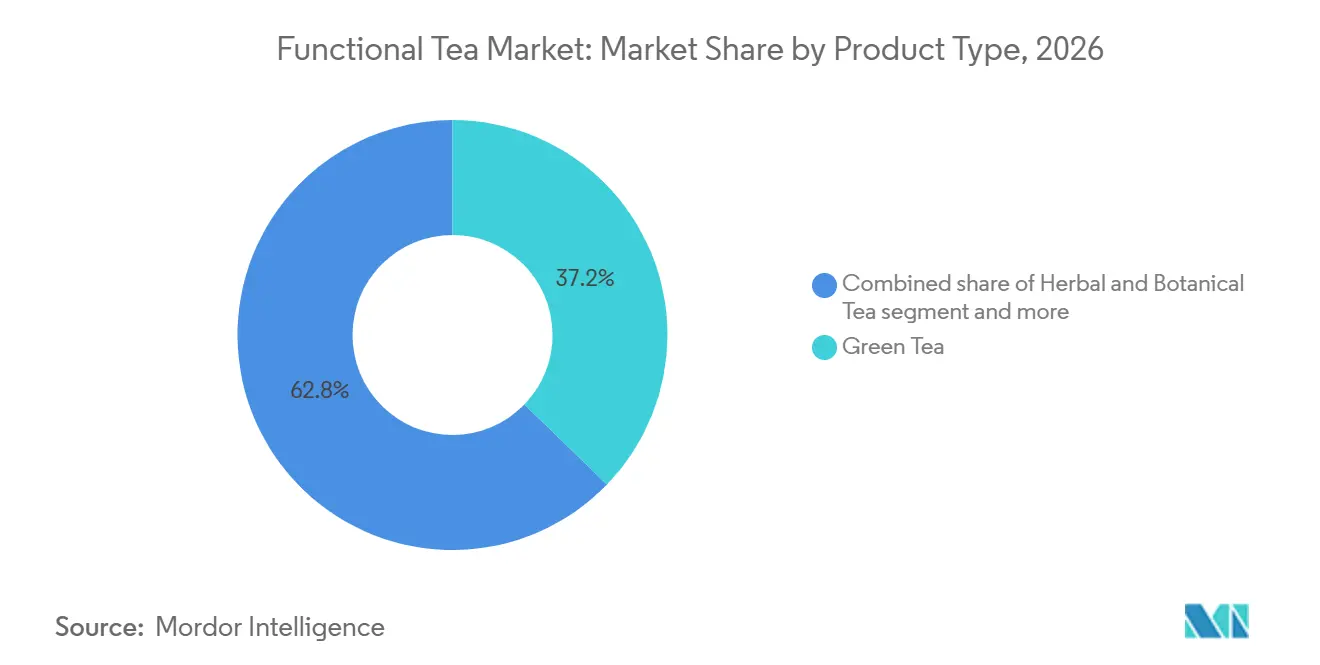
- By product type, green tea held 37.23% of the functional tea market share in 2026, while herbal and botanical tea are projected to grow at a CAGR of 7.57% through 2032.
- By functional benefit, immunity support accounted for 26.28% of the functional tea market size in 2026, while detoxification is forecast to advance at a CAGR of 7.83% through 2032.
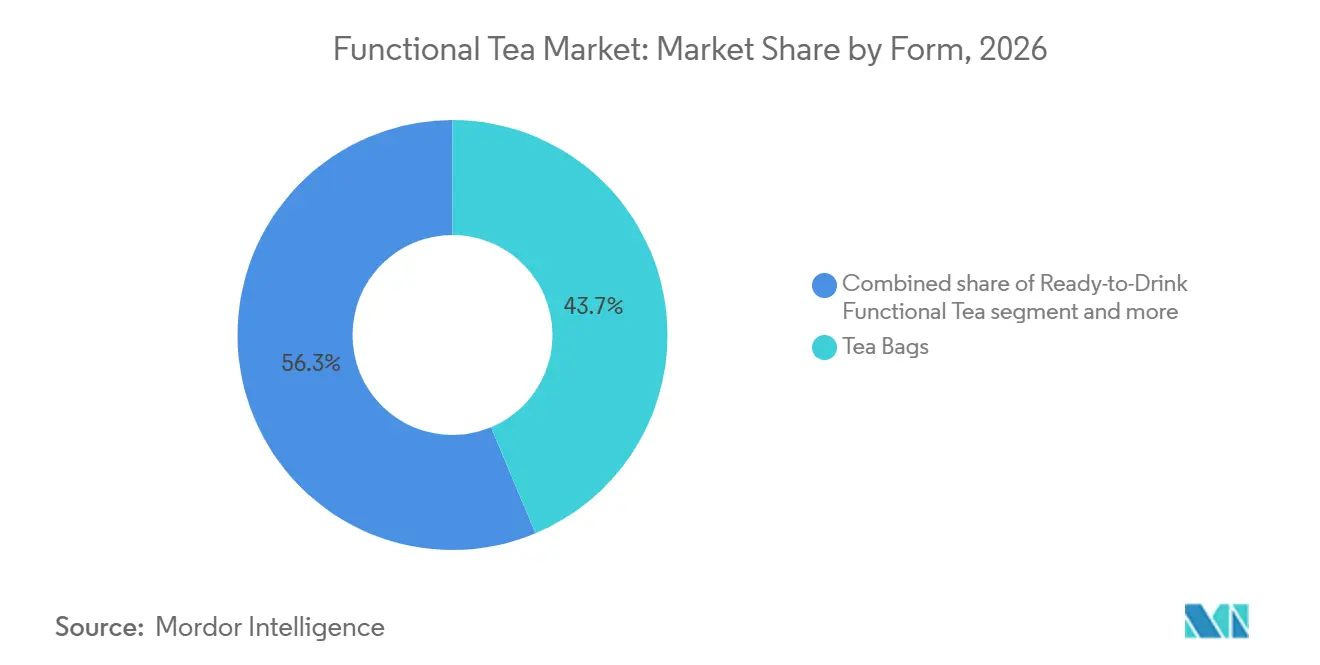
- By form, tea bags represented 43.65% of the functional tea market share in 2026, while ready-to-drink tea is expected to expand at a CAGR of 7.29% through 2032.
- By distribution channel, off-trade accounted for 71.87% of the functional tea market in 2026, while on-trade is forecast to grow at a CAGR of 7.14% through 2032.
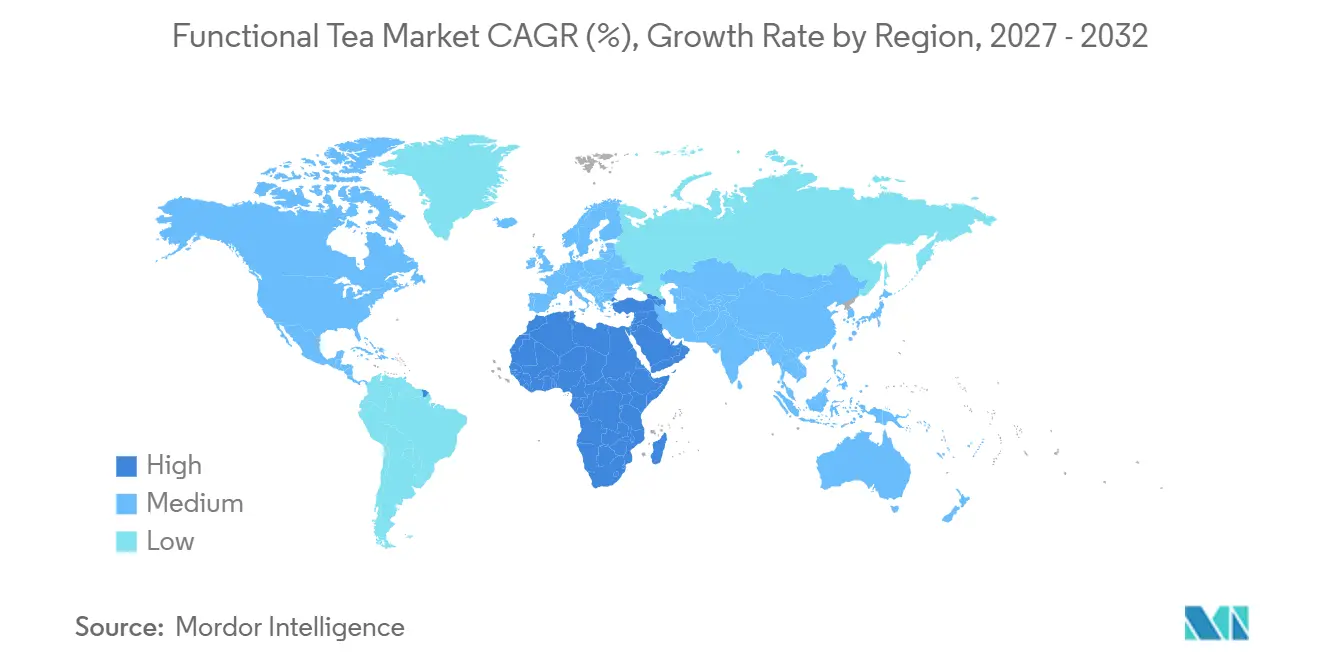
- By geography, Asia-Pacific led with 36.56% of the functional tea market in 2026, while the Middle East and Africa is projected to grow at a CAGR of 7.36% through 2032.
Note: Market numbers in this report are based on Mordor Intelligence's proprietary estimation framework, which combines nine months of actuals with Q4 projections for base year 2026.
Market Trends and Insights
Drivers Impact Analysis of Functional Tea Market*
| Driver | (~) % Impact on CAGR Forecast | Geographic Relevance | Impact Timeline |
|---|---|---|---|
| Preventive Wellness and Immunity-Oriented Consumption | +1.8% | Global, with high intensity in North America, Asia-Pacific, and Europe | Short term (≤ 2 years) |
| Clean-Label, Low-Sugar, and Plant-Based Beverage Demand | +1.2% | North America and Europe, with spillover to Asia-Pacific urban markets | Medium term (2-4 years) |
| Convenience-Led Growth of RTD, Sachet, Powder, and Subscription Formats | +1.0% | Asia-Pacific core, with spillover to North America and the Middle East and Africa | Short term (≤ 2 years) |
| Functional Botanicals, Adaptogens, and Multi-Benefit Formulation Innovation | +0.9% | Global, with product intensity in North America and Europe | Medium term (2-4 years) |
| Benefit-Specific Tea for Sleep, Stress, Digestion, and Mental Focus | +0.8% | North America, Europe, and Asia-Pacific urban centers | Medium term (2-4 years) |
| Development of Convenient Tea Bags and Instant Functional Tea Formats | +0.6% | Global, with high uptake in South Asia and the Middle East and Africa | Long term (≥ 4 years) |
| Source: Mordor Intelligence | |||
Preventive Wellness and Immunity-Oriented Consumption
Preventive wellness supports the everyday demand for functional tea, especially among consumers seeking defined benefits from a familiar beverage. Westrock Coffee's 2025 consumer research found that 45% of U.S. shoppers sought immune-support teas, 43% sought antioxidants, and 32% sought probiotics in tea refreshers. These preferences make benefit-specific ingredient communication more important than general wellness language. The U.S. Food and Drug Administration finalized a revised definition for the voluntary use of the term healthy in December 2024, creating a clearer framework for qualifying foods while preserving limits on disease claims[1]. The functional tea market is therefore more likely to reward brands that connect familiar ingredients with compliant, well-supported product information.
Clean-Label, Low-Sugar, and Plant-Based Beverage Demand
Demand for low-sugar and transparent-label beverages gives functional tea a credible route into routine wellness purchases. Tea can meet this demand when brands clearly describe ingredients, sugar content, and the purpose of each botanical. Tata Consumer Products reported that 80 products launched in FY2026 were centered on health, wellness, and convenience, including the Tetley Slim Care range with L-Carnitine. This activity shows how established tea companies are expanding functional positioning without leaving their core beverage portfolios. As consumers compare labels before purchasing, transparent dose information and sourcing details can help brands avoid competing only on price. The functional tea market has room for products that combine familiar tea formats with straightforward communication about nutrition and ingredients.
Convenience-Led Growth of Ready-to-Drink and Instant Formats
Convenience broadens the occasions when consumers can choose functional tea, particularly during commuting, work, and travel. Ready-to-drink beverages remove preparation time, while sachets, powders, and concentrates provide a portable alternative to brewed tea. Hindustan Unilever launched Lipton Metabolism Boost Effervescent Tablets in India in March 2026, featuring green tea catechins and apple cider vinegar, packaged in a portable tube. The launch illustrates how brands are adapting tea ingredients to formats that fit shorter consumption occasions. Convenience also increases the importance of product stability, dosage consistency, and simple preparation instructions. These requirements favor companies that can combine beverage development with dependable retail execution.
Botanicals and Multi-Benefit Formulation Innovation
Botanical formulation is broadening the functional tea market beyond conventional green and herbal tea positioning. Manufacturers are using ingredients such as ashwagandha, reishi, lion's mane, moringa, and turmeric to address several consumer needs within a single product. Caraway Tea Company expanded its U.S. manufacturing capabilities in April 2026 to produce private-label adaptogen- and mushroom-based tea blends in pyramid sachet and loose-leaf formats. Research published in 2025 noted the relevance of tea polyphenols, theanine, caffeine, and flavonoids in functional foods and nutraceutical applications. This supports product development, but it also raises the need for controlled specifications and credible health communication. Multi-benefit products may gain shelf attention, provided brands retain clear benefit boundaries and avoid overcomplicated claims.
Restraints Impact Analysis of Functional Tea Market*
| Restraint | (~) % Impact on CAGR Forecast | Geographic Relevance | Impact Timeline |
|---|---|---|---|
| Health-Claim Substantiation and Novel-Botanical Compliance Burden | -0.9% | Europe and North America, with regulatory influence extending to global exporters | Medium term (2-4 years) |
| Botanical Supply Volatility and Active-Compound Standardization | -0.7% | Global, with acute impact on Asia-Pacific-origin ingredient supply chains | Short term (≤ 2 years) |
| Premium Price Gap Versus Conventional Tea and Competing Functional Beverages | -0.6% | Global, with highest sensitivity in South Asia, South America, and the Middle East and Africa | Medium term (2-4 years) |
| Consumer Confusion from Counterfeit, Adulterated, and Inconsistent-Strength Products | -0.5% | Asia-Pacific, South America, and the Middle East and Africa, with spillover trust erosion in North America and Europe | Long term (≥ 4 years) |
| Source: Mordor Intelligence | |||
Health-Claim Compliance and Price Accessibility
Rules governing botanical claims can delay launches and add compliance work for companies operating across several regions. The Court of Justice of the European Union ruled on April 30, 2025, that advertising foods containing botanicals with health claims is not permitted until the relevant claim is authorized under the applicable framework. India’s Food Safety and Standards Authority clarified in December 2025 that non-Camellia sinensis products cannot use the word tea under misleading designations[2]. These differences require companies to adapt labels, claims, and sometimes formulations by country. Premium functional products also remain more exposed to consumer trading down when conventional tea or lower-priced functional beverages are available. The functional tea market needs clear benefit communication that justifies a higher price without creating consumer confusion.
Supply Volatility and Product Consistency
Functional tea formulas depend on botanical ingredients whose cost and availability can vary by harvest, weather, trade conditions, and quality requirements. AP News reported in 2025 that Japanese matcha prices rose amid poor weather, labor shortages, and tariffs, with one California importer paying 75% more for premium crop supply. Reuters also reported that dry conditions in India contributed to tea import pressure and a record 45.3 million kg of imports in 2024. A 2024 scientific review identified unapproved enhancement as the most common type of tea fraud in the reviewed RASFF cases, accounting for 43% of cases[3]. These conditions can affect margins, product consistency, and consumer confidence. Strong supplier qualification, testing, and standardized active-compound specifications are therefore essential for brands that make functional claims.
*Our forecasts treat driver/restraint impacts as directional, not additive. The impact forecasts reflect baseline growth, mix effects, and variable interactions.
Functional Tea Market Segment Analysis
By Product Type:
Green Tea Leads While Herbal and Botanical Tea ExpandsGreen tea held 37.23% of the functional tea market share in 2026, supported by its established association with catechins and polyphenols. Its familiar taste, broad availability, and compatibility with hot, cold, and ready-to-drink formats reinforce its commercial position. ITO EN stated in 2025 that it was expanding matcha supply and international operations as global interest in green tea continued to increase. Green tea offers a recognized basis for benefits associated with antioxidant content and focus, allowing brands to develop new products without straying far from consumer expectations. It remains particularly relevant in Asia-Pacific, where long-standing tea habits and growing interest in premium matcha strengthen demand.
Herbal and botanical tea is forecast to grow at a CAGR of 7.57% during 2027-2032, making it the fastest-growing product type. The segment uses ingredients such as ashwagandha, reishi, turmeric, moringa, and elderberry to address more specific consumer needs. Bigelow Tea introduced Golden Turmeric Honey Herbal Tea plus Adaptogens in August 2025, bringing an adaptogen-focused product into mass retail. Herbal blends also help brands create caffeine-free options for evening, relaxation, and digestion occasions. Growth in botanical blends will depend on taste quality, safe sourcing, and wording that accurately reflects the evidence for individual ingredients.

By Functional Benefit:
Immunity Support Leads While Detoxification Gains MomentumImmunity support accounted for 26.28% of the functional tea market size in 2026. This position reflects sustained consumer interest in ingredients and beverages that fit everyday preventive wellness routines. Tea’s established use, combined with demand for antioxidants and low-sugar options, supports this segment’s wide retail presence. Yogi Tea launched Cozy Cardamom Immune + Sleep in June 2025, showing how brands are pairing immunity with an adjacent need in a single tea offering. The functional tea market continues to rely on substantiation and compliant language when companies present immunity-related benefits.
Detoxification is projected to grow at a 7.83% CAGR through 2032, the highest rate among functional benefits. Urban consumers are showing interest in products connected with lighter routines, ingredient transparency, and low-calorie consumption. This demand is also supporting products positioned around digestive comfort and metabolic wellness. Weight management, stress, relaxation, sleep, energy, and focus teas create additional demand opportunities for specialty brands. Distinct product positioning is necessary to prevent overlap between benefit claims and to retain consumer clarity.
By Form:
Tea Bags Remain the Largest Format While Ready-to-Drink Tea Grows FastestTea bags held 43.65% of the functional tea market share in 2026. They remain accessible because they are familiar, portion-controlled, widely distributed, and simple to prepare. Single-serving bags can also help brands deliver consistent amounts of tea and botanical ingredients across each package. This format works across supermarkets, specialty retailers, and online channels, giving it a broad consumer reach. Tea bags also meet demand for a lower-cost entry point compared with premium ready-to-drink products.
Ready-to-drink functional tea is forecast to expand at a CAGR of 7.29% through 2032. The format combines portability with immediate consumption and can compete in refrigerated beverage locations instead of only in tea aisles. Tata Consumer Products reported 23% revenue growth in its ready-to-drink business in Q4 FY2026, its 3rd consecutive quarter of double-digit growth. Loose-leaf tea retains its premium specialty position, while powders, tablets, and concentrates offer companies additional ways to serve portable occasions. The functional tea market size in ready-to-drink formats will be shaped by cold-chain access, pricing, flavor, and formulation stability.
By Distribution Channel:
Off-Trade Leads While On-Trade Builds Premium DemandOff-trade channels accounted for 71.87% of the functional tea market in 2026. Supermarkets, health-food stores, specialty outlets, and online retailers give consumers regular access to both established brands and small specialist producers. This channel is important because shoppers can compare labels, prices, package formats, and ingredients before purchase. Juni expanded into select Whole Foods Market stores in November 2025 and reported distribution in 6,000 U.S. retail doors. Off-trade leadership gives the functional tea market a strong base for repeat household purchases.
On-trade is expected to grow at a CAGR of 7.14% during 2027-2032. Cafes, restaurants, hotels, and specialty tea houses can introduce consumers to premium blends, cold tea products, and benefit-specific menus. These venues help consumers try unfamiliar flavors and botanicals before purchasing packaged products. On-trade expansion is particularly relevant in urban areas of the Asia-Pacific, the Middle East, and Africa, where premium tea service and social consumption play a visible role. Companies need coordinated channel strategies because relying on a single retail channel can limit reach and increase commercial risk.
Geography Analysis
APAC Functional Tea Market
Asia-Pacific held 36.56% of the functional tea market share in 2026. China, Japan, India, and South Korea contribute different demand patterns, ranging from traditional brewed tea to ready-to-drink and specialty botanical products. The region combines deep tea consumption habits with active innovation in green tea, matcha, cold-brew, and ready-to-drink products. ITO EN created a dedicated matcha division in 2025 to address global demand, while Tata Consumer Products reported above-average growth from its Organic India portfolio. The region’s established supply networks and consumer familiarity make it the leading functional tea market.
MEA Functional Tea Market
The Middle East and Africa are projected to grow at a CAGR of 7.36% during 2027-2032. A young consumer base, rising disposable incomes in Gulf markets, and new consumption occasions beyond traditional hot tea service support the outlook. Local ingredients such as rooibos, moringa, and hibiscus enable producers to develop products linked to regional sourcing. Premium retail, cafes, and e-commerce are expanding the touchpoints where consumers can encounter functional tea. The functional tea market share in the region is smaller today, but its forecast growth reflects broader shifts in beverage preferences and urban retail access.
The Americas and Europe Functional Tea Market
North America is shaped by demand for clear labeling, natural retail distribution, and benefit-specific product launches. The revised U.S. healthy labeling definition gives unsweetened tea brands a clearer regulatory reference point, although it does not replace the need for compliant claim support. Europe has a large base of premium artisanal and herbal tea brands, but stricter botanical claim standards require greater attention to evidence. Canada remains important for premium wellness offerings, while South America offers potential through interest in yerba mate and other botanical ingredients.
Competitive Landscape
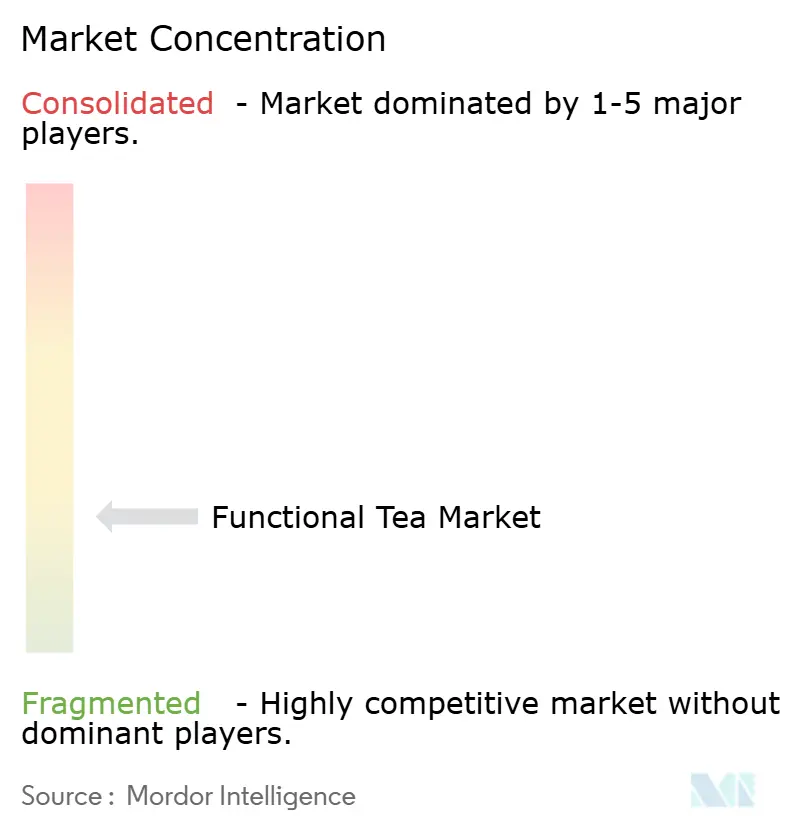
The functional tea market is highly fragmented, and no leading player holds a dominant share. Large consumer goods companies compete alongside specialists with narrower portfolios and a stronger focus on particular benefits. Tata Consumer Products, Unilever, ITO EN, and PepsiCo have established distribution, established tea brands, and resources for new product development. Yogi Tea, Traditional Medicinals, Organic India, Bigelow Tea, and Juni use botanical formulations, certifications, and specialty retail to differentiate their offerings. This mix creates competition around trust, flavor, formulation quality, access to ingredients, and the ability to communicate benefits responsibly.
Portfolio development is a central competitive tool. Tata Consumer Products reported 80 new products in FY2026, while Hindustan Unilever introduced Lipton Metabolism Boost Effervescent Tablets in India in March 2026. PepsiCo completed its USD 1.95 billion acquisition of Poppi in May 2025, demonstrating investment in the broader functional beverage space that can influence tea innovation. ITO EN also signed an Oi Ocha partnership with Major League Baseball in January 2025, using a global sports platform to extend green tea visibility. These moves show that large companies can combine product development with distribution, marketing, and adjacent beverage capabilities.
Specialists can build defensible positions where they offer transparency that is meaningful to consumers. Traditional Medicinals announced Fair for Life certification for Rosy Mood and Stress Ease Calm products in September 2025. Yogi Tea expanded into ready-to-mix formats with organic herbal tea concentrates in September 2025. QR-linked product information, certifications, and direct online sales can strengthen trust where consumers want more evidence on ingredients.
Functional Tea Industry Leaders
-
Tata Consumer Products Limited
-
Unilever PLC
-
Associated British Foods plc
-
The Hain Celestial Group, Inc.
-
PepsiCo, Inc.
- *Disclaimer: Major Players sorted in no particular order
Functional Tea Market Companies Covered in this Report
- Tata Consumer Products Limited
- Unilever PLC
- Associated British Foods plc
- The Hain Celestial Group, Inc.
- PepsiCo, Inc.
- ITO EN, LTD.
- Nestlé S.A.
- The Coca-Cola Company
- Dilmah Ceylon Tea Company PLC
- Organic India Pvt. Ltd.
- Yogi Tea
- Traditional Medicinals, Inc.
- Harney and Sons Fine Teas
- Bigelow Tea Company
- The Republic of Tea, Inc.
- Rishi Tea and Botanicals
- Numi, Inc.
- VAHDAM India Private Limited
- Barry’s Tea
- Teekanne GmbH and Co. KG
Recent Industry Developments in Functional Tea Market
- April 2026: Pure Leaf (PepsiCo-Unilever joint venture) launched Mental Focus, its first functional sparkling brewed iced tea formulated with naturally occurring caffeine from black tea and added L-theanine. The launch marks the brand's formal entry into the cognitive wellness beverage segment.
- March 2026: Hindustan Unilever launched Lipton's Metabolism Boost Effervescent Tablets in India, delivering 2X catechins compared with standard green tea bags and featuring apple cider vinegar in a compact, portable format. The product effectively reformats functional tea bioactives into a pharmaceutical-adjacent delivery system.
- November 2025: Juni, the adaptogenic sparkling tea brand co-founded by Jay Shetty and Kim Perell, expanded nationally into select Whole Foods Market stores, reaching 6,000 US retail doors and projecting 300% revenue growth. The brand's proprietary Super-5™ blend incorporates ashwagandha, lion's mane, reishi mushroom, acerola cherry, and green tea extract.
Global Functional Tea Market Report Scope
Functional tea refers to tea products formulated or positioned to provide specific health and wellness benefits beyond conventional refreshment, including support for immunity, digestion, relaxation, energy, weight management, and other functional needs. The Functional Tea Market is segmented by product type, functional benefit, form, distribution channel, and geography. By product type, the market includes Green Tea, Herbal and Botanical Tea, Black Tea, Fruit Tea, Flower Tea, Oolong Tea, and Other Product Types. By functional benefit, the market is segmented into: Immunity Support; Digestive and Gut Health; Stress Relief; Relaxation and Sleep Support; Energy and Mental Focus; Weight Management and Metabolic Support; Detoxification; and Other Functional Benefits. By form, the market is categorized into Tea Bags, Loose Leaf Tea, Instant Tea Powder, Ready-to-Drink Functional Tea, and Others. By distribution channel, the market is divided into On-Trade and Off-Trade, with Off-Trade further segmented into Supermarkets and Hypermarkets, Convenience Stores, Specialty Tea and Health-Food Stores, Online Retail, and Other Off-trade Distribution Channels. By geography, the report covers North America, South America, Europe, Asia-Pacific, and the Middle East and Africa, with market size and forecasts provided for each region. The market sizing has been done in value terms in USD for all the abovementioned segments.
Segmentation Overview
| Green Tea |
| Herbal and Botanical Tea |
| Black Tea |
| Fruit Tea |
| Flower Tea |
| Oolong Tea |
| Other Product Types |
| Immunity Support |
| Digestive and Gut Health |
| Stress Relief, Relaxation, and Sleep Support |
| Energy and Mental Focus |
| Weight Management and Metabolic Support |
| Detoxification |
| Other Functional Benefits |
| Tea Bags |
| Loose Leaf Tea |
| Instant Tea Powder |
| Ready-to-Drink Functional Tea |
| Others |
| On-Trade | |
| Off-Trade | Supermarkets and Hypermarkets |
| Convenience Stores | |
| Specialty Tea and Health-Food Stores | |
| Online Retail | |
| Other Off-trade Distribution Channels |
| North America | United States |
| Canada | |
| Mexico | |
| Rest of North America | |
| South America | Brazil |
| Argentina | |
| Colombia | |
| Chile | |
| Rest of South America | |
| Europe | United Kingdom |
| Germany | |
| France | |
| Italy | |
| Spain | |
| Russia | |
| Sweden | |
| Belgium | |
| Poland | |
| Netherlands | |
| Rest of Europe | |
| Asia-Pacific | China |
| Japan | |
| India | |
| Thailand | |
| Singapore | |
| Indonesia | |
| South Korea | |
| Australia | |
| New Zealand | |
| Rest of Asia-Pacific | |
| Middle East and Africa | United Arab Emirates |
| South Africa | |
| Saudi Arabia | |
| Nigeria | |
| Egypt | |
| Morocco | |
| Turkey | |
| Rest of Middle East and Africa |
| Product Type | Green Tea | |
| Herbal and Botanical Tea | ||
| Black Tea | ||
| Fruit Tea | ||
| Flower Tea | ||
| Oolong Tea | ||
| Other Product Types | ||
| By Functional Benefit | Immunity Support | |
| Digestive and Gut Health | ||
| Stress Relief, Relaxation, and Sleep Support | ||
| Energy and Mental Focus | ||
| Weight Management and Metabolic Support | ||
| Detoxification | ||
| Other Functional Benefits | ||
| By Form | Tea Bags | |
| Loose Leaf Tea | ||
| Instant Tea Powder | ||
| Ready-to-Drink Functional Tea | ||
| Others | ||
| By Distribution Channel | On-Trade | |
| Off-Trade | Supermarkets and Hypermarkets | |
| Convenience Stores | ||
| Specialty Tea and Health-Food Stores | ||
| Online Retail | ||
| Other Off-trade Distribution Channels | ||
| By Geography | North America | United States |
| Canada | ||
| Mexico | ||
| Rest of North America | ||
| South America | Brazil | |
| Argentina | ||
| Colombia | ||
| Chile | ||
| Rest of South America | ||
| Europe | United Kingdom | |
| Germany | ||
| France | ||
| Italy | ||
| Spain | ||
| Russia | ||
| Sweden | ||
| Belgium | ||
| Poland | ||
| Netherlands | ||
| Rest of Europe | ||
| Asia-Pacific | China | |
| Japan | ||
| India | ||
| Thailand | ||
| Singapore | ||
| Indonesia | ||
| South Korea | ||
| Australia | ||
| New Zealand | ||
| Rest of Asia-Pacific | ||
| Middle East and Africa | United Arab Emirates | |
| South Africa | ||
| Saudi Arabia | ||
| Nigeria | ||
| Egypt | ||
| Morocco | ||
| Turkey | ||
| Rest of Middle East and Africa | ||
Key Questions Answered in the Report
What is the projected value of the functional tea market by 2032?
The functional tea market is forecast to reach USD 12.70 billion by 2032, expanding at a 6.67% CAGR from 2027.
Which product category leads functional tea sales?
Green tea leads product demand with a 37.23% share in 2026, supported by consumer familiarity and its polyphenol profile.
Which functional tea category is growing the fastest?
Herbal and botanical tea is the fastest-growing product category, with a projected CAGR of 7.57% through 2032.
Why are ready-to-drink functional tea products gaining traction?
Ready-to-drink tea reduces preparation time and provides portability, helping it achieve a forecast CAGR of 7.29% through 2032.