
Morocco Fruits And Vegetables Market Analysis by Mordor Intelligence
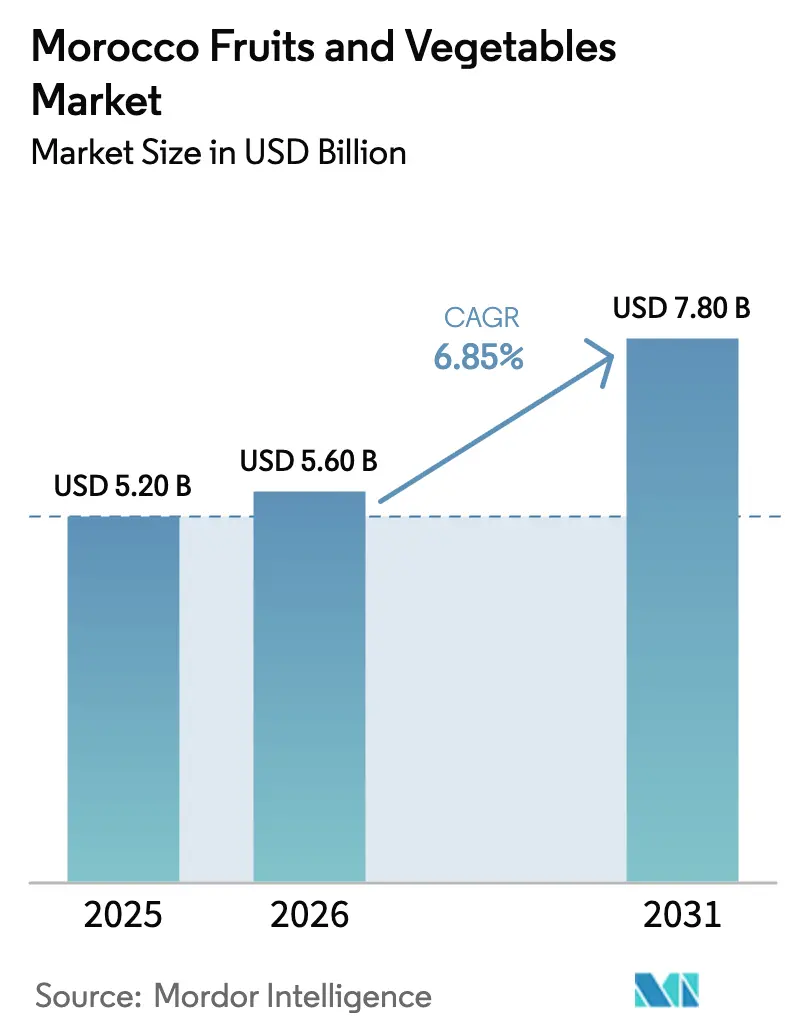
The Moroccan fruits and vegetables market size is projected to expand from USD 5.20 billion in 2025 and USD 5.60 billion in 2026 to USD 7.80 billion by 2031, registering a CAGR of 6.85% between 2026 to 2031. This expansion reflects Morocco’s shift from bulk commodity shipments to specialty crops that obtain premiums in European retail channels. In 2025, vegetables represented the majority of the national output. Meanwhile, fruit acreage is anticipated to expand more rapidly as growers prioritize planting blueberries, avocados, and seedless citrus, which are popular among European consumers. Export flows constitute the majority of vegetable shipments. Additionally, new contract farming models are being applied to berries, enabling processors to secure supply and mitigate pricing risks. Parallel investments in desalination, cold storage, and drip systems are reducing production costs, minimizing post-harvest waste, and maintaining a competitive advantage despite water scarcity.
Key Report Takeaways
- By type, vegetables held 57.4% of the Morocco fruits and vegetables market share in 2025, while fruits are on track to advance at a 7.8% CAGR through 2031.
Note: Market size and forecast figures in this report are generated using Mordor Intelligence’s proprietary estimation framework, updated with the latest available data and insights as of January 2026.
Morocco Fruits And Vegetables Market Trends and Insights
Drivers Impact Analysis*
| Driver | (~) % Impact on CAGR Forecast | Geographic Relevance | Impact Timeline |
|---|---|---|---|
| Rising exports of high-value crops | +1.8% | Nationwide, strongest in Souss-Massa and Gharb | Medium term (2-4 years) |
| Growth in agri-logistics infrastructure | +1.4% | Agadir, Casablanca, and Tangier corridors | Medium term (2-4 years) |
| Expansion of drip-irrigation acreage | +1.2% | Souss-Massa, Gharb, Haouz, and Tadla | Long term (≥ 4 years) |
| European Union–Morocco duty-free quota renewals | +1.0% | Tomato and citrus export zones | Short term (≤ 2 years) |
| Climate-smart certification demand | +0.8% | Nationwide, premium uptake in Souss-Massa and Gharb | Medium term (2-4 years) |
| Surge in contract farming by processors | +0.7% | Souss-Massa, Gharb, and Doukkala | Medium term (2-4 years) |
| Source: Mordor Intelligence | |||
Rising Exports of High-Value Crops
Morocco shipped 83,000 metric tons of blueberries in 2024, 43% higher on average each year since 2009, pushing the country from seventh to fourth among global suppliers and giving it 8% of world trade[1]Source: International Trade Centre, “Trade Map – Morocco Fruit and Vegetable Exports,” trademap.org. Blueberry cultivars timed for early spring fill a European supply gap, while proximity to European Union markets enables 48-hour air freight. Avocado exports rose to 90,000 metric tons in 2024/25, up from 60,000 metric tons the prior season, with farm-gate prices stable at MAD 19–20/kg (USD 1.90–2.00/kg) in January 2025, according to the President of the Moroccan Avocado Association. Tangerine and clementine shipments hit 500,000 metric tons in 2024/25, a 27% jump driven by new northern plantings that meet Russian and Middle Eastern demand for seedless fruit[2]Source: European Commission, “EU Agricultural Trade with Morocco,” EUROSTAT, ec.europa.eu. Because these crops return three to five times the revenue per hectare of cereals, land reallocation and foreign investment from Chile and the Netherlands continue to accelerate. Contract farming arrangements guarantee offtake, further de-risking orchard expansion for growers.
Growth in Agri-Logistics Infrastructure
The EUR 425 million (USD 450 million) Chtouka desalination plant began service in 2024 and now sells irrigation water at MAD 5.40/m³ (USD 0.54/m³), roughly half the pre-project cost and thus protects margins amid energy inflation. Agadir cold storage capacity expanded 12% in 2025 after 18,000 pallet positions came online, pushing berry and stone-fruit losses below 10%. Agadir port handled 1.2 million metric tons of fresh produce in 2024, 9% more than in 2023, while Tangier Med’s new refrigerated terminal trimmed transit to Rotterdam and Marseille by 18 hours. National desalination projects scheduled through 2030 will deliver 1.7 billion m³ each year, unlocking 200,000 hectares for irrigation, mainly along the coast. These upgrades reduce spoilage, alleviate water stress, and anchor investor confidence in the Morocco fruits and vegetables market.
Expansion of Drip-Irrigation Acreage
Drip-irrigated land climbed to 700,000 hectares in 2024 from 585,000 hectares in 2020, driven by subsidies covering 80% of installation outlays. Tomato yields inside drip-equipped greenhouses averaged 450 metric tons/ha in 2025 versus 180 metric tons/ha in open fields, justifying the MAD 80,000/ha (USD 8,000/ha) capital cost. Souss-Massa targets 1 million hectares of drip by 2030 to counter its 100 million m³ annual aquifer overdraft. Avocado orchards in Gharb using subsurface drip lines cut fertilizer by 30% and secured uniform fruit size that commands a 15% premium at EU retail. However, smallholder adoption lags because bank credit is scarce, widening the productivity gap with corporate farms.
European Union–Morocco Duty-Free Quota Renewals
The European Union-Morocco Association Agreement keeps 285,000 metric tons of tomatoes duty-free each year, provided shipment prices exceed European Union reference levels. Morocco supplied 573,730 metric tons of tomatoes in 2024/25, paying standard tariffs on the over-quota balance yet still earning EUR 1.05 billion (USD 1.12 billion). Duty-free citrus quotas of 380,000 metric tons for oranges and 60,000 metric tons for clementines hold through 2028, giving investors multi-year certainty. The entry-price safeguard, however, rewards exporters who deliver during European off-season months, so firms with controlled-environment greenhouses reap the largest gains. Ongoing renewal talks focus on carbon labeling and social compliance, signaling a move toward broader sustainability metrics.
Restraints Impact Analysis*
| Restraint | (~) % Impact on CAGR Forecast | Geographic Relevance | Impact Timeline |
|---|---|---|---|
| Declining arable land per capita | -0.9% | Casablanca–Rabat corridor and coastal zones | Long term (≥ 4 years) |
| Water-table depletion in Souss-Massa | -1.2% | Chtouka and Massa basins | Short term (≤ 2 years) |
| High post-harvest loss in cold chain | -0.8% | Rural areas distant from Agadir and Casablanca | Medium term (2-4 years) |
| Volatile farm-gate pricing cycles | -0.6% | Nationwide, acute in tomato and potato crops | Short term (≤ 2 years) |
| Source: Mordor Intelligence | |||
Declining Arable Land per Capita
Urban sprawl removed 12,000 hectares of farmland in the Casablanca–Rabat corridor from 2020 to 2024, converting orchards into housing and industrial estates. Per-capita arable area slipped to 0.18 hectares in 2024, down 14% from 2015, as population growth outpaced land access. Soil degradation affects 30% of cropland, shaving yields 10–15% and pushing fertilizer use higher. Average farm size fell to 5.1 hectares in 2024, limiting mechanization and forcing fragmented producers to compete against vertically integrated exporters whose unit costs are 20–25% lower. Without land consolidation and soil restoration, production gains will be harder to achieve and could drag on the Morocco fruits and vegetables market.
Water-Table Depletion in Souss-Massa
Groundwater extraction exceeded recharge by 67% in 2024, leaving a 58–60 million m³ annual deficit[3]Source: World Bank, “Morocco Water Resources and Agricultural Development,” worldbank.org. Wells in Chtouka dropped 2 to 3 meters each year, lifting pumping costs from MAD 0.80/m³ (USD 0.08/m³) in 2020 to MAD 1.50/m³ (USD 0.15/m³) in 2024. Salinity intrusion rendered 4,000 hectares unproductive for citrus, triggering a pivot to almonds and olives by 2024. Desalinated water at MAD 5.40/m³ (USD 0.54/m³) still exceeds historical groundwater costs, squeezing margins for tomato growers whose net returns average 12%. Emergency rationing in 2024 cut allocations by 30%, leading to temporary output dips and amplifying supply volatility in European markets.
*Our forecasts treat driver/restraint impacts as directional, not additive. The impact forecasts reflect baseline growth, mix effects, and variable interactions.
Segment Analysis
By Product Type: Fruits Extend the Growth Curve
Vegetables delivered 57.4% of the market share in 2025, but the fruit segment is expanding at a 7.8% CAGR as growers prioritize blueberries, avocados, and seedless citrus that satisfy European off-season demand. Blueberry acreage rose from 2,000 hectares in 2015 to 11,000 hectares in 2024, while avocado groves doubled to 10,000 hectares. In 2024/25, citrus remains the largest fruit group at 2.06 million metric tons. Water scarcity flattened watermelon and melon production at 450,000 metric tons in 2024, and grape cultivation fell 8% as land shifted toward higher-margin stone fruit.
Export data reveal further divergence. In 2024/25, vegetables accounted for 573,730 metric tons of tomato exports to Europe, though subject to quota restrictions. In contrast, blueberry exports, totaling 83,000 metric tons, benefited from tariff-free access and generated USD 620 million in 2024. In 2024/25, avocado exports of 90,000 metric tons target Russian and Middle Eastern buyers who pay premiums for winter supply. Citrus shipments grew, yet intensifying Spanish and Turkish competition pressures margins, compelling Moroccan exporters to rely on organic labels for differentiation. This mix shift underscores how specialty fruits are reinforcing premium positioning in the Morocco fruits and vegetables market.




Geography Analysis
Souss-Massa generated a significant portion of national output in 2025, anchored by Chtouka greenhouses that exported 85% of their tomatoes and gained USD 1 billion in foreign currency. Desalinated water from the Chtouka plant now irrigates 15,000 hectares at MAD 5.40/m³ (USD 0.54/m³), buffering margins against aquifer depletion. In 2024, citrus orchards produced 600,000 metric tons, but salinity forced 4,000 hectares out of production, prompting growers to adopt almonds and olives. In 2024, blueberry acreage reached 6,500 hectares and supplied 48,000 metric tons that sold at USD 7.50/kg retail, validating the USD 35,000/ha establishment cost[5]Source: Food and Agriculture Organization, “FAOSTAT – Morocco Production Statistics,” fao.org.
Gharb is the fastest-growing through 2031. Avocado plantings rose to 7,000 hectares, delivering 60,000 metric tons in 2024/25, while abundant rainfall slices irrigation costs to USD 0.55/kg, well below Souss-Massa. Late-season Navel and Nadorcott citrus acreage expanded 12% in 2024, hitting European Union shelves when Spanish supply wanes. In 2024, Potato volumes totaled 450,000 metric tons but saw prices swing from MAD 2.00/kg (USD 0.20/kg) to MAD 0.90/kg (USD 0.09/kg) in three months due to oversupply[4]Source: Morocco Ministry of Agriculture, “Generation Green Plan,” agriculture.gov.ma. Foreign capital rose 22% in 2024 as Dutch and Chilean investors leased 3,200 hectares for berries and greenhouses.
Loukkos, Haouz, and Berkane add niche strengths. In 2024, Loukkos shipped 28,000 metric tons of strawberries across a November to May window that reduces disease pressure. Haouz produced 180,000 metric tons of watermelons but lost 15% of its irrigated land to drought in 2024. Berkane’s clementines reached 150,000 metric tons and targeted Russian buyers despite payment risk in 2024. Dakhla emerged as a frontier zone, planting 800 hectares of blueberries in 2024 that capitalize on desert microclimates and Atlantic fog, with trial exports commanding EUR 9/kg (USD 9.50/kg) retail premiums. These shifts show capital moving northward to water-abundant areas, spreading risk across the Morocco fruits and vegetables market.
Regulatory Landscape
Morocco's fruits and vegetables regulatory framework is shaped by decrees and ministerial orders published in the Bulletin Officiel, with enforcement spread across agencies covering food safety, exports, and customs. ONSSA (Office National de Securite Sanitaire des produits Alimentaires) oversees food safety requirements, import controls, and commissions that draft standards for fruits, vegetables, and derived products. These standards are subsequently approved through IMANOR (Institut Marocain de Normalisation), with alignment efforts referencing international frameworks such as Codex Alimentarius.
Export compliance is centered on mandatory technical control for agricultural exports coordinated by Morocco Foodex, including electronic authorization via the EACCE system and labeling and classification requirements at the customs declaration. On January 1, 2026, Morocco issued Circular 6705/222 detailing tariff changes, TRQs, and agricultural safeguard measures (including under the US-Morocco FTA and the Morocco-UK Association Agreement) for the period through December 31, 2026, reinforcing the role of ADII (Administration des Douanes et Impots Indirects) in managing border-related compliance for agri-food trade.
Value Chain Analysis
Morocco's fruits and vegetables value chain runs from input suppliers (seed, fertilizers, crop protection, irrigation and greenhouse equipment) to farm production across key regions, notably Souss-Massa, Gharb, Loukkos, and Berkane. It then moves through aggregation, packhouses, cold storage, and distribution to domestic wholesale markets and export corridors. Sector programming is led by the Ministry of Agriculture, Maritime Fisheries, Rural Development, Water and Forests, with Generation Green using the Agricultural Aggregation model to link small farmers with aggregators for technical support, subsidized irrigation equipment, and investment in valorization units that improve grading, traceability, and export readiness.
Downstream, the chain is shaped by export technical control and documentation, including EACCE authorizations, and by logistics performance at produce hubs and ports, where refrigerated handling reduces losses for berries and other high-value crops. Water availability and climate stress remain the key operating constraints, which has driven prioritization of drinking water over irrigation during drought periods. The USD 250 million Transforming Agri-food Systems in Morocco program approved in December 2024 targets climate resilience, food safety, and market access, supporting models such as Productive Alliances that connect cooperatives and commercial buyers to strengthen the commercialization segment of the value chain.
Competitive Landscape
The Moroccan fruits and vegetables market demonstrates steady growth potential, offering opportunities for mid-tier entrants. Azura Group holds a significant market share, utilizing semi-closed greenhouses designed to optimize environmental conditions, resulting in higher yields and improved crop quality. These greenhouses enable better control over temperature, humidity, and ventilation, contributing to enhanced productivity. The collaboration between the Delassus Group, the Food and Agriculture Organization (FAO), and the European Bank for Reconstruction and Development (EBRD) in 2025 is projected to strengthen Morocco's position in global produce markets, driven by its expansion into Asian destinations.
Growth strategies concentrate on three levers. First, geographic diversification away from drought-prone Souss-Massa reduces water risk and stabilizes yields. Second, certifications like GlobalG.A.P. and Linking Environment And Farming (LEAF) capture retail premiums of up to 18%. Third, downstream control of the cold chain trims waste and secures shelf presence. The Moroccan agricultural cooperative COPAG supports approximately 24,000 farmers and collaborates with Delight Co. to ensure a reliable supply, sustainable practices, and high-quality fruit that meets global citrus ingredient standards.
Opportunities exist in underdeveloped processed product lines, such as pre-packaged salads and cut fruit, which cater to the growing urban demand in the Morocco fruits and vegetables market. Secondary export destinations, including Russia and the Middle East, offer attractive premiums but require specialized trade-finance expertise, which remains limited among current market participants. Moroccan agtech startups are testing precision irrigation and drone scouting technologies that can reduce water and pesticide usage by up to 20%. However, the adoption of these innovations is hindered by fragmented landholdings. As competition intensifies in segments like berries, avocados, and organic citrus, success will depend increasingly on factors such as speed to market, sustainability practices, and proprietary genetics rather than solely on pricing strategies.
Market Opportunities and Future Outlook
Export diversification and higher-value product positioning are being reinforced through policy measures and investment in export-oriented capacity. In March 2026, Morocco introduced a subsidy of MAD 750 per ton for fresh tomato exports to markets outside the EU and the UK (effective from the 2025-2026 season). This creates a clearer commercial pathway for exporters to develop routes into non-traditional destinations while managing margin pressure under EU price and timing rules. At the same time, private investment signals in high-value fruit supply are expanding, including Elite Agro opening a 200-hectare blueberry and raspberry site in Kenitra in June 2026. This supports scale-up of berry volumes beyond traditional clusters and increases demand for packing, cold storage, and compliant export services.
Domestic market modernization and chain formalization also remain areas with limited build-out, especially in wholesale distribution and traceability where operational adoption lags infrastructure upgrades. Government programming disclosed in 2026 includes 107,000 hectares earmarked for high-consumption vegetables for the national market, alongside mobilization of phosphate fertilizers, indicating continued emphasis on stabilizing local supply alongside export crops. Financing capacity for climate-smart upgrades is broadening as well; in April 2026, Credit Agricole du Maroc and Cassa Depositi e Prestiti signed an MoU at SIAM 2026 to finance sustainable agriculture and green-transition projects. The agreement supports investable pipelines in drip irrigation, controlled-environment production, and post-harvest infrastructure that influence fruit and vegetable competitiveness.
Recent Industry Developments
- June 2026: Elite Agro inaugurated its seventh agricultural site in Kenitra, a 200-hectare farm dedicated to blueberry and raspberry cultivation. The expansion increases commercial berry capacity in a water-advantaged corridor and adds throughput needs for cold chain and export packing serving high-value fruit channels.
- June 2025: Morocco's Ministry of Agriculture and Jungnong Group launched a MAD 220 million smart farming partnership focused on water-efficient irrigation, soil rehabilitation, and high-value crop cultivation. The program strengthens the technology layer of production systems and supports broader adoption of precision practices that improve yields and resource efficiency.
- December 2024: Morocco imposed export restrictions on select commodities such as olives and olive oil as a market-stabilization measure following drought-driven price increases. The step showed how domestic supply and food-price management can temporarily reshape export availability and redirect capacity toward local market priorities.


Research Methodology Framework and Report Scope
Market Definition and Coverage
This market is sized as the annual value of fresh, whole fruits and vegetables produced and traded in Morocco, including volumes moving through domestic wholesale and retail routes, as well as export shipments within the year.
Scope exclusions: We exclude produce that is only used for on-farm feed and any value added beyond the fresh sale stage, such as canning, juicing, drying, or freezing.
Segmentation Overview
- By Type
- Fruits
- Lemon
- Production Analysis
- Production Volume
- Area Harvested and Yield
- Consumption Analysis (Value and Volume)
- Trade Analysis (Value and Volume)
- Import Market Analysis
- Import Value and Volume
- Key Supplying Markets
- Export Market Analysis
- Export Value and Volume
- Key Supplying Markets
- Import Market Analysis
- Wholesale Price Trend Analysis and Forecast
- Seasonality Analysis
- Production Analysis
- Orange
- Production Analysis
- Production Volume
- Area Harvested and Yield
- Consumption Analysis (Value and Volume)
- Trade Analysis (Value and Volume)
- Import Market Analysis
- Import Value and Volume
- Key Supplying Markets
- Export Market Analysis
- Export Value and Volume
- Key Supplying Markets
- Import Market Analysis
- Wholesale Price Trend Analysis and Forecast
- Seasonality Analysis
- Production Analysis
- Watermelon
- Production Analysis
- Production Volume
- Area Harvested and Yield
- Consumption Analysis (Value and Volume)
- Trade Analysis (Value and Volume)
- Import Market Analysis
- Import Value and Volume
- Key Supplying Markets
- Export Market Analysis
- Export Value and Volume
- Key Supplying Markets
- Import Market Analysis
- Wholesale Price Trend Analysis and Forecast
- Seasonality Analysis
- Production Analysis
- Tangerine, Mandarin, and Clementine
- Production Analysis
- Production Volume
- Area Harvested and Yield
- Consumption Analysis (Value and Volume)
- Trade Analysis (Value and Volume)
- Import Market Analysis
- Import Value and Volume
- Key Supplying Markets
- Export Market Analysis
- Export Value and Volume
- Key Supplying Markets
- Import Market Analysis
- Wholesale Price Trend Analysis and Forecast
- Seasonality Analysis
- Production Analysis
- Grape
- Production Analysis
- Production Volume
- Area Harvested and Yield
- Consumption Analysis (Value and Volume)
- Trade Analysis (Value and Volume)
- Import Market Analysis
- Import Value and Volume
- Key Supplying Markets
- Export Market Analysis
- Export Value and Volume
- Key Supplying Markets
- Import Market Analysis
- Wholesale Price Trend Analysis and Forecast
- Seasonality Analysis
- Production Analysis
- Peach and Nectarine
- Production Analysis
- Production Volume
- Area Harvested and Yield
- Consumption Analysis (Value and Volume)
- Trade Analysis (Value and Volume)
- Import Market Analysis
- Import Value and Volume
- Key Supplying Markets
- Export Market Analysis
- Export Value and Volume
- Key Supplying Markets
- Import Market Analysis
- Wholesale Price Trend Analysis and Forecast
- Seasonality Analysis
- Production Analysis
- Strawberry
- Production Analysis
- Production Volume
- Area Harvested and Yield
- Consumption Analysis (Value and Volume)
- Trade Analysis (Value and Volume)
- Import Market Analysis
- Import Value and Volume
- Key Supplying Markets
- Export Market Analysis
- Export Value and Volume
- Key Supplying Markets
- Import Market Analysis
- Wholesale Price Trend Analysis and Forecast
- Seasonality Analysis
- Production Analysis
- Blueberry
- Production Analysis
- Production Volume
- Area Harvested and Yield
- Consumption Analysis (Value and Volume)
- Trade Analysis (Value and Volume)
- Import Market Analysis
- Import Value and Volume
- Key Supplying Markets
- Export Market Analysis
- Export Value and Volume
- Key Supplying Markets
- Import Market Analysis
- Wholesale Price Trend Analysis and Forecast
- Seasonality Analysis
- Production Analysis
- Avocado
- Production Analysis
- Production Volume
- Area Harvested and Yield
- Consumption Analysis (Value and Volume)
- Trade Analysis (Value and Volume)
- Import Market Analysis
- Import Value and Volume
- Key Supplying Markets
- Export Market Analysis
- Export Value and Volume
- Key Supplying Markets
- Import Market Analysis
- Wholesale Price Trend Analysis and Forecast
- Seasonality Analysis
- Production Analysis
- Lemon
- Vegetables
- Tomato
- Production Analysis
- Production Volume
- Area Harvested and Yield
- Consumption Analysis (Value and Volume)
- Trade Analysis (Value and Volume)
- Import Market Analysis
- Import Value and Volume
- Key Supplying Markets
- Export Market Analysis
- Export Value and Volume
- Key Supplying Markets
- Import Market Analysis
- Wholesale Price Trend Analysis and Forecast
- Seasonality Analysis
- Production Analysis
- Potato
- Production Analysis
- Production Volume
- Area Harvested and Yield
- Consumption Analysis (Value and Volume)
- Trade Analysis (Value and Volume)
- Import Market Analysis
- Import Value and Volume
- Key Supplying Markets
- Export Market Analysis
- Export Value and Volume
- Key Supplying Markets
- Import Market Analysis
- Wholesale Price Trend Analysis and Forecast
- Seasonality Analysis
- Production Analysis
- Beans
- Production Analysis
- Production Volume
- Area Harvested and Yield
- Consumption Analysis (Value and Volume)
- Trade Analysis (Value and Volume)
- Import Market Analysis
- Import Value and Volume
- Key Supplying Markets
- Export Market Analysis
- Export Value and Volume
- Key Supplying Markets
- Import Market Analysis
- Wholesale Price Trend Analysis and Forecast
- Seasonality Analysis
- Production Analysis
- Pepper
- Production Analysis
- Production Volume
- Area Harvested and Yield
- Consumption Analysis (Value and Volume)
- Trade Analysis (Value and Volume)
- Import Market Analysis
- Import Value and Volume
- Key Supplying Markets
- Export Market Analysis
- Export Value and Volume
- Key Supplying Markets
- Import Market Analysis
- Wholesale Price Trend Analysis and Forecast
- Seasonality Analysis
- Production Analysis
- Onion
- Production Analysis
- Production Volume
- Area Harvested and Yield
- Consumption Analysis (Value and Volume)
- Trade Analysis (Value and Volume)
- Import Market Analysis
- Import Value and Volume
- Key Supplying Markets
- Export Market Analysis
- Export Value and Volume
- Key Supplying Markets
- Import Market Analysis
- Wholesale Price Trend Analysis and Forecast
- Seasonality Analysis
- Production Analysis
- Cucumber
- Production Analysis
- Production Volume
- Area Harvested and Yield
- Consumption Analysis (Value and Volume)
- Trade Analysis (Value and Volume)
- Import Market Analysis
- Import Value and Volume
- Key Supplying Markets
- Export Market Analysis
- Export Value and Volume
- Key Supplying Markets
- Import Market Analysis
- Wholesale Price Trend Analysis and Forecast
- Seasonality Analysis
- Production Analysis
- Pumpkin
- Production Analysis
- Production Volume
- Area Harvested and Yield
- Consumption Analysis (Value and Volume)
- Trade Analysis (Value and Volume)
- Import Market Analysis
- Import Value and Volume
- Key Supplying Markets
- Export Market Analysis
- Export Value and Volume
- Key Supplying Markets
- Import Market Analysis
- Wholesale Price Trend Analysis and Forecast
- Seasonality Analysis
- Production Analysis
- Zucchini
- Production Analysis
- Production Volume
- Area Harvested and Yield
- Consumption Analysis (Value and Volume)
- Trade Analysis (Value and Volume)
- Import Market Analysis
- Import Value and Volume
- Key Supplying Markets
- Export Market Analysis
- Export Value and Volume
- Key Supplying Markets
- Import Market Analysis
- Wholesale Price Trend Analysis and Forecast
- Seasonality Analysis
- Production Analysis
- Tomato
- Fruits
Data Sources, Market Sizing, and Validation
Desk Research
Desk research is used to set the market boundaries, build the first data model, and anchor production and trade volumes to public time series that can be rechecked. We typically start with official agriculture, trade, and price signals such as those published by FAOSTAT, UN Comtrade, the World Bank, and the IMF, and then we layer in Morocco-specific releases from government statistical and agriculture bodies where they are available.
To translate volumes into value, we use public price references such as wholesale market price bulletins, customs unit values, and agriculture outlook notes from trade associations and reputed press. This helps the model reflect seasonality and mix changes. Company filings and investor presentations are used as secondary checks for export emphasis, cold chain expansion, and procurement trends, and then a paid subscription that covers company financials and another that tracks shipment-level trade flows are applied selectively for validation only. These are illustrative examples, and many other public sources were also reviewed to collect data points, validate assumptions, and clarify any conflicting information.
Primary Interviews and Surveys
Interviews with growers, wholesalers, exporters, importers, retailers, processors, and logistics specialists in Morocco help test production assumptions, channel margins, seasonal supply changes, wholesale prices, and gaps in public trade data. Analysts compare these responses with production, trade, and pricing findings from desk research.
Distribution of primary research fieldwork respondents
| Company type | Respondent position |
|---|---|
| Top tier: 26% | CXOs: 18% |
| Mid tier: 49% | Functional/Unit leaders: 32% |
| Smaller Players: 25% | Managers: 50% |
Market-Sizing & Forecasting
Our sizing starts with a top-down reconstruction where production and trade data are translated into a Morocco value pool after adjusting for export share, post-harvest losses, and typical wholesale to retail price spreads. Once that demand pool is built, we use selective bottom-up approximations as a check, including sampled price per kilogram by crop group multiplied by traded volumes, and channel checks on margin ranges to confirm that the implied value is realistic.
Key inputs used in the model include harvested output trends, yield and seasonality patterns, import and export volumes, wholesale price movements, and the share of higher-grade produce that is routed to export markets. Forecasts are built using scenario analysis around weather-driven supply variability, export demand strength, and expected price progression, and then those scenarios are pressure-tested with expert views so the final path stays practical. Where a bottom-up check cannot cover smaller crops consistently, gaps are handled by using proxy price bands and aligning them to the nearest comparable crop group before totals are rolled up.
Data Validation & Update Cycle
Outputs are cross-checked against independent signals such as trade values, customs unit values, and the implied per capita availability once imports and exports are considered. When a variance looks large, the driver is isolated, for example a price spike or a volume jump. Then the assumption is rechecked through an additional desk pass and, where needed, a re-contact with a relevant respondent.
Before sign-off, the model and narrative go through multi-step analyst review so calculations, unit conversions, and scope rules are consistent across all years. The report is refreshed annually, and interim updates are made when there is a material change in policy, trade flows, or price behavior. Right before delivery, a final sweep is completed to ensure the latest public releases are reflected.
Mordor Intelligence's Morocco Fruits and Vegetables Market Size Compared With Other Published Estimates
Published market sizes for Morocco fruits and vegetables do not always match, even when they appear to refer to the same topic, because the underlying price basis and coverage choices can shift the value materially. Differences usually come from whether the figure is built from farmgate versus wholesale pricing, whether exports are treated as a separate value pool, and how the local currency is converted into USD for the stated year.
In our work, the refresh step matters because price and mix can move within a year, so currency timing and ASP updates are rechecked against the most recent trade and wholesale price signals before the final year is locked, which is a key reason the stated 2025 value differs in Mordor Intelligence.
Benchmark comparison
| Source | Market Size | Gaps in Research Methodology |
|---|---|---|
| Mordor Intelligence | USD 5.20 B (2025) | |
| Market Listing A | USD 4.37 B (2024) | Uses a different base year and a lower growth path, and the value can land lower when pricing is closer to farmgate or when export-grade premiums are not fully carried through the USD conversion approach. |
| Advisory Note B | USD 0.10 B (2023) | Reports only incremental growth over a period rather than the full market value, and the scope appears oriented to retail channel shifts, which does not capture the full traded value across wholesale and export flows. |
The spread mainly comes from what is being measured and how the price basis is refreshed, since full market value, incremental growth, and different year choices are not directly comparable. By keeping the scope tied to fresh whole produce traded across domestic and export routes, and by validating the USD conversion and realized pricing logic against observable trade and wholesale signals, the results stay traceable to clear steps that can be repeated year to year without hidden adjustments.


Key Questions Answered in the Report
What is the Current Market Value of Fruits and Vegetables in Morocco?
The Morocco fruits and vegetables market size is USD 5.6 billion in 2026.
What crops offer the highest margins for Moroccan growers?
Blueberries and avocados lead margins, generating about USD 28,000 and USD 15,000 per hectare, respectively.
How significant are exports to overall market growth?
Exports already account for nearly 69% of vegetable shipments and are expanding at 7.5% annually, making them the main growth engine.
What are the biggest operational risks?
Water scarcity, post-harvest losses, and volatile farm-gate prices pose the greatest risks, together trimming forecast CAGR by an estimated 3.5 percentage points.
Page last updated on:


 Your data is secure and never sold or shared.


