
Fresh Strawberry Market Size and Share
Fresh Strawberry Market Analysis by Mordor Intelligence
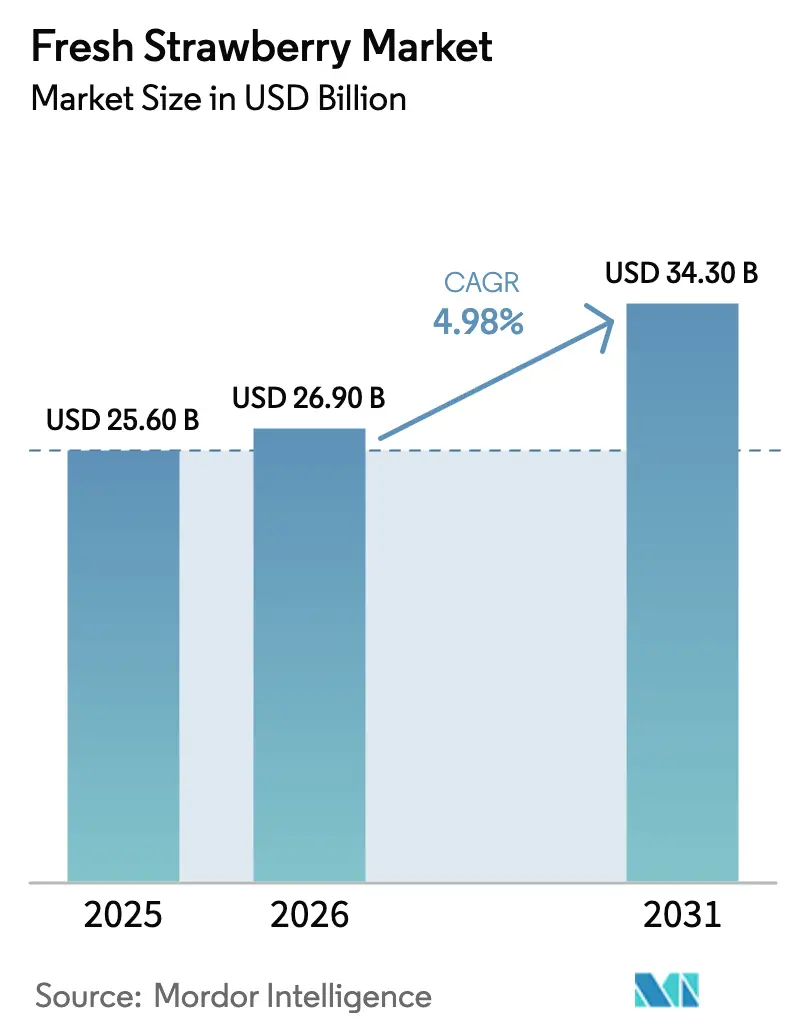
The Fresh Strawberry Market is projected to grow from USD 25.6 billion in 2025 to USD 26.9 billion in 2026 and is forecast to reach USD 34.3 billion by 2031 at a 4.98% CAGR over 2026-2031. Protected cultivation, counter-seasonal sourcing across hemispheres, and the rapid uptake of day-neutral genetics collectively underpin this growth trajectory, allowing retailers to keep shelves stocked year-round. Grower economics remain challenged by rising labor costs, yet yield stability in high-tech tunnels and greenhouses is offsetting margin pressure in many regions. Asia-Pacific dominates current volume, while Africa is emerging fastest, with Moroccan and Egyptian producers adding protected acreage to meet European winter demand. The fresh strawberry market continues to attract investment due to fragmented competition, which provides opportunities for regional specialists and technology-driven entrants to differentiate through genetics, sustainability, and logistics.
Key Report Takeaways
- By geography, Asia-Pacific commanded 35.2% of the fresh strawberry market share in 2025, while Africa is projected to record the 6.2% CAGR over the forecast period.
Note: Market size and forecast figures in this report are generated using Mordor Intelligence’s proprietary estimation framework, updated with the latest available data and insights as of January 2026.
Global Fresh Strawberry Market Trends and Insights
Drivers Impact Analysis*
| Driver | (~) % Impact on CAGR Forecast | Geographic Relevance | Impact Timeline |
|---|---|---|---|
| Expanding off-season supermarket demand | +1.2% | North America and Europe lead | Medium term (2-4 years) |
| Growth in protected cultivation acreage | +1.0% | Asia-Pacific core, strong in the Middle East and North America | Long term (≥4 years) |
| Adoption of day-neutral and ever-bearing cultivars | +0.8% | North America and Europe | Medium term (2-4 years) |
| Rise of online wholesale trading platforms | +0.5% | North America and Asia-Pacific | Short term (≤2 years) |
| Carbon-footprint labeling driving local sourcing premiums | +0.4% | Europe and North America | Medium term (2-4 years) |
| Genetic advances enabling heat-tolerant strawberries | +0.3% | Middle East, Africa, and Asia-Pacific | Long term (≥4 years) |
| Source: Mordor Intelligence | |||
Expanding Off-Season Supermarket Demand
Retailers in North America and Europe now treat twelve-month strawberry availability as a strategic requirement. They blend California summer output with Chilean and Moroccan winter fruit shipped in controlled-temperature containers. Multi-year supply contracts indexed to freight and fertilizer costs give large growers predictable revenue while exposing smaller farms to spot-market swings. Per-capita consumption keeps rising as consistent supply turns strawberries into an everyday purchase [1]Source: United States Department of Agriculture, “Fruit and Tree Nut Outlook 2026,” USDA, usda.gov.
Growth in Protected Cultivation Acreage
Greenhouses and high tunnels already cover more than 40% of global strawberry hectares, up sharply from 2020 levels. Yields above 12 kilograms per square meter and longer harvest windows justify capital costs exceeding USD 500,000 per hectare. Subsidy programs in China and Gulf states reimburse up to 40% of these investments, speeding adoption in land-scarce or climate-challenged zones. The projected growth rate for protected systems is projected to remain strong through 2031[2]Source: Eurostat, “Agriculture and Horticulture Statistics,” European Commission, ec.europa.eu .
Adoption of Day-Neutral and Ever-Bearing Cultivars
Day-neutral genetics, such as Albion and San Andreas fruit, are continuously under long daylight, closing seasonal supply gaps. California acreage planted to such varieties now tops 60%, reflecting grower preference for extended picking windows that smooth labor demand. Public breeding programs add disease resistance and firmness traits, letting these cultivars command price premiums in wholesale markets. The category is experiencing steady growth, driven by retailers' preference for consistent calendars and growers' efforts to mitigate weather-related risks.
Carbon-footprint labeling driving local sourcing premiums
European supermarkets now display greenhouse-gas scores on berry packs, highlighting emissions from field to shelf. Driscoll’s pilot showed locally grown fruit earned 10% to 15% higher prices when labels underscored lower transport emissions. Retail buyers are weaving these metrics into contracts to meet corporate Scope 3 targets. The practice is expanding to North American chains and is anticipated to contribute to the forecasted growth as growers benefit from locality premiums[3]Source: United Kingdom Department for Environment, Food and Rural Affairs, “Food Strategy 2026,” GOV.UK, gov.uk .
Restraints Impact Analysis*
| Restraint | (~) % Impact on CAGR Forecast | Geographic Relevance | Impact Timeline |
|---|---|---|---|
| Farm-labor shortages and higher wages | -0.9% | North America, Europe, and Australia | Short term (≤2 years) |
| Climate-driven extreme weather volatility | -0.7% | California, Spain, and central China | Medium term (2-4 years) |
| Soil-borne disease and pesticide resistance | -0.5% | Open-field systems worldwide | Long term (≥4 years) |
| Increasing phytosanitary barriers in key importing nations | -0.3% | Export hubs in North Africa, South America, and Mexico | Medium term (2-4 years) |
| Source: Mordor Intelligence | |||
Soil-Borne Disease and Pesticide Resistance
Verticillium wilt and Fusarium oxysporum persist in soil for years and can slash yields by up to half once fields are infected. Chemical fumigants such as methyl bromide are banned, leaving growers with limited curative options and forcing reliance on crop rotation and resistant cultivars. Two-spotted spider mites and aphids exhibit reduced sensitivity to common insecticides, driving up spray frequency and cost. Adopting integrated pest management requires investments in biological controls and staff training that many smallholders cannot fund.
Increasing phytosanitary barriers in key importing nations
The European Union lowered maximum residue levels for key fungicides effective January 2025, imposing costly compliance testing on exporters in Morocco, Mexico, and Peru. The United States Food and Drug Administration has intensified inspections and issues import alerts when shipments exceed tolerance thresholds. Suppliers must reformulate spray programs and upgrade laboratory capacity, raising per-kilogram costs and thinning profit margins. Heightened scrutiny also slows border transit times, shortening the shelf life of berries that do reach market.
*Our forecasts treat driver/restraint impacts as directional, not additive. The impact forecasts reflect baseline growth, mix effects, and variable interactions.
Geography Analysis
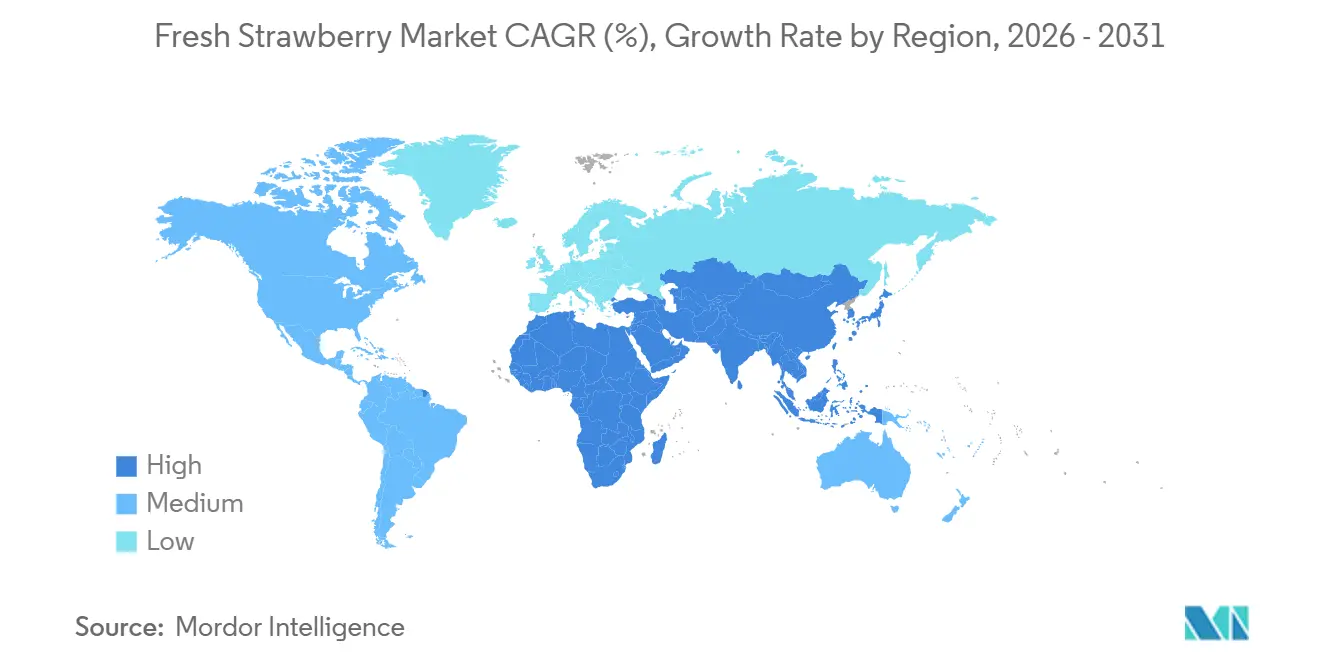
Asia-Pacific held the leading position with 35.2% of fresh strawberry market share in 2025, powered by China’s output and by aggressive greenhouse adoption in Japan and South Korea. Rising middle-class incomes and urban cold-chain expansion support continued regional growth through 2031. Africa, led by Morocco and Egypt, is the fastest-growing region and is projected to advance at a 6.2% CAGR as protected acreage scales to meet European winter demand. Government subsidies that offset up to 40% of tunnel construction costs further accelerate African capacity gains.
North America relies on California for most summer volume and Mexico for winter shipments, ensuring supermarkets receive fruit every month. Europe sources winter berries from Spain and Morocco while Poland and Germany supply spring and summer demand, maintaining relatively stable consumption levels. The Middle East is building climate-controlled greenhouses in the United Arab Emirates and Saudi Arabia to cut reliance on imports, and early harvests show promising yields. South America, anchored by Chile and Argentina, continues to leverage counter-seasonal supply windows into Northern Hemisphere markets.
Expanded protected cultivation, improved genetics, and digital trading platforms are helping every region lift output and reduce waste. Asia-Pacific growers are trialing vertical farms near major cities, a model that could spread once renewable electricity costs fall. African exporters are investing in faster sea freight and quality monitoring to enhance shelf life and capture higher European premiums. Collectively, these initiatives are projected to enlarge global supply, keep retail prices stable, and draw new consumers into the category.


Competitive Landscape
The five largest suppliers together accounted for majority of global revenue in 2025, confirming a moderately fragmented market. Driscoll’s leads by leveraging proprietary genetics and a global network of licensed growers that deliver uniform quality across continents. Naturipe Farms follows with a multi-hemisphere sourcing model that balances California summer fruit with Mexico and Peru winter harvests, giving retailers year-round volumes. Both companies invest heavily in sensor-based irrigation and blockchain traceability to secure premium shelf space with supermarket chains.
Hortifrut anchors its strategy on joint ventures in Chile and Mexico that align supply with North American retail calendars. Costa Group concentrates on high-tech glasshouses in Australia and expanding distribution into key Asian cities where consumers pay premiums for branded berries. BerryWorld operates a grower-cooperative model that aggregates fruit from Europe and South Africa, spreading climate risk and meeting strict European residue rules. These firms differentiate through exclusive cultivars, integrated logistics, and strong retailer relationships rather than sheer acreage.
Growth initiatives revolve around protected cultivation, genetics, and digital market access. Driscoll’s partnership with Plenty Unlimited pilots vertical farms that can place production near urban centers and trim freight time. Hortifrut and Naturipe are expanding protected hectares in Peru and Mexico, aiming to lift combined output by 25% within three years. At the same time, Costa Group and BerryWorld pursue automation and renewable-powered greenhouses to meet rising sustainability standards in export destinations.
Recent Industry Developments
- June 2025: Université Laval received CAD 5 million (USD 3.8 million) in federal and provincial funding to extend Canada’s berry season and deliver healthy, resilient, high-performance strawberry plants, supporting growers in cooler climates.
- November 2025: The Brazilian Agricultural Research Corporation (Embrapa) reported that the new Fênix cultivar has doubled domestic strawberry production, strengthening Brazil’s internal supply and reducing dependence on imports.
- December 2025: Malaysia’s Agroz introduced an AI-enabled controlled environment system that now cultivates premium Japanese strawberries in vertical farms, and targeting local distribution by Q2 2026 before expanding into Southeast Asia and Gulf Cooperation Council markets.


Global Fresh Strawberry Market Report Scope
The Fresh Strawberry Market Report is Segmented by Geography (North America, South America, and More). The Report Includes Production Analysis (Volume), Consumption Analysis (Value and Volume), Import Analysis (Value and Volume), Export Analysis (Value and Volume), Wholesale Price Trend Analysis and Forecast, Regulatory Framework, List of Key Players, Logistics and Infrastructure, and Seasonality Analysis. The Market Forecasts are Provided in Terms of Value (USD) and Volume (Metric Tons).
| North America | United States | Production Analysis (Area Harvested, Yield, and Production Volume) |
| Consumption Analysis (Consumption Value and Volume) | ||
| Import Market Analysis (Import Value, Volume, and Key Supplying Markets) | ||
| Export Market Analysis (Export Value, Volume, and Key Destination Markets) | ||
| Wholesale Price Trend Analysis and Forecast | ||
| Regulatory Framework | ||
| List of Key Players | ||
| Logistics and Infrastructure | ||
| Seasonality Analysis | ||
| Canada | Production Analysis (Area Harvested, Yield, and Production Volume) | |
| Consumption Analysis (Consumption Value and Volume) | ||
| Import Market Analysis (Import Value, Volume, and Key Supplying Markets) | ||
| Export Market Analysis (Export Value, Volume, and Key Destination Markets) | ||
| Wholesale Price Trend Analysis and Forecast | ||
| Regulatory Framework | ||
| List of Key Players | ||
| Logistics and Infrastructure | ||
| Seasonality Analysis | ||
| Mexico | Production Analysis (Area Harvested, Yield, and Production Volume) | |
| Consumption Analysis (Consumption Value and Volume) | ||
| Import Market Analysis (Import Value, Volume, and Key Supplying Markets) | ||
| Export Market Analysis (Export Value, Volume, and Key Destination Markets) | ||
| Wholesale Price Trend Analysis and Forecast | ||
| Regulatory Framework | ||
| List of Key Players | ||
| Logistics and Infrastructure | ||
| Seasonality Analysis | ||
| South America | Brazil | Production Analysis (Area Harvested, Yield, and Production Volume) |
| Consumption Analysis (Consumption Value and Volume) | ||
| Import Market Analysis (Import Value, Volume, and Key Supplying Markets) | ||
| Export Market Analysis (Export Value, Volume, and Key Destination Markets) | ||
| Wholesale Price Trend Analysis and Forecast | ||
| Regulatory Framework | ||
| List of Key Players | ||
| Logistics and Infrastructure | ||
| Seasonality Analysis | ||
| Argentina | Production Analysis (Area Harvested, Yield, and Production Volume) | |
| Consumption Analysis (Consumption Value and Volume) | ||
| Import Market Analysis (Import Value, Volume, and Key Supplying Markets) | ||
| Export Market Analysis (Export Value, Volume, and Key Destination Markets) | ||
| Wholesale Price Trend Analysis and Forecast | ||
| Regulatory Framework | ||
| List of Key Players | ||
| Logistics and Infrastructure | ||
| Seasonality Analysis | ||
| Chile | Production Analysis (Area Harvested, Yield, and Production Volume) | |
| Consumption Analysis (Consumption Value and Volume) | ||
| Import Market Analysis (Import Value, Volume, and Key Supplying Markets) | ||
| Export Market Analysis (Export Value, Volume, and Key Destination Markets) | ||
| Wholesale Price Trend Analysis and Forecast | ||
| Regulatory Framework | ||
| List of Key Players | ||
| Logistics and Infrastructure | ||
| Seasonality Analysis | ||
| Europe | Germany | Production Analysis (Area Harvested, Yield, and Production Volume) |
| Consumption Analysis (Consumption Value and Volume) | ||
| Import Market Analysis (Import Value, Volume, and Key Supplying Markets) | ||
| Export Market Analysis (Export Value, Volume, and Key Destination Markets) | ||
| Wholesale Price Trend Analysis and Forecast | ||
| Regulatory Framework | ||
| List of Key Players | ||
| Logistics and Infrastructure | ||
| Seasonality Analysis | ||
| France | Production Analysis (Area Harvested, Yield, and Production Volume) | |
| Consumption Analysis (Consumption Value and Volume) | ||
| Import Market Analysis (Import Value, Volume, and Key Supplying Markets) | ||
| Export Market Analysis (Export Value, Volume, and Key Destination Markets) | ||
| Wholesale Price Trend Analysis and Forecast | ||
| Regulatory Framework | ||
| List of Key Players | ||
| Logistics and Infrastructure | ||
| Seasonality Analysis | ||
| Spain | Production Analysis (Area Harvested, Yield, and Production Volume) | |
| Consumption Analysis (Consumption Value and Volume) | ||
| Import Market Analysis (Import Value, Volume, and Key Supplying Markets) | ||
| Export Market Analysis (Export Value, Volume, and Key Destination Markets) | ||
| Wholesale Price Trend Analysis and Forecast | ||
| Regulatory Framework | ||
| List of Key Players | ||
| Logistics and Infrastructure | ||
| Seasonality Analysis | ||
| Poland | Production Analysis (Area Harvested, Yield, and Production Volume) | |
| Consumption Analysis (Consumption Value and Volume) | ||
| Import Market Analysis (Import Value, Volume, and Key Supplying Markets) | ||
| Export Market Analysis (Export Value, Volume, and Key Destination Markets) | ||
| Wholesale Price Trend Analysis and Forecast | ||
| Regulatory Framework | ||
| List of Key Players | ||
| Logistics and Infrastructure | ||
| Seasonality Analysis | ||
| Russia | Production Analysis (Area Harvested, Yield, and Production Volume) | |
| Consumption Analysis (Consumption Value and Volume) | ||
| Import Market Analysis (Import Value, Volume, and Key Supplying Markets) | ||
| Export Market Analysis (Export Value, Volume, and Key Destination Markets) | ||
| Wholesale Price Trend Analysis and Forecast | ||
| Regulatory Framework | ||
| List of Key Players | ||
| Logistics and Infrastructure | ||
| Seasonality Analysis | ||
| Asia-Pacific | China | Production Analysis (Area Harvested, Yield, and Production Volume) |
| Consumption Analysis (Consumption Value and Volume) | ||
| Import Market Analysis (Import Value, Volume, and Key Supplying Markets) | ||
| Export Market Analysis (Export Value, Volume, and Key Destination Markets) | ||
| Wholesale Price Trend Analysis and Forecast | ||
| Regulatory Framework | ||
| List of Key Players | ||
| Logistics and Infrastructure | ||
| Seasonality Analysis | ||
| Japan | Production Analysis (Area Harvested, Yield, and Production Volume) | |
| Consumption Analysis (Consumption Value and Volume) | ||
| Import Market Analysis (Import Value, Volume, and Key Supplying Markets) | ||
| Export Market Analysis (Export Value, Volume, and Key Destination Markets) | ||
| Wholesale Price Trend Analysis and Forecast | ||
| Regulatory Framework | ||
| List of Key Players | ||
| Logistics and Infrastructure | ||
| Seasonality Analysis | ||
| India | Production Analysis (Area Harvested, Yield, and Production Volume) | |
| Consumption Analysis (Consumption Value and Volume) | ||
| Import Market Analysis (Import Value, Volume, and Key Supplying Markets) | ||
| Export Market Analysis (Export Value, Volume, and Key Destination Markets) | ||
| Wholesale Price Trend Analysis and Forecast | ||
| Regulatory Framework | ||
| List of Key Players | ||
| Logistics and Infrastructure | ||
| Seasonality Analysis | ||
| South Korea | Production Analysis (Area Harvested, Yield, and Production Volume) | |
| Consumption Analysis (Consumption Value and Volume) | ||
| Import Market Analysis (Import Value, Volume, and Key Supplying Markets) | ||
| Export Market Analysis (Export Value, Volume, and Key Destination Markets) | ||
| Wholesale Price Trend Analysis and Forecast | ||
| Regulatory Framework | ||
| List of Key Players | ||
| Logistics and Infrastructure | ||
| Seasonality Analysis | ||
| Middle East | Turkey | Production Analysis (Area Harvested, Yield, and Production Volume) |
| Consumption Analysis (Consumption Value and Volume) | ||
| Import Market Analysis (Import Value, Volume, and Key Supplying Markets) | ||
| Export Market Analysis (Export Value, Volume, and Key Destination Markets) | ||
| Wholesale Price Trend Analysis and Forecast | ||
| Regulatory Framework | ||
| List of Key Players | ||
| Logistics and Infrastructure | ||
| Seasonality Analysis | ||
| Saudi Arabia | Production Analysis (Area Harvested, Yield, and Production Volume) | |
| Consumption Analysis (Consumption Value and Volume) | ||
| Import Market Analysis (Import Value, Volume, and Key Supplying Markets) | ||
| Export Market Analysis (Export Value, Volume, and Key Destination Markets) | ||
| Wholesale Price Trend Analysis and Forecast | ||
| Regulatory Framework | ||
| List of Key Players | ||
| Logistics and Infrastructure | ||
| Seasonality Analysis | ||
| United Arab Emirates | Production Analysis (Area Harvested, Yield, and Production Volume) | |
| Consumption Analysis (Consumption Value and Volume) | ||
| Import Market Analysis (Import Value, Volume, and Key Supplying Markets) | ||
| Export Market Analysis (Export Value, Volume, and Key Destination Markets) | ||
| Wholesale Price Trend Analysis and Forecast | ||
| Regulatory Framework | ||
| List of Key Players | ||
| Logistics and Infrastructure | ||
| Seasonality Analysis | ||
| Africa | South Africa | Production Analysis (Area Harvested, Yield, and Production Volume) |
| Consumption Analysis (Consumption Value and Volume) | ||
| Import Market Analysis (Import Value, Volume, and Key Supplying Markets) | ||
| Export Market Analysis (Export Value, Volume, and Key Destination Markets) | ||
| Wholesale Price Trend Analysis and Forecast | ||
| Regulatory Framework | ||
| List of Key Players | ||
| Logistics and Infrastructure | ||
| Seasonality Analysis | ||
| Egypt | Production Analysis (Area Harvested, Yield, and Production Volume) | |
| Consumption Analysis (Consumption Value and Volume) | ||
| Import Market Analysis (Import Value, Volume, and Key Supplying Markets) | ||
| Export Market Analysis (Export Value, Volume, and Key Destination Markets) | ||
| Wholesale Price Trend Analysis and Forecast | ||
| Regulatory Framework | ||
| List of Key Players | ||
| Logistics and Infrastructure | ||
| Seasonality Analysis | ||
| Morocco | Production Analysis (Area Harvested, Yield, and Production Volume) | |
| Consumption Analysis (Consumption Value and Volume) | ||
| Import Market Analysis (Import Value, Volume, and Key Supplying Markets) | ||
| Export Market Analysis (Export Value, Volume, and Key Destination Markets) | ||
| Wholesale Price Trend Analysis and Forecast | ||
| Regulatory Framework | ||
| List of Key Players | ||
| Logistics and Infrastructure | ||
| Seasonality Analysis | ||
| By Geography | North America | United States | Production Analysis (Area Harvested, Yield, and Production Volume) |
| Consumption Analysis (Consumption Value and Volume) | |||
| Import Market Analysis (Import Value, Volume, and Key Supplying Markets) | |||
| Export Market Analysis (Export Value, Volume, and Key Destination Markets) | |||
| Wholesale Price Trend Analysis and Forecast | |||
| Regulatory Framework | |||
| List of Key Players | |||
| Logistics and Infrastructure | |||
| Seasonality Analysis | |||
| Canada | Production Analysis (Area Harvested, Yield, and Production Volume) | ||
| Consumption Analysis (Consumption Value and Volume) | |||
| Import Market Analysis (Import Value, Volume, and Key Supplying Markets) | |||
| Export Market Analysis (Export Value, Volume, and Key Destination Markets) | |||
| Wholesale Price Trend Analysis and Forecast | |||
| Regulatory Framework | |||
| List of Key Players | |||
| Logistics and Infrastructure | |||
| Seasonality Analysis | |||
| Mexico | Production Analysis (Area Harvested, Yield, and Production Volume) | ||
| Consumption Analysis (Consumption Value and Volume) | |||
| Import Market Analysis (Import Value, Volume, and Key Supplying Markets) | |||
| Export Market Analysis (Export Value, Volume, and Key Destination Markets) | |||
| Wholesale Price Trend Analysis and Forecast | |||
| Regulatory Framework | |||
| List of Key Players | |||
| Logistics and Infrastructure | |||
| Seasonality Analysis | |||
| South America | Brazil | Production Analysis (Area Harvested, Yield, and Production Volume) | |
| Consumption Analysis (Consumption Value and Volume) | |||
| Import Market Analysis (Import Value, Volume, and Key Supplying Markets) | |||
| Export Market Analysis (Export Value, Volume, and Key Destination Markets) | |||
| Wholesale Price Trend Analysis and Forecast | |||
| Regulatory Framework | |||
| List of Key Players | |||
| Logistics and Infrastructure | |||
| Seasonality Analysis | |||
| Argentina | Production Analysis (Area Harvested, Yield, and Production Volume) | ||
| Consumption Analysis (Consumption Value and Volume) | |||
| Import Market Analysis (Import Value, Volume, and Key Supplying Markets) | |||
| Export Market Analysis (Export Value, Volume, and Key Destination Markets) | |||
| Wholesale Price Trend Analysis and Forecast | |||
| Regulatory Framework | |||
| List of Key Players | |||
| Logistics and Infrastructure | |||
| Seasonality Analysis | |||
| Chile | Production Analysis (Area Harvested, Yield, and Production Volume) | ||
| Consumption Analysis (Consumption Value and Volume) | |||
| Import Market Analysis (Import Value, Volume, and Key Supplying Markets) | |||
| Export Market Analysis (Export Value, Volume, and Key Destination Markets) | |||
| Wholesale Price Trend Analysis and Forecast | |||
| Regulatory Framework | |||
| List of Key Players | |||
| Logistics and Infrastructure | |||
| Seasonality Analysis | |||
| Europe | Germany | Production Analysis (Area Harvested, Yield, and Production Volume) | |
| Consumption Analysis (Consumption Value and Volume) | |||
| Import Market Analysis (Import Value, Volume, and Key Supplying Markets) | |||
| Export Market Analysis (Export Value, Volume, and Key Destination Markets) | |||
| Wholesale Price Trend Analysis and Forecast | |||
| Regulatory Framework | |||
| List of Key Players | |||
| Logistics and Infrastructure | |||
| Seasonality Analysis | |||
| France | Production Analysis (Area Harvested, Yield, and Production Volume) | ||
| Consumption Analysis (Consumption Value and Volume) | |||
| Import Market Analysis (Import Value, Volume, and Key Supplying Markets) | |||
| Export Market Analysis (Export Value, Volume, and Key Destination Markets) | |||
| Wholesale Price Trend Analysis and Forecast | |||
| Regulatory Framework | |||
| List of Key Players | |||
| Logistics and Infrastructure | |||
| Seasonality Analysis | |||
| Spain | Production Analysis (Area Harvested, Yield, and Production Volume) | ||
| Consumption Analysis (Consumption Value and Volume) | |||
| Import Market Analysis (Import Value, Volume, and Key Supplying Markets) | |||
| Export Market Analysis (Export Value, Volume, and Key Destination Markets) | |||
| Wholesale Price Trend Analysis and Forecast | |||
| Regulatory Framework | |||
| List of Key Players | |||
| Logistics and Infrastructure | |||
| Seasonality Analysis | |||
| Poland | Production Analysis (Area Harvested, Yield, and Production Volume) | ||
| Consumption Analysis (Consumption Value and Volume) | |||
| Import Market Analysis (Import Value, Volume, and Key Supplying Markets) | |||
| Export Market Analysis (Export Value, Volume, and Key Destination Markets) | |||
| Wholesale Price Trend Analysis and Forecast | |||
| Regulatory Framework | |||
| List of Key Players | |||
| Logistics and Infrastructure | |||
| Seasonality Analysis | |||
| Russia | Production Analysis (Area Harvested, Yield, and Production Volume) | ||
| Consumption Analysis (Consumption Value and Volume) | |||
| Import Market Analysis (Import Value, Volume, and Key Supplying Markets) | |||
| Export Market Analysis (Export Value, Volume, and Key Destination Markets) | |||
| Wholesale Price Trend Analysis and Forecast | |||
| Regulatory Framework | |||
| List of Key Players | |||
| Logistics and Infrastructure | |||
| Seasonality Analysis | |||
| Asia-Pacific | China | Production Analysis (Area Harvested, Yield, and Production Volume) | |
| Consumption Analysis (Consumption Value and Volume) | |||
| Import Market Analysis (Import Value, Volume, and Key Supplying Markets) | |||
| Export Market Analysis (Export Value, Volume, and Key Destination Markets) | |||
| Wholesale Price Trend Analysis and Forecast | |||
| Regulatory Framework | |||
| List of Key Players | |||
| Logistics and Infrastructure | |||
| Seasonality Analysis | |||
| Japan | Production Analysis (Area Harvested, Yield, and Production Volume) | ||
| Consumption Analysis (Consumption Value and Volume) | |||
| Import Market Analysis (Import Value, Volume, and Key Supplying Markets) | |||
| Export Market Analysis (Export Value, Volume, and Key Destination Markets) | |||
| Wholesale Price Trend Analysis and Forecast | |||
| Regulatory Framework | |||
| List of Key Players | |||
| Logistics and Infrastructure | |||
| Seasonality Analysis | |||
| India | Production Analysis (Area Harvested, Yield, and Production Volume) | ||
| Consumption Analysis (Consumption Value and Volume) | |||
| Import Market Analysis (Import Value, Volume, and Key Supplying Markets) | |||
| Export Market Analysis (Export Value, Volume, and Key Destination Markets) | |||
| Wholesale Price Trend Analysis and Forecast | |||
| Regulatory Framework | |||
| List of Key Players | |||
| Logistics and Infrastructure | |||
| Seasonality Analysis | |||
| South Korea | Production Analysis (Area Harvested, Yield, and Production Volume) | ||
| Consumption Analysis (Consumption Value and Volume) | |||
| Import Market Analysis (Import Value, Volume, and Key Supplying Markets) | |||
| Export Market Analysis (Export Value, Volume, and Key Destination Markets) | |||
| Wholesale Price Trend Analysis and Forecast | |||
| Regulatory Framework | |||
| List of Key Players | |||
| Logistics and Infrastructure | |||
| Seasonality Analysis | |||
| Middle East | Turkey | Production Analysis (Area Harvested, Yield, and Production Volume) | |
| Consumption Analysis (Consumption Value and Volume) | |||
| Import Market Analysis (Import Value, Volume, and Key Supplying Markets) | |||
| Export Market Analysis (Export Value, Volume, and Key Destination Markets) | |||
| Wholesale Price Trend Analysis and Forecast | |||
| Regulatory Framework | |||
| List of Key Players | |||
| Logistics and Infrastructure | |||
| Seasonality Analysis | |||
| Saudi Arabia | Production Analysis (Area Harvested, Yield, and Production Volume) | ||
| Consumption Analysis (Consumption Value and Volume) | |||
| Import Market Analysis (Import Value, Volume, and Key Supplying Markets) | |||
| Export Market Analysis (Export Value, Volume, and Key Destination Markets) | |||
| Wholesale Price Trend Analysis and Forecast | |||
| Regulatory Framework | |||
| List of Key Players | |||
| Logistics and Infrastructure | |||
| Seasonality Analysis | |||
| United Arab Emirates | Production Analysis (Area Harvested, Yield, and Production Volume) | ||
| Consumption Analysis (Consumption Value and Volume) | |||
| Import Market Analysis (Import Value, Volume, and Key Supplying Markets) | |||
| Export Market Analysis (Export Value, Volume, and Key Destination Markets) | |||
| Wholesale Price Trend Analysis and Forecast | |||
| Regulatory Framework | |||
| List of Key Players | |||
| Logistics and Infrastructure | |||
| Seasonality Analysis | |||
| Africa | South Africa | Production Analysis (Area Harvested, Yield, and Production Volume) | |
| Consumption Analysis (Consumption Value and Volume) | |||
| Import Market Analysis (Import Value, Volume, and Key Supplying Markets) | |||
| Export Market Analysis (Export Value, Volume, and Key Destination Markets) | |||
| Wholesale Price Trend Analysis and Forecast | |||
| Regulatory Framework | |||
| List of Key Players | |||
| Logistics and Infrastructure | |||
| Seasonality Analysis | |||
| Egypt | Production Analysis (Area Harvested, Yield, and Production Volume) | ||
| Consumption Analysis (Consumption Value and Volume) | |||
| Import Market Analysis (Import Value, Volume, and Key Supplying Markets) | |||
| Export Market Analysis (Export Value, Volume, and Key Destination Markets) | |||
| Wholesale Price Trend Analysis and Forecast | |||
| Regulatory Framework | |||
| List of Key Players | |||
| Logistics and Infrastructure | |||
| Seasonality Analysis | |||
| Morocco | Production Analysis (Area Harvested, Yield, and Production Volume) | ||
| Consumption Analysis (Consumption Value and Volume) | |||
| Import Market Analysis (Import Value, Volume, and Key Supplying Markets) | |||
| Export Market Analysis (Export Value, Volume, and Key Destination Markets) | |||
| Wholesale Price Trend Analysis and Forecast | |||
| Regulatory Framework | |||
| List of Key Players | |||
| Logistics and Infrastructure | |||
| Seasonality Analysis | |||


Key Questions Answered in the Report
How large will the fresh strawberry market be in 2031?
It is forecast to reach USD 34.3 billion by 2031, expanding at a 4.98% CAGR from 2026.
Which production system is growing fastest in fresh strawberries?
Protected cultivation, including tunnels and greenhouses, is projected to expand at a higher growth rate through 2031.
What region currently leads global strawberry demand?
Asia-Pacific holds the largest share at 35.2%, driven by China’s dominant production and rising consumption.
Who is the leading company in fresh strawberries?
Driscoll’s leads with a significant revenue share, supported by proprietary genetics and a global grower network.
Why are day-neutral cultivars important?
They allow continuous harvests over six to eight months, easing labor peaks and meeting retailer demand for year-round supply.
Page last updated on:


 Your data is secure and never sold or shared.


