
France Soil Monitoring Market Size and Share
Market Overview
| Study Period | 2022 - 2032 |
|---|---|
| Forecast Data Period | 2027 - 2032 |
| Base Year Market Size (2026) | USD 44.35 Million |
| Market Size (2027) | USD 48.18 Million |
| Market Size (2032) | USD 72.88 Million |
| Growth Rate (2027 - 2032) | 8.63 % |
| Market Concentration | Medium |
Major Players *Disclaimer: Major Players sorted in no particular order Image © Mordor Intelligence. Reuse requires attribution under CC BY 4.0. | |
France Soil Monitoring Market Analysis by Mordor Intelligence
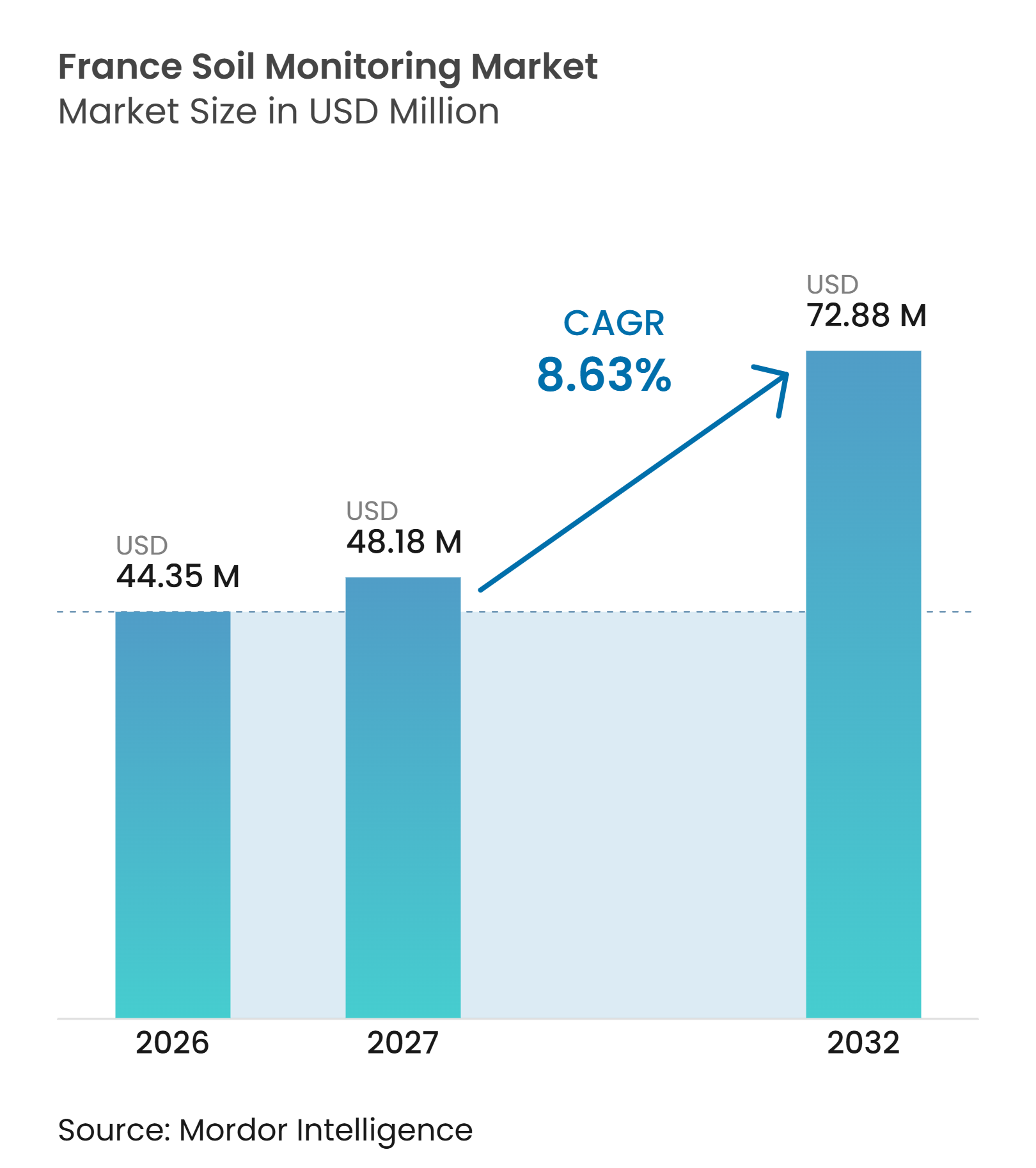
The France Soil Monitoring Market was valued at USD 44.35 million in 2026 and is estimated to reach USD 48.18 million in 2027. The market size is forecast to reach USD 72.88 million by 2032, growing at a CAGR of 8.63% from 2027 to 2032. France’s agricultural base makes continuous diagnostics increasingly relevant to farm operations, particularly where input use, water availability, and regulatory reporting are closely linked. The seventh national nitrate action program and related regional programs have made nitrogen-residue measurement a recurring requirement in vulnerable areas, providing a steadier basis for monitoring purchases. Suppliers are responding by combining sensors, connectivity, and agronomic advice rather than selling equipment alone. This model can make monitoring more practical for farms that need support with interpreting measurements and documenting decisions in the French soil-monitoring market.
Key Report Takeaways
- By component, hardware was the largest segment, accounting for 56.6% of the France soil monitoring market share in 2026, while services are the fastest-growing segment and are forecast to grow at a CAGR of 6.3% from 2027 to 2032.
- By product type, in-situ sensors were the largest segment, accounting for 47.1% of the France soil monitoring market share in 2026, while remote sensing platforms are the fastest-growing segment and are forecast to grow at a CAGR of 8.1% from 2027 to 2032.
- By connectivity technology, wireless connectivity was both the largest and fastest-growing segment, accounting for 74.1% of the France soil monitoring market size in 2026, and is forecast to grow at a CAGR of 9.8% from 2027 to 2032.
- By application, open-field agriculture was the largest segment, accounting for 63.8% share of the France soil monitoring market in 2026, while protected cultivation is the fastest-growing segment and is forecast to grow at a CAGR of 8.2% from 2027 to 2032.
- By end user, large commercial farms were the largest segment, accounting for 42.9% share of the France soil monitoring market in 2026, while research institutes and universities are the fastest-growing segment and are forecast to grow at a CAGR of 7.6% from 2027 to 2032.
Note: Market numbers in this report are based on Mordor Intelligence's proprietary estimation framework, which combines nine months of actuals with Q4 projections for base year 2026.
Market Trends and Insights
Drivers Impact Analysis of France Soil Monitoring Market*
| Driver | (~) % Impact on CAGR Forecast | Geographic Relevance | Impact Timeline |
|---|---|---|---|
| Precision agriculture and input optimization adoption | +2.2% | France, with early gains in the Paris Basin and Grand Est | Medium term (2-4 years) |
| Water-scarcity-driven irrigation management | +1.7% | Occitanie, Nouvelle-Aquitaine, and Provence-Alpes-Côte d’Azur | Short term (≤ 2 years) |
| Nitrate compliance and nitrogen-residue testing | +1.4% | France, especially vulnerable zones in Bretagne and Pays de la Loire | Short term (≤ 2 years) |
| CAP and public funding for digital and sustainable agriculture | +1.1% | France, with cross-border research support | Medium term (2-4 years) |
| National soil-quality monitoring and open data infrastructure | +0.7% | France, including the Réseau de Mesures de la Qualité des Sols network | Long term (≥ 4 years) |
| Sensor-to-decision-support integration | +0.9% | France, particularly viticulture and row-crop areas | Medium term (2-4 years) |
| Source: Mordor Intelligence | |||
Precision Agriculture and Input Optimization Adoption
Precision agriculture has moved beyond small trials in many French farming areas, and the France soil monitoring market now supports its routine use. Variable-rate nitrogen programs depend on field information about organic matter, electrical conductivity, and pH. Fertilizer price volatility has increased the value of avoiding unnecessary applications. Soil mapping methods developed by Institut National de Recherche pour l’Agriculture, l’Alimentation et l’Environnement use automated analysis of multispectral imagery to make detailed characterization more accessible. Pessl Instruments GmbH, through Metos France, is active on 15,000 French farms, showing the importance of locally supported deployment. Cooperatives can spread infrastructure and advisory costs across member farms, which expands access beyond what individual farm budgets would support.
Water-Scarcity-Driven Irrigation Management
Water stress is creating a direct reason for growers to use soil moisture measurements in southern France. Irrigation consumption could more than double in nearly 1 quarter of French catchments under the stated trend scenario, with the Adour-Garonne basin among the areas facing the highest risk. The 2025 Fonds hydraulique agricole supported 97 water-resilience projects, including 14 in Occitanie and 10 in Nouvelle-Aquitaine[1]. These projects create demand for equipment that helps farms schedule irrigation. Weenat works with UnaBiz France and Orange Business through networks that use Sigfox 0G and Long Range Wide Area Network connectivity. Moisture records also help growers respond to water restrictions set by local authorities.
Nitrate Compliance and Nitrogen-Residue Testing
The seventh Programme d'Actions Nitrates has strengthened the link between soil measurement and fertilizer decisions. The national program took effect in January 2024, while regional programs began in September 2024. In designated vulnerable areas, nitrogen residue measurements are required before fertilizer application. This requirement ensures that fertilizer application rates are based on actual soil nitrogen levels, reducing the risk of over-application and minimizing nitrate leaching into water bodies. The program also introduces stricter record-keeping obligations for farmers, who must document soil measurement results and corresponding fertilizer decisions. These measures aim to improve nitrogen use efficiency across French agricultural zones while aligning with broader European Union nitrate reduction targets under the Nitrates Directive[2]. A ministerial circular issued in June 2025 initiated a new designation round that will take effect from September 2026. Satellite-based advice can support fertilizer decisions, but a 2025 study noted regulatory tensions around relying on remote data alone. This keeps a role for field measurements alongside satellite-based advice.
Common Agricultural Policy and Public Funding for Digital Agriculture
France’s Common Agricultural Policy Strategic Plan supports precision investment, farm digitalization, and advisory services. The plan was amended in March 2026, so these measures remain part of the current policy framework. FranceAgriMer allocated EUR 15.1 million (USD 16.3 million) through its 2025 knowledge funding program for applied research and knowledge-sharing projects, including work relevant to digital soil tools[3]. Reimbursements can follow procurement by 12 to 18 months, which favors farms with stronger cash flow. The European Commission’s 2025 proposal for the next policy period reserves EUR 293.7 billion (USD 317.2 billion) for agriculture EUR. Continued funding can support longer-term adoption, although the timing of payments remains important for smaller operators.
Restraints Impact Analysis of France Soil Monitoring Market*
| Restrain | (~) % Impact on CAGR Forecast | Geographic Relevance | Impact Timeline |
|---|---|---|---|
| Upfront cost and uncertain farm-level payback | -1.2% | France, especially smallholder and cooperative farms with limited working capital | Short term (≤ 2 years) |
| Calibration drift across soil textures and horizons | -0.5% | France, notably Sologne, Landes, and the Alsace Rift Valley | Medium term (2-4 years) |
| Fragmented data ownership and interoperability | -0.8% | France, especially mixed-vendor cooperative plots | Medium term (2-4 years) |
| Rural connectivity and maintenance constraints | -0.6% | Massif Central, Alpine foothills, Corsica, and sparsely populated rural areas | Short term (≤ 2 years) |
| Source: Mordor Intelligence | |||
Upfront Cost and Uncertain Farm-Level Payback
Upfront cost remains a significant barrier for smallholder and cooperative farms. Multi-parameter arrays can be difficult to justify on small parcels when the expected payback covers 4 to 7 seasons. Public reimbursements can arrive 12 to 18 months after the purchase, which places pressure on working capital. A 2024 dataset covering 44 farms in northwestern France found digital soil measurement adoption below 30%, including among conservation agriculture farms. Measurement variation across neighboring fields can reduce confidence in the financial case for a system. These constraints slow adoption even where continuous soil information could improve management.
Calibration Drift Across Soil Textures and Horizons
France has a wide range of soil conditions, and a sensor setting that works in one field may not perform equally well in another. This issue is especially relevant across the silt loam soils of Beauce and the calcareous profiles of Champagne viticole. Factory calibration cannot fully account for changes in texture, depth, salinity, and local management. Inconsistent readings can weaken trust in fertilizer or irrigation recommendations. Farmers may then rely on manual checks, which limits the time savings promised by automated networks. The France soil monitoring market needs local calibration support if systems are to retain their value across varied production areas.
*Our forecasts treat driver/restraint impacts as directional, not additive. The impact forecasts reflect baseline growth, mix effects, and variable interactions.
France Soil Monitoring Market Segment Analysis
By Component:
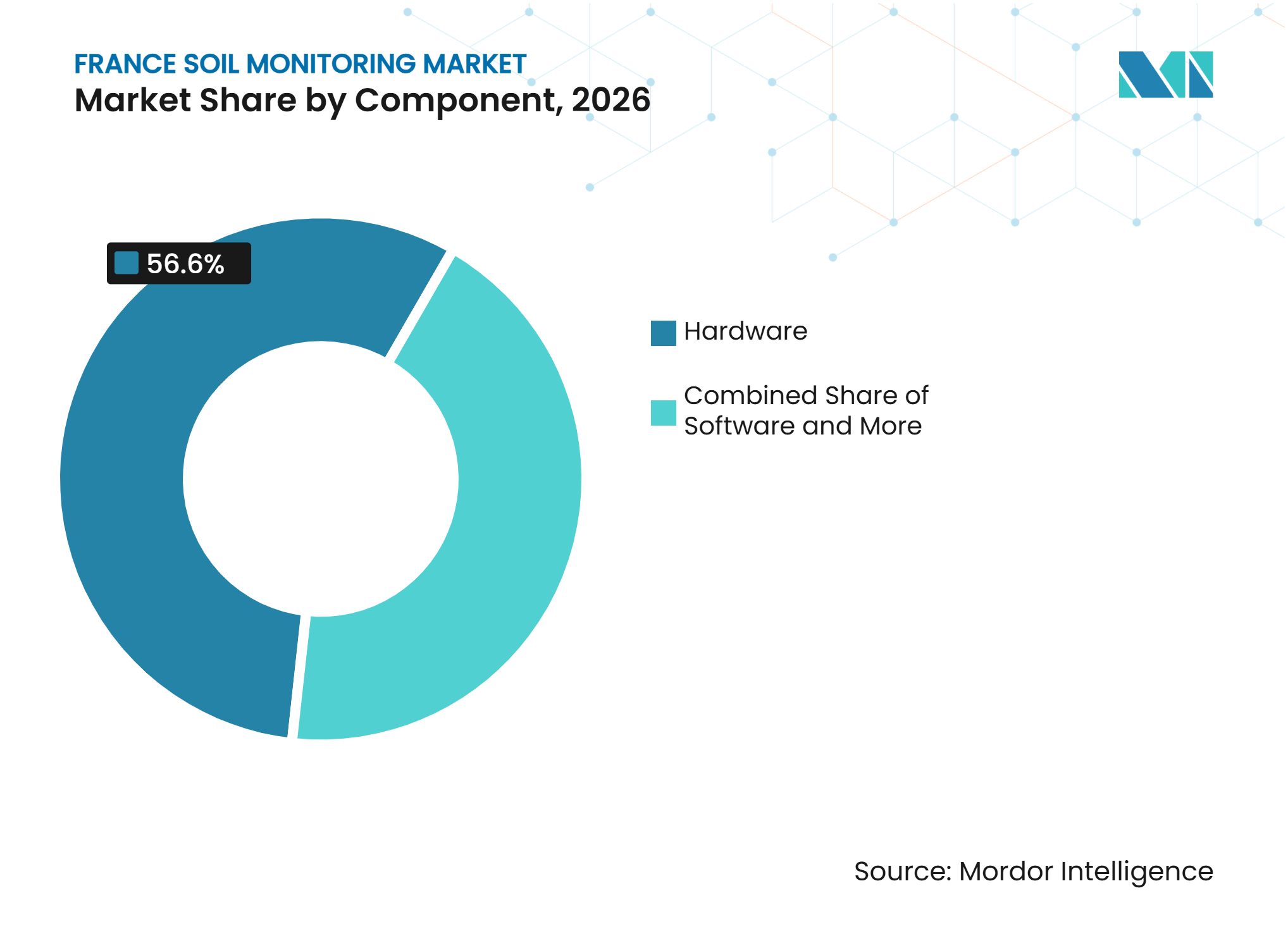
Services Gain Ground Beyond Hardware LeadershipHardware was the largest component segment, accounting for 56.6% of the France soil monitoring market share in 2026. Soil moisture probes and agronomic weather stations formed the installed base behind this position. Sensors measuring soil temperature, electrical conductivity, and nutrient levels further supported hardware adoption across French farms. The hardware segment remains significant because every continuous monitoring system begins with field equipment, and without reliable sensors in place, downstream data processing has limited value. Software occupies the middle of the component mix by converting sensor feeds, satellite imagery, and weather data into usable farm records. Its role grows when farms use variable-rate maps or irrigation schedules, as these applications depend on accurate, real-time data interpretation to support field-level decisions.
Services were the fastest-growing component segment and are forecast to grow at a CAGR of 6.3% from 2027 to 2032. Weenat combines sensor sales with software-as-a-service irrigation forecasting, and services accounted for 25% of its international revenue. Subscription models can grow without the same logistics requirements as new hardware installations. They can also provide cooperative agronomists with access to specialized soil analysis. This pattern favors providers that can offer support after the initial device sale in the France soil monitoring market.



By Product Type:
Remote Platforms Expand Alongside In-Situ SensorsIn-situ sensors were the largest product type segment, accounting for 47.1% of the France soil monitoring market share in 2026. These sensors are installed directly in the soil at specific locations within a field, allowing continuous or near-continuous monitoring of soil moisture conditions. Capacitive sensors and time-domain reflectometry sensors provide measurements near the crop root zone, enabling growers to make timely irrigation decisions based on actual soil conditions. METER Group, Inc. USA, Sentek Pty Ltd, and Irrometer Company, Inc. offer established product portfolios in this category, covering a range of sensor types suited to different soil textures and crop requirements. In-situ equipment remains the preferred choice when growers require frequent readings at defined locations, particularly in high-value crop production, where precise moisture management directly affects yield and resource efficiency.
Remote sensing platforms were the fastest-growing product type segment and are forecast to grow at a CAGR of 8.1% from 2027 to 2032. The France soil monitoring market size for this product type benefits from platforms that combine satellite moisture data with farm management information. EOS Data Analytics, Inc. integrates Soil Moisture Active Passive and Advanced Microwave Scanning Radiometer data through its EOSDA Crop Monitoring service. Weenat invested EUR 2.5 million (USD 2.7 million) in Soil Vision, which forecasts field-scale moisture without sensors at every location. Product competition in the France soil monitoring market is increasingly shaped by hybrid systems that combine satellites and field devices.
By Connectivity Technology:
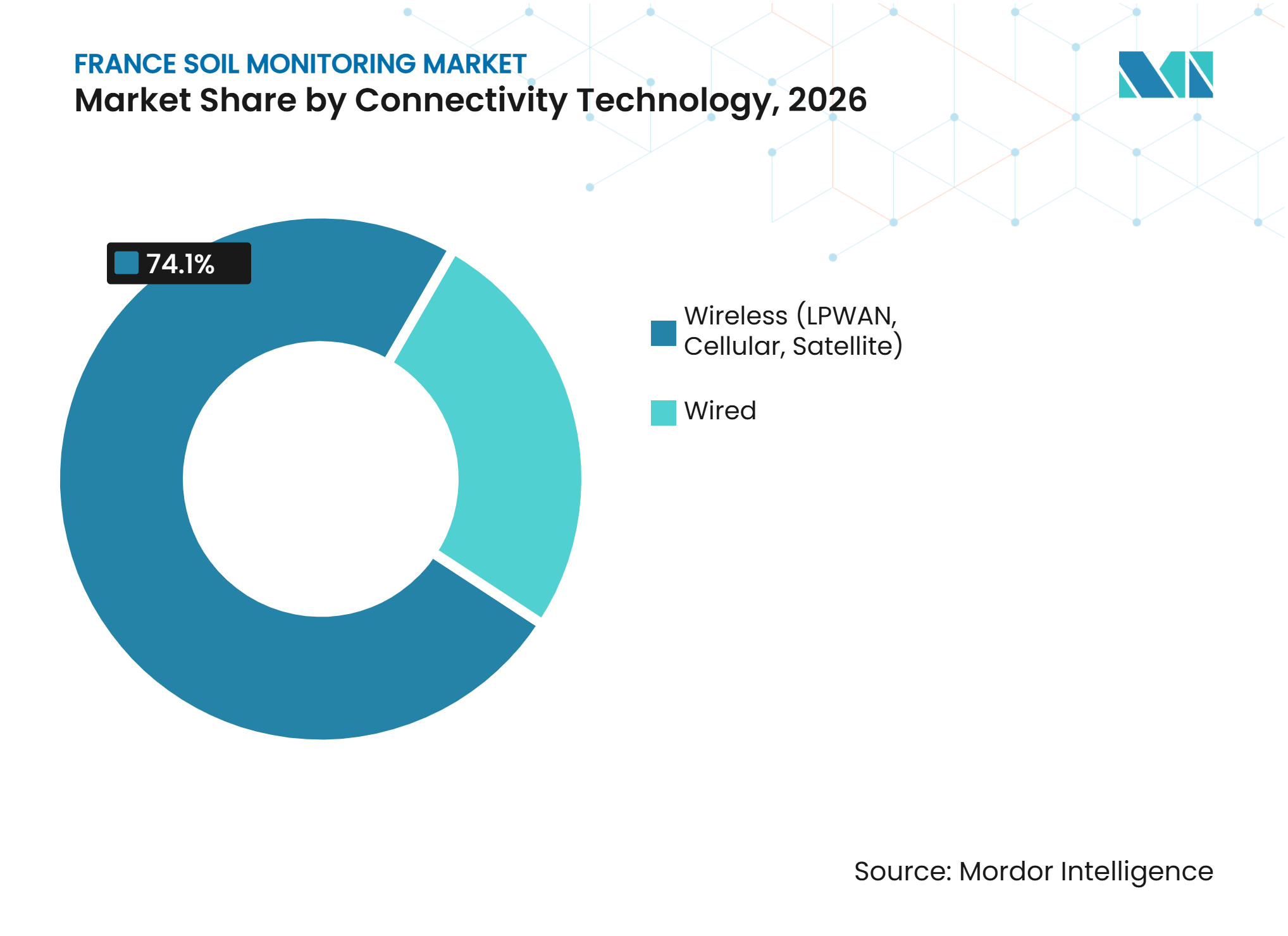
Wireless Systems Lead AdoptionWireless connectivity was the largest connectivity technology segment, accounting for 74.1% of the France soil monitoring market size in 2026. It includes Long Range Wide Area Network, Sigfox 0G, Narrowband Internet of Things, Long-Term Evolution for Machines, and satellite links. Wireless systems avoid the installation burden of cables across large farm plots. Wired connections retain a role at research stations where uninterrupted logging is more important than installation flexibility. This balance explains why wireless systems have a much broader commercial footprint.
Wireless connectivity was also the fastest-growing connectivity technology segment and is forecast to grow at a CAGR of 9.8% from 2027 to 2032. Weenat’s hybrid design can use both Sigfox 0G and Long Range Wide Area Network connections when signal conditions differ. A published vineyard study found that Class A Long Range Wide Area Network sensors transmitting every 15 minutes could support agronomic recommendations. Cellular Narrowband Internet of Things has additional potential in areas with dense fourth-generation mobile coverage. Connectivity choice remains dependent on local terrain and network availability. Suppliers that provide more than 1 communication option can reduce the risk of data loss in remote areas.

By Application:
Open-Field Agriculture Retains the Broadest UseOpen-field agriculture was the largest application segment, accounting for 63.8% of the France soil monitoring market revenue in 2026. France soil monitoring market size for this application reflects the country’s extensive arable and permanent crop areas. Cereal, oilseed, sugar beet, and permanent crop growers use field data to improve nitrogen and irrigation decisions. Forestry represents the smallest application because its use is more closely tied to environmental observation than commercial production management. Open-field demand remains linked to the ability to lower input use across large areas.
Protected cultivation was the fastest-growing application segment and is forecast to grow at a CAGR of 8.2% from 2027 to 2032. Greenhouse and tunnel growers have a strong need to manage moisture and nutrients near the root zone. Precision fertigation is especially relevant where irrigation is tightly controlled. Pilot work in French tunnel horticulture found water-use efficiency gains of up to 30% from sensor-guided irrigation. Faster growth in protected cultivation reflects high monitoring intensity rather than a larger land base.
By End User:
Large Commercial Farms Lead Current DemandLarge commercial farms were the largest end-user segment, accounting for 42.9% of the France soil monitoring market share in 2026. Their field area allows sensor costs to be spread over more hectares. These farms often have greater administrative capacity to access agricultural investment programs. Smallholder and cooperative farms form a meaningful middle tier within the France soil monitoring industry. Cooperative procurement can reduce individual costs by sharing networks and advisory services.
Research institutes and universities were the fastest-growing end-user segment and are forecast to grow at a CAGR of 7.6% from 2027 to 2032. The Institut National de Recherche pour l’Agriculture, l’Alimentation et l’Environnement programs use field sensors for carbon sequestration, biodiversity, and soil-quality research. Government bodies and nongovernmental organizations provide a stable source of demand through regional environmental assessment and soil observation. Research purchases often test new instruments before they are adopted by commercial farms. This makes the segment important for technology validation. Commercial suppliers can use research deployments to improve calibration and demonstrate field performance.
Geography Analysis
Northern and central France represent the highest concentration of monitoring activity in 2026. The Paris Basin, Île-de-France, Centre-Val de Loire, and Grand Est have intensive cereal, oilseed, and sugar beet production. These areas also include substantial agricultural land classified as nitrate-vulnerable under the seventh national program. The Beauce plateau has deep silt loam soils where variable-rate nitrogen management can deliver value at scale. Grand Est benefits from cross-border agronomy ties with German institutions. Cooperative networks in these regions have also accelerated the adoption of precision agriculture tools, with several departmental chambers of agriculture integrating soil moisture and crop growth monitoring into their advisory frameworks. The density of arable farming operations in the Paris Basin further supports the economic case for deploying sensor networks and satellite-based monitoring at the farm level.
Southern France is the fastest-growing regional demand area, driven by the convergence of water scarcity, viticulture, and protected horticulture. Occitanie received 14 projects and Nouvelle-Aquitaine received 10 projects under the 2025 Fonds hydraulique agricole. Weenat has significant activity in vineyards across Bordeaux, Languedoc, and the Rhône Valley. The Space Climate Observatory validated satellite data fusion across Gers and Alsace in 2025. This work supports the use of remote observations within cooperative advisory services. The region's exposure to recurring drought conditions has increased grower interest in real-time soil and canopy monitoring, particularly in irrigated vegetable production and permanent crops. Regional agricultural authorities have also prioritized digital tools as part of broader water management strategies, creating a supportive environment for precision agriculture adoption across both large estates and smallholder operations.
Western France is a growth area where regulatory pressure exceeds current sensor adoption. A 2024 assessment found that sensor adoption remained below 30% among the 44 reviewed northwestern farms, including conservation agriculture farms. Pays de la Loire has been fully designated as a vulnerable zone since September 2024. This designation requires farmers to adhere to stricter nutrient management rules, increasing the need for precise soil and water monitoring tools. As compliance requirements tighten, demand for sensor-based solutions is expected to rise, which may improve the position of coordinated regional deployment models over time.
Competitive Landscape
Market Concentration
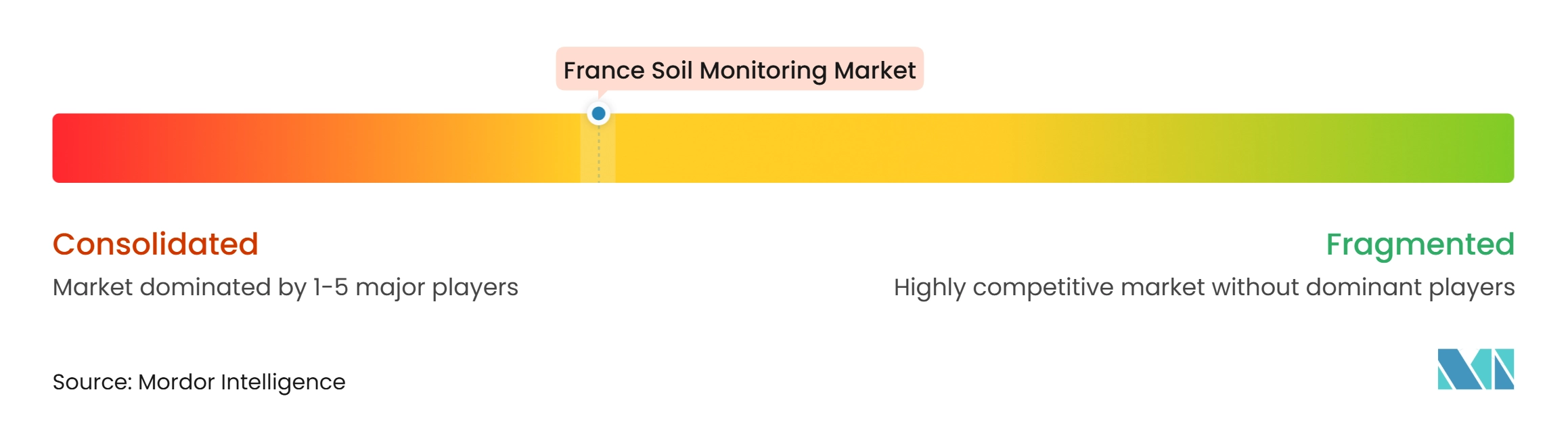
The France soil monitoring market has a moderately fragmented structure in 2025. Weenat, ISAGRI, CropX Technologies Ltd., Spectrum Technologies, Inc., and Campbell Scientific, Inc. compete on product specifications, pricing, and regional relationships. Domestic suppliers have advantages in distribution, agronomic support, and service bundling. Weenat has deployed more than 40,000 sensors and raised EUR 8.5 million (USD 9.2 million) in April 2024. Its acquisition of CoRHIZE added irrigation management and fertigation scheduling capabilities. The combined offering links field data with water management advice. ISAGRI provides farm management software integrated with soil data, giving it a strong presence among French agricultural cooperatives and advisory networks. CropX Technologies Ltd. offers cloud-based soil sensing platforms that combine hardware sensors with agronomic algorithms, enabling variable-rate irrigation and fertilization recommendations. Spectrum Technologies, Inc. focuses on portable and fixed soil monitoring instruments, serving both field research and commercial farming applications. Campbell Scientific, Inc. supplies data loggers and environmental monitoring systems widely used in research institutions and precision agriculture projects across France.
Competition among these players is shaped by the ability to integrate soil data with broader farm management platforms, offer localized agronomic support, and maintain competitive pricing for both hardware and subscription-based services. ISAGRI Group acquired Sencrop in December 2024, combining farm management, agro-meteorology, and connected monitoring within a France-based platform. Pessl Instruments GmbH launched METOS STREMO in April 2025, adding permanent plant-stress monitoring to the FieldClimate platform. In November 2025, it introduced METOS 5 as a scalable weather-station upgrade. These moves show that competition extends beyond the sensor itself to the usefulness of linked crop and weather information.
SGS SA and Element Materials Technology Group Limited operate in the laboratory-testing tier, where accreditation and sample turnaround are central differentiators. SGS SA completed 11 acquisitions in 2024, including Beta Analytic in November 2024, to broaden specialty testing capability. Calibration services adapted to local soil profiles remain a gap in the France soil monitoring market. Satellite and field-data fusion tailored to nitrate compliance is another area where the France soil monitoring market lacks a complete standard offering. The market concentration is moderate because no combined market share for the leading players is provided and the presence of domestic platforms, international instrument suppliers, and laboratory firms indicates a moderately fragmented competitive structure.
France Soil Monitoring Industry Leaders
-
Weenat
-
ISAGRI
-
CropX Technologies Ltd.
-
Spectrum Technologies, Inc.
-
Campbell Group, Inc.
- *Disclaimer: Major Players sorted in no particular order
France Soil Monitoring Market Companies Covered in this Report
- Weenat
- ISAGRI
- SGS SA
- METER Group, Inc. USA
- CropX Technologies Ltd.
- Pessl Instruments GmbH
- Sentek Pty Ltd
- Stevens Water Monitoring Systems, Inc.
- Spectrum Technologies, Inc.
- Campbell Group, Inc.
- Element Materials Technology Group Limited
- The Toro Company
- Irrometer Company, Inc.
- Soil Scout Oy
- EOS Data Analytics, Inc.
Recent Industry Developments in France Soil Monitoring Market
- April 2025: Pessl Instruments GmbH launched METOS STREMO, the first real-time permanent plant stress monitoring system using leaf transpiration sensors. Integrated with the FieldClimate platform alongside soil moisture sensors, METOS STREMO creates a combined soil-plant physiological dataset applicable to French viticulture and high-value horticulture.
- December 2024: ISAGRI Group acquired 100% of Sencrop, a Lille-based connected weather-station company with EUR 8 million (USD 8.6 million) in revenue and 80 employees. The acquisition, self-funded from ISAGRI Group’s own capital, supports development of a combined ISAGRI Group and Sencrop product integrating agro-meteorological and soil sensor data streams, planned for 2025 launch.
- December 2024: Weenat acquired CoRHIZE, a specialist in irrigation management and fertigation scheduling solutions, strengthening its algorithmic capability in soil-water balance modeling. The combined group now supports more than 40,000 farmers and 40,000 sensors across France and Europe, with a distributor network exceeding 360 agro-meteorological partners, including the Chambers of Agriculture France network.
France Soil Monitoring Market Report Scope
Soil monitoring is the regular measurement of soil conditions such as moisture, pH, nutrients, temperature, and salinity to assess soil health. It helps farmers and agronomists make better irrigation, fertilization, and crop-management decisions. The France Soil Monitoring Market Report is Segmented by Component (Hardware, Software, and Services), by Product Type (In-Situ Sensors, Remote-Sensing Platforms, and Portable Probes and Test Kits), by Connectivity Technology (Wired and Wireless), by Application (Open Field, Protected Cultivation, and Forestry), and by End-User (Large Commercial Farms, Smallholder and Cooperative Farms, Research Institutes and Universities and Government and NGOs). The Market Forecasts are Provided in Terms of Value (USD).
Segmentation Overview
| Hardware |
| Software |
| Services |
| In-situ Sensors |
| Remote-Sensing Platforms |
| Portable Probes and Test Kits |
| Wired |
| Wireless (LPWAN, Cellular, Satellite) |
| Open Field |
| Protected Cultivation |
| Forestry |
| Large Commercial Farms |
| Smallholder and Cooperative Farms |
| Research Institutes and Universities |
| Government and NGOs |
| By Component | Hardware |
| Software | |
| Services | |
| By Product Type | In-situ Sensors |
| Remote-Sensing Platforms | |
| Portable Probes and Test Kits | |
| By Connectivity Technology | Wired |
| Wireless (LPWAN, Cellular, Satellite) | |
| By Application | Open Field |
| Protected Cultivation | |
| Forestry | |
| By End User | Large Commercial Farms |
| Smallholder and Cooperative Farms | |
| Research Institutes and Universities | |
| Government and NGOs |
Key Questions Answered in the Report
What is the forecast growth rate for soil monitoring in France?
The France soil monitoring market is forecast to grow at a CAGR of 8.63% from 2027 to 2032, reaching USD 72.88 million by 2032.
Which component currently generates the most revenue?
Hardware was the largest component segment, accounting for 56.6% of the France soil monitoring market revenue in 2026, supported by the installed base of soil probes and weather stations.
Which soil monitoring technology is growing fastest in France?
Wireless connectivity is the fastest-growing connectivity technology segment and is forecast to grow at a CAGR of 9.8% from 2027 to 2032. Remote sensing platforms are the fastest-growing product type segment and are forecast to grow at a CAGR of 8.1% over the same period.
Why are French farms investing in soil moisture monitoring?
Rising water stress, irrigation restrictions, and the need for more precise water scheduling are increasing demand, especially in southern production regions.
Which end users will grow fastest through 2032?
Research institutes and universities are forecast to be the fastest-growing end-user segment, growing at a CAGR of 7.6% from 2027 to 2032, supported by increasing soil carbon, biodiversity, and environmental monitoring programs.
What limits wider adoption of connected soil systems?
Research institutes and universities are forecast to be the fastest-growing end-user segment, growing at a CAGR of 7.6% from 2027 to 2032, supported by increasing soil carbon, biodiversity, and environmental monitoring programs.