
Size and Share of Size & Share Analysis - Growth Trends and Forecast
Market Overview
| Study Period | 2021 - 2031 |
|---|---|
| Forecast Data Period | 2026 - 2031 |
| Base Year Market Size (2025) | USD 460.09 Million |
| Market Size (2026) | USD 493.58 Million |
| Market Size (2031) | USD 701.38 Million |
| Growth Rate (2026 - 2031) | 7.28 % |
| Market Concentration | Low |
Major Players *Disclaimer: Major Players sorted in no particular order Image © Mordor Intelligence. Reuse requires attribution under CC BY 4.0. | |
Analysis of Size & Share Analysis - Growth Trends and Forecast by Mordor Intelligence
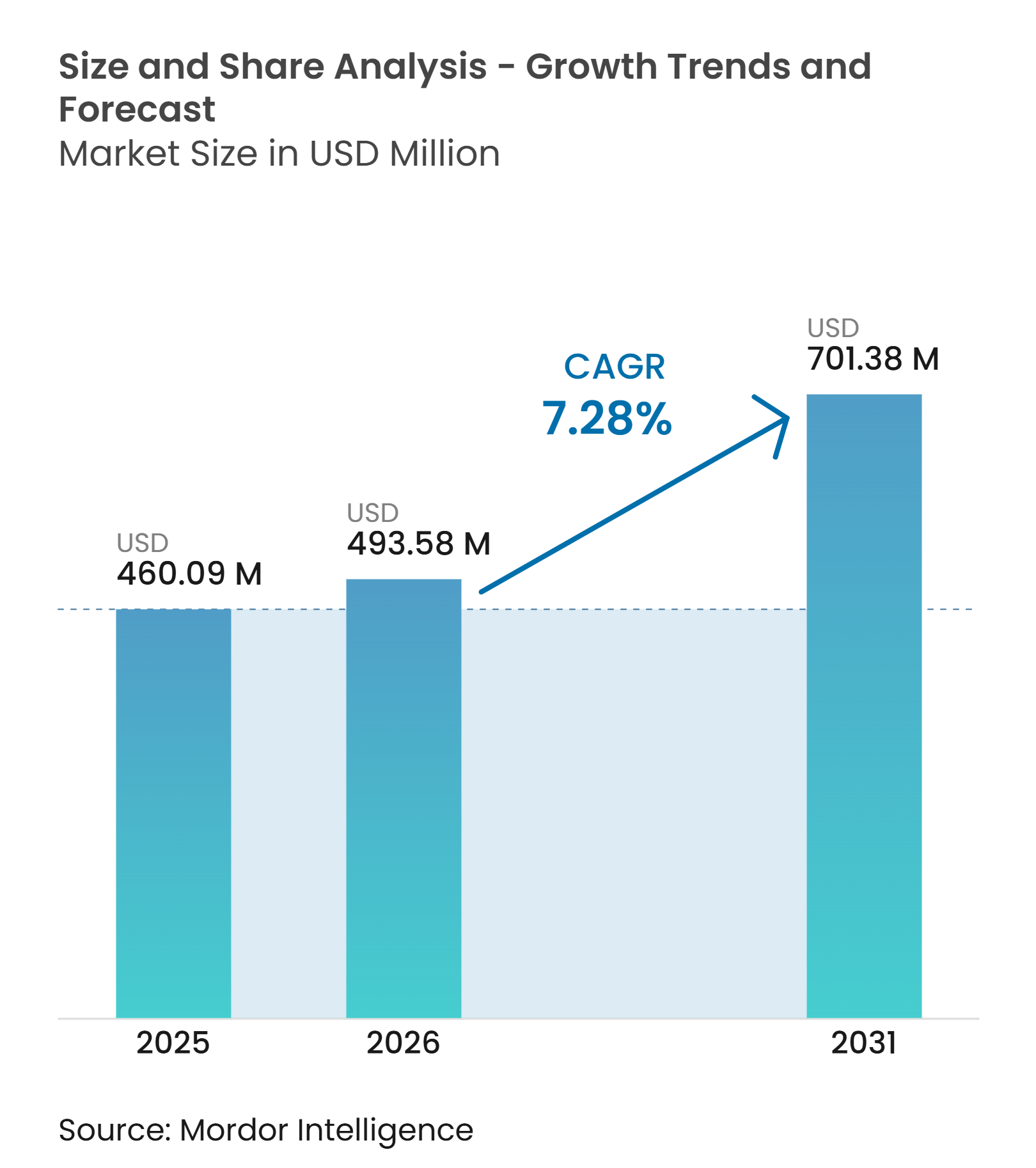
The France robotic lawn mower market was valued at USD 460.09 million in 2025 and is projected to grow from USD 493.58 million in 2026 to USD 701.38 million by 2031, registering a CAGR of 7.28% from 2026 to 2031. Connected-home adoption is making app-based lawn scheduling more familiar to households that already use connected thermostats and security devices. Rising landscaping labor costs are strengthening the case for autonomous mowing among households, contractors, and facility managers. Wire-free navigation is reducing installation complexity and expanding the potential buyer base beyond early adopters. The market also benefits from demand for quieter electric equipment and from commercial applications at solar parks, sports facilities, and managed green spaces. Competition is shifting toward navigation reliability, software support, dealer service, and pricing rather than mower hardware alone.
Key Report Takeaways
- By range, Medium (501-2,000 m2) accounted for the largest 44.1% of the France robotic lawn mower market share in 2025, while High (More Than 2,000 m2) is projected to grow at the fastest CAGR of 15.6% from 2026 to 2031.
- By navigation technology, boundary-wire accounted for the largest share at 52.7% in 2025, while the France robotic lawn mower market size for the vision/camera segment is projected to grow at the fastest CAGR of 14.7% from 2026 to 2031.
- By end user, residential accounted for the largest share at 68.5% in 2025, while commercial is projected to grow at the fastest CAGR of 11.9% from 2026 to 2031.
- By distribution channel, offline (diy stores, specialty dealers) accounted for the largest share at 58.0% in 2025, while online (direct, marketplaces) is projected to grow at the fastest CAGR of 16.4% from 2026 to 2031.
Note: Market size and forecast figures in this report are generated using Mordor Intelligence’s proprietary estimation framework, updated with the latest available data and insights as of January 2026.
Market Trends and Insights
Drivers Impact Analysis of Size & Share Analysis - Growth Trends and Forecast*
| Driver | (~) % Impact on CAGR Forecast | Geographic Relevance | Impact Timeline |
|---|---|---|---|
| Smart-Home Integration and Remote Lawn Management | 1.6% | National, concentrated in Île-de-France and Auvergne-Rhône-Alpes | Medium term (2-4 years) |
| Rising Landscaping Labor Costs | 1.4% | National, most acute in Île-de-France and Provence-Alpes-Côte d’Azur | Short term (≤ 2 years) |
| Demand for Low-Emission and Low-Noise Equipment | 1.2% | National, especially urban communes with noise ordinances | Medium term (2-4 years) |
| Wire-Free Navigation Cost Compression | 1.0% | National | Short term (≤ 2 years) |
| French Demand for Dealer-Assisted Outdoor Equipment | 0.7% | National, strongest in rural and peri-urban areas | Long term (≥ 4 years) |
| PV-Park and Managed-Green-Space Mowing Applications | 0.8% | Occitanie, Nouvelle-Aquitaine, and Provence-Alpes-Côte d’Azur | Medium term (2-4 years) |
| Source: Mordor Intelligence | |||
Smart-Home Integration and Remote Lawn Management
France's established use of connected home devices supports the adoption of robotic lawn mowers with remote scheduling, monitoring, and app-based control. According to the National Institute of Statistics and Economic Studies (INSEE), 36% of internet users in France used connected devices at home in 2024. This represents a substantial user base already familiar with connected household equipment, making smart-home-compatible robotic mowers relevant to consumers seeking integrated home automation. As connectivity becomes a standard feature of household equipment, manufacturers can drive adoption of robotic mowers by incorporating remote management and smart-home functionality.
Rising Landscaping Labor Costs
French landscaping businesses are facing a growing payroll burden, which is strengthening the incentive to automate labor-intensive maintenance activities. According to VALHOR (2026), payroll costs accounted for 28% of revenue among landscaping companies analyzed by CER France in 2024, with the payroll share increasing each year since 2021[1]. This rising labor-cost burden is encouraging professional landscaping operators to adopt robotic lawn mowers for repetitive mowing tasks, thereby reducing reliance on manual labor and improving workforce productivity. As a result, increasing payroll costs are supporting demand for robotic lawn mowers in France.
Demand for Low-Emission and Low-Noise Equipment
France's decarbonization targets are reinforcing demand for electric outdoor equipment, including robotic lawn mowers that operate without direct fuel combustion. According to the French Ministry for Ecological Transition (MTET), France's third National Low-Carbon Strategy, due in 2026, targets a 50% reduction in territorial greenhouse gas emissions by 2030 compared with 1990 levels. This policy direction encourages the adoption of lower-emission equipment for landscape maintenance. Electric robotic mowers support this transition by automating mowing, making decarbonization objectives a key driver of market demand.
Wire-Free Navigation Cost Compression
The growing availability of wire-free robotic lawn mowers is expanding consumer and professional access to navigation technologies that eliminate the need to install perimeter wire. According to Husqvarna Group (2025), the company expanded its portfolio to 24 boundary wire-free robotic lawn mower models for the 2025 season, covering residential and professional applications. Broader product availability can increase consumer awareness and offer more choices across lawn sizes and applications, supporting the adoption of wire-free robotic mowing solutions and contributing to the continued growth of the market.
Restraints Impact Analysis of Size & Share Analysis - Growth Trends and Forecast*
| Restraint | (~) % Impact on CAGR Forecast | Geographic Relevance | Impact Timeline |
|---|---|---|---|
| High Initial Acquisition Cost | -1.0% | National, most pronounced in rural and lower-income peri-urban areas | Short term (≤ 2 years) |
| Complex Terrain and Irregular Lawn Layouts | -0.7% | Rural France, including Bretagne, Auvergne, and Pays de la Loire | Long term (≥ 4 years) |
| Theft, Vandalism, and Device-Security Concerns | -0.4% | National, urban and peri-urban areas | Medium term (2-4 years) |
| Connectivity, Data-Privacy, and Firmware-Dependence Risks | -0.4% | National, with greater consumer-awareness gaps in rural areas | Long term (≥ 4 years) |
| Source: Mordor Intelligence | |||
High Initial Acquisition Cost
High initial acquisition costs can restrain the adoption of robotic lawn mowers in France by increasing the upfront financial commitment required from consumers. According to Que Choisir (2026), prices for robotic lawn mowers ranged from EUR 249 (USD 291) to EUR 3,000 (USD 3,510), depending on the level of technological sophistication. This wide price range indicates that advanced robotic lawn mower models can involve substantial upfront costs, which may delay purchasing decisions among price-sensitive consumers, thereby restraining market growth.
Complex Terrain and Irregular Lawn Layouts
Complex terrain and irregular lawn layouts can limit the adoption of robotic lawn mowers, as navigation and traction requirements become more demanding in sloped and obstacle-dense gardens. According to Husqvarna Group (2026), its Automower models with all-wheel drive can manage slopes of up to 70% (35°), while obstacles such as trees or stones must be avoided on slopes between 50% and 70%[2]. This highlights the operating constraints that persist in challenging gardens with steep sections and obstacles. As a result, terrain complexity can restrict the suitability of robotic lawn mowers and limit market expansion in France.
*Our forecasts treat driver/restraint impacts as directional, not additive. The impact forecasts reflect baseline growth, mix effects, and variable interactions.
Size & Share Analysis - Growth Trends and Forecast Segment Analysis
By Range:
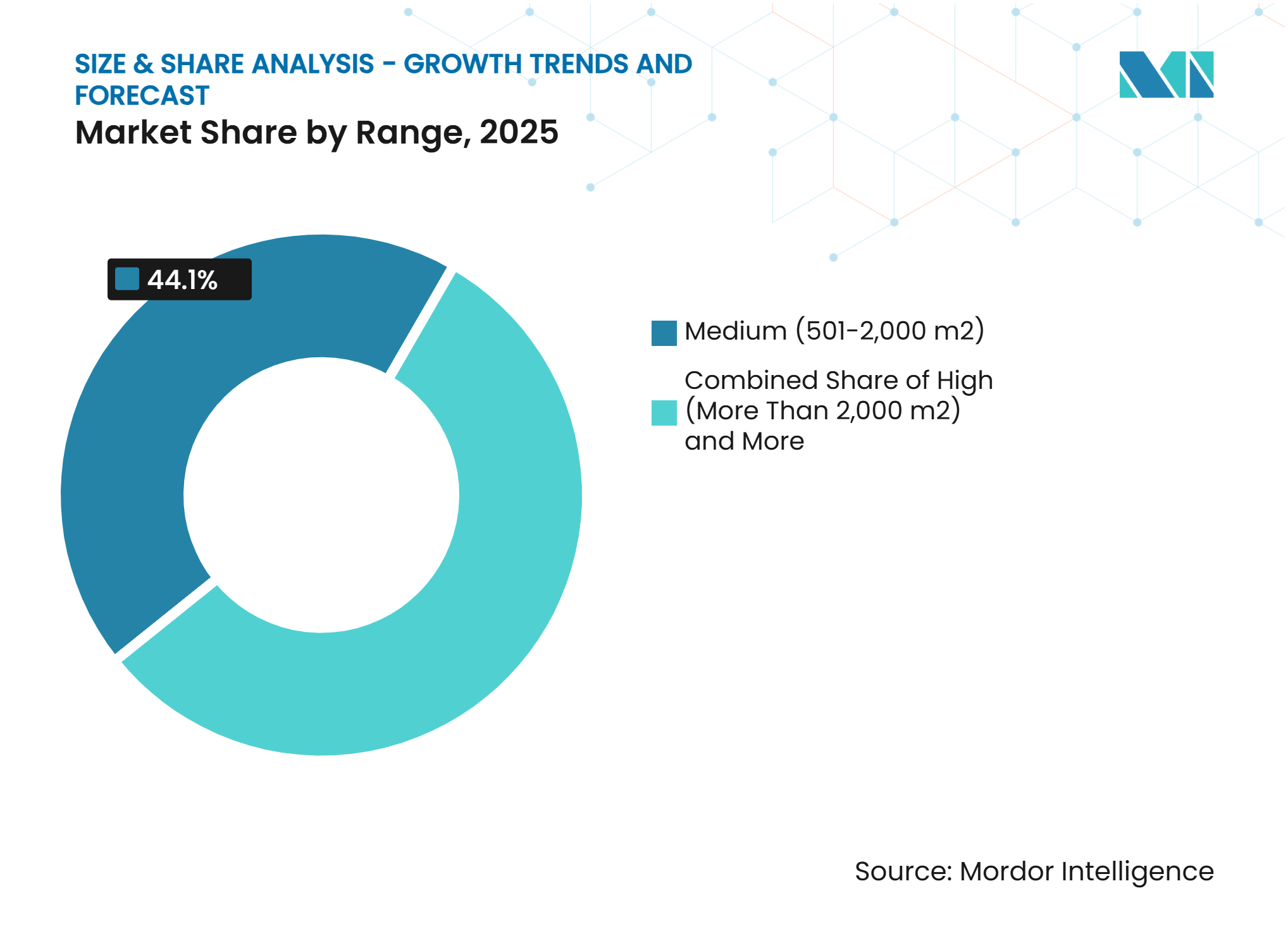
Medium (501-2,000 m2) Segment Lead, While High (More Than 2,000 m2) Redefine GrowthThe medium (501–2,000 m²) segment accounted for the largest 44.1% of the France robotic lawn mower market share in 2025. This segment benefits from the broad applicability of robotic mowers for residential properties requiring regular lawn maintenance. Equipment designed for medium-sized areas provides automated mowing without the higher capacity requirements of larger properties. Product availability across different navigation technologies allows buyers to select systems based on lawn configuration and installation preferences. These factors support continued demand for robotic lawn mowers in the Medium (501–2,000 m²) segment across France.
The high (more than 2,000 m²) segment is projected to grow at the fastest CAGR of 15.6% from 2026 to 2031. Larger lawns require equipment capable of covering extensive areas while maintaining consistent mowing schedules. This creates opportunities across residential estates and professional applications where recurring lawn maintenance demands greater operating capacity. Manufacturers are expanding their product portfolios to include higher-capacity robotic mowers and navigation systems designed for larger areas, thereby improving the suitability of autonomous mowing for extensive properties. As a result, increasing automation across large lawn applications is projected to support faster growth of this segment.



By Navigation Technology:
Boundary-Wire Retains Scale, Vision/Camera Sets PaceThe boundary-Wire segment accounted for the largest share at 52.7% in 2025, making it the largest navigation technology category. Boundary-wire systems remain established because they provide a defined mowing perimeter and a familiar operating approach for consumers and installers. Physical boundary installation offers predictable navigation across lawns with clearly defined boundaries. The technology is also supported by established product portfolios and installation practices across residential applications. These characteristics continue to support demand for boundary-wire robotic lawn mowers as alternative navigation technologies develop additional solutions for different lawn configurations and installation requirements.
The France robotic lawn mower market size for the vision/camera segment is projected to grow at the fastest CAGR of 14.7% from 2026 to 2031. Vision-based navigation can reduce reliance on physical boundary installation by using cameras and software to identify lawn areas, obstacles, and mowing paths. This approach can simplify deployment for consumers seeking reduced installation requirements and greater flexibility. Vision systems can also support automated obstacle recognition and route management, enabling robotic mowers to operate across changing lawn environments. Continued development of camera-based navigation and artificial intelligence capabilities can broaden the applications of autonomous mowing, supporting faster growth of the Vision/Camera segment.
By End-User:
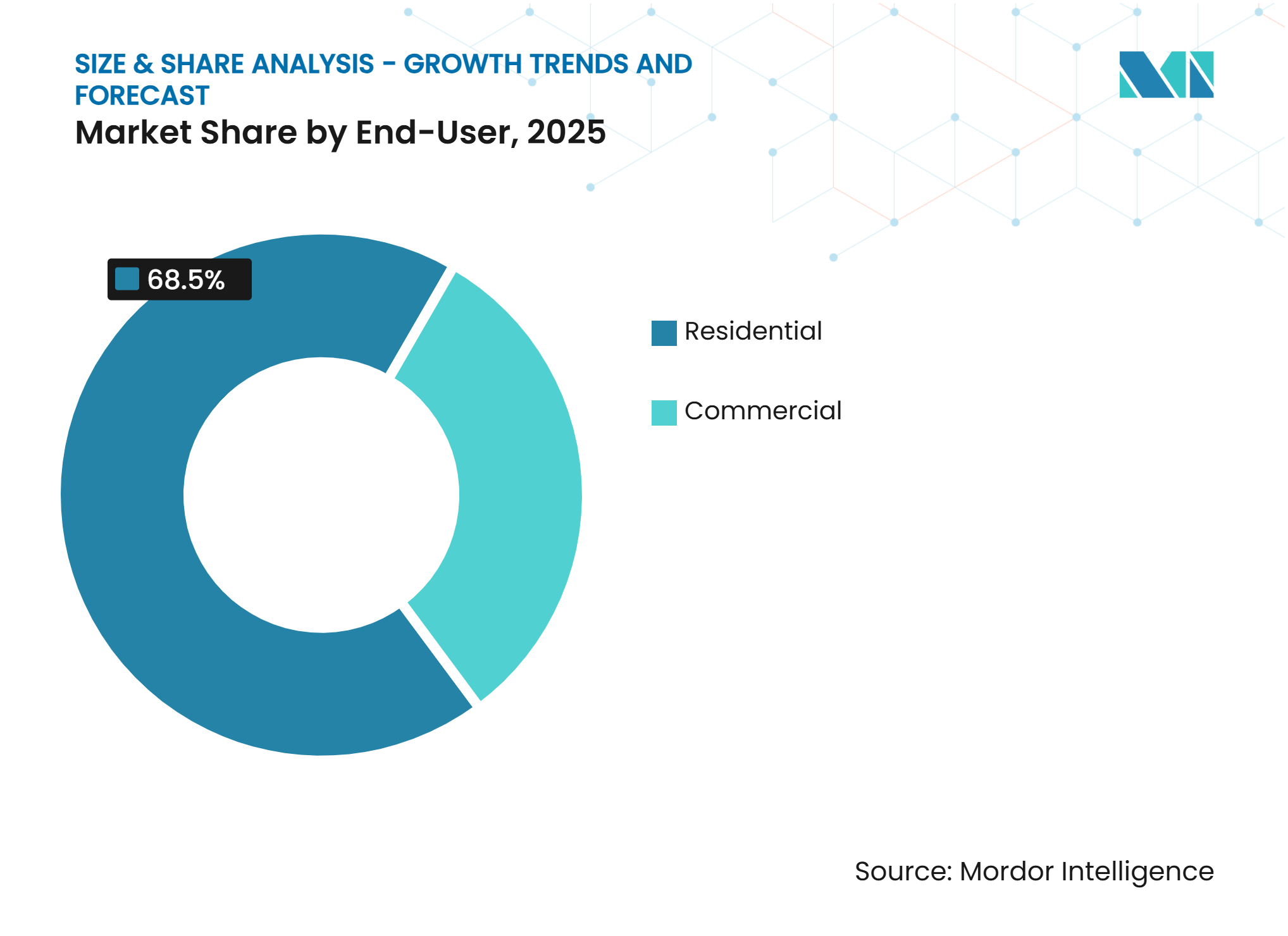
Residential Anchors Volume, Commercial Drives VelocityThe residential segment accounted for the largest share at 68.5% in 2025. Residential demand is supported by the convenience of automated lawn maintenance for households with privately maintained outdoor areas. Robotic mowers can perform regular mowing on programmed schedules, reducing the need for continuous manual intervention. Manufacturers offer products across various lawn sizes and navigation technologies, allowing households to select equipment based on their garden requirements. The broad applicability of robotic mowers in residential settings supports continued demand for the segment across France.
The commercial segment is projected to grow at the fastest CAGR of 11.9% from 2026 to 2031. Commercial applications include landscaping services, municipalities, sports facilities, golf courses, and other organizations responsible for maintaining green spaces on a recurring basis. These users benefit from automated mowing schedules and equipment designed for broader coverage requirements. Robotic mowers also allow professional operators to manage repetitive maintenance activities and allocate personnel to other landscaping tasks. Growing interest in automation across professional lawn-care operations is expanding the addressable application base beyond households, supporting faster growth of the commercial segment during the forecast period.

By Distribution Channel:
Offline (DIY Stores, Specialty Dealers) Holds the Volume, Online (Direct, Marketplaces) Rewrites VelocityOffline channels (DIY stores, specialty dealers) accounted for the largest share at 58.0% in 2025. Physical retailers remain important for robotic mower purchases, as they offer product demonstrations, installation guidance, and after-sales service. Specialty dealers help customers evaluate equipment based on lawn configuration and navigation requirements. Do-It-Yourself retailers provide in-store access to robotic mowers and related lawn-care equipment. These services are particularly relevant for buyers requiring installation or maintenance assistance, and this combination of product access and customer support continues to sustain the Offline segment's position in France.
The online (direct, marketplaces) segment is projected to grow at the fastest CAGR of 16.4% from 2026 to 2031. Online purchasing gives consumers access to product specifications, pricing information, customer reviews, and a wide range of robotic mower models through direct stores and marketplaces. Digital channels also simplify comparisons across navigation technologies, lawn coverage capabilities, and product features. The growing availability of wire-free systems further supports online purchasing by reducing installation complexity for some users. As consumers become more comfortable evaluating robotic lawn mowers through digital channels, direct and marketplace platforms are projected to expand their role in product discovery and sales.
Geography Analysis
France has a residential base conducive to robotic lawn mower adoption, with demand shaped by private outdoor spaces and regional differences in housing patterns. Suburban and peri-urban areas support residential applications where homeowners maintain individual lawns, while urban areas offer a more limited addressable base due to higher housing density. Coastal and rural regions present varied garden configurations and maintenance requirements. These geographic differences create distinct opportunities for manufacturers and distributors. Residential demand, therefore, varies by housing structure, garden availability, and local property characteristics.
Regional demand varies with the concentration of individual housing and the characteristics of maintained outdoor areas. Areas surrounding major metropolitan centers support residential robotic mowing where detached housing is prevalent, while less-dense territories offer opportunities on larger residential properties. Regional differences in terrain, garden configuration, and access to professional landscaping services also influence technology selection and purchasing behavior. These conditions favor a differentiated geographic approach, with manufacturers addressing residential and professional applications according to local property characteristics. This variation supports multiple regional demand patterns rather than a uniform national adoption profile.
The geographic opportunity is supported by the widespread presence of private outdoor spaces across French households. According to FranceAgriMer and VALHOR (2026), 74% of French households had a garden or terrace in 2025. This provides a broad base of households with outdoor areas where automated lawn maintenance is relevant, although not every garden is suitable for robotic mowing. Regional differences in property layout, accessibility, and landscaping needs continue to affect addressable demand. The broad prevalence of outdoor spaces supports residential market potential, while meaningful variation remains across regions and individual garden configurations.
Competitive Landscape
Market Concentration
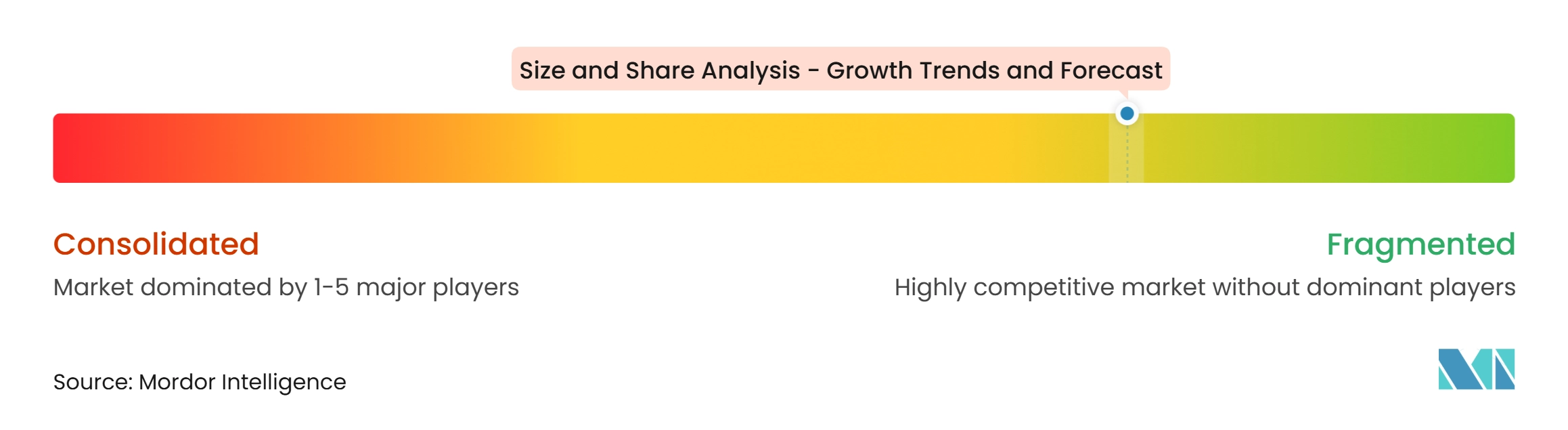
The France robotic lawn mower market is fragmented in 2025, with Husqvarna AB, Robert Bosch GmbH, STIGA S.p.A., Honda Motor Co., Ltd., and Positec Group Limited among the key players. Established suppliers compete through dealer networks, product breadth, installation services, and after-sales support, while newer technology-focused participants emphasize wire-free operation, automation, and advanced sensing. Suppliers address residential and professional applications through products designed for different lawn sizes and operating conditions. Competitive differentiation increasingly depends on navigation capability, installation requirements, obstacle handling, connectivity, and service support alongside cutting performance.
Competition is also shaped by differences in navigation technology and deployment requirements. Boundary-wire products continue to serve buyers seeking established perimeter control, while newer systems use vision, LiDAR, or satellite-based positioning to reduce installation requirements or support complex lawn management. Independent consumer testing highlights the importance of matching the mower to garden configuration, including surface area, slopes, trees, and walls. This indicates that suppliers compete not only on product specifications but also on suitability for specific garden conditions. Navigation capability, ease of setup, and application fit remain important competitive considerations.
Product innovation is intensifying competitive differentiation as suppliers introduce robotic mowers with increasingly automated navigation and simplified installation. In June 2025, STIGA S.p.A. introduced the A 4 and A 8 autonomous robotic mowers, designed for gardens up to 400 m² and 800 m², respectively[3]. The models feature digital garden mapping and wire-free installation through the STIGA.GO application. This development illustrates how suppliers are differentiating products through simplified setup and automated garden management. Competition is therefore increasingly centered on navigation technology, installation convenience, application flexibility, and user experience in residential lawn care.
Leaders of Size & Share Analysis - Growth Trends and Forecast
-
Husqvarna AB
-
Robert Bosch GmbH
-
STIGA S.p.A.
-
Honda Motor Co., Ltd.
-
Positec Group Limited
- *Disclaimer: Major Players sorted in no particular order
Size & Share Analysis - Growth Trends and Forecast Companies Covered in this Report
- Husqvarna AB
- Robert Bosch GmbH
- STIGA S.p.A.
- Honda Motor Co., Ltd.
- Deere and Company
- Positec Group Limited
- ANDREAS STIHL AG & Co. KG
- Navimow B.V. (Segway-Ninebot)
- Shenzhen Mammotion Technology Co., Ltd.
- Zucchetti Centro Sistemi S.p.A.
- Dreame Innovation Technology (Suzhou) Co., Ltd.
- Globe Technologies Group
Recent Industry Developments in Size & Share Analysis - Growth Trends and Forecast
- March 2026: STIGA S.p.A. launched eight new autonomous robotic lawn mowers featuring Vista Technology, combining AI-driven camera navigation with antenna-free operation. The new models cover lawn areas from 600 m² to 14,000 m², expanding STIGA’s autonomous mowing portfolio.
- February 2026: Husqvarna AB introduced the Automower 540, 560, 580, and 580L EPOS professional platform in France, featuring enhanced vision technology that improves obstacle detection and navigation capabilities for professional green-space management.
- February 2026: Navimow B.V. (Segway-Ninebot) launched its 2026 robotic mower range in Paris, introducing the X4, H2, i2 AWD, i2 LiDAR, i2 LiDAR Pro, and Terranox series for residential and professional applications. The range features LiDAR, RTK, and vision-based navigation.
Scope of Report on Size & Share Analysis - Growth Trends and Forecast
A robotic lawn mower is an automated outdoor equipment system that uses sensors, navigation technology, and programmed controls to mow grass with minimal human intervention. It is used to maintain residential, commercial, and institutional lawns efficiently and consistently.
The France robotic lawn mower market report is segmented by range (low (less than 500 m²), medium (501–2,000 m²), and high (more than 2,000 m²)), by navigation technology (boundary-wire, vision/camera, and GNSS/RTK-GPS), by end user (residential and commercial), and by distribution channel (online (direct and marketplaces) and offline (DIY stores and specialty dealers)). The market forecasts are provided in terms of value (USD).
Segmentation Overview
| Low (Less Than 500 m2) |
| Medium (501-2,000 m2) |
| High (More Than 2,000 m2) |
| Boundary-Wire |
| Vision/Camera |
| GNSS/RTK-GPS |
| Residential |
| Commercial |
| Online (Direct, Marketplaces) |
| Offline (DIY Stores, Specialty Dealers) |
| By Range | Low (Less Than 500 m2) |
| Medium (501-2,000 m2) | |
| High (More Than 2,000 m2) | |
| By Navigation Technology | Boundary-Wire |
| Vision/Camera | |
| GNSS/RTK-GPS | |
| By End-User | Residential |
| Commercial | |
| By Distribution Channel | Online (Direct, Marketplaces) |
| Offline (DIY Stores, Specialty Dealers) |
Key Questions Answered in the Report
What is the forecast growth rate along with market size from 2026 to 2031?
The France robotic lawn mower market is projected to grow at a 7.28% CAGR from 2026 to 2031, rising from USD 493.58 million in 2026 to USD 701.38 million by 2031.
Which robotic mower technology is growing fastest?
Vision/camera segment is projected to grow at the fastest CAGR of 14.7% from 2026 to 2031.
Why do French buyers still use offline retailers?
Buyers value demonstrations, local servicing, and installation guidance, particularly for higher-priced Boundary-Wire equipment.
Which customer group will grow fastest through 2031?
Commercial segment is projected to grow fastest CAGR of 11.9% from 2026 to 2031.