
France Plant Growth Regulators Market Size and Share
Market Overview
| Study Period | 2021 - 2031 |
|---|---|
| Forecast Data Period | 2026 - 2031 |
| Base Year Market Size (2025) | USD 179.5 Million |
| Market Size (2026) | USD 194.30 Million |
| Market Size (2031) | USD 289.5 Million |
| Growth Rate (2026 - 2031) | 8.30 % |
| Market Concentration | Medium |
Major Players *Disclaimer: Major Players sorted in no particular order Image © Mordor Intelligence. Reuse requires attribution under CC BY 4.0. | |
France Plant Growth Regulators Market Analysis by Mordor Intelligence
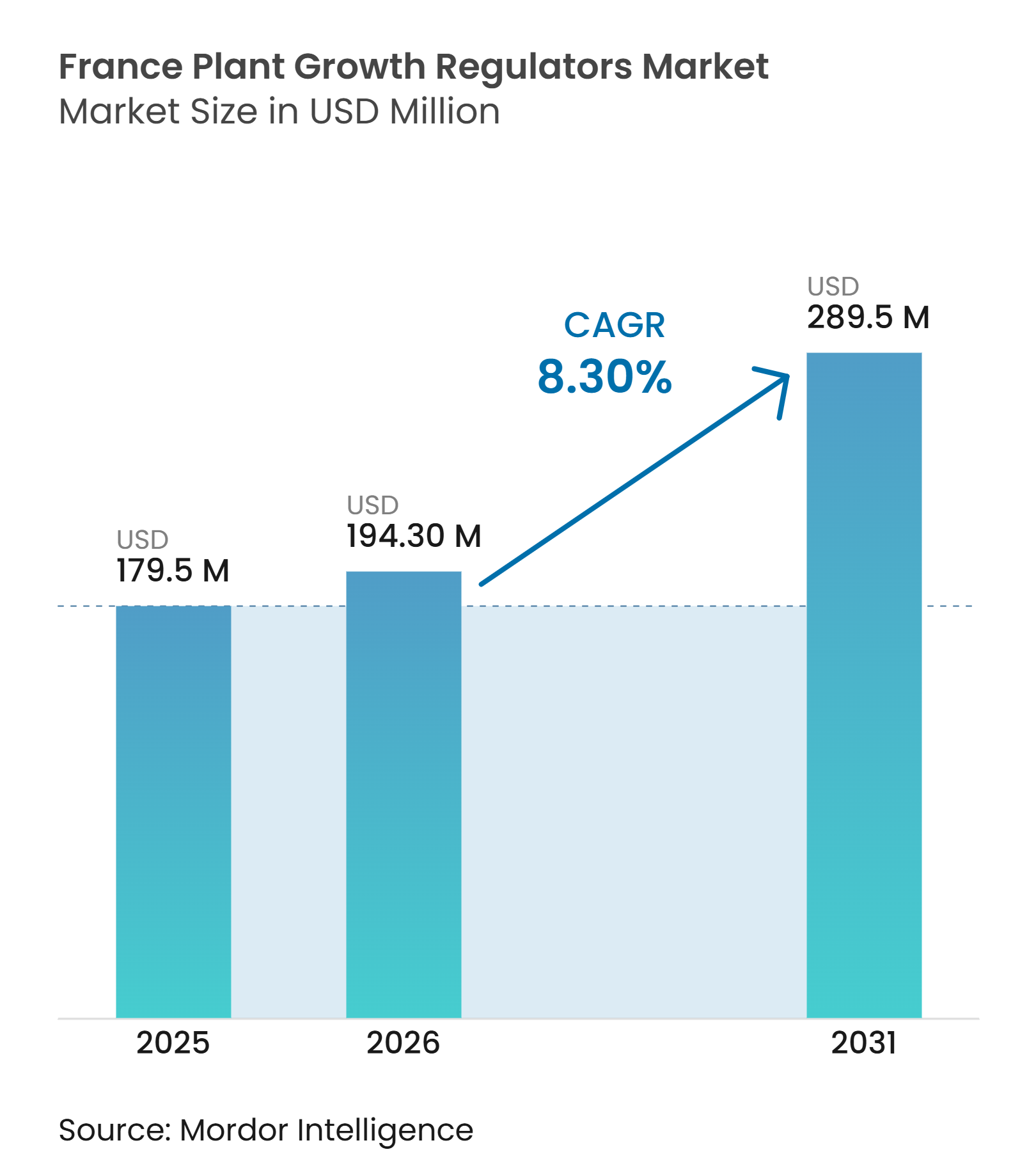
The France plant growth regulators market size is projected to grow from USD 179.5 million in 2025 to USD 194.3 million in 2026, reaching USD 289.5 million by 2031, with a CAGR of 8.3% during 2026-2031. France's large agricultural base, with close to 28 million hectares of utilized agricultural area, supports demand across field crops, vineyards, orchards, and horticulture. Écophyto 2030 is shifting investment from older synthetic products toward lower-risk alternatives and biostimulant platforms. This shift supports spending on crop-stability, fruit-set, stress-management, and canopy-control products that can meet stricter risk and residue requirements. The France plant growth regulators market favors suppliers that can meet the French Agency for Food, Environmental and Occupational Health and Safety's authorization requirements while maintaining both conventional and biological portfolios. This is creating lower volume demand for some mature synthetic active substances, while registered biostimulants and lower-risk products support higher-value growth.
Key Report Takeaways
- By type, cytokinins accounted for 34% of France plant growth regulators market size in 2025, while gibberellins are projected to grow fastest at a CAGR of 9.1% through 2026-2031.
- By application, grains and cereals accounted for 31% of revenue in 2025, while fruits and vegetables are forecast to be fastest growing segment at a CAGR of 9.4% through 2026-2031.
- By formulation, soluble granules held 39% of the France plant growth regulator market share in 2025, while soluble liquids is the fastest-growing segment at a CAGR of 8.8% through 2026-2031.
Note: Market size and forecast figures in this report are generated using Mordor Intelligence’s proprietary estimation framework, updated with the latest available data and insights as of January 2026.
Market Trends and Insights
Drivers Impact Analysis of France Plant Growth Regulators Market*
| Driver | (~) % Impact on CAGR Forecast | Geographic Relevance | Impact Timeline |
|---|---|---|---|
| Sustainable and organic acreage expansion | 1.80% | National, with higher intensity in Brittany, Auvergne-Rhône-Alpes, and Occitanie | Medium term (2–4 years) |
| Cereal production and anti-lodging demand | 1.60% | Grand Est, Hauts-de-France, and Centre-Val de Loire | Short term (≤ 2 years) |
| Climate stress in fruit, vegetable, and orchard production | 1.40% | Bordeaux, Burgundy, Champagne, Loire Valley, and Languedoc-Roussillon | Short term (≤ 2 years) |
| Precision and protected cultivation adoption | 1.20% | Brittany, Loire-Atlantique, and Provence-Alpes-Côte d'Azur | Medium term (2–4 years) |
| France Soil Nutrient Apparent Balance (SNuB) pathway for natural growth-management products | 0.80% | National, with R&D concentration in Occitanie and Pays de la Loire | Long term (≥ 4 years) |
| PARSADA-led substitution of at-risk actives | 0.60% | National, with priority in vineyards and major field crops | Medium term (2–4 years) |
| Source: Mordor Intelligence | |||
Sustainable And Organic Acreage Supports Growth-Regulation Adoption
The French plant growth regulator market is supported by the country's extensive base of certified organic farming, which accounted for nearly 10% of the total utilized agricultural area in 2024. As more agricultural land transitions to organic and closely monitored production systems, growers face limited input options and increasingly prioritize registered products that enhance crop vigor, fruit development, and stress management within regulatory guidelines. This trend drives demand for biostimulant plant growth regulators that comply with EU organic standards and are already authorized through France's ITAB pathways[1]. Additionally, farms are working towards HVE Level 3 certification, expanding the market for seaweed-derived and amino-acid-based products beyond fully organic farms. The market also experiences a pricing dynamic: growers operating under stricter certification standards tend to purchase narrower, more specialized product portfolios rather than broad commodity inputs. Furthermore, expanding the Soil Nutrient apparent Balance (SNuB) positive plant list from 148 pharmacopeia species to over 1,193 authorized plant species has reduced barriers to the development and commercialization of new natural formulations. This combination of certification requirements and increased eligibility for natural inputs is anticipated to sustain steady demand for higher-value solutions in the France plant growth regulators market over time.
Cereal Production And Anti-Lodging Demand
The French plant growth regulator market is strongly supported by cereal cultivation, as France annually produces significant quantities of wheat and barley, maintaining its position as the European Union's largest cereal producer. This large crop base creates steady demand for anti-lodging plant growth regulators in high-input production programs. Growers applying higher nitrogen rates require stem-strength support to reduce lodging risk and protect harvest quality. National crop production increased by 3.5% in 2025 following the weather-disrupted 2024 season, restoring spending on field-crop input programs. The France plant growth regulators market retains a stable cereal demand base even as other pesticide categories face stronger reduction pressure. Arvalis participates in the Strategic Action Plan for Anticipating the Potential European Withdrawal of Active Substances and Developing Alternative Crop Protection Techniques (PARSADA)'s intersectoral work, which provides cereal suppliers with clearer direction on the future role of anti-lodging solutions. This positions cereals as an important volume segment for companies that can balance conventional retardants with emerging lower-risk alternatives.
Climate Stress In Fruit, Vegetable, And Orchard Production
The France plant growth regulators market is gaining support from fruit, vegetable, and orchard growers who require more consistent crop management under variable weather conditions. These growers increasingly use biostimulant programs to support flowering, fruit set, canopy development, and recovery after weather-related stress. This is especially relevant in wine and high-value crop areas, where a small loss in quality can affect farm returns more than a modest change in yield. Trials results by Biodevas Laboratories published in October 2025 showed that a biostimulant program applied in 2024 produced 39% more grape clusters and 38% higher harvest weight in the 2025 follow-up season. These results give growers reason to use products across multiple seasons rather than only purchase them after a difficult year. The France plant growth regulators market benefits from this pattern because repeat use raises the value of each managed hectare. Demand is strongest where growers need to protect both quality and crop consistency in premium produce and wine systems.
Precision And Protected Cultivation Adoption
Protected cultivation represents a higher-value opportunity within the France plant growth regulators market, as growers require consistent support for uniformity, plant architecture, and canopy management. Tomato, cucumber, strawberry, and ornamental production depend on reliable crop response across repeated production cycles. Product selection is influenced by residue expectations, tank-mix behavior, and the availability of technical support from suppliers. This gives companies with documented local trial results and approved products for professional horticulture an advantage. Protected crop operators also prefer products compatible with existing foliar equipment and applicable at different crop stages. The shift toward zero-pesticide-residue sourcing further supports the use of cytokinin and auxin products with acceptable residue profiles. This segment benefits the France plant growth regulators market because applications are more frequent and formulation performance is more critical than in many open-field crops.
Restraints Impact Analysis of France Plant Growth Regulators Market*
| Restraint | (~) % Impact on CAGR Forecast | Geographic Relevance | Impact Timeline |
|---|---|---|---|
| Approval timelines and dossier costs | -1.20% | National, with the highest impact on SME suppliers and new active ingredient developers | Short term (≤ 2 years) |
| Water, biodiversity, and resident-exposure controls | -1.00% | Sensitive zones, including Loire, Gironde, and Languedoc-Roussillon watercourses | Medium term (2–4 years) |
| PPPand biostimulant regulatory boundary complexity | -0.70% | National, particularly affecting natural-extract products with broad product claims | Medium term (2–4 years) |
| Grower return-on-investment pressure and organic-acreage softness | -0.50% | National, with higher exposure in regions where organic farming premiums are declining | Long term (≥ 4 years) |
| Source: Mordor Intelligence | |||
Approval Timelines and Dossier Costs
The France plant growth regulators market faces significant challenges due to one of Europe’s most stringent authorization processes. The French Agency for Food, Environmental and Occupational Health & Safety (ANSES) typically requires 3 to 5 years to approve a complete phytopharmaceutical product dossier. Submission costs often exceed EUR 1 million (USD 1.1 million) per active substance, making the full registration process inaccessible for many smaller innovators. This delays the introduction of new products, such as cytokinins and gibberellins, despite existing grower demand. The regulatory environment benefits companies with multinational registration pipelines, as they can distribute compliance costs across multiple countries and product lines. In contrast, smaller developers frequently partner with large distributors to access regulatory support and broader commercialization networks. However, such partnerships can limit their independence and reduce future profit margins. As a result, the active-substance pipeline in the France plant growth regulators market remains more concentrated than the level of demand would indicate.
Water, Biodiversity, and Resident-Exposure Controls
The HRI-1 indicator under Écophyto 2030 tracks pesticide risk in relation to watercourses, biodiversity-sensitive areas, and residential zones. This makes product selection more complex in areas with strict local conditions, especially around vineyards and sensitive catchments. The Pestiriv study published in 2025 also reported higher pesticide exposure among residents living near vineyards. This finding supports stricter measures around buffer zones and application restrictions in wine-producing areas. The Plant Protection Product Savings Certificates (CEPP) system requires distributors to promote and document risk-reduction actions, thereby increasing demand for lower-risk alternatives. In the short term, this may create uncertainty for established synthetic products that remain widely used but face changing compliance conditions. The France plant growth regulators market must therefore manage compliance costs while maintaining dependable crop-performance solutions.
*Our forecasts treat driver/restraint impacts as directional, not additive. The impact forecasts reflect baseline growth, mix effects, and variable interactions.
France Plant Growth Regulators Market Segment Analysis
By Type:
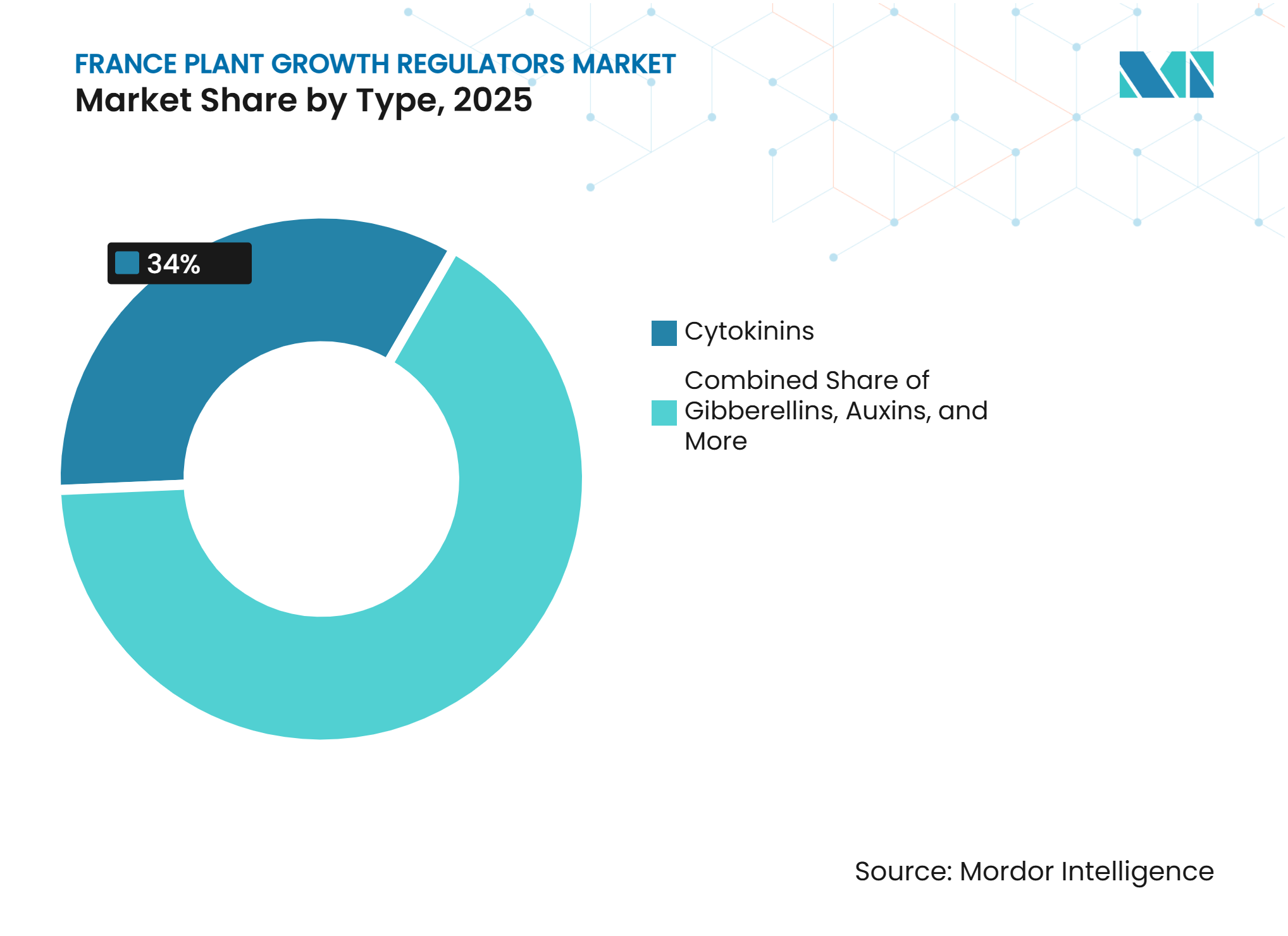
Dominance of Cytokinins and Growth in GibberellinsCytokinins accounted for 34% of the France plant growth regulators market share in 2025, making them the largest type segment. Their widespread use across orchards, vineyards, brassicas, lettuce, turf, and protected vegetables supports this position. Depending on the label claim and product category, cytokinins can also qualify under different regulatory routes in France. This gives suppliers greater flexibility in positioning products for professional growers. The versatility of cytokinins benefits the France plant growth regulators market, as a single active class can address multiple high-value crop uses.
Gibberellins are forecast to grow at a 9.1% CAGR from 2026 to 2031, making them the fastest-growing type segment. Demand is supported by their use in seedless table grapes, where elongation treatments can command premium pricing. Organic oilseeds and pulses present an additional opportunity as certification-compatible yield tools. Auxins remained one of the argest type due to their role in rooting and fruit thinning. Ethylene releasers and other retardants continued to serve established crop uses, though their outlook is more restricted under HRI-1 risk scoring.



By Application:
Cereals Lead the Market while Fruits And Vegetables Grow FasterGrains and cereals accounted for 31% of the France plant growth regulators market size in 2025, supported by the country's large wheat and barley cultivation area. Anti-lodging applications remain a standard component of high-input cereal programs. Chlormequat products face tighter scrutiny, while trinexapac-ethyl and prohexadione-calcium are gaining relevance within the retardant category. As a result, the segment remains large, but its product mix is changing, with cereals retained as the main volume base of the France plant growth regulators market.
Fruits and vegetables are projected to grow at a 9.4% CAGR through 2031, the fastest rate among application segments. Table grapes, berries, brassicas, and protected vegetables require products that meet stricter quality and residue requirements. Cash crops, including wine grapes, sugar beets, flax, and lavender, generate higher expenditure per hectare than cereals, as programs in these crops are often more specialized. Oilseeds and pulses represent emerging opportunities, supported by the EUR 45 million (USD 49.8 million) Strategic Action Plan for Anticipating the Potential European Withdrawal of Active Substances and Developing Alternative Crop Protection Techniques (PARSADA) call for projects announced in 2025. Turf, ornamentals, and nursery crops remain smaller segments but support recurring demand for premium professional formulations.
By Formulation:
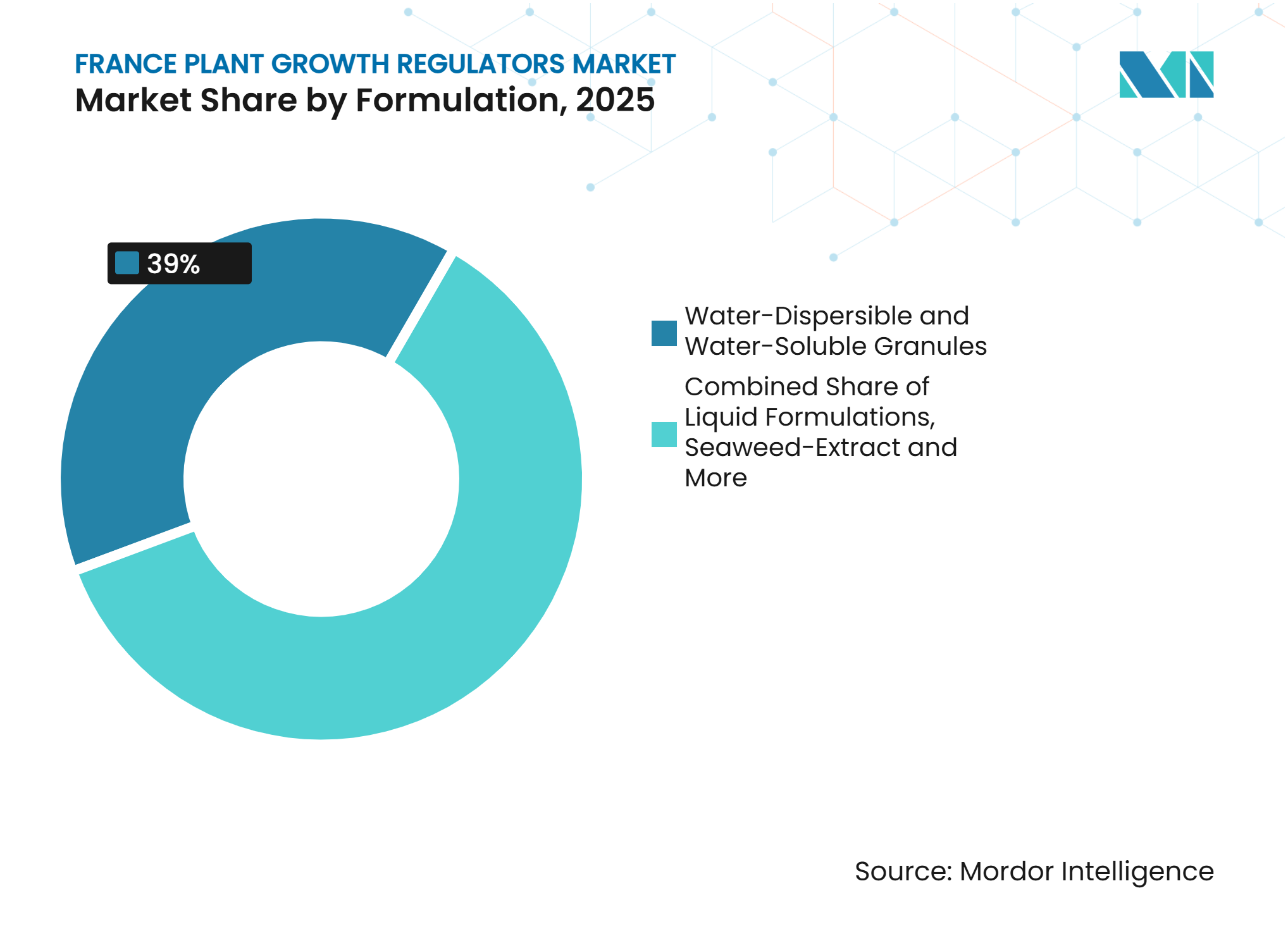
Soluble Granules Lead While Soluble Liquids ExpandSoluble granules accounted for 39% of the France plant growth regulators market size in 2025. Growers prefer this format for active substances such as gibberellic acid, forchlorfenuron, and trinexapac-ethyl because it supports precise dosing and longer storage. Soluble granules also fit fertigation and drip-irrigation systems used in professional horticulture. These practical benefits keep the format prominent in the France plant growth regulators market, and it remains the leading formulation even as demand for liquid products rises.
Soluble liquids are forecast to grow at an 8.8% CAGR from 2026 to 2031. Seaweed extract and amino-acid liquids are well-suited to foliar programs in vineyards and orchards. Their compatibility with existing spray equipment supports use in repeated seasonal programs. Suspension concentrates continue to serve orchard and protected-horticulture applications where spray-tank stability is important. Wettable powders and other legacy formats remain available, but professional applicators increasingly prefer soluble and liquid alternatives that are easier to mix.

Geography Analysis
The northern and central cereal plains held the largest share of anti-lodging plant growth regulator demand in 2025, led by Hauts-de-France, Grand Est, Centre-Val de Loire, and the Beauce corridor. These regions have dense wheat, barley, and rapeseed production, making them central to the France plant growth regulators market. National crop production rose 3.5% in 2025, helping restore spending on cereal input programs after the 2024 disruption. Demand is concentrated in soluble granule products based on trinexapac-ethyl and chlormequat. Sensitive water catchments in the region also increase the need for lower-risk formulations and careful compliance planning.
The wine and cash crop belt is the second major demand area, spanning Bordeaux, Burgundy, Champagne, the Loire Valley, Alsace, and Languedoc-Roussillon. France's 770,000 hectares of vineyard support higher per-hectare spending on plant growth regulators than cereal land. Demand in this area is driven by flowering, fruit set, and stress management programs. Synthetic and Soil Nutrient apparent Balance (SNuB) category products are increasingly used together, extending growers' purchase cycles. IFV coordinates work under the Strategic Action Plan for Anticipating the Potential European Withdrawal of Active Substances and Developing Alternative Crop Protection Techniques (PARSADA) vine action plans, connecting future research outputs with commercial grower needs.
The western and southern horticulture and polyculture zones, including Brittany, Loire-Atlantique, Pays de la Loire, and Provence-Alpes-Côte d'Azur, are the fastest-expanding geographic demand areas. These regions support professional vegetable, fruit, and ornamental production with strong requirements for crop uniformity and residue compliance. Organic and HVE production systems drive demand for products that meet accepted-input rules. Occitanie and Nouvelle-Aquitaine also contribute to demand through sunflower and maize biostimulant programs linked to Strategic Action Plan for Anticipating the Potential European Withdrawal of Active Substances and Developing Alternative Crop Protection Techniques (PARSADA) supported research.
Competitive Landscape
Market Concentration
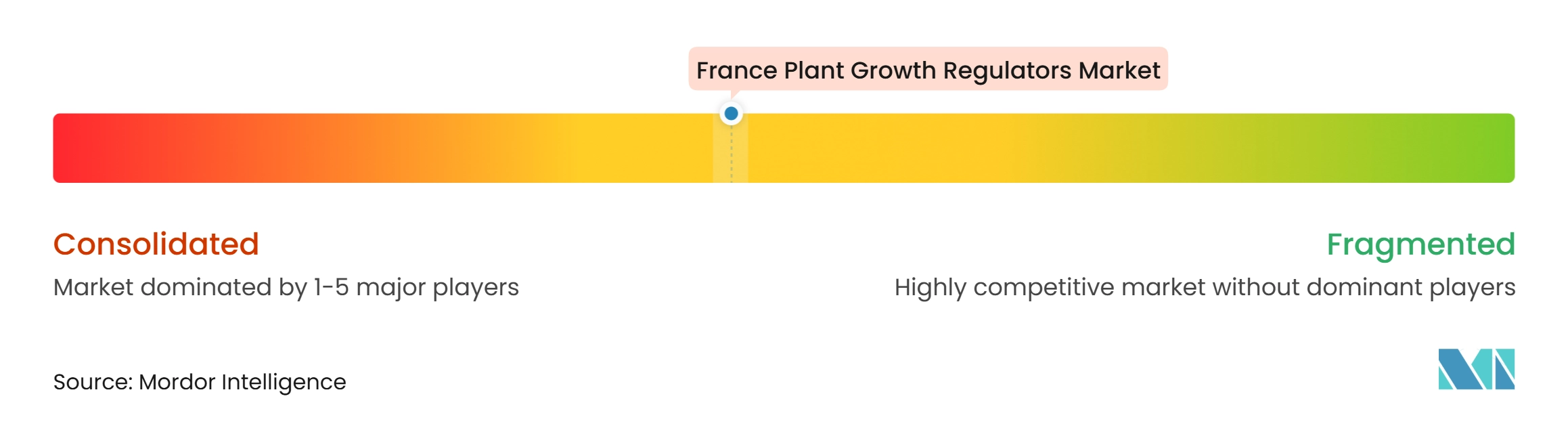
The France plant growth regulators market is moderately consolidated, with BASF SE, Bayer AG, Syngenta Group, Corteva Agriscience, and De Sangosse being the five largest players in 2025. Multinational companies hold stronger positions in cereals and oilseeds, supported by multi-country registration capabilities and established cooperative distribution systems. French specialists maintain stronger positions in vineyards, horticulture, and biostimulants, where local grower relationships and field-trial experience are important. The market includes both broadacre leaders and focused domestic suppliers. Competition centers on product approval, biological innovation, formulation quality, and agronomic support.
BASF SE and Bayer AG each signed exclusive France distribution agreements with Elicit Plant in 2024, giving them access to its elicitor-class biostimulant products. Corteva Agriscience expanded its biological portfolio by integrating Stoller and Symborg science into its branded crop programs. Syngenta opened a 22,000 m² biologicals facility in 2025, reflecting continued investment in biological manufacturing capacity. De Sangosse announced a EUR 42 million (USD 44.2 million) France investment roadmap in November 2025, including a EUR 12 million (USD 12.6 million) global R&D center and EUR 30 million (USD 31.6 million) across two production plants. These developments indicate that major companies are strengthening their positions across both biological products and local production capacity.
The clearest opportunities exist in gibberellin-based liquids for table grapes and berries, Soil Nutrient apparent Balance (SNuB) compatible alternatives for anti-lodging uses, and specialized formulations for protected horticulture. Elicit Plant's EUR 45 million (USD 47.4 million) Series B round in October 2024 reflected investor confidence in French agricultural biologicals. Local field evidence and strong technical support are likely to matter as much as product price, particularly in vineyards and protected crops. The France plant growth regulators market will remain open to specialized competitors, but they will need credible registrations, local trials, and effective distribution partners to scale.
France Plant Growth Regulators Industry Leaders
-
BASF SE
-
Bayer AG
-
Syngenta Group
-
De Sangosse Group
-
Corteva Agriscience
- *Disclaimer: Major Players sorted in no particular order
France Plant Growth Regulators Market Companies Covered in this Report
- BASF SE
- Bayer AG
- Syngenta Group
- Corteva Agriscience
- De Sangosse
- Philagro France
- UPL Ltd.
- Nufarm Limited
- FMC Corporation
- Sipcam Oxon S.p.A.
- Rovensa Next
- ICL Group
- Biostadt India Limited
- Lallemand, Inc.
- Olmix Group
Recent Industry Developments in France Plant Growth Regulators Market
- January 2026: Agronutrition, part of De Sangosse Group, participated in SIVAL 2026, showcasing AngioSTART root biostimulant applied at sowing for cereals and oilseeds, directly targeting France's largest plant growth regulator volume crop category and demonstrating the group's pipeline strength in the biostimulant segment
- December 2025: Olmix Group invested EUR 2 million (USD 2.1 million) to double biostimulant production at its Guetavet facility in Bréhan, France, reaching 2 million liters per year. The expansion addresses supply constraints for algae-based plant growth regulator-adjacent products targeting vine and vegetable crops sold through its Violleau partnership and direct channels
- October 2025: UPL launched Carbo XL and Bovato biostimulants for French viticulture, following the October 2025 launch of Gaxy for nitrogen optimization in cereals, which helped reduce greenhouse gas emissions in field pilots.
France Plant Growth Regulators Market Report Scope
Plant Growth Regulators (PGRs), often called plant hormones or phytohormones, are natural or synthetic organic compounds that govern all aspects of plant growth and development.
The France plant growth regulators market report is segmented by type (cytokinins, auxins, gibberellins, ethylene releasers, others), application (crop: grains and cereals, pulses, fruits and vegetables, cash crops, others; non-crop: turf and ornamentals, nursery crops), and formulation (soluble liquids, soluble granules, suspension concentrates, wettable powders, others). The market forecasts are provided in terms of value (USD).
Segmentation Overview
| Cytokinins |
| Auxins |
| Gibberellins |
| Ethylene and Ethylene-Releasing Compounds |
| Other Types |
| Crop-Based | Grains and Cereals |
| Pulses and Oilseeds | |
| Fruits and Vegetables | |
| Cash Crops | |
| Other Crops | |
| Non-Crop-Based | Turf and Ornamental Grass |
| Ornamentals and Nursery Crops |
| Soluble Liquids |
| Soluble Granules |
| Suspension Concentrates |
| Wettable Powders |
| Other Formulations |
| By Type | Cytokinins | |
| Auxins | ||
| Gibberellins | ||
| Ethylene and Ethylene-Releasing Compounds | ||
| Other Types | ||
| By Application | Crop-Based | Grains and Cereals |
| Pulses and Oilseeds | ||
| Fruits and Vegetables | ||
| Cash Crops | ||
| Other Crops | ||
| Non-Crop-Based | Turf and Ornamental Grass | |
| Ornamentals and Nursery Crops | ||
| By Formulation | Soluble Liquids | |
| Soluble Granules | ||
| Suspension Concentrates | ||
| Wettable Powders | ||
| Other Formulations | ||
Key Questions Answered in the Report
What is the current size and outlook for plant growth regulators in France?
The France plant growth regulators market was valued at USD 179.5 million in 2025, stands at USD 194.3 million in 2026, and is forecast to reach USD 289.5 million by 2031 at an 8.3% CAGR.
Which product type leads demand in France?
Cytokinins led the market in 2025 with a 34% revenue share because they are used across orchards, vineyards, leafy vegetables, turf, and protected crops.
Which crop application is growing the fastest?
Fruits and vegetables are forecast to expand at a 9.4% CAGR through 2031, supported by high-value crop requirements for quality, crop consistency, and lower residue risk.
Why are anti-lodging products important in France?
France has close to 9 million hectares of wheat and barley, and high-input cereal programs use anti-lodging products to protect crop structure and harvest quality.
What is driving biological and biostimulant adoption in France?
Écophyto 2030, SNUB expansion, and PARSADA funding are pushing suppliers and growers toward lower-risk alternatives, especially in organic, HVE, vineyard, and horticulture applications.