
France Enterprise Content Management (ECM) Market Size and Share
Market Overview
| Study Period | 2020 - 2031 |
|---|---|
| Forecast Data Period | 2026 - 2031 |
| Base Year Market Size (2025) | USD 1.01 Billion |
| Market Size (2026) | USD 1.14 Billion |
| Market Size (2031) | USD 2.12 Billion |
| Growth Rate (2026 - 2031) | 13.21% CAGR |
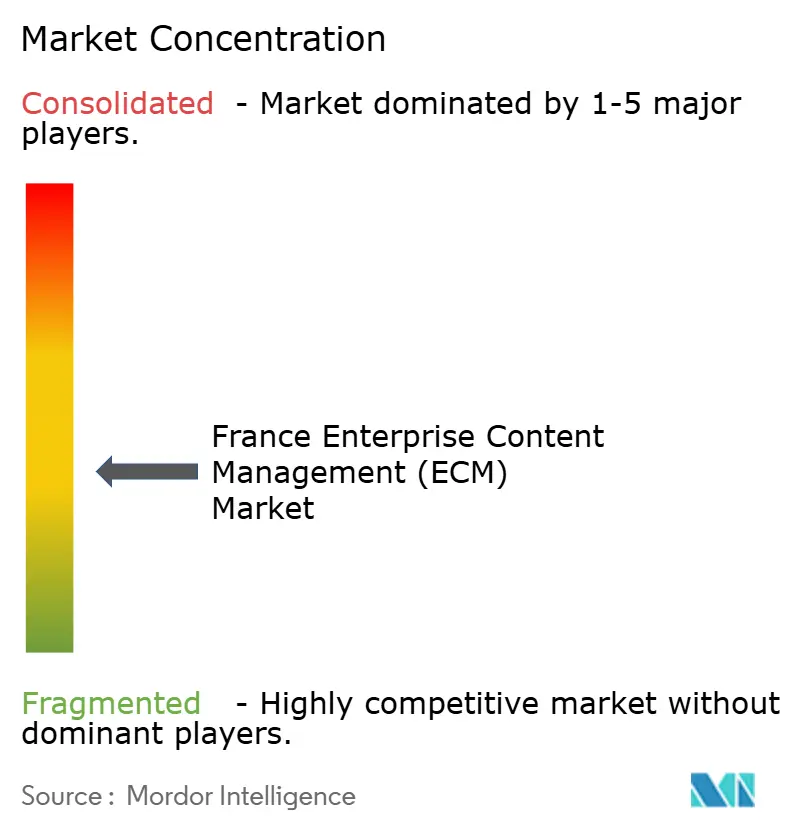
| Market Concentration | Medium |
Major Players *Disclaimer: Major Players sorted in no particular order Image © Mordor Intelligence. Reuse requires attribution under CC BY 4.0. | |
France Enterprise Content Management (ECM) Market Analysis by Mordor Intelligence
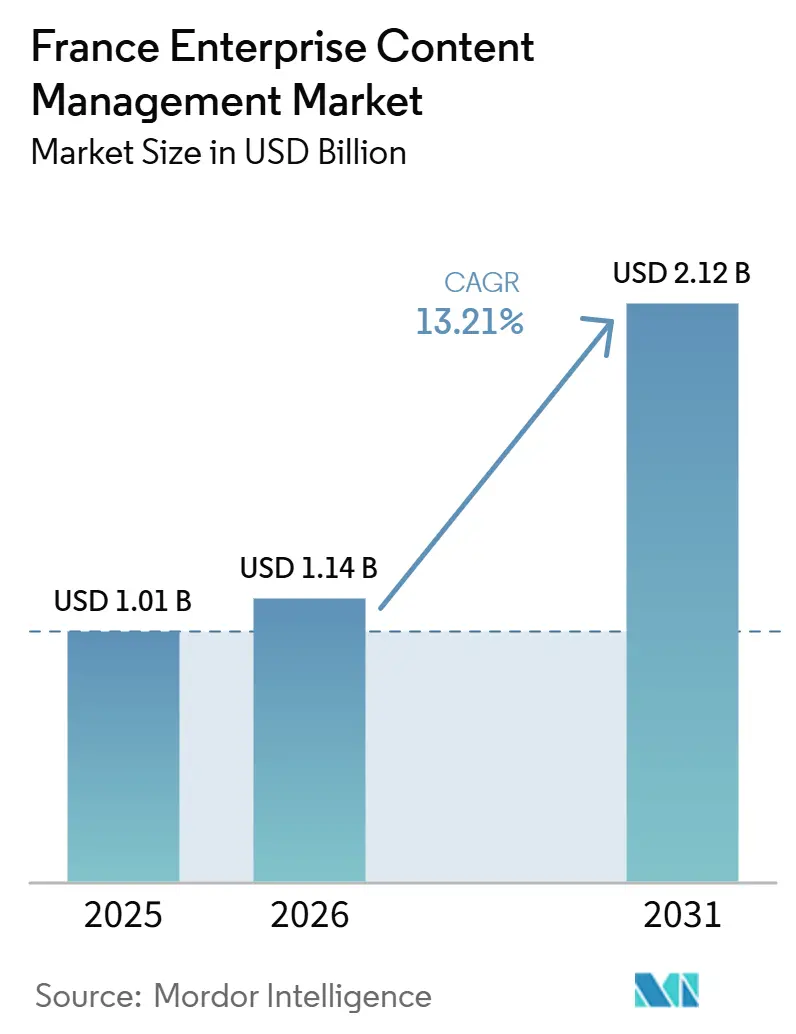
The France enterprise content management (ECM) market size is projected to expand from USD 1.01 billion in 2025 and USD 1.1 billion in 2026 to USD 2.12 billion by 2031, registering a CAGR of 13.21% between 2026-2031. The market is moving beyond basic document digitization as French enterprises connect content systems more directly with workflow control, audit readiness, and AI-led decision support. Demand is rising from both large organizations and smaller firms because regulatory compliance, cloud adoption, and wider use of digital work tools are pushing content governance higher on the spending agenda. Competitive positioning is also shifting because vendors now need to combine workflow capability, AI-based classification, and stronger sovereignty alignment rather than rely only on storage and retrieval functions. The France enterprise content management (ECM) market is also benefiting from wider acceptance of SaaS delivery models, which lowers entry barriers for SMEs and supports faster rollout across distributed operations. At the same time, the strongest opportunities are forming around compliant cloud deployment, workflow automation, and vertical use cases where document volumes, audit needs, and interoperability requirements are already high.
Key Report Takeaways
- By solution type, document management held 26.78% revenue share in France enterprise content management (ECM) market in 2025, while workflow and business process management are projected to expand at a 14.11% CAGR through 2031.
- By deployment mode, cloud held 73.59% share of the France enterprise content management (ECM) market size in 2025, and it is projected to expand at a 15.62% CAGR through 2031.
- By enterprise size, large enterprises held 63.48% of France enterprise content management (ECM) market share in 2025, while SMEs are projected to record the fastest CAGR at 16.47% through 2031.
- By end-user industry, BFSI held 24.91% of France enterprise content management (ECM) market share in 2025, while healthcare is projected to expand at a 16.36% CAGR through 2031.
Note: Market size and forecast figures in this report are generated using Mordor Intelligence’s proprietary estimation framework, updated with the latest available data and insights as of January 2026.
France Enterprise Content Management (ECM) Market Trends and Insights
Drivers Impact Analysis*
| DRIVER | (~) % IMPACT ON CAGR FORECAST | GEOGRAPHIC RELEVANCE | IMPACT TIMELINE |
|---|---|---|---|
| Rising Digital Transformation Across French Enterprises | +3.2% | National, concentrated in Île-de-France and Lyon metropolitan areas | Medium term (2-4 years) |
| Expansion of Cloud-First Content Infrastructure | +2.8% | National, strongest among large-enterprise clusters in Paris and major urban centers | Short term (≤ 2 years) |
| Regulatory Pressure for Traceable Records and Audit Trails | +2.2% | National, with early mandates in BFSI, public sector, and healthcare hubs | Short term (≤ 2 years) |
| AI-Enabled Content Classification and Retrieval Automation | +1.8% | National, with early adoption in Paris-Saclay and Lyon technology corridors | Medium term (2-4 years) |
| Remote and Hybrid Workflows Requiring Secure Content Access | +1.2% | National, with higher penetration in large-enterprise IT clusters | Short term (≤ 2 years) |
| Sovereign Hosting Demand in Regulated French Sectors | +0.8% | National, concentrated in defense, healthcare, and government sectors in Paris and Île-de-France | Long term (≥ 4 years) |
| Source: Mordor Intelligence | |||
Rising Digital Transformation Across French Enterprises
Digital transformation is creating steady demand for structured content systems across the France enterprise content management (ECM) market. France Num reported that 78% of SME leaders saw digital tools as a real operational benefit in the 2025 barometer, which shows a broad base of business readiness rather than limited pilot activity.[1]Ministère de l'Économie, des Finances et de la Souveraineté Industrielle et Numérique, “Baromètre France Num 2025 – Rapport,” France Num, francenum.gouv.fr The same source showed that AI tool usage among French SMEs rose from 13% in 2024 to 26% in 2025, which indicates that content platforms with search, classification, and workflow support are becoming more relevant outside large enterprises. The European Commission also noted continued digital investment momentum in France through national recovery and digital decade programs, which support multi-year enterprise software spending. This broader modernization wave means document control is being treated less as a back-office archive and more as a system that supports compliance, operations, and customer-facing processes. As a result, the France enterprise content management (ECM) market is seeing stronger demand from buyers who want platforms ready for both governance and process redesign.
Expansion of Cloud-First Content Infrastructure
Cloud deployment now sets the direction of enterprise content investment in France, even though buyer preferences still vary by regulation, workload type, and data sensitivity. The French government reported that procurement through the interministerial Nuage public marketplace reached EUR 84 million (USD 91.6 million) in 2025, up 62% from 2024, which points to accelerating acceptance of cloud-based digital infrastructure in the public domain.[2]Direction Interministérielle du Numérique, “État de Transition Cloud - Offres Européennes Souveraines,” Direction Interministérielle du Numérique, numerique.gouv.fr That momentum matters for the France enterprise content management (ECM) market because public sector buying patterns often shape expectations in regulated private sectors as well. Cloud adoption is also becoming more layered because buyers are increasingly weighing sovereign hosting, hybrid control, and qualification requirements alongside scalability and cost. This is changing vendor selection criteria, especially where public cloud alone is no longer enough to satisfy procurement expectations. In practice, growth favors providers that can combine cloud speed with stronger governance and local compliance alignment.
Regulatory Pressure for Traceable Records and Audit Trails
Compliance needs are making traceability a core requirement for enterprise content platforms across France. France Num reported that only 41% of French SMEs held the mandatory processing activity register, which points to a large gap between legal obligation and operating practice. That gap supports demand in the France enterprise content management (ECM) market because businesses need stronger record control, retention discipline, and audit-ready document access. In regulated sectors, buyers are less willing to separate document storage from policy management, approval history, and retrieval logging because those functions now support daily compliance work. This also raises the value of platforms that can standardize retention rules and link documents more directly to business workflows. The result is that regulatory readiness is becoming a baseline buying requirement rather than an optional add-on.
AI-Enabled Content Classification and Retrieval Automation
AI is changing how buyers define value in enterprise content systems across France. Finastra reported that 94% of French financial institutions used or planned to use AI in 2026, and document processing ranked as the leading AI use case at 48%. That shift matters for the France enterprise content management (ECM) market because it pulls spending toward platforms that can classify content, improve search quality, and automate routine document work. As document volumes increase, metadata quality becomes more important because retrieval performance weakens when legacy files are poorly tagged or stored in disconnected repositories. Buyers are therefore placing more weight on systems that can enrich, interpret, and route content rather than simply store it. This favors vendors with practical AI functions that improve document handling without forcing full replacement of existing business systems.
Restraints Impact Analysis*
| RESTRAINT | (~) % IMPACT ON CAGR FORECAST | GEOGRAPHIC RELEVANCE | IMPACT TIMELINE |
|---|---|---|---|
| Integration Complexity With Legacy Enterprise Systems | -1.8% | National, with acute pain points in manufacturing, BFSI, and public sector | Medium term (2-4 years) |
| Data Residency and Sovereignty Constraints | -1.4% | National, with heightened scrutiny in BFSI, public sector, and healthcare | Long term (≥ 4 years) |
| Budget Pressure From Multi-Year Migration Programs | -0.9% | National, concentrated in mid-market enterprises outside Paris | Medium term (2-4 years) |
| Change Management Friction in Highly Documented Workflows | -0.6% | National, with notable resistance in legal, healthcare, and public sector organizations | Long term (≥ 4 years) |
| Source: Mordor Intelligence | |||
Integration Complexity with Legacy Enterprise Systems
Legacy architecture remains one of the clearest limits on faster deployment across the France enterprise content management (ECM) market. Galeon noted that the average French hospital information system includes 50 to 200 distinct applications, which shows how fragmented content environments can be in document-heavy settings. Finastra also reported that 43% of French financial institutions cited legacy complexity as a primary challenge in technology modernization. These examples matter because the sectors with the strongest compliance needs often have the most difficult integration estates. Buyers are therefore looking more closely at connector depth, implementation risk, and the cost of linking ECM platforms with ERP, CRM, and sector-specific applications. Vendors that depend on large replacement projects face longer sales cycles because many organizations now prefer modular migration paths.
Data Residency and Sovereignty Constraints
Data sovereignty remains both a demand driver and a deployment barrier in France. The French government has continued to emphasize sovereign and European cloud options in its transition guidance, which keeps residency and control issues visible in public procurement and adjacent regulated sectors. This matters for the France enterprise content management (ECM) market because buyers in healthcare, finance, and government often evaluate hosting models as carefully as application functionality. Sovereignty requirements can lengthen procurement because they affect architecture choices, partner selection, and contractual review. They also raise delivery costs when a platform needs qualified hosting or dedicated migration support. As a result, vendors without a clear local compliance path face slower adoption even when their product capabilities are otherwise competitive.
*Our forecasts treat driver/restraint impacts as directional, not additive. The impact forecasts reflect baseline growth, mix effects, and variable interactions.
Segment Analysis
By Solution Type: Document Management Anchors Revenue As Process Automation Accelerates
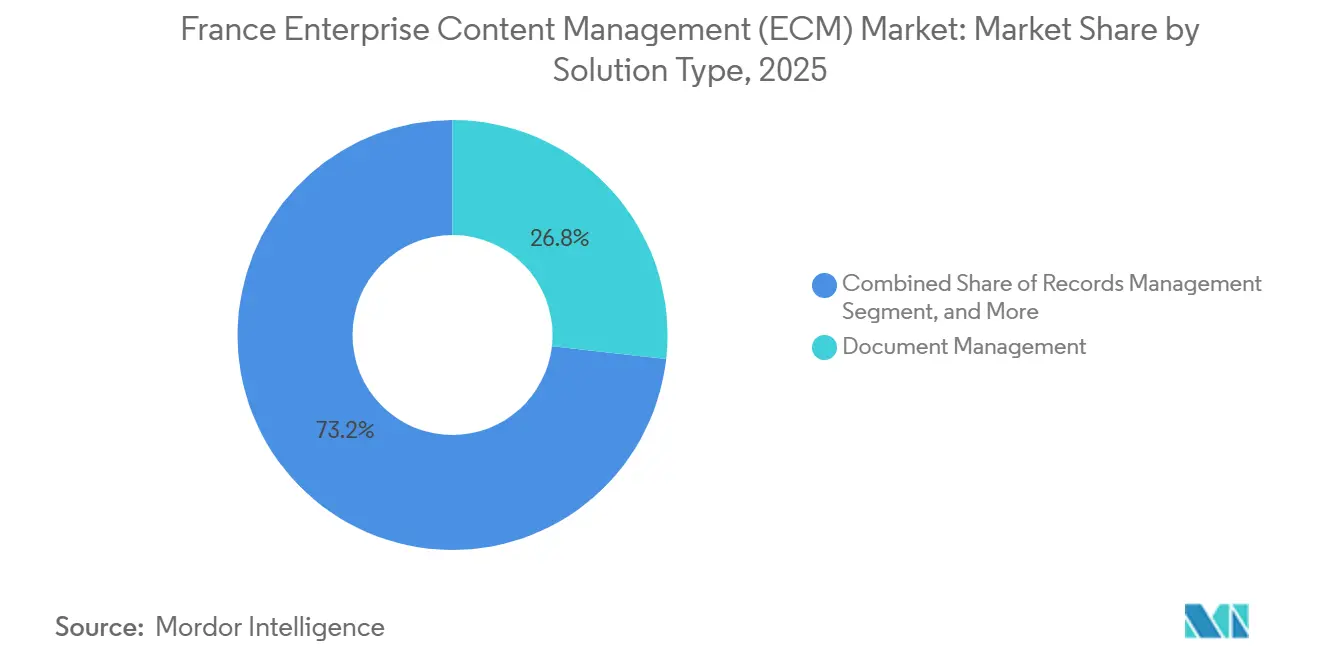
Document management held 26.78% of the France enterprise content management (ECM) market size in 2025, which kept it as the leading solution category while the broader buying mix continued to expand toward more process-led use cases. That position reflects the fact that many French organizations are still formalizing digital records, retention rules, and retrieval standards before moving deeper into automation. In the France enterprise content management (ECM) market, basic document control remains a practical first step for sectors that operate under strict audit, reporting, and review requirements. This is especially visible in BFSI, government, and administrative environments where policy discipline and searchability carry immediate operational value. The large installed base for core document management, therefore, continues to support revenue even as newer workflow needs gain speed.
Workflow and business process management is projected to expand at a 14.11% CAGR from 2026 to 2031, which shows where the next layer of demand is forming. Buyers are shifting attention from storing files to routing approvals, validating records, and linking content directly to transactional processes. This change is widening the role of ECM platforms from archive control to workflow execution across invoicing, claims, case handling, and internal governance. Records management and case management still hold a solid place because legal and administrative functions need structure, traceability, and defensible retention. Digital asset management and web content management are also becoming more relevant in sectors where content governance now extends to branded assets, customer interaction, and regulated digital communication.



By Deployment Mode: Cloud Dominates While SecNumCloud Reshapes the Competitive Boundary
Cloud held 73.59% share of the France enterprise content management (ECM) market size in 2025 and is projected to expand at a 15.62% CAGR through 2031, which confirms that deployment choice is moving steadily toward hosted delivery. That growth reflects demand for faster implementation, lower infrastructure burden, and easier feature updates across a broad set of enterprise users. The France enterprise content management (ECM) market is not moving to a single cloud model, however, because private, sovereign, and hybrid environments remain central in regulated sectors. Procurement decisions increasingly depend on how well vendors can balance scalability with governance, qualification, and local data expectations. This means cloud leadership in France is tied not only to architecture but also to trust and compliance alignment.
At the same time, on-premises deployment still retains relevance where organizations manage highly sensitive records or operate within strict internal control frameworks. Hybrid configurations are therefore becoming common because they allow firms to isolate critical data while still using cloud-based collaboration and workflow functions. This two-track pattern helps explain why the cloud is leading revenue while older environments still remain part of the installed base. It also gives providers an edge by supporting phased migration rather than insisting on full, immediate cloud replacement. In practical terms, deployment competition in the France enterprise content management industry is now shaped by flexibility, sovereignty readiness, and the ability to support mixed environments without creating new operational risk.
By Enterprise Size: Large Enterprises Lead, But SME Adoption is Reaching Inflection
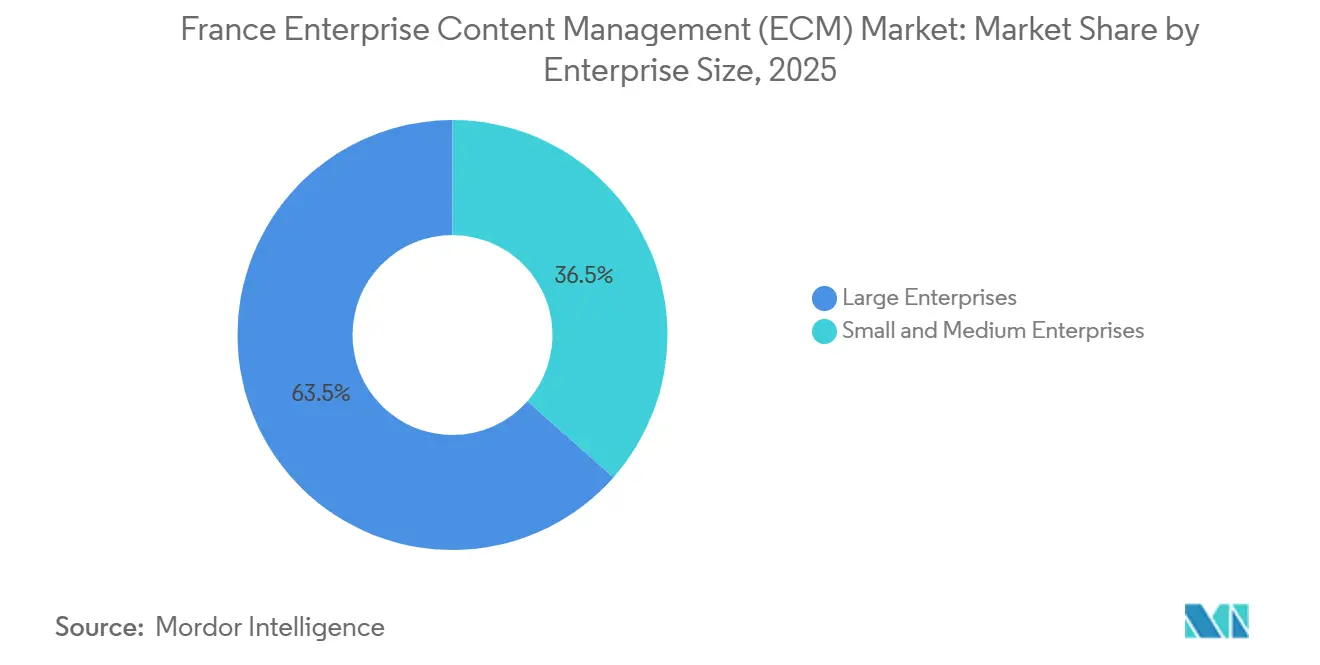
Large enterprises held 63.48% of the market in 2025, which reflected earlier investment cycles, larger document volumes, and stronger direct exposure to regulatory and audit requirements. This made them the main revenue anchors in the France enterprise content management (ECM) market as incumbent vendors expanded through existing IT relationships and broader enterprise platform sales. Large organizations also entered the current period with more mature hybrid environments and stronger budgets for AI-enabled document initiatives. That maturity is now supporting a second wave of spending focused less on digitization and more on classification, orchestration, and content intelligence. In effect, large enterprises continue to sustain market value even as the next growth pool shifts elsewhere.
SMEs are projected to expand at a 16.47% CAGR from 2026 to 2031, which marks the fastest growth pace among enterprise-size segments. France Num showed that AI usage among French SMEs doubled from 13% in 2024 to 26% in 2025, which suggests that smaller firms are becoming more comfortable with digital systems that previously looked too complex or too costly. Wider use of collaborative tools and document platforms is also creating a base from which structured ECM adoption can grow. SaaS pricing and lower infrastructure burden help reduce entry barriers for businesses that do not maintain large internal IT teams. The contrast between large-enterprise scale and SME growth means vendors that can address both standardized and advanced needs should be better placed over the forecast period.
By End-User Industry: BFSI Anchors Demand as Healthcare Opens the Next Growth Pocket
BFSI held 24.91% of market revenue in 2025, which made it the largest end-user segment in the France enterprise content management (ECM) market. The sector’s lead reflects its heavy dependence on audit trails, compliance records, document security, and structured processing across customer, claims, and regulatory workflows. Financial institutions also tend to adopt content controls early because reporting requirements and operational risk standards are already embedded in daily work. This helps keep BFSI at the center of vendor strategy, especially for platforms that combine governance with workflow and AI functions. The segment, therefore, remains a stable revenue base even as growth is broadening across other verticals.
Healthcare is projected to expand at a 16.36% CAGR from 2026 to 2031, which makes it the fastest-growing end-user segment. Galeon reported that French hospital information systems often span 50 to 200 applications, which shows why interoperability and document federation remain pressing issues in healthcare settings.[3]Galeon, “Health Data Interoperability, Why It Is the Top Priority for French Hospitals in 2026,” Galeon, galeon.care The same environment increases the value of ECM platforms that can connect fragmented content flows without forcing immediate replacement of all core systems. Government and public sector demand is also strengthening as cloud doctrine and data control expectations tighten around administrative workloads. Manufacturing, IT and telecommunications, education, energy and utilities, and media continue to add demand as content governance becomes more important across quality documentation, service delivery, and digital communication.
Geography Analysis
Île-de-France remains the largest demand center in the France enterprise content management (ECM) market because it combines financial headquarters, public institutions, and major enterprise technology buyers in a single region. The region’s concentration of banking, insurance, and government activity keeps procurement focused on auditability, compliance, and secure workflow control. That concentration also makes sovereignty alignment more important because regulated buyers in and around Paris tend to place greater weight on hosting and certification choices. SAP strengthened its position in this environment when it launched SAP Sovereign Cloud in France in partnership with Bleu in March 2026, targeting public administrations and other sensitive organizations with SecNumCloud-compliant SaaS services.[4]SAP, “SAP Launches Sovereign Cloud in France in Partnership with Bleu,” SAP News, news.sap.com In practical terms, Île-de-France continues to set the pace for the France enterprise content management (ECM) market because the region brings together large budgets, heavy compliance needs, and early adoption of cloud governance models.
The Lyon-Grenoble corridor forms the next major demand cluster because of its manufacturing, healthcare, and enterprise software activity. This regional profile supports sustained use of ECM in quality records, supplier coordination, technical documentation, and regulated process control. The mix of industrial operations and healthcare institutions also creates demand for platforms that can work across hybrid environments rather than rely on a single deployment model. As regional buyers modernize, ECM spending is increasingly tied to interoperability, document traceability, and practical workflow gains rather than broad digitization programs alone.
Demand is also spreading beyond the main metropolitan centers as SME digitization and public modernization programs reach a wider set of business communities. France Num reported that 81% of French SMEs used collaborative tools and document-sharing platforms in 2025, which shows that many organizations already have the behavioral base for more structured content management adoption. The European Commission also highlighted continued support for France’s digital advancement through national and European funding frameworks, which help extend modernization activity outside the capital. This wider spread matters for the France enterprise content management (ECM) market because future volume growth is unlikely to come only from Paris-based enterprises. Instead, regional adoption is being supported by a mix of cloud access, lower-cost SaaS models, and rising compliance expectations across smaller organizations. The national footprint is therefore broadening even though high-value procurement still remains concentrated in the largest urban and regulated centers.
Competitive Landscape
The France enterprise content management (ECM)market shows moderate to high competitive intensity because global platform vendors remain strong in large accounts while specialized providers continue to compete actively in the mid-market. Microsoft, SAP, and OpenText benefit from established enterprise relationships, broad product coverage, and the ability to align ECM investments with wider cloud and software spending. At the same time, specialized vendors such as DocuWare, M-Files, and Hyland are gaining attention where buyers want faster deployment, stronger document intelligence, or more focused workflow execution. Sovereignty expectations are sharpening this competition because product capability alone is no longer enough in many regulated deals. The market is therefore being shaped by a combination of installed-base strength, ecosystem positioning, and local compliance credibility.
SAP made one of the clearest strategic moves in March 2026 when it launched SAP Sovereign Cloud in France with Bleu to serve public administrations and other sensitive organizations. SAP then expanded that posture in June 2026 by announcing up to EUR 300 million (USD 327 million) of investment in France to strengthen sovereign cloud and Business AI capabilities, including a new SecNumCloud-qualified region planned for Q1 2027. These moves show that control over compliant infrastructure is becoming a direct competitive asset in the France enterprise content management (ECM) market. They also raise the pressure on rivals that still rely mainly on general cloud positioning without a strong France-specific sovereignty message.
Other vendors are also adjusting their strategy around workflow intelligence and AI-led document value. Finastra’s 2026 findings showed that 94% of French financial institutions used or planned to use AI, with document processing ranked first among AI use cases at 48%, which supports further competition around content automation in BFSI. M-Files reported record annual recurring revenue and more than 240 product innovations in 2025, including its Aino Metadata Agent at Scale, which signals continued investment in context-first document management. DocuWare also strengthened its position in the French mid-market through recognition in the Exaegis Blueprint 2025-2026 study, which supports its standing against larger enterprise-focused rivals. Taken together, these developments show that the France enterprise content management (ECM) market is rewarding vendors that pair practical AI execution with stronger compliance and deployment fit. This keeps the field competitive and limits the likelihood of control concentrating quickly around only 1 or 2 suppliers.
France Enterprise Content Management (ECM) Industry Leaders
OpenText Corporation
Hyland Software, Inc.
M‑Files Corporation
Box, Inc.
Laserfiche, Inc.
- *Disclaimer: Major Players sorted in no particular order

Recent Industry Developments
- June 2026: SAP announced an investment of up to EUR 300 million (USD 327 million) in France to expand sovereign cloud and Business AI capabilities, including a new SecNumCloud-qualified cloud region with 3 data center sites in Paris planned for Q1 2027. The investment includes deployment of the SAP Business AI Platform, Joule Studio, for enterprise agent development and targeted hundreds of new jobs in France, reinforcing the country as SAP's primary European sovereign cloud beachhead.
- June 2026: Hyland and Microsoft announced a strategic collaboration to integrate the Hyland Content Innovation Cloud on Microsoft Azure, enabling agentic content workflows at scale across regulated industries. Hyland solutions are made available through the Microsoft Marketplace, allowing organizations to apply existing Azure commitments toward ECM procurement, a procurement channel that is particularly strategic for Europe's large installed Microsoft base.
- April 2026: OpenText partnered with S3NS, the alliance between Thales and Google Cloud, to deliver sovereign ECM solutions certified to SecNumCloud 3.2 from France. The offering includes OpenText Content Management, Documentum Content Management, and OpenText Core Archive for SAP solutions on sovereign infrastructure, specifically targeting healthcare, finance, and public administration clients with strict data residency obligations.
- March 2026: SAP launched SAP Sovereign Cloud in France in partnership with Bleu, the French cloud company established by Orange and Capgemini, targeting public administrations, OVIs, and OSEs with ANSSI SecNumCloud-compliant SaaS solutions. The offering aims to have 80% of SAP cloud services running via Bleu by end of 2026, representing a decisive commitment to France's most regulated content environments.
- January 2026: DocuWare received definitive Plateforme Agréée, PA, certification from France's Direction Générale des Finances Publiques, positioning its ECM offering as a compliance-grade infrastructure for France's mandatory B2B e-invoicing system and establishing a direct regulatory moat ahead of the September 2026 deadline.


France Enterprise Content Management (ECM) Market Report Scope
The France enterprise content management (ECM) market refers to the platforms and solutions that enable organizations to manage, store, organize, and secure enterprise digital content in a centralized and scalable environment. ECM solutions help organizations in France manage documents, compliance records, customer communications, and marketing assets while improving workflows, supporting regulatory compliance, and strengthening collaboration across sectors such as government, banking, healthcare, telecom, and retail. The market plays a key role in France’s digital transformation by supporting GDPR compliance, AI-powered automation, operational efficiency, and omnichannel customer engagement.
The France Enterprise Content Management (ECM) Market Report is Segmented by Solution Type (Document Management, Records Management, Workflow and Business Process Management, Case Management, Digital Asset Management, Web Content Management, and Other Solutions), Deployment Mode (On-Premises, Cloud, and Hybrid), Enterprise Size (Small and Medium Enterprises (SME), and Large Enterprises). and End-User Industry (BFSI, Government and Public Sector, Healthcare, IT and Telecommunications, Manufacturing, Retail, Media and Entertainment, Education, Energy and Utilities, and Other End-User Industries). The Market Forecasts are Provided in Terms of Value (USD).
| Document Management |
| Records Management |
| Workflow and Business Process Management |
| Case Management |
| Digital Asset Management |
| Web Content Management |
| Other Solution Types |
| On-Premises |
| Cloud |
| Hybrid |
| Small and Medium Enterprises (SME) |
| Large Enterprises |
| BFSI |
| Government and Public Sector |
| Healthcare |
| IT and Telecommunications |
| Manufacturing |
| Retail |
| Media and Entertainment |
| Education |
| Energy and Utilities |
| Other End-User Industries |
| By Solution Type | Document Management |
| Records Management | |
| Workflow and Business Process Management | |
| Case Management | |
| Digital Asset Management | |
| Web Content Management | |
| Other Solution Types | |
| By Deployment Mode | On-Premises |
| Cloud | |
| Hybrid | |
| By Enterprise Size | Small and Medium Enterprises (SME) |
| Large Enterprises | |
| By End-User Industry | BFSI |
| Government and Public Sector | |
| Healthcare | |
| IT and Telecommunications | |
| Manufacturing | |
| Retail | |
| Media and Entertainment | |
| Education | |
| Energy and Utilities | |
| Other End-User Industries |


Key Questions Answered in the Report
What is the current and forecast value of the France enterprise content management (ECM) market?
The France enterprise content management (ECM) market was valued at USD 1.01 billion in 2025, is estimated at USD 1.1 billion in 2026, and is forecast to reach USD 2.12 billion by 2031 at a 13.21% CAGR.
Which deployment model leads content management adoption in France?
Cloud leads deployment with a 73.59% share in 2025 and is projected to post the fastest growth at a 15.62% CAGR through 2031.
Which solution category generates the most revenue in France?
Document Management held the largest solution share at 26.78% in 2025, while Workflow and Business Process Management is expected to grow the fastest through 2031.
Why are SMEs becoming more important buyers in France?
SMEs are projected to record the fastest CAGR at 16.47% because SaaS delivery lowers adoption barriers and digital tool usage among French SMEs is already broadening.
Which end-user group offers the strongest near-term opportunity?
BFSI remained the largest end-user segment in 2025 with 24.91% revenue share, but healthcare offers the strongest growth outlook with a 16.36% CAGR through 2031.
What is shaping vendor competition most strongly in France?
Competition is being shaped by sovereign cloud readiness, AI-enabled document automation, and the ability to connect ECM platforms with legacy systems in regulated sectors.
Page last updated on:






