
Fragrance Market Size and Share
Market Overview
| Study Period | 2021 - 2031 |
|---|---|
| Market Size (2026) | USD 97.92 Billion |
| Market Size (2031) | USD 139.07 Billion |
| Growth Rate (2026 - 2031) | 7.27% CAGR |
| Fastest Growing Market | Asia-Pacific |
| Largest Market | North America |
| Market Concentration | Medium |
Major Players *Disclaimer: Major Players sorted in no particular order Image © Mordor Intelligence. Reuse requires attribution under CC BY 4.0. | |
Fragrance Market Analysis by Mordor Intelligence
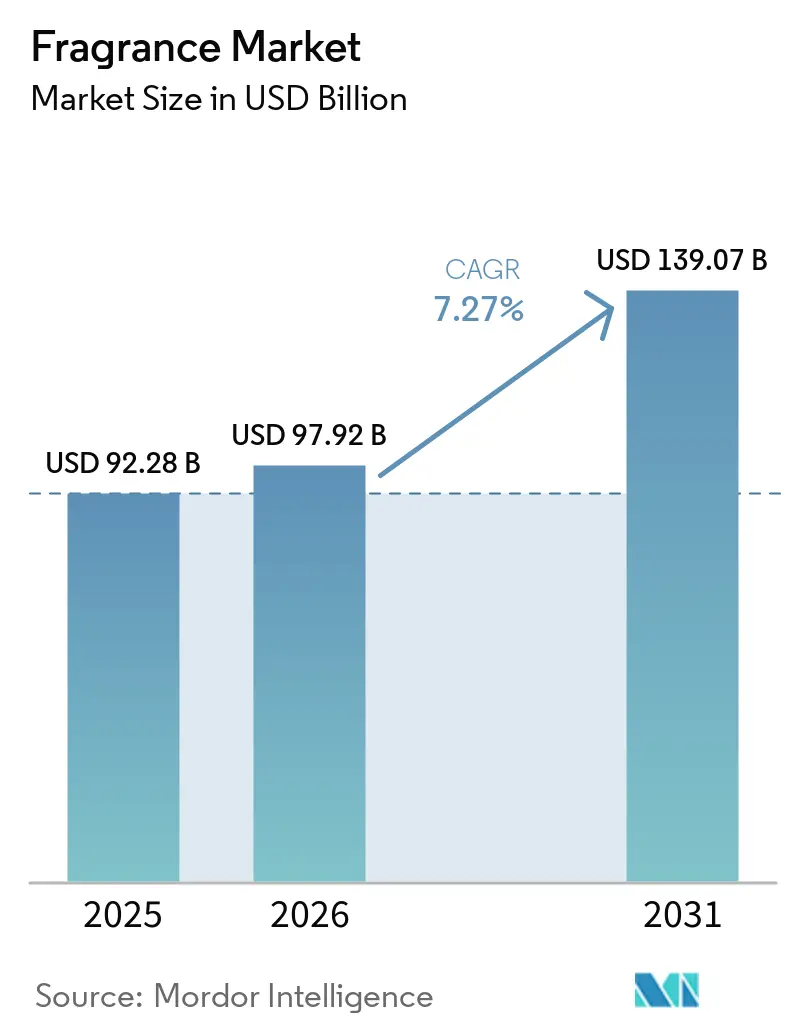
The fragrance market size is expected to increase from USD 92.28 billion in 2025 to USD 97.92 billion in 2026 and reach USD 139.07 billion by 2031, growing at a CAGR of 7.27% over 2026-2031. Fragrance spending now extends well beyond basic personal care because consumers increasingly connect scent with wellness, self-expression, and home atmosphere, helping the category stay relevant even as broader discretionary spending is under pressure. Biotechnology-led naturals, including fermentation-based aroma ingredients, CO2-extracted materials, and biosynthesized musks, are changing sourcing economics while also helping brands respond to cleaner formulation expectations. This is shortening launch cycles in the fragrance market and rewarding companies that can reformulate faster, improve traceability, and refresh portfolios without slowing innovation. Premiumization, home scent adoption, and digital discovery are widening the fragrance market's reach, even as specialty stores remain important because many consumers want guided testing before buying. Counterfeit products and tighter formulation rules continue to weigh on the category, but those same pressures are pushing more green chemis.try investment and making compliance a clearer source of competitive advantage.
Key Report Takeaways
- By product type, body fragrances accounted for 84.63% of the fragrance market share in 2025, while home fragrance will expand at a CAGR of 8.17% during 2026-2031.
- By category, conventional products accounted for 76.28% of the fragrance market in 2025, while organic formulations are expected to grow at a CAGR of 9.29% during 2026-2031.
- By price, premium and luxury products captured 61.28% of global market value in 2025, while the mass segment will advance at a CAGR of 8.28% during 2026-2031.
- By distribution channel, specialty stores accounted for 43.42% of global sales in 2025, while online retail is expected to grow at a CAGR of 9.18% during 2026-2031.
- By geography, North America accounted for 46.74% of the global market value in 2025, while the Asia-Pacific region will expand at a CAGR of 9.76% during 2026-2031.
Note: Market size and forecast figures in this report are generated using Mordor Intelligence’s proprietary estimation framework, updated with the latest available data and insights as of January 2026.
Global Fragrance Market Trends and Insights
Drivers Impact Analysis*
| Driver | (~) % Impact on CAGR Forecast | Geographic Relevance | Impact Timeline |
|---|---|---|---|
| Shift Toward Natural, Clean-Label, And Sustainable Fragrance Formulations | +0.9% | Global, highest intensity in Europe and North America | Short term (≤ 2 years) |
| Growing Demand For Niche, Artisanal, And Bespoke Fragrances | +1.1% | Europe, North America, APAC including China, Japan, and South Korea | Medium term (2-4 years) |
| Increasing Consumer Focus On Home Aesthetics And Wellness-Driven Lifestyles | +0.8% | North America, Europe, APAC | Medium term (2-4 years) |
| Social Media Influence And Celebrity-Led Brand Collaborations | +0.9% | Global, driven by North America and APAC digital adoption | Short term (≤ 2 years) |
| Premiumization And Rising Demand For Luxury Fragrance Offerings | +1.2% | Global, concentrated in North America, Europe, and Middle East | Medium term (2-4 years) |
| Growing Demand For Personalized Fragrances | +0.7% | North America, Europe, early gains in APAC | Long term (≥ 4 years) |
| Source: Mordor Intelligence | |||
Shift toward natural, clean-label, and sustainable fragrance formulations
Consumer demand for transparency has converted fragrance labeling from a marketing asset into a supply-chain imperative. IFRA's updated Transparency List, now covering over 3,000 ingredients, compels brands to disclose formulation contents at a granularity previously confined to pharmaceutical packaging, effectively raising the competitive floor for ingredient integrity[1]Source: International Fragrance Association, “IFRA Launches Updated Transparency List,” International Fragrance Association, ifrafragrance.org. Ingredient companies are meeting this shift with biotechnology-derived alternatives: Lallemand's Hevani bio-fermented vanillin, commercialized in 2025, offers a supply-chain-stable, crop-independent route to vanilla notes without the yield volatility of conventional Bourbon sourcing. IFF's LMR Naturals unveiled the Tonka Bean CO₂ Absolute in February 2026, a 100% natural, traceable ingredient positioned to replace synthetic coumarin in luxury formulations, signaling that green chemistry is now commercially viable at prestige concentrations. Brands that cannot retrofit their ingredient portfolios within the next three to five years face a real risk of shelf exclusion from European and North American premium retail as retailer-led clean-chemistry standards tighten.
Growing demand for niche, artisanal, and bespoke fragrances
The niche segment is redefining value perception at both ends of the price spectrum and forcing mainstream houses to recalibrate their competitive reference points. Amouage delivered double-digit revenue growth in 2025 by expanding directly operated retail while maintaining strict allocation controls in wholesale, demonstrating that scarcity management and channel discipline are as important as product quality in sustaining niche premiums. Parfums de Marly surpassed USD 400 million in retail sales for fiscal 2025, reinforcing the commercial viability of independent houses that combine olfactory storytelling with selective distribution rather than broad wholesale coverage. These results are compelling global conglomerates to acquire or incubate niche properties as a defensive move, not just to access brand equity but to understand the direct-community relationships that niche brands build more efficiently than legacy wholesale models. Olfactory NYC's expansion into Texas in 2025 signals that multi-brand niche fragrance retail is scaling beyond coastal US origins into secondary markets, indicating a structural broadening of the addressable consumer base.
Social media influence and celebrity-led brand collaborations
The rise of platform-native discovery has significantly shortened the traditional fragrance brand development cycle, reducing it from several years to just a few months, and created a market environment in which a small number of successful brands capture a disproportionate share of consumer attention. Brands with strong creator networks are particularly well-positioned to benefit from this trend. For example, Noyz’s collaboration with Ella Langley in 2025 resulted in a limited-edition fragrance that sold out within 72 hours, demonstrating the ability of social-media-driven celebrity partnerships to generate rapid sales momentum that is difficult for brands relying primarily on traditional advertising channels to achieve. Similarly, Ulta Beauty’s partnership with Beyoncé’s COWBOY CARTER TOUR fragrance collection in April 2025 integrated the product launch with a live-event retail experience, boosting store traffic and increasing customer spending per visit beyond what purely digital campaigns can deliver. This shift presents a significant challenge for established fragrance companies, many of which lack the creator-affiliate networks necessary to produce authentic, large-scale user-generated content at the pace demanded by Gen Z consumers. As a result, brands that invest early in building creator-driven ecosystems are establishing a competitive advantage that will be costly and difficult for late-entering competitors to replicate.
Premiumization and rising demand for luxury fragrance offerings
The luxury tier is the primary arena where fragrance heritage converts into sustainable margin, and the evidence base for its resilience is strengthening. Estée Lauder's pivot toward a Paris-based fragrance atelier model signals a deliberate repositioning away from department-store volume toward controlled, story-led distribution that preserves price architecture and supports higher average selling prices. Estée Lauder's fragrance category posted positive growth momentum in Q1 FY2026, outperforming the company's overall topline, confirming that premium fragrance positioning is a margin-stabilizing lever even when broader portfolio performance is under pressure. The Middle East, where Oud-based luxury spending per capita is among the highest globally, continues to attract investment from European luxury houses seeking to extend price architecture beyond what Western markets will bear. CHANEL's expansion of the Chance franchise with Eau Splendide illustrates how heritage equity compounds: franchise extensions recruit new consumers while driving repeat purchase among loyalists, simultaneously expanding the addressable pool and deepening brand attachment.
Restraints Impact Analysis*
| Restraint | (~) % Impact on CAGR Forecast | Geographic Relevance | Impact Timeline |
|---|---|---|---|
| Rising Penetration Of Counterfeit And Grey-Market Fragrances | -0.7% | APAC, MEA, South America, with spillover to North America | Short term (≤ 2 years) |
| Heightened Consumer Concerns Over Synthetic And Allergenic Ingredients | -0.5% | Europe with highest intensity, North America, APAC | Medium term (2-4 years) |
| Tightening VOC Compliance Standards Restricting Product Formulation Options | -0.4% | North America, Canada, EU | Short term (≤ 2 years) |
| Regulatory Restrictions Complicating Formulations | -0.3% | Global, highest impact in Europe | Medium term (2-4 years) |
| Source: Mordor Intelligence | |||
Rising penetration of counterfeit and grey-market fragrances
Counterfeit fragrances represent a supply-side threat that conventional brand-protection investments have consistently struggled to contain at scale. In 2025, Bangkok police seized 34,000 counterfeit perfume units in a single enforcement operation, while Ho Chi Minh City authorities dismantled a counterfeit ring producing replica luxury products with near-authentic packaging quality. France's customs agency confiscated approximately 20,000 counterfeit perfumes at a single checkpoint in 2025, evidence that the problem is not confined to emerging markets and that established European entry points remain vulnerable. The grey market introduces a legally ambiguous dimension: parallel imports diverted from lower-priced regions undercut authorized retailers without triggering traditional enforcement mechanisms, eroding both revenue and the price architecture. Michigan Attorney General Nessel's 2025 felony charges against a domestic counterfeit fragrance network indicate that US enforcement is intensifying, yet the fragmented jurisdictional responses across markets limit systematic global deterrence[2]Source: Dana Nessel, “Attorney General Nessel Announces Felony Charges Following Counterfeit Fragrance Investigation,” Michigan Department of Attorney General, michigan.gov.
Tightening VOC compliance standards restricting product formulation options
VOC limits are narrowing the formulation palette for aerosol and pump-spray products most acutely in North America, where CARB's updated standards took effect in March 2026, setting new ceilings on solvent concentrations across body sprays, deodorants, and room fragrance formats[3]Source: California Air Resources Board, “Consumer Products Program,” California Air Resources Board, arb.ca.gov. Formulators face the sharpest constraints in ethanol and propellant blends, the primary carriers in these product categories, and the leading natural replacements carry inferior solvency profiles that require significant reformulation investment to achieve equivalent performance. Canada's parallel regulatory framework compounds the burden for brands manufacturing across North American supply chains, essentially doubling compliance documentation requirements. For large multinationals with centralized research and development resources, VOC compliance is an incremental operating cost. For independent brands relying on third-party contract manufacturers, a mid-cycle portfolio disruption can set back product roadmaps by twelve to eighteen months, a competitive penalty that creates consolidation pressure among smaller players.
*Our forecasts treat driver/restraint impacts as directional, not additive. The impact forecasts reflect baseline growth, mix effects, and variable interactions.
Segment Analysis
By Product Type: Home Fragrance Closes the Gap on Personal Care
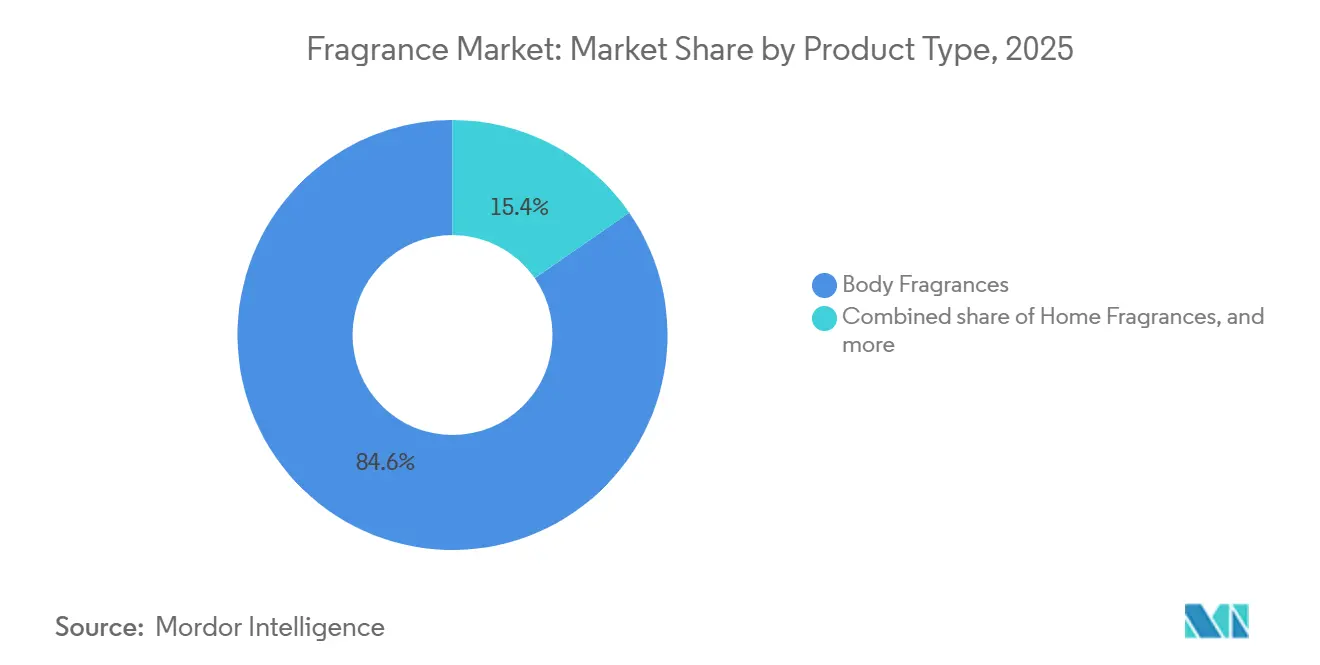
Body fragrances accounted for 84.6% of value in 2025 and remained the core of the fragrance market, as deodorants are widely used and perfume continues to trade consumers up. Deodorants maintain household penetration across income bands, while perfume formats such as eau de parfum and eau de toilette deliver higher value per unit and support margins. This balance between scale and premium mix explains why body fragrances still anchor the fragrance market even as consumer preferences continue to widen. Home fragrance is projected to grow at a 8.2% CAGR through 2031, making it the fastest-growing product segment as consumers spend more on domestic comfort, wellness routines, and decorative scenting. That momentum also reflects the way the fragrance market now reaches into home aesthetics, where candles, diffusers, and room sprays are purchased for mood, gifting, and everyday use.
Body fragrances still define the revenue base of the category, but home fragrance is closing the gap by capturing spending from consumers who want scent in more than one setting. The product mix is therefore becoming more balanced, with personal scent driving scale and home scent driving incremental premiumization and more frequent experimentation. Room sprays and other ambient formats also function as lower-ticket entry points into premium names, which helps brands recruit new users without relying only on fine fragrance. As this gap narrows, the fragrance market is likely to reward companies that can present a coherent portfolio across both personal and residential use occasions.



By Category: Organic Tier Resets the Competitive Baseline
Conventional products captured 76.3% of global value in 2025, so they still defined the volume center of the fragrance market. That position reflected the still-limited penetration of organic formulations in mass deodorant and mainstream fine fragrance lines. Organic products are projected to grow at a 9.3% CAGR through 2031, making them the fastest-growing category in the fragrance market as cleaner-label expectations move beyond niche positioning and into broader retail standards. A 2025 study in Frontiers in Toxicology added clinical weight to concerns about dermal sensitization linked to certain synthetic musks, keeping reformulation pressure high for brands that depend on conventional ingredient systems. The result is a category structure in which conventional products still dominate current sales, but the organic tier is setting the direction for future product development.
Organic formulations have a stronger growth profile in the fragrance market, but scaling them requires stable access to traceable natural and biotech-enabled ingredients. The segment is also split between certified organic offerings at the premium end and broader natural or free-from claims at accessible price points, which means brand positioning has to stay precise rather than generic. IFRA’s recent standards work has tightened the safety and usage framework around fragrance ingredients, which raises the bar for formulas that want to present as natural while still performing consistently. That shift is resetting cost structures and compressing the gap between conventional and cleaner propositions across the fragrance market.
By Price: Luxury Consolidates Share While Mass Accelerates Volume
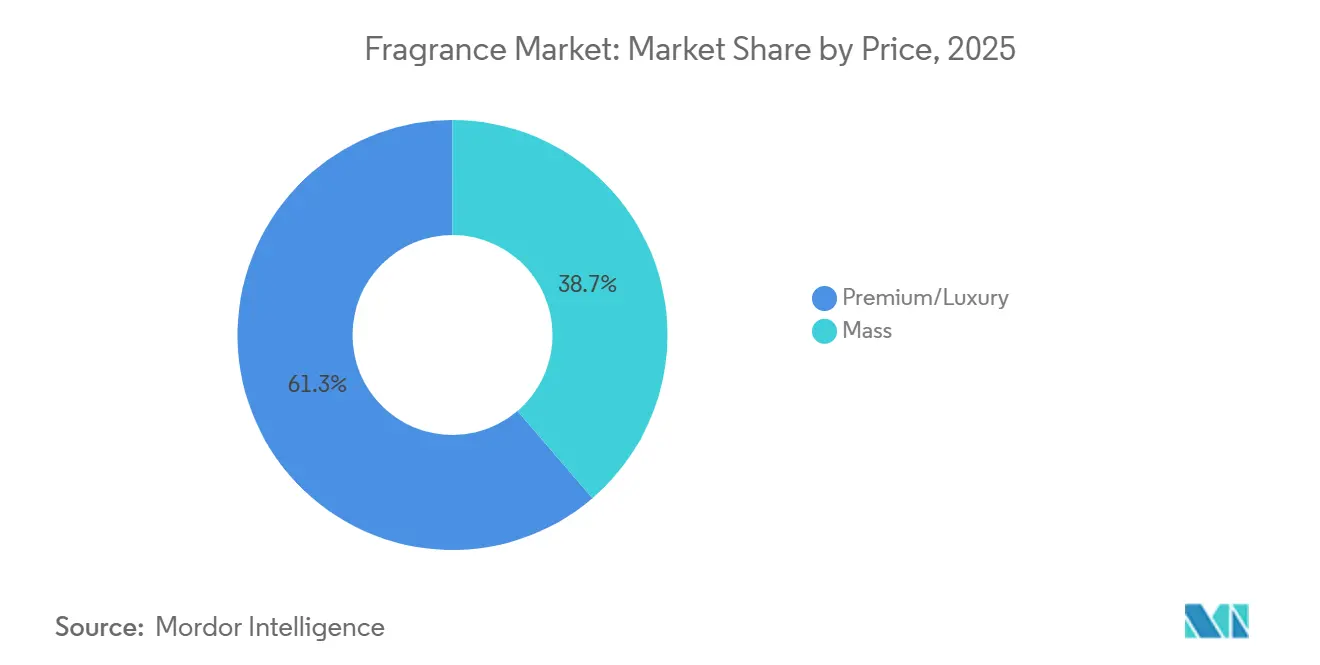
Premium and luxury products captured 61.3% of global value in 2025, indicating that aspiration still drives a large share of the fragrance market. Heritage brands continue to benefit from pricing power, stronger storytelling, and tighter control over distribution, especially in prestige channels where consumers expect a more elevated purchase experience. LVMH’s 2025 results underlined the resilience of perfumes and cosmetics in a difficult operating environment, supporting the continued strength of high-end fragrance demand. This premium tilt matters because fragrance is one of the few beauty categories where emotion, gifting, and brand symbolism can still protect value even when shoppers become more selective. It also explains why the fragrance market continues to focus so much on luxury launches, limited editions, and heritage brand extensions.
The mass segment is forecast to grow at a 8.3% CAGR through 2031, making it the fastest-growing volume segment in the fragrance market as adoption rises in Asia-Pacific and Latin America. That growth is not limited to low-ticket products, because many first-time users are moving toward mid-tier or masstige products that offer better packaging, stronger quality cues, and more visible brand identity. The Estée Lauder Companies reported stronger fragrance momentum within its portfolio in fiscal 2025, reinforcing the idea that fragrance remains a strategic category for quality growth and mix improvement. The price ladder is therefore becoming more layered, with luxury holding current value leadership and mass supporting the next wave of volume expansion in the fragrance market.
By Distribution Channel: Digital Commerce Outpaces Physical Retail Growth
Specialty stores accounted for 43.4% of global sales in 2025 and remained the largest channel, as the fragrance market still relies heavily on guided trial, assisted selling, and sensory comparison. Physical stores matter most when consumers want validation on scent profile, longevity, and brand fit before they commit to a purchase. Online retail is projected to grow at a 9.2% CAGR through 2031, making it the fastest channel in the fragrance market as search, content, and convenience move closer to conversion. This channel is especially valuable for niche and direct-to-consumer brands because it lowers the barrier to discovery and reduces dependence on limited shelf space. As digital recommendation tools and more personalized purchase journeys improve, the fragrance market will continue to shift toward more planned online buying.
Online retail has a stronger growth profile, but specialty stores still shape premium discovery in the fragrance market and often influence later repeat purchases in digital channels. Hypermarkets, supermarkets, and convenience stores remain relevant for deodorants and entry-level body fragrance, where routine shopping behavior and visible price comparison drive sales. Other channels, including department stores, pharmacies, and travel retail, face greater fragmentation as brand-direct and platform-direct models divert traffic away from older wholesale routes. Distribution success now depends less on single-channel strength and more on how well a brand links physical testing, digital education, and repeat purchase across the full fragrance market journey.
Geography Analysis
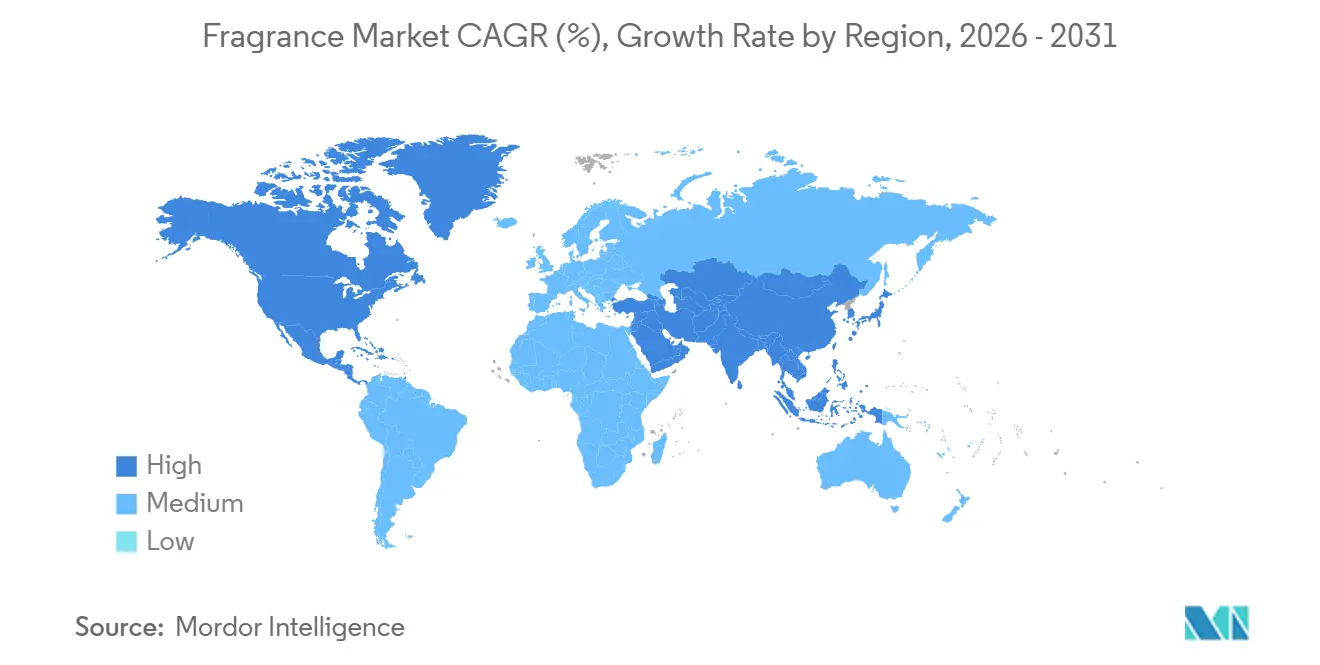
North America accounted for 46.7% of global value in 2025 and remained the largest regional market due to high per-capita spending, broad prestige participation, and a mature specialty retail base. The United States continues to influence launch sequencing and prestige pricing, which gives the region an outsized role in shaping value expectations across the fragrance market. Canada adds room for accessible luxury and cleaner-label premiumization, while Mexico expands the base through mass deodorants and growing mid-tier adoption among younger urban consumers. Europe remains the historical center of fine fragrance, supported by deep production roots, heritage houses, and a consumer base that is comfortable with both luxury and artisanal formats. Regulatory tightening on ingredient safety and disclosure keeps Europe central to formulation review and compliance, reinforcing its importance as a standard-setting region for the fragrance market.
Asia-Pacific is projected to grow at 9.8% CAGR through 2031, the fastest regional pace in the fragrance market, as rising incomes and changing beauty habits widen the consumer base. China still has lower fragrance penetration than mature Western markets, which means even moderate adoption gains can translate into meaningful revenue growth over the forecast period. India is moving along a similar path, with more organized retail helping urban consumers trade up from body sprays into premium fragrance formats. Japan and South Korea support premium demand through a preference for subtler scent profiles, and that preference is influencing product development outside the region as global brands adapt to softer olfactory styles. South America remains important as well because Brazil anchors high-frequency fragrance use, while Colombia, Chile, Argentina, and Peru continue to build a more formal mix of specialty retail and premium demand.
The Middle East and Africa remained a smaller but strategically important part of the fragrance market, with the Gulf states standing out for high spending on oud-led, layered, and bespoke offerings. That demand attracts both global luxury houses and regional specialists, which makes the premium end of the fragrance market especially dynamic in the UAE and Saudi Arabia. Turkey adds manufacturing relevance as well as consumption potential, while South Africa, Nigeria, Egypt, and Morocco represent earlier-stage formalization markets where brand-building today can support stronger loyalty later. Across regions, the fragrance market is increasingly shaped by a split between mature premium centers that set pricing and faster-growth adoption markets that will set the next wave of volume.

Competitive Landscape
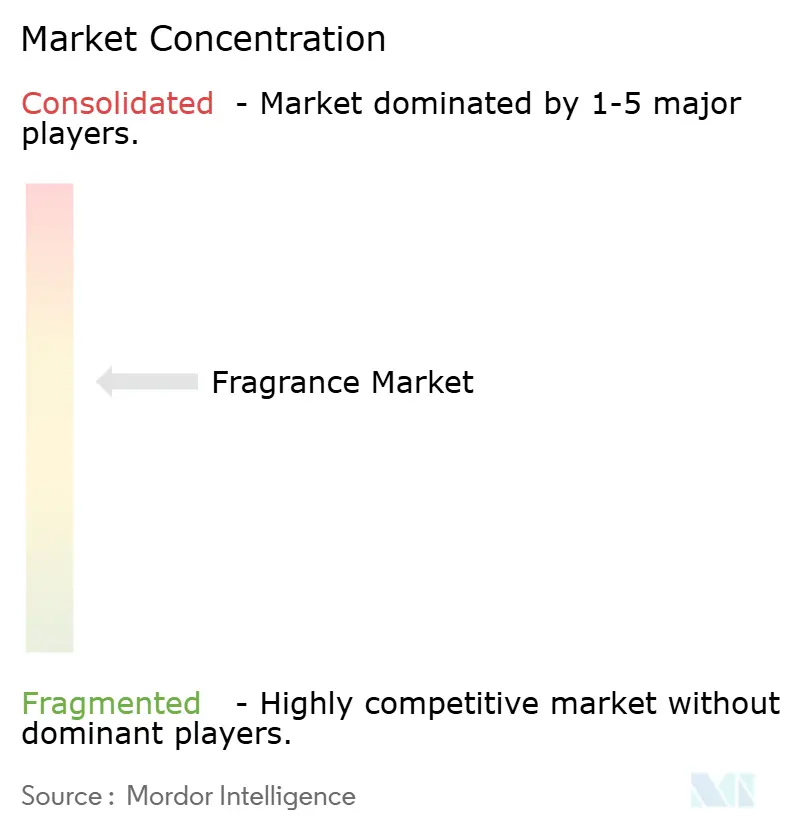
The fragrance market shows moderate concentration, meaningful but not closed, with global groups holding clear scale advantages while niche and regional brands keep the field contestable. L'Oréal, The Estée Lauder Companies, Coty, LVMH, and CHANEL remain the most visible names across prestige fragrance, while Beiersdorf, Unilever, and Procter & Gamble are stronger in mass body fragrance. This structure gives the largest players leverage in manufacturing, licensing, retail access, and marketing efficiency, yet it does not eliminate room for specialists with clear scent identities or more focused communities. The fragrance market, therefore, behaves like a tiered competitive set in which conglomerates dominate breadth, while independent brands compete through specificity, selectivity, and speed. Regional players in Asia-Pacific also matter because local knowledge around lighter scent preferences, gifting behavior, and channel habits can be difficult for Western houses to replicate quickly.
Coty said in its FY2025 10-K that it continued to invest in prestige fragrance and direct-to-consumer capabilities, indicating that major players are trying to capture more margin and customer data rather than relying mainly on wholesale. LVMH continued to support its perfumes and cosmetics portfolio across established and emerging geographies in 2025, reinforcing the value of brand depth and global distribution in the fragrance market. The Estée Lauder Companies also highlighted stronger fragrance momentum within its broader portfolio in fiscal 2025, which suggests that leading groups are leaning on fragrance to stabilize mix and protect premium relevance. These moves point to a common playbook built on tighter brand control, sharper premium positioning, and better access to the end consumer. In the fragrance market, companies that combine heritage with faster channel execution are in the best position to defend share and manage pricing.
Open white space is most visible in personalized fragrance, more sustainable packaging formats, and the premium-mass corridor in Asia-Pacific where no single company has full control. That leaves mid-sized brands in a difficult position because they face pressure from scale leaders above and faster innovators below. Some will remain relevant through strong ingredient stories or tightly built communities, but others will struggle if they lack either price advantage or prestige credibility. The fragrance market is likely to keep consolidating at the top while staying innovative at the edges, which is why the competitive field remains active rather than fully concentrated.
Fragrance Industry Leaders
L'Oréal SA
The Estée Lauder Companies Inc.
Coty Inc.
LVMH Moët Hennessy Louis Vuitton SE
CHANEL SA
- *Disclaimer: Major Players sorted in no particular order

Recent Industry Developments
- March 2026: L'Oréal completed the acquisition of Kering Beauté, incorporating fragrance licenses including Bottega Veneta Parfums, Balenciaga, and Alexander McQueen into its luxury portfolio. The deal strengthens L'Oréal's luxury-tier positioning and extends its olfactory brand equity into adjacent fashion categories with significant distribution overlap in Asia-Pacific and the Middle East.
- February 2026: Bath & Body Works officially launched across Amazon US stores, giving its home fragrance and body care range access to Amazon's 200+ million Prime member base. The move marks a major omnichannel acceleration for a brand previously anchored to proprietary retail and direct e-commerce, and materially expands its reach into convenience-purchase fragrance occasions.
- February 2026: IFF's LMR Naturals unveiled the Tonka Bean CO₂ Absolute, a fully traceable, 100% natural ingredient developed to replace synthetic coumarin in luxury perfumery. The ingredient addresses clean-label demand at the prestige tier and is positioned for adoption by European and North American fragrance houses navigating IFRA allergen restrictions.
- April 2025: Ulta Beauty partnered with Beyoncé's COWBOY CARTER TOUR for an exclusive fragrance collection, combining live-event and in-store activation to drive fragrance discovery among a large and highly engaged fan base, reinforcing celebrity tie-ins as a structural growth mechanism for specialty beauty retail.


Global Fragrance Market Report Scope
Fragrances are scented products formulated using aromatic compounds to provide pleasant scents for personal use and indoor environments. The fragrance market is segmented by product type, category, price, distribution channel, and geography. By product type, the market includes body fragrances and home fragrances. Body fragrances are further segmented into perfumes, deodorants, and other products, while home fragrances include candles, diffusers, room sprays, and other products. By category, the market is divided into organic and conventional products. Based on price, the market is categorized into mass and premium/luxury segments. By distribution channel, the market covers hypermarkets/supermarkets, specialty stores, convenience stores, online retail stores, and other distribution channels. By geography, the report covers North America, Europe, Asia-Pacific, South America, and the Middle East and Africa, with market size and forecasts provided for each region. For each segment, market sizing and forecasts have been done on the basis of value (USD billion).
| Body Fragrances | Perfumes |
| Deodorants | |
| Others | |
| Home Fragrances | Candles |
| Diffusers | |
| Room Sprays | |
| Others |
| Organic |
| Conventional |
| Mass |
| Premium/Luxury |
| Hypermarkets/Supermarkets |
| Specialty Stores |
| Convience Stores |
| Online Retail Stores |
| Other Distribution Channel |
| North America | United States |
| Canada | |
| Mexico | |
| Rest of North America | |
| Europe | Germany |
| United Kingdom | |
| Italy | |
| France | |
| Spain | |
| Netherlands | |
| Poland | |
| Belgium | |
| Sweden | |
| Rest of Europe | |
| Asia-Pacific | China |
| India | |
| Japan | |
| South Korea | |
| Australia | |
| Indonesia | |
| Thailand | |
| Singapore | |
| Rest of Asia-Pacific | |
| South America | Brazil |
| Argentina | |
| Colombia | |
| Chile | |
| Peru | |
| Rest of South America | |
| Middle East and Africa | South Africa |
| Saudi Arabia | |
| United Arab Emirates | |
| Turkey | |
| Nigeria | |
| Egypt | |
| Morocco | |
| Rest of Middle East and Africa |
| By Product Type | Body Fragrances | Perfumes |
| Deodorants | ||
| Others | ||
| Home Fragrances | Candles | |
| Diffusers | ||
| Room Sprays | ||
| Others | ||
| By Category | Organic | |
| Conventional | ||
| By Price | Mass | |
| Premium/Luxury | ||
| By Distribution Channel | Hypermarkets/Supermarkets | |
| Specialty Stores | ||
| Convience Stores | ||
| Online Retail Stores | ||
| Other Distribution Channel | ||
| By Geography | North America | United States |
| Canada | ||
| Mexico | ||
| Rest of North America | ||
| Europe | Germany | |
| United Kingdom | ||
| Italy | ||
| France | ||
| Spain | ||
| Netherlands | ||
| Poland | ||
| Belgium | ||
| Sweden | ||
| Rest of Europe | ||
| Asia-Pacific | China | |
| India | ||
| Japan | ||
| South Korea | ||
| Australia | ||
| Indonesia | ||
| Thailand | ||
| Singapore | ||
| Rest of Asia-Pacific | ||
| South America | Brazil | |
| Argentina | ||
| Colombia | ||
| Chile | ||
| Peru | ||
| Rest of South America | ||
| Middle East and Africa | South Africa | |
| Saudi Arabia | ||
| United Arab Emirates | ||
| Turkey | ||
| Nigeria | ||
| Egypt | ||
| Morocco | ||
| Rest of Middle East and Africa | ||


Key Questions Answered in the Report
What is the projected value of the fragrance market by 2031?
The fragrance market is projected to reach USD 139.07 billion by 2031, rising from USD 97.92 billion in 2026 at a 7.27% CAGR.
Which product segment leads global fragrance sales?
Body fragrances led in 2025 with 84.63% of total value, supported by broad deodorant use and continued premiumization in perfume.
Which product area is growing the fastest?
Home fragrance is the fastest-growing product segment, forecast to expand at 8.17% CAGR through 2031 as home scenting becomes part of wellness and décor spending.
Which region is the largest and which is the fastest growing?
North America was the largest region in 2025 with 46.74% share, while Asia-Pacific is projected to grow the fastest at 9.76% CAGR through 2031.
What are the biggest challenges for brands?
Counterfeit goods, tighter VOC rules, and higher scrutiny around allergen and ingredient safety are increasing compliance costs and brand-protection needs.
Page last updated on:






