
Fractional CMO Services Market Size and Share
Market Overview
| Study Period | 2020 - 2031 |
|---|---|
| Market Size (2026) | USD 2.28 Billion |
| Market Size (2031) | USD 3.51 Billion |
| Growth Rate (2026 - 2031) | 9.01 % |
| Fastest Growing Market | Asia-Pacific |
| Largest Market | North America |
| Market Concentration | Low |
Major Players *Disclaimer: Major Players sorted in no particular order Image © Mordor Intelligence. Reuse requires attribution under CC BY 4.0. | |
Fractional CMO Services Market Analysis by Mordor Intelligence
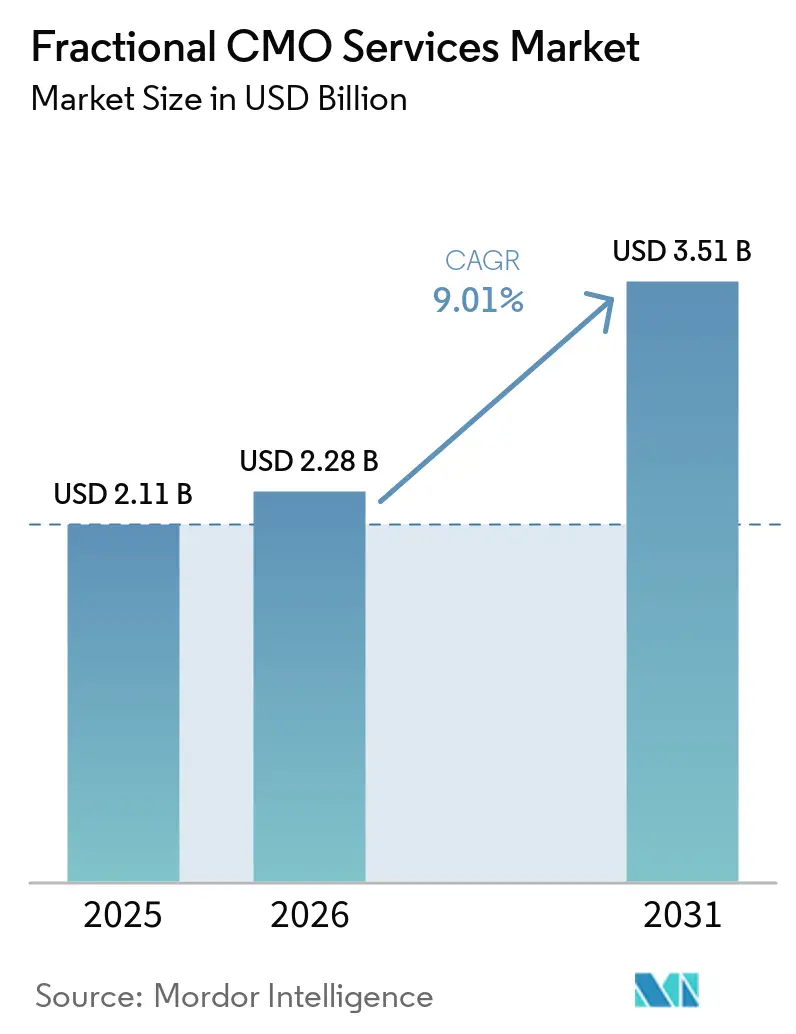
The fractional CMO market size is projected to expand from USD 2.11 billion in 2025 to USD 2.28 billion in 2026, and to USD 3.51 billion by 2031, registering a CAGR of 9.01% between 2026 and 2031. The fractional CMO market is expanding because companies need senior marketing direction while keeping fixed executive costs under closer review, and because they need leadership that can be adjusted when commercial priorities change. Flat marketing budgets are making defined retainers more attractive than open-ended permanent hiring, particularly when leaders must show clear commercial outcomes, coordinate with finance, and explain how spending supports revenue goals. The model also gives companies access to specialists for time-bound work such as market entry, post-merger integration, AI governance, pricing reviews, and rebuilding go-to-market processes without changing their long-term leadership structure.
Key Report Takeaways
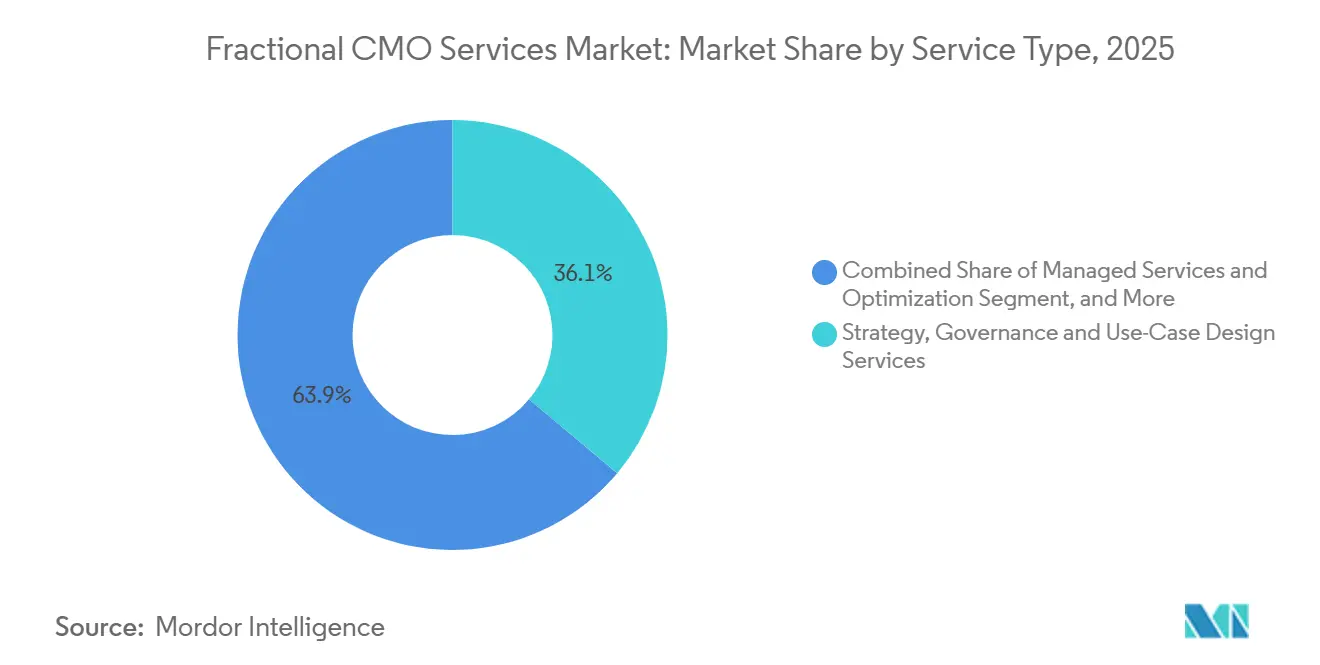
- By service type, Strategy, Governance and Use-Case Design Services held 36.11% of the fractional CMO market share in 2025 and is projected to expand at a 10.20% CAGR through 2031.
- By client company size, small and mid-market businesses held 78.06% of overall revenue in 2025, while large enterprises are projected to record the highest CAGR at 9.88% through 2031.
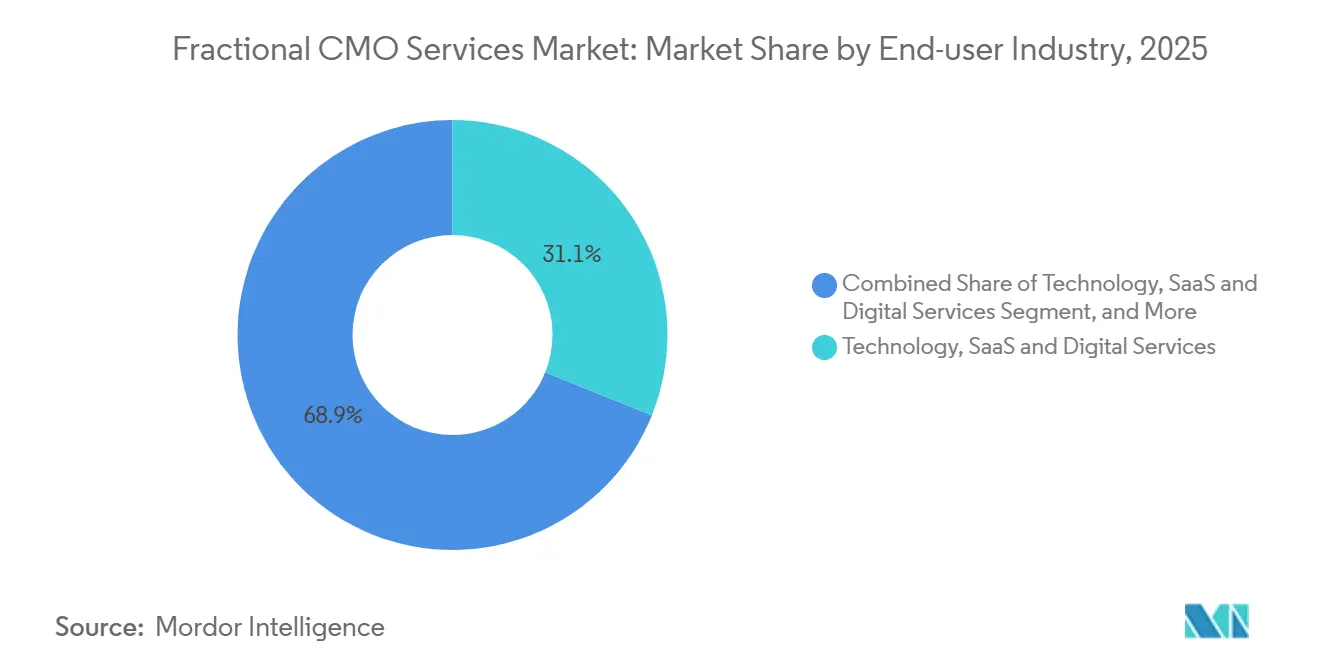
- By end-user industry, Technology, SaaS and Digital Services accounted for 31.09% of the overall sector in 2025, while Healthcare and Life Sciences are projected to advance at a 9.94% CAGR through 2031.
- By geography, North America held 62.23% of global revenue in 2025, while Asia-Pacific is projected to expand at a 10.06% CAGR through 2031.
Note: Market size and forecast figures in this report are generated using Mordor Intelligence’s proprietary estimation framework, updated with the latest available data and insights as of January 2026.
Market Trends and Insights
Drivers Impact Analysis of Fractional CMO Services Market*
| Driver | (~) % Impact on CAGR Forecast | Geographic Relevance | Impact Timeline |
|---|---|---|---|
| Full-Time CMO Cost Inflation and Hiring Risk | +3.2% | Global, most acute in North America | Short term (≤ 2 years) |
| Need for Senior Expertise Without Long-Term Commitment | +2.0% | Global, spill-over to Asia-Pacific and Europe | Medium term (2-4 years) |
| Faster Time-to-Value Than Permanent Executive Hiring | +1.1% | North America and Europe | Short term (≤ 2 years) |
| Rising AI and Martech Orchestration Complexity | +0.9% | Global | Medium term (2-4 years) |
| Board and CFO Pressure for Revenue-Linked Marketing Accountability | +0.6% | North America, UK, Europe | Medium term (2-4 years) |
| Private Equity Value-Creation Playbooks | +0.5% | North America, spill-over to Europe | Long term (≥ 4 years) |
| Source: Mordor Intelligence | |||
Full-Time CMO Cost Inflation and Hiring Risk Pressures the Permanent-Hire Model
The first-year cost of a full-time CMO at a mid-market company ranged from USD 450,000 to USD 900,000, including salary, benefits, and executive search costs. That cost profile has increased the appeal of the fractional CMO market for businesses that need senior oversight but cannot support a permanent executive role, especially when revenue plans are uncertain, or management must preserve flexibility. A full-time appointment also carries the risk of a lengthy search, onboarding period, compensation negotiation, and a possible change in leadership before a strategy is fully established. Fractional retainers ranging from USD 8,000 to USD 22,000 per month offered a clearer financial commitment for companies, enabling them to compare alternatives and plan marketing expenditure against an agreed mandate. These engagements could begin within 30 days, while a permanent search and ramp cycle often took 90-180 days, leaving a meaningful gap when an organization faced an immediate commercial decision. The model was particularly relevant for companies with USD 10 million to USD 75 million in revenue, where executive overhead directly affected operating margins, investment capacity, and the timing of other growth initiatives.
Need for Senior Expertise Without Long-Term Commitment Reflects a Shift in Talent Deployment
Senior marketing operators are increasingly choosing portfolio careers, which has widened the pool of leaders available for fractional work and created a more established route for experienced executives seeking independent assignments. This shift gives clients access to executives who have worked across several operating contexts and can apply lessons from prior assignments without requiring a permanent organizational change. The fractional CMO market benefits when buyers value this cross-company experience more than a traditional single-employer career path, particularly when they need perspective from similar commercial situations. A strong relationship between marketing and finance remains important because marketing leaders must connect activity to revenue, investment choices, forecasting, and business outcomes. Retainer renewals depend on visible commercial progress, which encourages fractional leaders to establish measures, reporting routines, decision rights, and a clear definition of what the organization will treat as success early in an assignment. That incentive can help companies address accountability gaps that remain difficult to resolve within permanent employment structures, where reporting lines and priorities may change more slowly.
Faster Time-to-Value Than Permanent Executive Hiring Reshapes the Build-or-Buy Decision
The fractional CMO market can offer faster access to strategic leadership when a company needs action before a planned launch, funding event, commercial change, or decision that cannot wait for a conventional recruitment process. Fractional leaders can begin with a narrow mandate and focus on priorities that internal teams have already identified, reducing the time spent early on defining the role. AI tools can reduce time spent on reporting, content coordination, lead enrichment, routine campaign work, and the preparation of management information when properly governed. This allows the executive to devote more paid time to positioning, measurement, team decisions, customer priorities, and the choices that require senior judgment rather than routine production. Companies using the model reported seeing pipeline-related progress within 30-60 days, while permanent executive hires could require a 9-12-month ramp period, depending on the scale of the role and the state of the internal team. The difference is relevant to private equity portfolio companies because their 3-7-year holding periods leave limited room for slow leadership transitions, delayed commercial action, or repeated changes to the marketing plan.
Rising AI and Martech Orchestration Complexity Elevates the Strategic Governance Role
CMOs are directing more of their budgets toward AI initiatives, yet many organizations still use only part of their available marketing technology capability and struggle to connect separate tools into a coherent operating process. This gap has increased demand in the fractional CMO market for leaders who can connect commercial priorities with data, technology, privacy, operating processes, and the practical needs of the people expected to use new tools. Marketing technology decisions are also spread across marketing and IT teams, making clear ownership, shared objectives, and practical governance more important. Fractional CMOs can define AI use cases, establish measurement standards, clarify how internal teams should use customer and campaign data, and identify which decisions require senior sign-off. Their value is strongest when the work creates a practical governance structure rather than another isolated technology project that produces activity without improving marketing execution.
Restraints Impact Analysis of Fractional CMO Services Market*
| Restraint | (~) % Impact on CAGR Forecast | Geographic Relevance | Impact Timeline |
|---|---|---|---|
| Limited Client-Side Execution Bandwidth | -1.8% | Global | Short term (≤ 2 years) |
| Multi-Client Bandwidth and Continuity Constraints | -1.2% | Global | Medium term (2-4 years) |
| Credential Ambiguity and No Qualification Standard | -0.7% | Global | Long term (≥ 4 years) |
| Cross-Border Tax and Contractor Compliance Risk | -0.4% | Europe, Asia-Pacific, North America | Medium term (2-4 years) |
| Source: Mordor Intelligence | |||
Limited Client-Side Execution Bandwidth Constrains Fractional Model Effectiveness
The fractional CMO market works best when a client has sufficient internal capacity to translate leadership direction into day-to-day work, maintain momentum between senior meetings, and take ownership of agreed-upon actions. Companies without a marketing coordinator, content specialist, or data analyst can struggle to translate a strategy document into consistent execution, even when the strategic recommendations are sound. This constraint is most evident among businesses with revenue below USD 5 million, where the model is affordable but teams are often very small, and individuals carry multiple operational responsibilities. Some providers address the issue by combining a fractional CMO with specialist execution support, which can give a client access to skills that it would not otherwise hire directly. Kalungi presents its offering as a combination of senior leadership and a broader team for B2B growth work. That approach can improve delivery, but retainers ranging from USD 10,000 to USD 32,000 per month may narrow the financial benefit for smaller clients and require a more careful assessment of the work that should remain in-house.
Multi-Client Bandwidth and Continuity Constraints Create Engagement Risk
A fractional CMO who serves 4-6 clients can face competing demands when several organizations schedule launches, strategic reviews, board meetings, or product decisions in the same period. The client must therefore agree on availability, escalation routes, meeting cadence, expected response times, and the circumstances that justify additional support before work begins. The rapid increase in the number of people using fractional titles has also made it harder for buyers to assess whether an operator has held senior responsibility for budgets, teams, board reporting, and the difficult trade-offs that arise under commercial pressure. The fractional CMO market lacks a common licensing body or a uniform qualification framework, so provider screening, reference checks, and a thorough review of prior operating roles remain important. Continuity can also become a concern if an executive reduces time or leaves before the client has documented plans, reporting tools, decision records, key relationships, and responsibilities for the next stage of work.
*Our forecasts treat driver/restraint impacts as directional, not additive. The impact forecasts reflect baseline growth, mix effects, and variable interactions.
Fractional CMO Services Market Segment Analysis
By Service Type:
Strategy Governance Anchors Fractional CMO Value DeliveryStrategy, Governance and Use-Case Design Services accounted for 36.11% of the fractional CMO market in 2025 and are projected to grow at a 10.20% CAGR through 2031. Its leadership shows that many buyers are seeking organizational accountability, decision structures, and clearer priorities, not simply campaign production. These assignments can include AI use-case frameworks, data governance practices, measurement designs, and practical responsibilities that internal teams continue to operate after the initial leadership engagement. Clean Room Implementation and Integration Services and Privacy-Safe Analytics, Measurement, and Activation Services address the need to maintain measurement quality as third-party data becomes less available and buyers require more reliable information for decision-making. The fractional CMO market, therefore, rewards executives who can obtain cross-functional access, translate commercial goals into workable operating rules, and explain why those rules matter to marketing, finance, technology, and business leaders.
Managed Services and Optimization accounted for much of the remaining service demand, as clients often need ongoing campaign oversight after initial strategy work and may lack sufficient staff to sustain the new direction. Training and Change Management also remains important when a company needs its teams to adopt new processes, reporting methods, go-to-market systems, and responsibilities that extend beyond the engagement itself. The shift toward clearly defined deliverables is changing how providers scope, price, explain, and monitor their engagements, giving clients a clearer view of the work included in a retainer. Chief Outsiders launched GrowthGears OS and Team Outsiders in February 2025 to combine fractional leadership with playbooks, workflow support, and execution resources.[1] The platform incorporated methods developed from more than 2,000 client engagements, showing how established providers are seeking more repeatable service delivery and a more consistent way to carry strategic recommendations into client operations.

By Client Company Size:
Large Enterprise Demand Reshapes Growth DynamicsSmall and mid-market businesses accounted for 78.06% of the sector's total value in 2025, reflecting the model's long-standing fit for companies earning USD 5 million to USD 50 million in revenue. These businesses often need senior marketing leadership but find it difficult to justify the cost of a permanent executive when sales plans, customer needs, and staffing requirements are still changing. Retainers ranging from USD 5,000 to USD 15,000 per month offer a flexible alternative to first-year full-time CMO costs of USD 280,000 to USD 450,000. The fractional CMO industry has historically served this group because its operating needs often change faster than its permanent hiring plans and because management teams may prefer to test a leadership model before committing. The model also allows an owner or chief executive to bring in expertise without committing to a long employment agreement, while retaining direct access to senior judgment during important commercial decisions.
Large enterprises are projected to post the fastest client-company CAGR at 9.88% through 2031. They commonly use fractional leaders for defined work, including post-merger brand integration, entry into a new geography, AI marketing governance, commercial launches, and programs that require expertise beyond the capacity of a permanent team. In these settings, the role supplements a permanent marketing organization rather than replacing its chief marketing officer, with responsibilities determined by a particular initiative or period of change. A specialist can be engaged within 30 days and released with 30 days' notice, which gives companies more flexibility for temporary priorities, new leadership requirements, and projects that do not justify an ongoing executive appointment. The fractional CMO market is also supported by enterprise demand for leaders who have used AI in several client environments and can apply lessons without disrupting the existing internal structure or bypassing established governance.
By End-User Industry:
Healthcare and Life Sciences Changes the Growth PatternTechnology, SaaS and Digital Services held 31.09% of the end-user segment in 2025. The sector has adopted flexible go-to-market models early and includes many companies that need commercial leadership before they can support a permanent CMO role with a broad internal team. Its demand is linked to the need for faster positioning, pipeline development, customer acquisition, sales alignment, and regular adjustment as products or customer needs change. Many companies in this group operate within the USD 5 million to USD 30 million annual recurring revenue range, where an external leadership model can fit a changing growth plan and a relatively lean operating structure. The fractional CMO market remains relevant to these businesses because product changes, funding cycles, sales performance, and expansion plans may require varying levels of support at different stages.
Healthcare and Life Sciences is projected to be the fastest-growing end-user segment at a 9.94% CAGR through 2031. Medical device companies nearing commercialization, digital health businesses preparing for payer engagement, and healthcare software providers all need focused commercial work. Their needs can include clinical evidence communication, compliance-aware marketing technology, multi-stakeholder buying processes, and longer enterprise sales cycles. Specialized operators in healthcare and fintech have commanded retainers 10-25% above generalist rates because the work requires experience that cannot be acquired quickly. This demand pattern supports the role of vertical specialists, while informal credentialing may continue to limit the supply of proven operators.
Geography Analysis
North America Fractional CMO Services Market
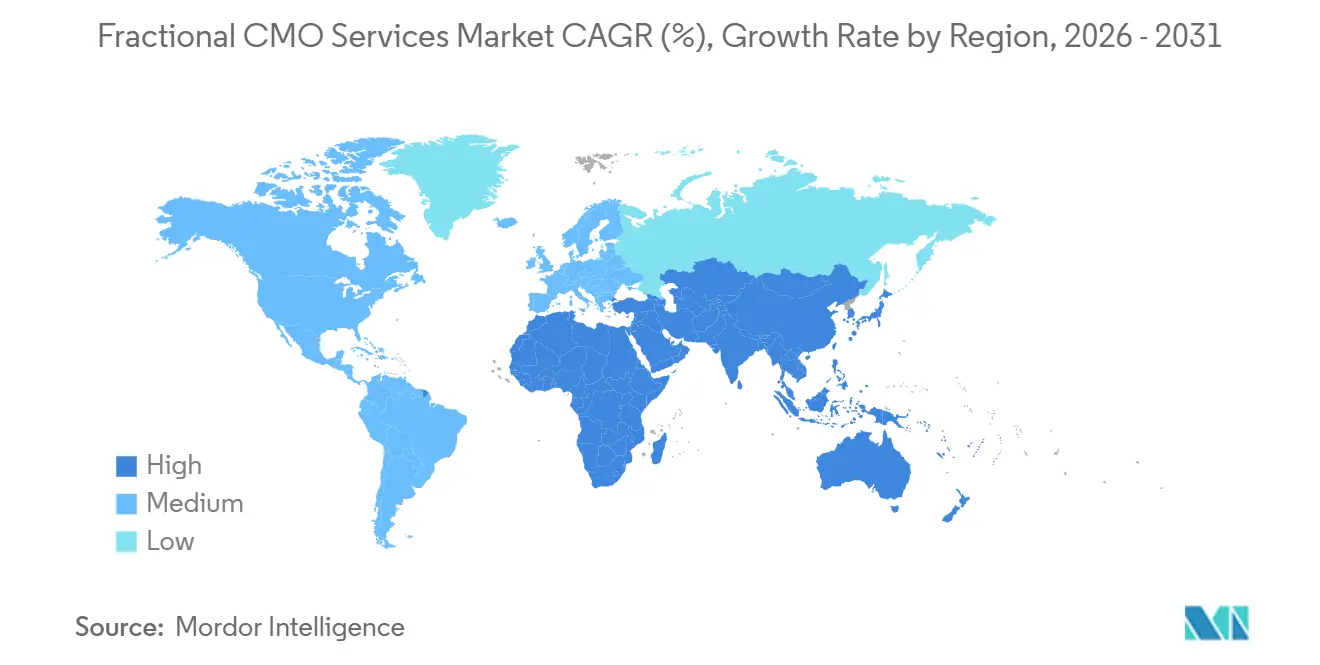
North America held 62.23% of the fractional CMO market share in 2025. The region benefits from high executive compensation, an established private equity ecosystem, and a long-standing base of fractional leadership providers, with the United States remaining the center of activity where firms serve companies across many sectors and build relationships with private equity sponsors. Chief Outsiders reported that it had served more than 300 private equity firms and 500 portfolio companies, underscoring the scale a platform model can reach in the region. Canada and Mexico are smaller markets, but technology centers in Toronto, Vancouver, and Montreal are adopting flexible leadership models as venture-backed companies develop their marketing capabilities and seek external support before building a wider senior team.
Europe Fractional CMO Services Market
Europe remains an important opportunity because the United Kingdom, Germany, the Netherlands, and Nordic countries have active technology, finance, and SaaS communities. Higher employment costs and contractor rules can make a defined engagement attractive, while also making its legal structure more complex and creating a need for clear terms around the role, duration, and responsibilities of an external executive. Employer National Insurance changes in the United Kingdom took effect in April 2025, and IR35 rules continue to affect how businesses structure contractor relationships. Germany's classification rules and Dutch DBA enforcement also require careful attention when companies use cross-border fractional leaders. Southern Europe and Central and Eastern European technology hubs are at an earlier stage of adoption, leaving room for the fractional CMO market to develop over a longer period as buyers become more familiar with the model.
APAC, South America and MEA Fractional CMO Services Market
Asia-Pacific is projected to grow at a 10.06% CAGR through 2031. India, China, South Korea, and Australia have a smaller pool of marketing leaders with global go-to-market experience relative to the number of growing technology and SaaS companies. This makes fractional leadership a response to an experience shortage rather than only a cost decision, with India’s B2B SaaS and startup ecosystem and Australia’s professional services base serving as early areas of demand. Proxi launched full fractional go-to-market leadership services for New Zealand technology companies in April 2025, indicating that regional specialists are formalizing the model.[2] South America, particularly Brazil and Chile, and the Middle East and Africa, led by the UAE and Saudi Arabia, remain earlier-stage areas where demand exists but provider infrastructure is limited, which may favor locally informed specialists as the fractional CMO market develops.
Competitive Landscape
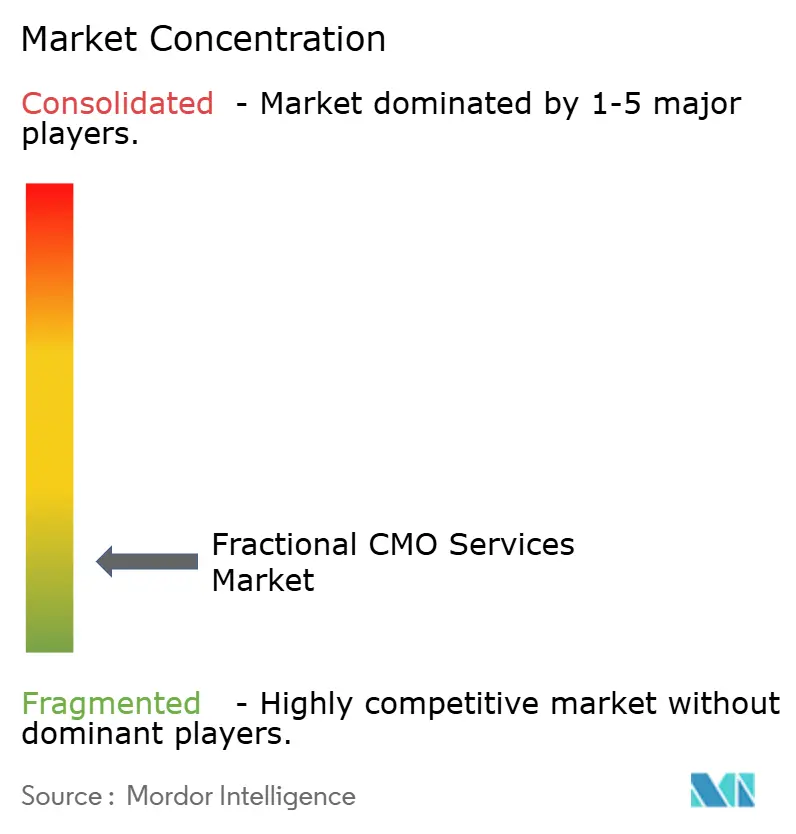
The fractional CMO market is fragmented, with no single provider holding a decisive position across all geographies and verticals. Competition includes platform firms with structured methods, larger executive benches, and technology-enabled tools, as well as specialist boutiques with narrower expertise and closer involvement from senior partners. Chief Outsiders, CMOx, Authentic Brand, and Marketri represent the platform-oriented group, and these firms seek consistent delivery through client matching, defined operating frameworks, and access to wider execution support. Smaller specialists compete through sector knowledge, direct partner involvement, and the ability to tailor an engagement to a specific client situation, especially when the client has a regulated, technical, or region-specific requirement.
Chief Outsiders acquired Jauntboards in March 2025 and integrated its sales and marketing intelligence capability into GrowthGears OS.[3] The move showed how larger providers are using proprietary technology and operating methods to differentiate their work. Marketri relaunched in July 2026 as a technology-enabled B2B growth firm with consulting, fractional marketing teams, and AI consulting divisions. Its planned partnership with Anthropic signaled an effort to embed generative AI in client work, although the partnership remained a stated pursuit. Kalungi appointed Antoine Vial as chief executive officer in March 2026, while founder Stijn Hendrikse moved to chairman and Brian Graf joined the board while returning to client work.
The fractional CMO market has open areas in Europe and Asia-Pacific, where established platforms have less coverage than in North America. Healthcare, financial services, and industrial manufacturing also offer room for providers with proven specialized experience, while AI-enabled engagement models may become more common when providers can combine strategic leadership with governed execution tools. Boardroom Advisors, Kalungi, and The Marketing Centre Limited compete through differentiated positions in the UK mid-market, B2B SaaS, and broader mid-market segments. Authentic Brand expanded its leadership team in March 2026 by appointing Kristi Gloppen as chief client officer and adding Sue Rodeman and Jessica Bartell as fractional CMOs.[4] The lack of formal standards means proprietary methods and provider screening continue to function as practical ways to establish buyer confidence and to help clients compare providers that use similar titles but have different operating experience.
Fractional CMO Services Industry Leaders
-
Chief Outsiders, LLC
-
CMOx, LLC
-
Authentic Brand, LLC
-
Marketri, LLC
-
The Marketing Centre Limited
- *Disclaimer: Major Players sorted in no particular order
Fractional CMO Services Market Companies Covered in this Report
- Chief Outsiders, LLC
- CMOx, LLC
- Authentic Brand, LLC
- Marketri, LLC
- The Marketing Centre Limited
- Fractional CMO, LLC
- The Geisheker Group, Inc.
- CMOvate, LLC
- Agni Consulting Inc.
- SaaSpire Marketing, LLC
- Simon Fractional, LLC
- Mahdlo, LLC
- Digital Division, LLC
- GrowthMode Marketing Inc.
- Bambino Agency, LLC
- New North, Inc.
- Boardroom Advisors Ltd.
Recent Industry Developments in Fractional CMO Services Market
- July 2026: Marketri relaunched as a technology-enabled B2B growth firm, establishing three integrated divisions, B2B Marketing Consulting, Fractional Marketing Teams, and AI Consulting. Simultaneously, Marketri announced the pursuit of a formal partnership with Anthropic to embed Claude-powered generative AI across all client engagements, a strategic repositioning that signals AI consulting as a revenue-equal pillar to traditional fractional marketing services.
- March 2026: Authentic Brand announced a strategic leadership expansion, appointing Kristi Gloppen as Chief Client Officer and welcoming 2 experienced fractional CMOs, Sue Rodeman and Jessica Bartell, to its national team, in direct response to growing inbound demand from private equity-backed and founder-led companies across the United States.
- March 2025: Chief Outsiders acquired Jauntboards, an AI technology company specializing in sales and marketing intelligence, integrating its capabilities into the GrowthGears OS platform, described as the first AI-powered growth acceleration platform trained on expertise from more than 120 executive consultants and over 2,000 client engagements. The acquisition deepens Chief Outsiders' proprietary technology moat in an increasingly platform-competitive market.
- February 2025: Chief Outsiders launched GrowthGears OS and Team Outsiders execution services, formalizing its expansion from pure fractional leadership into end-to-end go-to-market execution. GrowthGears OS incorporates workflow management, best-practice playbooks, and AI models to operationalize strategic insights across concurrent client engagements.
Global Fractional CMO Services Market Report Scope
The fractional CMO services market refers to the market for outsourced, part-time chief marketing officer services that provide businesses with senior-level marketing leadership, strategy development, and execution support without the cost of hiring a full-time executive.
The Fractional CMO Services Market Report is Segmented by Service Type (Strategy, Governance and Use-Case Design Services, Clean Room Implementation and Integration Services, Privacy-Safe Analytics, Measurement and Activation Services, Managed Services and Optimization, Training, Change Management, and Other Service Types), Client Company Size (Small and Mid-Market Businesses, and Large Enterprises), End-user Industry (Technology, SaaS and Digital Services, Manufacturing and Industrial, Consumer, Retail and E-commerce, Healthcare and Life Sciences, Financial Services, Education and EdTech, and Other End-user Industries), and Geography (North America, South America, Europe, Asia-Pacific, Middle East, and Africa). The Market Forecasts are Provided in Terms of Value (USD).
| Strategy, Governance and Use-Case Design Services |
| Clean Room Implementation and Integration Services |
| Privacy-Safe Analytics, Measurement and Activation Services |
| Managed Services and Optimization |
| Training, Change Management |
| Other Service Types |
| Small and Mid-Market Businesses |
| Large Enterprises |
| Technology, SaaS and Digital Services |
| Manufacturing and Industrial |
| Consumer, Retail and E-commerce |
| Healthcare and Life Sciences |
| Financial Services |
| Education and EdTech |
| Other End-user Industries |
| North America | United States |
| Canada | |
| Mexico | |
| South America | Brazil |
| Argentina | |
| Chile | |
| Rest of South America | |
| Europe | Germany |
| United Kingdom | |
| France | |
| Italy | |
| Spain | |
| Rest of Europe | |
| Asia-Pacific | China |
| Japan | |
| India | |
| South Korea | |
| Australia | |
| Rest of Asia-Pacific | |
| Middle East | United Arab Emirates |
| Saudi Arabia | |
| Qatar | |
| Rest of Middle East | |
| Africa | South Africa |
| Egypt | |
| Nigeria | |
| Rest of Africa |
| By Service Type | Strategy, Governance and Use-Case Design Services | |
| Clean Room Implementation and Integration Services | ||
| Privacy-Safe Analytics, Measurement and Activation Services | ||
| Managed Services and Optimization | ||
| Training, Change Management | ||
| Other Service Types | ||
| By Client Company Size | Small and Mid-Market Businesses | |
| Large Enterprises | ||
| By End-user Industry | Technology, SaaS and Digital Services | |
| Manufacturing and Industrial | ||
| Consumer, Retail and E-commerce | ||
| Healthcare and Life Sciences | ||
| Financial Services | ||
| Education and EdTech | ||
| Other End-user Industries | ||
| By Geography | North America | United States |
| Canada | ||
| Mexico | ||
| South America | Brazil | |
| Argentina | ||
| Chile | ||
| Rest of South America | ||
| Europe | Germany | |
| United Kingdom | ||
| France | ||
| Italy | ||
| Spain | ||
| Rest of Europe | ||
| Asia-Pacific | China | |
| Japan | ||
| India | ||
| South Korea | ||
| Australia | ||
| Rest of Asia-Pacific | ||
| Middle East | United Arab Emirates | |
| Saudi Arabia | ||
| Qatar | ||
| Rest of Middle East | ||
| Africa | South Africa | |
| Egypt | ||
| Nigeria | ||
| Rest of Africa | ||
Key Questions Answered in the Report
What is the fractional CMO market size?
The fractional CMO market is projected to rise from USD 2.28 billion in 2026 to USD 3.51 billion by 2031, at a 9.01% CAGR.
What services lead fractional CMO demand?
Strategy, Governance and Use-Case Design Services held 36.11% in 2025 and is projected to grow at a 10.20% CAGR through 2031.
Why do small and mid-market businesses use fractional CMOs?
The fractional CMO market gives these businesses access to senior leadership without carrying the full cost and long-term commitment of a permanent executive appointment.
Which end-user sector is growing fastest for fractional CMO services?
Healthcare and Life Sciences is projected to grow at a 9.94% CAGR through 2031, supported by specialized commercial and compliance needs.
Which region is expected to grow fastest?
Asia-Pacific is projected to expand at a 10.06% CAGR through 2031, supporting its growing role in the fractional CMO market.
How are providers differentiating their offerings?
In the fractional CMO market, providers are combining senior leadership with specialist expertise, structured methods, technology tools, and execution support.