
Forensic Analytics Software Market Size and Share
Market Overview
| Study Period | 2020 - 2031 |
|---|---|
| Market Size (2026) | USD 3.96 Billion |
| Market Size (2031) | USD 7.13 Billion |
| Growth Rate (2026 - 2031) | 12.47 % |
| Fastest Growing Market | Asia-Pacific |
| Largest Market | North America |
| Market Concentration | Medium |
Major Players *Disclaimer: Major Players sorted in no particular order Image © Mordor Intelligence. Reuse requires attribution under CC BY 4.0. | |
Forensic Analytics Software Market Analysis by Mordor Intelligence
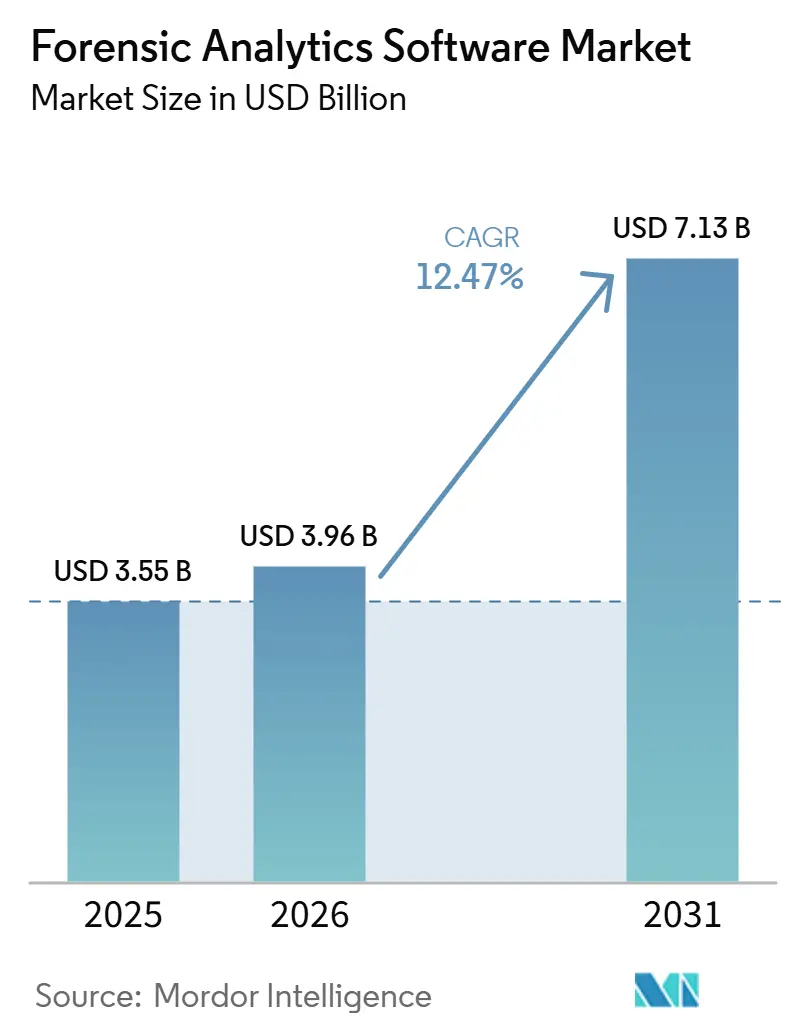
The forensic analytics software market is expected to increase from USD 3.55 billion in 2025 to USD 3.96 billion in 2026 and reach USD 7.13 billion by 2031, growing at a CAGR of 12.47% over 2026 to 2031. The forensic analytics software market is expanding because healthcare organizations are no longer treating forensic review as a post-incident task, and are instead moving it into daily compliance, claims, and clinical oversight work. Improper Medicare payments of USD 51.3 billion in fiscal 2024 kept fraud, waste, and abuse controls high on spending agendas, and that pressure continues to support software adoption across payer and provider settings. The forensic analytics software market is also benefiting from the wider use of electronic health records, cloud-hosted clinical data, and connected devices that generate evidence volumes beyond the reach of manual review. North America led revenue in 2025 because of strong HIPAA enforcement, active payer integrity programs, and a dense legal and compliance environment, while Asia-Pacific is set to record the fastest growth as health digitization programs widen the need for defensible analytics workflows. Competitive positioning in the forensic analytics software market is now shaped by platform depth, AI-led triage, explainable outputs, and the ability to support chain-of-custody requirements without forcing hospitals, payers, or pharmaceutical firms into long implementation cycles.
Key Report Takeaways
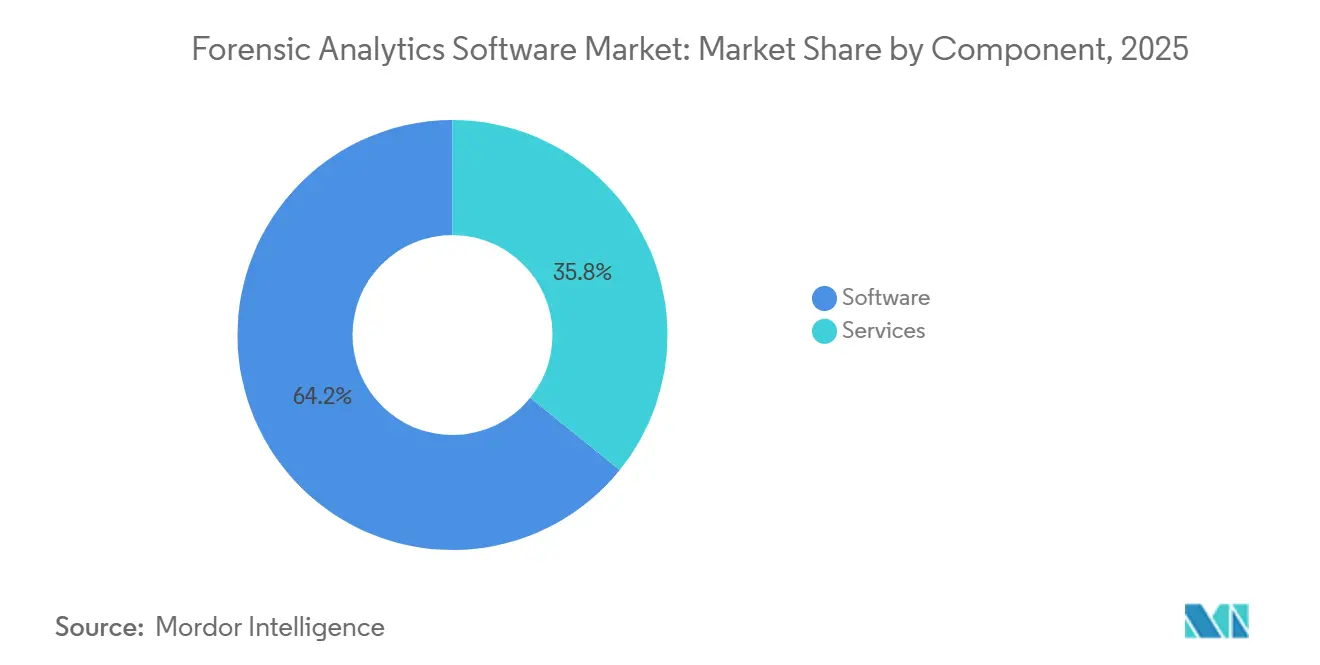
- By component, software held 64.20% of revenue in 2025, and software is also projected to record the fastest growth at 13.81% through 2031.
- By deployment, cloud-based delivery accounted for 66.50% share in 2025, and cloud-based delivery is expected to grow the fastest at 13.41% through 2031.
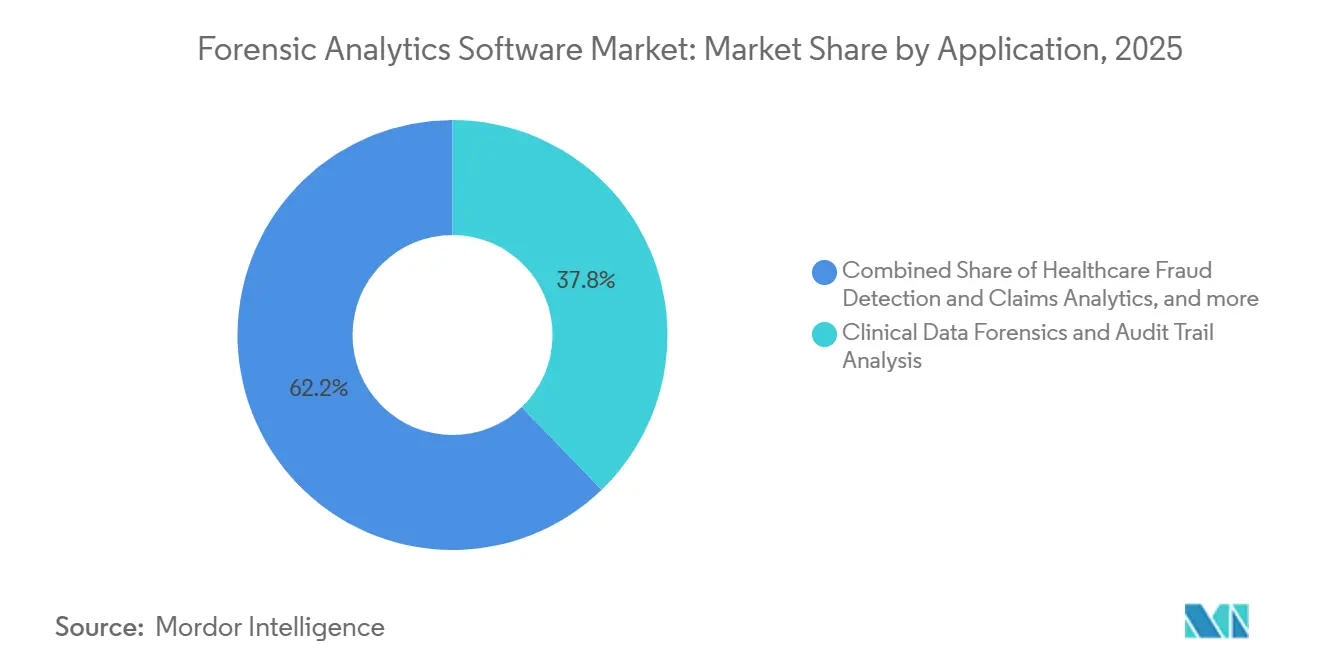
- By application, clinical data forensics and audit captured 37.80% share in 2025, while pharmaceutical compliance and monitoring are projected to expand at 13.95% through 2031.
- By end-user, hospitals and healthcare providers held 37.40% of the forensic analytics software market share in 2025, while healthcare payers are forecasted to grow at 13.52% through 2031.
- By geography, North America held 41.78% of the forensic analytics software market size in 2025, while Asia-Pacific is projected to advance at 13.75% through 2031.
Note: Market size and forecast figures in this report are generated using Mordor Intelligence’s proprietary estimation framework, updated with the latest available data and insights as of January 2026.
Global Forensic Analytics Software Market Trends and Insights
Drivers Impact Analysis*
| Driver | (~) % Impact on CAGR Forecast | Geographic Relevance | Impact Timeline |
|---|---|---|---|
| Rising Cybercrime Investigations Across Enterprise and Public-Sector Workflows | +3.4% | Global, concentrated in North America and Europe | Short term (≤ 2 years) |
| Regulatory Preservation and eDiscovery Requirements | +2.9% | North America and EU | Medium term (2-4 years) |
| Expansion of Mobile, Cloud, and Multi-Source Evidence Volumes | +2.5% | North America and EU, with spillover to Asia-Pacific | Short term (≤ 2 years) |
| AI-Assisted Triage, Entity Resolution, and Link Analysis Adoption | +2.2% | Global, with Asia-Pacific core relevance | Medium term (2-4 years) |
| Encryption by Default Increasing Forensic Complexity and Specialized Tool Demand | +1.5% | Global | Medium term (2-4 years) |
| Cross-Border Data Residency Constraints Favoring Localized Forensic Workflows | +1.0% | EU, China, and broader Asia-Pacific | Long term (≥ 4 years) |
| Source: Mordor Intelligence | |||
Rising Cybercrime Investigations Across Enterprise and Public-Sector Workflows
Healthcare remained one of the most targeted sectors for cyber incidents in 2024 and 2025, and that pressure kept investigation volumes high across hospitals, insurers, and pharmaceutical operations. HHS reported a record level of large healthcare breaches in 2024, with incidents affecting more than 167 million records, which expanded the need for review tools that can process logs, communications, and clinical records at speed.[1]HHS Office for Civil Rights, “HIPAA Breach Notification, Data and Statistics,” HHS, hhs.gov Each confirmed breach creates follow-on work across evidence preservation, entity resolution, documentation, and legal review, and that directly lifts demand for licensed analytics platforms instead of one-time manual examination. The forensic analytics software market is also being supported by civil litigation after breach events, because healthcare defendants increasingly need defensible software outputs that can stand up in court and in regulatory review. Cellebrite’s 2025 survey showed that 68% of investigators did not have enough time to fully review case data, which points to a structural capacity gap rather than a temporary surge in workload.[2]Cellebrite, “2025 Industry Trends Survey, Global Whitepaper,” Cellebrite, cellebrite.com That gap is pushing the forensic analytics software market toward automation features that help teams clear evidence backlogs without weakening audit rigor.
Regulatory Preservation and eDiscovery Requirements
Regulatory oversight of electronic records is widening, and that is making preservation, traceability, and defensible search more central to procurement decisions. Healthcare organizations now need software that can preserve audit trails, maintain evidentiary integrity, and support reviews across clinical, legal, and compliance teams without losing chain-of-custody control. The forensic analytics software market is gaining from this shift because hospitals and pharmaceutical firms are under pressure to manage electronic records in a tamper-evident and reviewable format. Cross-border matters add another layer of complexity, since legal requests, privacy rules, and evidence retention duties often overlap and create operational friction for multinational health systems. Research on cross-border cloud forensics in 2026 noted that the CLOUD Act and GDPR can create conflicting legal duties when providers are asked to produce data across jurisdictions. That tension supports the forensic analytics software market because buyers increasingly favor platforms that can separate preservation, review, and access rights across different legal environments.
Expansion of Mobile, Cloud, and Multi-Source Evidence Volumes
Healthcare evidence is no longer limited to electronic health records, because investigations now draw from mobile devices, connected medical equipment, cloud systems, messaging platforms, and financial records. The forensic analytics software market is benefiting from this change because traditional rule-based tools were not built to correlate these evidence types in a single workflow. MSAB’s 2026 product releases added new support for GPS extraction and cryptocurrency evidence recovery from RAM, which shows how investigative scope is widening beyond basic file recovery into more varied data environments.[3]MSAB, “Q1 2026 Major Release Is Now Available,” MSAB, msab.comFor pharmaceutical compliance work, the 2024 CMS Open Payments dataset covered USD 13.2 billion across 16.2 million records, which illustrates the evidence scale that health-related reviews now require. As more hospitals and payers centralize digital operations, the forensic analytics software market is moving toward platforms that can connect clinical, operational, and payment evidence without creating fragmented review trails. This is raising the value of vendors that can normalize multi-source data quickly while preserving evidentiary integrity for later investigation or litigation.
AI-Assisted Triage, Entity Resolution, and Link Analysis Adoption
AI is shifting buying priorities from simple evidence retrieval toward faster triage, stronger entity matching, and more usable investigative narratives. The forensic analytics software market is responding because healthcare users often need to review high volumes of communications, patient records, claims, and device logs under tight compliance deadlines. Cellebrite launched Genesis in 2026 with agentic AI capabilities that can interrogate extractions, records, and documents through natural-language prompts, and the company positioned the platform around major reductions in review time. Exterro stated in 2026 that its AI framework could process more than 40,000 documents per hour while preserving audit-trail integrity for regulated review environments. Proposed Federal Rule of Evidence 707 also raised the importance of explainable and validated machine outputs, because AI-generated evidence will face stricter scrutiny in legal settings. That change is helping the forensic analytics software market favor vendors that can combine speed with review transparency, especially in payer fraud detection and pharmaceutical compliance reviews.
Restraints Impact Analysis*
| Restraint | (~) % Impact on CAGR Forecast | Geographic Relevance | Impact Timeline |
|---|---|---|---|
| High Total Cost of Ownership for Advanced Forensic Platforms | -1.9% | Global, amplified in Middle East and Africa and South America | Short term (≤ 2 years) |
| Shortage of Court-Certified and Tool-Certified Examiners | -1.6% | Global, most acute in Asia-Pacific tier 2 cities and Latin America | Medium term (2-4 years) |
| Interoperability Gaps Across Evidence Sources and Vendor Ecosystems | -1.3% | Global | Medium term (2-4 years) |
| Lengthy Validation Cycles for AI-Driven Findings in Legal Proceedings | -1.0% | North America and EU | Long term (≥ 4 years) |
| Source: Mordor Intelligence | |||
High Total Cost of Ownership for Advanced Forensic Platforms
High ownership cost remains a real barrier for mid-sized provider groups, regional insurers, and health systems with limited digital investigation budgets. The forensic analytics software market still leans toward enterprise-grade deployments, and that makes advanced platforms harder to justify before a major breach or compliance event occurs. Cost pressure is not only tied to licensing, because storage, implementation, workflow redesign, and specialist staffing also affect the total decision. That slows conversion in price-sensitive accounts even when the operational case for proactive monitoring is clear. The restraint matters most in the underserved mid-market, where buyers often prefer smaller rollouts, narrower use cases, or delayed purchasing decisions. As a result, the forensic analytics software market gives an edge to vendors that can simplify deployment, shorten time to value, and package healthcare-ready workflows without large up-front commitments.
Shortage of Court-Certified and Tool-Certified Examiners
The shortage of qualified forensic personnel continues to slow implementation, scale-up, and defensibility across many healthcare use cases. The forensic analytics software market faces a tighter constraint in healthcare because effective review often requires both forensic certification and knowledge of electronic health record structures, HIPAA logging, and pharmaceutical compliance processes. Federal Rule of Evidence 707 also raises the standard for AI-generated evidence, which means the quality of software output still depends heavily on the person presenting and validating it. The National Institute of Justice funded 12 regional training hubs in 2025, but international capacity still trails demand, which keeps specialized talent a bottleneck for broader rollouts. This leaves the forensic analytics software market reliant on tools that reduce examiner workload without weakening courtroom defensibility.
*Our forecasts treat driver/restraint impacts as directional, not additive. The impact forecasts reflect baseline growth, mix effects, and variable interactions.
Segment Analysis
By Component: Software Revenue Anchors Platform-Led Growth
Software held 64.20% of revenue in 2025, and it is also expected to be the fastest-growing component with a 13.81% CAGR through 2031. That position shows that buyers increasingly prefer repeatable platforms over project-heavy services when managing fraud review, compliance monitoring, and clinical evidence analysis. The forensic analytics software market has moved toward configurable engines that can handle alerting, audit review, document preservation, and case management in a single operating layer. This preference is strongest in hospital systems and payer organizations that want recurring updates and policy changes without rebuilding workflows each time regulations shift.
The software lead is also reinforced by product investment from established vendors. Services still matter for complex multi-jurisdiction rollouts, especially when pharmaceutical sites or health systems need tailored operating models. Even so, embedded software capabilities now carry more of the value story, because AI triage, search, and record linking are increasingly sold as native functions rather than separate service work. NIST’s 2025 guidance on validation in forensic science also raised expectations for software methods, which supports vendors that can document performance and evidentiary fit with greater discipline.


By Deployment: Cloud Dominance with Persistent On-Premises Complexity
Cloud-based deployment held 66.50% share in 2025, and cloud is also projected to expand at 13.41% through 2031. That lead shows how strongly buyers value elastic storage, centralized access control, and faster provisioning when evidence volumes spike after an incident or audit request. The forensic analytics software market is seeing cloud adoption rise first among payers and mid-sized providers that want enterprise functionality without building dedicated infrastructure. The model also fits distributed networks, where clinics, health plans, compliance teams, and legal reviewers need controlled access to shared cases.
Cloud growth is supported by the need for faster collaboration across multiple facilities and data sources. User-supplied content noted that SaaS compliance tools have helped some hospital clients reduce workload by as much as 50%, which aligns with the appeal of managed updates and faster deployment cycles. The forensic analytics software market still retains a meaningful on-premises base because some healthcare and pharmaceutical buyers cannot move sensitive records freely across borders or into external environments. In practice, cloud wins on scalability and speed, while on-premises and hybrid designs remain necessary wherever jurisdiction, trial data, or patient record controls are stricter.
By Application: Pharmaceutical Compliance Fastest Growing While Clinical Forensics Holds Revenue Leadership
Clinical data forensics and audit accounted for 37.80% of the forensic analytics software market in 2025, making it the largest application segment by revenue. That lead reflects how often healthcare organizations need to review electronic health records, clinical trial materials, audit trails, and post-breach evidence in ways that can stand up to legal scrutiny. The application remains central because clinical records carry both operational importance and high litigation sensitivity. Hospitals, research sites, and integrated delivery networks continue to spend on this function because manual review cannot keep pace with rising evidence complexity.
Pharmaceutical compliance and monitoring is projected to grow at 13.95% through 2031, giving it the strongest expansion profile in the application mix. The forensic analytics software market is also supported by fraud detection, EHR management, and patient safety investigation workflows, but those uses are not changing the ranking set by clinical audit and pharma compliance. Healthcare fraud detection remains a major revenue pillar because payer and public program oversight depends on structured review of large claims and payment datasets. EHR management stays relevant because duplicate entries, coding errors, and manipulated notes can all become legal and compliance issues once questioned in formal review. Patient safety investigations add steady demand because organizations need defensible evidence trails during root-cause analysis and regulatory follow-up.

By End-User: Providers Hold Volume While Payers Accelerate Faster
Hospitals and healthcare providers held 37.40% of the forensic analytics software market share in 2025, which kept them as the largest end-user group. Their lead is tied to custody of clinical data, direct exposure to breach reporting, and frequent involvement in malpractice, reimbursement, and audit disputes. The forensic analytics software market has long depended on provider demand because large health systems need tools that link security, compliance, and records review under common governance. Academic medical centers and integrated delivery networks also tend to formalize forensic capability earlier than smaller organizations because they face broader legal, clinical, and operational risk.
Healthcare payers are projected to expand at 13.52% through 2031, making them the fastest-growing end-user segment. This reflects the shift from post-payment recovery toward pre-payment anomaly detection, where suspicious claims, payments, or relationships must be identified before funds leave the system. Pharmaceutical and biotechnology companies remain a distinct demand pocket because their needs center on clinical trial integrity, manufacturing records, and supply chain review. Other end-users, including laboratories and health information exchanges, add incremental demand as interoperability expands the surface area of regulated healthcare data.
Geography Analysis
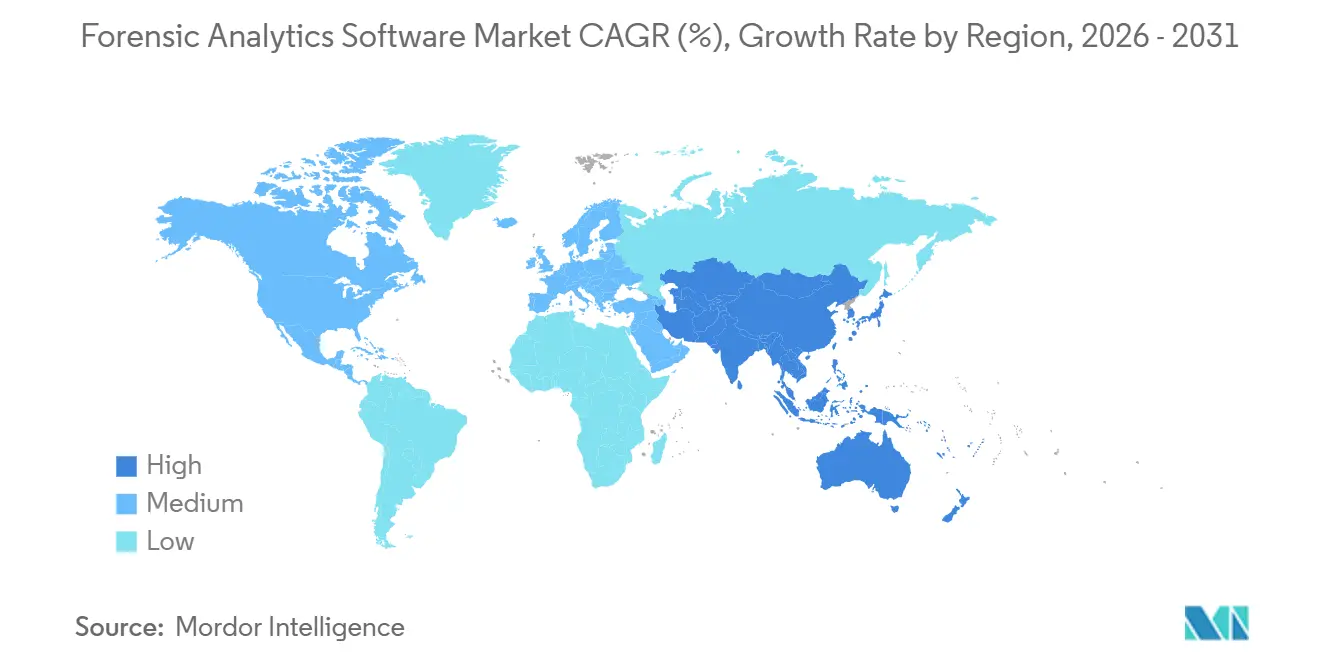
North America held 41.78% of the forensic analytics software market size in 2025, keeping the region in the lead. The United States drives most of that position because its healthcare system combines strong breach reporting rules, active fraud enforcement, and a broad installed base of payer integrity programs. The forensic analytics software market in North America also benefits from faster adoption of AI-assisted review tools, and Cellebrite made Genesis generally available first to North American state and local government customers in June 2026. Canada and Mexico remain smaller contributors, but their adoption path is improving as regional integrity efforts move closer to U.S. operating models.
Europe held the second-largest revenue position, with Germany, the United Kingdom, and France forming the core markets. Demand in Europe remains closely tied to privacy, evidentiary control, and localized data handling rather than to pure scale alone. The forensic analytics software market in Europe therefore favors vendors that can support defensible processing within stricter legal environments and under more fragmented jurisdictional rules. Western Europe remains the strongest subregional base, while Central and Eastern European systems are adding demand as health digitization and interoperability obligations expand.
Asia-Pacific is forecasted to record the fastest CAGR at 13.75% through 2031, which makes it the strongest growth geography in the forensic analytics software market. Growth is being driven by national health digitization programs across China, Japan, India, and South Korea, all of which are expanding the volume of clinical and operational data that may later require forensic review. In Japan, Fujita Medical University Hospital used Microsoft Sentinel in a broader digital security transformation, reflecting how large institutions are strengthening log preservation and threat analysis capabilities. Middle East and Africa and South America still represent smaller shares, but health modernization efforts, fraud recovery programs, and cloud-led adoption create a steady long-term pipeline for lower-cost deployments.

Competitive Landscape
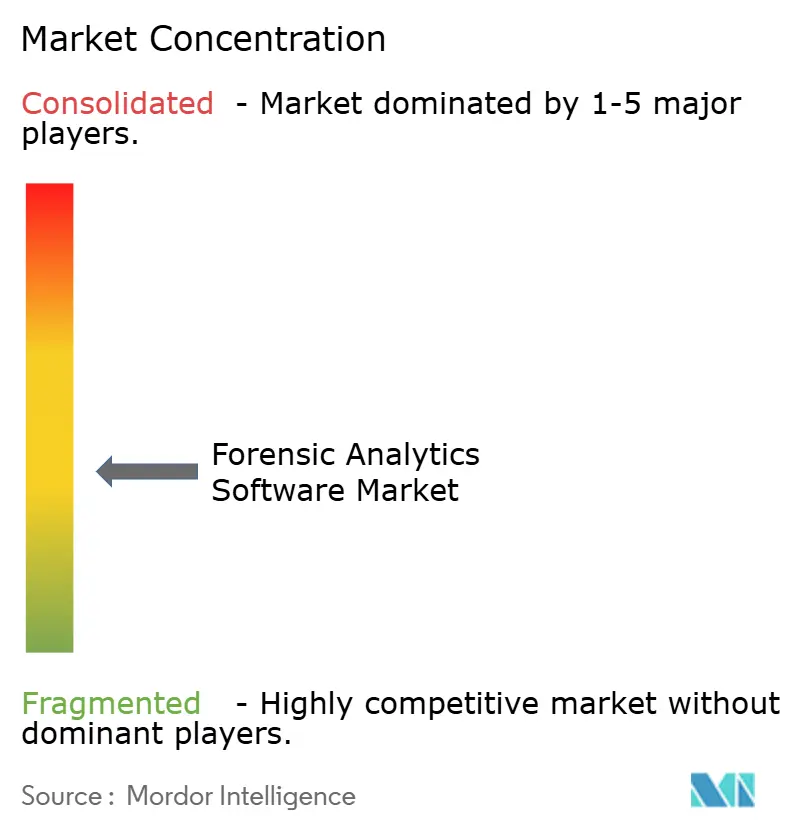
The forensic analytics software market remains moderately fragmented, with established digital forensics vendors operating alongside healthcare-focused analytics specialists. No single company controls a dominant cross-segment position, which leaves room for specialized products in pharmaceutical compliance, claims integrity, and connected medical device evidence review. The leading vendors compete less on basic extraction and more on workflow breadth, automation quality, deployment flexibility, and evidentiary defensibility. That keeps the forensic analytics software market open to both larger platform vendors and narrower specialists with strong healthcare fit.
One competitive path is the broad platform model. Exterro outlined that strategy in May 2026 through its ARMOUR framework, which connected eDiscovery, digital forensics, privacy, and governance into a unified operating vision for enterprise buyers. In this part of the forensic analytics software market, vendors try to win by reducing tool sprawl and giving legal, privacy, and compliance teams a common operating environment. That value proposition matters for large health systems and pharmaceutical groups that manage several kinds of regulated data at once.
The second path is the specialist innovation model, where vendors focus on evidence intelligence and review efficiency. The remaining white space is in healthcare-specific AI workflows, because many current products were built first for law enforcement or enterprise IT rather than for clinical records, payer data, or pharma quality systems. Vendors that can close that fit gap while meeting validation and audit requirements are likely to gain the most traction by 2031. The overall competitive picture therefore supports steady rivalry, selective differentiation, and continued opportunity for vendors that can combine forensic rigor with healthcare context.
Forensic Analytics Software Industry Leaders
Cellebrite DI Ltd.
OpenText Corporation
Magnet Forensics Inc.
Nuix Limited
MSAB (Micro Systemation AB)
- *Disclaimer: Major Players sorted in no particular order

Recent Industry Developments
- June 2026: Cellebrite launches Cellebrite Genesis for general availability. Cellebrite DI Ltd. made Cellebrite Genesis, its agentic AI investigation platform, generally available to North American state and local government customers, with international expansion planned through 2026. The platform interrogates mobile extractions, documents, and messages via natural language queries, compressing multi-week investigations to minutes and addressing structural staffing shortages in forensic units.
- May 2026: Exterro unveils ARMOUR autonomous risk management framework. Exterro announced its ARMOUR, Autonomous Risk Management, Orchestration, and Unified Response, strategic vision, extending agentic AI across eDiscovery, digital forensics, data privacy, and governance in a unified enterprise platform. The framework targets organizations managing simultaneous legal, compliance, and incident response obligations, directly relevant to large pharmaceutical and healthcare payer clients.
- April 2026: Magnet Forensics unveils Magnet AI and acquires V2 Forensics. Magnet Forensics launched Magnet AI, an evidence intelligence engine powering Intelligent Insights and Intelligent Search in Magnet Review, and announced the acquisition of V2 Forensics alongside the release of Magnet Autokey, the first product enabling non-invasive digital evidence extraction from vehicle infotainment systems via USB without physical teardown.


Global Forensic Analytics Software Market Report Scope
According to the report’s scope, the forensic analytics software market comprises digital tools that detect, analyze, and reconstruct electronic evidence, using data mining, pattern recognition, and anomaly detection, to support investigations across cybersecurity, fraud, compliance, and law‑enforcement environments.
The forensic analytics software market is segmented into component, deployment, application, end-user, and geography. By component, the market is segmented into software and services. By deployment, the market is segmented into cloud-based and on-premises. By application, the market is segmented into healthcare fraud detection and claims analytics, clinical data forensics and audit trail analysis, electronic health record (EHR) misuse and access investigation, pharmaceutical compliance and clinical trial data forensics, patient safety incident investigation and root cause analysis, and other applications. By end-user, the market is segmented into hospitals and healthcare providers, healthcare payers, pharmaceutical and biotechnology companies, and other end-users. By geography, the market is segmented into North America, Europe, Asia-Pacific, the Middle East and Africa, and South America. The report also covers the estimated market sizes and trends for 17 countries across major regions globally. The report offers values (USD) for all the above segments.
| Software |
| Services |
| Cloud-Based |
| On-Premises |
| Healthcare Fraud Detection and Claims Analytics |
| Clinical Data Forensics and Audit Trail Analysis |
| Electronic Health Record (EHR) Misuse and Access Investigation |
| Pharmaceutical Compliance and Clinical Trial Data Forensics |
| Patient Safety Incident Investigation and Root Cause Analysis |
| Other Applications |
| Hospitals and Healthcare Providers |
| Healthcare Payers |
| Pharmaceutical and Biotechnology Companies |
| Other End-Users |
| North America | United States |
| Canada | |
| Mexico | |
| Europe | Germany |
| United Kingdom | |
| France | |
| Italy | |
| Spain | |
| Rest of Europe | |
| Asia-Pacific | China |
| Japan | |
| India | |
| Australia | |
| South Korea | |
| Rest of Asia-Pacific | |
| Middle East and Africa | GCC |
| South Africa | |
| Rest of Middle East and Africa | |
| South America | Brazil |
| Argentina | |
| Rest of South America |
| By Component | Software | |
| Services | ||
| By Deployment | Cloud-Based | |
| On-Premises | ||
| By Application | Healthcare Fraud Detection and Claims Analytics | |
| Clinical Data Forensics and Audit Trail Analysis | ||
| Electronic Health Record (EHR) Misuse and Access Investigation | ||
| Pharmaceutical Compliance and Clinical Trial Data Forensics | ||
| Patient Safety Incident Investigation and Root Cause Analysis | ||
| Other Applications | ||
| By End-User | Hospitals and Healthcare Providers | |
| Healthcare Payers | ||
| Pharmaceutical and Biotechnology Companies | ||
| Other End-Users | ||
| By Geography | North America | United States |
| Canada | ||
| Mexico | ||
| Europe | Germany | |
| United Kingdom | ||
| France | ||
| Italy | ||
| Spain | ||
| Rest of Europe | ||
| Asia-Pacific | China | |
| Japan | ||
| India | ||
| Australia | ||
| South Korea | ||
| Rest of Asia-Pacific | ||
| Middle East and Africa | GCC | |
| South Africa | ||
| Rest of Middle East and Africa | ||
| South America | Brazil | |
| Argentina | ||
| Rest of South America | ||


Key Questions Answered in the Report
What is driving growth in forensic analytics software through 2031?
Growth is being supported by rising healthcare breach volumes, stronger fraud oversight, wider use of cloud and connected devices, and growing demand for AI-assisted review. The market is expected to rise from USD 3.55 billion in 2025 to USD 3.96 billion in 2026 to USD 7.13 billion by 2031 at a 12.47% CAGR.
Which region leads revenue and which region is growing the fastest?
North America led with 41.78% share in 2025 because of strong enforcement and payer integrity programs. Asia-Pacific is projected to grow the fastest at 13.75% through 2031 as health digitization expands across major countries.
Which application area generates the most revenue?
Clinical data forensics and audit held the largest application share at 37.80% in 2025. It remains central because of litigation exposure, breach review needs, and the legal sensitivity of clinical records.
Why are healthcare payers becoming a key buyer group?
Healthcare payers are projected to grow at 13.52% through 2031 as the operating model shifts toward pre-payment anomaly detection. Large payment and relationship datasets now require automated triage that manual review cannot handle efficiently.
Page last updated on:





