
Foreign Exchange Rate Risk Management Services Market Size and Share
Market Overview
| Study Period | 2021 - 2032 |
|---|---|
| Market Size (2027) | USD 5 Billion |
| Market Size (2032) | USD 7.70 Billion |
| Growth Rate (2027 - 2032) | 9.00 % |
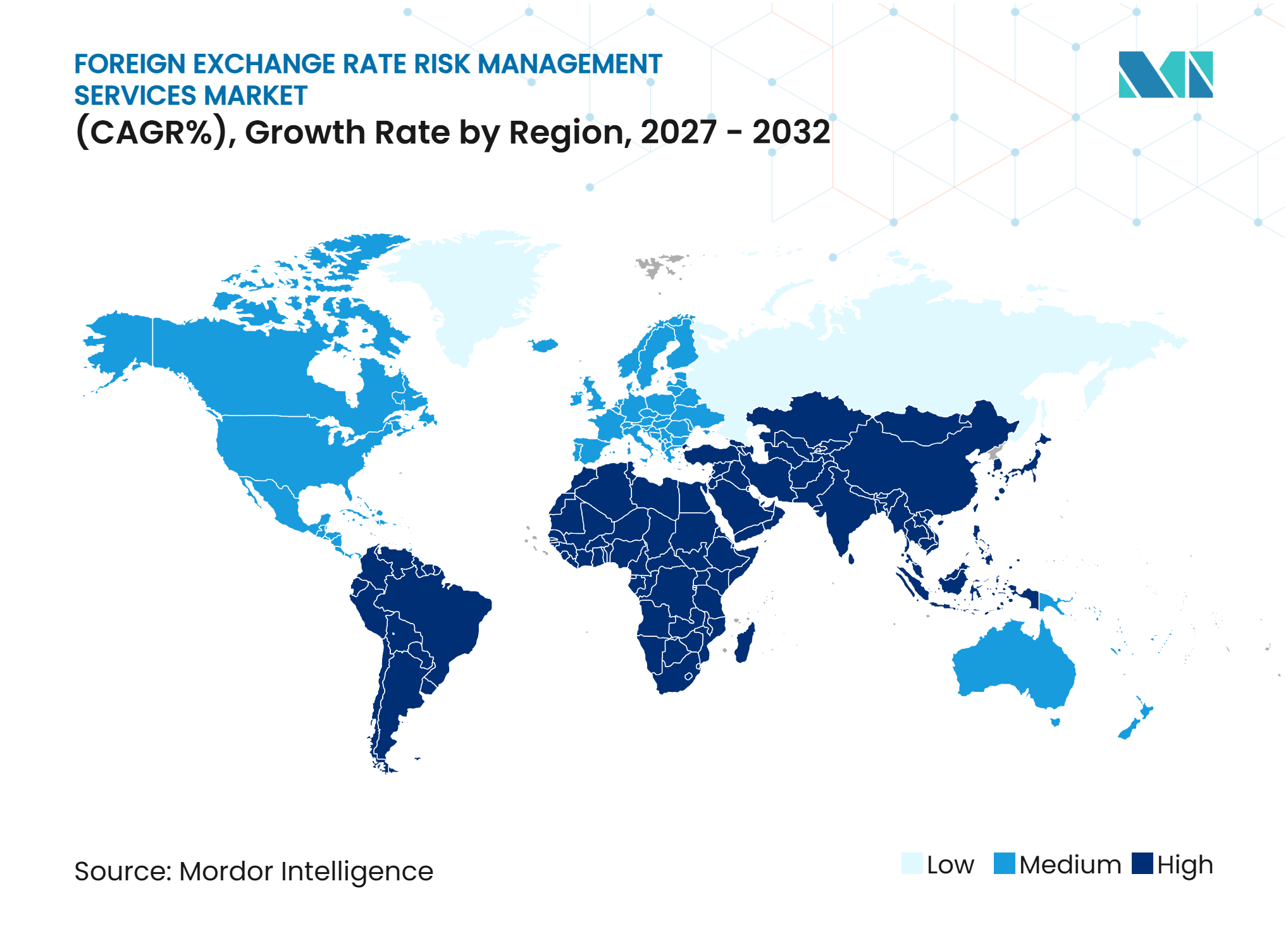
| Fastest Growing Market | Asia-Pacific |
| Largest Market | North America |
| Market Concentration | Low |
Major Players *Disclaimer: Major Players sorted in no particular order Image © Mordor Intelligence. Reuse requires attribution under CC BY 4.0. | |
Foreign Exchange Rate Risk Management Services Market Analysis by Mordor Intelligence
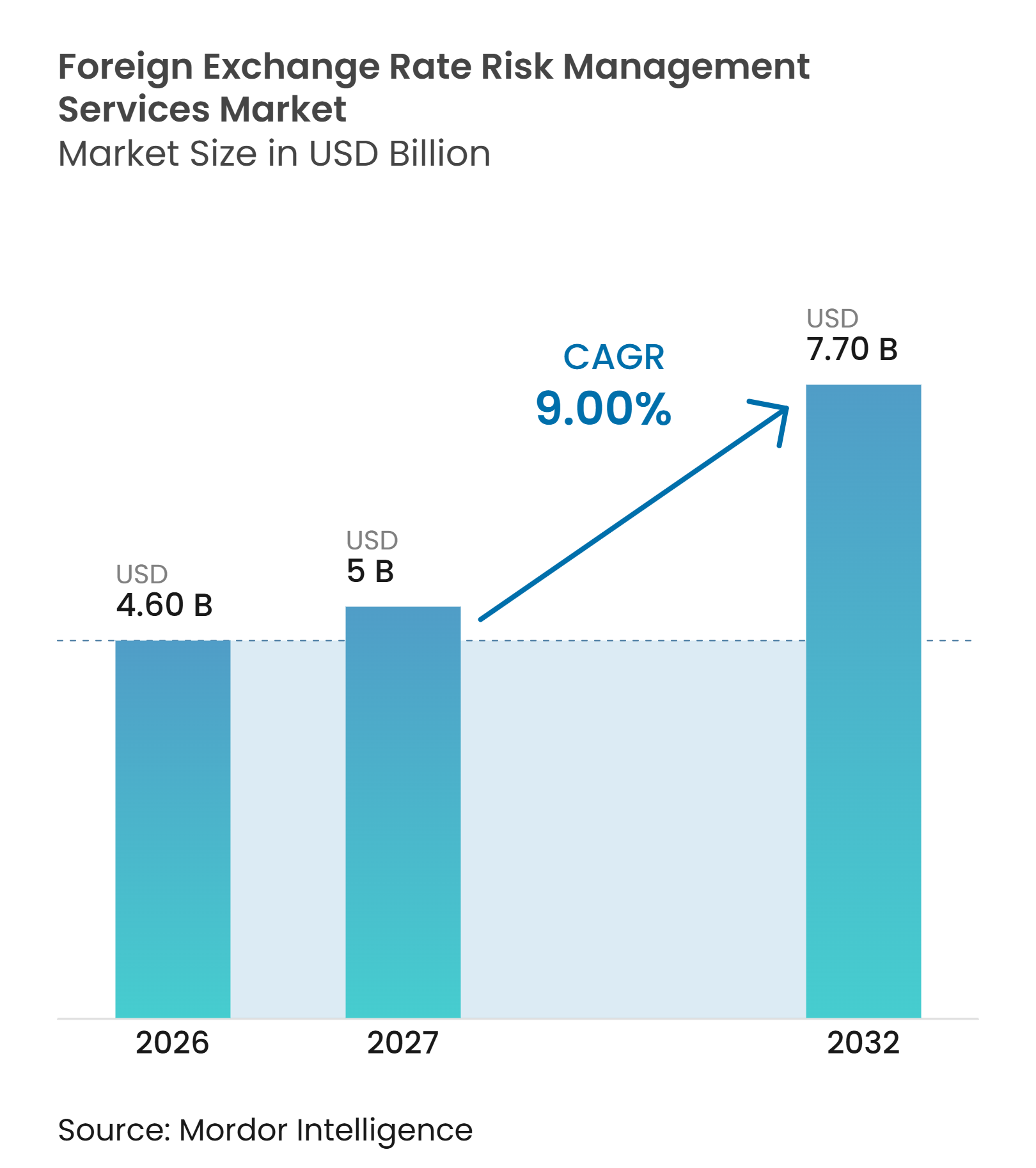
The Foreign Exchange Rate Risk Management Services Market size is expected to increase from USD 4.60 billion in 2026 to USD 5 billion in 2027 and reach USD 7.70 billion by 2032, growing at a CAGR of 9% over 2027-2032.
Daily foreign exchange activity is nearing USD 10 trillion, while average daily FX derivatives turnover reached USD 6.6 trillion in April 2025, with outright forwards and options taking a larger role in corporate portfolios. Tariff changes, geopolitical escalation, and differing central-bank policies have made currency risk a supply-chain and board-level concern rather than a treasury-only responsibility. The foreign exchange risk management services market is therefore moving toward continuous monitoring, documented hedge programs, and integrated payment and treasury workflows. Providers that combine technology, hedge accounting knowledge, and implementation support are better placed to serve complex multinational clients. Higher hedging costs limited emerging-market liquidity, and control requirements for AI tools may slow adoption by smaller organizations while increasing demand for specialized advisory support.
Key Report Takeaways
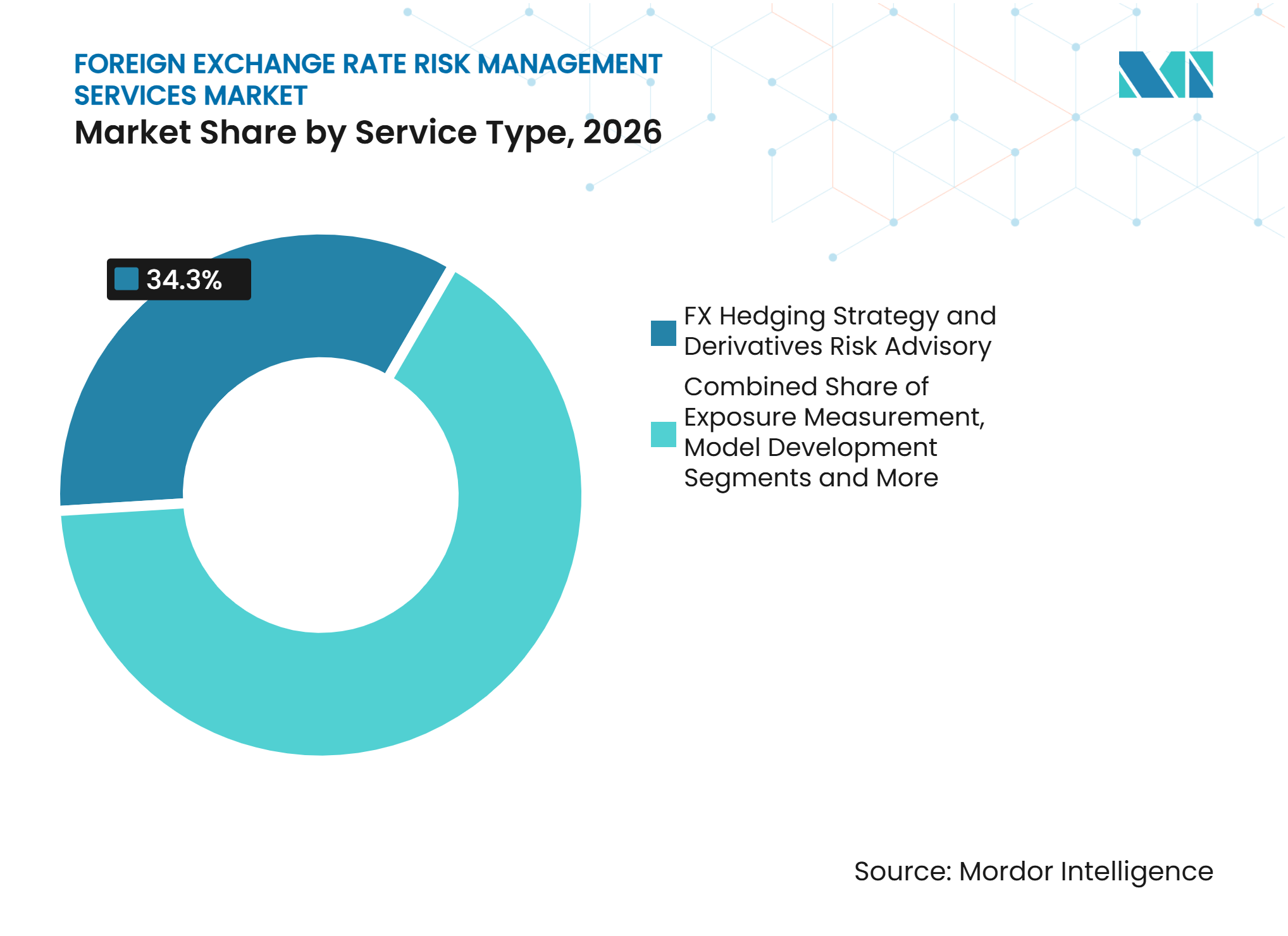
- By service type, FX Hedging Strategy & Derivatives Risk Advisory Services held a 34.3% share of the foreign exchange risk management services market in 2026, while Managed FX Monitoring, Reporting & Operations Services is forecast to grow at a 12.4% CAGR through 2032.
- By end user, Non-Financial Corporate Treasuries held a 44.1% share of the foreign exchange risk management services market in 2026, while Asset Management Firms are forecast to grow at 11.5% CAGR through 2032.
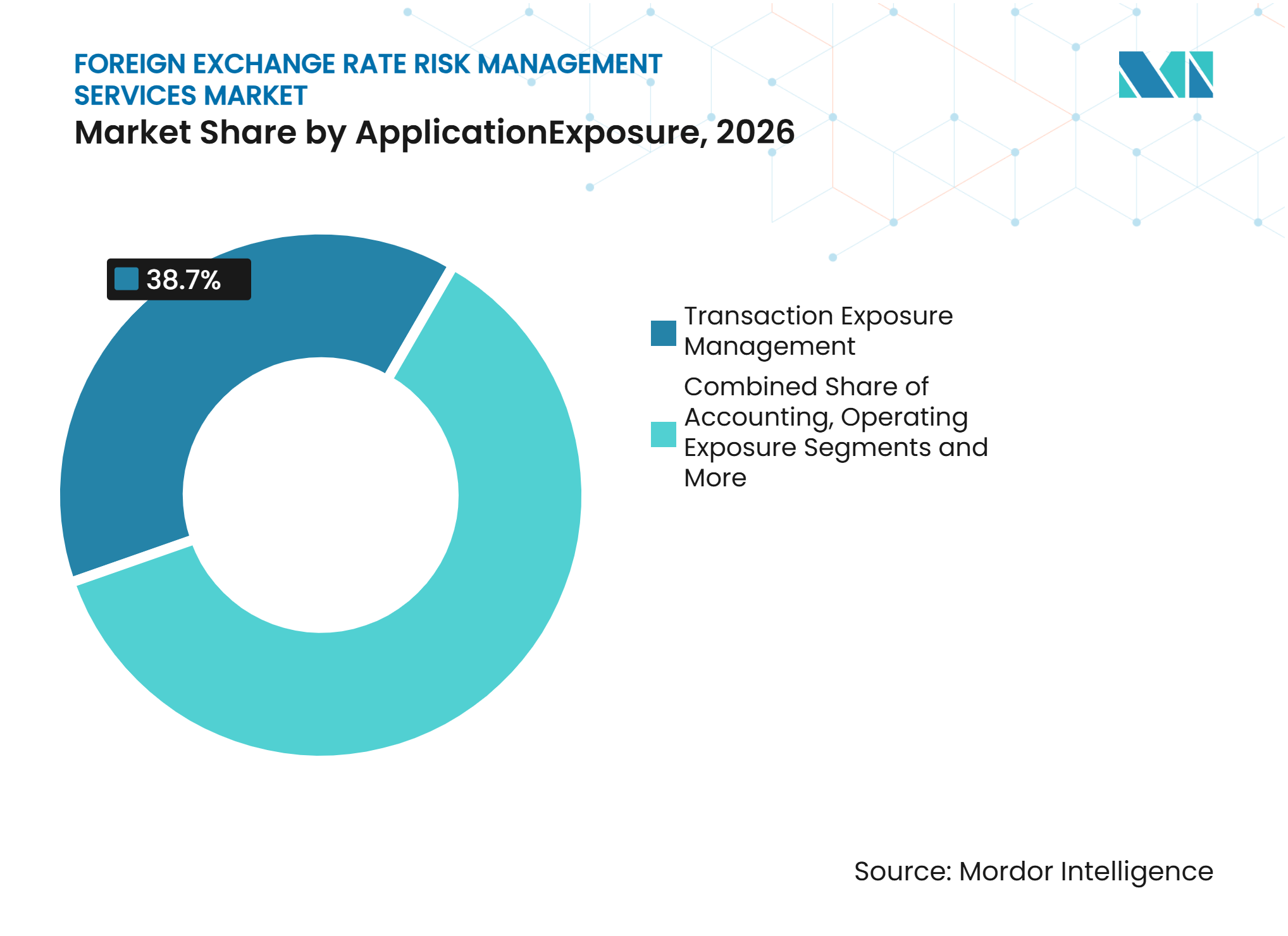
- By application or exposure, Transaction Exposure Management accounted for 38.7% of the foreign exchange risk management services market size in 2026, while Regulatory Compliance, Hedge Accounting & Risk Governance is forecast to grow at 11.8% CAGR through 2032.
- By geography, North America held a 36.5% share of the foreign exchange risk management services market in 2026, while Asia-Pacific is forecast to grow at 11.2% CAGR through 2032.
Note: Market numbers in this report are based on Mordor Intelligence's proprietary estimation framework, which combines nine months of actuals with Q4 projections for base year 2026.
Market Trends and Insights
Drivers Impact Analysis of Foreign Exchange Risk Management Services Market of Foreign Exchange Rate Risk Management Services Market*
| Driver | (~) % Impact on CAGR Forecast | Geographic Relevance | Impact Timeline |
|---|---|---|---|
| Increasing Foreign Exchange Volatility and Geopolitical Uncertainty | +1.7% | Global | Short term (≤ 2 years) |
| Expansion of Cross-Border Trade, International Investments and Multi-Currency Exposure | +1.5% | Global, with strong gains in APAC and EMEA | Medium term (2-4 years) |
| Rising Adoption of FX Hedging Instruments and Sophisticated Risk-Mitigation Strategies | +1.3% | North America and EU | Medium term (2-4 years) |
| Increasing Regulatory, Derivatives Reporting and Counterparty Risk Management Requirements | +1.1% | EU, UK, North America | Long term (≥ 4 years) |
| Accelerating Adoption of AI-Enabled FX Analytics and Automated Treasury Management Platforms | +1.4% | APAC core, spillover to North America and EU | Medium term (2-4 years) |
| Growing Demand for FX Settlement Risk Mitigation and Cross-Border Payment Risk Management | +0.9% | Global | Short term (≤ 2 years) |
| Source: Mordor Intelligence | |||
Increasing Foreign Exchange Volatility and Geopolitical Uncertainty
Nonresident nonbank financial institutions sought more dollar-depreciation hedges after the April 2025 U.S. tariff announcements. The International Monetary Fund described this behavior as a structural change in the way non-U.S. investors manage currency mismatches. Subsequent Middle East escalation events pushed developed-market currency volatility 40% above expectations and emerging-market currency volatility nearly 100% above expectations. North American companies also adjusted sourcing and manufacturing plans in response to dollar volatility, connecting FX exposure to operating decisions. Organizations without pre-positioned hedge programs sought external support when hedge costs were already elevated. This pattern supports ongoing demand for managed monitoring and formal hedge policies in the foreign exchange risk management services market.
Expansion of Cross-Border Trade, International Investments and Multi-Currency Exposure
Cross-border operations create a broader set of currency pairs and larger exposure-management workloads for multinational groups. Intercompany activity can account for up to 30% of a multinational's transactions, and incompatible accounting systems can leave currency gains and losses poorly visible[1]. Cross-currency private-credit portfolios add another source of exposure because USD-based managers holding floating-rate euro loans must manage rolling forward positions and basis risk. The 2026 ISDA FX Definitions replace the 1998 framework in November 2027 and require documentation updates across dealers and corporate counterparties. These changes make exposure aggregation, netting, and documentation work recurring needs instead of periodic projects. This supports wider use of external platforms and advisory services across the foreign exchange risk management services market.
Rising Adoption of FX Hedging Instruments and Sophisticated Risk-Mitigation Strategies
North American fund managers are using a wider range of currency hedging tools. A 2025 MillTech survey reported that 85% of North American fund managers hedge forecastable currency risk, while 95% increased use of FX options for downside protection. U.S. multinationals extended hedge durations after the April 2025 tariff shock, moving from short-dated cover toward multi-tenor programs. FASB issued ASU 2025-09 in November 2025, which introduced targeted hedge-accounting changes that require companies to reassess hedging relationships before the December 2026 effective date[2]. Entities need documented methods for designation, effectiveness testing, and audit trails. These requirements increase the value of specialist implementation work in the foreign exchange risk management services market.
Accelerating Adoption of AI-Enabled FX Analytics and Automated Treasury Management Platforms
AI tools are becoming part of treasury and FX operating models. Standard Chartered and Ant International reported that their August 2025 solution processed more than 60% of Ant International's FX conversion transactions and exceeded 90% hourly forecasting accuracy[3]. The companies reported client hedging-cost reductions of up to 60% from the solution. FIS launched its Neural Treasury Suite in September 2025 to automate exposure classification and hedge recommendations within the treasury workflow. AI deployment still requires reliable data, explainable outputs, and audit trails that support IFRS 9 and EMIR obligations. That requirement creates room for providers that can connect automation with governance and operational controls.
Restraints Impact Analysis of Foreign Exchange Risk Management Services Market of Foreign Exchange Rate Risk Management Services Market*
| Restraint | (~) % Impact on CAGR Forecast | Geographic Relevance | Impact Timeline |
|---|---|---|---|
| High Costs of FX Hedging, Risk Analytics and Treasury Technology Implementation | -1.4% | Global | Short term (≤ 2 years) |
| Limited Visibility and Accuracy of Multi-Currency Exposure Data | -0.9% | Global, most acute in APAC and MEA | Medium term (2-4 years) |
| Liquidity Constraints and Limited Hedging Instruments in Emerging-Market Currencies | -0.7% | MEA, APAC emerging markets, South America | Medium term (2-4 years) |
| Counterparty Credit Risk, Collateral Requirements and Operational Complexity | -0.6% | Global | Long term (≥ 4 years) |
| Source: Mordor Intelligence | |||
High Costs of FX Hedging, Risk Analytics and Treasury Technology Implementation
Higher hedging and technology costs can prevent smaller firms from running systematic programs. Mean hedging costs for North American corporates rose 52% in 2026 after a 76% increase in 2025. MillTech also reported that 30% of non-hedgers cited burdensome infrastructure as their main reason for remaining unhedged. Cloud migrations, ERP integration, and multibank API connections lengthen deployment schedules and weaken short-term return calculations. Treasury management system concentration also raises switching costs and extends implementation cycles. These conditions constrain adoption in the foreign exchange risk management services market even where currency exposures are clear.
Liquidity Constraints and Limited Hedging Instruments in Emerging-Market Currencies
Settlement and liquidity constraints across emerging-market currency corridors hinder standardization, while growing activity in currencies outside CLS coverage has increased reliance on FX settlement arrangements that lack payment-versus-payment protection, elevating counterparty and settlement risk. Exchange-rate movements and hedging costs rise more sharply for emerging-market currencies during uncertainty episodes[4]. This is the period when corporate users need risk-management support most, but available instruments can be limited or costly. The gap reduces the ability of global providers to offer consistent solutions across rising trade corridors. Providers must therefore adapt local instruments, settlement processes, and compliance practices to serve these regions.
*Our forecasts treat driver/restraint impacts as directional, not additive. The impact forecasts reflect baseline growth, mix effects, and variable interactions.
Foreign Exchange Rate Risk Management Services Market Segment Analysis
By Service Type:
Advisory Leads, Operations Closing the GapFX Hedging Strategy & Derivatives Risk Advisory Services held 34.3% of the foreign exchange risk management services market size in 2026. The segment benefits from multi-tenor program design, IFRS 9 and ASC 815 documentation, and continuing effectiveness testing. The 2025 tariff shock increased demand for portfolio-based programs that require sustained adviser involvement. FX Exposure Measurement & Risk Analytics and FX Model Development, Calibration & Economic-Exposure Modelling occupy the middle of the service mix. Independent Model Validation & Risk Governance has a defensible role where regulators seek third-party review of models used in IFRS 9 assessments.
Managed FX Monitoring, Reporting & Operations Services is forecast to expand at 12.4% CAGR through 2032. Treasury teams use these services to outsource daily exposure tracking, effectiveness testing, and reporting for complex multi-entity operations. This model addresses pressure when internal teams cannot manage multiple currencies and entities. FIS introduced Neural Treasury in September 2025, bringing AI-led cash and risk tools into a single treasury workflow. The EMIR refit and the 2026 ISDA FX Definitions create recurring documentation and independent-review needs that allow managed operations to displace in-house activity and episodic advice.



By End User:
Corporate Treasuries Dominate, Asset Managers AccelerateNon-Financial Corporate Treasuries held 44.1% of the foreign exchange risk management services market share in 2026. Multinational manufacturers, exporters, and retailers rely on external support because currency movements affect margins and sourcing decisions. In 2026, 82% of North American corporates were actively hedging, while 72% of non-hedgers were considering a program. Those non-hedgers represent a readily convertible group for service providers. Commercial and universal banks, investment banks, and broker-dealers form the next demand tier because Dodd-Frank, EMIR, and Basel III and IV create counterparty-risk and reporting obligations.
Asset Management Firms are forecast to expand at 11.5% CAGR through 2032. Rising hedge ratios and cross-currency private-credit portfolios increase demand for independent oversight and outsourced execution. Russell Investments secured a USD 8.6 billion FX overlay mandate for Income Insurance in Singapore during 2026. Insurance companies and pension funds also outsource currency overlay work when governance obligations exceed internal capacity. Solvency II reporting standards increase the need for defined control frameworks, which specialist providers can deliver without clients building comparable in-house teams.
By Application/Exposure:
Transaction Hedging Anchors, Compliance Spurs New DemandTransaction Exposure Management accounted for 38.7% of the foreign exchange risk management services market size in 2026. This application covers receivables and payables hedging, invoice-currency management, and rolling forward programs tied to cross-border trading activity. Automation does not remove the need for advisory work around hedge-ratio calibration and policy governance. In 2026, 48% of North American corporates were exploring automated price discovery, and 43% were exploring automated trade execution. External expertise remains relevant when firms must connect automation to documented decision rules.
Regulatory Compliance, Hedge Accounting & Risk Governance is forecast to grow at 11.8% CAGR through 2032. IFRS 9, ASU 2025-09, the EMIR refit, and the 2026 ISDA FX Definitions each create additional documentation and effectiveness-testing work. Translation Exposure Management is high-volume but more standardized than other applications. Economic and operating exposure management is more advisory-intensive and generally supports higher fees. Structural FX and capital-ratio protection for banks, along with Multi-Currency ALM & Portfolio Overlay for insurers and pension funds, require specialized managed-service support.

Geography Analysis
North America: Corporate Risk Tolerance Recalibrates Under Policy Uncertainty
North America held 36.5% of the foreign exchange risk management services market share in 2026. The region has a large population of active corporate hedgers and established derivatives-reporting obligations under Dodd-Frank. In 2026, 90% of North American corporates had delayed investment decisions because of policy uncertainty, while 81% had adjusted sourcing strategies, changing their currency exposure profiles and increasing the need for re-hedging support. Manufacturers prioritize price stability through supply-chain hedging, while technology companies layer options onto forward programs and providers integrate treasury, payment, and risk workflows. Dodd-Frank reporting remains a key compliance factor, while Mexico’s nearshoring links with the United States create new multicurrency exposures for organizations changing their production footprint.
Asia-Pacific: AI-Powered Hedging Reshaping Competitive Benchmarks
Asia-Pacific is forecast to grow at 11.2% CAGR through 2032, the highest regional rate in the foreign exchange risk management services market. Institutional de-dollarization, greater cross-border activity, and AI adoption support demand across the region. Standard Chartered and Ant International launched an AI-based treasury and FX solution in August 2025 through Singapore’s MAS PathFin.ai program. The solution processes more than 60% of Ant International’s FX conversion transactions and reported hedging-cost reductions of up to 60%, raising expectations for automation and accuracy. Japanese life insurers increased hedge ratios from 44% to 48% in 2025, while China’s PBOC Circular 159 mechanisms and differing local infrastructure create specialized advisory requirements.
Europe and Emerging Markets: Regulatory Intensity Sustains Structural Demand
Europe is shaped by the combined compliance demands of EMIR, MiFID II, IFRS 9, and the 2026 ISDA FX Definitions. These frameworks maintain demand for advisory, model-validation, and reporting services, while differences between UK EMIR and EU EMIR add cross-border work. The United Kingdom remains a global FX trading hub, and Germany and France provide demand from globally active industrial companies. Spain and Italy are becoming more active as exporters formalize hedging, while Brazil, Argentina, the UAE, and Saudi Arabia create opportunities for providers that can address local settlement, liquidity, and regulatory conditions in the foreign exchange risk management services market.
Competitive Landscape
Market Concentration
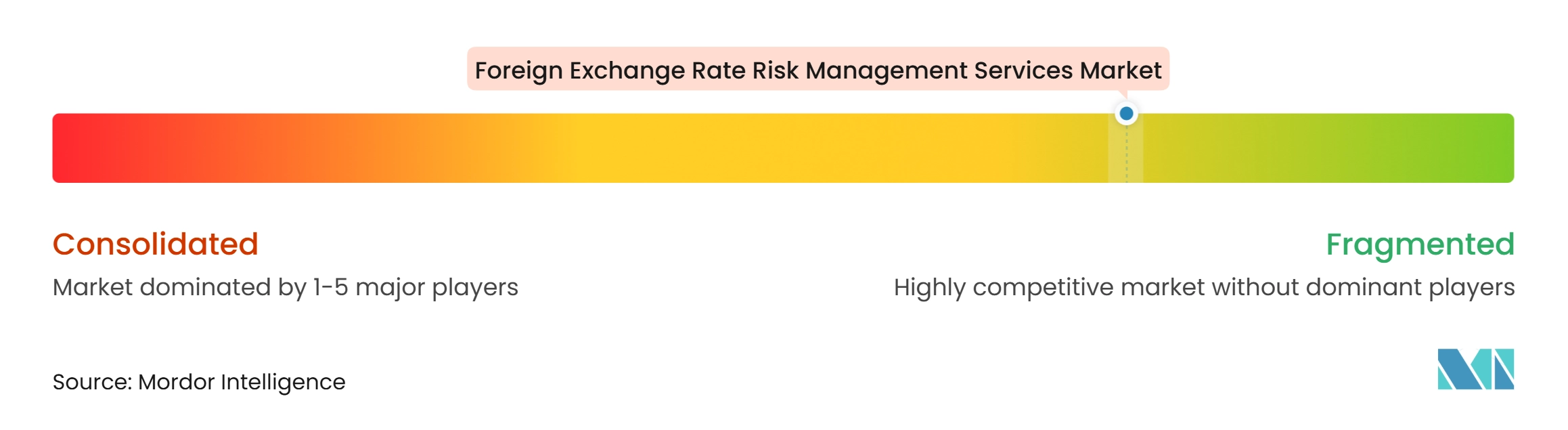
The foreign exchange risk management services market is moderately fragmented, with the top 5 to 6 providers estimated to hold 35% to 45% of the addressable market. This leaves room for regional specialists, boutique advisers, and technology-focused entrants. FIS, Oracle, SS&C Technologies, and Finastra compete by combining FX analytics with broader treasury-management capabilities. FIS launched Treasury & Risk Manager, Quantum Cloud Edition, in April 2025 as a cloud-based platform with liquidity analysis and FX capabilities. It was followed by Neural Treasury in September 2025, adding machine learning, robotics, and Treasury GPT to one operating environment for cash visibility, payments, liquidity, and FX risk.
Finastra launched its Transformation Service in April 2025 to support ISO 20022 and CBPR+ messaging requirements. The service is certified as a SWIFT Compatible Interface and translates MT messages to MX standards through an API-based microservice. Integrated payment messaging is becoming important for customers that want FX processes connected to cross-border payment workflows. Advisory-led firms such as Accenture and KPMG compete in governance design, hedge-accounting documentation, and ERP-to-TMS integration. Finalyse S.A. and Prometeia S.p.A. hold positions in regulatory valuation and integrated risk analytics, while EMIR, MiFID II, IFRS 9, and the 2026 FX Definitions favor established reporting and model-validation capabilities.
Ripple acquired GTreasury for USD 1 billion in October 2025, combining treasury management with digital-asset payment rails. GTreasury serves more than 1,000 clients across 160 countries, giving Ripple a broader route into corporate FX and treasury processes. Providers are differentiating through automation, regulatory coverage, data integration, and implementation support rather than execution services alone, while new entrants face high switching costs around embedded platforms. Smaller specialists can still compete where local regulation or complex hedge-accounting needs require focused expertise, sustaining several delivery models in the foreign exchange risk management services market.
Foreign Exchange Rate Risk Management Services Industry Leaders
-
Quantitative Risk Management (QRM)
-
Finalyse S.A.
-
Prometeia S.p.A.
-
ALM First
-
The Baker Group
- *Disclaimer: Major Players sorted in no particular order
Foreign Exchange Rate Risk Management Services Market Companies Covered in this Report
- Quantitative Risk Management (QRM)
- Finalyse S.A.
- Prometeia S.p.A.
- ALM First
- The Baker Group
- Darling Consulting Group
- ValuRisk Partners
- IRR-analytics, LLC
- Wolters Kluwer N.V.
- Moody's Analytics, Inc.
- Oracle Corporation
- Fidelity National Information Services, Inc. (FIS)
- SAS Institute Inc.
- Finastra International Limited
- MORS Software
- Empyrean Solutions
- SS&C Technologies Holdings, Inc.
- Abrigo, Inc.
- Accenture plc
- KPMG International
Recent Industry Developments in Foreign Exchange Rate Risk Management Services Market
- November 2026: Oracle launched Oracle Financial Services Data Intelligence Treasury Analytics, an AI-assisted application enabling treasury, finance, and risk leaders to explore liquidity, funding, and market risk in natural language, deployed globally for financial institutions and insurers managing multi-currency balance sheets.
- March 2026: ISDA and EMTA published the 2026 FX Definitions, replacing the 1998 framework effective November 2027, requiring documentation overhauls for FX derivatives transactions across the dealer and corporate counterparty universe.
- December 2025: Regnology completed its acquisition of Wolters Kluwer’s Finance, Risk & Regulatory Reporting unit for EUR 450 million (USD 480 million), consolidating regulatory reporting capabilities under a cloud-native SaaS platform serving financial institutions and regulators globally.
- October 2025: Ripple acquired GTreasury for USD 1 billion, combining GTreasury’s FX risk management platform, serving over 1,000 clients in 160 countries, with Ripple’s digital-asset payment rails, creating a vertically integrated treasury-and-payments proposition that bypasses traditional bank-centric FX arrangements.
Global Foreign Exchange Rate Risk Management Services Market Report Scope
The Foreign Exchange Risk Management Services Market comprises advisory and analytical services that help businesses and financial institutions identify, measure, monitor, and mitigate risks arising from exchange-rate fluctuations through currency hedging, exposure assessment, risk modelling, FX forecasting, treasury management, and regulatory compliance.
The Foreign Exchange Risk Management Services Market is Segmented by Service Type (FX Hedging, Exposure Measurement and Risk Analytics, Model Development, Implementation, Validation, Managed Ops), End User (Banks, Asset Managers, Pension Funds, Corporate Treasuries), Application (Transaction, Translation, Economic, Structural FX, Regulatory Compliance, ALM), and Geography. The Market Forecasts are Provided in Terms of Value (USD).
Segmentation Overview
| FX Exposure Measurement and Risk Analytics Services |
| FX Hedging Strategy and Derivatives Risk Advisory Services |
| FX Model Development, Calibration and Economic-Exposure Modelling Services |
| Implementation, Integration and Customization Services |
| Independent Model Validation and Risk Governance Services |
| Managed FX Monitoring, Reporting and Operations Services |
| Commercial and Universal Banks |
| Investment Banks and Broker-Dealers |
| Insurance Companies |
| Asset Management Firms |
| Pension Funds and Endowments |
| Non-Financial Corporate Treasuries |
| Other Non-Bank Financial Institutions |
| Transaction Exposure Management |
| Translation (Accounting) Exposure Management |
| Economic / Operating Exposure Management |
| Structural FX and Capital-Ratio Protection |
| Regulatory Compliance, Hedge Accounting and Risk Governance |
| Multi-Currency ALM and Portfolio Overlay |
| North America | United States |
| Canada | |
| Mexico | |
| South America | Brazil |
| Argentina | |
| Rest of South America | |
| Europe | United Kingdom |
| Germany | |
| France | |
| Italy | |
| Spain | |
| Rest of Europe | |
| Asia-Pacific | China |
| Japan | |
| India | |
| South Korea | |
| Australia | |
| Indonesia | |
| Thailand | |
| Malaysia | |
| Singapore | |
| Vietnam | |
| Rest of Asia-Pacific | |
| Middle East and Africa | Saudi Arabia |
| United Arab Emirates | |
| Turkey | |
| South Africa | |
| Egypt | |
| Rest of Middle East and Africa |
| By Service Type | FX Exposure Measurement and Risk Analytics Services | |
| FX Hedging Strategy and Derivatives Risk Advisory Services | ||
| FX Model Development, Calibration and Economic-Exposure Modelling Services | ||
| Implementation, Integration and Customization Services | ||
| Independent Model Validation and Risk Governance Services | ||
| Managed FX Monitoring, Reporting and Operations Services | ||
| By End User | Commercial and Universal Banks | |
| Investment Banks and Broker-Dealers | ||
| Insurance Companies | ||
| Asset Management Firms | ||
| Pension Funds and Endowments | ||
| Non-Financial Corporate Treasuries | ||
| Other Non-Bank Financial Institutions | ||
| By Application / Exposure Focus | Transaction Exposure Management | |
| Translation (Accounting) Exposure Management | ||
| Economic / Operating Exposure Management | ||
| Structural FX and Capital-Ratio Protection | ||
| Regulatory Compliance, Hedge Accounting and Risk Governance | ||
| Multi-Currency ALM and Portfolio Overlay | ||
| By Geography | North America | United States |
| Canada | ||
| Mexico | ||
| South America | Brazil | |
| Argentina | ||
| Rest of South America | ||
| Europe | United Kingdom | |
| Germany | ||
| France | ||
| Italy | ||
| Spain | ||
| Rest of Europe | ||
| Asia-Pacific | China | |
| Japan | ||
| India | ||
| South Korea | ||
| Australia | ||
| Indonesia | ||
| Thailand | ||
| Malaysia | ||
| Singapore | ||
| Vietnam | ||
| Rest of Asia-Pacific | ||
| Middle East and Africa | Saudi Arabia | |
| United Arab Emirates | ||
| Turkey | ||
| South Africa | ||
| Egypt | ||
| Rest of Middle East and Africa | ||
Key Questions Answered in the Report
What is driving demand for foreign exchange risk management services?
Across the foreign exchange risk management services market, currency volatility, changing trade patterns, and tighter documentation requirements are increasing demand for continuous exposure monitoring and hedge-accounting support.
How large is the foreign exchange risk management services market?
The market is valued at USD 4.6 billion in 2026 and is forecast to reach USD 7.7 billion by 2032 at a 9.0% CAGR.
Which service category leads the foreign exchange risk management services market?
FX Hedging Strategy & Derivatives Risk Advisory Services leads with a 34.3% share in 2026.
Which end user creates the greatest demand for FX risk services?
Within the foreign exchange risk management services market, Non-Financial Corporate Treasuries account for 44.1% of demand because currency exposures directly affect multinational operating margins.
Which region is growing fastest for foreign exchange risk management services?
Asia-Pacific is the fastest-growing region in the foreign exchange risk management services market, with an 11.2% CAGR through 2032 supported by cross-border activity and AI-enabled treasury adoption.
How are AI tools changing FX risk management?
In the foreign exchange risk management services market, AI tools can automate exposure analysis and forecasting, but firms still need reliable data, explainable outputs, and audit trails for IFRS 9 and EMIR compliance.