
Football Merchandise Market Size and Share
Market Overview
| Study Period | 2027 - 2032 |
|---|---|
| Market Size (2027) | USD 16.92 Billion |
| Market Size (2032) | USD 22.82 Billion |
| Growth Rate (2027 - 2032) | 6.15 % |
| Fastest Growing Market | Asia-Pacific |
| Largest Market | Europe |
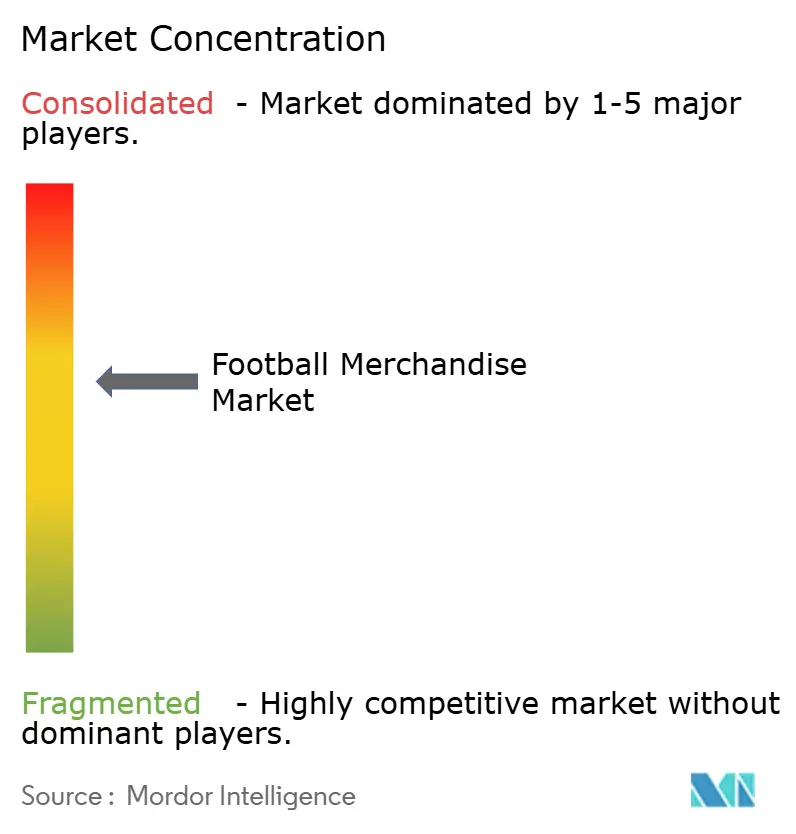
| Market Concentration | Medium |
Major Players *Disclaimer: Major Players sorted in no particular order Image © Mordor Intelligence. Reuse requires attribution under CC BY 4.0. | |
Football Merchandise Market Analysis by Mordor Intelligence
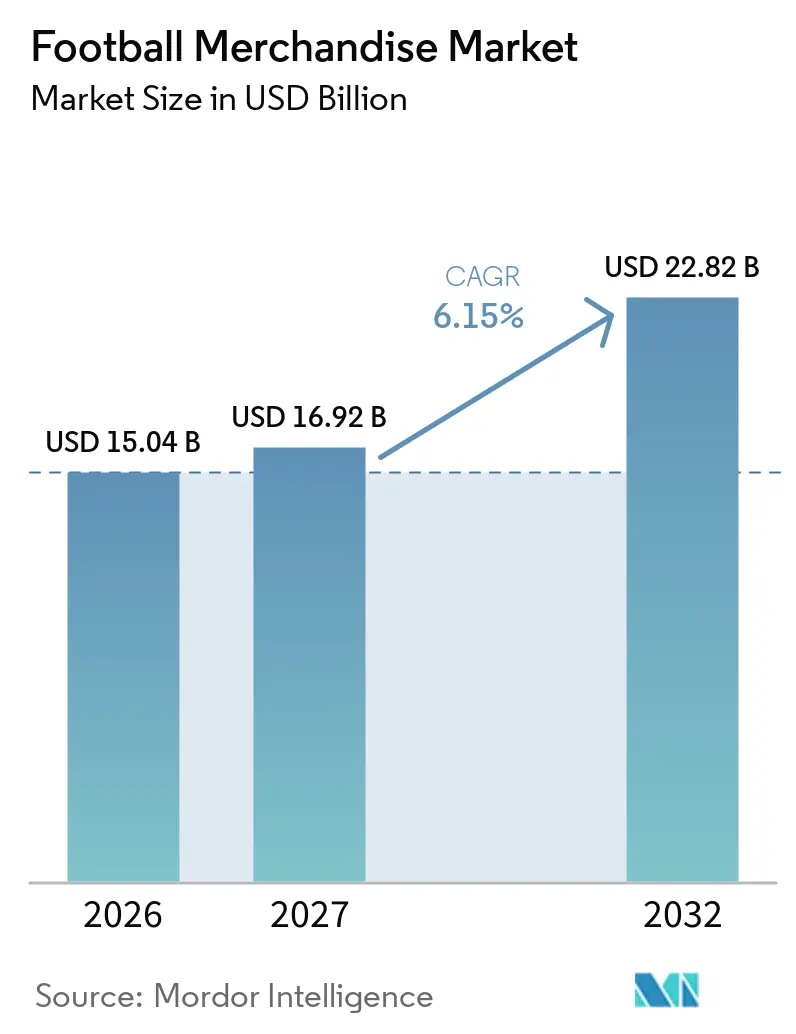
The football merchandise market size is projected to expand from USD 15.04 billion in 2026 and USD 16.92 billion in 2027 to USD 22.82 billion by 2032, registering a CAGR of 6.15% between 2027 and 2032. The growing global popularity of football clubs and leagues is strengthening demand for official team jerseys, apparel, accessories, and other merchandise. Major football tournaments are creating opportunities for merchandise sales by increasing fan engagement and encouraging purchases of team-branded products. The expansion of e-commerce platforms is improving access to official merchandise across international markets, while collectible products and limited-edition releases are providing additional opportunities to engage dedicated supporters. Apparel accounted for the largest product segment in 2026, representing 49.48% of the market, while toys and games are projected to be the fastest-growing product segment, with a CAGR of 6.25% during 2027–2032.
Key Report Takeaways
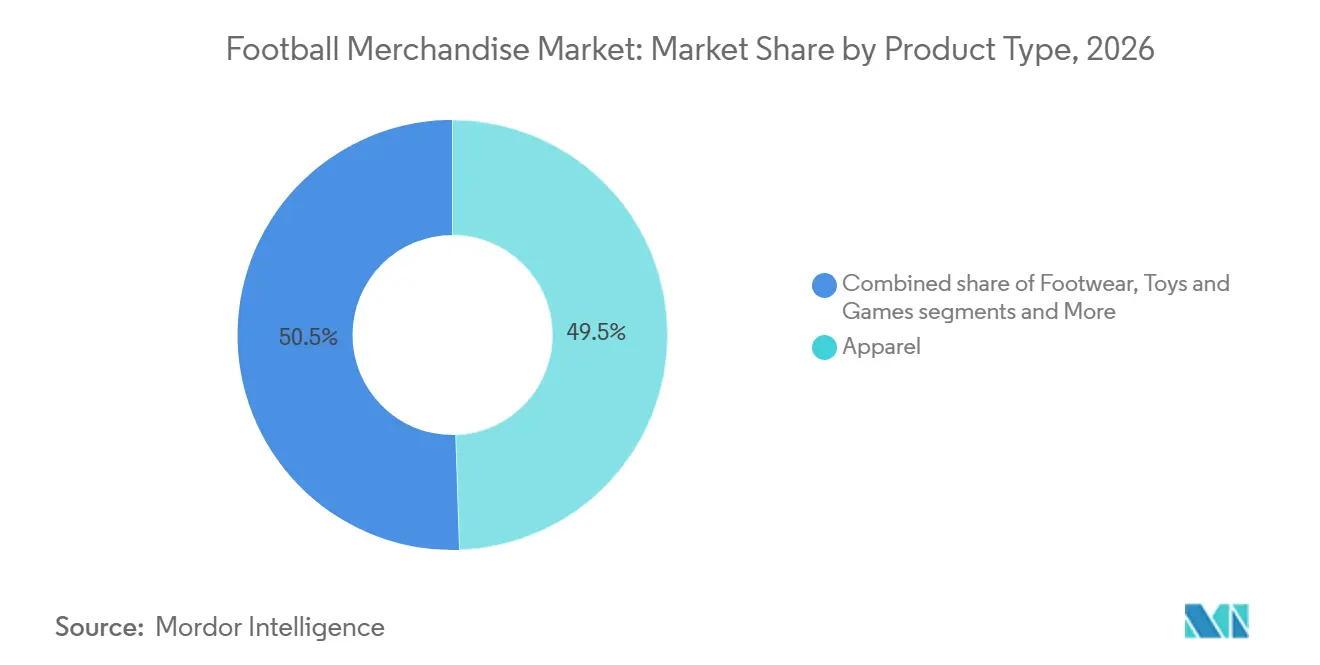
- By product type, apparel accounted for 49.48% of the football merchandise market share in 2026, while toys and games are projected to grow at a CAGR of 6.25% through 2032.
- By end user, adults dominated the football merchandise market with an 82.36% share in 2026, while children are forecast to be the fastest-growing segment, registering a CAGR of 6.91% during 2027–2032.
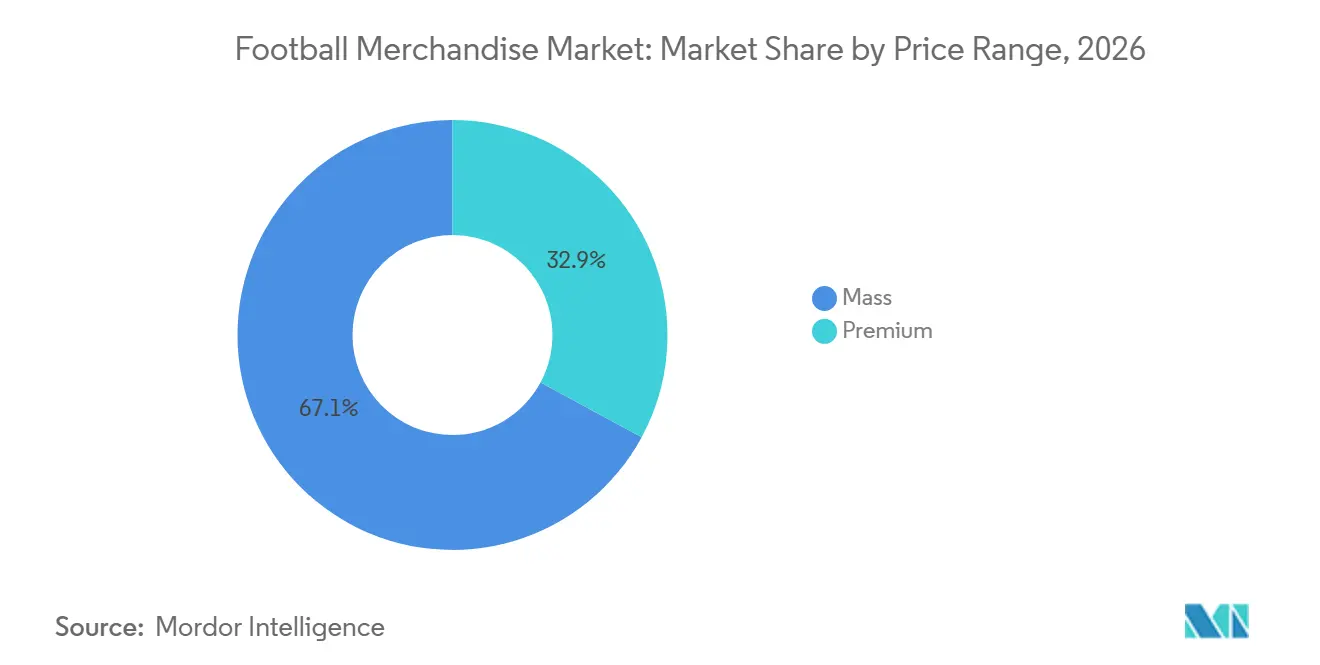
- By price range, mass-market merchandise held 67.12% of the market in 2026, whereas premium merchandise is projected to expand at a CAGR of 6.65% through 2032.
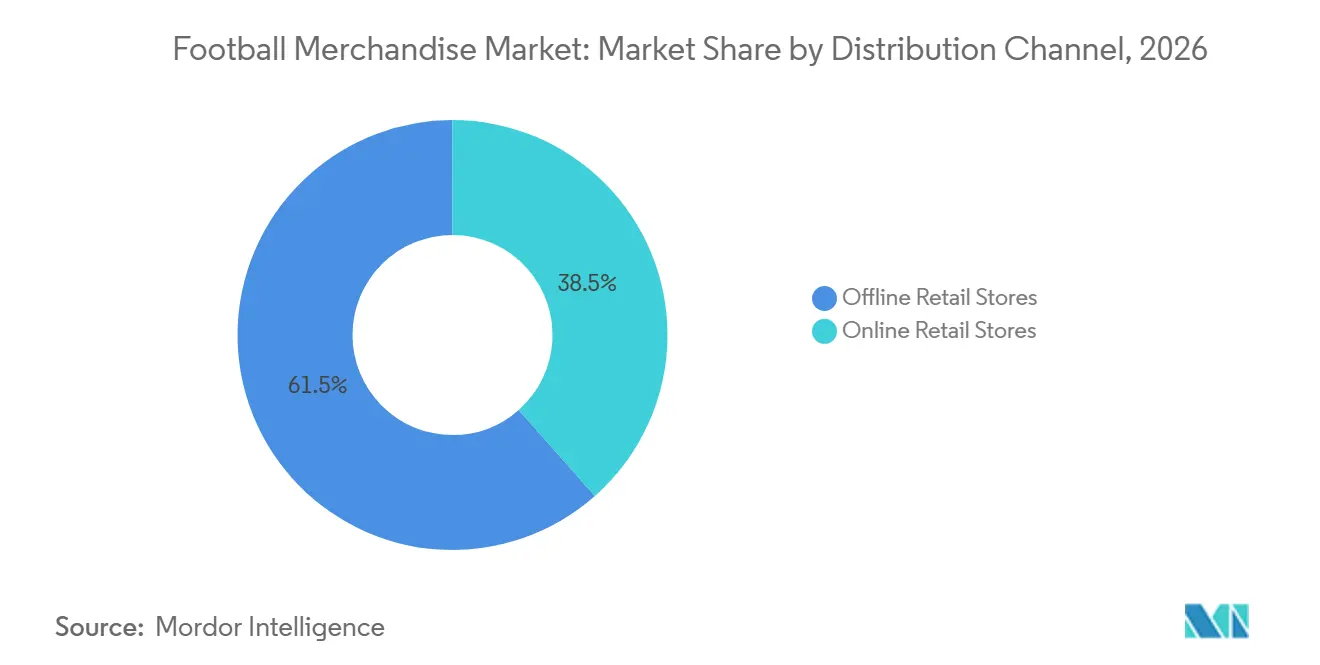
- By distribution channel, offline retail accounted for 61.52% of the football merchandise market share in 2026, while online retail is expected to grow at a CAGR of 6.10% during 2027–2032.
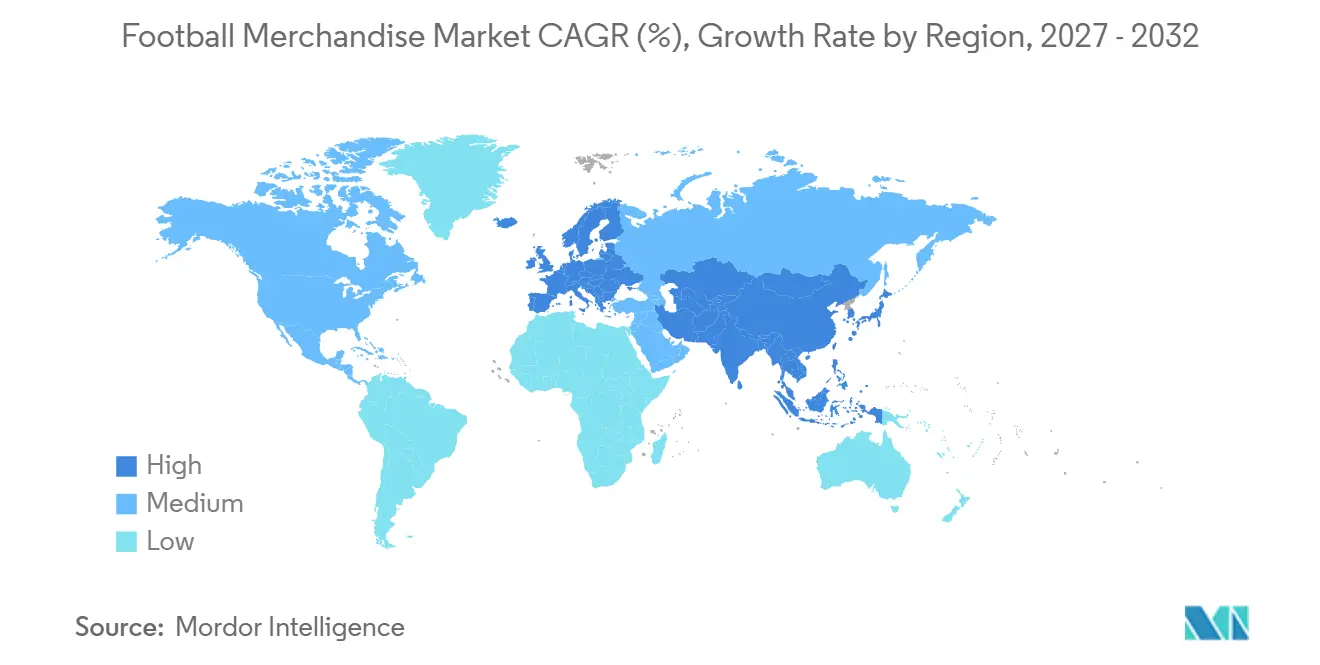
- By geography, Europe held the largest regional share at 37.60% in 2026, while Asia-Pacific is projected to record the fastest growth, with a CAGR of 6.50% through 2032.
Note: Market numbers in this report are based on Mordor Intelligence's proprietary estimation framework, which combines nine months of actuals with Q4 projections for base year 2026.
Market Trends and Insights
Drivers Impact Analysis of Football Merchandise Market*
| DRIVER | (~) % IMPACT ON CAGR FORECAST | GEOGRAPHIC RELEVANCE | IMPACT TIMELINE |
|---|---|---|---|
| Rising global popularity of football clubs and leagues | +1.0% | Global; Europe, South America, and Asia-Pacific | Medium term (2–4 years) |
| Growing demand for football apparel and jerseys | +0.9% | Global; Europe, North America, and Asia-Pacific | Short term (2 years or less) |
| Increasing fan engagement through major football tournaments | +0.8% | Global; Europe, North America, and Asia-Pacific | Short term (2 years or less) |
| Expansion of online retail and e-commerce merchandise sales | +0.7% | Global; Asia-Pacific, Europe, and North America | Medium term (2–4 years) |
| Growing demand for collectible and limited-edition football merchandise | +0.8% | Global; Europe, North America, and Asia-Pacific | Long term (4 years or more) |
| Source: Mordor Intelligence | |||
Rising Global Popularity of Football Clubs and Leagues
The growing global popularity of football clubs and leagues is a key demand driver for the football merchandise market. Strong fan loyalty encourages purchases of official jerseys, club-branded apparel, accessories, and collectibles, while major tournaments create additional opportunities for merchandise launches. Digital retail platforms are extending clubs’ reach beyond domestic markets, making official products more accessible to international supporters. For example, Chelsea FC expanded its partnership with Fanatics in July 2025 to enhance its global e-commerce operations and introduce exclusive merchandise ranges, demonstrating how clubs are leveraging digital retail to strengthen fan engagement and merchandise sales. These developments support demand for licensed products and create opportunities for clubs and retailers to reach wider consumer segments.[1]
Growing Demand for Football Apparel and Jerseys
Demand for football apparel and jerseys is driven by fan loyalty, player popularity, and the regular release of new club kits. Supporters increasingly purchase home, away, and third-kit jerseys, training wear, and personalized apparel to express their affiliation with football teams. Clubs and sportswear manufacturers also use new-season designs, player-name customization, and special-edition collections to encourage repeat purchases. FC Barcelona reported record merchandising performance in the 2024–25 season, identifying e-commerce as a major growth driver following a substantial increase in online sales.[2]Such developments demonstrate how product launches and direct-to-consumer retail can strengthen merchandise demand and extend clubs’ reach to international supporters.
Increasing Fan Engagement Through Major Football Tournaments
Major football tournaments stimulate merchandise demand by intensifying fan engagement and creating opportunities to purchase products associated with national teams, players, and memorable matches. Events such as the FIFA World Cup and UEFA European Championship encourage purchases of team jerseys, scarves, accessories, and commemorative collectibles before and during competitions. Tournament-specific designs and limited-edition products also appeal to supporters seeking souvenirs of significant football moments. FIFA’s official retail operations offer a broad range of licensed merchandise, including replica shirts, accessories, toys, and memorabilia, demonstrating how major tournaments translate fan enthusiasm into commercial opportunities.[3]These event-driven purchases support merchandise sales across online platforms, stadium stores, and other retail channels.
Expansion of Online Retail and E-commerce Merchandise Sales
The expansion of online retail is improving access to football merchandise by enabling supporters to purchase official club products regardless of their geographic location. Official club websites and third-party e-commerce platforms offer jerseys, training apparel, accessories, and collectibles, while personalized recommendations and exclusive online collections encourage purchases. For example, FC Bayern Munich has expanded the international availability of its merchandise through regional partnerships and an online store serving customers across more than 200 countries and regions. Similarly, football clubs are partnering with digital retail specialists to improve product availability, payment options, and delivery services. These developments are helping clubs reach international fan bases, strengthen direct-to-consumer sales, and create additional opportunities for merchandise growth.
Growing Demand for Collectible and Limited-Edition Football Merchandise
Demand for collectible and limited-edition football merchandise is supported by fans seeking exclusive products associated with their favorite clubs, players, and memorable football moments. Special-edition jerseys, signed memorabilia, trading cards, and commemorative collections offer supporters alternatives to standard merchandise and encourage repeat purchases. Clubs and licensed manufacturers use limited releases and distinctive designs to appeal to collectors and strengthen emotional connections with their fan bases. For example, Topps offers official football club collector tins featuring players from teams such as Real Madrid, FC Barcelona, Liverpool, and Bayern Munich. These products demonstrate how licensed collectibles can extend merchandise offerings beyond apparel and attract dedicated football enthusiasts.
Restraints Impact Analysis of Football Merchandise Market*
| RESTRAINT | (~) % IMPACT ON CAGR FORECAST | GEOGRAPHIC RELEVANCE | IMPACT TIMELINE |
|---|---|---|---|
| High Licensing Fees and Royalties for Official Merchandise | −0.7% | Global; particularly Europe and North America, where major football clubs and licensing networks are established | Medium term (2–4 years) |
| Counterfeit Products Undermining Merchandise Sales | −0.8% | Global; Europe, Asia-Pacific, and South America | Long term (4 years or more) |
| Seasonal Demand Fluctuations and Short Product Lifecycles | −0.6% | Global; particularly Europe and South America, where club seasons and major tournaments influence purchasing | Short term (2 years or less) |
| Supply Chain Disruptions and Inventory Management Challenges | −0.5% | Global; particularly Asia-Pacific manufacturing hubs and major consumer markets in Europe and North America | Medium term (2–4 years) |
| Source: Mordor Intelligence | |||
High Licensing Fees and Royalties for Official Merchandise
High licensing fees and royalty obligations can increase the cost of producing and selling officially licensed football merchandise, placing pressure on manufacturers’ and retailers’ profit margins. Agreements with football clubs, leagues, and governing bodies may also include minimum guarantees or other contractual commitments, increasing financial exposure when sales fall below expectations. These costs can make it more difficult for smaller manufacturers to secure official licenses and compete with established licensees that have stronger distribution networks and greater financial resources. Higher licensing-related costs may also limit pricing flexibility, particularly for mass-market products, where consumers are more price-sensitive. As a result, manufacturers may prioritize established, high-volume merchandise over experimental designs and niche product ranges, potentially limiting product variety and restricting participation by smaller businesses.
Counterfeit Products Undermining Merchandise Sales
Counterfeit football merchandise creates competition for officially licensed products by offering unauthorized jerseys, apparel, footwear, and memorabilia through online marketplaces and informal retail channels. These products may use club crests, tournament logos, and protected trademarks without permission, diverting potential purchases from legitimate licensees and weakening the commercial value of official licensing agreements. FIFA identifies counterfeit merchandise as a concern across several product categories and works with customs authorities and law-enforcement agencies to address unauthorized production and sales. Counterfeit products can also expose consumers to inconsistent product quality and undermine confidence in merchandise authenticity. For official licensees, the resulting challenge extends beyond lost sales to the costs of monitoring online platforms, protecting intellectual property, and maintaining consumer trust. These issues can be particularly difficult to manage across international e-commerce channels, where sellers and buyers may be located in different jurisdictions.
*Our forecasts treat driver/restraint impacts as directional, not additive. The impact forecasts reflect baseline growth, mix effects, and variable interactions.
Football Merchandise Market Segment Analysis
By Product Type:
Apparel Leads Demand While Toys and Games ExpandApparel accounted for 49.48% of the Football Merchandise Market in 2026, supported by demand for team jerseys, licensed clothing, and fanwear associated with football clubs and national teams. Jerseys serve both as match-day attire and as everyday clothing that allows supporters to express their affiliation with a club or player. Demand is also supported by the release of new home, away, and third-kit designs, alongside training apparel and other club-branded clothing. Meanwhile, the Toys and Games segment is projected to record the fastest growth, with a CAGR of 6.25% during 2027–2032, reflecting opportunities in football-themed games, miniature player figures, and products designed for younger fans and collectors.
Footwear and accessories provide additional merchandise options, including football-inspired shoes, caps, scarves, bags, and other team-branded products. Other merchandise, such as collectibles and commemorative items, can appeal to dedicated supporters seeking products associated with specific clubs, players, or football events. Across product categories, official licensing helps connect merchandise with established team identities, while online retail channels provide additional opportunities for consumers to access products across markets. Apparel's leading position reflects its broad functional and lifestyle appeal, while the projected growth of toys and games indicates an opportunity to engage younger consumers and broaden merchandise offerings beyond clothing.

By End User:
Adults Dominate Spending While Children Drive GrowthAdults accounted for 82.36% of the Football Merchandise Market in 2026, reflecting demand from football supporters purchasing club jerseys, licensed apparel, footwear, accessories, and collectibles. Adult consumers purchase merchandise to express loyalty to their preferred clubs, national teams, and players, with demand influenced by club identity, kit launches, major tournaments, and player popularity. Merchandise also extends beyond match-day use, as team-branded clothing and accessories can be incorporated into everyday wardrobes. Official online stores, sports retailers, and club merchandise outlets provide established purchasing channels for adult fans.
The children’s segment is projected to be the fastest-growing end-user category, registering a CAGR of 6.91% during 2027–2032. Demand in this segment is supported by opportunities for football-themed toys and games, junior-sized jerseys, children’s apparel, and accessories featuring popular clubs and players. Football merchandise can also appeal to parents and family members purchasing gifts or products linked to children’s interest in the sport. Club-specific products and tournament-related merchandise provide opportunities to engage younger fans, while a wider range of age-appropriate products can help manufacturers reach consumers beyond the adult supporter base.
By Price Range:
Mass-Market Products Lead While Premium Merchandise GrowsMass-market merchandise accounted for 67.12% of the Football Merchandise Market in 2026, reflecting its broad appeal among football supporters seeking accessible, team-branded products. This category includes comparatively affordable jerseys, T-shirts, caps, scarves, accessories, and football-themed toys that enable consumers to express club or national-team loyalty at different spending levels. The availability of products across retail outlets and e-commerce platforms supports accessibility, while a broad price range allows fans to purchase merchandise without necessarily opting for premium or collectible items.
The premium segment is projected to grow at a CAGR of 6.65% during 2027–2032. Demand in this category can be supported by authentic match-quality jerseys, limited-edition collections, personalized merchandise, commemorative products, and collectibles associated with prominent clubs, players, and tournaments. Product exclusivity, specialized designs, and perceived authenticity can differentiate premium merchandise from standard licensed products. Official club stores and online channels can also facilitate access to exclusive releases. While mass-market merchandise benefits from a wider potential customer base, premium products offer opportunities to serve dedicated supporters and collectors seeking distinctive merchandise.
By Distribution Channel:
Offline Retail Leads While Online Sales ExpandOffline retail stores accounted for 61.52% of the Football Merchandise Market in 2026, supported by the availability of licensed products through sports retailers, department stores, specialist football shops, and club merchandise outlets. Physical stores allow consumers to inspect product quality, compare sizes, and assess apparel designs before purchasing. Retail outlets located near stadiums and at football-related events can also serve supporters seeking team jerseys, scarves, caps, and commemorative merchandise. These channels provide direct access to products and can benefit from increased consumer interest around club matches and major tournaments.
Online retail stores are projected to record a CAGR of 6.10% during 2027–2032. E-commerce platforms and official club stores enable fans to purchase merchandise beyond their local markets, including products linked to international teams and leagues. Online channels also support access to a broader selection of sizes, designs, personalized products, and limited-edition releases. Product discovery through digital marketing and social media can further connect supporters with merchandise launches and club collections. Although offline stores retain an important role in product discovery and physical evaluation, online retail offers opportunities to expand geographic reach and improve access to specialized and officially licensed football merchandise.
Geography Analysis
Europe Football Merchandise Market
Europe accounted for 37.60% of the Football Merchandise Market in 2026, making it the largest regional market. The region’s position is supported by football’s established fan culture and the presence of prominent domestic leagues, clubs, and national teams that sustain demand for official jerseys, licensed apparel, accessories, and collectibles. Merchandise purchases are associated with club loyalty, new-season kit launches, player popularity, and major competitions. Established retail networks, stadium shops, and official online club stores provide multiple channels through which supporters can access licensed products. However, the region’s established market structure also requires brands and retailers to differentiate their offerings through product design, exclusive collections, and consumer experiences. Official licensing and product authenticity remain important considerations for businesses seeking to serve European football supporters.
APAC Football Merchandise Market
Asia-Pacific is projected to be the fastest-growing regional market, with a CAGR of 6.50% during 2027–2032. Growth opportunities are supported by the region’s large consumer base, interest in international football competitions, and increasing access to digital platforms through which fans can follow clubs and purchase merchandise. Online stores and cross-border e-commerce can improve access to officially licensed jerseys, apparel, and collectibles from European leagues and other international competitions. Demand can also benefit from merchandise associated with national teams, regional football competitions, and prominent players. Differences in purchasing power across countries create opportunities for both mass-market and premium products. For market participants, expanding digital distribution and offering merchandise suited to local consumer preferences can help strengthen engagement with football supporters across the region.
The Americas and MEA Football Merchandise Market
North America benefits from established sports retail infrastructure, e-commerce penetration, and demand for merchandise associated with international football clubs, national teams, and major tournaments. Football merchandise competes within a broader licensed sports-products environment, creating opportunities for apparel, accessories, and collectibles distributed through specialist retailers and online stores. South America has a strong football-supporter culture, particularly in countries such as Brazil and Argentina, where club and national-team identities can support demand for jerseys, scarves, and other licensed products. Merchandise sales may also fluctuate with international tournaments, club performance, and player popularity. Meanwhile, the Middle East and Africa present opportunities to expand access to official football merchandise through digital retail, organized sports retail, and products associated with prominent international clubs and competitions. Across these regions, product affordability, distribution reach, and access to authentic licensed merchandise remain relevant considerations for market participants.
Competitive Landscape
The Football Merchandise Market features competition among sportswear brands, football clubs, official licensees, specialist merchandise retailers, and manufacturers of collectibles and fan products. Market participants compete through licensing agreements, product authenticity, brand recognition, distribution reach, exclusive collections, and partnerships with football clubs and governing bodies. Official club stores and e-commerce platforms provide routes to consumers, while sports retailers and specialist merchandise outlets support physical distribution. The competitive environment spans apparel, footwear, accessories, toys and games, and other football-related products, with different companies focusing on specific product categories and consumer groups.
Product launches and licensing partnerships are important competitive strategies, particularly for manufacturers seeking to capitalize on major tournaments, new-season kit releases, and demand for club-branded merchandise. Apparel suppliers compete through design, product quality, team affiliations, and the availability of different kit versions, while collectible-focused businesses target fans seeking miniature figures, trading cards, memorabilia, and limited-edition products. Online retail also allows brands and licensees to reach international supporters and offer specialized products beyond their domestic markets.
The market accommodates both mass-market and premium positioning. Mass-market products serve consumers seeking affordable ways to demonstrate football allegiance, whereas premium merchandise targets dedicated supporters and collectors through authentic jerseys, exclusive designs, and commemorative releases. Counterfeit products, licensing costs, inventory risks, and changing consumer preferences remain important competitive challenges. Companies that manage official licensing, product availability, channel reach, and differentiated merchandise offerings are better positioned to address varied consumer needs across regions.
Football Merchandise Industry Leaders
-
Fanatics, Inc.
-
Nike, Inc.
-
adidas AG
-
PUMA SE
-
DICK'S Sporting Goods, Inc.
- *Disclaimer: Major Players sorted in no particular order
Football Merchandise Market Companies Covered in this Report
- Mattel Inc.
- Hasbro Inc.
- Spin Master Corp.
- MGA Entertainment Inc.
- TOMY Company, Ltd.
- Simba Dickie Group
- ZURU Ltd.
- Moose Toys
- Jakks Pacific Inc.
- Jazwares LLC
- Little Tikes (MGA Entertainment)
- Radio Flyer Inc.
- Step2 Company LLC
- Kettler International Inc.
- Intex Recreation Corp.
- Bestway Group
- Plum Products Ltd.
- TP Toys
- BIG-Spielwarenfabrik (Simba Dickie Group)
- Decathlon SE
Recent Industry Developments in Football Merchandise Market
- July 2026: Major League Soccer (MLS) and Avery Dennison extended their licensing agreement covering names, numbers, and jersey-sleeve logos for the league’s 30 clubs. The agreement supports jersey customization across matchday and retail operations, highlighting the role of personalized merchandise and product-identification technology in strengthening fan engagement.
- June 2026: Superdry launched its FIFA Official Licensed Products Collection in India ahead of the FIFA World Cup 2026. The limited-edition collection includes seven country-inspired jerseys and a football-themed athleisure range, combining national-team identity with lifestyle fashion. Products are available through Superdry stores, selected retail partners, its website, and Ajio.
- May 2026: FIFA and Fanatics expanded their commercial relationship through an exclusive long-term licensing agreement covering physical and digital collectibles, including trading cards, stickers, and trading card games. The agreement is scheduled to take full effect in 2031 and introduces a player jersey-patch programme for football trading cards, strengthening opportunities in football collectibles.
- May 2026: The Football Association (FA) and Fanatics announced an exclusive licensing agreement for trading cards, stickers, and trading card games featuring England’s men’s and women’s national teams. Beginning in 2031, the agreement will enable Topps to produce licensed products featuring team branding and player imagery, expanding the official collectibles category.
Global Football Merchandise Market Report Scope
The Football Merchandise Market comprises officially licensed products associated with football clubs, national teams, leagues, players, and tournaments, including apparel, footwear, toys and games, accessories, and other merchandise sold through physical and digital retail channels. The market is segmented by product type into apparel, footwear, toys and games, accessories, and other merchandise. By end user, it is divided into adults and children. By price range, the market covers mass-market and premium merchandise. By distribution channel, it includes online retail stores and offline retail stores. Geographically, the market spans North America, Europe, Asia-Pacific, South America, and the Middle East and Africa, with further country-level segmentation within each region. Market sizing is presented in value terms in USD across the aforementioned segments.
Segmentation Overview
| Apparel |
| Footwear |
| Toys and Games |
| Accessories |
| Other Merchandise |
| Adults |
| Children |
| Mass |
| Premium |
| Online Retail Stores |
| Offline Retail stores |
| North America | United States |
| Canada | |
| Mexico | |
| Rest of North America | |
| Europe | United Kingdom |
| Germany | |
| France | |
| Italy | |
| Spain | |
| Sweden | |
| Belgium | |
| Poland | |
| Netherlands | |
| Rest of Europe | |
| Asia-Pacific | China |
| Japan | |
| India | |
| Thailand | |
| Singapore | |
| Indonesia | |
| South Korea | |
| Australia | |
| Rest of Asia-Pacific | |
| South America | Brazil |
| Argentina | |
| Colombia | |
| Peru | |
| Chile | |
| Rest of South America | |
| Middle East and Africa | South Africa |
| Saudi Arabia | |
| United Arab Emirates | |
| Nigeria | |
| Egypt | |
| Morocco | |
| Turkey | |
| Rest of Middle East and Africa |
| By Product Type | Apparel | |
| Footwear | ||
| Toys and Games | ||
| Accessories | ||
| Other Merchandise | ||
| By End User | Adults | |
| Children | ||
| By Price Range | Mass | |
| Premium | ||
| By Distribution Channel | Online Retail Stores | |
| Offline Retail stores | ||
| By Geography | North America | United States |
| Canada | ||
| Mexico | ||
| Rest of North America | ||
| Europe | United Kingdom | |
| Germany | ||
| France | ||
| Italy | ||
| Spain | ||
| Sweden | ||
| Belgium | ||
| Poland | ||
| Netherlands | ||
| Rest of Europe | ||
| Asia-Pacific | China | |
| Japan | ||
| India | ||
| Thailand | ||
| Singapore | ||
| Indonesia | ||
| South Korea | ||
| Australia | ||
| Rest of Asia-Pacific | ||
| South America | Brazil | |
| Argentina | ||
| Colombia | ||
| Peru | ||
| Chile | ||
| Rest of South America | ||
| Middle East and Africa | South Africa | |
| Saudi Arabia | ||
| United Arab Emirates | ||
| Nigeria | ||
| Egypt | ||
| Morocco | ||
| Turkey | ||
| Rest of Middle East and Africa | ||
Key Questions Answered in the Report
What is the size of the Football Merchandise Market?
The Football Merchandise Market is projected to grow from USD 15.04 billion in 2026 and USD 16.92 billion in 2027 to USD 22.82 billion by 2032.
Which product segment holds the largest share of the Football Merchandise Market?
Apparel is the largest product segment, accounting for 49.48% of the Football Merchandise Market in 2026.
Which region dominates the Football Merchandise Market?
Europe is the leading regional market, accounting for 37.60% of the Football Merchandise Market in 2026.
Which segment is expected to grow the fastest in the Football Merchandise Market?
The toys and games segment is projected to be the fastest-growing product segment, registering a CAGR of 6.25% during 2027–2032.