
Food Processing Automation Market Size and Share
Market Overview
| Study Period | 2019 - 2030 |
|---|---|
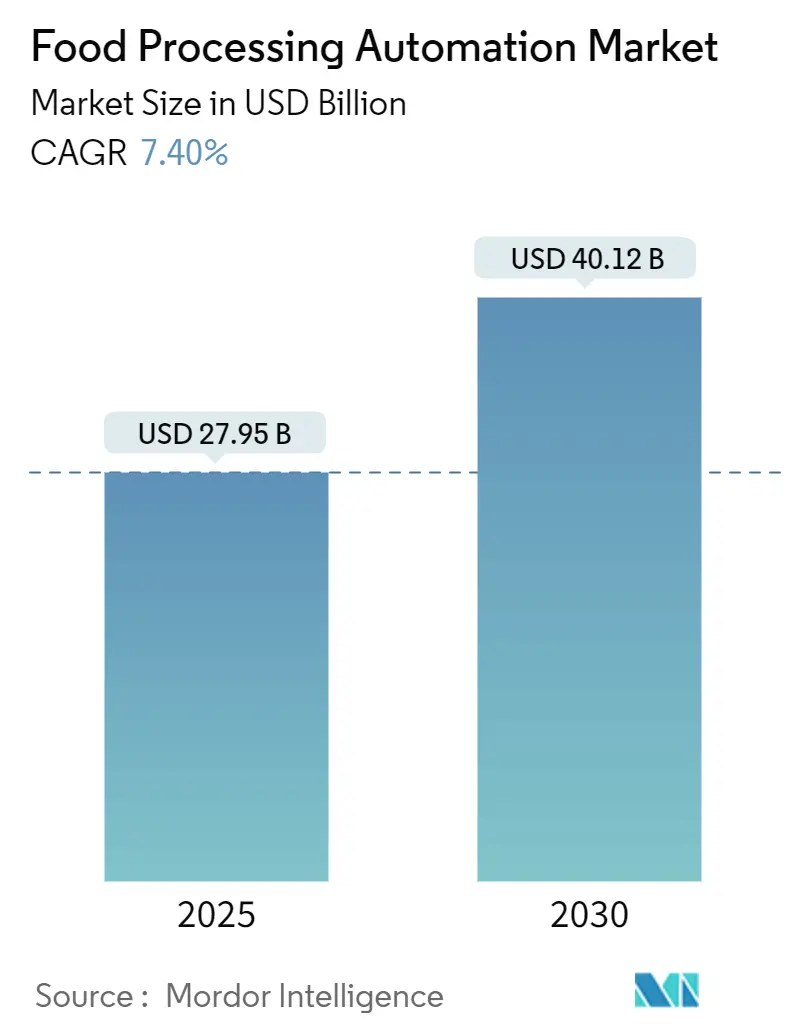
| Market Size (2025) | USD 27.95 Billion |
| Market Size (2030) | USD 40.12 Billion |
| Growth Rate (2025 - 2030) | 7.40 % |
| Fastest Growing Market | South America |
| Largest Market | Asia Pacific |
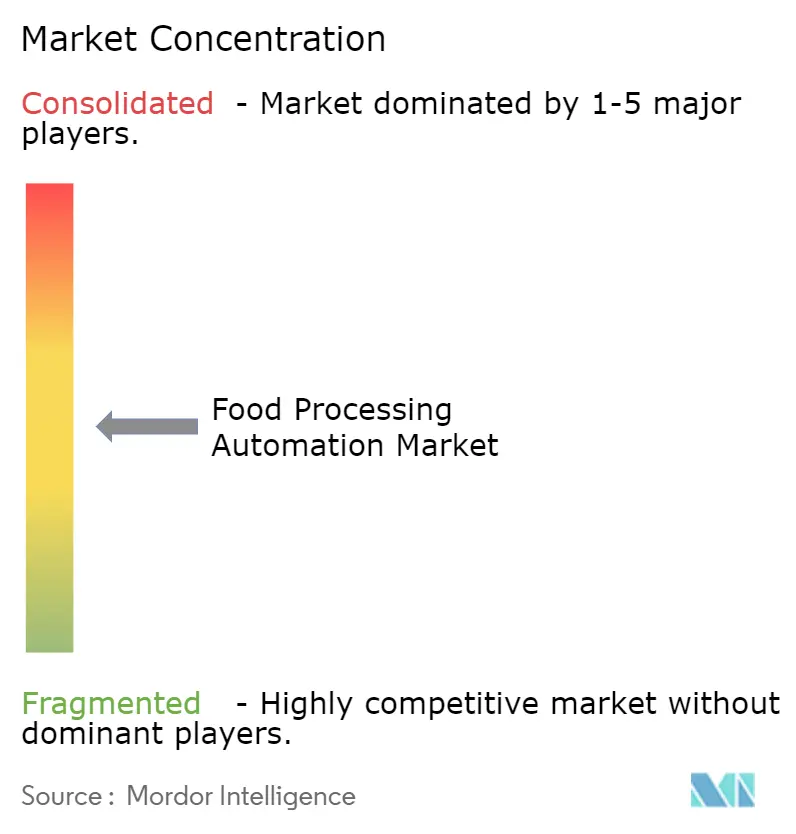
| Market Concentration | Medium |
Major Players *Disclaimer: Major Players sorted in no particular order Image © Mordor Intelligence. Reuse requires attribution under CC BY 4.0. | |
Food Processing Automation Market Analysis by Mordor Intelligence
The Food Processing Automation Market size was valued at USD 27.95 billion in 2025 and is forecast to reach USD 40.12 billion by 2030, reflecting a 7.49% CAGR. This expansion stemmed from escalating labor shortages, tighter global food-safety rules, and the push for lean, energy-efficient production. Roughly 48% of capital spending by large food manufacturers in 2025 flowed toward new or upgraded automation projects, signifying a decisive move from isolated machinery toward connected, data-driven lines. The food-grade robotics boom, the proliferation of real-time OEE dashboards, and widespread cloud adoption further accelerated uptake. Providers that bundled hardware, software, and compliance services captured rising demand for turnkey solutions.
Key Report Takeaways
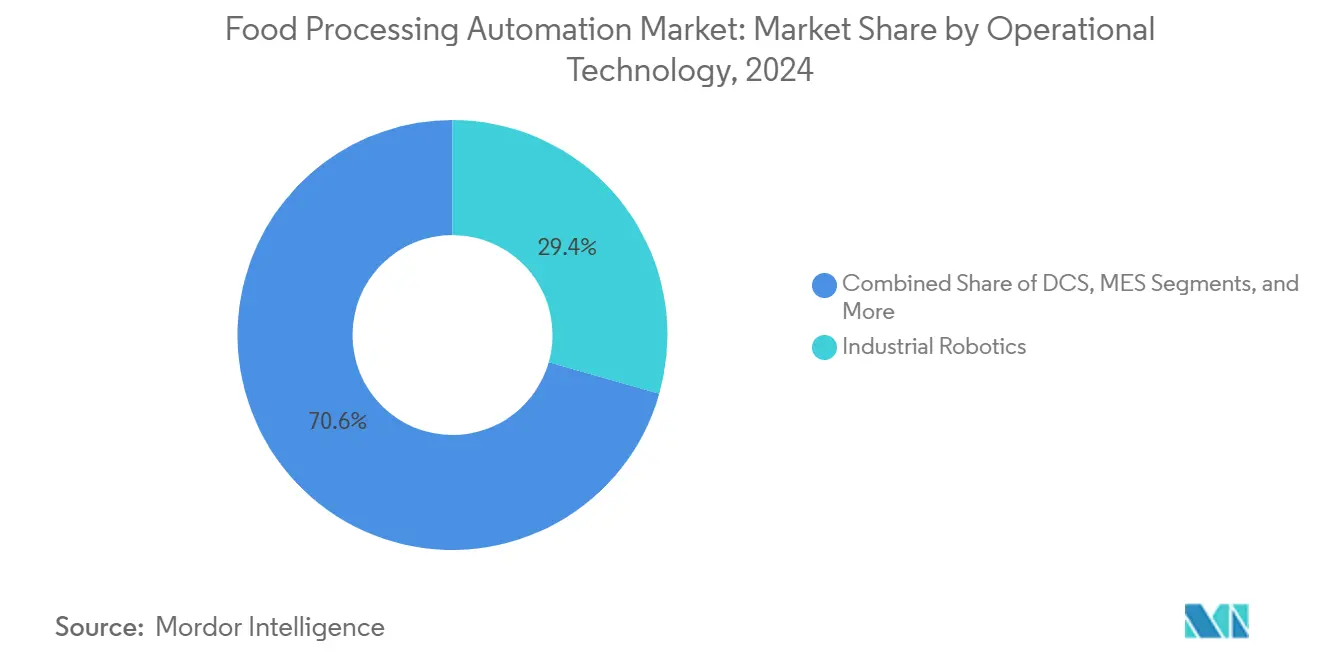
- By operational technology and software, industrial robotics led with 29.4% revenue share in 2024; the same segment is projected to expand at a 9.8% CAGR through 2030.
- By component, hardware commanded 67.3% of the food processing automation market size in 2024, while software and services record the highest projected CAGR at 10.5% through 2030.
- By end-user, meat, poultry and seafood processing accounted for 26.3% of the food processing automation market share in 2024; fruit and vegetable processing is forecast to advance at 9.2% CAGR to 2030.
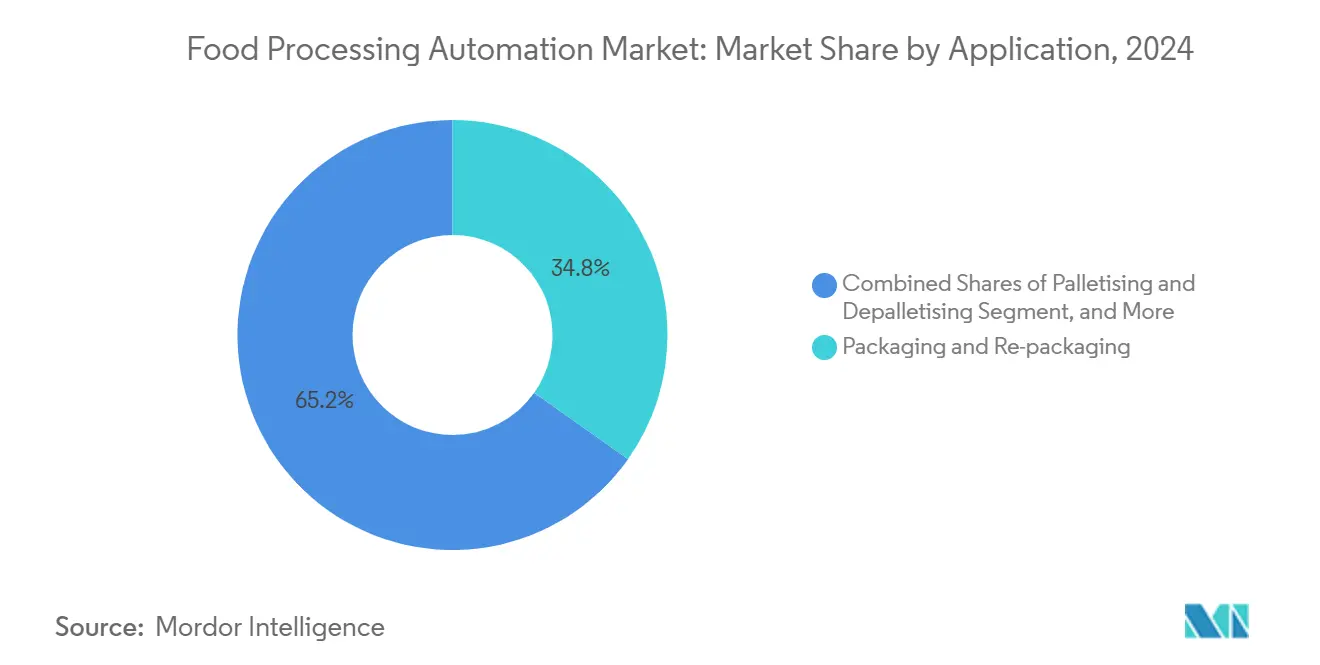
- By application, packaging and re-packaging held 34.8% of the food processing automation market size in 2024, whereas palletising and depalletising is set to grow at 11.6% CAGR through 2030.
- By automation level, semi-automatic lines captured 60.1% share in 2024; fully-automatic lines are projected to expand at 8.1% CAGR to 2030.
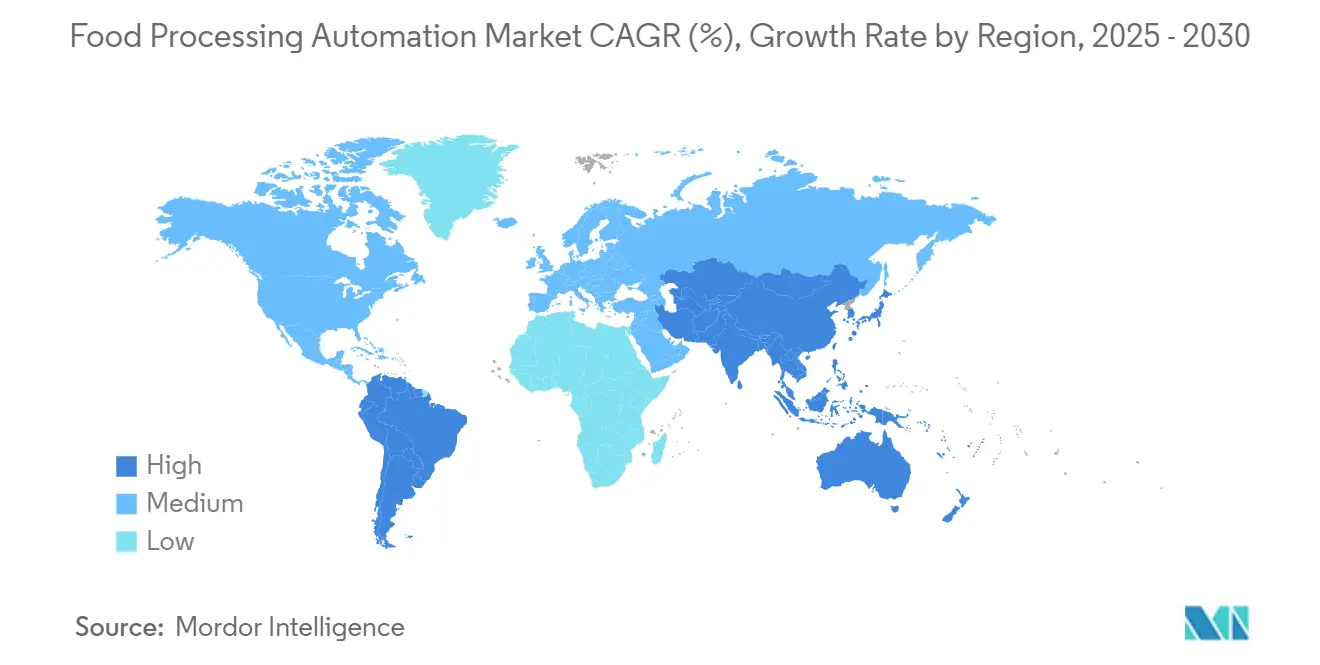
- By geography, Asia-Pacific dominated with 38.7% revenue share in 2024, while South America is projected to post the fastest 9.7% CAGR to 2030.
Global Food Processing Automation Market Trends and Insights
Drivers Impact Analysis*
| Driver | (~) % Impact on CAGR Forecast | Geographic Relevance | Impact Timeline |
|---|---|---|---|
| Digitisation of HACCP-compliant traceability | +1.2% | Global, early adoption in North America and EU | Medium term (2-4 years) |
| Adoption of hygienic, wash-down-ready robotics | +1.8% | Global, particularly strong in Asia-Pacific | Short term (≤ 2 years) |
| Surge in ready-to-eat meal demand post-pandemic | +1.1% | North America and Europe core, expanding to Asia-Pacific | Medium term (2-4 years) |
| Workforce shortages accelerating “lights-out” plants | +2.1% | Global, most acute in developed markets | Short term (≤ 2 years) |
| Real-time OEE analytics lowering downtime | +0.9% | Global, advanced implementations in North America | Medium term (2-4 years) |
| ESG-driven energy-efficient line retrofits | +0.8% | Europe and North America leading, expanding globally | Long term (≥ 4 years) |
| Source: Mordor Intelligence | |||
Digitisation of HACCP-compliant traceability
Digital traceability platforms replaced manual logs by linking IoT sensors, blockchain databases, and cloud dashboards that captured cooking temperatures, lot codes, and supplier credentials in real time. These systems cut average recall response from weeks to hours and prepared processors for FDA traceability mandates effective January 2026. Large buyers adopted them to lower insurance premiums and protect brand equity, creating new revenue streams for automation integrators that offered end-to-end compliance packages.
Adoption of hygienic, wash-down-ready robotics
Food-grade robots, boasting IP69K housings and corrosion-proof surfaces, have successfully automated zones once considered off-limits, including moist, chilled, and high-pressure wash-down areas. These robots, using food-safe lubricants, have led to significant advancements in the industry. Notably, in cheese and dairy cutting deployments, waste was reduced by an impressive 83%. Furthermore, medium-sized plants frequently saw returns on investment (ROI) in under 18 months.[1]KUKA AG, “Automated Cheese Processing,” kuka.com
Surge in ready-to-eat (RTE) meal demand
RTE lines adeptly managed delicate ingredients, navigated multiple temperature zones, and accommodated frequent recipe changes. With AI guidance, robots dynamically adjusted gripper force and placement paths, automating the assembly of over 40 million meals for major meal-kit brands. This innovation garnered a notable USD 43.1 million in venture funding, projected by early 2025, highlighting the growing demand for automation in the food processing industry.
Workforce shortages accelerating “lights-out” plants
In 2024, manufacturers grappled with over 615,000 unfilled positions, compelling many to run third shifts with scant staff and limited resources. Pioneering firms that integrated digital twins with contemporary MES platforms enabled remote supervisors to boost throughput, fine-tune predictive maintenance, and realize an impressive 64% cut in expensive downtime.
Restraints Impact Analysis*
| Restraint | (~) % Impact on CAGR Forecast | Geographic Relevance | Impact Timeline |
|---|---|---|---|
| High up-front CAPEX for retrofit brown-field sites | -1.5% | Global, particularly acute in emerging markets | Short term (≤ 2 years) |
| Cyber-security vulnerabilities in legacy SCADA | -0.8% | Global, most critical in developed markets | Medium term (2-4 years) |
| Low ROI in price-sensitive emerging markets | -1.2% | Asia-Pacific emerging economies, Africa, Latin America | Medium term (2-4 years) |
| Skills gap in OT-IT convergence | -0.9% | Global, acute shortages in North America and Europe | Long term (≥ 4 years) |
| Source: Mordor Intelligence | |||
High up-front CAPEX for retrofit brown-field sites
Retrofits often cost 40-60% more than new-build installations because lines must stay partially operational, utilities must be relocated, and legacy PLCs need custom gateways. RaaS contracts and modular cells that slide into existing layouts began to ease the burden, yet finance teams in small plants still viewed payback windows cautiously.[2]Food Engineering, “Cybersecurity Vulnerabilities Increasing at the Operations Technology Level,” foodengineeringmag.com
Cybersecurity vulnerabilities in legacy SCADA
Seventy-three publicly reported ransomware attacks targeted global food processors in 2023 alone. Outdated PLC firmware lacked encryption or role-based access, exposing recipes, batch schedules, and even CIP valves to malicious actors. Vendors expanded zero-trust service tiers, and some insurers mandated annual penetration testing before renewing premiums.[3]ABB, “Cyber Security in Food and Beverage Industry,” new.abb.com
*Our forecasts treat driver/restraint impacts as directional, not additive. The impact forecasts reflect baseline growth, mix effects, and variable interactions.
Segment Analysis
By Operational Technology: Industrial Robotics Drives Innovation
Industrial Robotics contributed USD 8.22 billion to the Food processing automation market size in 2024 and is projected to grow at a 9.8% CAGR. Installations spanned primary cutting, pick-and-place, and case packing. AI-vision upgrades allowed grippers to adjust in milliseconds to irregular produce, boosting first-pass yield. Distributed Control Systems remained essential for dairy pasteurization and brewing, providing deterministic control over temperature-sensitive stages. MES adoption climbed as processors synchronized shop-floor data with ERP suites to streamline audit queries and allergen control.
Meanwhile, VFD retrofits cut conveyor energy draw by up to 25%, prompting utility rebate programs in Europe. Continuous sensor miniaturization pushed decision logic to the edge, letting production cells self-optimize without waiting for cloud feedback. Even with robotics dominance, manufacturers layered multiple technologies to maximize uptime. A protein plant might feed vision-guided robots through a DCS buffer, log KPIs into MES, and fine-tune motor torque via VFDs, illustrating platform convergence across the Food processing automation market.



By Component: Hardware Dominance with Software Acceleration
Hardware retained 67.3% revenue share in 2024 because processors still needed stainless servo actuators, wash-down robots, and sealed motors before digital analytics could add value. However, software and services grew 10.5% annually as users demanded predictive maintenance dashboards, cloud MES subscriptions, and 24/7 cyber-monitoring.
Smart cameras embedded neural inference chips, while robotics OEMs bundled SaaS licenses that delivered firmware updates and AI models over-the-air. Managed cybersecurity, regulatory reporting, and energy-optimization contracts expanded margins beyond the one-time equipment sale. As a result, integrated offerings blurred the line between physical assets and code, reshaping vendor revenue streams throughout the Food processing automation market.
By End-User: Meat Processing Leads, Produce Accelerates
Meat, poultry and seafood plants represented USD 7.35 billion of the Food processing automation market size in 2024, benefitting from blade-tracking robots that portioned cuts with millimetric precision while meeting stringent hygiene. Robots replaced up to 80 manual cutters per line and drove consistent yields in high-throughput plants.
Fruit and vegetable processors posted the highest 9.2% CAGR thanks to hyperspectral grading that identified ripeness and surface bruising invisible to workers, reducing trim waste by over one-third. Dairy, bakery, and beverage facilities quietly expanded automation footprints as real-time analytics cut off-spec volumes and water use. Collectively, multi-industry traction affirmed broad applicability of advanced controls across the Food processing automation market.
By Application: Packaging Dominates, Palletising Accelerates
Packaging and re-packaging systems delivered 34.8% of 2024 revenue, driven by demand for tamper-evident films, recyclable materials, and dynamic label printing. At 600 packages per minute, high-speed cartoners relied on servo synchronization and inline inspection cameras to catch seal defects instantly. Palletising and depalletising grew fastest at 10.6% CAGR as e-commerce and SKU proliferation required flexible pallet patterns.
Vision-guided robotic arms stacked mixed cases without slipsheets, minimizing warehouse labor. Sorting, grading, and upstream processing cells continued to adopt AI-enabled sensors to verify color, density, and foreign-matter contamination, extending intelligent decision-making across the Food processing automation market.
By Automation Level: Semi-Automatic Leads, Fully-Automatic Gains
Semi-automatic lines commanded a 60.1% market share, as processors increasingly preferred a synergy of human finesse and robotic precision. While operators focused on the final inspection, robots efficiently managed the repetitive heavy lifting tasks.
Fully-automatic alternatives registered a 8.1% CAGR as line-integrated cameras and self-learning PLCs enabled continuous operation with minimal oversight. Digital twin simulations cut commissioning times, enabling brown-field plants to switch from three crews to a single day crew that supervised several lights-out cells remotely. The progressive migration illustrated an industry arc toward autonomy within the Food processing automation market.
Geography Analysis
Asia-Pacific maintained leadership with 38.7% revenue share in 2024, underpinned by China’s food-safety rule tightening and wage inflation that accelerated robotics adoption in meat deboning, dairy filling, and snack packaging. Japanese OEMs exported food-grade robots across the region, reinforcing a dense support ecosystem. Indian processors modernized fruit sorting and spice grinding lines through government automation incentives.
South America registered an 9.7% CAGR outlook. Brazilian meatpackers retrofitted chilled rooms with hygienic robots to meet EU import standards, while sugar mills installed MES and VFDs to cut energy consumption. Investments rippled into Argentina and Chile where produce exporters automated washing and grading to secure new shelf-life-sensitive markets.
North America’s mature installed base focused on AI retrofits and cybersecurity hardening. RTE meal producers in urban corridors adopted cobots to meet convenience-food demand spikes. European processors pushed ESG goals, adding high-efficiency drives and water-recapture skid packages. The Middle East and parts of Africa initiated palm-date and dairy modernisation programs, showing rising but uneven penetration in the global Food processing automation market.

Competitive Landscape
The competitive terrain remained moderately fragmented. Global automation majors ABB, Siemens, Rockwell Automation, Emerson leveraged broad portfolios, lifecycle services, and cybersecurity suites. Sector specialists Marel, JBT, Tetra Pak focused on protein, aseptic, or packaging niches and deep process expertise.
JBT sealed a USD 3.5 billion acquisition of Marel in January 2025, creating a platform covering poultry evisceration to high-pressure pasteurisation. Start-ups such as Chef Robotics and Sojo Industries captured meal-kit assembly and mobile packaging projects via Robotics-as-a-Service pricing. Technology differentiation centered on on-board AI, edge analytics, and blockchain traceability plug-ins.
Vendors sought partnerships with cloud hyperscalers to align OT data with enterprise planning. Small and mid-size plants represented untapped white space, spurring modular cells that shipped pre-wired, slashing installation days. Collectively, these moves intensified innovation and price competition throughout the Food processing automation market.
Food Processing Automation Industry Leaders
Schneider Electric SE
Rockwell Automation Inc.
Honeywell International Inc.
Emerson Electric Company
ABB Limited
- *Disclaimer: Major Players sorted in no particular order

Recent Industry Developments
- June 2025: Cargill committed USD 90 million to robotic deboning and vision inspection at its Colorado beef plant, targeting higher yield and lower trim waste.
- June 2025: Sojo Industries closed USD 40 million Series B funding to scale its blockchain-enabled mobile packaging line.
- May 2025: ProMach acquired DJS Systems, expanding flexible packaging automation capabilities.
- March 2025: Chef Robotics raised USD 43.1 million Series A to broaden AI-robot deployment for meal assembly.


Global Food Processing Automation Market Report Scope
The Food Processing Automation Market Report Is Segmented by Operational Technology and Software (Distributed Control Systems (DCS), Manufacturing Execution Systems (MES), Variable-Frequency Drives (VFD), Valves and Actuators, Electric Motors, Sensors and Transmitters, Industrial Robotics, and Other Technologies), Component (Hardware and Software & Services), End-User (Dairy Processing, Bakery and Confectionery, Meat, Poultry and Seafood, Fruit and Vegetable Processing, Beverage Manufacturing, and Other End-Users), Application (Packaging and Re-Packaging, Palletising and Depalletising, Sorting and Grading, Primary and Secondary Processing, and Other Applications), Automation Level (Fully-Automatic Lines and Semi-Automatic Lines), and Geography (North America, South America, Europe, Asia-Pacific, Middle East, and Africa).
| Distributed Control Systems (DCS) |
| Manufacturing Execution Systems (MES) |
| Variable-Frequency Drives (VFD) |
| Valves and Actuators |
| Electric Motors |
| Sensors and Transmitters |
| Industrial Robotics |
| Other Operational Technologies |
| Hardware |
| Software and Services |
| Dairy Processing |
| Bakery and Confectionery |
| Meat, Poultry and Seafood |
| Fruit and Vegetable Processing |
| Beverage Manufacturing |
| Other End-Users |
| Packaging and Re-packaging |
| Palletising and Depalletising |
| Sorting and Grading |
| Primary and Secondary Processing |
| Other Applications |
| Fully-Automatic Lines |
| Semi-Automatic Lines |
| North America | United States | |
| Canada | ||
| Mexico | ||
| South America | Brazil | |
| Argentina | ||
| Rest of South America | ||
| Europe | Germany | |
| United Kingdom | ||
| France | ||
| Italy | ||
| Russia | ||
| Rest of Europe | ||
| Asia-Pacific | China | |
| Japan | ||
| South Korea | ||
| India | ||
| ASEAN | ||
| Rest of Asia-Pacific | ||
| Middle East and Africa | Middle East | Saudi Arabia |
| United Arab Emirates | ||
| Turkey | ||
| Rest of Middle East | ||
| Africa | South Africa | |
| Nigeria | ||
| Rest of Africa | ||
| By Operational Technology | Distributed Control Systems (DCS) | ||
| Manufacturing Execution Systems (MES) | |||
| Variable-Frequency Drives (VFD) | |||
| Valves and Actuators | |||
| Electric Motors | |||
| Sensors and Transmitters | |||
| Industrial Robotics | |||
| Other Operational Technologies | |||
| By Component | Hardware | ||
| Software and Services | |||
| By End-User | Dairy Processing | ||
| Bakery and Confectionery | |||
| Meat, Poultry and Seafood | |||
| Fruit and Vegetable Processing | |||
| Beverage Manufacturing | |||
| Other End-Users | |||
| By Application | Packaging and Re-packaging | ||
| Palletising and Depalletising | |||
| Sorting and Grading | |||
| Primary and Secondary Processing | |||
| Other Applications | |||
| By Automation Level | Fully-Automatic Lines | ||
| Semi-Automatic Lines | |||
| By Geography | North America | United States | |
| Canada | |||
| Mexico | |||
| South America | Brazil | ||
| Argentina | |||
| Rest of South America | |||
| Europe | Germany | ||
| United Kingdom | |||
| France | |||
| Italy | |||
| Russia | |||
| Rest of Europe | |||
| Asia-Pacific | China | ||
| Japan | |||
| South Korea | |||
| India | |||
| ASEAN | |||
| Rest of Asia-Pacific | |||
| Middle East and Africa | Middle East | Saudi Arabia | |
| United Arab Emirates | |||
| Turkey | |||
| Rest of Middle East | |||
| Africa | South Africa | ||
| Nigeria | |||
| Rest of Africa | |||


Key Questions Answered in the Report
What is the current value of the Food processing automation market?
The market stood at USD 27.95 billion in 2025.
How fast is the Food processing automation market expected to grow?
It is projected to register a 7.49% CAGR and reach USD 40.12 billion by 2030.
Which operational technology segment leads the Food processing automation market?
Industrial Robotics held 29.4% revenue share in 2024 and is also the fastest-growing segment at a 9.8% CAGR.
Why are processors investing in fully automatic lines?
Persistent labor shortages, predictive maintenance tools, and rapid payback periods are driving a 8.1% CAGR for fully automatic installations.
Page last updated on:





