
Flavored Powder Drinks Market Size and Share
Market Overview
| Study Period | 2021 - 2031 |
|---|---|
| Market Size (2026) | USD 78.56 Billion |
| Market Size (2031) | USD 92.61 Billion |
| Growth Rate (2026 - 2031) | 3.35 % |
| Fastest Growing Market | Asia-Pacific |
| Largest Market | Asia-Pacific |
| Market Concentration | Medium |
Major Players *Disclaimer: Major Players sorted in no particular order Image © Mordor Intelligence. Reuse requires attribution under CC BY 4.0. | |
Flavored Powder Drinks Market Analysis by Mordor Intelligence
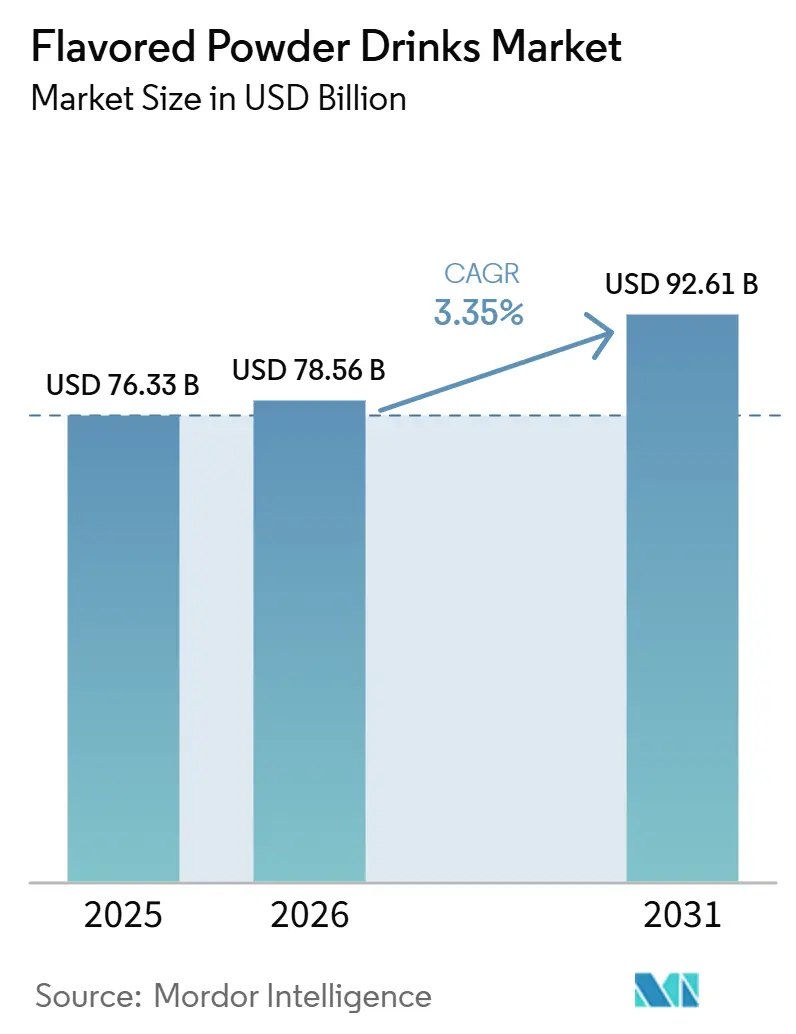
The flavored powder drinks market size is expected to grow from USD 76.33 billion in 2025 to USD 78.56 billion in 2026 and is forecast to reach USD 92.61 billion by 2031 at 3.35% CAGR over 2026-2031. The flavored powder drinks market benefits from ambient storage, lower shipping weight, and a long shelf life compared with ready-to-drink products. These characteristics make the format suitable for online fulfillment and for households that want a lower cost per serving. Large beverage companies are extending established brands into powdered formats, which brings more investment to the category. Demand is also moving toward products that provide clearer portions, functional ingredients, and lower sugar content. The flavored powder drinks market is therefore competing for occasions once served mainly by bottled beverages.
Key Report Takeaways
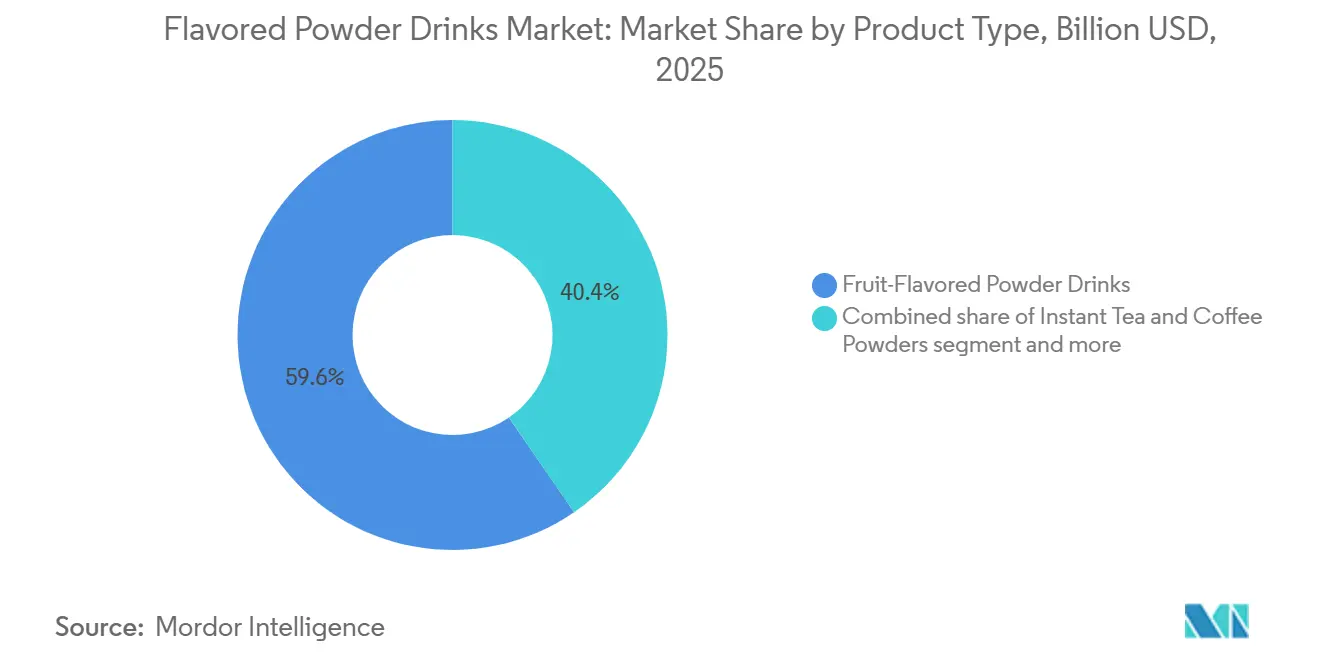
- By product type, fruit-flavored drinks held 59.56% of the flavored powder drinks market share in 2025, while functional and wellness drink powders are forecast to grow at a 4.761% CAGR through 2031.
- By flavor, citrus held 25.71% of revenue in 2025, while tropical flavors are forecast to grow at a 4.89% CAGR through 2031.
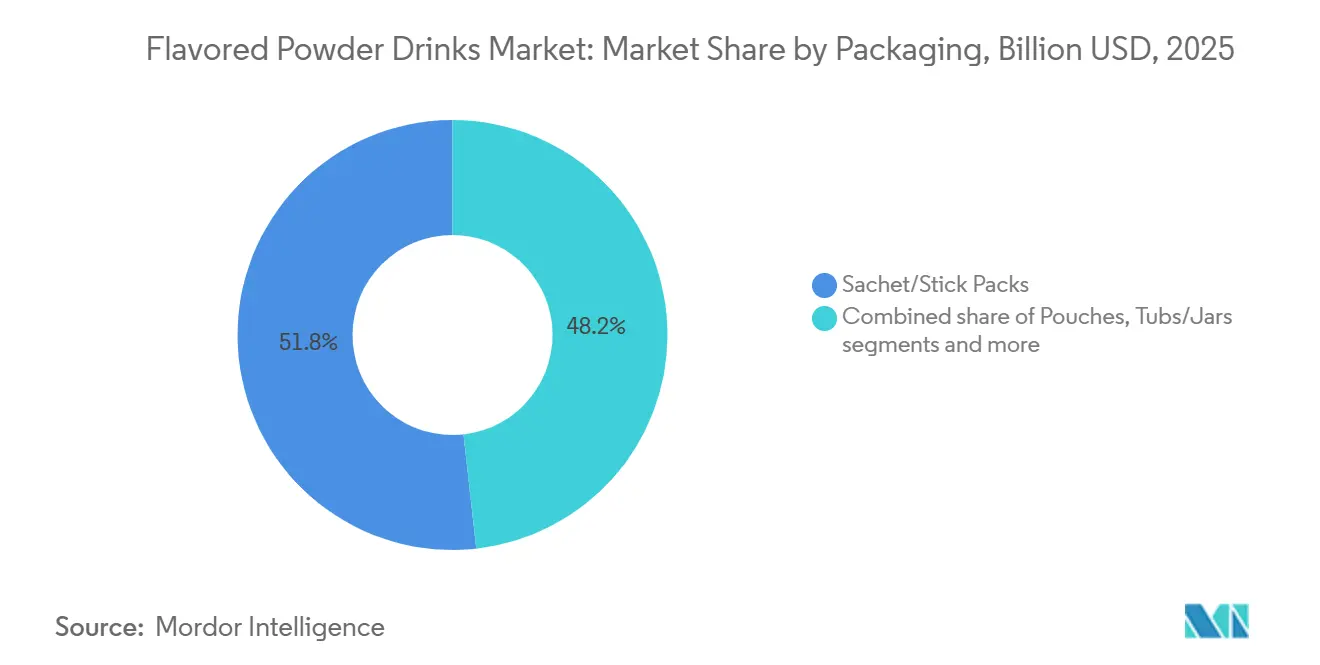
- By packaging, sachets and stick packs held 51.77% of packaging volume in 2025, while pouches are forecast to grow at a 5.06% CAGR through 2031.
- By distribution channel, supermarkets and hypermarkets held 41.85% of sales in 2025, while online retail stores are forecast to grow at a 4.45% CAGR through 2031.
- By geography, Asia-Pacific held 40.41% of revenue in 2025 and is forecast to grow at a 4.66% CAGR through 2031.
Note: Market size and forecast figures in this report are generated using Mordor Intelligence’s proprietary estimation framework, updated with the latest available data and insights as of January 2026.
Market Trends and Insights
Drivers Impact Analysis of Flavored Powder Drinks Market*
| Driver | (~) % Impact on CAGR Forecast | Geographic Relevance | Impact Timeline |
|---|---|---|---|
| Rising Demand for Convenient Beverage Options | +0.7% | Global | Short term (≤ 2 years) |
| Growing Health and Wellness Awareness | +0.6% | Global | Medium term (2-4 years) |
| Increasing Consumption of Functional Beverages | +0.5% | Global, core in North America and Asia-Pacific | Medium term (2-4 years) |
| Product Innovation in Flavors and Formulations | +0.4% | Global | Short term (≤ 2 years) |
| Growing Demand for Low-Sugar and Natural Products | +0.4% | North America and Europe | Medium term (2-4 years) |
| Expansion of E-Commerce and Online Grocery Retail | +0.4% | Global, concentrated in Asia-Pacific | Medium term (2-4 years) |
| Source: Mordor Intelligence | |||
Rising Demand for Convenient Beverage Options
Convenience remains a key purchase driver in the flavored powder drinks market. The format serves commuters, travelers, and consumers managing dietary intake under clinical guidance, beyond buyers seeking a basic product to mix with water. Portability, customization, and a lower cost per serving strengthen its appeal over bottled alternatives. PepsiCo is scheduled to launch Propel Clear Protein in May 2026 for consumers seeking high-protein, low-calorie, and low-volume nutritional options, including people using GLP-1 medications. The product will provide 20 g of protein, fiber, electrolytes, zero sugar, and no artificial sweeteners. PepsiCo is also scheduled to launch Quaker Oat Shake & Go in July 2026, an oat-based protein powder that requires only the addition of liquid and is designed for portable use.
Growing Health and Wellness Awareness
Growing health and wellness awareness is influencing consumers to make more informed choices about the beverages they consume, supporting demand for healthier flavored powder drinks. Consumers are increasingly seeking products with reduced sugar, natural ingredients, vitamins, minerals, electrolytes, and other functional components. According to the UK Food Standards Agency, 75% of respondents surveyed between May and August 2025 had made at least one change to their eating habits for health reasons during the previous 12 months[1]Source: UK Food Standards Agency, “Food Standards Agency”, food.gov.uk. This shift is encouraging manufacturers to develop low-sugar, sugar-free, and nutrient-fortified powdered beverage formulations. The growing focus on hydration, immunity, energy, and overall wellness is further expanding demand for functional beverage products.
Increasing Consumption of Functional Beverages
Functional beverage use has expanded into cognitive support, gut health, sleep, hydration, and beauty-focused products. This trend broadens consumption occasions in the flavored powder drinks market and supports repeat purchases across multiple need states. Glanbia reported 18.8% revenue growth for Optimum Nutrition in the first quarter of 2026, supported by category demand, broader fitness and online distribution, and sponsorship activity[2]Source: Glanbia, “Q1 2026 Interim Management Statement”, glanbia.com. In August 2025, Liquid I.V. introduced Energy Multiplier Sugar-Free in a stick-pack format, offering 100 mg of natural caffeine, hydration electrolytes, and zero sugar. The combination of energy and hydration in a single serving expands usage beyond the gym. However, food safety regulations and health-claim requirements in the flavored powder drinks market increase the investment needed for brands seeking to make credible functional claims.
Product Innovation in Flavors and Formulations
Innovation is expanding the flavored powder drinks market beyond standard fruit mixes and conventional protein powders. Companies are using clear whey, bioactive blends, electrolyte systems, and flavor combinations designed for specific routines. Glanbia is slated to launch Optimum Nutrition Clear Whey Protein in the United Kingdom in June 2026, offering 20 g of whey protein isolate per serving in a fruit-inspired drink format. Jarritos and Taste Salud launched co-branded functional mixes in June 2025, combining Mandarin, Guava, Fruit Punch, and Lime profiles with hydration, immunity, energy, and focus benefits. These releases give brands room to address local tastes while maintaining a functional proposition. They also make it more difficult for a single flavor profile to define the category.
Restraints Impact Analysis of Flavored Powder Drinks Market*
| Restraint | (~) % Impact on CAGR Forecast | Geographic Relevance | Impact Timeline |
|---|---|---|---|
| Competition from Ready-to-Drink Beverages | -0.5% | Global | Short term (≤ 2 years) |
| Concerns Over Added Sugar and Artificial Ingredients | -0.4% | North America and Europe | Medium term (2-4 years) |
| Availability of Low-Cost Beverage Alternatives | -0.3% | Emerging markets in Asia-Pacific, the Middle East, and Africa | Long term (≥ 4 years) |
| Fluctuations in Raw Material Prices | -0.3% | Global | Short term (≤ 2 years) |
| Source: Mordor Intelligence | |||
Competition from Ready-to-Drink Beverages
Ready-to-drink beverages remain a constraint in consumption occasions where convenience matters more than preparation. Powder products require buyers to add liquid, which can limit adoption during impulse purchases or travel. Gatorade entered the powder category with a hydration booster in 2025, indicating that liquid beverage brands are also expanding into powders. Abbott launched Ensure Max Protein shakes in December 2025, increasing competition in muscle health and healthy-aging nutrition across formats. Powder brands can respond by offering portion control, a lower cost per serving, and packaging suited to subscriptions. However, these benefits still require consumer education in markets where bottled products are already familiar.
Concerns Over Added Sugar and Artificial Ingredients
Concerns over added sugar and artificial ingredients are restraining the growth of the flavored powder drinks market as consumers become increasingly attentive to the nutritional composition of beverages. According to the World Health Organization (WHO), in 2025, approximately 830 million people worldwide were living with diabetes, with more than half of those affected not receiving treatment, highlighting the growing global burden of diabetes[3]Source: World Health Organization, “Diabetes”, who.int. This is increasing consumer interest in healthier, lower-sugar food and beverage options. Many traditional powdered drinks contain added sugars, artificial sweeteners, synthetic flavors, and colorants, which can discourage health-conscious consumers. Growing demand for clean-label and naturally formulated products is also increasing pressure on manufacturers to reformulate existing offerings.
*Our forecasts treat driver/restraint impacts as directional, not additive. The impact forecasts reflect baseline growth, mix effects, and variable interactions.
Flavored Powder Drinks Market Segment Analysis
By Product Type:
Fruit-Flavored Leads as Functional Formats Gain GroundBy product type, fruit-flavored powder drinks represented the largest segment, accounting for 59.56% of the market share in 2025. The segment’s dominance is supported by the broad consumer appeal of fruit flavors across different age groups and consumer demographics. Fruit-flavored powders are widely available in various formulations, including instant beverages, hydration drinks, and powdered mixes. Their affordability, convenience, and long shelf life further support their widespread consumption. These factors have enabled fruit-flavored drinks to maintain a leading position in the flavored powder drinks market.
Functional and wellness drink powders are projected to be the fastest-growing product type, expanding at a 4.761% CAGR through 2031. Growth is being supported by rising consumer interest in beverages that offer benefits beyond basic hydration. Consumers are increasingly seeking powdered drinks fortified with vitamins, minerals, electrolytes, probiotics, and other functional ingredients. The convenient format also allows these products to be easily consumed at home, during travel, or after physical activity. Product innovation focused on immunity, energy, digestion, and overall wellness is further expanding the segment’s consumer base.



By Flavor:
Citrus Anchors Volume While Tropical AcceleratesCitrus flavors accounted for the largest share of the flavored powder drinks market, representing 25.7% of revenue in 2025. Their leading position is supported by the broad consumer acceptance of familiar citrus profiles such as lemon, lime, and orange. Citrus flavors are widely used across powdered refreshment drinks, hydration mixes, and other instant beverage formulations. Their refreshing taste and compatibility with both sweetened and reduced-sugar formulations further support their popularity. Manufacturers also continue to introduce new citrus combinations and blends to attract consumers seeking variety.
Tropical flavors are projected to be the fastest-growing flavor segment, expanding at a 4.989% CAGR through 2031. Growth is being driven by increasing consumer interest in distinctive and exotic taste profiles. Tropical flavors such as mango, pineapple, passion fruit, and guava provide greater variety compared with traditional beverage flavors. Their association with refreshing and indulgent consumption occasions is further supporting demand. Product innovation and the introduction of tropical flavor combinations are helping manufacturers attract younger consumers and expand product offerings.
By Packaging:
Sachets Dominate as Pouches Emerge as the Growth FrontierSachets and stick packs represented the largest share of packaging volume, accounting for 51.77% in 2025. Their leading position is supported by their convenience, portability, and suitability for single-serve consumption. These formats are particularly popular among consumers seeking easy-to-carry beverage options for travel, work, outdoor activities, and on-the-go consumption. Sachets and stick packs also require relatively less storage space and allow manufacturers to offer affordable, portion-controlled products. Their compatibility with a wide range of powdered beverage formulations further supports their widespread use.
Pouches are projected to be the fastest-growing packaging segment, expanding at a 5.06% CAGR through 2031. The segment is benefiting from increasing demand for resealable and convenient packaging formats for household consumption. Pouches can accommodate larger product quantities while providing easier storage and handling compared with rigid containers. Their lightweight structure can also reduce transportation and material requirements, supporting growing interest in efficient packaging solutions.
By Distribution Channel:
Hypermarkets Hold Scale as Online Rewrites Distribution LogicSupermarkets and hypermarkets accounted for the largest share of flavored powder drinks sales, representing 41.85% of sales in 2025. Their leading position is supported by extensive product availability and strong consumer footfall across modern retail outlets. These stores offer consumers a wide range of flavored powder drinks, enabling easy comparison of brands, flavors, pack sizes, and prices. Promotional discounts, in-store visibility, and private-label offerings further support sales through this channel. Supermarkets and hypermarkets also benefit from established supply chains and broad geographic coverage.
Online retail stores are projected to be the fastest-growing distribution channel, expanding at a 4.45% CAGR through 2031. Growth is being supported by increasing internet penetration and the rising adoption of online grocery shopping. E-commerce platforms provide consumers with convenient access to a broader range of flavored powder drink products, including specialized and niche offerings. Digital channels also enable consumers to compare prices, read product reviews, and benefit from online promotions.
Geography Analysis
APAC Flavored Powder Drinks Market
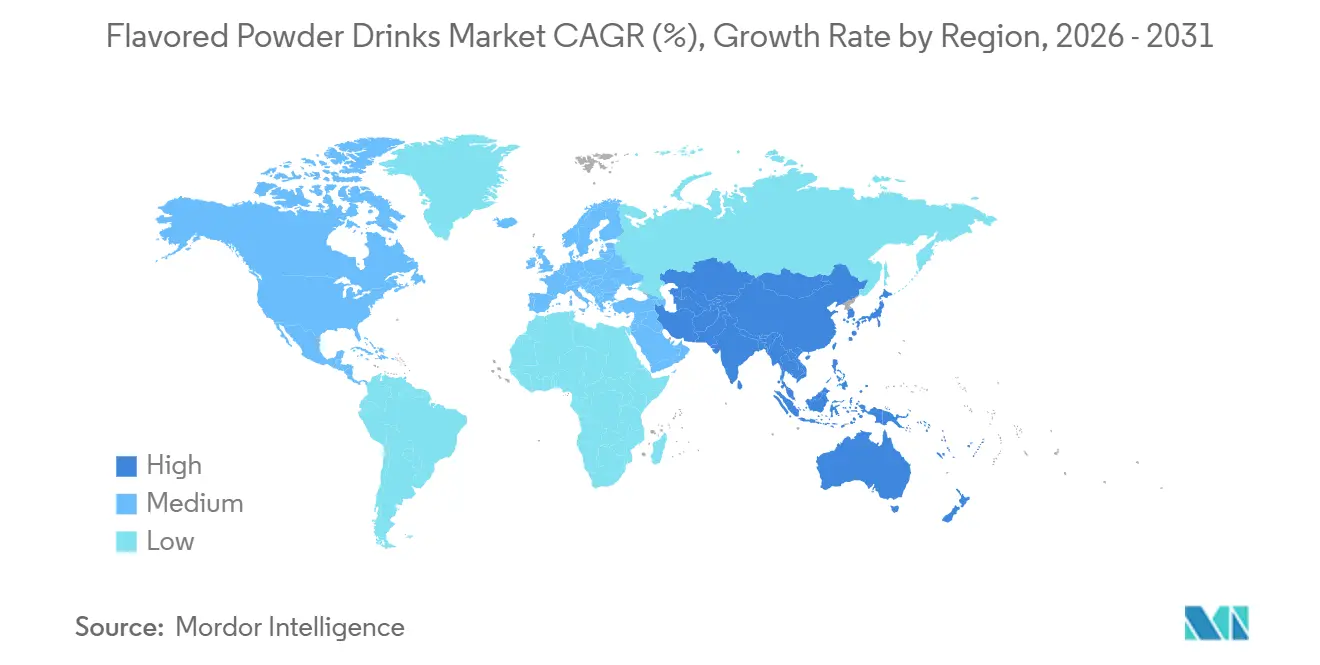
Asia-Pacific accounted for 40.41% of global revenue in 2025 and is forecast to grow at a CAGR of 4.66% through 2031. This combination positions it as the largest and fastest-growing region in the flavored powder drinks market. In China, urban adults focused on active health management are showing greater interest in protein, collagen, and probiotic powders. India continues to drive volume growth through low-priced sachets and an expanding pipeline of sports and functional drinks. Tata Consumer has outlined plans to enter the sports drinks category, reflecting growing interest in younger and health-conscious consumers.
ASEAN and North America Flavored Powder Drinks Market
Southeast Asia supports market growth through single-serve convenience formats, e-commerce, and social commerce. China’s Healthy China 2030 initiative and India’s updated food labeling framework are increasing compliance requirements for products that make functional claims. Established companies can use their regulatory capabilities as an advantage over fragmented local suppliers. In North America, demand for hydration and protein products supports the flavored powder drinks market, while ambient storage and lower delivery weight strengthen online grocery fulfillment.
EMEA and South America Flavored Powder Drinks Market
Europe has a steadier growth profile due to strong additive scrutiny and private-label competition. The United Kingdom and Germany remain important markets for clean-label electrolyte mixes, probiotic powders, and protein drink mixes. South America benefits from Brazil’s young consumer base and growing urban middle class. Nestlé plans to select Brazil as the first launch market for Vital in 2026 before expanding to Europe and Asia. Glanbia acquired Sweetmix in Brazil in 2025, adding local powder manufacturing capacity. Argentina remains constrained by macroeconomic volatility. Meanwhile, the Middle East and Africa offer demand opportunities in Saudi Arabia, the UAE, and South Africa, supported by young populations, warm climates, and growing digital purchasing.

Competitive Landscape
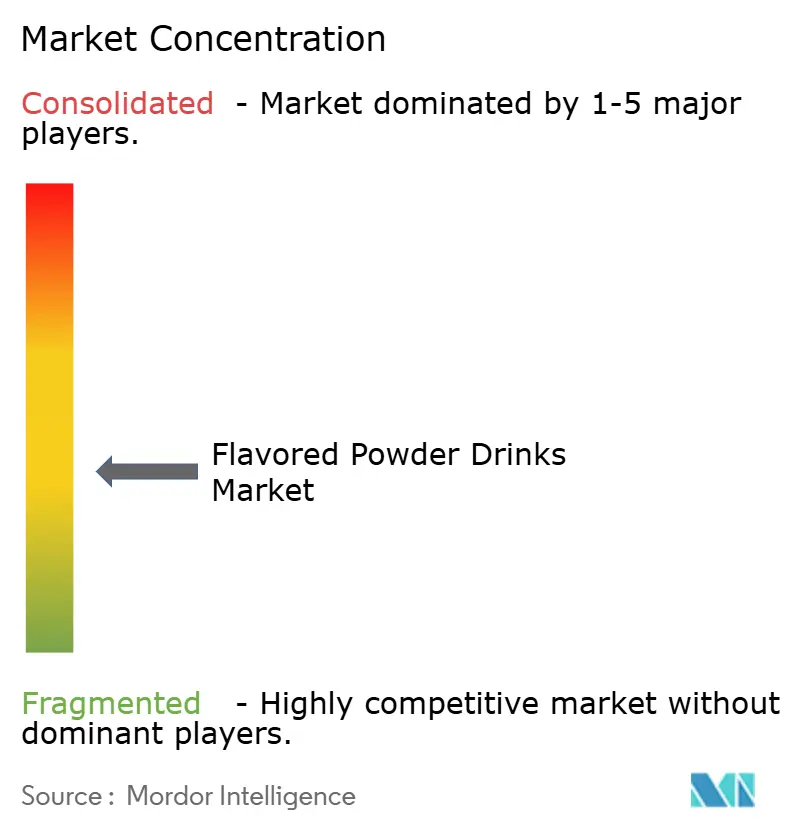
The flavored powder drinks market remains fragmented, with no single company leading across all geographies and product types. Nestlé is focusing on life-stage nutrition through Vital and clean-label family products through Nesquik. Glanbia is expanding its performance nutrition presence through Optimum Nutrition, which reported 18.8% revenue growth in the first quarter of 2026. Kraft Heinz is leveraging the broad brand recognition of Kool-Aid to compete at accessible price points in hydration powders. These strategies indicate that companies are targeting distinct buyer groups rather than relying on a single category-wide approach.
PepsiCo’s May 2026 launch of Propel Clear Protein highlights a strategy centered on clinically influenced nutrition needs. Nestlé’s Vital launch in Brazil represents another example, as the company positioned powdered shakes for adults over 40 and planned future expansion into Europe and Asia. Glanbia added Sweetmix in Brazil and Scicore in India during 2025, expanding its production footprint in two important growth markets. These moves provide larger companies with greater local capacity and increase competitive pressure on regional brands that rely on low pricing or a narrow sales footprint.
Regional companies in India, China, and Southeast Asia can respond quickly to local flavor preferences, lower price points, and social commerce demand. Larger companies maintain advantages in formulation capabilities, regulatory knowledge, distribution, and broader brand recognition. Keurig Dr Pepper’s August 2025 agreement to acquire JDE Peet’s, followed by a planned separation into Beverage Co. and Global Coffee Co., may sharpen its focus on non-coffee beverage activities (KeurigDrPepper.com). Online channels allow mid-sized brands to gain visibility without matching traditional retail spending, while market outcomes depend on product benefits, pricing, and local flavor fit.
Flavored Powder Drinks Industry Leaders
Nestlé S.A.
PepsiCo, Inc.
The Kraft Heinz Company
The Coca-Cola Company
Mondelēz International, Inc.
- *Disclaimer: Major Players sorted in no particular order
Flavored Powder Drinks Market Companies Covered in this Report
- Nestlé S.A.
- PepsiCo, Inc.
- The Kraft Heinz Company
- The Coca-Cola Company
- Mondelēz International, Inc.
- Unilever PLC
- Kerry Group plc
- TreeHouse Foods, Inc.
- Keurig Dr Pepper Inc.
- The J.M. Smucker Co.
- National Beverage Corp.
- Abbott Laboratories
- Cargill, Incorporated
- Associated British Foods plc
- Mars, Incorporated
- Suntory Holdings Limited
- Ajinomoto Co., Inc.
- Tata Consumer Products Limited
- Glanbia plc
- Simatech A/S



Global Flavored Powder Drinks Market Report Scope
Flavored powder drinks are powdered beverage products that are mixed with water or other liquids to create ready-to-consume flavored drinks. The flavored powder drinks market is segmented by product type, flavor, packaging, distribution channel and geography. Based on product type, the market is segmented into fruit-flavored powder drinks, sports and energy drink powders, instant tea and coffee powders, functional and wellness drink powders and other product types. Based on flavor, the market is segmented into citrus, berry, tropical, apple, mixed fruit and other flavors. Based on packaging, the market is segmented into sachets/stick packs, pouches, tubs/jars, cartons and other formats. Based on distribution channel, the market is segmented into supermarkets/hypermarkets, convenience stores, online retail stores and other distribution channels. By geography, the market is segmented into North America, Europe, Asia-Pacific, South America, and Middle-East and Africa. For each segment, the market sizing and forecasting have been done in value terms (USD).
| Fruit-Flavored Powder Drinks |
| Sports and Energy Drink Powders |
| Instant Tea and Coffee Powders |
| Functional and Wellness Drink Powders |
| Other Product Types |
| Citrus |
| Berry |
| Tropical |
| Apple |
| Mixed Fruit |
| Other Flavors |
| Sachets/Stick Packs |
| Pouches |
| Tubs/Jars |
| Cartons and Other Formats |
| Supermarkets/Hypermarkets |
| Convenience Stores |
| Online Retail Stores |
| Other Distribution Channels |
| North America | United States |
| Canada | |
| Mexico | |
| Rest of North America | |
| Europe | Germany |
| United Kingdom | |
| Italy | |
| France | |
| Spain | |
| Netherlands | |
| Rest of Europe | |
| Asia-Pacific | China |
| India | |
| Japan | |
| Australia | |
| Indonesia | |
| Rest of Asia-Pacific | |
| South America | Brazil |
| Argentina | |
| Rest of South America | |
| Middle East and Africa | South Africa |
| Saudi Arabia | |
| United Arab Emirates | |
| Rest of Middle East and Africa |
| By Product Type | Fruit-Flavored Powder Drinks | |
| Sports and Energy Drink Powders | ||
| Instant Tea and Coffee Powders | ||
| Functional and Wellness Drink Powders | ||
| Other Product Types | ||
| By Flavor | Citrus | |
| Berry | ||
| Tropical | ||
| Apple | ||
| Mixed Fruit | ||
| Other Flavors | ||
| By Packaging | Sachets/Stick Packs | |
| Pouches | ||
| Tubs/Jars | ||
| Cartons and Other Formats | ||
| By Distribution Channel | Supermarkets/Hypermarkets | |
| Convenience Stores | ||
| Online Retail Stores | ||
| Other Distribution Channels | ||
| By Geography | North America | United States |
| Canada | ||
| Mexico | ||
| Rest of North America | ||
| Europe | Germany | |
| United Kingdom | ||
| Italy | ||
| France | ||
| Spain | ||
| Netherlands | ||
| Rest of Europe | ||
| Asia-Pacific | China | |
| India | ||
| Japan | ||
| Australia | ||
| Indonesia | ||
| Rest of Asia-Pacific | ||
| South America | Brazil | |
| Argentina | ||
| Rest of South America | ||
| Middle East and Africa | South Africa | |
| Saudi Arabia | ||
| United Arab Emirates | ||
| Rest of Middle East and Africa | ||


Key Questions Answered in the Report
What is the projected growth rate for flavored powder drinks?
The market is forecast to grow at a 3.35% CAGR from 2026 to 2031, reaching USD 92.61 billion by 2031.
Which product type leads flavored powder drinks?
Fruit-flavored products led with 59.56% of product-type revenue in 2025.
Why are powder formats gaining attention from beverage companies?
Ambient storage, lower shipping weight, longer shelf life, and lower cost per serving make powders well suited to e-commerce and recurring household use.
Which region has the strongest position in flavored powder drinks?
Asia-Pacific held 40.41% of revenue in 2025 and is expected to grow at a 4.66% CAGR through 2031.
What packaging is used most often for flavored powder drinks?
Sachets and stick packs held 51.77% of packaging volume in 2025, while resealable pouches are projected to expand at a 5.06% CAGR.
Page last updated on:





