
Field Marketing Services Market Size and Share
Market Overview
| Study Period | 2020 - 2031 |
|---|---|
| Market Size (2026) | USD 61.73 Billion |
| Market Size (2031) | USD 90.19 Billion |
| Growth Rate (2026 - 2031) | 7.88 % |
| Fastest Growing Market | Asia-Pacific |
| Largest Market | North America |
| Market Concentration | Medium |
Major Players *Disclaimer: Major Players sorted in no particular order Image © Mordor Intelligence. Reuse requires attribution under CC BY 4.0. | |
Field Marketing Services Market Analysis by Mordor Intelligence
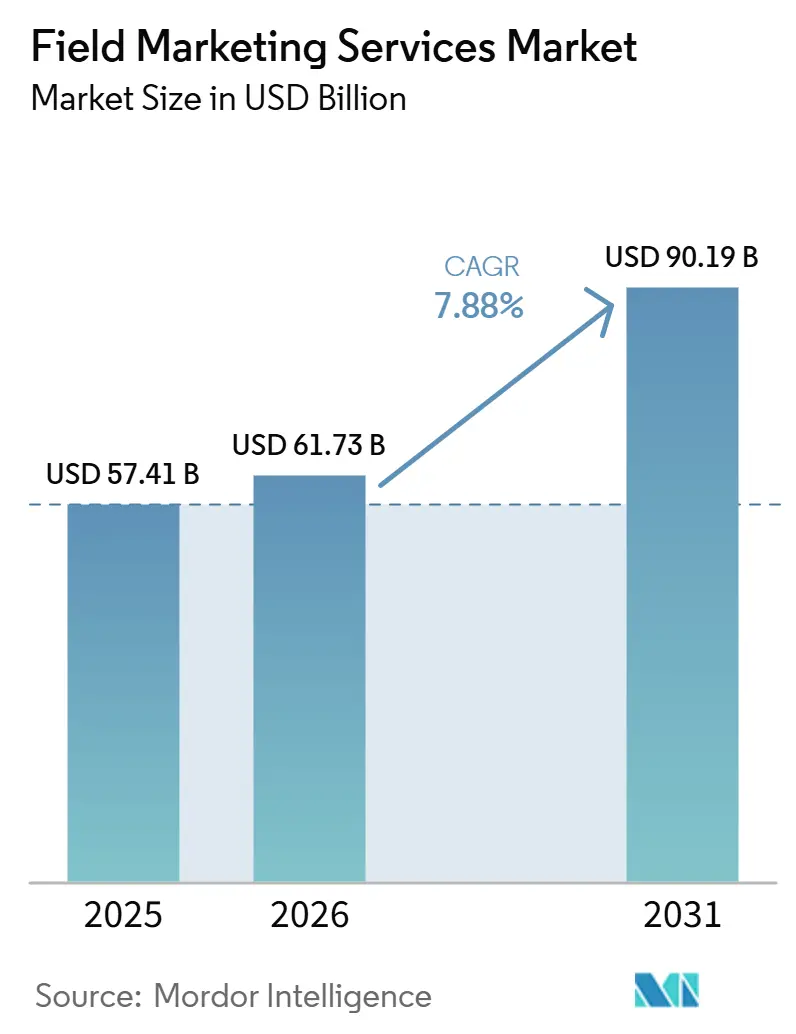
The Field Marketing Services Market size is expected to grow from USD 57.41 billion in 2025 to USD 61.73 billion in 2026, and is forecast to reach USD 90.19 billion by 2031, at a 7.88% CAGR over 2026-2031. Physical activation has moved into a core role in brand planning because brands now expect store visits, demonstrations, roadshows, and event programs to support measurable commercial outcomes, not just awareness. The field marketing services market is also benefiting from stronger advertiser willingness to invest in in-person engagement in 2026, even while digital channels continue to absorb a parallel share of budgets. Competition remains moderate, but the field marketing services market is tightening at the upper end as larger agencies expand geographic coverage and deepen staffing networks to win multi-market retainers. At the same time, specialist firms continue to hold a position in premium verticals where category familiarity, local execution quality, and cultural fit matter more than pure scale. Labor inflation, attribution gaps, and the growing importance of real-time execution analytics will continue to shape the development of the field marketing services market through 2031.
Key Report Takeaways
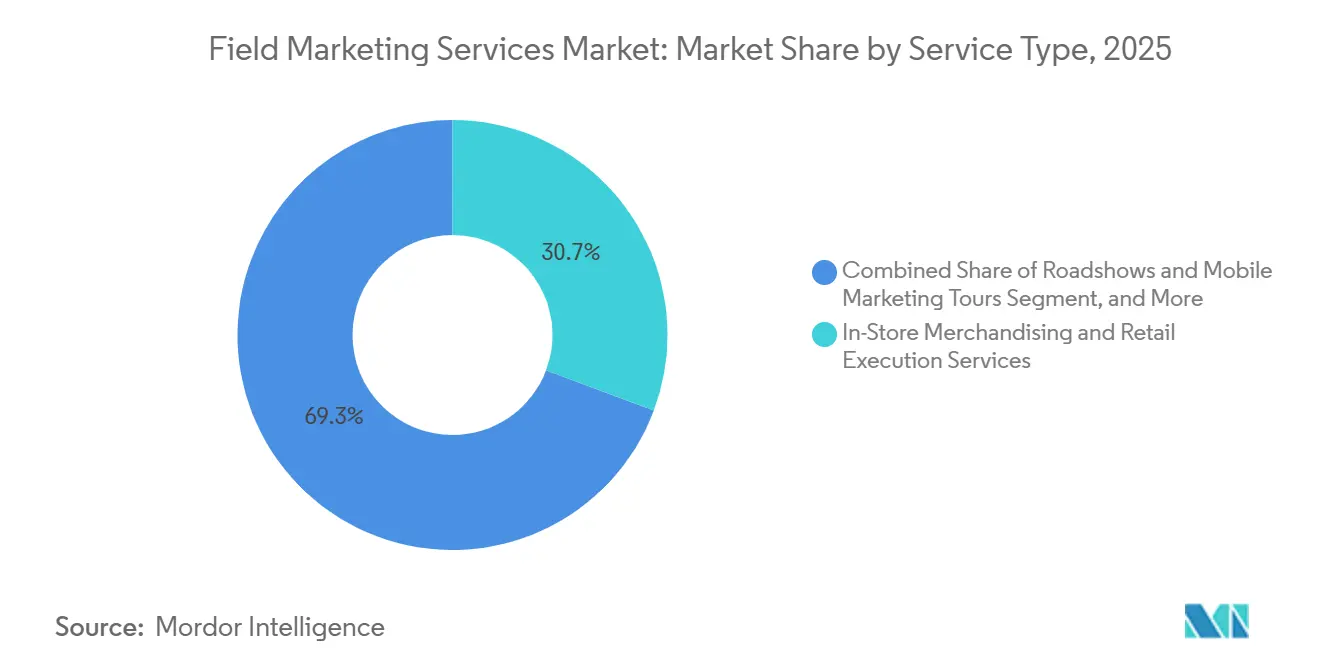
- By service type, in-store merchandising and retail execution services accounted for 30.72% of the field marketing services market size in 2025, while brand activation and experiential campaigns are projected to grow at a CAGR of 9.01% through 2031.
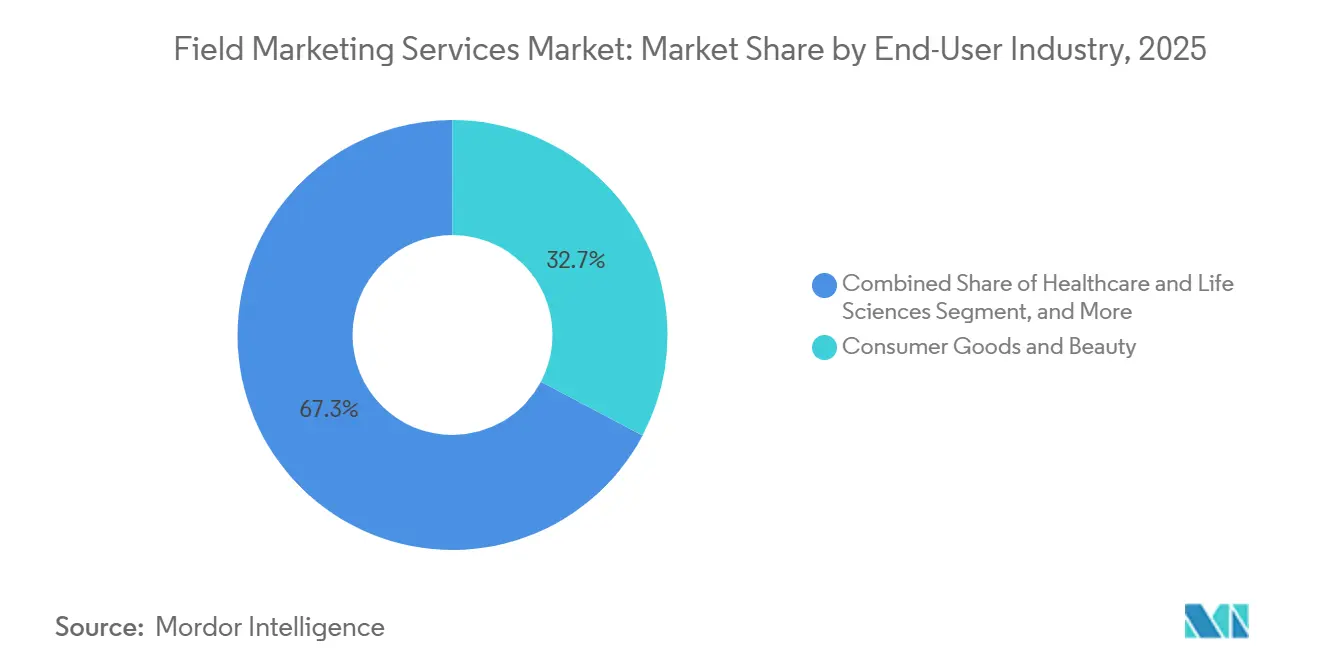
- By end-user industry, consumer goods and beauty accounted for 32.74% of the field marketing services market share in 2025, while Retail and E-commerce are projected to grow at a CAGR of 9.06% through 2031.
- By geography, North America held 26.93% share in 2025, while the Asia-Pacific is projected to expand at a CAGR of 9.32% through 2031.
Note: Market size and forecast figures in this report are generated using Mordor Intelligence’s proprietary estimation framework, updated with the latest available data and insights as of January 2026.
Market Trends and Insights
Drivers Impact Analysis of Field Marketing Services Market*
| Driver | (~) % Impact on CAGR Forecast | Geographic Relevance | Impact Timeline |
|---|---|---|---|
| Rising Brand Demand for Measurable Omnichannel Activation | +2.1% | Global, with concentrated early adoption in North America and Western Europe | Short term (≤ 2 years) |
| Expansion of Organized Retail and Modern Trade Execution Needs | +1.6% | Asia-Pacific core, spill-over to Middle East, Africa, and South America | Medium term (2-4 years) |
| Growing Preference for Product Trial and Immersive Brand Experiences | +1.3% | Global, led by Consumer Goods and Beauty sector | Short term (≤ 2 years) |
| Wider Use of Real-Time Analytics and Experience Measurement | +0.9% | North America and Europe, with rapid adoption accelerating in Asia-Pacific | Medium term (2-4 years) |
| Creator-Led Commerce and Retailtainment Programs Requiring On-Ground Orchestration | +0.6% | North America, Asia-Pacific, and Brazil | Short term (≤ 2 years) |
| Shift Toward Micro-Experiences and Localized Community Activations | +0.5% | Global, with strength in campus and urban markets | Medium term (2-4 years) |
| Source: Mordor Intelligence | |||
Rising Brand Demand for Measurable Omnichannel Activation
Brands no longer want physical campaigns that end with a traffic count and a photo report. The field marketing services market is moving toward programs that connect physical touchpoints with sales pipelines, digital actions, and follow-up conversion signals. Advertiser sentiment has supported that shift, with 41% of advertising buyers planning to increase spending on in-person and experiential marketing in 2026, indicating that physical activation still carries budget support when tied to broader campaign objectives.[1]Interactive Advertising Bureau, “2026 Outlook, Ad Spend Forecasts and Buyer Intentions,” IAB, iab.com QR triggers, NFC interactions, social sharing mechanics, and digital content capture have become part of standard activation planning because they help brands connect on-ground engagement with measurable next steps. This has favored agencies in the field marketing services market that can combine staffing, production, and measurement within one operating model.
Expansion of Organized Retail and Modern Trade Execution Needs
Organized retail expansion is changing, where demand is building across the field marketing services market. As modern trade formats spread into India’s tier-2 and tier-3 cities and China continues to integrate digital payments, social commerce, and physical merchandising, brands need store-level execution that is more consistent and measurable. Each additional modern retail outlet adds work tied to planogram compliance, promotional installation, stock visibility, and field auditing. This has widened the role of retail execution providers beyond basic merchandising to include ongoing operational support for brand performance in stores. The field marketing services market is also seeing more demand for hybrid field teams that can work across both modern and traditional channels under a single program structure.
Growing Preference for Product Trial and Immersive Brand Experiences
Hands-on experience remains a durable reason brands continue to spend on physical activation. The field marketing services market continues to benefit from categories where texture, taste, scent, and live demonstrations directly influence purchase decisions, especially in beauty, personal care, food and beverage, and selected technology products. That makes product trial difficult to replace with digital media alone, even in countries with high online advertising maturity. It also explains why in-store demonstrations, sampling, and event-led product interaction continue to hold a central position in campaign design. In practical terms, the field marketing services market still has a structural demand floor because many consumer categories require physical interaction before conversion.
Wider Use of Real-Time Analytics and Experience Measurement
Real-time data is changing how field programs are staffed, routed, and evaluated across the field marketing services market. In practice, AI-enabled image recognition, planogram auditing, and predictive visit routing are helping teams spend less time on low-value store calls and more time on accounts that can move revenue. That shortens the time between spotting underperformance and correcting it in the field. As a result, the field marketing services market is moving toward a model in which execution quality and performance visibility improve together rather than separately.
Restraints Impact Analysis of Field Marketing Services Market*
| Restraint | (~) % Impact on CAGR Forecast | Geographic Relevance | Impact Timeline |
|---|---|---|---|
| High Labor, Logistics, And Venue Costs in Multi-Market Programs | -1.8% | North America, Western Europe, and high-labor-cost urban markets globally | Short term (≤ 2 years) |
| Limited Reach and Scaling Efficiency Versus Digital-Only Campaigns | -1.2% | Global, most acute in markets with advanced digital infrastructure | Medium term (2-4 years) |
| Centralized Campaign Governance Weakening Local Relevance | -0.7% | North America and Europe | Medium term (2-4 years) |
| Rising Promotional Talent Churn and Training Burdens | -0.5% | North America, the United Kingdom, and high-cost urban markets globally | Short term (≤ 2 years) |
| Source: Mordor Intelligence | |||
High Labor, Logistics, and Venue Costs in Multi-Market Programs
Cost inflation remains one of the clearest constraints on the field marketing services market. Multi-city programs require staffing, transport, storage, venue coordination, and local execution, which quickly raise delivery costs, especially in large urban markets. These pressures are most visible in roadshows, large sampling programs, and multi-market launches where timing errors or rush changes create additional cost exposure. The result is that agencies and clients are placing more emphasis on managed-service models, stronger staffing networks, and tighter deployment planning to protect program margins. Even with those adjustments, the field marketing services market still faces recurring comparison against digital channels that can extend reach at much lower marginal cost.
Limited Reach and Scaling Efficiency Versus Digital-Only Campaigns
Physical campaigns do not scale across markets as easily as digital campaigns do. A digital campaign can add countries at minimal extra cost, while a field activation requires new staffing, permits, local partners, and operational coordination each time it enters a new city or country. That makes the field marketing services market work harder to defend budgets when senior marketers are comparing physical execution with lower-cost digital alternatives. Hybrid formats are helping because they allow brands to anchor a campaign in a physical event and extend it through digital content, social amplification, and lead capture. Even so, the field marketing services market still needs better attribution discipline to justify the added cost of the physical layer in quarterly budget reviews.
*Our forecasts treat driver/restraint impacts as directional, not additive. The impact forecasts reflect baseline growth, mix effects, and variable interactions.
Field Marketing Services Market Segment Analysis
By Service Type:
In-Store Execution Anchors Revenue, Experiential Demand Broadens the MixIn-Store Merchandising and Retail Execution Services accounted for 30.72% of revenue in 2025, keeping this category at the center of the field marketing services market. Its lead reflects the practical importance of shelf compliance, on-shelf availability checks, promotional installation, and execution accuracy across grocery, pharmacy, club, and mass channels. Retailers have also become more demanding about display quality and planogram adherence, which strengthens the case for specialized execution partners. For many brands, this part of the field marketing services market remains less discretionary than event-led work because it directly supports store performance and promotional compliance.
The rest of the mix remains commercially important because it serves different conversion goals across sectors. Product Demonstrations and Sampling Programs continue to matter when physical trials influence purchase, while Lead Generation and Customer Acquisition Programs remain relevant in financial services and other conversion-led campaigns. Brand Activation and Experiential Campaigns are projected to grow at a CAGR of 9.01% through 2031, indicating that the field marketing services market is directing more brand spend toward immersive formats with clearer purchase intent outcomes. Event Staffing and Promotional Workforce Management is also moving beyond simple headcount supply, with more clients expecting training, compliance control, and performance benchmarking as part of the same service package.



By End-User Industry:
Consumer Goods and Beauty Lead Demand, Telecom and Tech Expand FastestConsumer Goods and Beauty accounted for 32.74% of revenue in 2025, making it the largest end-user segment in the field marketing services market. This leadership is tied to categories such as food and beverage, cosmetics, personal care, and household products, where trial, demonstration, and shelf visibility directly affect conversion. Brands in these categories also maintain large, recurring field deployments across their store networks, which gives the segment structural weight within the field marketing services industry. Retail and E-commerce followed as another major buyer group, as retailers increasingly use third-party support for in-store compliance, footfall, and branded experience programs.
Retail and e-commerce are projected to grow at a CAGR of 9.06% through 2031, making them the fastest-growing end-user segments. This has pushed the field marketing services industry toward more immersive formats, including flagship store activations, roadshows, product launches, and subscriber acquisition programs. BFSI continues to use field activation, where product explanation and customer acquisition benefit from in-person engagement, while healthcare and life sciences remain active in demonstrations and awareness formats that fit within regulatory boundaries.
Geography Analysis
North America Field Marketing Services Market
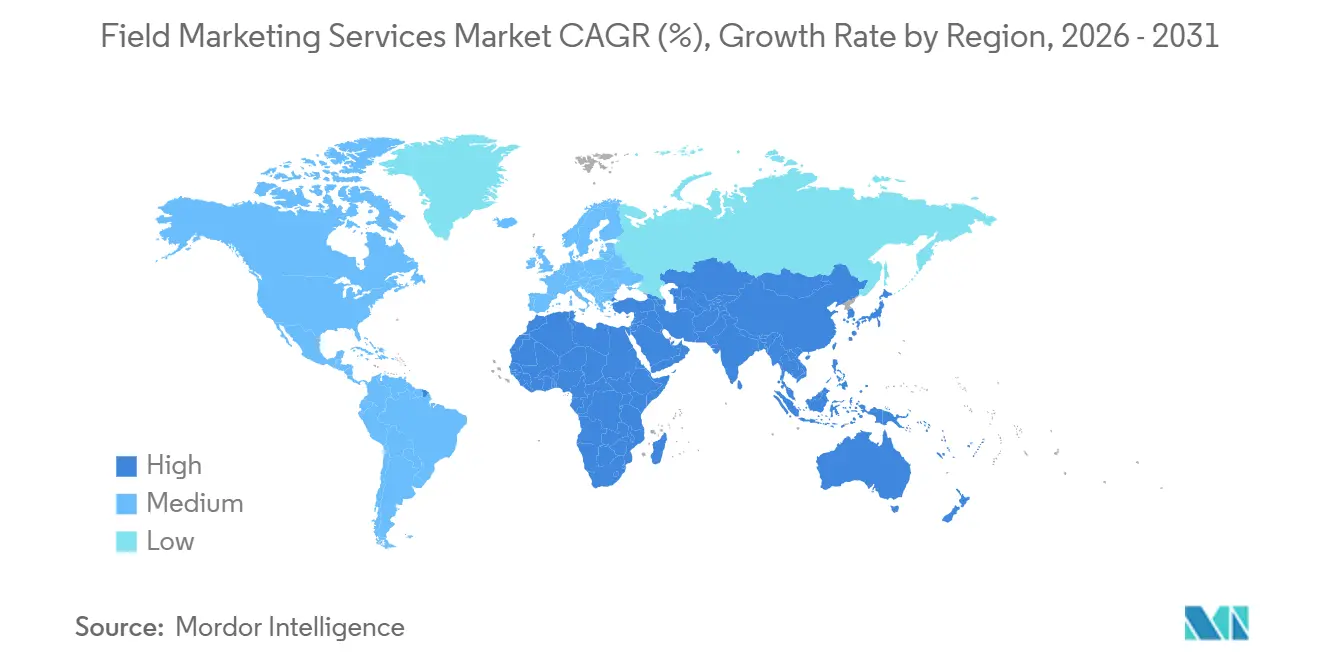
North America accounted for 26.93% of the field marketing services market share in 2025, which made it the largest regional contributor. The region’s lead came from mature organized retail, high activation spending, and the concentration of global agency headquarters based in the United States and Canada that coordinate large multi-market programs. The United States remained the main revenue engine because consumer goods programs, grocery and mass-retail execution, and sports-linked activation budgets stayed large. Advertiser intent also supported the regional outlook, with 41% of US advertising buyers planning to increase spending on in-person and experiential marketing in 2026. That combination kept North America in a leading position in the field marketing services market, even as growth rates in other regions rose.
APAC Field Marketing Services Market
Asia-Pacific is projected to expand at a CAGR of 9.32% through 2031, making it the fastest-growing geography in the field marketing services market. Growth is being supported by organized retail expansion in India, rising middle-class consumption, and a stronger link between physical activation and digital commerce across major Asian markets. China continues to stand out because modern trade formats increasingly connect social commerce, digital payments, and in-store merchandising into a single shopper journey. Japan, South Korea, and Southeast Asia add to the opportunity set through premium activation demand, urban retail density, and growing agency investment in Singapore-led regional hub structures.
EMEA and South America Field Marketing Services Market
Europe held the second-largest regional position in the field marketing services market, with Germany, the United Kingdom, and France leading spend across retail execution, trade show engagement, and branded experience programs. The United Kingdom has also become a visible consolidation point as larger operators absorb specialist capabilities and simplify brand structures. Smollan’s January 2026 brand unification across the United Kingdom and Ireland reflected that wider push toward scale and consistency in cross-market delivery.[2]Smollan, “REL Field Marketing Transitions to Smollan in UK and Ireland,” Fieldmarketing.com, fieldmarketing.com South America remained an emerging growth zone led by Brazil, where large public events are increasingly treated as formal platforms for brand activation rather than one-off sponsorship moments. The Middle East continued to build new demand through retail and entertainment infrastructure in the United Arab Emirates, Saudi Arabia, and Qatar, while Africa remained an earlier-stage opportunity led by South Africa, Nigeria, and Egypt.

Competitive Landscape
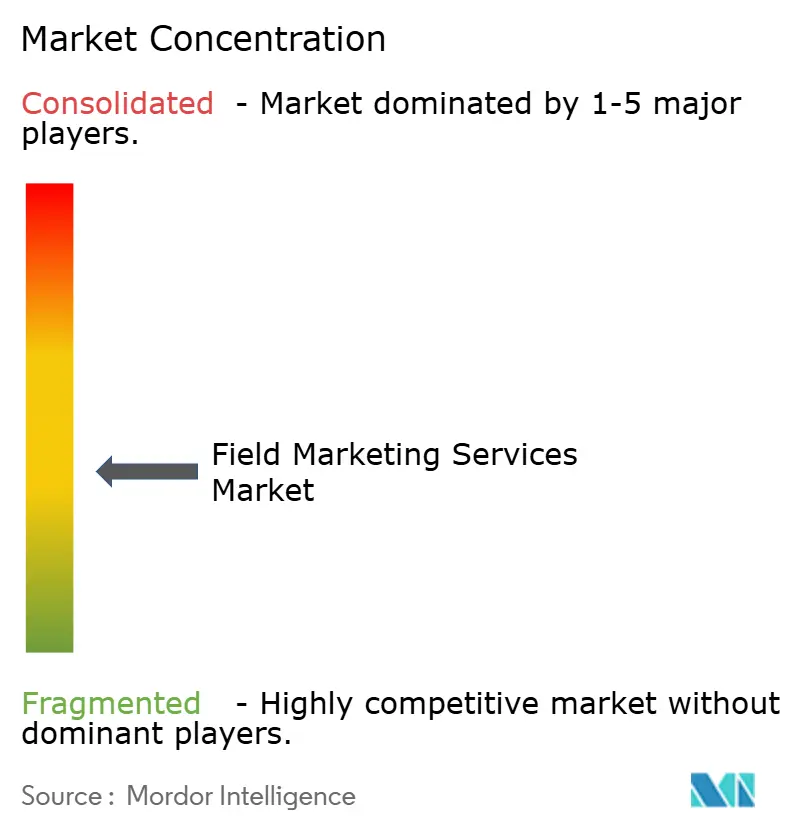
The field marketing services market remains fragmented globally, but consolidation has accelerated among enterprise-scale operators. Larger agencies are using acquisitions, staffing scale, and wider geographic coverage to compete for managed-service retainers that smaller firms struggle to match. Acosta Group strengthened that model after completing its acquisitions of Crossmark and Product Connections in July 2024, expanding the company to more than 60,000 associates and over 3,000 clients.[3]Acosta Group, “Acosta Group Completes Acquisition of Crossmark and Product Connections,” Acosta Group, acosta.group Smollan moved in a similar direction when it unified its brand structure across 60-plus markets in January 2026, reinforcing the value of a single operating identity for multinational clients. These moves show that the field marketing services market increasingly rewards agencies that can offer scale, coverage, and process consistency under a single contract.
At the same time, premium specialists continue to defend space where category knowledge and execution style matter more than network breadth. The merger between Jack Morton Worldwide and Impact XM in February 2026 created a global experiential operator with more than 1,000 specialists across 20 offices, which strengthened competition at the upper end of the field marketing services market. This type of deal matters because it gives specialist agencies more scale without forcing them into a broad generalist positioning. It also raises pressure on mid-sized independents that lack either the scale of platform agencies or the category authority of premium boutiques.
Strategic differentiation is now centered on technology ownership, creator-led execution, and data discipline. Agencies that can combine image recognition, visit routing, KPI dashboards, and activation reporting are gaining an advantage because clients want visible proof of return from physical programs. Creator-led commerce has added another layer, with Unilever’s 2026 FIFA World Cup activation across 3 host cities showing how brand partnerships now require content production, logistics, and live execution to work together on the ground.[4]Unilever, “Unilever Launches Largest Sports Partnership Activation for FIFA World Cup 2026,” Unilever, unilever.com Smaller agencies are still finding room by focusing on premium relationships and selective expansion, as shown by NVE Experience Agency’s move into London in April 2026. The field marketing services market is therefore not consolidating into a simple winner-takes-all structure, but it is becoming harder for undifferentiated agencies to compete.
Field Marketing Services Industry Leaders
Acosta Group
Jack Morton Worldwide Inc.
Pico Far East Holdings Limited
Denave India Private Limited
Momentum Worldwide Inc.
- *Disclaimer: Major Players sorted in no particular order
Field Marketing Services Market Companies Covered in this Report
- Acosta Group
- George P. Johnson Company
- Jack Morton Worldwide Inc.
- Pico Far East Holdings Limited
- Denave India Private Limited
- GMR Marketing LLC
- Momentum Worldwide Inc.
- Inspira Marketing Group LLC
- TRO Group Ltd.
- BDS Connected Solutions, LLC
- ASTOUND Group LLC
- NVE Experience Agency
- Sense Marketing Services Ltd.
- Evolve Activation LLC

Recent Industry Developments in Field Marketing Services Market
- February 2026: Jack Morton Worldwide and Impact XM merged to form a unified global experiential powerhouse, backed by The Riverside Company, which manages over USD 13 billion in capital. The combined entity retains the Jack Morton name, operates 20-plus offices spanning North America and the Asia-Pacific, and brings together over 1,000 specialists in strategy, creative, production, and measurement.
- January 2026: REL Field Marketing officially transitioned to the Smollan brand in the United Kingdom and Ireland on January 21, 2026, completing Smollan's global brand unification strategy. The consolidation eliminates sub-brand complexity across a network spanning 60-plus markets and positions Smollan as a single-identity global field marketing and brand activation operator for multinational clients.
- December 2025: Spiro, owned by GES Events, acquired 2Heads, a UK-originated experience agency with a global footprint. The acquisition expanded Spiro's creative capabilities and provided 2Heads clients with access to Spiro's worldwide event production and execution network, strengthening both organizations' positions in corporate and brand experience markets.
- December 2025: OrangeDoor merged with Unbridled to form OrangeDoor, an Unbridled company, combining OrangeDoor's creative event innovation with Unbridled's US production and performance expertise. The merger targets large-scale corporate and brand events requiring integrated strategy-to-execution delivery.


Global Field Marketing Services Market Report Scope
Field marketing services encompass a range of activities conducted in the field to promote products or services. These activities include product demonstrations, in-store promotions, merchandising, event marketing, and direct customer engagement to drive brand awareness and sales.
The Field Marketing Services Market Report is Segmented by Service Type (Brand Activation and Experiential Campaigns, Product Demonstrations and Sampling Programs, In-Store Merchandising and Retail Execution Services, Roadshows and Mobile Marketing Tours, Lead Generation and Customer Acquisition Programs, Event Staffing and Promotional Workforce Management, and Other Service Types), End-User Industry (Retail and E-commerce, Consumer Goods and Beauty, Media and Entertainment, IT and Telecom, BFSI, Healthcare and Life Sciences, and Other End-User Industries), and Geography (North America, South America, Europe, Asia-Pacific, Middle East, and Africa). The Market Forecasts are Provided in Terms of Value (USD).
| Brand Activation and Experiential Campaigns |
| Product Demonstrations and Sampling Programs |
| In-Store Merchandising and Retail Execution Services |
| Roadshows and Mobile Marketing Tours |
| Lead Generation and Customer Acquisition Programs |
| Event Staffing and Promotional Workforce Management |
| Other Service Types |
| Retail and E-commerce |
| Consumer Goods and Beauty |
| Media and Entertainment |
| IT and Telecom |
| BFSI |
| Healthcare and Life Sciences |
| Other End-User Industries |
| North America | United States |
| Canada | |
| Mexico | |
| South America | Brazil |
| Argentina | |
| Chile | |
| Rest of South America | |
| Europe | Germany |
| United Kingdom | |
| France | |
| Italy | |
| Spain | |
| Rest of Europe | |
| Asia-Pacific | China |
| Japan | |
| India | |
| South Korea | |
| Australia | |
| Rest of Asia-Pacific | |
| Middle East | United Arab Emirates |
| Saudi Arabia | |
| Qatar | |
| Rest of Middle East | |
| Africa | South Africa |
| Egypt | |
| Nigeria | |
| Rest of Africa |
| By Service Type | Brand Activation and Experiential Campaigns | |
| Product Demonstrations and Sampling Programs | ||
| In-Store Merchandising and Retail Execution Services | ||
| Roadshows and Mobile Marketing Tours | ||
| Lead Generation and Customer Acquisition Programs | ||
| Event Staffing and Promotional Workforce Management | ||
| Other Service Types | ||
| By End-User Industry | Retail and E-commerce | |
| Consumer Goods and Beauty | ||
| Media and Entertainment | ||
| IT and Telecom | ||
| BFSI | ||
| Healthcare and Life Sciences | ||
| Other End-User Industries | ||
| By Geography | North America | United States |
| Canada | ||
| Mexico | ||
| South America | Brazil | |
| Argentina | ||
| Chile | ||
| Rest of South America | ||
| Europe | Germany | |
| United Kingdom | ||
| France | ||
| Italy | ||
| Spain | ||
| Rest of Europe | ||
| Asia-Pacific | China | |
| Japan | ||
| India | ||
| South Korea | ||
| Australia | ||
| Rest of Asia-Pacific | ||
| Middle East | United Arab Emirates | |
| Saudi Arabia | ||
| Qatar | ||
| Rest of Middle East | ||
| Africa | South Africa | |
| Egypt | ||
| Nigeria | ||
| Rest of Africa | ||


Key Questions Answered in the Report
What is the current and forecast value of the field marketing services market?
The Field Marketing Services Market size is expected to grow from USD 57.41 billion in 2025 to USD 61.73 billion in 2026 and is forecast to reach USD 90.19 billion by 2031 at 7.88% CAGR over 2026-2031.
Which region leads global demand for field marketing services?
North America led in 2025 with a 26.93% share, supported by mature, organized retail, large consumer goods field programs, and strong advertiser spending on in-person activation.
Which region is growing the fastest through 2031?
Asia-Pacific is projected to record the fastest growth, with a 9.32% CAGR from 2026 to 2031, supported by organized retail expansion and stronger digital-physical retail integration.
Which service category generates the most revenue?
In-Store Merchandising and Retail Execution Services led with 30.72% of revenue in 2025 because brands continue to rely on shelf compliance, planogram accuracy, and promotional execution.
Which end-user group is expanding the fastest?
Retail and E-commerce is projected to grow at a 9.06% CAGR through 2031, as operators and technology firms use physical experiences to differentiate devices, service bundles, and subscriber offerings.
Page last updated on:





