
Female Sterilization Procedures Market Size and Share
Market Overview
| Study Period | 2020 - 2031 |
|---|---|
| Market Size (2026) | USD 9.64 Billion |
| Market Size (2031) | USD 12.37 Billion |
| Growth Rate (2026 - 2031) | 5.12 % |
| Fastest Growing Market | Asia-Pacific |
| Largest Market | North America |
| Market Concentration | Medium |
Major Players *Disclaimer: Major Players sorted in no particular order Image © Mordor Intelligence. Reuse requires attribution under CC BY 4.0. | |
Female Sterilization Procedures Market Analysis by Mordor Intelligence
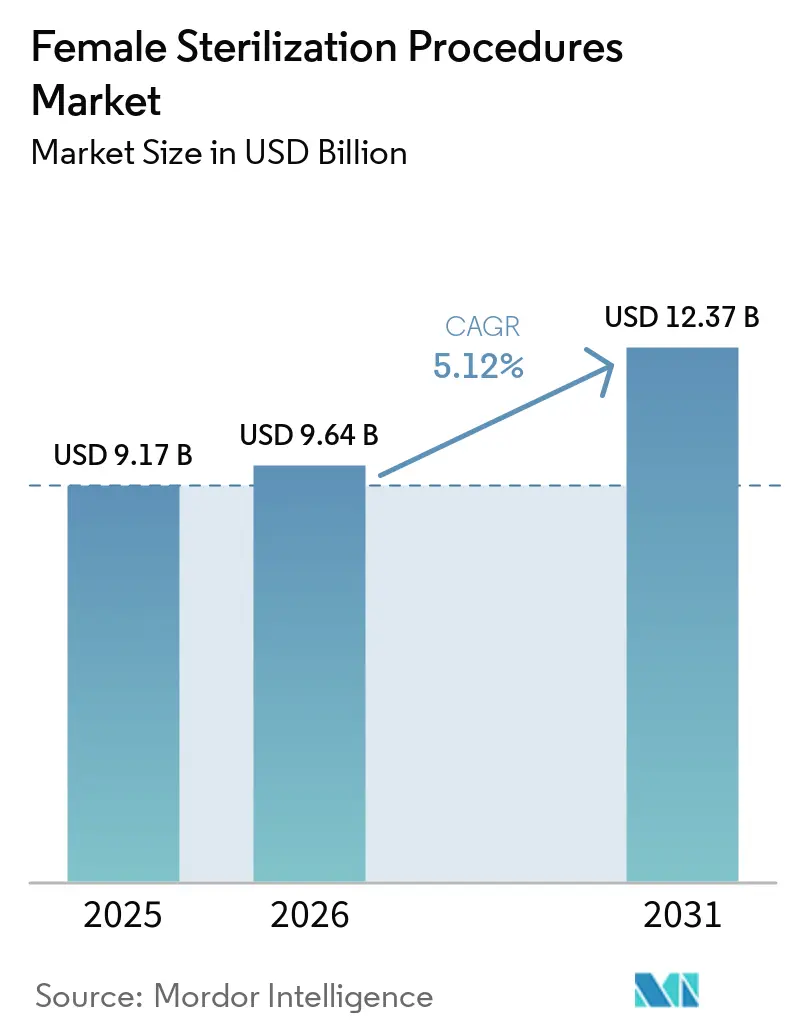
The Female Sterilization Procedures Market size is expected to grow from USD 9.17 billion in 2025 to USD 9.64 billion in 2026 and is forecast to reach USD 12.37 billion by 2031 at 5.12% CAGR over 2026-2031.
Surgical care remains a core component of the female sterilization procedures market, as laparoscopic and abdominal approaches have replaced many formerly used transcervical devices. The transition from tubal ligation to bilateral salpingectomy is reshaping clinical practice and the overall procedure mix. Market demand is further influenced by reproductive autonomy, public reimbursement policies, and the capacity of hospitals and outpatient providers to meet patient requirements. However, funding constraints may limit service availability in aid-dependent settings, despite the continued high demand for permanent contraception. As a result, market conditions vary across countries, with stronger service capacity supporting market growth in higher-income healthcare systems, while access gaps constrain the number of completed procedures in other settings.
Key Report Takeaways
- By procedure type, surgical sterilization held 63.54% of the female sterilization procedures market share in 2025 and is projected to grow at a 7.54% CAGR through 2031.
- By end user, hospitals and maternity centers held 64.76% of procedure volume in 2025, while ambulatory surgical centers are projected to grow at an 8.12% CAGR through 2031.
- By geography, North America held 42.43% of the female sterilization procedures market share in 2025, while Asia-Pacific is projected to grow at a 6.54% CAGR through 2031.
Note: Market size and forecast figures in this report are generated using Mordor Intelligence’s proprietary estimation framework, updated with the latest available data and insights as of January 2026.
Global Female Sterilization Procedures Market Trends and Insights
Drivers Impact Analysis*
| Driver | (~) % Impact on CAGR Forecast | Geographic Relevance | Impact Timeline |
|---|---|---|---|
| Expanding Access to Permanent Contraception | +1.20% | Global, concentrated in South Asia, Sub-Saharan Africa, and Latin America | Medium term (2-4 years) |
| Government-Supported Family-Planning Programs | +0.90% | South Asia, Sub-Saharan Africa, and Latin America, with lower support in aid-dependent settings | Short term (≤ 2 years) |
| Shift Toward Minimally Invasive and Outpatient Procedures | +1.40% | North America, Europe, and urban Asia-Pacific | Long term (≥ 4 years) |
| Rising Reproductive Autonomy and Sterilization Awareness | +0.60% | North America, Europe, and urban Asia-Pacific | Long term (≥ 4 years) |
| Postpartum and Cesarean-Delivery Integration | +0.50% | North America, Europe, and Asia-Pacific | Medium term (2-4 years) |
| Opportunistic Salpingectomy for Ovarian-Cancer Risk Reduction | +0.70% | North America, Europe, Asia-Pacific, and other global settings | Long term (≥ 4 years) |
| Source: Mordor Intelligence | |||
Expanding Access to Permanent Contraception
Expanding hospital capacity across South Asia, Sub-Saharan Africa, and Latin America is expected to help convert unmet demand into completed procedures. Postpartum care serves as a key delivery channel, as providers can perform sterilization during cesarean delivery or shortly after birth. A 2024 multicenter U.S. study found that 41.6% of 3,013 patients who requested postpartum permanent contraception did not receive the procedure before discharge[1]A. Makins et al., “Ongoing Contraceptive Goals of Patients Who Did Not Achieve Desired Postpartum Permanent Contraception Prior to Hospital Discharge,” Contraception, doi.org.. Invalid Medicaid consent forms and limited operating room or physician availability each accounted for 27% of these unmet cases. In settings where public insurance covers the procedure, fulfillment rates approached 90%, demonstrating the role of coverage in converting stated preferences into treatment. The female sterilization procedures market stands to benefit as providers streamline consent processes, improve operating room access, and strengthen coordination between obstetric and surgical teams.
Government-Supported Family-Planning Programs
Public family-planning programs continue to underpin procedure volumes across many low- and middle-income countries. In fiscal year 2024, the U.S. government appropriated USD 607.5 million for international family-planning and reproductive health programs. This funding enabled access to modern contraceptive care for 47.6 million women and couples and helped prevent 17.1 million unintended pregnancies. However, the proposed withdrawal of U.S. international funding in 2026 may create a financing gap that other donors may be unable to offset, particularly as their combined contributions declined in 2024. India remains a significant demand center, with female sterilization accounting for 68.1% of the country’s modern contraceptive method mix in 2025. Public programs, including outreach initiatives in high-fertility districts, continue to support the female sterilization procedures market in India, while aid-dependent service systems face increasing uncertainty.
Shift Toward Minimally Invasive and Outpatient Procedures
The shift from inpatient procedures to outpatient care is reshaping the delivery of permanent contraception. Laparoscopic techniques can shorten recovery times and enable scheduling without hospital admission. A 2025 review found that salpingectomy during cesarean delivery added a mean of 15 minutes compared with tubal ligation, with no statistically significant difference in adverse outcomes. This clinical evidence supports the use of minimally invasive surgical approaches where trained teams and appropriate equipment are available. Femasys developed FemBloc as an office-based, non-surgical option that does not require anesthesia. The female sterilization procedures market may benefit from expanded access through outpatient settings, as patients can avoid inpatient stays and providers can deliver care through shorter visits.
Opportunistic Salpingectomy for Ovarian-Cancer Risk Reduction
Healthcare providers increasingly consider opportunistic salpingectomy when patients undergo other appropriate surgical procedures. A 2025 meta-analysis involving more than 5.7 million patients associated bilateral salpingectomy with a 52% lower risk of tubo-ovarian carcinoma compared with no salpingectomy. The European Society of Gynaecological Oncology based its 2025 consensus guidance on 129 studies. The guidance indicated that the procedure could be feasible during selected gynecological and non-gynecological surgeries, including cholecystectomy, hernia repair, bariatric surgery, and colon resection. Feasibility studies reported a median additional operating time of 13 minutes and no attributed complications. The female sterilization procedures market may gain an additional growth avenue as surgical teams apply these protocols to patients who would not otherwise schedule elective permanent contraception.
Restraints Impact Analysis*
| Restraint | (~) % Impact on CAGR Forecast | Geographic Relevance | Impact Timeline |
|---|---|---|---|
| Irreversibility, Regret, and Informed-Consent Requirements | -0.90% | North America and Europe, with higher risk among younger and lower-income populations | Long term (≥ 4 years) |
| Competition from Long-Acting Reversible Contraception | -1.10% | North America, Europe, and urban Asia-Pacific | Medium term (2-4 years) |
| Unequal Surgical Capacity and Reimbursement Access | -0.70% | Sub-Saharan Africa, rural Asia-Pacific, and Latin America | Medium term (2-4 years) |
| Historical Device-Safety Concerns and Trust Deficits | -0.40% | Global, concentrated in locations where transcervical devices were sold | Long term (≥ 4 years) |
| Source: Mordor Intelligence | |||
Irreversibility, Regret, and Informed-Consent Requirements
The permanent nature of sterilization requires comprehensive counseling and may delay or discourage procedure uptake. A nationally representative U.S. survey conducted in 2022 and 2023 found that 21.3% of women who underwent tubal sterilization wanted a reversal. Although this proportion declined from 26.8% in 2006, it remains a key consideration for patient counseling and service delivery. A 2024 Canadian study found that 15.9% of patients reported regret, 9.5% recalled coercive elements, and 33.3% did not recall discussing alternative methods before surgery[2]S. Dunn et al., “Regret in the Modern Contraceptive Landscape: Evaluating Regret in Patients Undergoing Tubal Ligation or Bilateral Salpingectomy for Contraception,” Journal of Obstetrics and Gynaecology Canada, jogc.com.. U.S. federal regulations require a 30-day waiting period for federally funded sterilization procedures. This requirement can affect postpartum procedure completion when patients are discharged before fulfilling the waiting-period requirement. These regulations may constrain elective procedure volumes among younger individuals, while increasing the need for structured counseling and access to reversible contraceptive alternatives.
Competition from Long-Acting Reversible Contraception
Long-acting reversible contraception offers an alternative for people who want highly effective contraception without a permanent decision. LARC use reached 10.5% among U.S. women aged 15 to 49 in 2022 and 2023, compared with 11.5% for female sterilization. LARC use was 13.8% among people aged 20 to 29 and 12.4% among those aged 30 to 39[3]“Current Contraceptive Status Among Females Ages 15-49: United States, 2022-2023,” National Center for Health Statistics, cdc.gov.. Research released in 2025 found that LARC insertions had a more lasting rise after Dobbs than sterilization across many age and demographic groups. In South America, 33% of modern method users relied on sterilization and 11% used LARC methods, although urban younger groups were increasingly receiving LARC-first counseling. The female sterilization procedures market remains relevant, but providers that offer both choices can better match patients with an appropriate method and reduce avoidable regret.
*Our forecasts treat driver/restraint impacts as directional, not additive. The impact forecasts reflect baseline growth, mix effects, and variable interactions.
Segment Analysis
By Procedure Type: Salpingectomy Shift Redrawing Surgical Practice
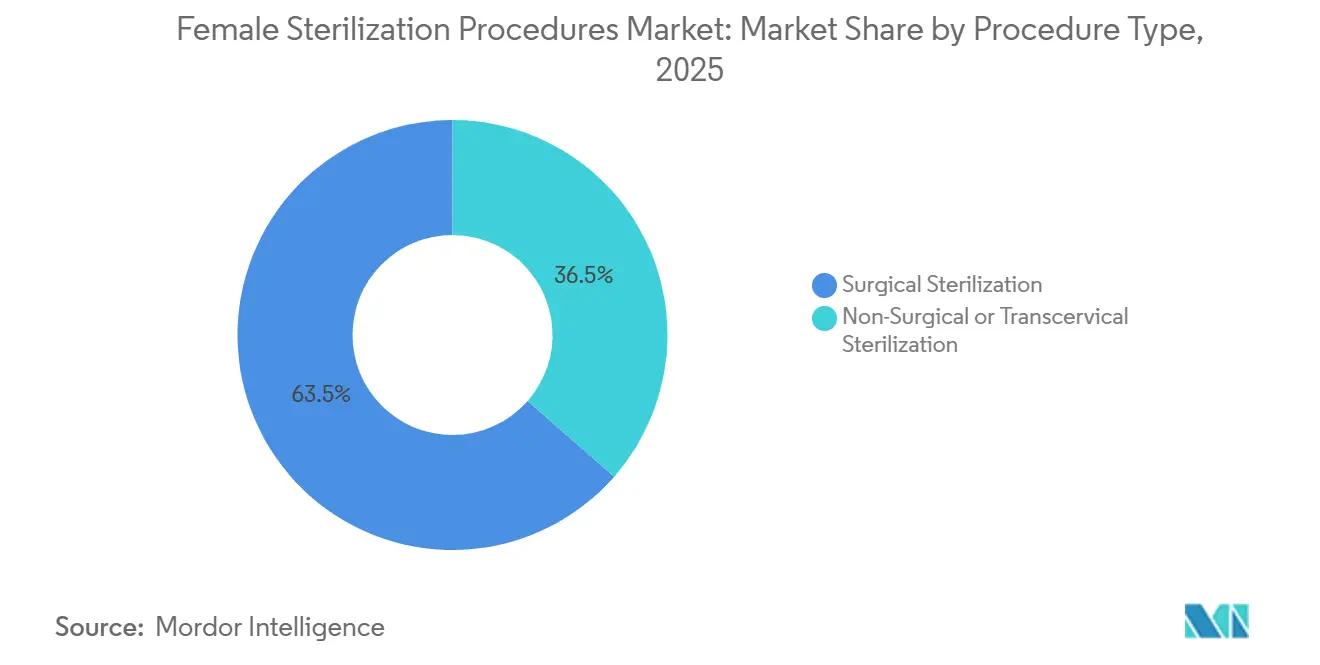
Surgical sterilization is expected to account for 63.54% of global procedure volume in 2025 and is projected to grow at a CAGR of 7.54% through 2031. This trend indicates that the largest procedure category will also be the fastest growing, with bilateral salpingectomy becoming more common than tubal ligation. In 2024, salpingectomies outnumbered tubal ligations by 3.3 to 1, compared with 1.2 to 1 in 2015. Within the female sterilization procedures market, this shift reflects broader clinical interest in reducing ovarian cancer risk. The female sterilization procedures industry is increasingly adopting complete fallopian tube removal in appropriate cases.
Non-surgical or transcervical sterilization is expected to represent the remaining 36.46% of procedure volume in 2025. However, the withdrawal of Essure in 2018 reduced patient and provider confidence in implant-based methods. Hysteroscopic tubal occlusion continues to serve a role in specialist centers that can provide office-based care. FemBloc is expected to receive approvals in Europe, the United Kingdom, and New Zealand in 2025. Femasys is expected to initiate enrollment for the U.S. FINALE pivotal trial in March 2026. U.S. approval could shift procedures toward clinic-based care among patients seeking an option that does not require anesthesia.


By End User: Hospital Dominance Holds as ASCs Build Sustainable Momentum
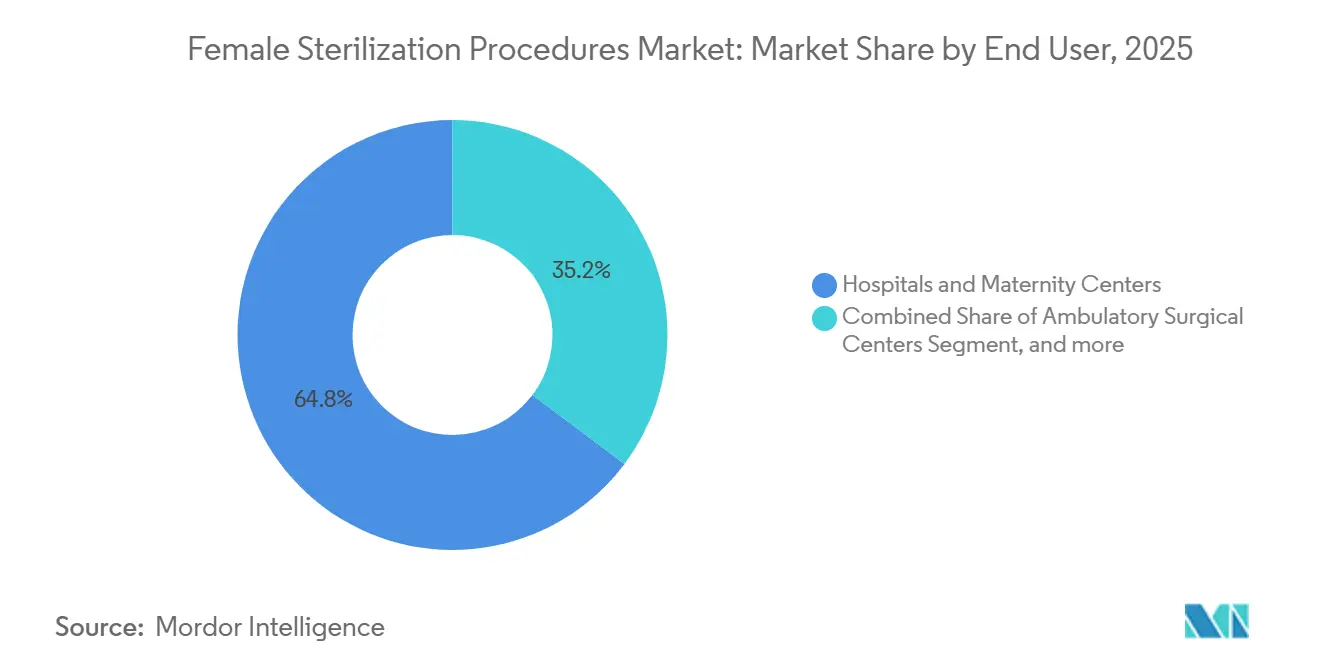
Hospitals and maternity centers are expected to account for 64.76% of procedure volume in 2025. Their position is supported by their integration with postpartum and concurrent cesarean procedures, ability to manage infrequent complications, and established relationships with public and private payers. In India, Apollo Hospitals, Fortis Healthcare, Narayana Health, and Manipal Health Enterprises are expanding the availability of gynecology services across major and secondary cities. In the United States, Catholic health systems operate 14% of hospital beds, although ethical directives may restrict direct elective sterilization. These restrictions can shift female sterilization procedures market activity to secular facilities and outpatient providers.
Ambulatory surgical centers are projected to grow at a CAGR of 8.12% through 2031, making them the fastest-growing end-user setting. Growth in this segment of the female sterilization procedures market is supported by the broader shift toward outpatient surgery. Gynecology and family-planning clinics play an important access role in areas with limited hospital coverage. MSI Reproductive Choices, EngenderHealth, and Planned Parenthood deliver services through clinic networks across several markets, while mobile outreach units remain important in rural areas of Sub-Saharan Africa and South Asia. The female sterilization procedures industry relies on these care settings to reach individuals who cannot readily access hospital-based services.

Geography Analysis
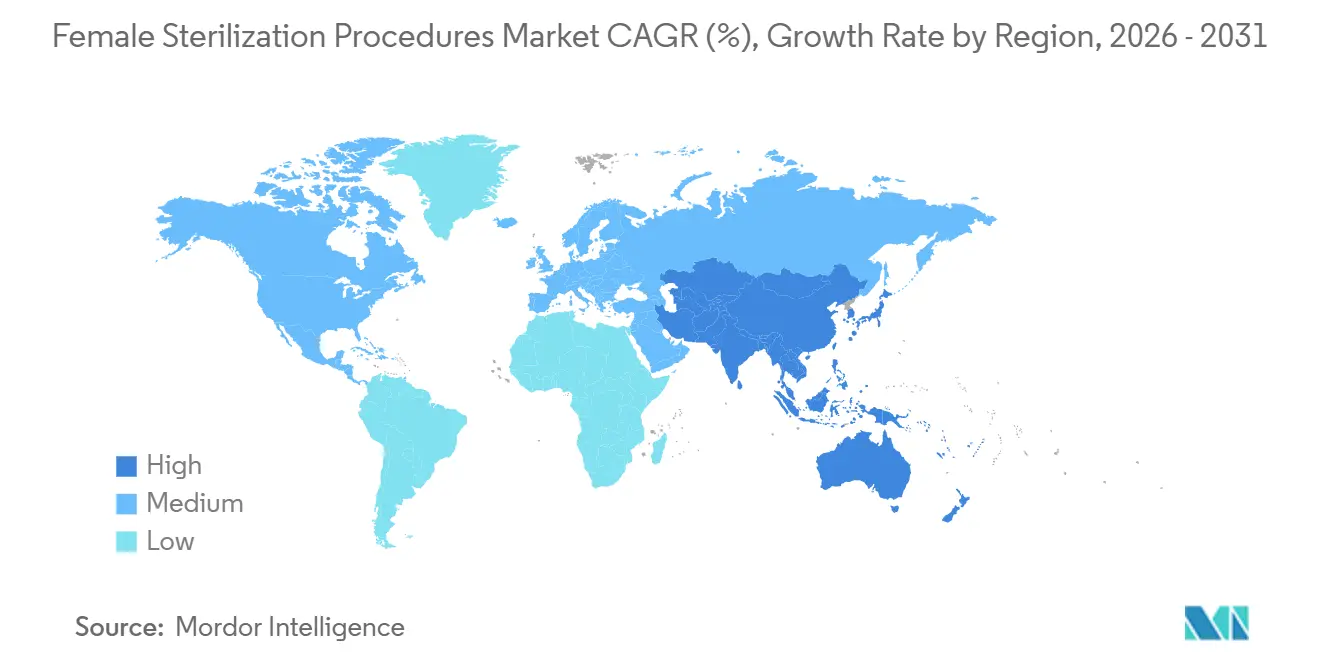
North America is projected to account for 42.43% of global procedure volume in 2025. The United States is expected to remain the region’s largest contributor, with female sterilization prevalence at 11.5% among women aged 15–49 in 2022 and 2023. Federal Title X funding totals USD 286.5 million for fiscal year 2025. However, the proposed elimination of the program in 2026 creates uncertainty for the 2.8 million low-income patients who accessed Title X-funded clinics in 2023. In abortion-restrictive states, monthly sterilization rates among women aged 18–25 remained 84% higher through 2023 following the Dobbs ruling. Canada has reported high satisfaction with postpartum sterilization; however, consent gaps continue to attract regulatory scrutiny in the female sterilization procedures market.
Asia-Pacific is projected to grow at a CAGR of 6.54% through 2031. India is expected to serve as the primary volume driver, with female sterilization accounting for 68.1% of its modern contraceptive method mix in 2025. Mission Parivar Vikas targets 146 high-fertility districts across seven states and supports the expansion of postpartum service delivery. While China has recorded declining tubal ligation volumes since 2015, Japan, South Korea, and Australia have established laparoscopic practices. Indonesia, Vietnam, and the Philippines are expected to support female sterilization procedures market growth as secondary hospital capacity expands and insurance coverage improves.
Europe is projected to hold the second-largest regional share in 2025, supported by mature surgical infrastructure. The European Union Medical Device Regulation’s clinical evaluation requirements may extend commercialization timelines for new tubal occlusion devices. However, FemBloc is expected to enter European markets in June 2025. Femasys is also expected to receive its first commercial order in Spain in August 2025, valued at USD 400,000. In Latin America, 33% of women of reproductive age in Colombia rely on female sterilization. Meanwhile, the Middle East and Africa face access constraints as foreign-aid reductions affect MSI programs across 31 countries. The female sterilization procedures market has the most uneven outlook in these settings, as demand does not consistently translate into the availability of surgical care.

Competitive Landscape
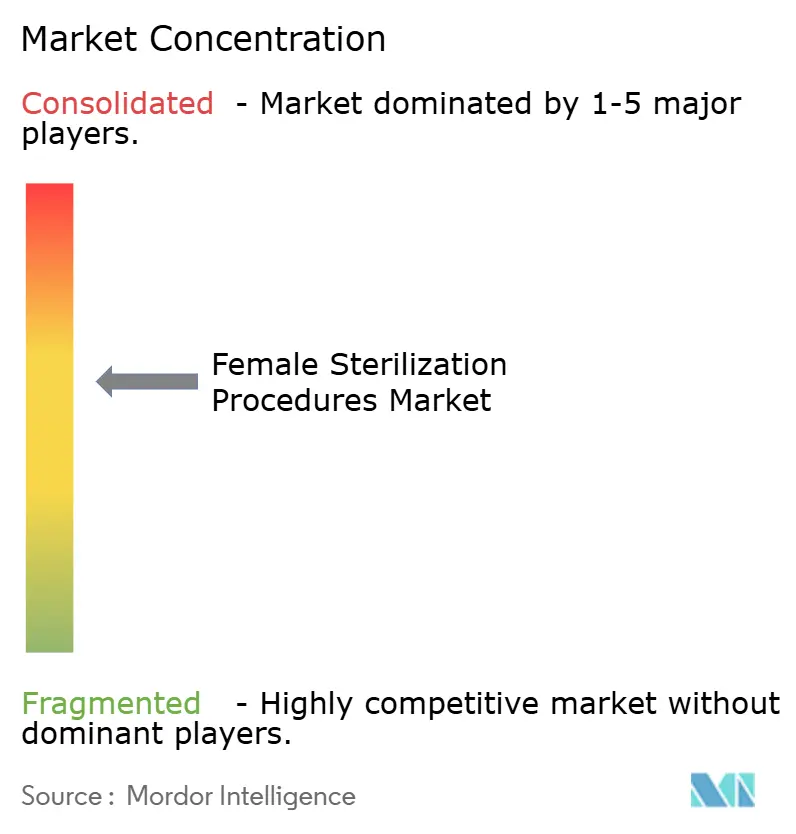
The female sterilization procedures market is globally fragmented, with no single organization maintaining leadership across all countries. In lower-income settings, reproductive health organizations compete based on geographic reach, public-sector relationships, and their ability to adapt to changes in donor funding. MSI Reproductive Choices is expected to serve 27.8 million people across six continents in 2025 and support 14,700 government health workers. EngenderHealth, Planned Parenthood Federation of America, and the International Planned Parenthood Federation also support service delivery through their respective networks. Aid reductions create a more challenging operating environment for organizations that depend on donated commodities and external program funding.
In the United States, Kaiser Permanente, Mayo Clinic, Cleveland Clinic, Johns Hopkins Medicine, and Mass General Brigham compete through clinical expertise, specialist networks, and payer relationships. Indian hospital chains, including Apollo Hospitals, Fortis Healthcare, Narayana Health, and Manipal Health Enterprises, compete through service availability and pricing. Public subsidy programs establish a practical price floor for many public-sector cases, while corporate hospitals serve a growing private-pay patient group. Mid-tier cities in India and Southeast Asia offer further growth opportunities, as NGO outreach programs and large hospital groups have not established broad coverage across all locations. The female sterilization procedures market benefits when hospitals integrate obstetrics, gynecology, and general surgery within existing care pathways.
Technology is an important competitive factor in the female sterilization procedures market. Femasys is expected to receive patents for FemBloc’s blended polymer component in the United States, Japan, South Korea, Brazil, Hong Kong, India, and 13 European countries in August 2026. The company is expected to begin enrollment for its U.S. FINALE pivotal trial in March 2026 and secure its first European FemBloc order in Spain in August 2025. Surgical providers are also responding to European guidance by considering salpingectomy during appropriate abdominal procedures.
Female Sterilization Procedures Industry Leaders
Planned Parenthood Federation of America
MSI Reproductive Choices
EngenderHealth
International Planned Parenthood Federatio
Apollo Hospitals Enterprise Limited
- *Disclaimer: Major Players sorted in no particular order

Recent Industry Developments
- August 2026: Femasys initiated enrollment in the FINALE pivotal trial, NCT05977751. The trial is part of the U.S. FDA premarket approval pathway for FemBloc FEMASYS.
- February 2026: Femasys announced that FemBloc achieved Medical Device Single Audit Program certification. The certification supported regulatory readiness for Canada, Japan, Australia, and Brazil, alongside European commercialization.
- August 2025: FemBloc received regulatory approval in New Zealand. This was the third international jurisdiction to clear the device in 2025.


Global Female Sterilization Procedures Market Report Scope
According to the report’s scope, female sterilization procedures are surgical methods used to permanently prevent pregnancy by blocking or sealing the fallopian tubes. Common techniques include tubal ligation, tubal implants, and salpingectomy.
The female sterilization procedures market is segmented into procedure type, end user, and geography. By procedure type, the market is segmented into Surgical Sterilization and Non-Surgical or Transcervical Sterilization. Surgical Sterilization procedure type is further bifurcated into laparoscopic tubal surgery, abdominal tubal surgery, minilaparotomy, partial salpingectomy, and complete bilateral salpingectomy. Non-surgical or transcervical sterilization procedure type is further bifurcated into hysteroscopic tubal occlusion and transcervical implant-based approaches. By end user, the market is segmented into hospitals and maternity centers, ambulatory surgical centers, gynecology and family-planning clinics, and other end users. By geography, the market is segmented into North America, Europe, Asia-Pacific, the Middle East and Africa, and South America. The report also covers the estimated market sizes and trends for 17 countries across major regions globally. The report offers values (USD) for all the above segments.
| Surgical Sterilization | Laparoscopic Tubal Surgery |
| Abdominal Tubal Surgery | |
| Minilaparotomy | |
| Partial Salpingectomy | |
| Complete Bilateral Salpingectomy | |
| Non-Surgical or Transcervical Sterilization | Hysteroscopic Tubal Occlusion |
| Transcervical Implant-Based Approaches |
| Hospitals and Maternity Centers |
| Ambulatory Surgical Centers |
| Gynecology and Family-Planning Clinics |
| Other End Users |
| North America | United States |
| Canada | |
| Mexico | |
| Europe | Germany |
| United Kingdom | |
| France | |
| Italy | |
| Spain | |
| Rest of Europe | |
| Asia-Pacific | China |
| Japan | |
| India | |
| Australia | |
| South Korea | |
| Rest of Asia-Pacific | |
| Middle East and Africa | GCC |
| South Africa | |
| Rest of Middle East and Africa | |
| South America | Brazil |
| Argentina | |
| Rest of South America |
| By Procedure Type | Surgical Sterilization | Laparoscopic Tubal Surgery |
| Abdominal Tubal Surgery | ||
| Minilaparotomy | ||
| Partial Salpingectomy | ||
| Complete Bilateral Salpingectomy | ||
| Non-Surgical or Transcervical Sterilization | Hysteroscopic Tubal Occlusion | |
| Transcervical Implant-Based Approaches | ||
| By End User | Hospitals and Maternity Centers | |
| Ambulatory Surgical Centers | ||
| Gynecology and Family-Planning Clinics | ||
| Other End Users | ||
| Geography | North America | United States |
| Canada | ||
| Mexico | ||
| Europe | Germany | |
| United Kingdom | ||
| France | ||
| Italy | ||
| Spain | ||
| Rest of Europe | ||
| Asia-Pacific | China | |
| Japan | ||
| India | ||
| Australia | ||
| South Korea | ||
| Rest of Asia-Pacific | ||
| Middle East and Africa | GCC | |
| South Africa | ||
| Rest of Middle East and Africa | ||
| South America | Brazil | |
| Argentina | ||
| Rest of South America | ||


Key Questions Answered in the Report
What is driving growth in female sterilization procedures?
The female sterilization procedures market is supported by greater access to permanent contraception, outpatient care, and salpingectomy for ovarian cancer risk reduction.
How large is the female sterilization procedures market?
The market is projected to grow from USD 9.64 billion in 2026 to USD 12.37 billion by 2031 at a 5.12% CAGR.
Which procedure type leads demand?
Surgical sterilization led with 63.54% of procedure volume in 2025 and is projected to grow at a 7.54% CAGR through 2031.
Why are ambulatory surgical centers gaining relevance?
Ambulatory surgical centers are projected to grow at an 8.12% CAGR as more procedures move to outpatient settings.
Which region is growing fastest?
Asia-Pacific is projected to grow at a 6.54% CAGR through 2031, led by India's large role in permanent contraception use.
How do LARC methods affect permanent contraception choices?
LARC use reached 10.5% in the United States in 2022 and 2023, close to the 11.5% prevalence of female sterilization.
Page last updated on:





