
Facial Paralysis Market Size and Share
Market Overview
| Study Period | 2020 - 2031 |
|---|---|
| Market Size (2026) | USD 2.70 Billion |
| Market Size (2031) | USD 3.48 Billion |
| Growth Rate (2026 - 2031) | 5.24 % |
| Fastest Growing Market | Asia-Pacific |
| Largest Market | North America |
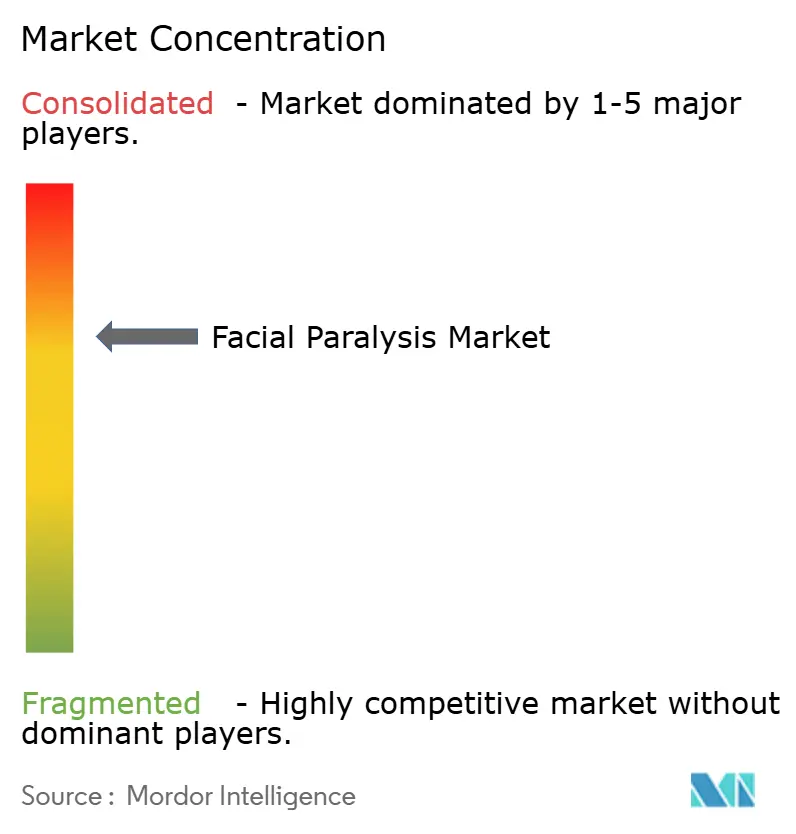
| Market Concentration | Medium |
Major Players *Disclaimer: Major Players sorted in no particular order Image © Mordor Intelligence. Reuse requires attribution under CC BY 4.0. | |
Facial Paralysis Market Analysis by Mordor Intelligence
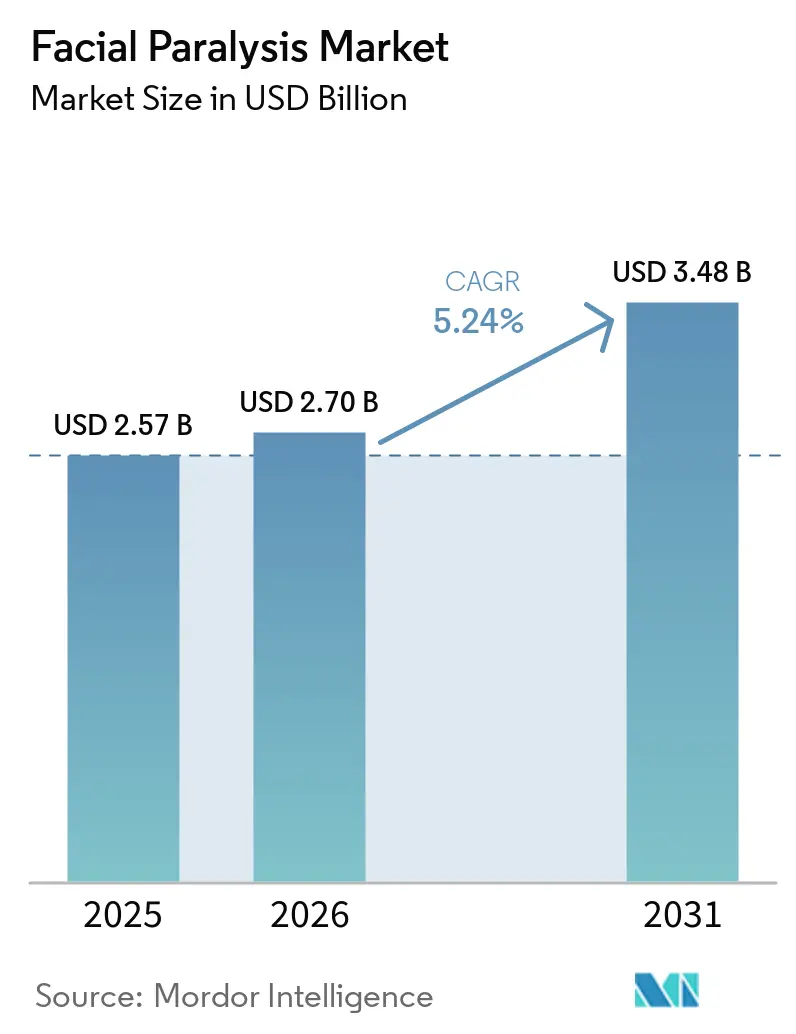
The facial paralysis market is projected to expand from USD 2.57 billion in 2025 and USD 2.70 billion in 2026 to USD 3.48 billion by 2031, registering a CAGR of 5.24% between 2026 and 2031. Rising recognition of facial nerve disorders is widening care pathways beyond acute Bell's palsy treatment. Providers are placing more emphasis on early referral, objective assessment, rehabilitation, and long-term management of synkinesis. The facial paralysis market also benefits from wider access to specialist surgery, outpatient procedures, and digital monitoring. Reimbursement differences for reanimation surgery, electrotherapy, and chemodenervation can still limit adoption even when clinical evidence is favorable. Companies that support multidisciplinary care and clear outcome reporting are better placed to address unmet needs across the facial paralysis market.
Key Report Takeaways
- By etiology, Bell's palsy led with 38.72% revenue share in 2025, while Ramsay Hunt syndrome is forecasted to expand at a 6.15% CAGR through 2031.
- By component, treatment held 51.33% revenue share in 2025, while diagnosis is forecasted to grow at a 7.26% CAGR through 2031.
- By end-user, hospitals held 42.22% revenue share in 2025, while ambulatory surgical centers are forecasted to grow at a 6.64% CAGR through 2031.
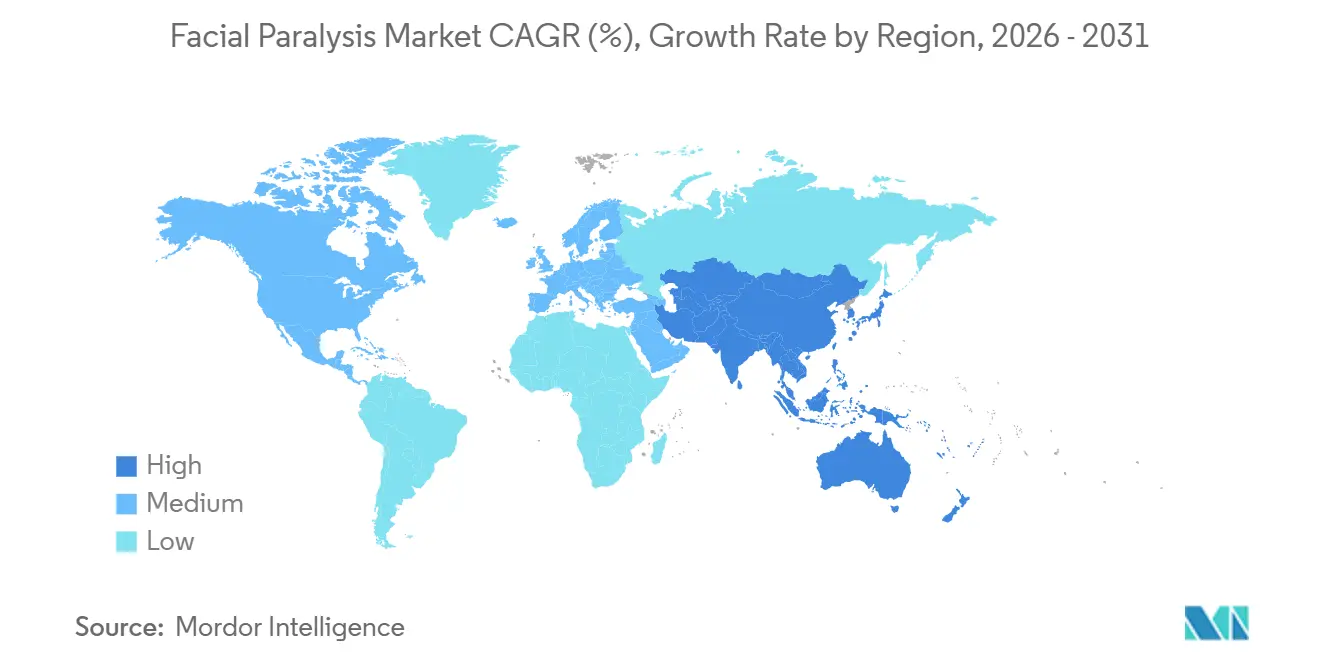
- By geography, North America held 46.27% revenue share in 2025, while the Asia-Pacific is forecasted to grow at 8.32% CAGR through 2031.
Note: Market size and forecast figures in this report are generated using Mordor Intelligence’s proprietary estimation framework, updated with the latest available data and insights as of January 2026.
Market Trends and Insights
Drivers Impact Analysis of Facial Paralysis Market*
| Driver | (~) % Impact on CAGR Forecast | Geographic Relevance | Impact Timeline |
|---|---|---|---|
| Recognition of Facial Nerve Disorders Beyond Bell’s Palsy | +0.8% | Global | Medium term (2-4 years) |
| Earlier Referral to Multidisciplinary Facial Nerve Centers | +0.6% | North America and Europe, with spillover to Asia-Pacific | Medium term (2-4 years) |
| Expansion of Functional Facial Reanimation Surgery | +0.7% | North America and Europe | Medium term (2-4 years) |
| Structured Facial Neuromuscular Rehabilitation Adoption | +0.5% | Global | Short term (≤ 2 years) |
| AI-Assisted Assessment and Tele-Rehabilitation | +0.4% | North America and core Asia-Pacific markets | Medium term (2-4 years) |
| Need for Eye-Surface Protection and Blink Restoration | +0.3% | Global | Short term (≤ 2 years) |
| Source: Mordor Intelligence | |||
Rising Recognition of Facial Nerve Disorders Beyond Bell's Palsy
Bell's palsy historically received most clinical and commercial attention, which left other facial nerve conditions less visible. A U.S. claims analysis found adult incidence of all facial nerve disorders reached 30.5 per 100,000, while Bell's palsy incidence reached 24.5 per 100,000, and total incidence rose by 2.1 cases per 100,000 adults each year from 2007 to 2022.[1]The same research found higher incidence among men and older age groups, which increases demand for care as populations age. A 2025 analysis of TriNetX records also reported that Bell's palsy incidence increased from 48 per 100,000 in 2016-2017 to 69 per 100,000 in 2023-2024, while prevalence rose from 228 to 434 per 100,000.[2] Broader training for neurologists, ENT specialists, and primary care clinicians can bring Ramsay Hunt Syndrome, acquired palsy after head and neck surgery, and congenital conditions into the facial paralysis market sooner. Earlier referral also makes specialist care more relevant before delayed treatment reduces functional recovery options.
Expansion of Functional Facial Reanimation Surgery
Functional facial reanimation is becoming a more established care option for people with permanent or prolonged palsy. Earlier microneurosurgical intervention, masseteric nerve transfer, and dual-innervation procedures have improved the consistency of surgical planning. A 2025 systematic review and meta-analysis found that masseteric nerve transposition performed better than cross-facial nerve grafting on commissural excursion and recovery measures. The facial paralysis market can therefore gain from demand for grafts, implants, and intraoperative monitoring as surgeons adopt common reporting approaches. An international multispecialty consensus published in 2026 established a framework for reporting outcomes after nerve repair, free muscle transfer, and selective myectomy.
Growing Adoption of Structured Facial Neuromuscular Rehabilitation
Structured facial neuromuscular rehabilitation uses targeted exercises, biofeedback, and muscle retraining for people with synkinesis and post-paralytic facial syndrome. A 2025 study found that corticosteroid treatment started within 72 hours was associated with an 87.5% complete recovery rate in Bell's palsy, while early rehabilitation was independently associated with better Sunnybrook scores and faster recovery at 6 and 12 months.[3] Botulinum toxin A can support retraining by reducing synkinesis, improving symmetry, and helping voluntary movement in chronic palsy. A 2025 systematic review reported functional and asymmetry improvements with botulinum toxin treatment across several muscle groups and etiologies. Dedicated rehabilitation centers can create repeat demand for therapy, monitoring, and chemodenervation within the facial paralysis market. The need for eye-surface protection and blink restoration also supports regular follow-up for patients with incomplete recovery.
AI-Assisted Facial Function Assessment and Tele-Rehabilitation
Conventional facial grading can vary between evaluators, while needle EMG can create discomfort and deter some patients. A 2025 review reported inter-evaluator consistency as low as 0.49 for House-Brackmann grade III-IV palsy and cited a 15% refusal rate for needle EMG. A prospective smartphone study published in 2026 reported a System Usability Scale score of 88.3 out of 100 and strong correlations with 3 established grading scales among 21 patients. The study also recorded significant physical and social function improvement after 4 weeks of home rehabilitation. This creates a route for the facial paralysis market to serve patients in Japan and South Korea where specialist access can be constrained by aging populations.
Restraints Impact Analysis of Facial Paralysis Market*
| Restraint | (~) % Impact on CAGR Forecast | Geographic Relevance | Impact Timeline |
|---|---|---|---|
| Uneven Access to Specialized Facial Nerve Care | -0.4% | Global, most acute in the Middle East and Africa and South America | Medium term (2-4 years) |
| High Cost and Limited Reimbursement for Advanced Reanimation | -0.5% | North America and Europe | Medium term (2-4 years) |
| Limited Evidence for Emerging Bioelectronic Therapies | -0.3% | Global | Long term (≥ 4 years) |
| Treatment Delay and Heterogeneous Outcome Measurement | -0.3% | Global | Short term (≤ 2 years) |
| Source: Mordor Intelligence | |||
Uneven Access to Specialized Facial Nerve Care
Facial palsy outcomes depend heavily on timely access to clinicians who can assess and treat the full condition. Multidisciplinary facial nerve centers are concentrated in tertiary academic institutions in North America and Western Europe. A 2025 review found that individualized plans based on intelligent sensor data reduced recovery time by 40% and recurrence by 27%, but these approaches require infrastructure that is not widely available. In South America, the Middle East, and sub-Saharan Africa, limited specialist capacity can lead to underdiagnosis and delayed treatment. This restricts the facial paralysis market despite the underlying need for care.
High Cost and Limited Reimbursement for Advanced Reanimation
Free muscle transfers, nerve grafting, and multistage reconstruction require specialized teams and can carry high treatment costs. Payment policies for electrotherapy in Bell's palsy can require detailed medical necessity documentation and may exclude long-term maintenance treatment. Reimbursement uncertainty can discourage use of costly biologics and surgical interventions. Formulary rules may also direct treatment choices for chemodenervation rather than allowing a clinician's preferred therapy. Limited evidence for emerging bioelectronic therapies adds another barrier because payers and providers require stronger clinical results before broader adoption. These conditions create a gap between available clinical options and realized use in the facial paralysis market.
*Our forecasts treat driver/restraint impacts as directional, not additive. The impact forecasts reflect baseline growth, mix effects, and variable interactions.
Facial Paralysis Market Segment Analysis
By Etiology:
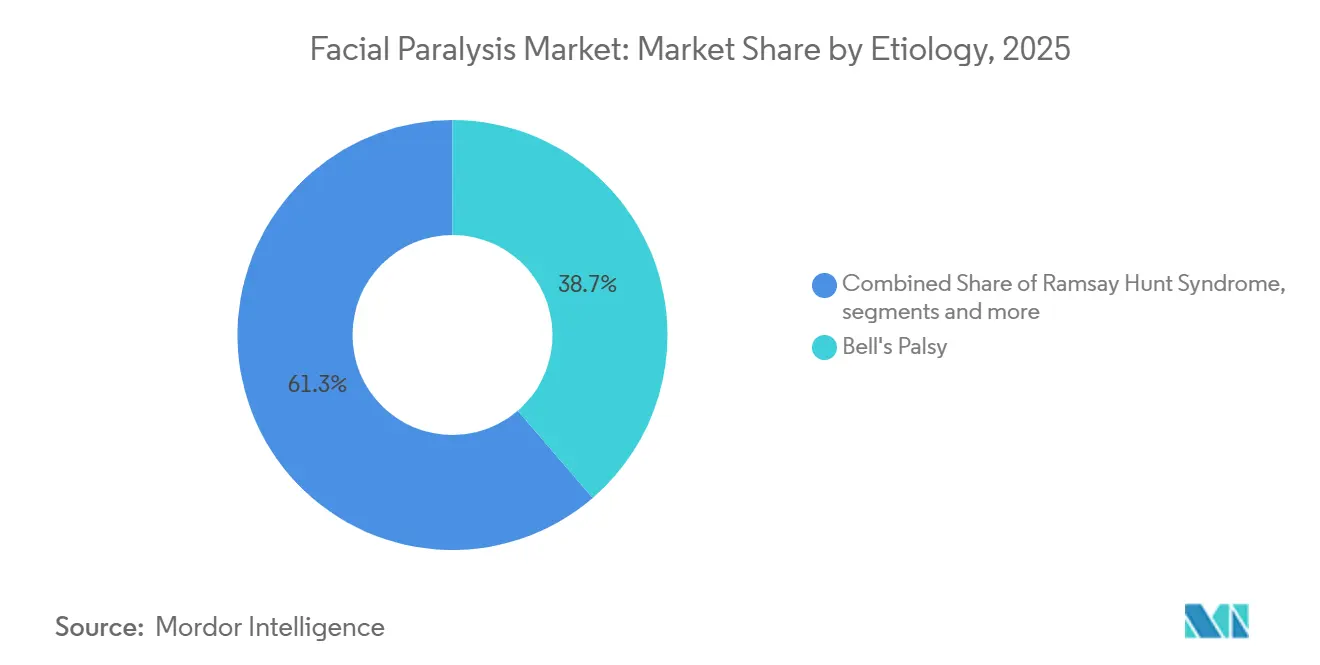
Bell's Palsy Remains the Largest Diagnosis While Zoster-Related Palsy Gains AttentionBell's palsy held 38.72% of the facial paralysis market share in 2025 and remained the largest etiology segment. Published research identified a global annual incidence range of 11.5 to 53.3 per 100,000, making it the most common acute mononeuropathy of the facial nerve. Its demand base includes acute corticosteroid treatment, rehabilitation, and botulinum toxin A for post-paralytic synkinesis. These care settings help sustain medication volume and initial diagnostic demand across the facial paralysis market.
Ramsay Hunt syndrome is forecasted to grow at a 6.15% CAGR through 2031, with rising herpes zoster reactivation in older populations supporting this pattern. Specialist referral and digital triage can reduce this gap, while acquired palsy after parotid tumor resection or skull base surgery is gaining relevance as surgical reporting becomes standardized. Congenital facial paralysis represents a smaller patient group but can require complex procedures and supports higher-value care within the facial paralysis market.

By Component:
Treatment Dominates While Diagnosis Shows Strong GrowthTreatment accounted for 51.33% of revenue in 2025 and remained the largest component of the facial paralysis market. The dominance of the treatment segment is driven by the widespread use of pharmacological therapies, facial reanimation procedures, physical therapy, and supportive interventions aimed at restoring facial function and improving patient quality of life. Growing awareness, increasing treatment-seeking behavior, and advancements in surgical and minimally invasive therapeutic approaches continue to support segment growth across both developed and emerging healthcare markets.
Diagnosis is expected to grow at a CAGR of 7.26% through 2031, making it the fastest-growing component segment. Growth is being driven by increasing adoption of advanced diagnostic tools, including electromyography (EMG), computed tomography (CT), and digital facial assessment technologies, which enable earlier and more accurate evaluation of nerve dysfunction. Improved access to specialist care, rising awareness of facial nerve disorders, and the integration of artificial intelligence-assisted imaging and analysis solutions are further enhancing diagnostic capabilities. As healthcare providers increasingly emphasize early detection and personalized treatment planning, demand for diagnostic services is expected to accelerate throughout the forecast period.
By End-User:
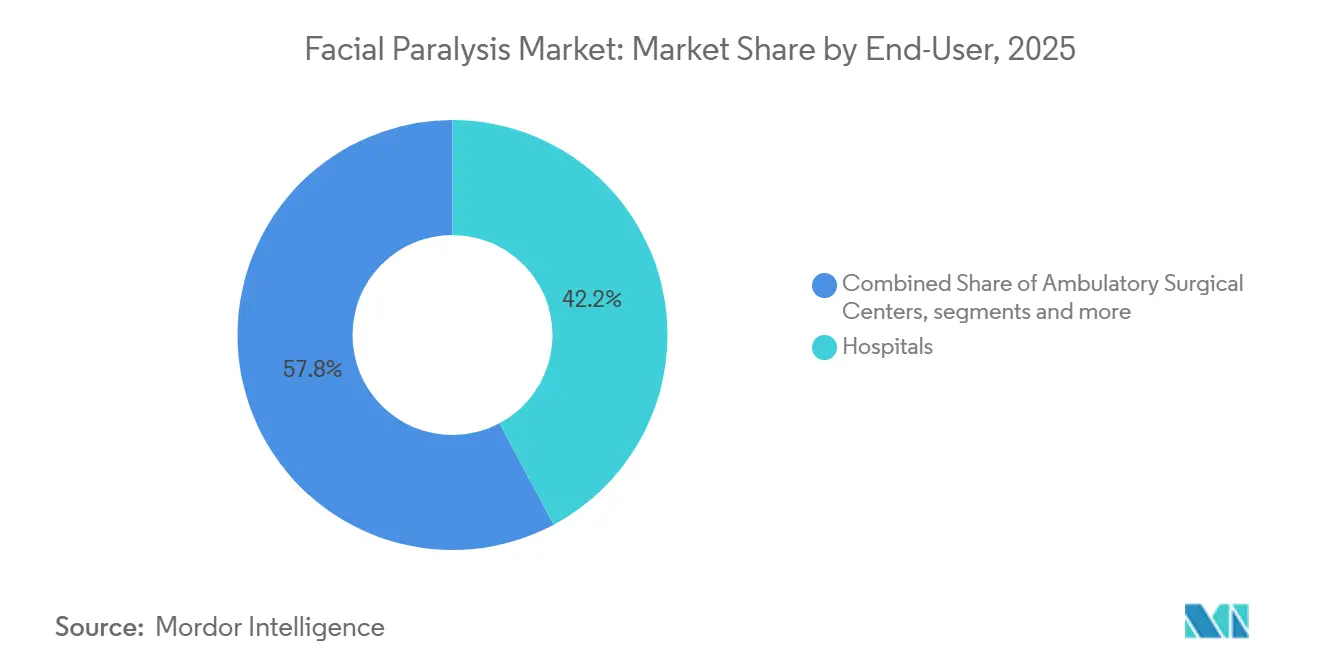
Hospitals Lead While Ambulatory Surgical Centers Gain VolumeHospitals commanded 42.22% of revenue in 2025 and remained the largest end-user setting. They manage acute presentation, complex imaging, inpatient reanimation, and multidisciplinary specialist care. Hospital systems also provide access to neurology, ENT, plastic surgery, and rehabilitation teams. These capabilities make hospitals the central setting in the facial paralysis market.
Ambulatory surgical centers are anticipated to grow at a 6.64% CAGR through 2031, the fastest end-user rate. Expanding outpatient privileges for chemodenervation, nerve repair, and selected reanimation procedures support this change. Payer preference for lower-cost outpatient settings can shift procedural volume away from inpatient care and provides a distinct growth route for the facial palsy industry.
Geography Analysis
North America Facial Paralysis Market
North America held 46.27% of facial paralysis market share in 2025 and remained the largest regional contributor. The United States has a dense concentration of multidisciplinary facial nerve programs and broad use of chemodenervation and surgical reanimation. Canada and Mexico add regional demand, although specialist capacity and reimbursement are less consistent than in the United States.
Europe Facial Paralysis Market
Europe remained the second-largest regional area for the facial paralysis market, supported by established programs in Germany, the United Kingdom, France, and Spain. Universal healthcare systems can improve treatment access compared with similarly sized markets that have more fragmented coverage. The United Kingdom has facial palsy pathways through specialist providers including Queen Victoria Hospital NHS Foundation Trust, while Germany combines a strong ENT surgical base with demand for neurology monitoring and EMG equipment. Italy, Spain, and France are seeing wider use of botulinum toxin A protocols in ENT and plastic surgery outpatient care.
APAC, MEA and South America Facial Paralysis Market
Asia-Pacific is projected to grow at an 8.32% CAGR from 2026 to 2031, the fastest regional pace in the facial paralysis market. Aging populations, herpes zoster burden, expanding ENT infrastructure, and private healthcare investment in India support demand across major countries. A Korean cohort study published in 2025 found an 87.5% complete recovery rate with corticosteroid-based ENT department care and stronger results in severe cases. South Korea's reimbursement-based herbal medicine research reflects willingness to assess complementary approaches within its health system. The Middle East and Africa and South America remain underpenetrated because prevalence data and specialist infrastructure are limited, although GCC investment and Brazil's private hospital expansion offer future opportunities.
Competitive Landscape
The facial paralysis market has a divided competitive structure. Pharmaceutical and chemodenervation activity is concentrated among AbbVie, Ipsen, and Merz Pharma. The device, diagnostic, and surgical areas include larger medical technology companies and smaller innovators with specialized products. AbbVie's onabotulinumtoxinA has strong specialist recognition for synkinesis management and benefits from injector training and established clinical use. Ipsen reported in 2025 that its LANTIC Phase II study of IPN10200 supported initiation of Phase III development for upper facial indications, illustrating competition through clinical evidence, specialist engagement, and product development.
Medtronic received U.S. Food and Drug Administration clearance in March 2026 for the Stealth AXiS surgical system for cranial and ENT procedures, combining navigation, planning, robotics, and intraoperative ultrasound where facial nerve preservation can matter. These moves strengthen the surgical and nerve-repair portion of the facial paralysis market and raise the importance of regulatory planning for smaller firms. FDA 510(k), De Novo, and biologics pathways can shape how quickly products reach clinical settings.
Tele-rehabilitation remains an open area because digital providers can focus on software and patient engagement without a legacy device portfolio. Bioelectronic neuromodulation is also under development, but its evidence base remains limited. Companies developing tools for objective assessment may compete by making follow-up more convenient and measurable. ISO 13485 compliance remains important for device companies that want to expand in North America and Europe.
Facial Paralysis Industry Leaders
-
AbbVie Inc.
-
Ipsen S.A.
-
Merz Pharma GmbH & Co. KGaA
-
Medtronic plc
-
Integra LifeSciences Holdings Corporation
- *Disclaimer: Major Players sorted in no particular order
Facial Paralysis Market Companies Covered in this Report
- Abbvie
- Axogen, Inc.
- Boston Scientific
- Brain Lab
- GE HealthCare Technologies Inc.
- GlaxoSmithKline
- Integra LifeSciences
- Ipsen
- Johnson & Johnson
- Medtronic
- Merz Pharma
- Natus Medical
- Neurotrigger Ltd
- Nihon Kohden
- Novartis
- Pfizer
- Sanofi
- Siemens Healthineers
- Stryker
- Teva Pharmaceutical Industries
Recent Industry Developments in Facial Paralysis Market
- May 2026: The University of Virginia Health System launched a dedicated research initiative to expand scientific investigation into facial paralysis treatment, signaling institutional commitment to translating bench findings into clinical protocols and potentially expanding the evidence base for emerging therapies.
- March 2026: Medtronic received United States FDA clearance for the Stealth AXiS surgical system for cranial and ENT procedures, integrating AI-enabled navigation, robotics, and GE HealthCare's intraoperative ultrasound, bkActiv, into a unified platform. The system's AI-based automatic tractography enables patient-specific brain mapping and neural pathway visualization during skull base and ENT procedures where facial nerve preservation is critical.
- December 2025: Axogen, Inc. received FDA approval of its Biologics License Application for AVANCE acellular nerve allograft-arwx for treating adult and pediatric patients aged ≥1 month with peripheral nerve discontinuities, including mixed and motor nerves. Commercial availability under the licensed biologic framework began in early Q2 2026, with the approval carrying an implication of 12 years of potential United States market exclusivity.
Global Facial Paralysis Market Report Scope
According to the report’s scope, the facial paralysis market for diagnostic tools, surgical interventions, and therapeutic devices is aimed at treating facial nerve dysfunction that causes partial or complete loss of facial movement. It includes nerve repair techniques, grafts, muscle transfers, rehabilitation therapies, and implantable devices that restore facial symmetry, function, and patient quality of life.
The facial paralysis market is segmented into etiology, component, end-user, and geography. By etiology, the market is segmented into Bell's palsy, Ramsay Hunt syndrome, acquired facial palsy, congenital facial paralysis, and other etiologies. By component, the market is segmented into diagnosis and treatment. The diagnosis is further segmented into clinical examination and facial grading, electromyography, computed tomography, and other diagnoses. The treatment is further segmented into medications, physical and rehabilitation therapy, surgical intervention, and combination therapy. By end-user, the market is segmented into hospitals, ambulatory surgical centers, specialty clinics, diagnostic centers, and other end-users. By geography, the market is segmented into North America, Europe, Asia-Pacific, the Middle East and Africa, and South America. The report also covers the estimated market sizes and trends for 17 countries across major regions globally. The report offers values (USD) for all the above segments.
Segmentation Overview
| Bell's Palsy |
| Ramsay Hunt Syndrome |
| Traumatic Facial Paralysis |
| Congenital Facial Paralysis |
| Other Etiologies |
| Diagnosis | Clinical Examination and Facial Grading |
| Electromyography | |
| Computed Tomography | |
| Other Diagnoses | |
| Treatment | Medications |
| Physical and Rehabilitation Therapy | |
| Surgical Intervention | |
| Combination Therapy |
| Hospitals |
| Ambulatory Surgical Centers |
| Specialty Clinics |
| Diagnostic Centers |
| Other End-Users |
| North America | United States |
| Canada | |
| Mexico | |
| Europe | Germany |
| United Kingdom | |
| France | |
| Italy | |
| Spain | |
| Rest of Europe | |
| Asia-Pacific | China |
| Japan | |
| India | |
| Australia | |
| South Korea | |
| Rest of Asia-Pacific | |
| Middle East and Africa | GCC |
| South Africa | |
| Rest of Middle East and Africa | |
| South America | Brazil |
| Argentina | |
| Rest of South America |
| By Etiology | Bell's Palsy | |
| Ramsay Hunt Syndrome | ||
| Traumatic Facial Paralysis | ||
| Congenital Facial Paralysis | ||
| Other Etiologies | ||
| By Component | Diagnosis | Clinical Examination and Facial Grading |
| Electromyography | ||
| Computed Tomography | ||
| Other Diagnoses | ||
| Treatment | Medications | |
| Physical and Rehabilitation Therapy | ||
| Surgical Intervention | ||
| Combination Therapy | ||
| By End-User | Hospitals | |
| Ambulatory Surgical Centers | ||
| Specialty Clinics | ||
| Diagnostic Centers | ||
| Other End-Users | ||
| By Geography | North America | United States |
| Canada | ||
| Mexico | ||
| Europe | Germany | |
| United Kingdom | ||
| France | ||
| Italy | ||
| Spain | ||
| Rest of Europe | ||
| Asia-Pacific | China | |
| Japan | ||
| India | ||
| Australia | ||
| South Korea | ||
| Rest of Asia-Pacific | ||
| Middle East and Africa | GCC | |
| South Africa | ||
| Rest of Middle East and Africa | ||
| South America | Brazil | |
| Argentina | ||
| Rest of South America | ||
Key Questions Answered in the Report
What is driving growth in facial paralysis market?
Rising recognition of facial nerve disorders, earlier referral, rehabilitation, and growth in surgical treatment are supporting expansion through 2031. The market is forecasted to grow from USD 2.57 billion in 2025 to USD 2.70 billion in 2026 to reach USD 3.48 billion in 2031, through 5.24% CAGR.
Which facial paralysis condition has the largest share?
Bell's palsy led by etiology with 38.72% revenue share in 2025. Its care pathway includes acute medications, clinical assessment, rehabilitation, and longer-term treatment for residual synkinesis when needed.
Which component category is growing the fastest?
Diagnosis is forecasted to grow at a 7.26% CAGR through 2031 as healthcare providers increasingly emphasize early detection and accurate assessment of facial nerve dysfunction.
Which region is expected to grow fastest for facial paralysis market?
Asia-Pacific is projected to grow at an 8.32% CAGR from 2026 to 2031, supported by aging populations and expanding specialist care. China, Japan, South Korea, and India each contribute through different care and investment patterns.