
Exterior Insulation and Finish System (EIFS) Market Size and Share
Market Overview
| Study Period | 2022 - 2032 |
|---|---|
| Market Size (2027) | USD 121.5 Billion |
| Market Size (2032) | USD 177.29 Billion |
| Growth Rate (2027 - 2032) | 7.85 % |
| Fastest Growing Market | Asia-Pacific |
| Largest Market | Asia-Pacific |
| Market Concentration | Low |
Major Players *Disclaimer: Major Players sorted in no particular order Image © Mordor Intelligence. Reuse requires attribution under CC BY 4.0. | |
Exterior Insulation and Finish System (EIFS) Market Analysis by Mordor Intelligence
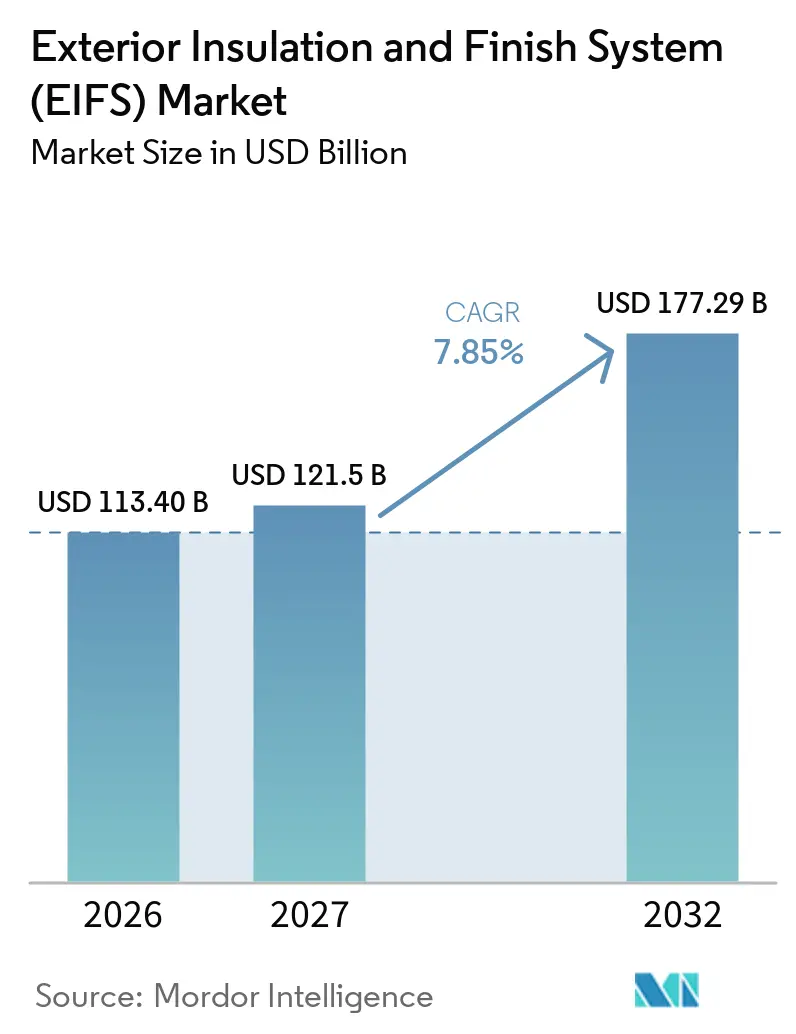
The Exterior Insulation and Finish System (EIFS) Market size was valued at USD 113.40 billion in 2026 and is estimated to grow from USD 121.50 billion in 2027 to reach USD 177.29 billion by 2032, at a CAGR of 7.85% during the forecast period (2027-2032). Demand is moving toward renovation work as building-energy rules require owners to improve poorly performing structures. The revised Energy Performance of Buildings Directive requires European Union countries to prepare national renovation plans and sets renovation requirements for the least efficient nonresidential buildings. Continuous insulation is gaining attention because it limits heat loss through wall connections and supports compliance with stricter envelope requirements. Suppliers are responding by packaging insulation, barriers, coatings, and warranties as one system. Installation quality, project financing, moisture control, and insurer requirements remain important limits on adoption.
Key Report Takeaways
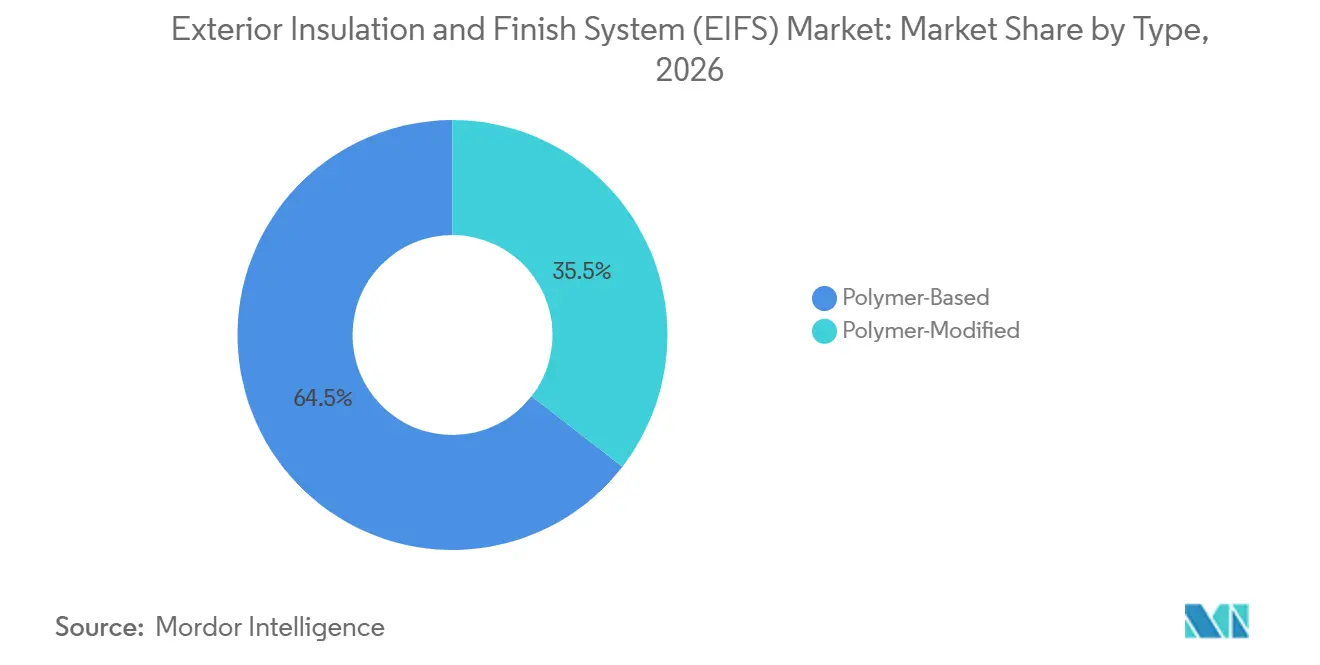
- By type, polymer-based held 64.51% of the exterior insulation and finish system (EIFS) market share in 2026 and is forecast to advance at an 8.25% CAGR through 2032.
- By insulation type, expanded polystyrene (EPS) held 58.13% of the exterior insulation and finish system (EIFS) market share in 2026, while mineral wool (MW) is forecast to advance at an 8.48% CAGR through 2032.
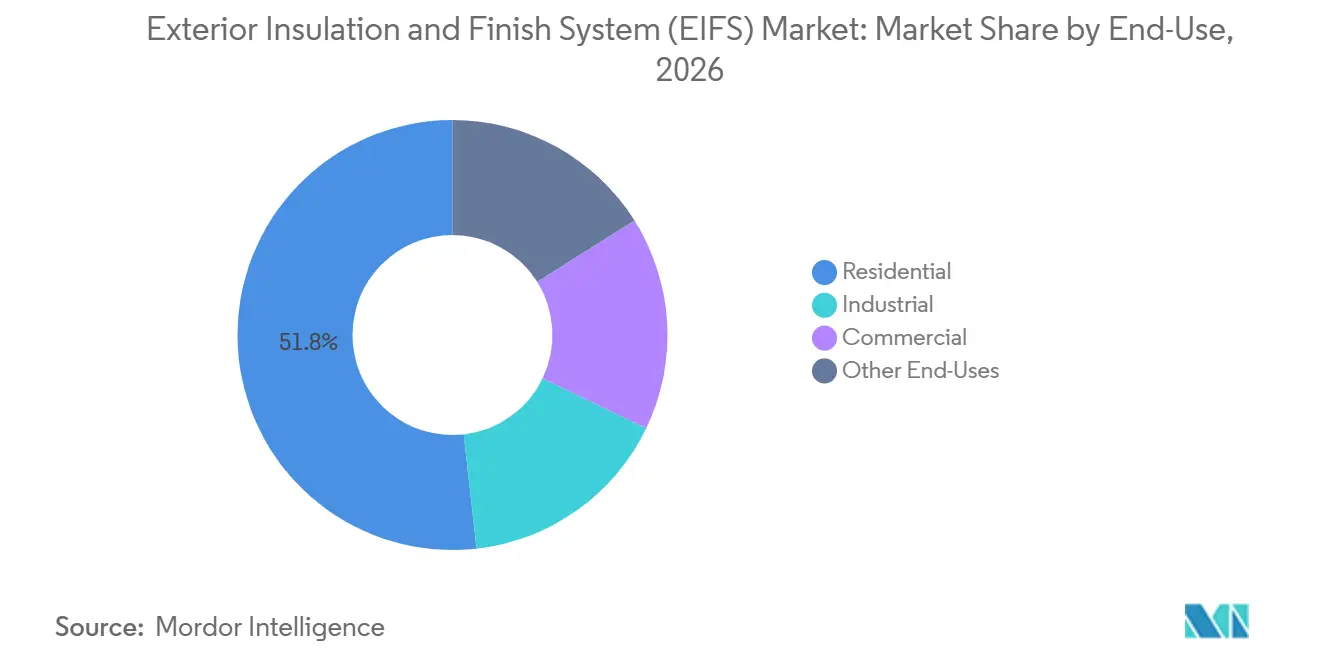
- By end-use, residential held 51.78% of the exterior insulation and finish system (EIFS) market share in 2026 and is forecast to advance at an 8.91% CAGR through 2032.
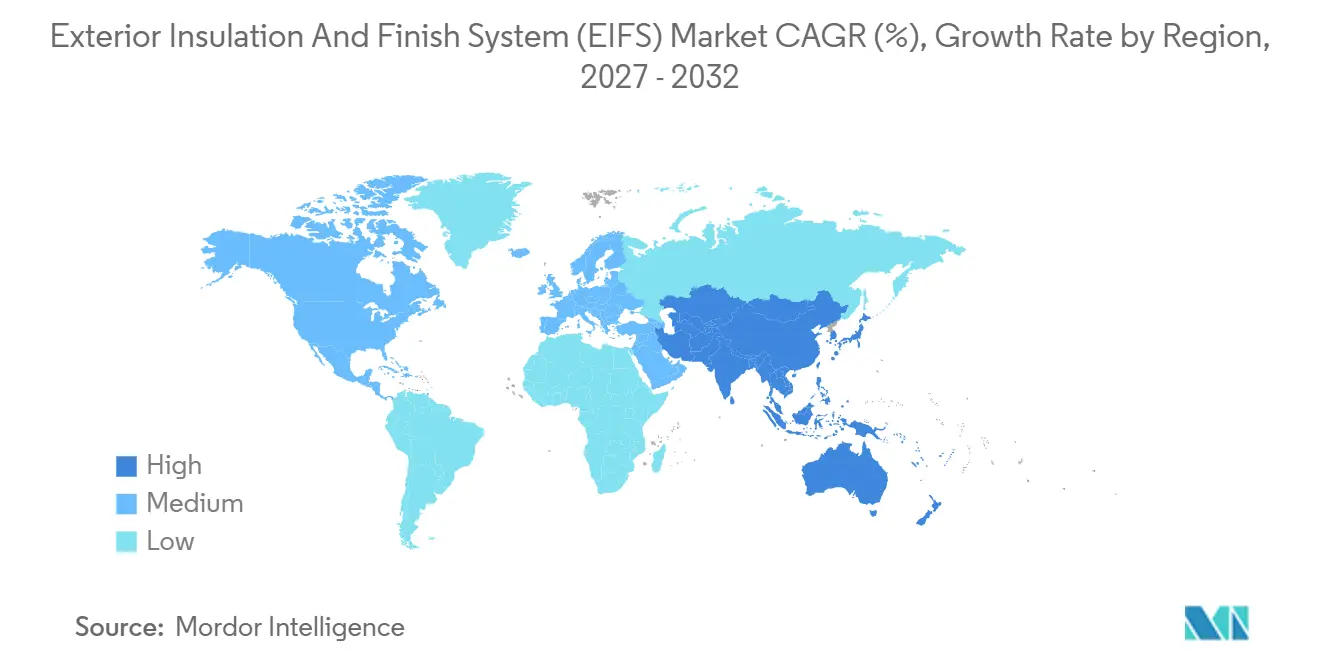
- By geography, Asia-Pacific held 35.32% of the exterior insulation and finish system (EIFS) market share in 2026 and is forecast to advance at an 8.77% CAGR through 2032.
Note: Market numbers in this report are based on Mordor Intelligence's proprietary estimation framework, which combines nine months of actuals with Q4 projections for base year 2026.
Market Trends and Insights
Drivers Impact Analysis of Exterior Insulation and Finish System (EIFS) Market*
| Driver | (~) % Impact on CAGR Forecast | Geographic Relevance | Impact Timeline |
|---|---|---|---|
| Stricter Building Energy Codes and Retrofit Mandates | +2.1% | Global, particularly EU, North America, and China | Short term (≤ 2 years) |
| Energy-Cost Reduction and Continuous-Insulation Demand | +1.8% | Global, with concentration in Europe and Asia-Pacific | Medium term (2–4 years) |
| Green-Building Investment and Carbon-Reduction Targets | +1.4% | North America, EU, Asia-Pacific core; spillover to MEA | Medium term (2–4 years) |
| Urbanization and Lightweight Façade Construction | +1.1% | Asia-Pacific core (China, India, ASEAN); South America | Long term (≥ 4 years) |
| Heat, Moisture, and Climate-Resilience Requirements | +0.9% | APAC, MEA, South America; early gains in North America | Long term (≥ 4 years) |
| Source: Mordor Intelligence | |||
Stricter Building Energy Codes and Retrofit Mandates
Building-energy rules are moving beyond minimum performance and are creating a larger renovation pipeline for the exterior insulation and finish system (EIFS) market. The revised Energy Performance of Buildings Directive requires European Union member states to submit national building renovation plans by December 2026[1]. It requires renovation of the worst-performing 16% of nonresidential buildings by 2030 and 26% by 2033. The Commission states that 85% of European Union buildings were built before 2000, and 75% have poor energy performance. California’s 2025 Building Energy Efficiency Standards apply to permits from January 1, 2026, and tighten building-envelope requirements. National implementation can take time, which extends the work pipeline after a code is adopted.
Energy-Cost Reduction and Continuous-Insulation Demand
Energy expenses continue to support the business case for continuous insulation in the exterior insulation and finish system (EIFS) market. EIFS can reduce thermal bridging that remains in wall assemblies relying only on cavity insulation. The International Energy Agency states that buildings constructed under stringent codes can use up to 50% less energy than buildings constructed before such codes. This performance case supports greater use of drainage-type systems where owners seek longer service life. The 2025 edition of American Society of Heating, Refrigerating and Air-Conditioning Engineers (ASHRAE) Standard 90.1 includes updates affecting continuous insulation and window-to-wall thermal alignment in commercial buildings.
Green-Building Investment and Carbon-Reduction Targets
Green-building programs are supporting demand in the exterior insulation and finish system (EIFS) market beyond conventional construction cycles. Leadership in Energy and Environmental Design version 5 gives greater weight to decarbonization and energy performance in project evaluation. This approach makes envelope performance more important for projects seeking higher certification levels. BASF launched WALLTITE RSB in December 2025 with recycled and biobased inputs and an Environmental Product Declaration aligned with ISO 14067:2018. The product shows how insulation suppliers are combining product chemistry with environmental documentation. Energy-performance thresholds used in financing and procurement can also turn voluntary owner preferences into renovation requirements.
Urbanization and Lightweight Façade Construction
Urban growth is expanding the need for lightweight façade systems in the exterior insulation and finish system (EIFS) market, especially in the Asia-Pacific and South America. The Global Status Report for Buildings and Construction projects an average annual growth of 1.5% in building energy demand across Africa and Asia-Pacific through 2030. Dense cities also need systems that address heat, moisture, and rainfall while fitting constrained project schedules. Sika acquired Singapore-based Elmich Pte Ltd in February 2025, extending its building-envelope offering into urban greening and green-roof systems. These requirements support integrated envelope specifications that include thermal, water-management, acoustic, and façade functions.
Restraints Impact Analysis of Exterior Insulation and Finish System (EIFS) Market*
| Restraint | (~) % Impact on CAGR Forecast | Geographic Relevance | Impact Timeline |
|---|---|---|---|
| High Upfront Cost and Financing Friction | -1.8% | Global; most acute in emerging APAC, South America, MEA | Short term (≤ 2 years) |
| Skilled-Installer Dependence and Quality Variability | -1.4% | Global; most acute in rapidly urbanizing APAC and North America | Medium term (2–4 years) |
| Moisture-Ingress, Cracking, and Warranty Risk | -0.9% | North America (Gulf Coast, Southeast); high-humidity APAC | Long term (≥ 4 years) |
| Source: Mordor Intelligence | |||
High Upfront Cost and Financing Friction
Upfront cost can limit uptake in the exterior insulation and finish system (EIFS) market even when energy savings support life-cycle value. The challenge is most pronounced where developers rely on short-term project financing and cannot retain the benefit of lower operating costs. Owners may also lack the tools needed to evaluate future energy savings against initial spending. The revised Energy Performance of Buildings Directive requires member states to establish one-stop renovation shops by May 29, 2026, combining technical, financial, and administrative support. Insurance exclusions and surcharges in humid U.S. locations can further raise ownership costs. Wider access to energy-performance lending and Property Assessed Clean Energy financing could improve adoption among cost-sensitive developers.
Skilled-Installer Dependence and Quality Variability
EIFS performance depends on installation practices, which create a persistent constraint for the exterior insulation and finish system (EIFS) market. Adhesive coverage, mesh placement, base-coat thickness, and sealing at penetrations affect long-term water control. American Society for Testing and Materials (ASTM) E2568 covers performance requirements for EIFS and supports the drainage approach required under applicable building codes. A shortage of trained construction workers can result in work being moved to crews without EIFS-specific skills. Poor installation can lead to cracking or moisture damage, and those claims can weaken confidence in the full product category. Manufacturers are expanding certification and installation guidance, but quality control will remain a medium-term issue across fragmented contractor networks.
*Our forecasts treat driver/restraint impacts as directional, not additive. The impact forecasts reflect baseline growth, mix effects, and variable interactions.
Exterior Insulation and Finish System (EIFS) Market Segment Analysis
By Type:
Polymer-Based Leads Demand Through Broad Formulation OptionsPolymer-based segment held 64.51% of the exterior insulation and finish system (EIFS) market share in 2026 and is projected to expand at an 8.25% CAGR through 2032. Their broad use reflects compatibility with acrylic and silicone finish coats, application across climate zones, and lower installed costs than polymer-modified alternatives. This position also benefits from a large contractor base familiar with standard adhesive-mortar methods. Wacker Chemie AG supplies VINNAPAS polymer binders used in mortars and base coats for EIFS applications. These binders support adhesion and finish performance without requiring a shift to more expensive system architectures.
The 2025 revision of ISO 4898 sets specifications for rigid cellular plastic thermal-insulation products used in buildings. More consistent product requirements can support the quality baseline for polymer-based assemblies using expanded polystyrene boards. Polymer-modified systems remain relevant for commercial and institutional projects where owners need greater impact resistance and adhesion on difficult substrates. They are also used where project teams seek extended warranty coverage. That system approach can raise average project values while maintaining price competition among product types.
By Insulation Type:
Mineral Wool Gains Ground as Fire Standards TightenExpanded polystyrene held 58.13% of the exterior insulation and finish system (EIFS) market in 2026. Its low density, thermal performance per unit cost, and compatibility with established installation practices support its continued use. ISO 4898:2025 provides updated specifications for rigid cellular plastics used as thermal insulation in buildings. These requirements raise attention to dimensional and thermal performance across the supply base. Expanded polystyrene remains a practical choice for many standard residential and commercial wall applications.
Mineral wool is projected to advance at an 8.48% CAGR through 2032 as high-rise and densely occupied buildings place more emphasis on noncombustible insulation. ROCKWOOL A/S states that its Frontrock board is designed for EIFS use and is supported for building types I-V under the International Building Code. The product range also addresses applications where fire and smoke performance shape material selection. Other insulation types, including phenolic foam and mineral boards, serve specialized thermal or acoustic requirements. Their use remains project-specific because the systems do not have the broad installer familiarity of expanded polystyrene. The exterior insulation and finish system (EIFS) market therefore has a widening performance range rather than a single replacement path.
By End-Use:
Residential Retrofits Support the Largest and Fastest-Growing SegmentThe residential segment held 51.78% of the exterior insulation and finish system (EIFS) market in 2026 and is projected to advance at an 8.91% CAGR through 2032. The segment benefits from the scale of the existing housing stock and policy pressure to improve building efficiency. EIFS can be applied over many existing exterior surfaces, which can limit disruption during renovation. The European Union directive requires at least 55% of residential energy-use reductions to come from renovation of the worst-performing buildings. This directs attention to homes where exterior insulation can improve wall performance without major interior work.
Commercial projects use more premium systems with integrated air and water-resistive barriers, mineral wool, and extended warranties. Sto SE & Co. KGaA introduced StoShield SA and Sto GoldSeal STPE in June 2025 to strengthen its building-envelope offering in North America. Industrial use is focused on facilities where thermal control matters, including cold storage and pharmaceutical manufacturing. Other end-uses include schools, hospitals, and transport infrastructure, where long maintenance cycles and fire requirements shape specifications. The exterior insulation and finish system (EIFS) market can therefore draw on both housing work and specialized institutional demand.

Geography Analysis
APAC Exterior Insulation and Finish System (EIFS) Market
Asia-Pacific held 35.32% of the exterior insulation and finish system (EIFS) market in 2026 and is projected to expand at an 8.77% CAGR through 2032. China supports demand through residential, commercial, and public construction, together with building-efficiency programs. Japan, South Korea, Australia, and New Zealand have more retrofit-focused demand. New Zealand published the 2025 amendments to building product specifications for Building Code clauses, including H1 Energy Efficiency[2]. Vietnam, Thailand, and Indonesia are emerging demand centers where rainfall conditions increase interest in drainage-oriented systems.
Europe Exterior Insulation and Finish System (EIFS) Market
Europe has a renovation-led exterior insulation and finish system (EIFS) market because of the scale and age of its building stock. Buildings account for around 40% of European Union energy consumption, and 75% of the building stock has poor energy performance. Germany, France, and Italy remain important demand markets because they have large existing building stocks. Nordic countries have a demand for higher-performing mineral wool systems due to cold climate requirements. Fire-safety requirements are also shifting some high-rise specifications away from combustible insulation. Saint-Gobain reported strategic acquisitions during the first half of 2025, including FOSROC and Cemix, to expand construction-chemicals capabilities and geographic reach.
The Americas and MEA Exterior Insulation and Finish System (EIFS) Market
North America is a mature exterior insulation and finish system (EIFS) market with demand from the renovation of earlier installations and new commercial construction. ASHRAE Standard 90.1-2025 raises attention to continuous insulation and wall thermal performance in commercial buildings. South America is developing demand through urbanization and commercial real estate construction, led by Brazil and Argentina. The Middle East and Africa are expanding from a smaller base through major construction activity and institutional building programs. Terraco Group participates in façade systems across these regions through local technical support and product availability. Climate exposure makes moisture management and durable finishes central to specification decisions across these developing regions.
Competitive Landscape
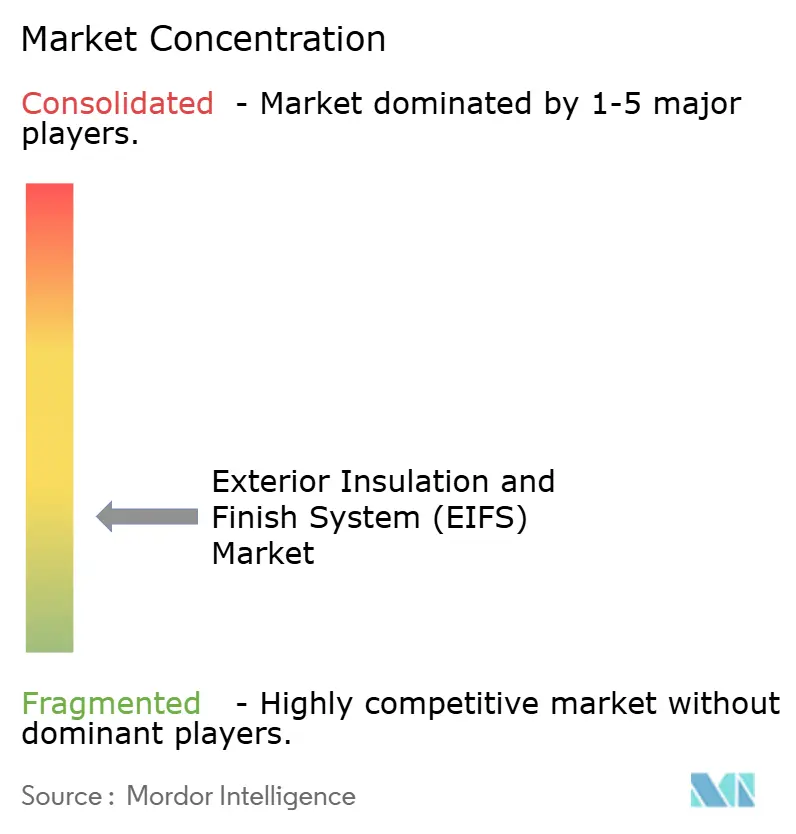
The exterior insulation and finish system (EIFS) market is highly fragmented, with the top five players including BASF, Saint-Gobain, Sika AG, Sto SE & Co. KGaA, and RPM International, Inc. Their scale supports formulation development across adhesives, base coats, reinforcement meshes, and finishes. System warranties can be important because owners want clearer responsibility for envelope performance. Wacker Chemie AG supports the value chain with polymer binders and silicone-resin technologies for EIFS applications. This vertical depth makes product chemistry and warranty coverage important competitive factors.
Regional companies, including ADEX SYSTEMS INC., Master Wall Inc., Omega Products International, Durabond Products Limited, DUROCK ALFACING INTERNATIONAL LIMITED, Terraco Group, and Tremco Incorporated, compete through distribution, contractor familiarity, and local service. Owens Corning, ROCKWOOL A/S, RPM International, Inc., and Saint-Gobain also bring wider insulation or building-envelope portfolios to customer discussions. ROCKWOOL A/S’s Frontrock product addresses EIFS projects where noncombustible stone wool is required. BASF introduced Cavipor clay foam in November 2025 for energy-efficient renovation applications in masonry, floor slabs, and roofing. This development adds a mineral-based insulation alternative in renovation work where fire requirements limit organic materials.
Suppliers are increasingly competing on installation simplicity as well as material performance in the exterior insulation and finish system (EIFS) market. In April 2025, Sika AG launched SikaWall-3000 Rapid Bond, a one-component polyurethane foam adhesive designed for EIFS installation and one-hour curing. In June 2025, Sto SE & Co. KGaA introduced barrier products that can integrate with its EIFS and rainscreen systems. Wacker Chemie AG began producing GENIOSIL STP-E hybrid polymers at Nünchritz in 2025 for adhesives, sealants, and waterproofing applications. Testing requirements and multi-jurisdiction compliance create barriers for smaller suppliers without comparable technical resources.
Exterior Insulation and Finish System (EIFS) Industry Leaders
-
BASF
-
Saint-Gobain
-
Sika AG
-
Sto SE & Co. KGaA
-
RPM International, Inc.
- *Disclaimer: Major Players sorted in no particular order
Exterior Insulation and Finish System (EIFS) Market Companies Covered in this Report
- ADEX SYSTEMS INC.
- BASF
- Durabond Products Limited
- DUROCK ALFACING INTERNATIONAL LIMITED
- Master Wall Inc.
- Omega Products International
- Owens Corning
- ROCKWOOL A/S
- RPM International, Inc.
- Saint-Gobain
- Sika AG
- Sto SE & Co. KGaA
- Terraco Group
- Tremco Incorporated
- Wacker Chemie AG
Recent Industry Developments in Exterior Insulation and Finish System (EIFS) Market
- July 2026: Durabond Products Ltd. added Elastolith brick slips as a finish option for its EIFS exterior cladding systems, enabling brick-like aesthetics alongside customized colors, textures, and patterns. The addition supports the exterior insulation and finish system (EIFS) market by expanding architectural design flexibility while retaining the lightweight and insulation benefits of EIFS assemblies.
- March 2026: Sika AG partnered with Georgia-Pacific Building Products to introduce EIFS solutions integrating the DensElement Barrier System across its Senergy, Parex, and LaHabra brands. The integrated systems reduce installation steps and material waste while supporting continuous insulation and moisture management, strengthening the exterior insulation and finish system (EIFS) market through more efficient building-envelope solutions.
Global Exterior Insulation and Finish System (EIFS) Market Report Scope
Exterior insulation and finish systems (EIFS) are multi-layered exterior wall systems designed to provide thermal insulation, weather protection, and a finished facade. They combine insulation boards with reinforced base coats and decorative finishes to improve building energy efficiency and exterior durability.
The Exterior Insulation and Finish System (EIFS) Market is segmented by type, insulation type, end-use, and geography. By type, the market is segmented into polymer-based and polymer-modified. By insulation type, the market is segmented into expanded polystyrene (EPS), mineral wool (MW), and other insulation types. By end-use, the market is segmented into residential, commercial, industrial, and other end-uses. The report also covers the market size and forecasts for exterior insulation and finish systems across 16 countries. For each segment, the market sizing and forecasts have been done on the basis of value (USD).
Segmentation Overview
| Polymer-Based |
| Polymer-Modified |
| Expanded Polystyrene (EPS) |
| Mineral Wool (MW) |
| Other Insulation Types |
| Residential |
| Commercial |
| Industrial |
| Other End-Uses |
| Asia-Pacific | China |
| India | |
| Japan | |
| South Korea | |
| ASEAN Countries | |
| Rest of Asia-Pacific | |
| North America | United States |
| Canada | |
| Mexico | |
| Europe | Germany |
| United Kingdom | |
| France | |
| Italy | |
| NORDIC Countries | |
| Russia | |
| Rest of Europe | |
| South America | Brazil |
| Argentina | |
| Rest of South America | |
| Middle East and Africa | Saudi Arabia |
| South Africa | |
| Rest of Middle East and Africa |
| By Type | Polymer-Based | |
| Polymer-Modified | ||
| By Insulation Type | Expanded Polystyrene (EPS) | |
| Mineral Wool (MW) | ||
| Other Insulation Types | ||
| By End-Use | Residential | |
| Commercial | ||
| Industrial | ||
| Other End-Uses | ||
| By Geography | Asia-Pacific | China |
| India | ||
| Japan | ||
| South Korea | ||
| ASEAN Countries | ||
| Rest of Asia-Pacific | ||
| North America | United States | |
| Canada | ||
| Mexico | ||
| Europe | Germany | |
| United Kingdom | ||
| France | ||
| Italy | ||
| NORDIC Countries | ||
| Russia | ||
| Rest of Europe | ||
| South America | Brazil | |
| Argentina | ||
| Rest of South America | ||
| Middle East and Africa | Saudi Arabia | |
| South Africa | ||
| Rest of Middle East and Africa | ||
Key Questions Answered in the Report
What is the size of the exterior insulation and finish system (EIFS) market?
The exterior insulation and finish system (EIFS) market size was valued at USD 113.40 billion in 2026 and is estimated to grow from USD 121.50 billion in 2027 to reach USD 177.29 billion by 2032, at a CAGR of 7.85% during the forecast period (2027-2032).
What is driving demand for exterior insulation and finish systems?
Building energy codes, renovation mandates, energy-cost savings, and green-building requirements are supporting demand for continuous insulation systems in the exterior insulation and finish system (EIFS) market.
Which type leads global demand?
Polymer-based systems lead demand with a 64.51% share in 2026 and are projected to advance at an 8.25% CAGR through 2032.
Why is mineral wool becoming more important in EIFS applications?
Mineral wool is projected to advance at an 8.48% CAGR through 2032 because fire performance is increasingly important in high-rise and densely occupied buildings.