
Event Marketing Services Market Size and Share
Market Overview
| Study Period | 2020 - 2031 |
|---|---|
| Market Size (2026) | USD 101.20 Billion |
| Market Size (2031) | USD 204.90 Billion |
| Growth Rate (2026 - 2031) | 15.15 % |
| Fastest Growing Market | Middle East |
| Largest Market | North America |
| Market Concentration | Low |
Major Players *Disclaimer: Major Players sorted in no particular order Image © Mordor Intelligence. Reuse requires attribution under CC BY 4.0. | |
Event Marketing Services Market Analysis by Mordor Intelligence
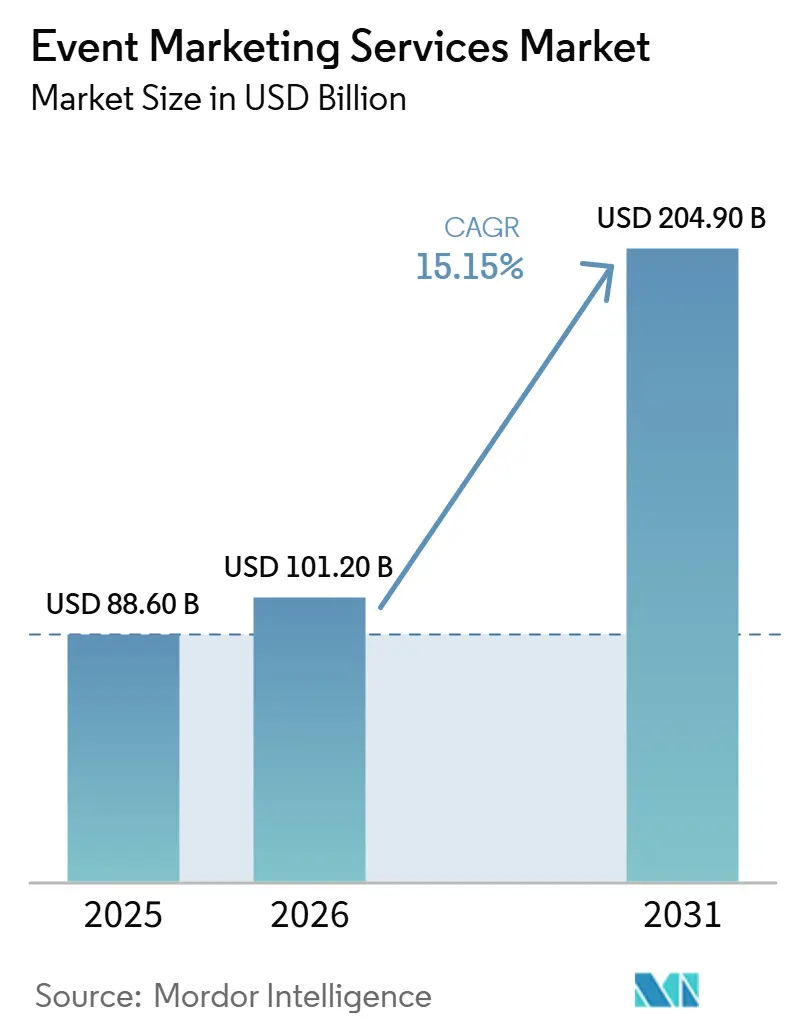
The event marketing services market size is expected to increase from USD 88.60 billion in 2025 to USD 101.20 billion in 2026 and reach USD 204.90 billion by 2031, growing at a CAGR of 15.15% over 2026-2031. Growth reflects the movement of corporate budgets toward programs that connect brand activity with audience engagement, lead development, and sales follow-up. Providers are responding by combining planning, audience services, data management, and event technology into broader service offers. Live formats remain important because direct interaction supports trust and relationship building, while hybrid delivery extends access and content reach. Buyers are also placing greater weight on proof of outcomes, favoring suppliers that can link attendance, engagement, and sales data. Higher venue, labor, and production costs are pushing organizers to concentrate spending on fewer programs with clearer strategic value.
Key Report Takeaways
- By service type, attendee acquisition and audience engagement held 26.43% of the event marketing services market share in 2025, while Event Communication and email marketing are projected to expand at a 16.73% CAGR through 2031.
- By event format, in-person events accounted for 54.10% of the event marketing services market size in 2025, while hybrid events are projected to grow at a 17.91% CAGR through 2031.
- By enterprise size, large enterprises held 63.89% share in 2025, while small and medium-sized enterprises are projected to record a 17.28% CAGR through 2031.
- By industry vertical, IT and telecommunications captured 21.05% of the market in 2025, while healthcare and life sciences are projected to grow at a 16.62% CAGR through 2031.
- By geography, North America held 37.40% of the event marketing services market share in 2025, while the Middle East is projected to expand at a 16.13% CAGR through 2031.
Note: Market size and forecast figures in this report are generated using Mordor Intelligence’s proprietary estimation framework, updated with the latest available data and insights as of January 2026.
Market Trends and Insights
Drivers Impact Analysis of Event Marketing Services Market*
| Driver | (~) % Impact on CAGR Forecast | Geographic Relevance | Impact Timeline |
|---|---|---|---|
| Rising Event-Led Growth Budgets | +3.2% | Global, with concentrated gains in North America and Western Europe | Short term (≤ 2 years) |
| Higher Demand for First-Party Attendee Data and ROI Attribution | +2.8% | Global, particularly North America and Europe | Medium term (2-4 years) |
| Expansion of Hybrid and Repeatable Field Event Programs | +2.5% | Global, with notable adoption in Asia-Pacific and North America | Medium term (2-4 years) |
| AI-Enabled Agenda Personalization and Content Repurposing | +2.2% | Global, with technology adoption concentrated in North America and Western Europe | Long term (≥ 4 years) |
| Increasing Sponsor Demand for Measurable Activation and Lead Quality | +1.8% | Global, strongest in North America and Europe | Medium term (2-4 years) |
| Buying-Committee Attendance Models Lift Multi-Stakeholder Event Spend | +1.2% | North America and Europe, with spillover to core Asia-Pacific markets | Medium term (2-4 years) |
| Source: Mordor Intelligence | |||
Rising Event-Led Growth Budgets
Event budgets increased even as wider B2B marketing investment faced pressure during 2025. The resulting shift in allocation gave the event marketing services market a larger role in corporate planning cycles. Large companies are increasing investment in premium programs, while many other B2B marketers are reducing the number of programs and concentrating funds on those with clearer measurement. Splash reported that organizations following event-led growth strategies were more likely to report company growth above 50%, reinforcing the value placed on events in senior budget discussions. Planning decisions are also moving earlier in the budget cycle, giving service providers more time to secure contracts and organize delivery. This favors suppliers that can translate marketing objectives into event programs with a clear commercial purpose.
Higher Demand for First-Party Attendee Data and ROI Attribution
First-party attendee data has become more valuable as organizations seek clearer evidence of an event's contribution to the pipeline and revenue. The event marketing services market benefits when providers connect registration, session activity, lead capture, and customer relationship management records. Deep platform integration improves the usability of event data by enabling sales teams to see the context behind attendee engagement. This need is especially important as digital intent data becomes more expensive and third-party tracking becomes less dependable. Suppliers that manage consent, data quality, and transfer into sales workflows can strengthen retention with enterprise clients. The same capability can support sponsor reporting by showing the quality and follow-up path of event-generated leads.
Expansion of Hybrid and Repeatable Field Event Programs
Hybrid events are projected to grow at a 17.91% CAGR, making them the fastest-growing format in the event marketing services market. They allow organizers to retain in-person interaction while widening participation through digital access. The model can also limit travel and venue exposure for programs affected by operating restrictions or geopolitical uncertainty. Repeatable field programs are becoming increasingly important as organizations favor smaller, focused gatherings over large-scale, broad events. This shifts service demand away from large-scale logistics toward audience selection, content delivery, and post-event activation. Providers that can apply a consistent operating model across locations are better placed to serve distributed corporate teams.
AI-Enabled Agenda Personalization and Content Repurposing
AI tools are being used to tailor agendas, support attendance forecasting, and extend the life of event content. Cvent stated that its CventIQ capabilities draw on more than 25 years of event data and processed 12.7 billion attendee interactions during the prior 12 months.[1]Cvent, “Cvent Unveils More Than 70 Product Innovations at Cvent CONNECT 2026, Backed by USD 1 Billion Technology Investment,” Cvent, cvent.com The tools can support venue recommendations, website creation, and multilingual reuse of session materials. Personalization is becoming more practical as event platforms, production workflows, and generative AI tools are increasingly widely available. Sessions can be converted into video, written materials, and training assets, which extend their use beyond the event date. This strengthens the case for higher-quality production because the content can support a broader annual communications plan.
Restraints Impact Analysis of Event Marketing Services Market*
| Restraint | (~) % Impact on CAGR Forecast | Geographic Relevance | Impact Timeline |
|---|---|---|---|
| Rising Venue, Labor, and Production Costs | -2.5% | Global, most acute in North America and Western Europe | Short term (≤ 2 years) |
| Persistent ROI Measurement and Martech Integration Gaps | -1.8% | Global, with greater impact in emerging markets where martech maturity is lower | Medium term (2-4 years) |
| Privacy-First Consent Rules Limit Sponsor Data Monetization | -0.9% | Europe, North America, with spillover to Asia-Pacific | Medium term (2-4 years) |
| Delegate Density Per Account Is Softening at Large B2B Events | -0.5% | Global, especially at enterprise B2B events in North America and Europe | Short term (≤ 2 years) |
| Source: Mordor Intelligence | |||
Rising Venue, Labor, and Production Costs
Venue, labor, and production inflation remain the clearest short-term pressure on event program margins. Material handling base rates rose 21.3% from 2022 to 2025, electrical overtime labor increased 41.2%, and straight-time display labor averaged USD 157.48 per hour nationally in 2025. Technical labor can account for 30-50% of event production budgets, making cost control difficult when specialist resources are required. Rigging rules, power distribution, and approved-vendor requirements add expenses that organizers cannot easily negotiate away. These pressures encourage buyers to assess cost per outcome more closely and favor fewer programs with stronger audience value. They also increase demand for suppliers that can standardize production and use technology to reduce manual coordination.
Persistent ROI Measurement and Martech Integration Gaps
Many event teams still struggle to connect event spending with revenue outcomes that satisfy finance leaders. The issue often begins when consent and engagement information collected at registration does not move reliably into customer relationship management and marketing automation systems. That break prevents sales teams from using the full context of attendee behavior. It also weakens the credit assigned to event activity in multi-touch sales journeys. The gap is wider among organizations with fragmented technology and limited data governance. Service providers can address this constraint by integrating data, attribution design, and reporting into the core event delivery model.
*Our forecasts treat driver/restraint impacts as directional, not additive. The impact forecasts reflect baseline growth, mix effects, and variable interactions.
Event Marketing Services Market Segment Analysis
By Service Type:
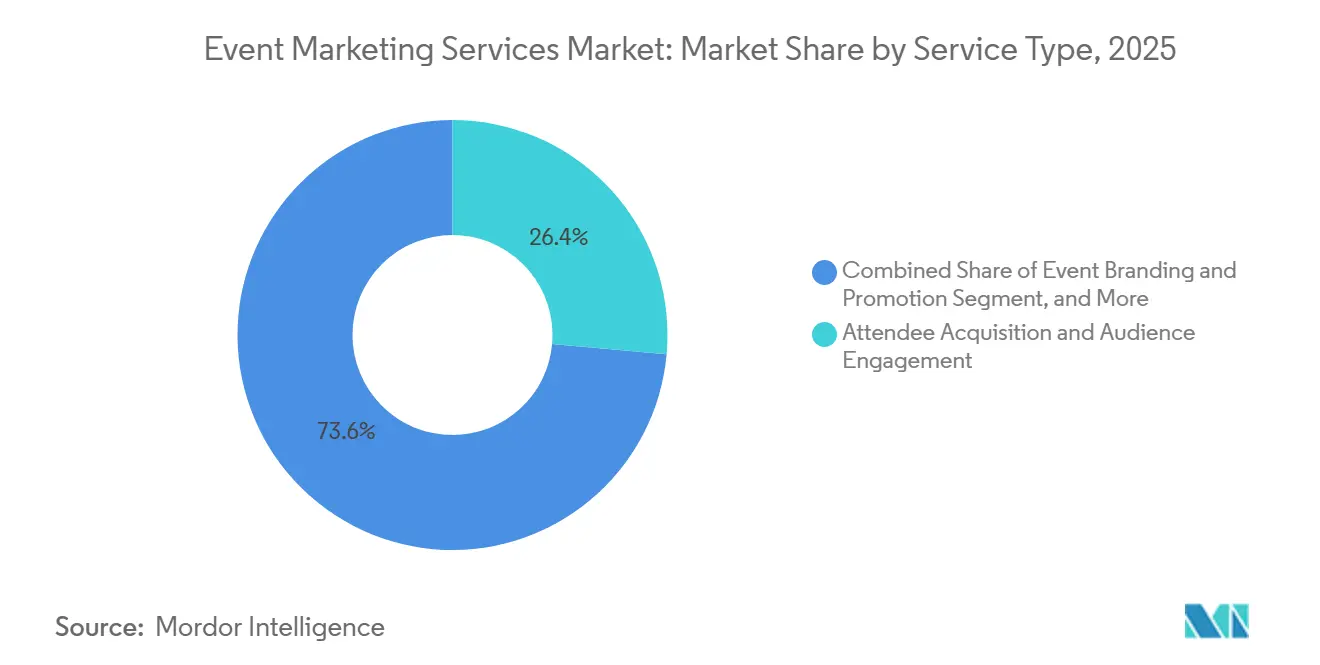
Audience Acquisition Anchors Revenue While Communication Automation GrowsAttendee Acquisition and Audience Engagement held 26.43% of the event marketing services market share in 2025. The position reflects the role of registered audiences in sponsorship value, pipeline generation, content reach, and the broader success of an event. Organizations continue to treat audience growth as a core objective because limited attendance reduces the value of every downstream activity. This makes acquisition services comparatively resilient when buyers reduce broad marketing portfolios. Event Communication and Email Marketing is projected to grow at a 16.73% CAGR through 2031. Its growth is tied to personalized registration flows and behavioral communication that guide prospective attendees from initial awareness to confirmed participation.
Dynamic registration flows converted at 24.4%, compared with 11.6% for static alternatives in the available benchmark evidence, which supports investment in more tailored communication programs. Event communications are moving away from one-time broadcasts and toward sequences based on attendee stage, session interest, and prior participation. This change can divert spending from paid media, as organizers can use existing first-party signals more effectively. Strategy and Planning, Event Branding and Promotion, Sponsorship Activation and Partner Promotion, and Lead Capture and Attendee Data Management make up the remaining service demand. Sponsors increasingly evaluate activation against qualified lead targets and follow-up progress over 30, 60, and 90 days. Lead capture and data management are therefore becoming more specialized as enterprise buyers apply consistent first-party data governance across their event portfolios.



By Event Format:
In-Person Events Lead While Hybrid Delivery Broadens AccessIn-person events accounted for 54.10% of the event marketing services market size in 2025. The value organizations gain from supporting their position through direct discussion, networking, and the ability to bring qualified decision-makers together in one setting. Cvent CONNECT 2026 in Nashville attracted nearly 5,000 in-person attendees and thousands of online participants, showing the continued draw of major live programs. Live interaction remains important as audiences become more skeptical of heavily automated outreach. The format also supports relationship-based activities that are harder to replicate through digital-only engagement. This keeps in-person delivery central to flagship conferences, trade shows, and high-value customer programs.
Hybrid events are projected to expand at a 17.91% CAGR through 2031. They combine live participation with digital access, allowing organizers to reach people who cannot travel or attend in person. The available evidence indicates that hybrid formats can lower venue and travel costs while improving cost effectiveness per attendee. Wider attendance can create revenue through virtual tickets and extended distribution of event content rather than simply replacing in-person registrations. Virtual events remain a separate programming option for restricted budgets, sensitive travel conditions, and audiences that need flexible access. The event marketing services market is therefore moving toward format portfolios in which organizers select delivery modes according to audience needs, risk, and the purpose of each program.
By Enterprise Size:
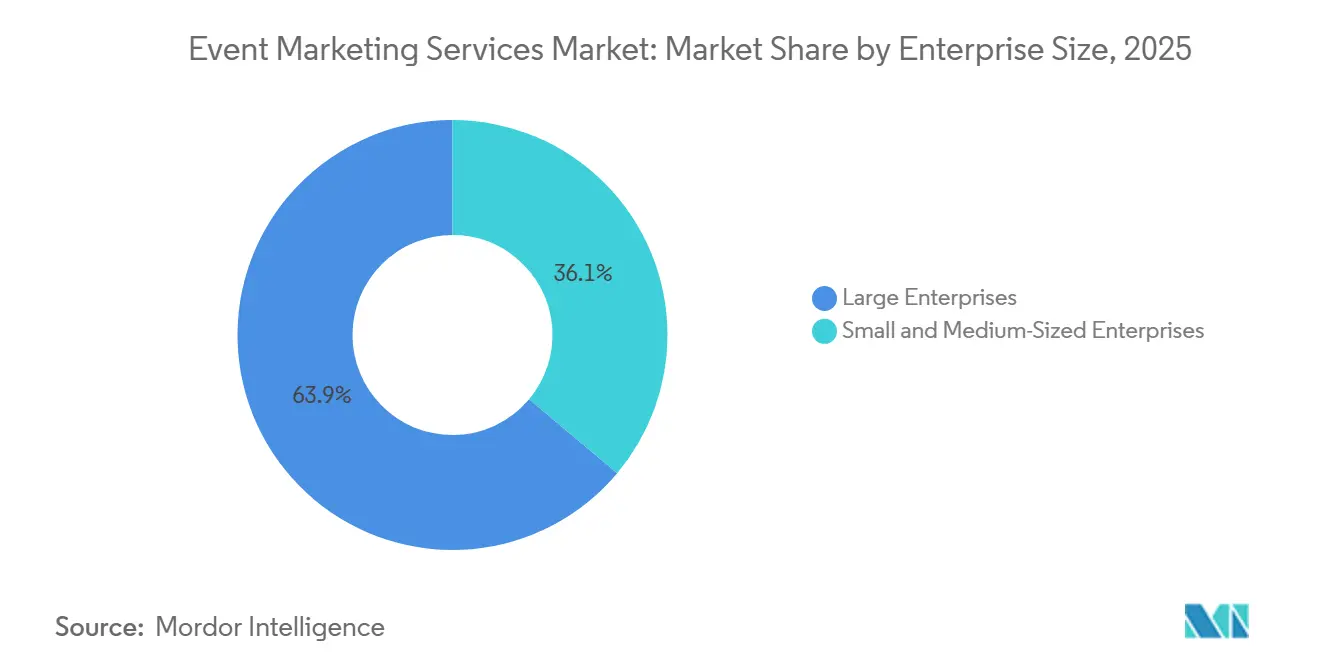
Large Enterprises Lead Spending While SMEs Grow FasterLarge enterprises held 63.89% of the event marketing services market share in 2025. Their scale supports premium production, international conferences, partner programs, and annual flagship events involving multiple decision-makers. Organizations with more than 5,000 employees spend USD 1 million or more annually on events, according to the available industry evidence. Large accounts also tend to buy long-term platform contracts and require integrated data architectures across multiple programs. Cvent stated that it serves 89% of Fortune 100 companies across more than 34,000 organizations. These characteristics make enterprise clients a major source of recurring demand for full-service agencies and technology-enabled service suppliers.
Small and medium-sized enterprises are projected to grow at a 17.28% CAGR through 2031. Cloud-based platforms with modular pricing, simple registration tools, and customer relationship management connections allow these businesses to run repeatable programs with lower upfront costs. The change does not reduce expectations for quality, because buyers still need clear reporting on attendance, engagement, and commercial outcomes. European companies were planning higher event budgets in 2026, with mid-market expansion identified as a factor in the source material. Accountability requirements, once associated mainly with larger procurement teams, are reaching smaller companies. This creates an opportunity for managed programs that combine planning, execution, and attribution without requiring an internal event operations department.
By Industry Vertical:
Technology Leads Spending While Healthcare and Life Sciences ExpandsIT and Telecommunications held 21.05% of the event marketing services market share in 2025. The sector relies on annual conferences, developer events, partner meetings, and product programs to generate revenue and develop the ecosystem. Technology companies are early users of AI-based agenda personalization and long-term platform contracts. Their multi-event planning and integrated data practices provide a model that other sectors are increasingly adopting. BFSI, Retail and E-commerce, Media and Entertainment, Travel and Hospitality, and Manufacturing and Industrials represent the remaining vertical demand. Each follows a different event pattern, including hosted-buyer programs in BFSI and trade exhibition schedules in manufacturing.
Healthcare and Life Sciences are projected to grow at a 16.62% CAGR through 2031. ASCO 2026 attracted more than 44,000 delegates, while BIO International Convention 2026 expected more than 16,000 attendees from 65 countries and more than 45,000 scheduled partnering meetings. The scale of these programs creates demand for specialized planning, communications, data handling, and stakeholder engagement. Inizio identified opportunities to save more than USD 2 million for a large pharmaceutical company by eliminating strategically redundant congresses within a single therapy area.[2]Inizio, “What the Best Congress Experiences Got Right at ASCO 2026,” Inizio, inizio.com US FDA Office of Prescription Drug Promotion requirements and EU Medical Device Regulation constraints add compliance needs around promotional content and clinical data presentations. These conditions favor agencies with healthcare knowledge and create a meaningful barrier for generalist providers.
Geography Analysis
North America Event Marketing Services Market
North America held 37.40% of the event marketing services market share in 2025. The region has a mature enterprise event base supported by B2B trade shows, association conferences, and corporate flagship programs in the United States, Canada, and Mexico. B2B exhibitors allocated 40.8% of their annual marketing budgets to exhibitions, according to the CEIR evidence cited in the research material. Event staffing costs also remain high, with average all-inclusive wages reported at USD 32.10 per hour nationally and higher charges in hub markets. This cost structure pushes producers to use automation and AI-assisted logistics while maintaining the broad range of services clients expect. North America remains a key setting for advanced event platforms, data activation, and premium production services.
Europe Event Marketing Services Market
Europe accounts for a significant share of global activity due to its dense B2B trade show calendar in Germany, the United Kingdom, and France. The United Kingdom recorded event-led marketing budget growth of 14.7% in the first quarter of 2026, according to the source material. Germany's established venues, including Messe Frankfurt and Hannover Messe, support manufacturing and industrial event activity. Organizers are using hybrid tools to broaden their geographic reach without increasing venue costs. Informa reported that more than 15 European B2B event brands were rescheduled in 2026 due to geopolitical disruptions, which affected close to 10% of its live events. This reinforces the need for flexible event portfolios and contingency-ready service arrangements.
MEA, APAC and South America Event Marketing Services Market
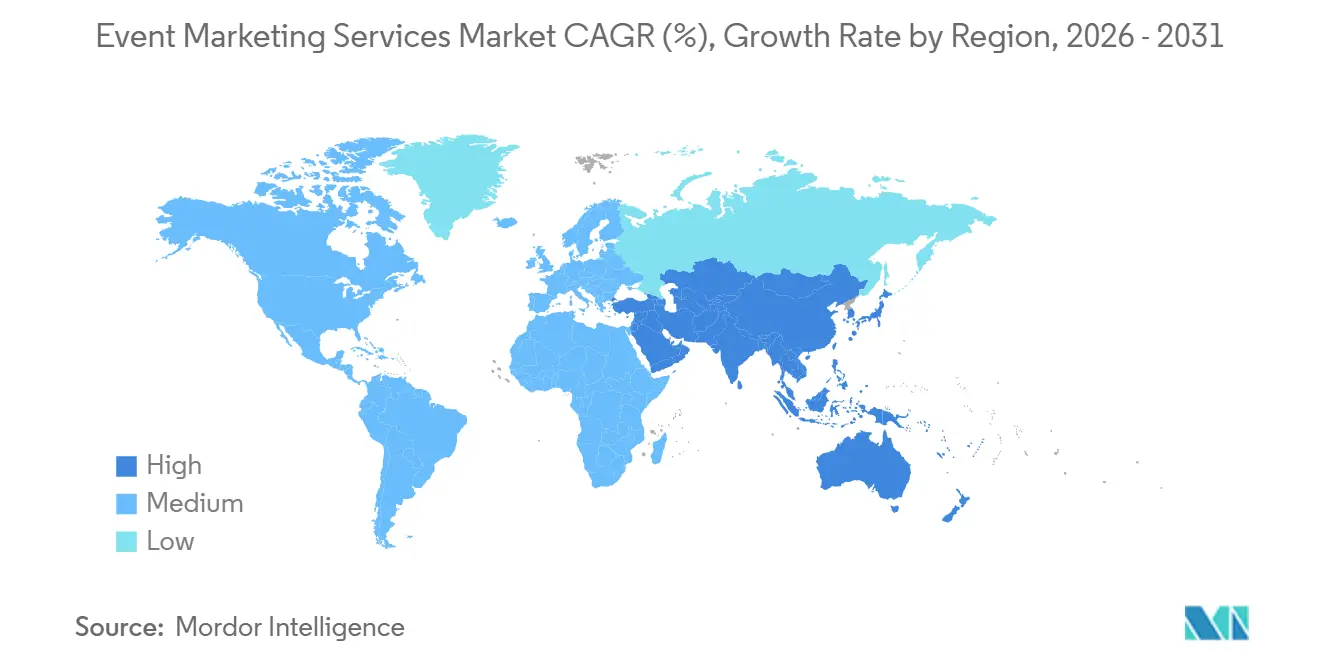
The Middle East is projected to record the fastest regional growth, at a 16.13% CAGR through 2031. The UAE and Saudi Arabia are important centers for new venue capacity and international B2B event activity. Informa and Dubai World Trade Center launched inD in January 2026, a jointly owned live-events business serving the UAE and the broader India, Middle East, and Africa region.[3]Informa PLC, “Informa 2026 Strategic Partnership,” Informa PLC, informa.com The venture targets more than USD 650 million in 2026 revenue and adjusted operating margins above 30%. Asia-Pacific is the second-fastest-growing region, supported by corporate demand in China, India, Japan, and South Korea. South America and Africa remain smaller emerging areas, with Brazil supporting South American demand and South Africa, Egypt, and Nigeria acting as key exhibition and conference centers.

Competitive Landscape
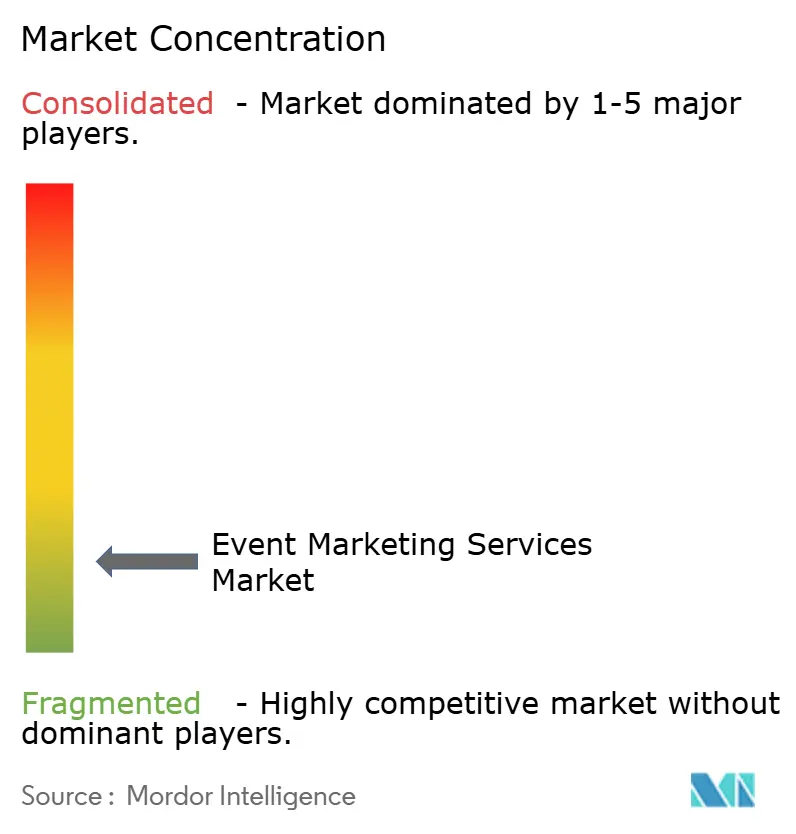
The event marketing services market remains fragmented, with regional agencies, production specialists, and technology vendors competing. The enterprise tier is more concentrated because large clients need integrated platforms, proprietary data, and AI capability. Providers compete on their ability to connect planning, registration, audience engagement, content delivery, and post-event reporting. Local agencies retain an important position where venue knowledge, production quality, and established client relationships determine delivery success. Global suppliers have an advantage when customers require consistent operations across countries and a unified view of program data.
Cvent completed its acquisition of ON24 in April 2026, following its acquisition of Goldcast in December 2025. The combined investment of approximately USD 700 million expanded its coverage across in-person, hybrid, virtual, and webinar programs.[4]Cvent, “Cvent Unveils More Than 70 Product Innovations at Cvent CONNECT 2026, Backed by $1 Billion Technology Investment,” Cvent, cvent.com. Cvent also announced more than 70 product innovations at Cvent CONNECT 2026 and planned a multi-year investment of USD 1 billion in technology and AI. The announcement included 34 new AI capabilities within CventIQ and integration access for Claude, ChatGPT, and Salesforce Agentforce. Informa expanded in the Middle East in January 2026 in partnership with Dubai World Trade Center, serving the UAE and the wider India, Middle East, and Africa region. These moves show how acquisition, product investment, and geographic expansion are shaping the event marketing services market.
Competitive opportunities remain in compliance-focused programs for Healthcare and Life Sciences, managed offerings for SMEs, and first-party data services that support sponsor reporting within privacy constraints. SMEs may favor bundled planning, execution, and measurement because they often have limited internal event operations capacity. AI-native intelligence tools can also appeal to buyers when they provide pipeline attribution without requiring a full platform change. The event marketing services market is likely to reward suppliers that make complex programs easier to manage and explain. Undifferentiated providers face greater pressure when they cannot offer either specialized expertise, strong local execution, or integrated technology capability.
Event Marketing Services Industry Leaders
Cvent Holding Corp.
Freeman Company, LLC
Informa PLC
Eventbrite, Inc.
Bizzabo Ltd.
- *Disclaimer: Major Players sorted in no particular order
Event Marketing Services Market Companies Covered in this Report
- Cvent Holding Corp.
- Freeman Company, LLC
- Opus Agency
- Bizzabo Ltd.
- RainFocus LLC
- Splashthat.com, Inc.
- Stova Group, LLC
- vFairs LLC
- Swoogo LLC
- Accelevents, Inc.
- Whova Inc.
- INVNT Group, LLC
- Informa PLC
- Questex LLC
- MCI Group Holding SA
- George P. Johnson Experience Marketing
- Jack Morton Worldwide, Inc.
- Maritz Holdings Inc.
- GL events SA
- Comexposium Group SAS

Recent Industry Developments in Event Marketing Services Market
- July 2026: Cvent unveiled more than 70 product innovations at Cvent CONNECT 2026 in Nashville, backed by a planned multi-year USD 1 billion technology and AI investment, the largest in the company's history. The launch spanned 34 net-new AI capabilities within CventIQ, a new brand identity centered on The Presence Premium, and the opening of CventIQ Skills to integration with Claude, ChatGPT, and Salesforce Agentforce. Nearly 5,000 in-person attendees and thousands of additional virtual participants attended the event.
- April 2026: Cvent completed its acquisition of ON24, an enterprise-grade webinar and intelligent digital engagement platform serving B2B marketers at scale. The deal, alongside the December 2025 acquisition of Goldcast, brought total acquisition investment to approximately USD 700 million, establishing Cvent as the sole vendor offering an integrated portfolio across in-person, hybrid, virtual, and webinar formats under a single AI-powered platform.
- January 2026: Informa PLC and Dubai World Trade Centre launched inD, a jointly owned B2B live events operating business covering the UAE and the wider India, Middle East, and Africa region. InD targets USD 650 million or more in 2026 revenue at more than 30% adjusted operating profit margins, with Gulfood from January 26-30, 2026, serving as its inaugural flagship event. The joint venture directly responds to structural growth in regional MICE demand driven by Vision 2030 and UAE Tourism Strategy 2031.
- January 2026: Nth Degree Events became a RainFocus Certified Reseller Partner, expanding the distribution and implementation reach of the RainFocus next-generation event marketing platform across enterprise technology event programs. The partnership formalizes Nth Degree's long-standing role as one of RainFocus' largest platform implementers.


Global Event Marketing Services Market Report Scope
The Event Marketing Services Market comprises professional services that help organizations plan, promote, execute, and optimize events to achieve marketing, branding, customer engagement, lead generation, and business development objectives. These services support the entire event lifecycle, from strategic planning and audience targeting to event promotion, attendee engagement, sponsorship activation, lead capture, post-event communication, and performance measurement. Event marketing services are delivered through in-house teams, specialized marketing agencies, event management firms, digital marketing providers, and integrated marketing service companies.
The Event Marketing Services Market Report is Segmented by Service Type (Strategy and Planning, Event Branding and Promotion, Attendee Acquisition and Audience Engagement, Sponsorship Activation and Partner Promotion, Lead Capture and Data Management, and Event Communication and Email Marketing, and Other Service Types), Event Format (In-Person Events, Hybrid Events, and Virtual Events), Enterprise Size (Large Enterprises and Small and Medium-Sized Enterprises), Industry Vertical (Retail and E-commerce, IT and Telecommunications, BFSI, Healthcare and Life Sciences, Media and Entertainment, Travel and Hospitality, Manufacturing and Industrials, and Other Industry Verticals), and Geography (North America, South America, Europe, Asia-Pacific, Middle East, and Africa). The Market Forecasts are Provided in Terms of Value (USD).
| Strategy and Planning |
| Event Branding and Promotion |
| Attendee Acquisition and Audience Engagement |
| Sponsorship Activation and Partner Promotion |
| Lead Capture and Attendee Data Management |
| Event Communication and Email Marketing |
| Other Service Types |
| In-Person Events |
| Hybrid Events |
| Virtual Events |
| Large Enterprises |
| Small and Medium-Sized Enterprises |
| Retail and E-commerce |
| IT and Telecommunications |
| BFSI |
| Healthcare and Life Sciences |
| Media and Entertainment |
| Travel and Hospitality |
| Manufacturing and Industrials |
| Other Industry Verticals |
| North America | United States |
| Canada | |
| Mexico | |
| South America | Brazil |
| Argentina | |
| Chile | |
| Rest of South America | |
| Europe | Germany |
| United Kingdom | |
| France | |
| Italy | |
| Spain | |
| Rest of Europe | |
| Asia-Pacific | China |
| Japan | |
| India | |
| South Korea | |
| Australia | |
| Rest of Asia-Pacific | |
| Middle East | United Arab Emirates |
| Saudi Arabia | |
| Qatar | |
| Rest of Middle East | |
| Africa | South Africa |
| Egypt | |
| Nigeria | |
| Rest of Africa |
| By Service Type | Strategy and Planning | |
| Event Branding and Promotion | ||
| Attendee Acquisition and Audience Engagement | ||
| Sponsorship Activation and Partner Promotion | ||
| Lead Capture and Attendee Data Management | ||
| Event Communication and Email Marketing | ||
| Other Service Types | ||
| By Event Format | In-Person Events | |
| Hybrid Events | ||
| Virtual Events | ||
| By Enterprise Size | Large Enterprises | |
| Small and Medium-Sized Enterprises | ||
| By Industry Vertical | Retail and E-commerce | |
| IT and Telecommunications | ||
| BFSI | ||
| Healthcare and Life Sciences | ||
| Media and Entertainment | ||
| Travel and Hospitality | ||
| Manufacturing and Industrials | ||
| Other Industry Verticals | ||
| By Geography | North America | United States |
| Canada | ||
| Mexico | ||
| South America | Brazil | |
| Argentina | ||
| Chile | ||
| Rest of South America | ||
| Europe | Germany | |
| United Kingdom | ||
| France | ||
| Italy | ||
| Spain | ||
| Rest of Europe | ||
| Asia-Pacific | China | |
| Japan | ||
| India | ||
| South Korea | ||
| Australia | ||
| Rest of Asia-Pacific | ||
| Middle East | United Arab Emirates | |
| Saudi Arabia | ||
| Qatar | ||
| Rest of Middle East | ||
| Africa | South Africa | |
| Egypt | ||
| Nigeria | ||
| Rest of Africa | ||


Key Questions Answered in the Report
What is the event marketing services market size?
The event marketing services market is expected to grow from USD 101.20 billion in 2026 to USD 204.90 billion by 2031 at a 15.15% CAGR.
Which service type leads event marketing services demand?
Attendee Acquisition and Audience Engagement led service demand with 26.43% share in 2025.
Which event format is growing fastest?
Hybrid events are projected to grow at a 17.91% CAGR through 2031, supported by wider access and flexible delivery.
Why are companies investing in event data and attribution?
Companies need to connect registration, engagement, and lead activity with sales outcomes and sponsor reporting.
Which customer group is expanding fastest?
Small and medium-sized enterprises are projected to grow at a 17.28% CAGR through 2031 as modular platforms make managed programs more accessible.
Which vertical has the strongest projected growth?
Healthcare and Life Sciences is projected to grow at a 16.62% CAGR through 2031, supported by large congress programs and specialized compliance needs.
Page last updated on:





