
Europe Urban Micro-Warehousing Market Size and Share
Market Overview
| Study Period | 2020 - 2031 |
|---|---|
| Forecast Data Period | 2026 - 2031 |
| Base Year Market Size (2025) | USD 4.23 Billion |
| Market Size (2026) | USD 4.73 Billion |
| Market Size (2031) | USD 8.06 Billion |
| Growth Rate (2026 - 2031) | 11.27 % |
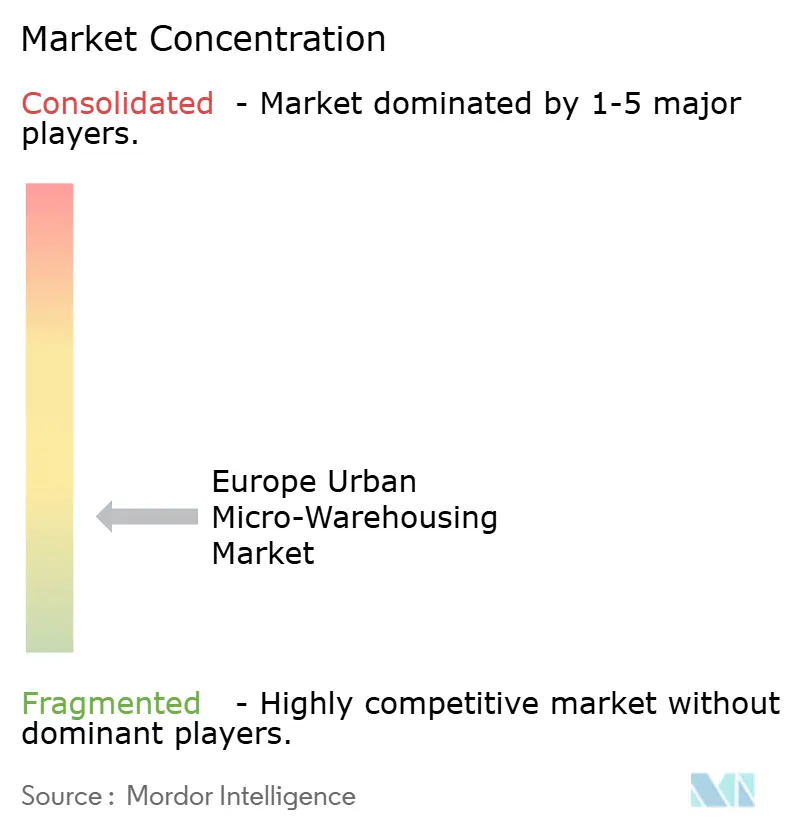
| Market Concentration | Low |
Major Players *Disclaimer: Major Players sorted in no particular order Image © Mordor Intelligence. Reuse requires attribution under CC BY 4.0. | |
Europe Urban Micro-Warehousing Market Analysis by Mordor Intelligence
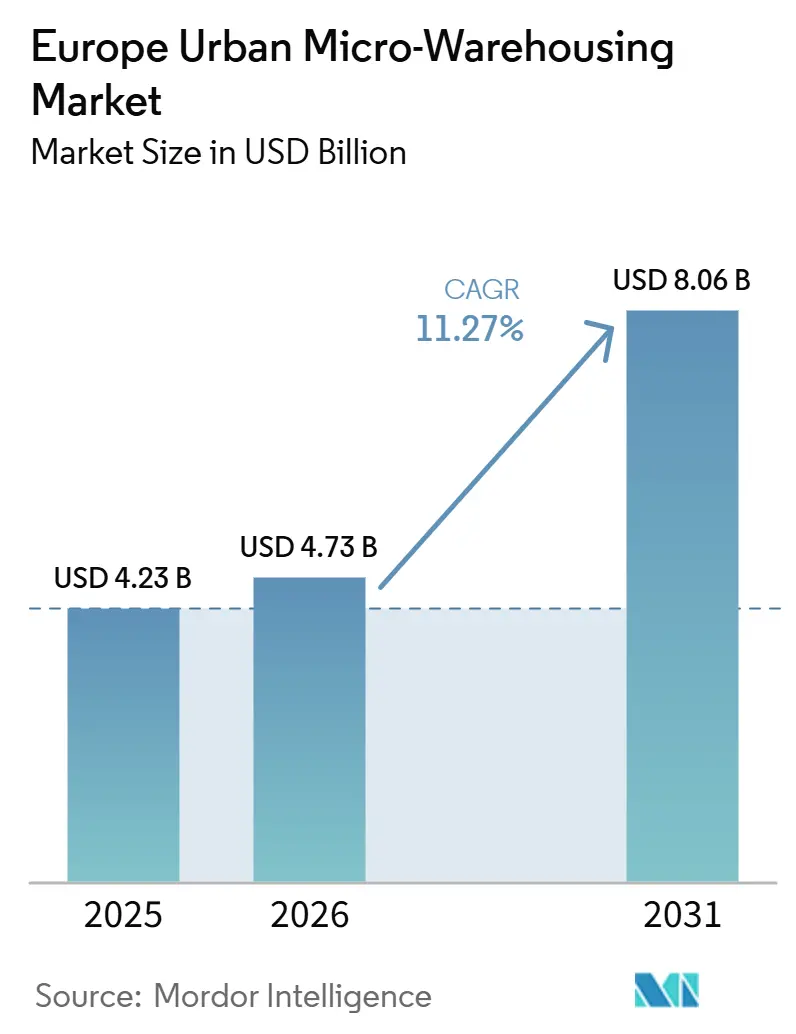
The Europe urban micro-warehousing market size was valued at USD 4.23 billion in 2025 and is estimated to grow from USD 4.73 billion in 2026 to reach USD 8.06 billion by 2031, at a CAGR of 11.27% during the forecast period (2026-2031).
The Europe urban micro-warehousing market is expanding because urban supply chains are moving away from large perimeter distribution centers and toward smaller in-city nodes that sit closer to final demand. Same-day and sub-two-hour delivery expectations are now deeply embedded in major cities such as London, Paris, Amsterdam, Berlin, and Madrid, which leaves operators with less room to rely on long dispatch routes from outer-city assets. The Europe urban micro-warehousing market is also benefiting from the rising cost of doorstep delivery in dense corridors, where faster inventory access often matters as much as transport efficiency in protecting order economics. Capital deployment by larger logistics operators is raising the competitive threshold, while tighter urban leasing conditions are making early site control a stronger advantage than it was even 2 years ago. The Europe urban micro-warehousing market still faces pressure from real estate cost inflation, zoning limits, and labor constraints, yet these same pressures are also pushing operators toward automation, hybrid fulfillment models, and better-placed city-serving assets.
Key Report Takeaways
- By facility type, micro-fulfillment centers held a 41.37% of the Europe urban micro-warehousing market share in 2025, while dark-store-based fulfillment is forecast to expand at a 18.18% CAGR through 2031.
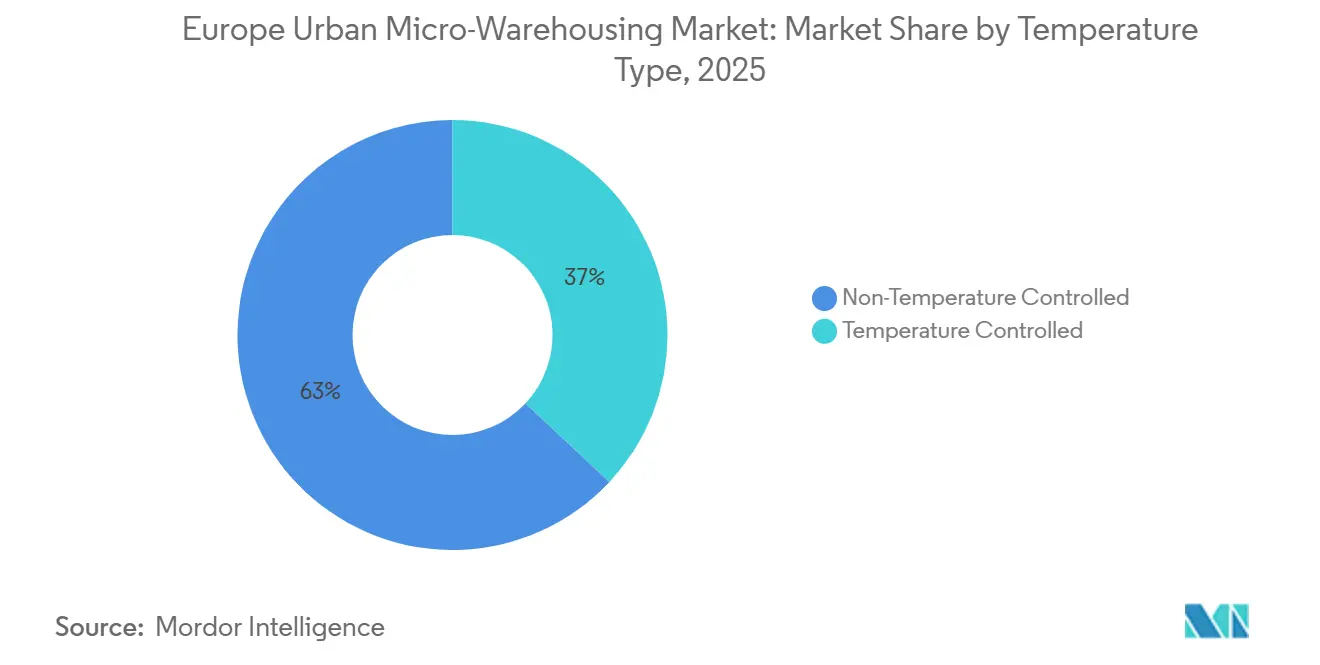
- By temperature type, non-temperature-controlled storage held a 63.02% of the Europe urban micro-warehousing market share in 2025, while temperature-controlled facilities are projected to grow at a 14.84% CAGR through 2031.
- By automation level, semi-automated facilities held a 43.99% share of the Europe urban micro-warehousing market size in 2025, while fully automated facilities are projected to grow at a 20.14% CAGR through 2031.
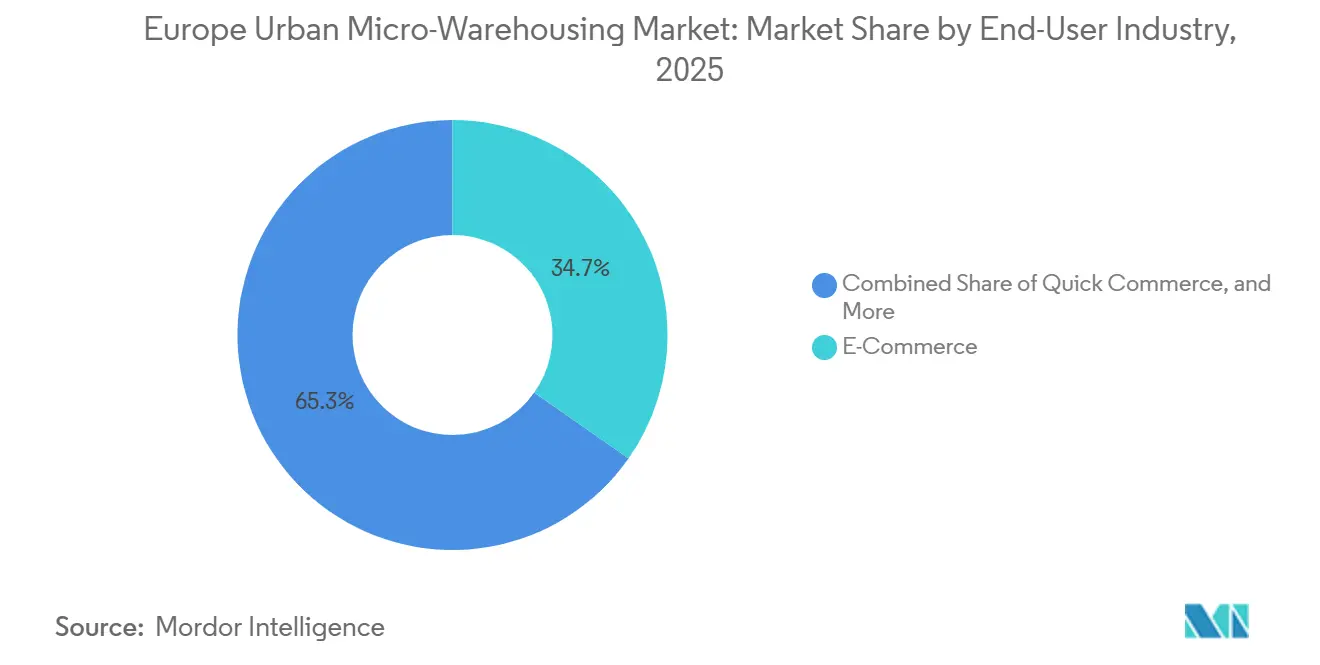
- By end-use industry, e-commerce accounted for 34.74% of the Europe urban micro-warehousing market share in 2025, while quick commerce is expected to grow at a 18.90% CAGR through 2031.
- By country, the United Kingdom held 21.89% of the Europe urban micro-warehousing market size in 2025, while Germany is forecast to grow at 15.32% CAGR through 2031.
Note: Market size and forecast figures in this report are generated using Mordor Intelligence’s proprietary estimation framework, updated with the latest available data and insights as of January 2026.
Market Trends and Insights
Drivers Impact Analysis of Europe Urban Micro-Warehousing Market*
| Driver | (~) % Impact on CAGR Forecast | Geographic Relevance | Impact Timeline |
|---|---|---|---|
| Last-Mile Delivery Density Pressure in Major European Cities | +2.8% | Europe, concentrated in the United Kingdom, Germany, France, and the Netherlands | Short term (≤ 2 years) |
| Growth of Quick Commerce and Same-Day Fulfillment Expectations | +2.3% | United Kingdom, Germany, France, Spain, and the Nordics | Medium term (2-4 years) |
| Urban Real-Estate Scarcity Driving In-City Inventory Proximity | +1.5% | United Kingdom, Netherlands, Belgium, and Germany | Medium term (2-4 years) |
| Rising Need for Micro-Fulfillment to Reduce Delivery Cost Per Order | +1.7% | Europe, with spillover to Southern Europe | Short term (≤ 2 years) |
| Retail Network Reconfiguration Away from Large Perimeter DCs | +1.2% | United Kingdom, France, Germany, and Italy | Long term (≥ 4 years) |
| Urban Property Scarcity and Rising Labor-Efficiency Demand | +1.0% | United Kingdom, Netherlands, Germany, and the Nordics | Medium term (2-4 years) |
| Source: Mordor Intelligence | |||
Last-Mile Delivery Density Pressure in Major European Cities
The Europe urban micro-warehousing market is being shaped by a simple operating reality: dense city routes do not leave enough room for slow inventory movement from distant facilities. When delivery stops are tightly packed and travel access is constrained, the value of inventory already inside the city rises faster than the value of adding more vehicles to an outer-network route. A 2026 study covering 90 European pedestrian zones found that different last-mile modes will be needed to decarbonize urban delivery in historic cores, reinforcing the case for closer inventory placement rather than longer dispatch distances[1]“Modeling the Performance of Emerging Last-Mile Modes in 90 European Pedestrian Zones,” Journal of Cleaner Production, doi.org. That finding matters because city logistics is no longer judged solely by speed and cost, and operators are increasingly being pushed to comply with local mobility and emissions rules. The Europe urban micro-warehousing market, therefore, gains support from the same urban conditions that are making legacy last-mile operating models less reliable. Operators that place stock closer to dense neighborhoods can respond faster, reduce route complexity, and protect fulfillment windows that are harder to sustain from peri-urban sites.
Growth of Quick Commerce and Same-Day Fulfillment Expectations
The Europe urban micro-warehousing market is also gaining from the steady normalization of same-day and near-immediate fulfillment expectations in large urban centers. Consumers now treat rapid delivery as part of the buying proposition for a wider set of products, which means operators must design networks around response time rather than around warehouse scale alone. Quick commerce has gone through a period of consolidation, leaving a more financially disciplined operator base better positioned to use larger, more efficient sites. This matters because the strongest players are no longer trying to fit every dark store into residential blocks; instead, they are shifting toward formats that support better throughput and more consistent replenishment. The Europe urban micro-warehousing market benefits from that transition because it redirects demand toward facilities that are easier to automate and more compatible with urban industrial zoning. Growth in this part of the market is therefore tied not only to category demand, but also to a maturing operating model that is becoming more durable after the early expansion phase.
Urban Real-Estate Scarcity Driving In-City Inventory Proximity
Urban land scarcity is acting as both a barrier and a demand catalyst for the Europe urban micro-warehousing market. France’s 2026 report on sustainable urban logistics identified secure urban land allocation as 1 of 5 transformation levers needed to make city logistics economically viable, and that position was formally received by the French government in February 2026[2]“Rapport au Gouvernement sur la Logistique Urbaine Durable 2025,” France Logistique, francelogistique.fr. The related government communication confirmed that the report was handed to ministers and moved into priority workstreams, indicating that logistics land is becoming a public policy issue rather than solely a private leasing issue. In practice, that means operators who secure urban footprints early are not just solving a near-term capacity problem; they are locking in strategic control over assets that may not return to market soon. The Europe urban micro-warehousing market is therefore being strengthened by scarcity itself, since limited site availability raises the relative value of every well-positioned urban logistics asset. Long lease structures, landlord partnerships, and conversion of underused retail space are becoming more important because access to the right location increasingly defines operating flexibility.
Rising Need for Micro-Fulfillment to Reduce Delivery Cost per Order
The Europe urban micro-warehousing market is being supported by the need to control per-order delivery economics in dense cities where the final mile absorbs a large share of fulfillment cost. Operators serving urban demand cannot protect margins for long if inventory is too far from the customer and each order requires more time, more labor coordination, and a less efficient route density. Verdion’s 2025 move to secure a EUR 95 million (USD 111.74 million) urban logistics hub in northern Cologne through a fund backed by more than EUR 300 million (USD 352.89 million) of equity shows that institutional capital is treating proximity as a priced logistics advantage rather than as a niche format. That type of investment signals confidence that the savings from faster inventory access and tighter delivery radii can justify higher site costs in the right locations. The Europe urban micro-warehousing market is therefore being pulled forward by operators that want better control over shipping cost, returns timing, and delivery promise execution at the same time. Once urban service expectations become part of the customer offer, closer stock placement shifts from optional optimization to core infrastructure.
Restraints Impact Analysis of Europe Urban Micro-Warehousing Market*
| Restraint | (~) % Impact on CAGR Forecast | Geographic Relevance | Impact Timeline |
|---|---|---|---|
| High Urban Property Costs and Limited Site Availability | -1.5% | United Kingdom, Netherlands, Belgium, and Germany | Medium term (2-4 years) |
| Complex Zoning, Permitting, and Municipal Use Restrictions | -0.9% | Netherlands, France, Belgium, and Germany | Short term (≤ 2 years) |
| Labor Constraints for Urban Night-Shift Operations | -0.6% | United Kingdom, Germany, and the Nordics | Medium term (2-4 years) |
| Capex Intensity of Automation and Retrofit Projects | -0.8% | Europe | Long term (≥ 4 years) |
| Source: Mordor Intelligence | |||
High Urban Property Costs and Limited Site Availability
High urban property costs remain 1 of the clearest brakes on the Europe urban micro-warehousing market. Prime sites in cities such as London, Paris, and Amsterdam are controlled by a narrow landlord base, and the rent premium for micro-warehouse space can rise well above levels smaller operators can comfortably absorb. The issue is not limited to rent, because many investment-grade urban leases also require balance-sheet strength and covenant quality that exclude undercapitalized entrants. That leaves the Europe urban micro-warehousing market more dependent on larger incumbents that can underwrite expensive urban locations over a longer time horizon. The result is a market where access to capital often determines who can operate in the best city nodes before service quality or technological differences do. This pressure also accelerates consolidation, since operators that cannot secure viable sites often have little choice but to partner, sublease, or exit.
Complex Zoning, Permitting, and Municipal Use Restrictions
Zoning and permitting friction is another meaningful restraint for the Europe urban micro-warehousing market, especially where city authorities are tightening the rules for urban goods movement and land use. The revised TEN-T framework requires 431 designated European urban nodes to adopt and publish Sustainable Urban Mobility Plans by December 2027, which will steadily shape how logistics facilities are approved and located across member states[3]“Commission Adopts Implementing Regulation to Strengthen Sustainable Urban Mobility Through Harmonized Indicators,” European Commission, transport.ec.europa.eu. That matters because site selection is no longer only a commercial judgment, and operators must increasingly align with mobility planning, sustainability reporting, and local access design. The Europe urban micro-warehousing market can still grow under these conditions, but project timelines become less predictable when each municipality adds a different interpretation of acceptable logistics use. Uncertainty tends to delay investment decisions, especially for dark store and retrofit formats that can sit close to residential or mixed-use districts. Over time, the operators with the strongest compliance capabilities and local planning knowledge are likely to gain an advantage over firms that approach every city with a uniform network template.
*Our forecasts treat driver/restraint impacts as directional, not additive. The impact forecasts reflect baseline growth, mix effects, and variable interactions.
Europe Urban Micro-Warehousing Market Segment Analysis
By Facility Type:
MFC Investment Consolidates While Dark Stores RepositionMicro-fulfillment centers accounted for a 41.37% share of the Europe urban micro-warehousing market size in 2025, making them the leading facility type in the Europe urban micro-warehousing industry. Their lead reflects a good fit between dense-city service expectations and facilities that can support compact, high-throughput inventory operations close to demand. The format works especially well because footprints of 2,000 to 5,000 m² are large enough for structured picking and storage, yet still small enough to fit urban logistics networks. Dark store-based fulfillment is forecast to grow at 18.18% CAGR through 2031, and that pace reflects adaptation as much as expansion. Growth is becoming concentrated in a more durable operator group that has responded to municipal pressure by moving away from residential settings and into better-suited industrial or mixed logistics zones.
Retail store-based fulfillment and hybrid facilities fill the rest of the facility mix, and both are important because they help operators use existing urban assets more efficiently. Hybrid models are especially relevant for omnichannel retailers that want a single location to support customer-facing activities and local fulfillment capacity. That structure can improve asset utilization and shorten break-even periods because the operator does not rely on a single use case for the site. Bleckmann’s 2025 launch of its Bscale modular plug-and-play warehousing solution in the United Kingdom and the Netherlands shows how flexible access models are opening the Europe urban micro-warehousing market to brands that do not want to fund a full dedicated buildout at the start. Facility choice is therefore becoming a long-duration strategic decision, because the building type selected at lease signing often determines what level of automation and throughput the site can realistically support later.
By Temperature Type:
Cold Chain Extends Urban Micro-Warehousing Into Premium SegmentsNon-temperature-controlled storage held 63.02% of the Europe urban micro-warehousing market share in 2025, which shows that the market still depends mainly on e-commerce, FMCG, and fashion flows that do not require specialized environmental control. Even so, temperature-controlled capacity is projected to grow at a 14.84% CAGR through 2031, indicating clear expansion into more complex and higher-value product categories. Pharmaceutical cold chain, fresh grocery distribution, and biologic medicine logistics are all pushing operators to place controlled inventory closer to metropolitan demand. This is important because temperature-controlled urban space is harder to develop, more expensive to operate, and often more affordable once in use. As a result, the Europe urban micro-warehousing market is moving beyond ambient goods and into segments where compliance, quality assurance, and faster replenishment carry a larger revenue premium.
A second demand stream is coming from quick commerce, as product assortments expand beyond shelf-stable goods to include fresh produce, dairy, meal kits, and chilled convenience items. Once that category mix changes, dark stores and micro-fulfillment centers need a different internal configuration, better insulation, and stronger process control than simple ambient storage requires. The January 2026 Arla Foods and XPO Logistics distribution center project at Prologis RFI DIRFT in Northamptonshire shows how chilled food networks are being reorganized around more specialized distribution infrastructure, with XPO set to operate the site from late 2027. In the Europe urban micro-warehousing industry, that kind of development reinforces the case for city-serving cold-chain capacity that can support both regulated pharmaceutical flows and commercially driven food delivery expansion. The segment is therefore gaining from 2 separate demand drivers, regulated healthcare distribution and premium urban grocery fulfillment, which together lift its strategic importance within the Europe urban micro-warehousing market.



By Automation Level:
Full Automation Shifts From Aspirational to OperationalSemi-automated facilities held 43.99% of the Europe urban micro-warehousing market share in 2025, which made them the most common operating model in the market. This lead is logical because semi-automated sites offer a workable balance between labor use, throughput improvement, and retrofit feasibility in constrained urban buildings. Conveyors, sortation tools, and collaborative systems can boost productivity without requiring every operator to undergo a full structural redesign of the site. Fully automated facilities are forecast to grow at a 20.14% CAGR through 2031, signaling that the economics of speed, labor efficiency, and repeatable order processing increasingly favor higher automation intensity. Manual operations will still remain relevant in some smaller cities and lower-volume sites, but they are less likely to define the long-term competitive frontier.
The direction of travel is clear because operators now see automation as part of the location equation rather than as a later optional upgrade. Buildings with poor floor loading, ceiling height, or internal layout can still limit what is possible, meaning the best urban assets are those that combine proximity with upgrade potential. Bleckmann’s 2025 Roosendaal distribution center launch with AutoStore automated storage and retrieval and automated packing shows that high automation is no longer limited to large suburban formats and can be deployed in European logistics assets at commercially useful scale. In the Europe urban micro-warehousing market, this shifts competition toward operators that can align property selection, system design, and workflow control from the start. The result is that automation is moving from an aspirational differentiator to an operational requirement in the busiest urban fulfillment corridors.
By End-User Industry:
E-Commerce Anchors Demand While Quick Commerce Redefines Speed BenchmarksE-commerce captured 34.74% of the Europe urban micro-warehousing market size in 2025, which confirms that the market is still anchored by digital retail volume and the need for faster city-serving fulfillment. That base matters because e-commerce exerts the broadest and most sustained pressure on local stock placement across fashion, general merchandise, personal care, and household categories. Quick commerce is projected to expand at a 18.90% CAGR through 2031, though the strongest economies remain concentrated in a limited set of dense cities where delivery speed can be consistently monetized. Grocery retail, FMCG, and food and beverage form the next major demand layer, especially where operators want to reduce store picking pressure and improve local order availability. The Europe urban micro-warehousing market is therefore shaped by a mix of high-volume retail demand and speed-led formats that are pushing service standards higher across the whole urban fulfillment chain.
Pharmaceuticals and healthcare are also becoming increasingly important because controlled urban inventory can support higher-value, more time-sensitive distribution. Fashion and lifestyle users benefit from shorter return loops, which improve handling speed in product categories where reverse logistics affects profitability. Industrial and B2B demand is also building as spare parts and maintenance inventory move closer to urban service and manufacturing customers that need faster delivery response. The Arla Foods and XPO chilled distribution project shows how food supply chains are centralizing specialized inventory through stronger logistics infrastructure, while Kuehne+Nagel and Mondadori’s July 2026 opening of Italy’s largest educational publishing logistics hub in Mantova shows how tailored distribution models are also expanding in more specialized verticals. This broadening end-use mix gives the Europe urban micro-warehousing market a wider demand base than quick commerce alone and reduces dependence on any single city-serving category.
Geography Analysis
United Kingdom and Germany Urban Micro-Warehousing Market
The United Kingdom held 21.89% of the Europe urban micro-warehousing market share in 2025, while Germany is projected to grow at 15.32% CAGR through 2031. The United Kingdom remains the most established national market because London and other major urban centers combine dense consumer demand with a mature commercial property environment that can support city-serving fulfillment formats. That combination lets operators test service speed, hybrid facility use, and automation deployment in a market with relatively strong demand visibility. Germany’s profile is different because its growth is being driven less by simple scale and more by a reworking of distribution architecture toward city-integrated networks. Hamburg’s 2025 logistics strategy provides a practical example of this shift, as urban logistics and climate-neutral last-mile delivery were formally elevated in the city’s long-term logistics agenda.
Europe Urban Micro-Warehousing Market
France, Spain, and Italy sit in a second group where market potential is clear, but the operating environment is still being shaped by policy and network formalization. France stands out because its 2026 sustainable urban logistics report moved land allocation and urban logistics governance into a more visible public policy conversation. The related French government communication showed that the work has already moved beyond diagnosis and into priority follow-up actions, which reduces uncertainty for long-term urban logistics planning. This matters for the Europe urban micro-warehousing market because policy clarity often affects site selection, permitting confidence, and investor willingness before it changes final demand.
Nordics, Belgium and Netherlands Urban Micro-Warehousing Market
The Nordics, Belgium, and the Netherlands represent the most automation-forward and network-dense part of the Europe urban micro-warehousing market outside the 2 largest country markets. Belgium and the Netherlands benefit from concentrated logistics ecosystems, which makes them useful launch points for cross-border service models and urban fulfillment testing. At the regional level, the European Commission’s July 2026 implementing regulation on harmonized sustainable urban mobility indicators adds another layer of structure that will influence how designated urban nodes measure and manage logistics-related sustainability and access questions. Over time, that framework is likely to shape where infrastructure investment is encouraged and where tighter operating controls may emerge, which keeps regulatory literacy central to geographic expansion choices[4]“Remise du Rapport ‘Logistique Urbaine Durable 2025’ Aux Ministres Serge Papin et Philippe Tabarot,” Ministère de l’Économie et des Finances, economie.gouv.fr.
Competitive Landscape
The Europe urban micro-warehousing market is moderately fragmented, and no single operator controls a dominant position across all facility types, automation levels, and country markets. Competition is split between large global contract logistics groups with broad geographic reach and smaller or mid-tier specialists that hold stronger positions in selected verticals or national corridors. The larger players compete through capital depth, network breadth, and the ability to secure and upgrade urban assets at speed. Specialists remain relevant because fashion logistics, temperature-controlled distribution, and modular fulfillment access each require operating models that broad networks do not always execute equally well. This creates a 2-speed structure in the Europe urban micro-warehousing market, where scale provides funding power and procurement strength, while focused expertise still matters in categories with more demanding service or compliance needs.
Several recent moves show how operators are trying to strengthen their position without relying on a single expansion template. Bleckmann’s Bscale launch in the United Kingdom and the Netherlands widened access to enterprise-grade fulfillment through a modular format, suggesting that flexibility and lower entry costs can be a competitive lever alongside physical scale. GXO’s 2026 multi-year agreement with L’Oreal for Central Europe logistics operations shows how large brand owners continue to place complex fulfillment activity with scaled operators that can absorb operational complexity across borders. Kuehne+Nagel’s July 2026 opening of Italy’s largest educational publishing logistics hub with Mondadori adds another example, this time showing how specialized distribution contracts can deepen national logistics presence while also improving category expertise.
White space remains strongest in 2 parts of the market, mid-market brands that cannot independently secure premium urban space, and city-serving cold-chain formats that combine speed with strict operating requirements. Real estate access is still a competitive moat because operators that lock in the right urban asset often prevent comparable local entry for years. Verdion’s Cologne urban logistics investment illustrates how property positioning itself is becoming a strategic differentiator, not just the background infrastructure for service delivery. The Europe urban micro-warehousing market is therefore likely to stay competitive, but the balance may tilt further toward operators that can align capital, site control, automation readiness, and vertical specialization within the same network strategy.
Europe Urban Micro-Warehousing Industry Leaders
DHL Group
Kuehne+Nagel
GEODIS
DSV A/S
CMA CGM Group (including CEVA Logistics)
- *Disclaimer: Major Players sorted in no particular order
Europe Urban Micro-Warehousing Market Companies Covered in this Report
- DHL Group
- Kuehne+Nagel
- DSV A/S
- CMA CGM Group (Including CEVA Logistics)
- GEODIS
- GXO Logistics, Inc.
- DACHSER
- Rhenus Logistics
- ID Logistics
- FM Logistic
- FIEGE
- Arvato
- Hellmann Worldwide Logistics
- Nippon Express Holdings
- NYK Line (Including Yusen Logistics)
- XPO Inc.
- Noatum Logistics
- Logwin AG
- Bleckmann Logistics
- STEF Group
- PostNord
- Katoen Natie

Recent Industry Developments in Europe Urban Micro-Warehousing Market
- July 2026: Kuehne+Nagel and Mondadori Group opened Italy's largest educational publishing logistics hub in Mantova, deepening Kuehne+Nagel's Italian distribution network.
- July 2026: CEVA Logistics opened a 508,000-sq-ft (approximately 47,200 m²) distribution center in Derby, United Kingdom, achieving full operational readiness from contract award in under 20 weeks. The BREEAM Excellent, EPC A+-rated facility features 147,000+ dynamic pick faces and rooftop solar, supporting CEVA's omnichannel and e-commerce supply chain expansion across the UK and creating approximately 300 jobs.
- July 2026: ID Logistics opened a 62,500 m² warehouse in Rugby, United Kingdom. its fourth site in under three years, bringing its footprint to approximately 130,000 m² and employing 450 people, dedicated to serving a global e-commerce leader operating in the United Kingdom.
- June 2026: Bleckmann opened a 70,786 m² mega distribution center in Lutterworth, United Kingdom, one of its largest UK sites, in the Midlands logistics "golden triangle," bringing its total United Kingdom footprint to 420,000 m².


Europe Urban Micro-Warehousing Market Report Scope
| Dark Store-Based Fulfillment |
| Micro-Fulfillment Center (MFC)-Based Fulfillment |
| Retail Store-Based Fulfillment |
| Hybrid Facility and Others |
| Temperature Controlled |
| Non-Temperature Controlled |
| Manual Operations |
| Semi-Automated Facilities |
| Fully Automated Facilities |
| E-commerce |
| Quick Commerce |
| Grocery Retail |
| FMCG |
| Food and Beverage |
| Pharmaceuticals and Healthcare |
| Consumer Electronics and Household Appliances |
| Fashion and Lifestyle (Accessories, Apparel, Footwear) |
| Industrial and B2B Distribution |
| Others |
| United Kingdom |
| Germany |
| France |
| Spain |
| Italy |
| Belgium |
| Netherlands |
| NORDICS (Denmark, Finland, Iceland, Norway, and Sweden) |
| Rest of Europe |
| By Facility Type | Dark Store-Based Fulfillment |
| Micro-Fulfillment Center (MFC)-Based Fulfillment | |
| Retail Store-Based Fulfillment | |
| Hybrid Facility and Others | |
| By Temperature Type | Temperature Controlled |
| Non-Temperature Controlled | |
| By Automation Level | Manual Operations |
| Semi-Automated Facilities | |
| Fully Automated Facilities | |
| By End-User Industry | E-commerce |
| Quick Commerce | |
| Grocery Retail | |
| FMCG | |
| Food and Beverage | |
| Pharmaceuticals and Healthcare | |
| Consumer Electronics and Household Appliances | |
| Fashion and Lifestyle (Accessories, Apparel, Footwear) | |
| Industrial and B2B Distribution | |
| Others | |
| By Country | United Kingdom |
| Germany | |
| France | |
| Spain | |
| Italy | |
| Belgium | |
| Netherlands | |
| NORDICS (Denmark, Finland, Iceland, Norway, and Sweden) | |
| Rest of Europe |


Key Questions Answered in the Report
What is the current size and outlook for Europe urban micro-warehousing?
The Europe urban micro-warehousing market was valued at USD 4.23 billion in 2025 and is projected to reach USD 8.06 billion by 2031 at 11.27% CAGR. Growth is tied to faster urban fulfillment needs and rising pressure on last-mile delivery economics.
Which country leads regional demand today?
The United Kingdom led with 21.89% share in 2025. Its position is supported by deep e-commerce penetration and a mature urban commercial lease market.
Which country is growing the fastest through 2031?
Germany is forecast to grow at 15.32% CAGR through 2031. The main driver is a structural shift from conventional long-distance distribution toward city-integrated fulfillment networks.
Which facility format is most important right now?
Micro-fulfillment centers led with 41.37% share in 2025. They are well suited to dense-city operations because they support compact, efficient inventory handling close to customers.
Which demand category is expanding the fastest?
Quick commerce is the fastest-growing end-use segment at 18.90% CAGR through 2031. Its growth is concentrated in dense cities where rapid delivery can be supported by enough order density.
How is automation changing urban fulfillment in Europe?
Semi-automated facilities still led with 43.99% share in 2025, but fully automated facilities are projected to grow at 20.14% CAGR. Operators are moving toward higher automation because labor efficiency and urban site productivity now matter more than before.
Page last updated on:





