
Europe Pump Rental Market Size and Share
Market Overview
| Study Period | 2022 - 2032 |
|---|---|
| Forecast Data Period | 2027 - 2032 |
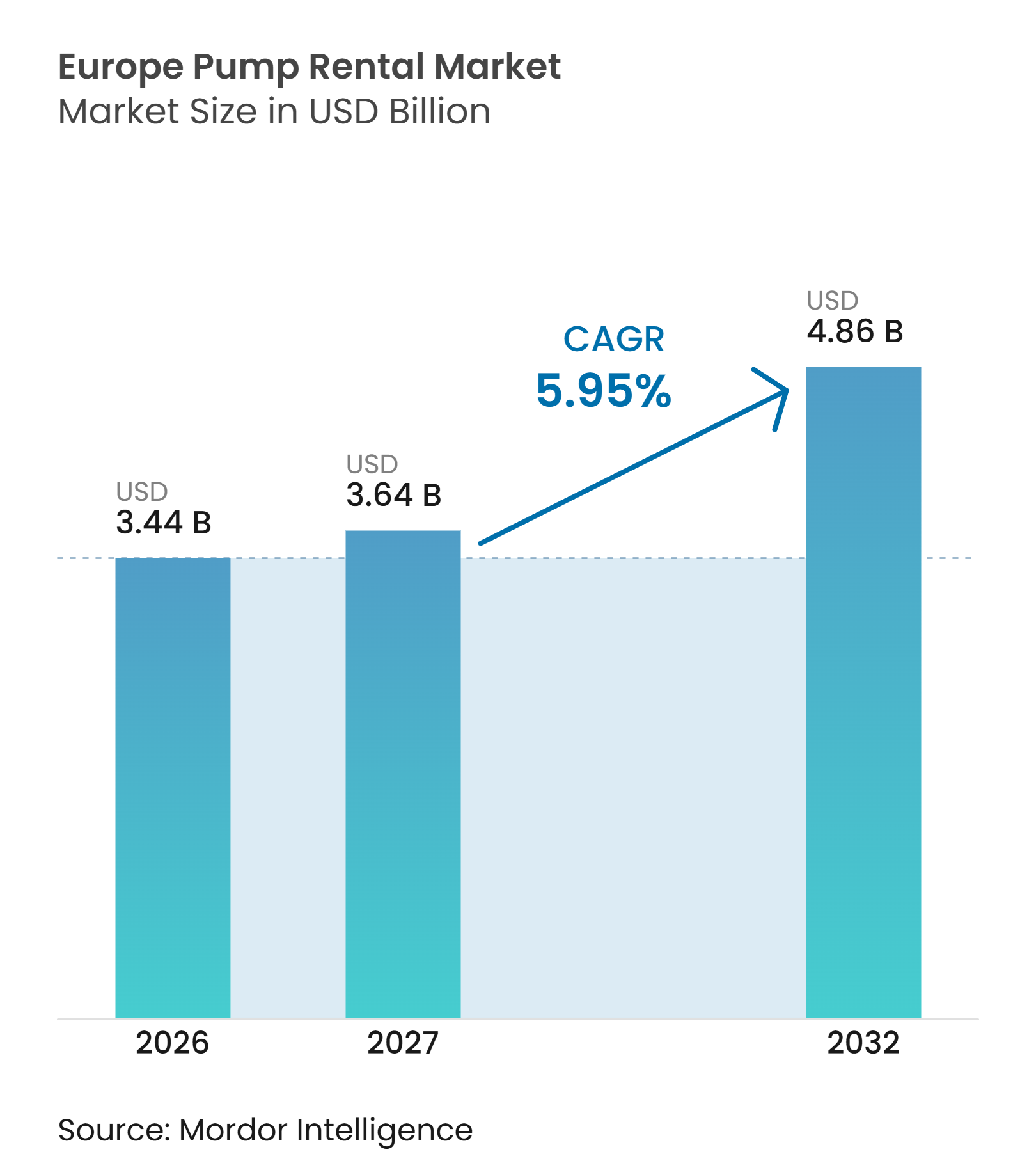
| Base Year Market Size (2026) | USD 3.44 Billion |
| Market Size (2027) | USD 3.64 Billion |
| Market Size (2032) | USD 4.86 Billion |
| Growth Rate (2027 - 2032) | 5.95 % |
| Market Concentration | Medium |
Major Players *Disclaimer: Major Players sorted in no particular order Image © Mordor Intelligence. Reuse requires attribution under CC BY 4.0. | |
Europe Pump Rental Market Analysis by Mordor Intelligence
The Europe Pump Rental Market size is projected to be USD 3.44 billion in 2026, USD 3.64 billion in 2027, and reach USD 4.86 billion by 2032, growing at a CAGR of 5.95% from 2027 to 2032. The Europe Pump Rental Market is moving toward managed service contracts as utilities, contractors, and industrial operators seek flexible capacity for work that does not justify permanent equipment ownership. Water treatment upgrades, pipe rehabilitation, stormwater projects, and brownfield shutdowns create temporary pumping needs that occur in concentrated periods. Climate-related flood response is also moving toward pre-arranged capacity agreements, which favors providers with broad fleets and rapid mobilization capability.[1] Providers are also renewing fleets with Stage V diesel, electric, and siphon systems to meet site requirements and reduce operating constraints.[2] Competition is increasingly shaped by fleet scale, local service coverage, remote monitoring, workforce capacity, and the ability to manage permitting across national markets.
Key Report Takeaways
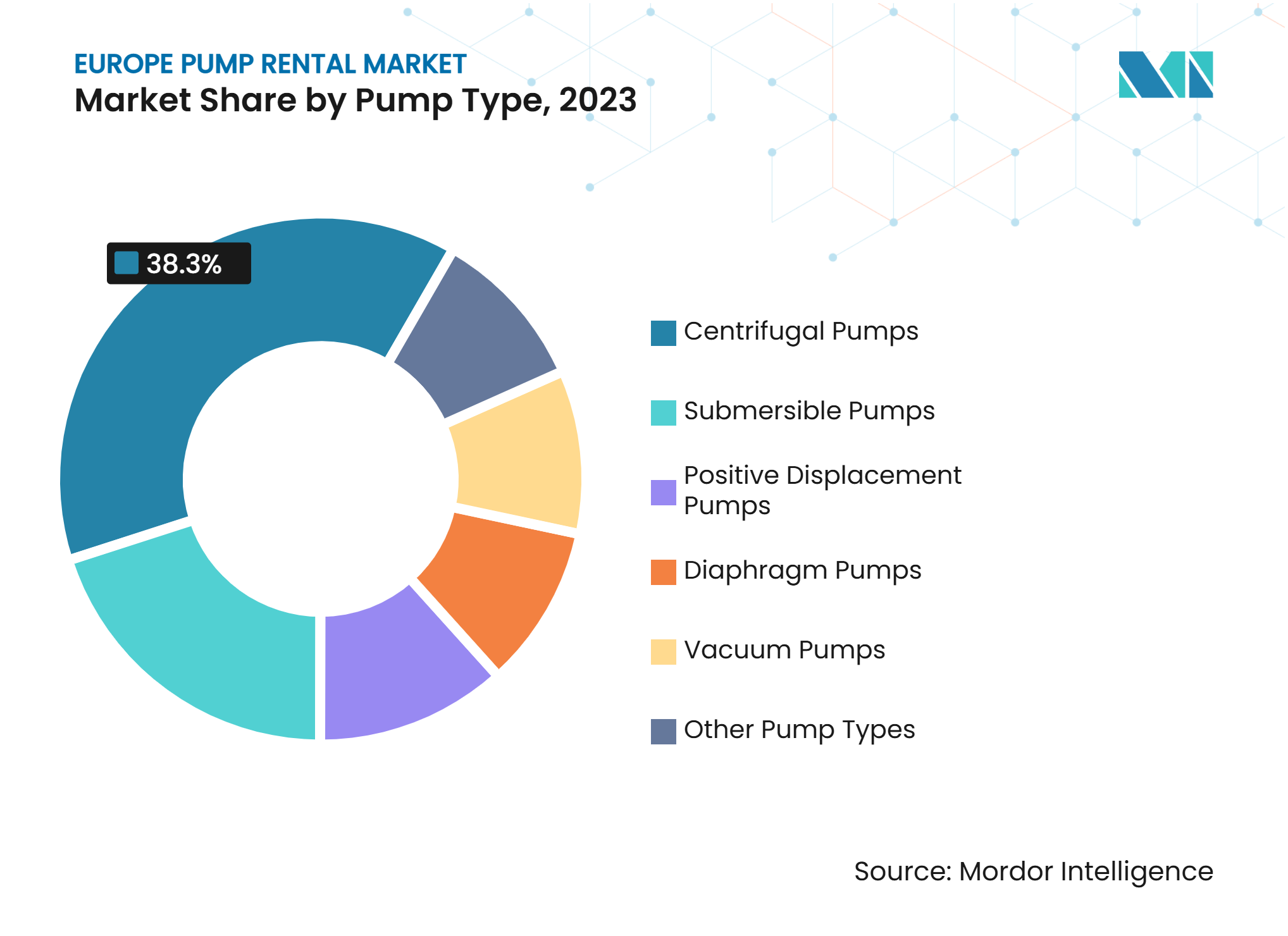
- By pump type, centrifugal pumps held 38.3% of the Europe Pump Rental Market share in 2026, while submersible pumps are projected to grow at a 6.2% CAGR through 2032.
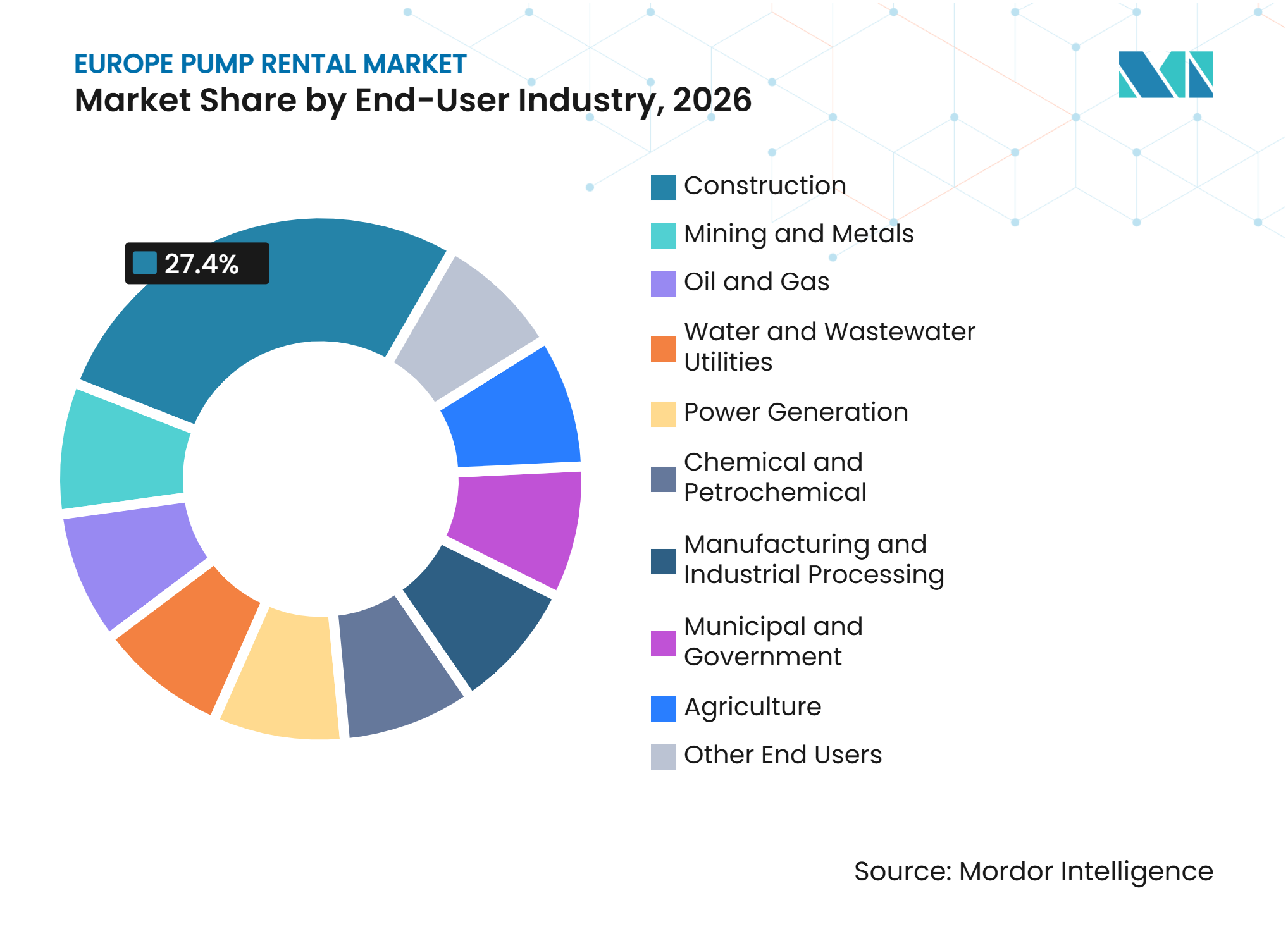
- By end-user industry, construction held 27.4% of the Europe Pump Rental Market share in 2026, while water and wastewater utilities are projected to grow at a 6.4% CAGR through 2032.
- By geography, Germany held 23.6% of the Europe Pump Rental Market share in 2026, while Poland is projected to grow at a 6.6% CAGR through 2032.
Note: Market size and forecast figures in this report are generated using Mordor Intelligence’s proprietary estimation framework, updated with the latest available data and insights as of January 2026.
Market Trends and Insights
Drivers Impact Analysis of Europe Pump Rental Market*
| Driver | (~) % Impact on CAGR Forecast | Geographic Relevance | Impact Timeline |
|---|---|---|---|
| European Water and Wastewater Infrastructure Renewal | +1.5% | EU-wide, strongest in Germany, France, Poland, and Italy | Long term (≥ 4 years) |
| Climate-Driven Flooding, Drought, and Emergency Pumping | +0.9% | Germany, Netherlands, UK, France, Spain, and Central Europe | Medium term (2-4 years) |
| Shift From Capital Purchase to Flexible Equipment Rental | +1.2% | EU-wide, with higher penetration potential in Benelux and the Nordics | Medium term (2-4 years) |
| Industrial Shutdowns, Brownfield Upgrades, and Temporary Capacity | +0.7% | Germany, Netherlands, France, UK, and Benelux | Long term (≥ 4 years) |
| Low-Emission Electric and Stage V Rental Fleets | +0.5% | EU-wide, particularly urban areas in Germany, France, and the UK | Medium term (2-4 years) |
| Cross-Border Digital Monitoring and Managed Pumping Services | +0.4% | Northern Europe, UK, Germany, and Poland | Medium term (2-4 years) |
| Source: Mordor Intelligence | |||
European Water and Wastewater Infrastructure Renewal
The Europe Pump Rental Market benefits from a sustained pipeline of water and wastewater works across the region. The European Investment Bank committed USD 16.84 billion (EUR 15 billion) to water projects for 2025 through 2027, with the program intended to mobilize a further USD 28.01 billion (EUR 25 billion) from commercial investors.[3] The funding supports wastewater upgrades, pipe rehabilitation, and stormwater management, each of which can require temporary bypass pumping during construction. The revised Urban Wastewater Treatment Directive adds compliance pressure for municipalities and supports a longer replacement cycle for treatment assets. Several utilities meeting similar deadlines can schedule work at the same time, which concentrates demand for temporary capacity. This scheduling pattern makes specialist rental fleets more useful than owned equipment for many contractors.
Shift From Capital Purchase to Flexible Equipment Rental
The Europe Pump Rental Market is supported by the move from capital purchases toward rental access for intermittent pumping needs. Regulation (EU) 2016/1628 has increased requirements for new non-road mobile machinery, including diesel-powered equipment used on many sites.[4] Contractors can therefore avoid large equipment commitments by renting pumps when project timing and flow requirements are clear. This approach also keeps fleets aligned with maintenance, emissions, and safety requirements without each contractor carrying the full fleet cost. Rental providers can gain longer contracts when temporary pumping is included in site-management plans rather than purchased as a single emergency service. The operating model is particularly relevant where construction activity and infrastructure work demand different pump configurations through the project cycle.
Climate-Driven Flooding, Drought, and Emergency Pumping
The Europe Pump Rental Market receives recurring demand from flooding and other water-management events. Germany’s Technical Relief Agency deployed high-capacity pumps in North Rhine-Westphalia and Sachsen-Anhalt during the September 2025 response to Storm Walter. Such deployments show why authorities need access to equipment that can be moved quickly across locations. Municipalities and water authorities increasingly need reliable pumping capacity during flood control, drainage, and overflow management work. Framework agreements can turn a one-time emergency response into a planned capacity reservation. Operators with distributed fleets, trained staff, and 24-hour response capability are better placed to serve these requirements.
Low-Emission Electric and Stage V Rental Fleets
Fleet renewal is becoming an important way to compete in the Europe Pump Rental Market. Stage V requirements apply to new non-road mobile machinery placed on the European market and affect diesel-driven pump equipment. Urban project locations also require alternatives that reduce local emissions and site disruption. Van Heck BV deployed 6 Stage V diesel pumps with outputs of up to 754 kW and a 180,000 m³/h siphon system in early 2026. A mixed fleet can match high-head work with diesel units, urban dewatering with electric submersibles, and low-emission transfer work with siphon systems. Providers that offer these options can respond to different engineering conditions without forcing clients into one equipment type.
Restraints Impact Analysis of Europe Pump Rental Market*
| Restraint | (~) % Impact on CAGR Forecast | Geographic Relevance | Impact Timeline |
|---|---|---|---|
| Skilled Pump-Operator and Commissioning Technician Shortage | -0.7% | Germany, UK, Netherlands, France, and Poland | Medium term (2-4 years) |
| Fragmented National Discharge and Groundwater Permitting | -0.6% | Germany, Netherlands, UK, Poland, Italy, and France | Long term (≥ 4 years) |
| Fleet Logistics, Maintenance, and Financing Intensity | -0.5% | EU-wide, with greater pressure in peripheral Eastern European markets | Long term (≥ 4 years) |
| Cybersecurity Exposure in Connected Temporary Pump Systems | -0.3% | EU-wide, primarily operators using IoT-enabled remote monitoring | Medium term (2-4 years) |
| Source: Mordor Intelligence | |||
Skilled Pump-Operator and Commissioning Technician Shortage
The Europe Pump Rental Market needs technicians who can commission, troubleshoot, and manage multi-pump installations under time pressure. This work requires practical knowledge of hydraulics, electrical systems, telemetry, and site safety. The combination is difficult to replace with general construction labor. Selwood maintained recruitment activity during 2025 and early 2026 for field technicians, emergency-response staff, and regional account managers. Larger providers can invest in apprenticeships and structured training, while smaller local specialists may have less capacity to build a similar workforce. The labor constraint can limit fleet utilization even when equipment is available.
Fragmented National Discharge and Groundwater Permitting
The Europe Pump Rental Market faces different rules for groundwater abstraction, discharge quality, and environmental monitoring across national markets. The Water Framework Directive sets common objectives, but national authorities and regional water boards retain an important role in implementation. Cross-border work can therefore require separate approval processes and different operating conditions. This can delay equipment mobilization and increase planning requirements for emergency deployments. The European Commission has also introduced a Water Resilience Investment Accelerator, highlighting the policy focus on water infrastructure. The regulatory setting continues to favor providers with local operating knowledge and established relationships with water authorities.
*Our forecasts treat driver/restraint impacts as directional, not additive. The impact forecasts reflect baseline growth, mix effects, and variable interactions.
Europe Pump Rental Market Segment Analysis
By Pump Type:
Submersibles Gain Ground on Centrifugal DominanceCentrifugal pumps held 38.3% of the Europe Pump Rental Market share in 2026. Their broad flow range and straightforward maintenance profile support construction dewatering, municipal bypass work, and agricultural drainage. They can operate with diesel or electric drives, which makes them suitable for fast site mobilization. The Europe Pump Rental Market size for centrifugal equipment is supported by projects that need high-volume water transfer with predictable equipment requirements.
Submersible pumps are projected to grow at a 6.2% CAGR through 2032, the highest rate among pump types. They are suited to below-grade water management and urban infrastructure work where above-ground equipment may face space or emissions constraints. Electric submersibles can help contractors meet local environmental conditions while maintaining dewatering performance. Positive displacement units remain relevant for chemical, petrochemical, and sludge-transfer work, while diaphragm and vacuum pumps support remediation, pharmaceutical dewatering, and industrial processes. Axial-flow and mixed-flow units serve flood-control and irrigation work that requires high-volume transfer.



By End-User Industry:
Utilities Accelerate Past Construction as Growth EngineConstruction held 27.4% of the Europe Pump Rental Market share in 2026. Civil engineering, building work, and infrastructure projects require temporary dewatering before, during, and after excavation. Eurostat reported that EU construction production increased 2.0% year on year in August 2026. Contractors use rental fleets when water conditions vary across sites or when equipment needs increase during peak construction activity. Construction therefore remains the largest end-user base even as individual projects maintain uneven schedules.
Water and wastewater utilities are forecast to expand at a 6.4% CAGR through 2032. The Europe Pump Rental Market size for utility work is supported by treatment plant upgrades and network rehabilitation that require bypass capacity during construction. The EUR 15 billion European Investment Bank commitment for 2025 through 2027 supports the investment environment for these projects. Mining and metals operations need groundwater control in Scandinavia and the Balkans, while oil and gas work continues to need temporary high-pressure transfer capacity around the North Sea. Chemical, petrochemical, and power-generation sites require specialist equipment and managed services during planned shutdowns, while municipal and agricultural users create recurring baseline demand.

Geography Analysis
Germany: Infrastructure Momentum Anchors the Largest Market
Germany accounted for 23.6% of the Europe Pump Rental Market share in 2026. Its construction base, industrial activity, water infrastructure, and energy-transition projects create several sources of temporary pumping demand. District-heating upgrades, coal plant conversions, and grid expansion can require dewatering and bypass work in urban and peri-urban locations. These conditions support electric submersible and low-emission siphon options alongside conventional diesel equipment. Atlas Copco acquired Heide Pumpen GmbH in April 2025, adding a 700-unit rental fleet and 42 employees to its Specialty Rental division. The transaction reflects the value of local fleet coverage in a market with a fragmented distributor network.
Poland: EU Fund Disbursements Propel the Fastest-Growing Market
Poland is projected to grow at a 6.6% CAGR through 2032. The Europe Pump Rental Market share for Poland is expected to benefit from recovery and resilience funding directed toward road, rail, energy, water, and municipal projects. Rental providers can serve these projects by offering temporary capacity that matches project phases without requiring contractors to purchase equipment. Renta Group has stated that it is extending specialty rental services, including pumps, across its operating countries. This approach positions the group to add specialized services where infrastructure activity expands.
Western and Southern Europe Shape Demand
The United Kingdom remains an important demand center outside the EU regulatory framework. Selwood operates a national network of 24 branches, including a Specialist Equipment Centre in Stoke-on-Trent that holds pumps, clean-water assets, SelTank equipment, and treatment equipment. France has a domestic equipment base serving construction, public-sector, and water projects, while Italy and Spain combine municipal renewal needs with agricultural groundwater management. TDF Rental serves construction, mining, water treatment, and industrial applications from locations in Spain. Countries in Central and Eastern Europe are broadening the use of rental equipment from construction into utility and municipal applications. Russia remains less connected to Western European equipment supply chains under current trade conditions. These differences require providers to balance standardized fleet models with local regulatory and service needs.
Competitive Landscape
Market Concentration
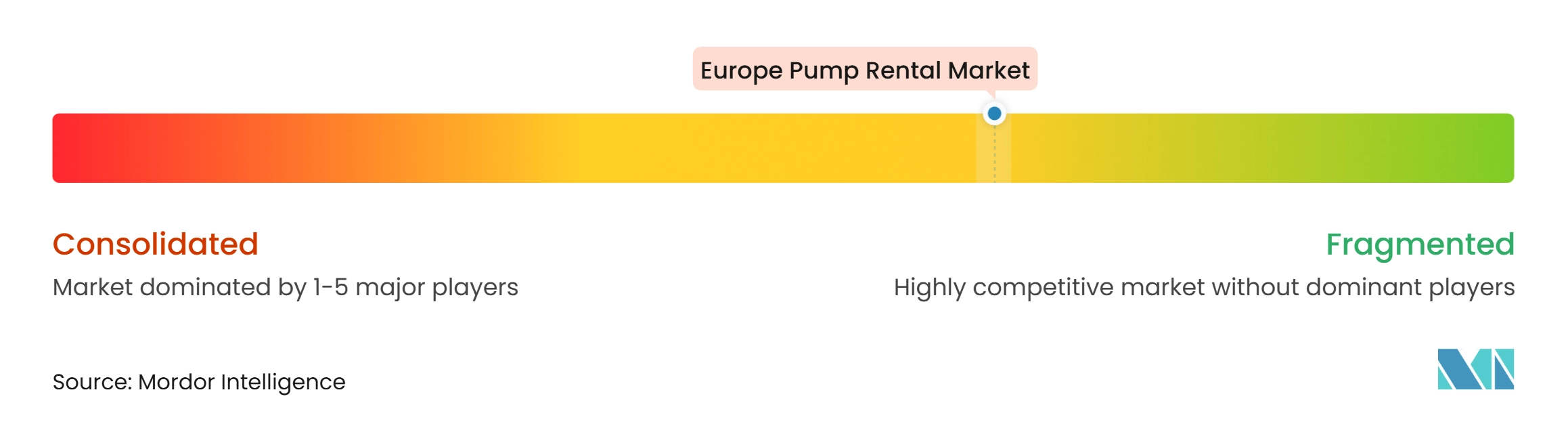
The Europe Pump Rental Market is moderately concentrated at the country level, but larger groups are building wider regional platforms. Workdry International, Atlas Copco Specialty Rental, and Xylem Water Solutions and Services combine equipment fleets with managed service offerings. Boels reported USD 2,089.97 million (EUR 1,862 million) in group revenue for 2025 across operations in 27 countries and offers pumps within a broader equipment range. Scale can reduce mobilization constraints and support clients that need one supplier across several locations. Smaller specialists still retain roles in technical applications, emergency response, and local service work.
Acquisitions are a key route to regional coverage in the Europe Pump Rental Market. Atlas Copco’s April 2025 acquisition of Heide Pumpen added a German portable-pump distributor and service provider to its rental operations. Pioneer Pump announced in March 2026 that its Hadleigh operation and Franklin Electric Group had strengthened their UK position through the Geoquip acquisition. Workdry International’s refinancing supports fleet investment and acquisitions as the group expands its managed-service footprint. These moves show why access to capital, local depots, and trained personnel are becoming important competitive factors.
Digital fleet management is becoming more relevant as clients seek faster equipment selection, reservations, monitoring, and maintenance support. Gorman-Rupp Europe has described ArchyRental.com as a digital platform for pump selection, reservation, and fleet management. Connected systems also create cybersecurity and compliance requirements for remote monitoring services. Fleet logistics, maintenance costs, and financing needs remain material constraints, especially in peripheral markets where depot coverage is thinner. The Europe Pump Rental Market therefore rewards operators that combine digital tools with dependable field service rather than treating online ordering as a replacement for technical support.
Europe Pump Rental Industry Leaders
-
Boels Topholding B.V.
-
Xylem Inc.
-
Atlas Copco AB
-
Workdry International Limited
-
Renta Group Oy
- *Disclaimer: Major Players sorted in no particular order
Europe Pump Rental Market Companies Covered in this Report
- Atlas Copco AB
- Boels Topholding B.V.
- Buitenkamp B.V.
- Delta Service Location B.V.
- Flexpumps B.V.
- GEARS Rentals GmbH
- Gorman-Rupp Company
- HPS Rental GmbH
- Pioneer Pump, Inc.
- Renta Group Oy
- Rental Pumps B.V.
- Rental Pumps België B.V.
- Selwood Limited
- Siltbuster Limited
- StrefaPomp.pl
- TDF Rental
- Van Heck B.V.
- Vanderkamp Pompen B.V.
- Workdry International Limited
- Xylem Inc.
Recent Industry Developments in Europe Pump Rental Market
- March 2026: Pioneer Pump in Hadleigh, Suffolk, part of Franklin Electric Group, announced the acquisition of Geoquip Water Solutions and Hydrodif Products, completed in December 2025. The acquisition strengthened the Group’s UK groundwater and water supply capabilities, combining Geoquip’s domestic manufacturing and distribution expertise with Pioneer Pump’s dewatering and rental pump portfolio.
- September 2025: Workdry International acquired Atlas Dewatering, a Florida-based wellpoint and drainage specialist, further deepening its US presence alongside Holland Pump. The move complements Workdry’s existing European platform, Selwood and Siltbuster in the UK and Vanderkamp in the Netherlands, with an operational capability in specialist dewatering that parallels the European product range.
- August 2025: Workdry International completed a USD 887.37 million (GBP 660 million) strategic debt refinancing, comprising USD 631.92 million (GBP 470 million) drawn at close and USD 255.46 million (GBP 190 million) in committed RCF and capital expenditure facilities. The refinancing, backed by majority shareholder Arcus Infrastructure Partners, is designed to fund international expansion across the UK, US, and Europe through organic fleet investment and acquisitions.
- April 2025: Atlas Copco acquired Heide Pumpen GmbH, headquartered in Gelsenkirchen, Germany, integrating a portable pump distributor and service provider with 700 rental pumps and 42 employees into the Atlas Copco Power Technique Specialty Rental division.
Europe Pump Rental Market Report Scope
Pump rental is a service that provides temporary or long-term access to specialized pumping equipment without requiring an outright purchase.
Europe pump rental market is segmented into pump type, end-use industry, and geography. By pump type, the market is segmented into centrifugal pumps, positive displacement pumps, submersible pumps, diaphragm pumps, vacuum pumps, and other pump types. By end-use industry, the market is divided among construction, mining and metals, oil and gas, water and wastewater utilities, power generation, chemical and petrochemical, manufacturing and industrial processing, municipal and government, agriculture, and other end users. The report also covers the market size and forecasts for the Europe pump rental market across 7 countries in key regions. For each segment, the market sizing and forecasts have been provided on the basis of value (USD).
Segmentation Overview
| Centrifugal Pumps |
| Positive Displacement Pumps |
| Submersible Pumps |
| Diaphragm Pumps |
| Vacuum Pumps |
| Other Pump Types |
| Construction |
| Mining and Metals |
| Oil and Gas |
| Water and Wastewater Utilities |
| Power Generation |
| Chemical and Petrochemical |
| Manufacturing and Industrial Processing |
| Municipal and Government |
| Agriculture |
| Other End Users |
| Germany |
| France |
| Italy |
| Spain |
| United Kingdom |
| Poland |
| Russia |
| Rest of Europe |
| By Pump Type | Centrifugal Pumps |
| Positive Displacement Pumps | |
| Submersible Pumps | |
| Diaphragm Pumps | |
| Vacuum Pumps | |
| Other Pump Types | |
| By End-User Industry | Construction |
| Mining and Metals | |
| Oil and Gas | |
| Water and Wastewater Utilities | |
| Power Generation | |
| Chemical and Petrochemical | |
| Manufacturing and Industrial Processing | |
| Municipal and Government | |
| Agriculture | |
| Other End Users | |
| By Geography | Germany |
| France | |
| Italy | |
| Spain | |
| United Kingdom | |
| Poland | |
| Russia | |
| Rest of Europe |
Key Questions Answered in the Report
What is the projected value of Europe pump rental services by 2032?
The Europe Pump Rental Market is projected to reach USD 4.86 billion by 2032, expanding at a 5.95% CAGR from 2027. The projection reflects demand for flexible temporary capacity in infrastructure, water treatment, construction, and industrial maintenance work, where purchased fleets can remain idle between scheduled upgrades, shutdowns, emergency deployments, or seasonal drainage projects.
Which pump type leads rental demand in Europe?
Centrifugal pumps lead with 38.3% share in 2026 because they serve common dewatering, bypass, drainage, and water-transfer needs. Their wide flow range and compatibility with diesel and electric drives also support rapid mobilization across varied sites, from municipal works to civil engineering and agricultural drainage assignments.
Which pump category is growing the fastest?
Submersible pumps are projected to grow at a 6.2% CAGR through 2032, supported by urban infrastructure work and below-grade dewatering. They are especially relevant where projects need electric-drive options or have limits on above-ground diesel equipment.
Which end user creates the largest demand for rented pumps?
Construction holds 27.4% share in 2026, driven by excavation, civil engineering, and project-based dewatering needs. Contractors use rental equipment when water conditions, project duration, and flow requirements differ across sites.
Why are water utilities increasing their use of temporary pumping?
Water and wastewater utilities are projected to grow at a 6.4% CAGR through 2032 as treatment upgrades and network rehabilitation require bypass capacity. Temporary pumping helps utilities keep water and wastewater systems operating while permanent assets are refurbished.
Which European country is expected to grow fastest for rented pumps?
Poland is projected to grow at a 6.6% CAGR through 2032, supported by infrastructure and municipal project activity. The countrys growth profile supports opportunities for providers with local fleet availability and specialist service capability, especially where road, rail, energy, water, and municipal works require phased, temporary pumping solutions rather than permanent fleet purchases.