
Market Overview
| Study Period | 2020 - 2031 |
|---|---|
| Forecast Data Period | 2026 - 2031 |
| Base Year Market Size (2025) | USD 1.93 Billion |
| Market Size (2026) | USD 2.06 Billion |
| Market Size (2031) | USD 2.87 Billion |
| Growth Rate (2026 - 2031) | 6.85 % |
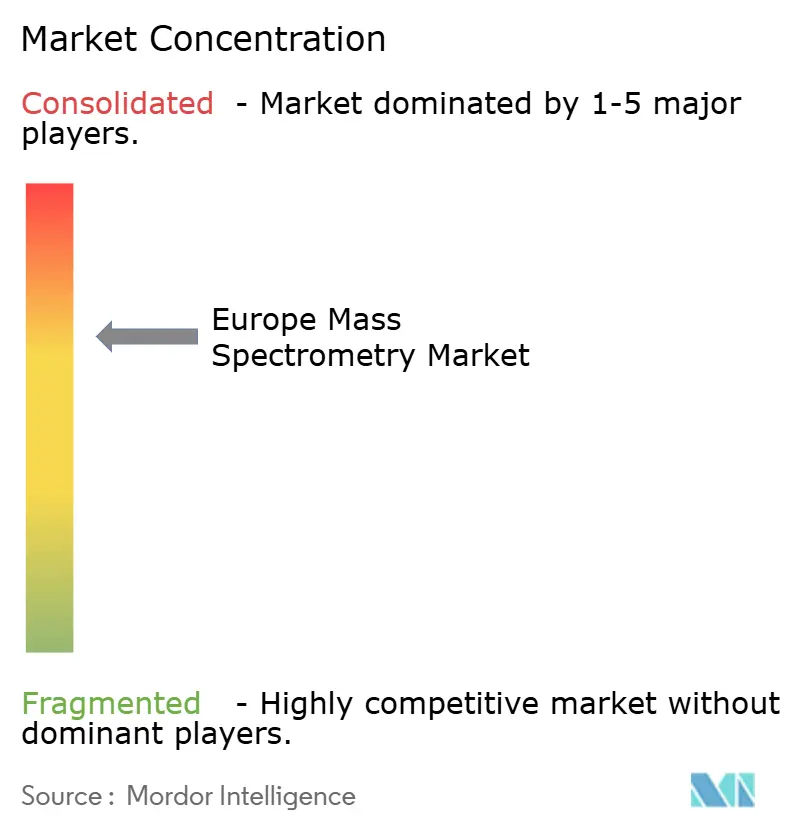
| Market Concentration | Medium |
Major Players *Disclaimer: Major Players sorted in no particular order Image © Mordor Intelligence. Reuse requires attribution under CC BY 4.0. | |
Europe Mass Spectrometry Market Analysis by Mordor Intelligence
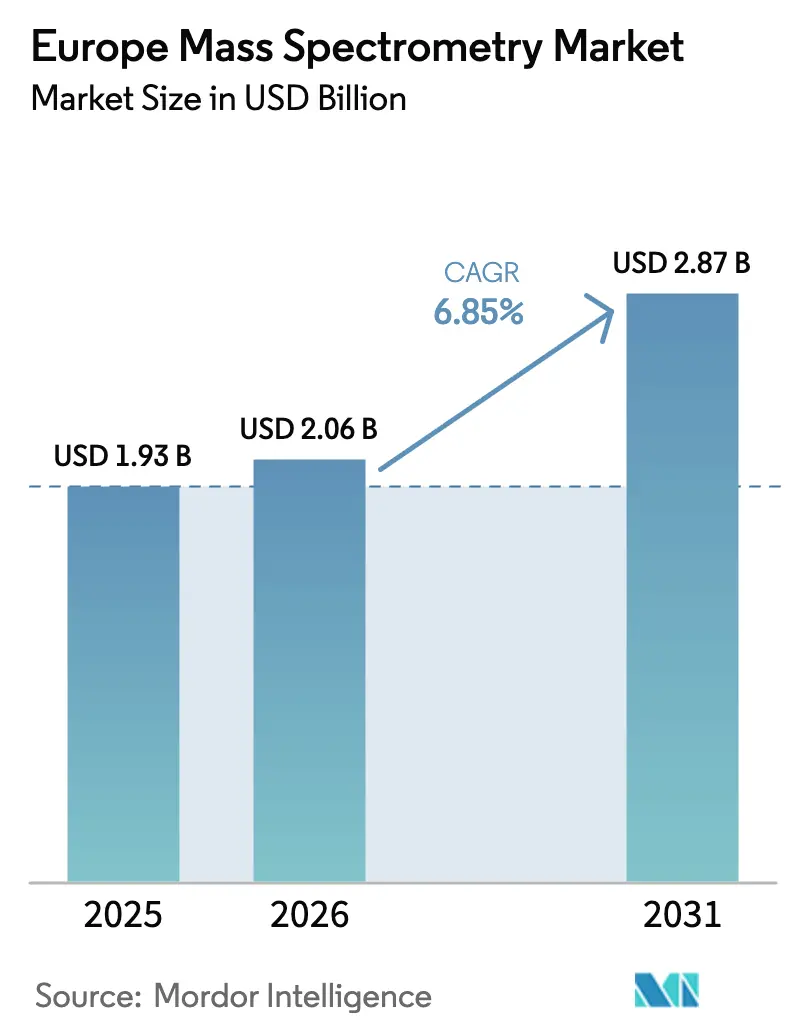
The Europe Mass Spectrometry Market size is expected to increase from USD 1.93 billion in 2025 to USD 2.06 billion in 2026 and reach USD 2.87 billion by 2031, growing at a CAGR of 6.85% over 2026-2031.
Growing pharmaceutical and biotechnology pipelines that demand sub-nanogram-per-milliliter quantitation, tighter EU residue-monitoring rules for food and water, and the rapid turn-round advantages of tandem-mass-spectrometry clinical assays are expanding the installed base of high-resolution systems. Instrument vendors are embedding artificial-intelligence spectral deconvolution that lifts sample throughput by 30% to 40%, enabling midsize laboratories to process workloads that formerly required reference-lab outsourcing. Environmental agencies in Germany and the Netherlands are migrating from single-quadrupole to time-of-flight ICP-MS in response to new PFAS limits that sit below 1 ng/L, reinforcing the shift toward hybrid and triple-quadrupole architectures. Capital budgets across Spain’s science-park network and United Kingdom contract research organizations show a clear preference for cloud-connected data systems over incremental hardware upgrades, signaling that recurring software and services revenue will outpace instrument sales during the forecast window.
Key Report Takeaways
- By platform, instruments led with 72.55% revenue share in 2025, whereas software and services is set to record the highest CAGR at 9.85% through 2031.
- By technology, hybrid systems commanded 48.53% of 2025 revenue, while ICP-MS is forecast to grow the fastest at 8.75% CAGR to 2031.
- By application, pharmaceutical analysis accounted for 36.15% share in 2025; clinical diagnostics is projected to expand at a 9.82% CAGR through 2031.
- By end user, pharmaceutical and biotechnology firms captured 42.32% of 2025 revenue, but hospitals and clinical laboratories are advancing at 9.29% CAGR to 2031.
- By geography, Germany held 39.52% of 2025 revenue, whereas Spain is expected to post the quickest growth at 8.32% CAGR over the forecast period.
Note: Market size and forecast figures in this report are generated using Mordor Intelligence’s proprietary estimation framework, updated with the latest available data and insights as of January 2026.
Market Trends and Insights
Drivers Impact Analysis of Europe Mass Spectrometry Market*
| Driver | (~) % Impact on CAGR Forecast | Geographic Relevance | Impact Timeline |
|---|---|---|---|
| Rising pharmaceutical & biotech R&D expenditure | +1.2% | Germany, France, United Kingdom, Switzerland | Medium term (2–4 years) |
| Stringent EU regulations for food safety & environmental monitoring | +1.5% | EU-wide, with early enforcement in Germany, Netherlands, Denmark | Short term (≤ 2 years) |
| Rapid adoption of hybrid & high-resolution MS technologies | +1.0% | Germany, United Kingdom, France, academic & pharma hubs | Medium term (2–4 years) |
| Expansion of clinical diagnostics & personalized medicine | +1.3% | Germany, Spain, United Kingdom, hospital networks | Long term (≥ 4 years) |
| AI-driven spectral interpretation enabling higher lab throughput | +0.8% | Global, with early gains in Germany, United Kingdom, Netherlands | Medium term (2–4 years) |
| Emergence of portable/benchtop MS unlocking decentralized testing | +0.7% | Spain, Italy, Rest of Europe, food & forensic sectors | Long term (≥ 4 years) |
| Source: Mordor Intelligence | |||
Rising Pharmaceutical & Biotech R&D Expenditure
European pharmaceutical firms invested EUR 55 billion in R&D during 2024, driving sustained orders for liquid-chromatography–mass-spectrometry platforms that handle large molecule impurity profiling and biosimilar comparability under EMA guidelines. The European Biotech Act, proposed in December 2025, promises streamlined authorizations for cell and gene therapies, pushing research laboratories toward Orbitrap and quadrupole-time-of-flight systems that deliver sub-ppm accuracy needed for complex glycoform mapping. Contract research organizations such as Quotient Sciences have enlarged United Kingdom bioanalytical suites, adding triple-quadrupole lines to meet Good Laboratory Practice capacity commitments. Spain’s 974 biotech entities alone deployed more than 120 new high-resolution instruments across 80 science parks in 2025, a trend likely to extend as oncology pipelines mature. Because Phase I and Phase II studies increasingly demand 24-hour bioanalysis, procurement momentum is expected to persist through 2031.
Stringent EU Regulations for Food Safety & Environmental Monitoring
The European Food Safety Authority tightened maximum residue limits for 126 pesticides in 2024, obliging laboratories to validate multi-residue screens that quantify 500+ compounds in a single run—functionality delivered only by triple-quadrupole or accurate-mass platforms[1]. The 2024 amendment to the EU Water Framework Directive added 24 PFAS to the priority list, requiring quarterly monitoring at levels below 1 ng/L and pushing environmental agencies to adopt triple-quadrupole ICP-MS for metal-free background and sub-ppt detection. Germany and the Netherlands have procured time-of-flight ICP-MS units that can track PFAS plumes around fluoropolymer facilities in real time. Food-testing labs across Denmark upgraded older single-quadrupole GC-MS to tandem configurations that meet ISO/IEC 17025 accreditation in under six months, shortening method-transfer cycles. This regulatory landscape is projected to lift the Europe mass spectrometry market CAGR by 1.5 percentage points through 2028, after which compliance-driven replacement demand levels off.
Rapid Adoption of Hybrid & High-Resolution MS Technologies
Hybrid designs that couple quadrupole mass filters with Orbitrap or time-of-flight analyzers delivered nearly half of Europe mass spectrometry market revenue in 2025 because they merge targeted quantitation with discovery-scale workflows. The Orbitrap Astral, introduced late-2024, captures 10,000 proteins per day from plasma by recording 200 spectra per second at 240,000 resolving power, transforming cohort-scale proteomics productivity. Academic alliances such as MSCoreSys in Germany operate shared quadrupole-time-of-flight libraries that harmonize quality-control metrics across four federal states. Fourier-transform ion-cyclotron-resonance remains a niche but is gaining recognition in complex petrochemical isomer resolution. As cloud-native algorithms automate deconvolution, hybrid platforms will consolidate dominance through 2031, blunting demand for legacy single-analyzer instruments.
Expansion of Clinical Diagnostics & Personalized Medicine
Hospitals across Germany, France, and the United Kingdom ran tandem-mass-spectrometry newborn-screening panels on more than 2 million infants in 2025, identifying metabolic disorders with specificity unmatched by immunoassays. Reimbursement reforms now cover vitamin D and testosterone quantitation via LC-MS/MS, removing a critical financial barrier to lab adoption in Germany. The MSTARS consortium is validating mass-spectrometry cardiovascular biomarker panels under EU in-vitro diagnostic regulation, targeting CE marking by 2027. Spain’s hospital networks funded 30 new triple-quadrupole installations during 2025 to support pharmacogenomic dosing workflows. These drivers position clinical diagnostics to be the fastest-growing application at 9.82% CAGR through 2031.
Restraints Impact Analysis of Europe Mass Spectrometry Market*
| Restraint | (~) % Impact on CAGR Forecast | Geographic Relevance | Impact Timeline |
|---|---|---|---|
| High capital & maintenance costs of advanced instruments | -0.9% | EU-wide, acute in Southern & Eastern Europe | Short term (≤ 2 years) |
| Shortage of skilled mass spectrometrists | -0.6% | United Kingdom, Germany, France, hospital labs | Medium term (2–4 years) |
| Complex regulatory validation & method-standardization hurdles | -0.5% | Clinical diagnostics, EU-wide | Long term (≥ 4 years) |
| Helium & high-purity gas supply volatility post-Ukraine conflict | -0.4% | Germany, France, United Kingdom, GC-MS users | Short term (≤ 2 years) |
| Source: Mordor Intelligence | |||
High Capital & Maintenance Costs of Advanced Instruments
List prices for triple-quadrupole and Orbitrap systems range between EUR 300,000 and EUR 1.2 million, with annual service contracts adding up to 12% of purchase cost. Smaller clinical laboratories in Spain and Greece defer upgrades, relying on send-out testing despite turnaround delays. Reagent-rental and pay-per-sample models offered by vendors reduce upfront burden but lock customers into multi-year consumable commitments that can exceed original capital cost. Refurbished equipment remains scarce because high-resolution systems stay useful for a decade. This fiscal drag is expected to shave 0.9 percentage points from the Europe mass spectrometry market CAGR until component prices fall and secondary markets mature.
Shortage of Skilled Mass Spectrometrists
A Royal Society of Chemistry survey in 2024 found that 40% of analytical-chemistry employers struggle to hire LC-MS/MS-proficient staff, hampering method development and troubleshooting[2]. German newborn-screening labs expanding from 25 to 50 disorders require analysts trained in ion-suppression mechanics, yet only two universities added relevant modules in 2025. Vendors now bundle AI-guided tuning wizards, but root-cause analysis of failed runs still depends on human expertise. Contract research organizations such as Synexa Life Sciences report that hiring bottlenecks limit utilization of nine LC-MS/MS lines in Manchester to 80% capacity. This workforce gap will hold market growth back by roughly 0.6 percentage points through 2029.
*Our forecasts treat driver/restraint impacts as directional, not additive. The impact forecasts reflect baseline growth, mix effects, and variable interactions.
Europe Mass Spectrometry Market Segment Analysis
By Platform:
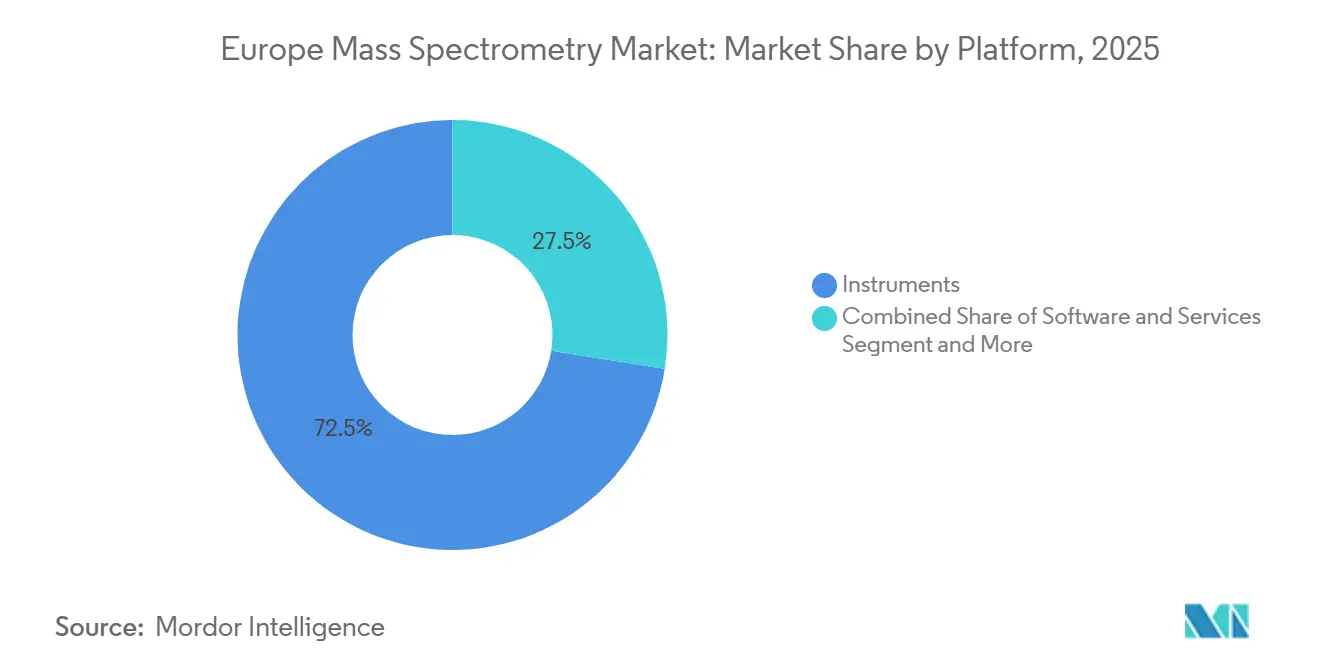
Software & Services Gain Ground on HardwareInstruments captured 72.55% of 2025 revenue, underscoring the capital-intensive nature of Orbitrap, triple-quadrupole, and ICP-MS purchases. Yet the software and services slice is projected to grow at 9.85% CAGR, outpacing hardware as laboratories prioritize data-integration, compliance documentation, and cloud pipelines. High-throughput contract labs that run 500 samples daily on a single triple-quadrupole consume EUR 70,000 in columns, calibration mixes, and ion-source spares each year, creating sticky recurring revenue. Subscription licensing models for enterprise chromatography data systems align vendor incentives with uptime, intensifying competition around analytics rather than detection limits.
Laboratories that already house multiple systems now view sample-to-report turnaround as the primary bottleneck. The Europe mass spectrometry market size for software tools that automate peak picking and audit trails rose sharply after Thermo Fisher introduced Chromeleon 7.3.2, which unites instrument control, LIMS connectivity, and AI-assisted method setup. Open-source alternatives such as MZmine 3 pressure commercial suites to prove tangible compliance benefits. As artificial-intelligence features mature, services tied to continuous algorithm upgrades are expected to offset slower instrument unit shipments, lifting overall market resilience.

By Technology:
ICP-MS Surges on Environmental MandatesHybrid platforms contributed 48.53% of revenue in 2025, favored for their ability to toggle between discovery and targeted assays in a single run. Triple-quadrupole LC-MS/MS remains dominant in pharmaceutical bioanalysis because it pairs femtogram-level sensitivity with rugged uptime. Quadrupole-time-of-flight instruments excel in untargeted metabolomics, where mass accuracy below 3 ppm speeds unknown identifications. Orbitrap instruments, a subset of Fourier-transform technology, now extend to 200 Hz acquisition, opening doors for single-cell proteomics.
Environmental legislation is accelerating ICP-MS adoption; the Europe mass spectrometry market share for ICP-MS is projected to climb as triple-quadrupole configurations remove spectral interferences that once hampered arsenic or selenium quantitation below regulatory cut-offs. Germany alone commissioned 25 time-of-flight ICP-MS units in 2025 to monitor PFAS plumes, and Italy’s water authorities plan similar upgrades by 2027. Though magnetic-sector systems keep a toehold in isotope ratio studies, high-resolution Orbitraps are eroding that niche with comparable precision at a lower total cost of ownership.
By Application:
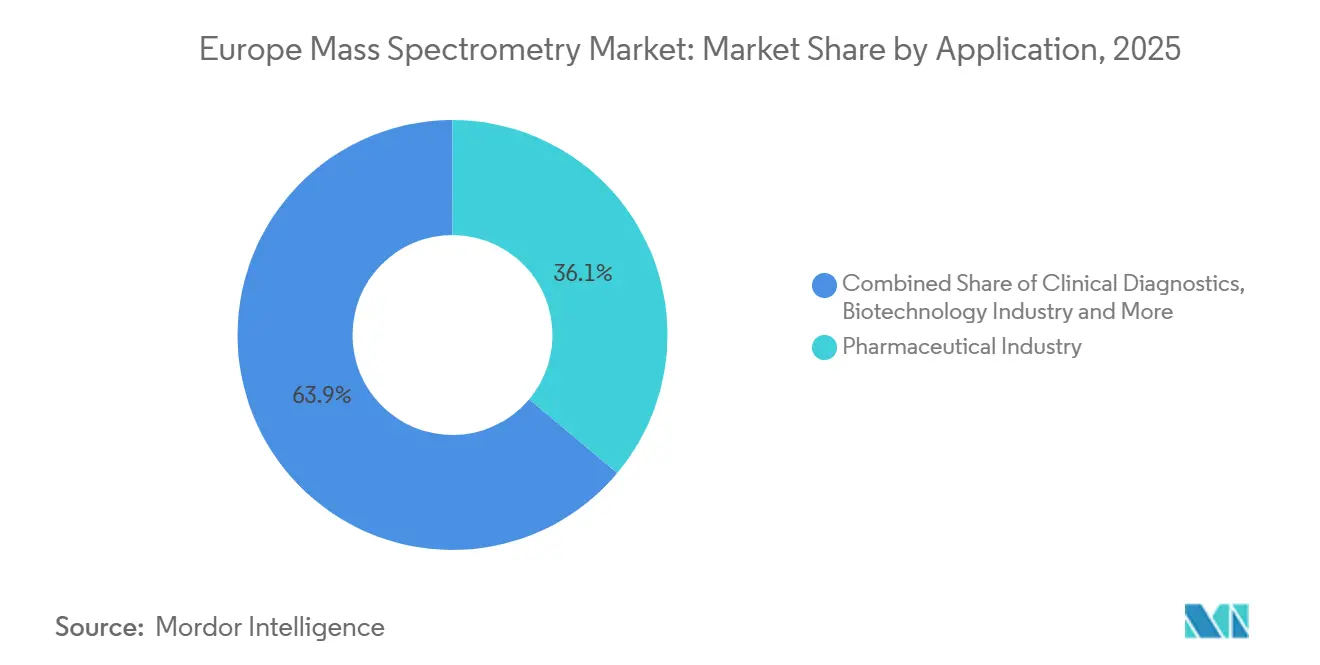
Diagnostics Overtakes Discovery in Growth PacePharmaceutical analysis dominated applications with 36.15% of 2025 revenue, fueled by EUR 55 billion in EU drug-development outlays that mandated impurity profiling and bioequivalence confirmation. Contract research labs in Verona and Manchester expanded triple-quadrupole lines to manage surging Phase I workloads, affirming hardware demand. However, clinical diagnostics is advancing at 9.82% CAGR and is on track to narrow the revenue gap by 2031.
Hospitals deploying LC-MS/MS assays for vitamin D, testosterone, and immunosuppressants report 25% declines in false-positive rates versus immunoassays, validating their economic case. Europe mass spectrometry market size for clinical assays will swell further once MSTARS gains CE marking for cardiovascular biomarker panels by 2027. Forensic toxicology, environmental surveillance, and food safety round out the application mix, but their collective growth lags diagnostics as reimbursement reforms reshape capital planning.
By End User:
Hospitals & Clinical Labs Accelerate ProcurementPharmaceutical and biotech companies retained 42.32% of 2025 spending, backed by multiyear pipeline funding that shields budgets from short-term volatility. Academic consortia such as MSCoreSys synchronized procurement across four German federal states, leveraging bulk discounts and shared spectral libraries to elevate Europe mass spectrometry market efficiency.
Hospitals and clinical laboratories are expected to add the most new systems, propelled by reimbursement shifts in Germany and the United Kingdom that now recognize LC-MS/MS for endocrine and therapeutic-drug tests. Charité–Universitätsmedizin Berlin alone processes 50,000 samples annually on a mixed triple-quadrupole and Orbitrap fleet, illustrating how clinical throughput needs reshape instrument specifications. As precision-medicine initiatives widen, the Europe mass spectrometry market size for hospital users will compound faster than any other end-user category through 2031.
Geography Analysis
Germany Mass Spectrometry Market
Germany controlled 39.52% of Europe mass spectrometry market revenue in 2025, supported by MSCoreSys, which pools procurement and training across Berlin, Heidelberg, Mainz, and Munich. A Deutsche Forschungsgemeinschaft grant financed 12 new quadrupole-time-of-flight units for Hanover institutions, cementing academic demand. The country’s environmental agencies transitioned to time-of-flight ICP-MS for PFAS mapping, emphasizing Germany’s lead in high-resolution adoption.
United Kingdom and France Mass Spectrometry Market
The United Kingdom and France each hold robust installed bases across CROs and hospital networks. Synexa Life Sciences runs nine LC-MS/MS systems in Manchester for outsourced bioanalysis, while French labs accelerated hydrogen-carrier retrofits after helium prices tripled by 2025, illustrating how gas-supply shocks influence capital cycles. Clinical centers in both countries benefit from ISO 15189-validated platforms, encouraging in-house testing.
Broader European Markets
Spain represents the fastest-growing cluster at 8.32% CAGR. Its 974 biotech firms occupy 80 science parks and invested EUR 1.218 billion in R&D during 2023, channeling funds into Orbitrap and TOF platforms for proteomics and biosimilar analysis[3]. Hospital consortia leveraged national innovation grants to install 30 new triple-quadrupole instruments in 2025 alone. Italy mirrors this trend on a smaller scale, with Evotec’s Verona site expanding GLP-certified mass-spectrometry suites to serve EU and U.S. sponsors. Horizon-funded programs such as MSTARS and EU-OPENSCREEN distribute instrumentation to smaller member states, ensuring that Rest-of-Europe markets participate in method-standardization gains.
Regulatory Landscape
Clinical and applied mass spectrometry in Europe is shaped by EU medical-device rules for diagnostic use, alongside method-development and validation expectations used in regulated pharmaceutical testing. Under IVDR (Regulation 746/2017) and MDCG guidance such as MDCG 2024-11, mass spectrometers used as IVD detection equipment, including laboratory-developed tests, face tighter expectations around documented performance, risk management, and quality systems aligned with ISO 13485 and ISO 15189. As a result, assay validation and audit readiness requirements for hospital labs continue to rise.
At the scientific-guidance level, the European Medicines Agency has adopted ICH Q2(R2) (Validation of Analytical Procedures) and ICH Q14 (Analytical Procedure Development). These guidelines reinforce standardized approaches for analytical procedures used in LC-MS/MS bioanalysis and impurity profiling. On the policy side, the European Commission tabled a late-2025 legislative proposal (COM(2025) 1023) to simplify aspects of medical device and IVD rules, and 2026 implementing and delegated acts under the broader EU medical-device framework indicate continued rule updates. Vendors and laboratories are tracking these changes when preparing compliance documentation, planning notified-body interactions, and managing instrument-software change control.
Competitive Landscape
Thermo Fisher Scientific, Waters, Agilent, Bruker, and other account for a dominant slice of Europe mass spectrometry market share, aided by ISO-accredited service networks that lower regulatory risk for clinical buyers. Thermo Fisher’s Orbitrap Astral targets single-cell proteomics with 200-Hz acquisition at 240,000 resolving power, while Waters’ Xevo TQ-XS consolidates pharmaceutical bioanalysis leadership by combining sub-pg/mL sensitivity with rugged pneumatic controls. Agilent’s 6546 Q-TOF and Bruker’s timsTOF Pro add ion-mobility separation that resolves co-eluting isomers in metabolomics.
Smaller entrants are exploiting whitespace in portable and benchtop formats. Microsaic Systems shipped compact quadrupoles to Italian pharma plants for real-time process monitoring, displacing bulky skid-mounted analyzers. TOFWERK’s cart-mounted TOF platforms support on-site VOC mapping for Austrian environmental agencies. Open-source software suites such as MZmine 3 and quantms erode proprietary data-analysis margins, prompting incumbents to add AI-driven compliance reporting.
Regulatory timelines shape switching costs; hospitals favor platforms already validated under ISO 15189, hindering late-stage challengers. The helium shortage accelerated R&D into hydrogen-compatible ion sources, an innovation race that could reorder vendor standings if operating-cost savings prove decisive. CRO expansions in Verona, Milan, and Manchester indicate enduring demand for multi-instrument, multi-vendor labs that can flex with sponsor requirements. Overall, competition revolves more around workflow integration and regulatory speed than raw resolving power.
Europe Mass Spectrometry Industry Leaders
-
Thermo Fisher Scientific Inc.
-
Bruker Corporation
-
Waters Corporation
-
Dani Instruments SpA
-
Agilent Technologies, Inc.
- *Disclaimer: Major Players sorted in no particular order
Europe Mass Spectrometry Market Companies Covered in this Report
- Agilent Technologies
- Ametek
- Analytik Jena
- Bruker
- Danaher
- Dani Instruments
- Endress+Hauser (Analytik Jena)
- Hitachi
- HORIBA Ltd.
- JEOL Ltd.
- Kore Technology Ltd.
- LECO
- Microsaic Systems plc
- PerkinElmer
- Rigaku
- Shimadzu
- SPECTRO Ametek
- Teledyne FLIR
- Thermo Fisher Scientific
- TOFWERK AG
- Waters Corporation
Market Opportunities and Future Outlook
A near-term opportunity is forming at the intersection of IVDR standardization and the adoption of certified, kit-based LC-MS/MS workflows with automation in hospital laboratories. The CE-marking activity for Roche’s cobas Mass Spectrometry Ionify reagent portfolio (Roche, December 2025) and the consideration of EU IVDR Class C certification for Shimadzu Chemistry & Diagnostics SAS’s DOSIMMUNE LC-MS/MS immunosuppressant kit (review completed November 2025 and announced in 2026) point to broader routine therapeutic drug monitoring and endocrine testing within regulated clinical workflows across Europe.
Separately, demand for higher-throughput, higher-resolution multiomics and biopharma characterization is creating room for platforms and software releases designed to shorten sample-to-answer time, not only raise detection performance. In 2026, Waters introduced the Xevo MRT P10 and Cyclic IMS P20 to target high-throughput HRMS and structural or spatial omics workflows, while Bruker launched timsMRMS and Biognosys released Spectronaut 21 and SpectroMine 6 to scale data processing and multiomics pipelines. Together, these product moves align with European lab preferences for cloud-connected data systems and integrated workflow solutions.
Recent Industry Developments in Europe Mass Spectrometry Market
- June 2026: Thermo Fisher Scientific introduced new Orbitrap instruments at ASMS 2026, including the Orbitrap Tribrid Apex, Orbitrap Excedion, and Orbitrap Exploris GC S systems. The launches broaden high-resolution coverage across research, biopharma, and applied testing workflows, shifting competitive focus toward end-to-end productivity and data-handling rather than standalone instrument specifications.
- March 2026: Shimadzu Corporation acquired a 75% stake in Germany-based Plasmion GmbH to gain control of SICRIT (Soft Ionization by Chemical Reaction In Transfer) technology. The acquisition strengthens Shimadzu’s position in prep-free, real-time mass spectrometry and expands its European innovation footprint in ionization and rapid-screening workflows.
- December 2025: Roche received CE-mark for its cobas Mass Spec Ionify reagent portfolio for automated LC-MS/MS testing, covering areas such as antibiotic therapeutic drug monitoring, steroid hormones, and vitamin D. This increases the addressable base for standardized clinical mass spectrometry workflows in Europe by pairing reagent portfolios with automation and regulated IVD positioning.
Europe Mass Spectrometry Market Report Scope and Research Methodology
Market Definition and Coverage
This market covers revenue generated from mass spectrometry used across laboratories in Europe, including instruments, related consumables, and attached software and services that enable routine and advanced testing.
Scope exclusions: Excludes chromatography-only systems and general lab equipment that is not directly required to run or maintain a mass spectrometry workflow.
Segments Covered in This Report
- By Platform
- Instruments
- Consumables
- Software & Services
- By Technology
- Hybrid Mass Spectrometry
- Triple Quadrupole (Tandem)
- Quadrupole-TOF (Q-TOF)
- FT-MS / Orbitrap
- Single Mass Spectrometry
- Ion Trap
- Quadrupole
- Time-of-Flight (TOF)
- Inductively-Coupled Plasma MS (ICP-MS)
- Single Quadrupole ICP-MS
- Triple Quadrupole ICP-MS
- TOF-ICP-MS
- Magnetic-Sector MS
- Other Specialised Technologies
- Hybrid Mass Spectrometry
- By Application
- Pharmaceuticals Industry
- Biotechnology Industry
- Clinical Diagnostics
- Forensic & Toxicology
- Other Applications
- By End User
- Pharmaceutical & Biotechnology Companies
- Academic & Research Institutes
- Contract Research Organisations
- Hospitals & Clinical Laboratories
- Other End Users
- By Country
- Germany
- United Kingdom
- France
- Italy
- Spain
- Rest of Europe
Data Sources, Market Sizing, and Validation
Desk Research
Desk research was used to build the demand fact base and the operating context across major European countries, then it was used to pressure-test what we heard from interviews. We reviewed public sources such as Eurostat for R&D and industrial indicators, the European Medicines Agency for signals on drug and quality testing intensity, and the European Environment Agency for monitoring and compliance-driven testing needs.
To avoid relying on one angle, we also checked sources such as OECD science and innovation statistics, the World Bank macro series for inflation and currency context, and peer-reviewed journals for technology adoption patterns (for example, LC-MS usage in regulated testing). Annual reports, investor presentations, and reputable press were used to understand product mix shifts and service attachment trends, and patent databases helped identify where new ionization and high-resolution workflows were being developed. The sources listed here are illustrative only, and many other public references were also used to collect data, validate assumptions, and clarify open points.
Primary Interviews and Surveys
Primary work was done through expert interviews and structured surveys with instrument channel participants, lab decision-makers, and technical specialists across key European markets, followed by re-checks where responses conflicted. We used these discussions to confirm utilization trends, typical replacement cycles, service attachment rates, and the practical split between research use and regulated routine testing (where pricing and purchasing cadence can differ).
Distribution of primary research fieldwork respondents
| Company type | Respondent position |
|---|---|
| Top tier: 38% | CXOs: 16% |
| Mid tier: 42% | Functional/Unit leaders: 25% |
| Smaller Players: 20% | Managers: 59% |
Market-Sizing & Forecasting
The sizing model starts with a top-down build where country-level laboratory demand is reconstructed using spending and activity signals, and then allocated to mass spectrometry based on observed adoption and replacement behavior. For Europe, the pool was anchored to practical inputs such as the installed base renewal cycle of MS instruments, new lab setup activity, the share of testing that requires MS-level sensitivity, and the typical split between routine and research workloads.
After that, the totals were corroborated with selective bottom-up approximations, mainly by sampling average selling prices by instrument class, pairing these with expected unit volumes, and then adding service and consumables attachment where interviews supported stable ratios. When data was missing for smaller countries, we used proxy scaling through R&D intensity and regulated testing activity, and then adjusted it after channel checks indicated the proxy was too high or too low. For forecasting, scenario analysis was applied with a base case agreed in interviews, using variables such as pharma and biotech funding, clinical diagnostics adoption pace, environmental compliance testing intensity, instrument price progression, and service contract penetration to shape the yearly trajectory.
Data Validation & Update Cycle
Validation is handled through repeated cross-checks, where model outputs are compared against independent signals such as R&D trends, lab capital spending direction, and observed instrument replacement timing, and then reviewed for outliers at country and platform levels. If a variance is large, we re-contact respondents or run a targeted secondary check until the driver is understood and documented.
Before sign-off, the model and assumptions go through a multi-step internal review so arithmetic, units, and logic stay consistent across the time series. Reports are refreshed annually, and interim updates are made when material events occur, such as major regulatory shifts, pricing shocks, or sudden changes in lab spending. Right before delivery, a fresh pass is completed so clients receive the most current view available at that time.
Mordor Intelligence's Europe Mass Spectrometry Market Size Compared With Other Published Estimates
Published market sizes for Europe mass spectrometry can differ across sources because each one chooses its own coverage of what counts as the market, and each one also picks a different base year and forecasting window. Currency timing, inflation handling, and whether services and software are counted the same way can also change the final value.
The main gap comes from platform scope and timing, where Mordor Intelligence counts instruments together with related consumables and software and services in Europe for the 2025 base year, while some other estimates lean on earlier-year values or narrower component breakdowns that do not always reflect service attachment and price shifts consistently.
Benchmark comparison
| Source | Market Size | Gaps in Research Methodology |
|---|---|---|
| Mordor Intelligence | USD 1.93 B (2025) | |
| Trade Publisher A | USD 1.73 B (2024) | Uses a 2024 starting point and a longer horizon, and the scope emphasis is more on technology and application buckets, which can understate service and consumables attachment if not modeled explicitly by platform. |
| Industry Publisher B | USD 1.83 B (2025) | Frames the market through component and product splits and highlights a 2025 value tied to a specific forecast set, which can differ depending on how software, services, and bundled pricing are treated across European countries. |
The comparison shows that year choice and what gets counted alongside instruments are the two biggest reasons the numbers spread out. By keeping the inputs tied to replacement cycles, regulated testing demand, and realistic attachment rates, the final estimate stays traceable to simple steps that can be reviewed and repeated.
Key Questions Answered in the Report
How fast is demand for clinical LC-MS/MS assays growing across European hospitals?
Clinical diagnostics revenue is rising at a 9.82% CAGR through 2031 as hospitals replace immunoassays with high-specificity mass-spectrometry panels.
Which European country leads current mass-spectrometry sales?
Germany accounts for 39.52% of 2025 revenue, supported by coordinated public-research funding and nationwide core-facility networks.
What technology segment is expanding quickest under EU environmental rules?
ICP-MS, particularly triple-quadrupole configurations, is advancing at 8.75% CAGR on the back of PFAS and heavy-metal monitoring mandates.
Are portable mass spectrometers ready for regulatory-grade testing?
Field units now meet ISO 17025 in pilot programs, but broader EMA guidance is still pending, so adoption remains confined to early-stage food and forensic applications.
How are AI tools influencing laboratory productivity?
Machine-learning peak-integration and retention-time prediction cut manual review by up to 40%, enabling a single triple-quadrupole to process 700 samples per day.