
Europe Environmental Protection Technical Textile Market Size and Share
Market Overview
| Study Period | 2021 - 2032 |
|---|---|
| Forecast Data Period | 2027 - 2032 |
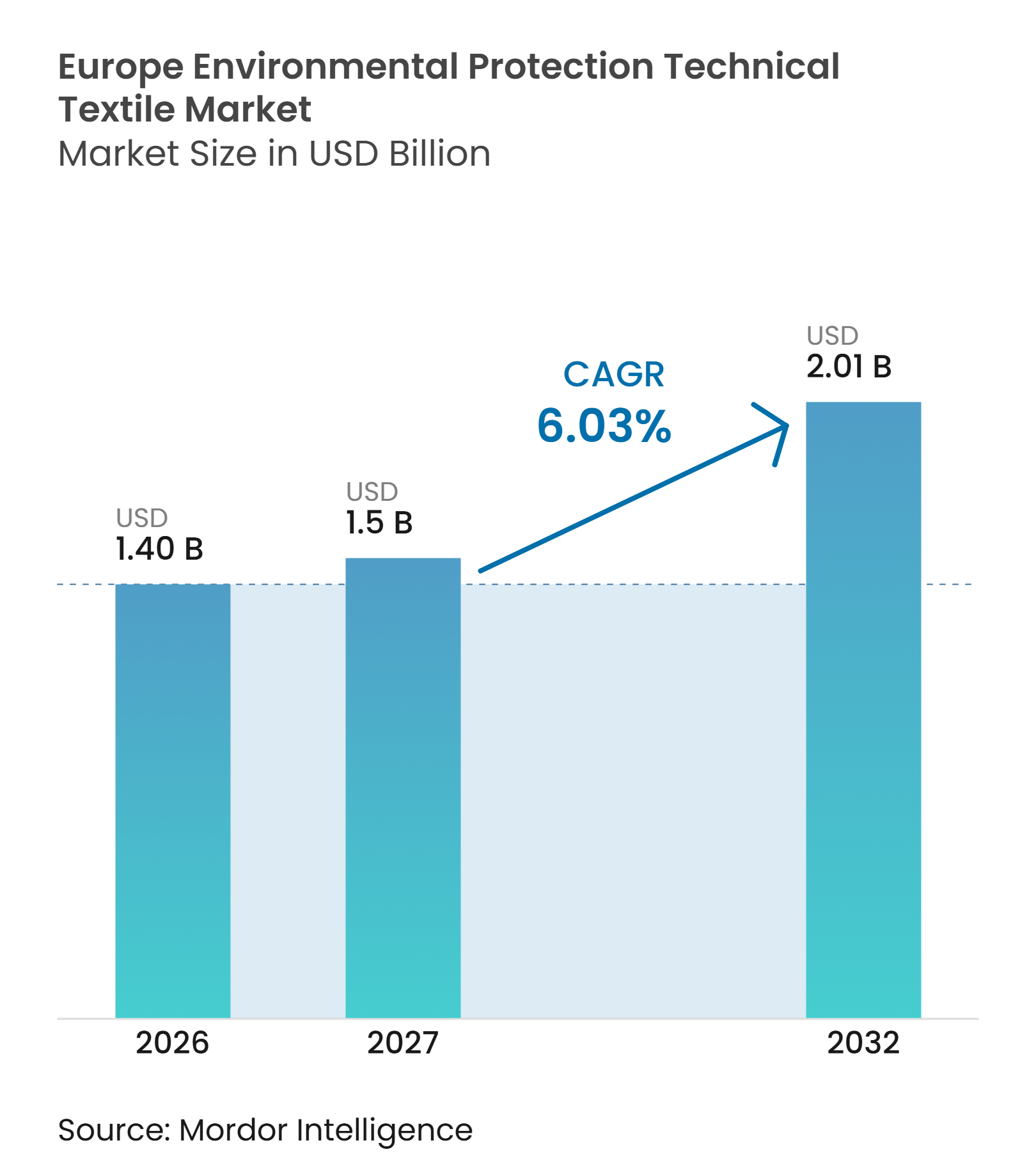
| Base Year Market Size (2026) | USD 1.40 Billion |
| Market Size (2027) | USD 1.5 Billion |
| Market Size (2032) | USD 2.01 Billion |
| Growth Rate (2027 - 2032) | 6.03 % |
| Market Concentration | Medium |
Major Players *Disclaimer: Major Players sorted in no particular order Image © Mordor Intelligence. Reuse requires attribution under CC BY 4.0. | |
Europe Environmental Protection Technical Textile Market Analysis by Mordor Intelligence
The Europe Environmental Protection Technical Textile Market size is projected to be USD 1.40 billion in 2026, USD 1.5 billion in 2027, and reach USD 2.01 billion by 2032, growing at a CAGR of 6.03% from 2027 to 2032.
Environmental compliance, wastewater upgrades, and climate adaptation works are directing demand toward filtration media, geotextiles, sorbents, and stormwater products. The Europe environmental protection technical textile market is supported by regulatory work that operators cannot easily postpone, which reduces its exposure to discretionary industrial spending. Procurement is increasingly focused on documented filtration performance, durability, and material traceability. Manufacturers that combine fiber production, fabric formation, coating, and conversion can provide more consistent products for demanding applications. This favors suppliers that have established technical qualifications and regional distribution networks.
Key Report Takeaways
- By product type, air pollution-control textiles accounted for 34.0% of the Europe environmental protection technical textile market share in 2026, while water and wastewater treatment textiles are forecast to grow at a 7.6% CAGR through 2032.
- By material type, polyester accounted for 30.5% of the Europe environmental protection technical textile market size in 2026, while high-performance synthetic fibers are forecast to grow at a 7.8% CAGR through 2032.
- By end-use application, industrial and manufacturing facilities accounted for a 32.0% share in 2026, while municipal water and wastewater utilities are forecast to grow at a 7.4% CAGR through 2032.
-
By geography, Germany accounted for a 27.5% share in 2026, while Poland is forecast to grow at a 7.1% CAGR through 2032.
Note: Market numbers in this report are based on Mordor Intelligence's proprietary estimation framework, which combines nine months of actuals with Q4 projections for base year 2026.
Market Trends and Insights
Drivers Impact Analysis of Europe Environmental Protection Technical Textile Market*
| Driver | (~) % Impact on CAGR Forecast | Geographic Relevance | Impact Timeline |
|---|---|---|---|
| Tightening Industrial Emissions and Wastewater Compliance | +2.0% | EU-wide, with early gains in Germany, France, and Italy | Short term (≤ 2 years) |
| Climate-Resilient Flood, Erosion, and Coastal Protection | +1.5% | Germany, Netherlands, United Kingdom, Belgium, Poland, and Sweden | Medium term (2-4 years) |
| Lower-Carbon Replacement of Aggregate and Mineral Layers | +0.9% | EU-wide, especially France, Poland, and Spain | Medium term (2-4 years) |
| Growing Demand for Landfill Lining and Leachate Management Systems | +0.7% | EU-wide, especially Belgium, France, and Germany | Medium term (2-4 years) |
| Specification-Led Demand for Documented Filtration Performance | +0.5% | EU-wide, with highest relevance in Germany and Italy | Short term (≤ 2 years) |
| Textile-Integrated Monitoring of Critical Environmental Infrastructure | +0.3% | Germany, Netherlands, Italy, Nordic countries, and Eastern Europe | Long term (≥ 4 years) |
| Source: Mordor Intelligence | |||
Tightening Industrial Emissions and Wastewater Compliance
The Europe environmental protection technical textile market benefits from permit conditions that require industrial sites to upgrade pollution-control systems within set compliance periods. Directive EU 2024/1785 entered into force on August 4, 2024, and required national transposition by July 1, 2026, creating time-bound upgrade schedules across the region. The recast Urban Wastewater Treatment Directive entered into force on January 1, 2025, and adds stronger treatment requirements that support advanced filtration investment.[1] These obligations raise demand for membrane supports, needlepunched media, filter cloths, and other durable products. They also move procurement toward higher-performance materials rather than low-cost replacement bags.
Climate-Resilient Flood, Erosion, and Coastal Protection
Flood protection investment is making geotextiles and drainage fabrics more important in planned public infrastructure projects. In January 2026, the European Investment Bank signed EUR 500 million (USD 588.2 million) in loan agreements with Emschergenossenschaft and Lippeverband to finance flood protection and climate adaptation projects in Germany's Emscher-Lippe region.[2] The program includes dyke rehabilitation, pumping-station upgrades, and stormwater improvements, which create demand for drainage composites, erosion-control fabrics, and filter inserts. These uses move technical textiles from emergency response into recurring public-works specifications. Long asset lives also create a later need for inspection, repair, and partial replacement. The Europe environmental protection technical textile market therefore gains a maintenance stream that continues after initial installation.
Growing Demand for Landfill Lining and Leachate Management Systems
Expansion of waste management infrastructure and the need for reliable containment of municipal and industrial waste are supporting demand for environmental protection technical textiles across Europe. Modern landfill facilities use geomembranes, geotextile protection layers, drainage composites, and filtration fabrics to prevent leachate migration, protect groundwater, and manage liquid drainage. Geotextiles also provide cushioning and separation between protective liners and surrounding soil, reducing the risk of liner damage during installation and operation. Increasing investment in landfill modernization, closure, and rehabilitation projects creates additional opportunities for specialized geosynthetic materials. Demand is particularly relevant in applications requiring multilayer containment systems, where textile-based products improve drainage efficiency, structural protection, and long-term environmental performance.
Circular-Economy Demand for Recycled and Bio-Based Textile Systems
The revised Waste Framework Directive entered into force in October 2025 and requires member states to establish extended producer responsibility schemes for textiles and footwear.[3] The measure strengthens the commercial case for products that can demonstrate recycled content, durability, and more manageable end-of-life pathways. Producers of environmental protection textiles face an incentive to develop supply chains for recycled fibers and lower-impact raw materials. France 2030 co-invested EUR 6 million (USD 7.1 million) in Occitanie Geotex, within a EUR 30 million (USD 35.3 million) financing round, for a hemp-based biodegradable geotextile plant in Ariège. The product is intended for erosion control, slope stabilization, and related applications where biodegradable performance is suitable. The Europe environmental protection technical textile market can gain from this shift, although applications requiring high temperatures or strong chemical resistance will continue to require carefully qualified materials.
Restraints Impact Analysis of Europe Environmental Protection Technical Textile Market*
| Restraint | (~) % Impact on CAGR Forecast | Geographic Relevance | Impact Timeline |
|---|---|---|---|
| Polymer and Energy Cost Volatility | -0.8% | EU-wide, especially polyolefin-intensive manufacturing hubs | Short term (≤ 2 years) |
| Fragmented National Approvals and Public Procurement Requirements | -0.5% | EU-wide, with highest friction in multi-country procurement and Eastern Europe | Medium term (2-4 years) |
| Low-Volume Qualification Burden for Smart Environmental Textiles | -0.4% | Germany, Netherlands, and Italy | Long term (≥ 4 years) |
| Recycled-Feedstock Competition and End-of-Life Complexity | -0.2% | EU-wide, especially PFAS-containing and blended-fiber applications | Medium term (2-4 years) |
| Source: Mordor Intelligence | |||
Polymer and Energy Cost Volatility
Raw material and energy costs can pressure margins for producers of sorbent pads, nonwoven filter bags, and other commodity-oriented products. These producers often sell through public contracts that offer limited scope for price adjustment. Price changes can delay replacement orders even when environmental rules support the underlying need for a product. The impact is strongest where products depend on polyolefin and other polymer inputs with fluctuating supply costs. Recycled feedstocks can also be difficult to use in applications that require consistent high-temperature, chemical, or filtration performance. The Europe environmental protection technical textile market must therefore balance lower-impact material goals with the cost and reliability requirements of critical environmental applications.
Fragmented National Approvals and Public Procurement Requirements
National implementation differences can slow the movement of common European environmental requirements into uniform procurement practice. Differences in national implementation can leave enforcement timing different across member states. Manufacturers may need separate technical documents, regional quality marks, and tender evidence to serve several markets. EURATEX has called for a harmonized approach to PFAS analytical thresholds and textile-specific test methods to avoid divergent national interpretations. Smart environmental textiles face an additional hurdle because pilot projects usually have low volumes and long qualification periods. Materials containing PFAS and blended fibers also present difficult end-of-life pathways, and ECHA specifically assessed technical textiles in its August 2025 update to the PFAS restriction proposal.
*Our forecasts treat driver/restraint impacts as directional, not additive. The impact forecasts reflect baseline growth, mix effects, and variable interactions.
Europe Environmental Protection Technical Textile Market Segment Analysis
By Product Type:
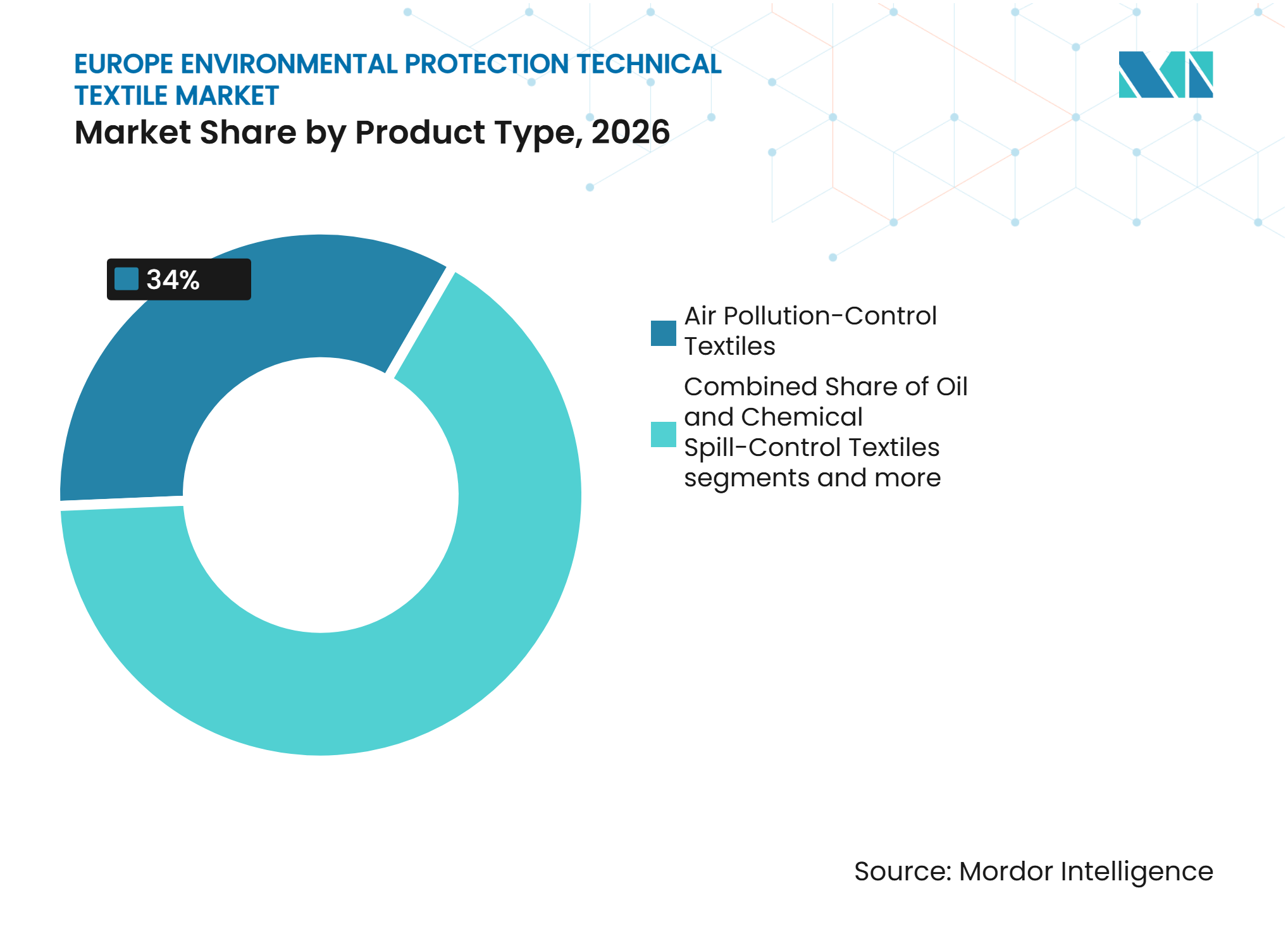
Filtration Compliance Anchors Air Pollution LeadershipAir pollution-control textiles accounted for 34.0% of the Europe environmental protection technical textile market size in 2026, making them the leading product category. Their installed base covers baghouse and pulse-jet systems in cement, chemicals, metals, power, and mineral processing. These facilities face continuing permit requirements under the Industrial Emissions Directive. High-temperature and chemically stable media are important where flue gases place greater stress on conventional fabrics. The product group also includes more specialized laminated and multifunctional products that can support more demanding separation needs.
Water and wastewater treatment textiles are forecast to expand at a 7.6% CAGR through 2032, the highest rate among product types. Products include membrane supports, filter cloths, dewatering belts, and media used in treatment and sludge handling. Oil and chemical spill-control textiles remain tied to refinery maintenance, chemical plant operations, and marine preparedness requirements. Stormwater fabrics gain relevance when local authorities add drain-inlet filters, mats, and cartridge inserts to urban drainage systems. Other specialized products serve remediation work, including containment and groundwater applications linked to the progression of PFAS restrictions.



By Material Type:
Polyester Commands Share, High-Performance Fibers Lead GrowthPolyester held 30.5% of the Europe environmental protection technical textile market share in 2026. It remains widely used in liquid filtration, geotextile drainage layers, and stormwater mats because it can balance performance and cost. Polypropylene also has a broad role in sorbents, separation layers, and water-treatment filter cloths. Polyamide and fluoropolymer media address applications that need chemical resistance, low-friction surfaces, or more specialized membrane support structures. The service environment, proof of performance, and future compliance exposure increasingly shape material selection.
High-performance synthetic fibers are forecast to grow at a 7.8% CAGR through 2032. PPS and aramid grades are suited to cement plants, incineration facilities, and power applications with sustained temperatures from 160°C to 240°C and aggressive gases. Natural and regenerated cellulosic fibers are smaller but developing for lower-temperature erosion-control and stormwater uses. Occitanie Geotex illustrates how certified biodegradable hemp products can serve slope stabilization and revegetation projects. Glass and other inorganic fibers retain a role where polymer fibers cannot provide the required temperature resistance. The Europe environmental protection technical textile market is therefore likely to use a wider material mix rather than shift uniformly away from established synthetics.
By End-Use Application:
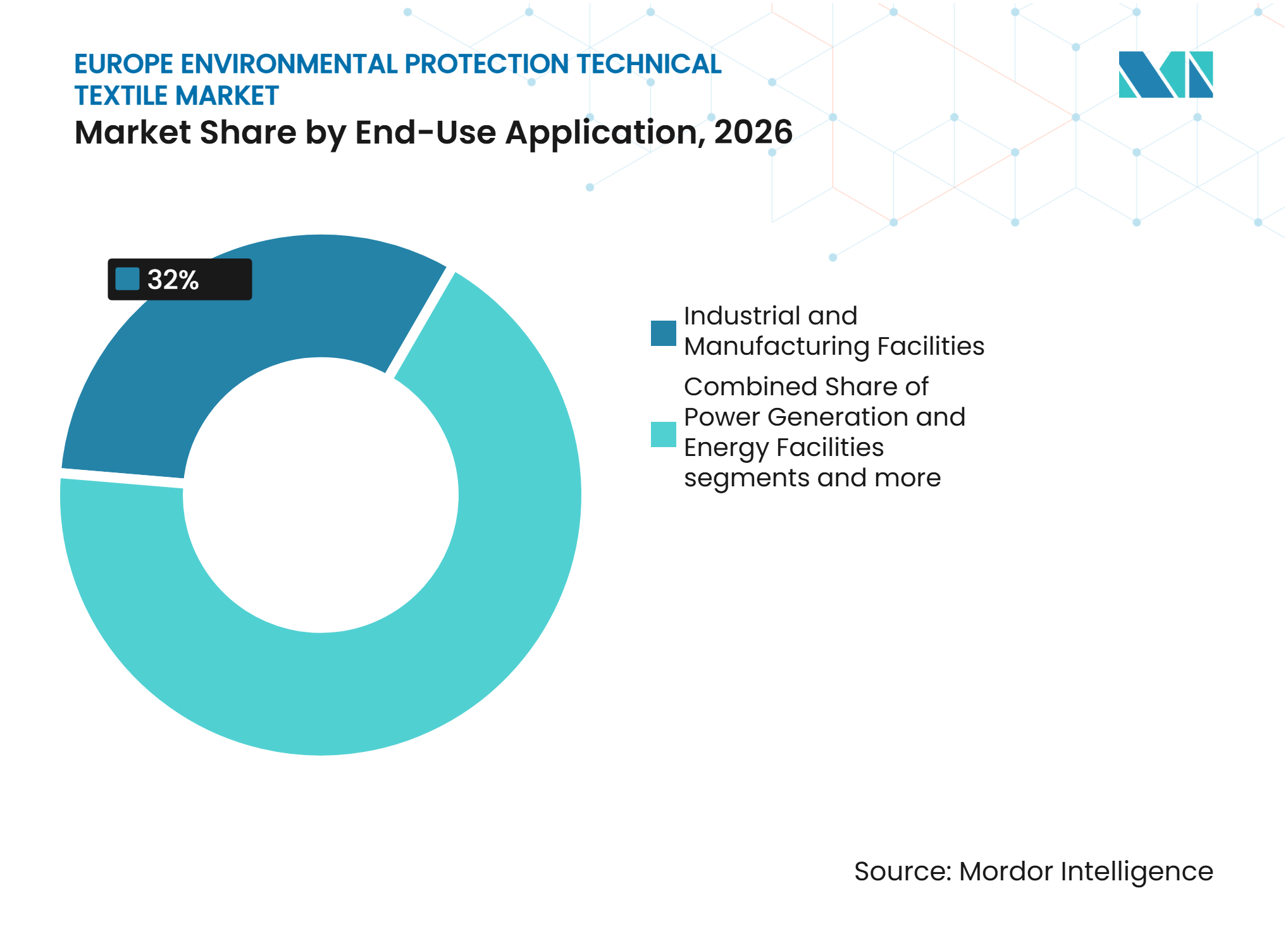
Industrial Demand Remains Largest While Municipal Utilities Grow FasterIndustrial and manufacturing facilities held 32.0% of the Europe environmental protection technical textile market size in 2026. Chemicals, petrochemicals, metals, mining, cement, and other continuous-process industries require high-volume filtration and environmental control systems. Their purchasing decisions emphasize durability, documented performance, and dependable supply. Power generation and energy facilities provide further demand for high-temperature flue-gas filtration fabrics. Coal plant retirements in Western Europe can reduce some volume, while waste-to-energy operations partly offset that change.
Municipal water and wastewater utilities are forecast to grow at a 7.4% CAGR through 2032. Their capital plans support advanced filtration media, dewatering belts, sludge-press fabrics, and related systems. Utility procurement can consolidate product specifications across plant networks, which favors suppliers that already meet qualification requirements. Oil and gas, marine, and spill-response organizations purchase sorbents and containment materials to meet preparedness needs. Urban stormwater and drainage infrastructure is also expanding as public works programs add textile-based water-management components. Environmental remediation and emergency-response services provide a smaller but specialized channel for containment and site-protection materials.

Geography Analysis
Germany: Europe’s Dominant Filtration Manufacturing and Demand Hub
Germany accounted for 27.5% of the Europe environmental protection technical textile market share in 2026. The country combines a dense base of regulated industrial installations with strong manufacturing capacity for technical textiles and filtration media. German technical textile producers generated close to EUR 2.5 billion (USD 2.9 billion) in revenue during 2025, close to one-quarter of the country’s EUR 10.07 billion (USD 11.8 billion) textile industry turnover. The Emscher-Lippe flood-protection program creates demand for drainage composites, erosion-control fabrics, and stormwater filter inserts. Germany also supports product development in bio-based meltblown materials, digital filtration simulation, and nanofiber integration.
Poland: Environmental Infrastructure Funding Supports Faster Growth
Poland is forecast to grow at a 7.1% CAGR through 2032, the fastest rate in the Europe environmental protection technical textile market. Its growth reflects environmental infrastructure investment and demand from chemicals, power, cement, and metals facilities. Poland's National Fund for Environmental Protection and Water Management planned to allocate PLN 37 billion (USD 10.3 billion) in 2026, with approximately 85% directed toward energy transformation and climate protection. Under the FEnIKS program, nearly PLN 5 billion (USD 1.4 billion) in water and wastewater contracts had been signed, covering sewerage, new household connections, and treatment-plant construction or modernization. This funding supports procurement of drainage, erosion-control, filtration, and water-treatment textiles while manufacturers consider more resilient regional production footprints.
Other European Markets: Different Demand Patterns Support Wider Adoption
The United Kingdom continues to support geotextile and erosion-control demand through its flood-defense pipeline and its environmental permitting framework. France combines demand from industrial pollution control with bio-based geotextile development supported by France 2030 funding. Italy provides a production base for sophisticated filtration media and a civil infrastructure market that faces flood-resilience needs. Ahlstrom completed an advanced molecular filtration-media production unit in Turin in June 2025, with dry technology and an in-line filtration test bench. Spain is shaped by municipal wastewater upgrades and stormwater needs in urbanized coastal areas. The Netherlands and Belgium have technically mature water-management and chemical-industry demand, while Sweden’s pulp, mining, and waste-to-energy sectors support quality filtration products. Czech Republic, Romania, Hungary, and Austria are supported by eastward rebalancing of cohesion-funded environmental infrastructure work.
Competitive Landscape
Market Concentration
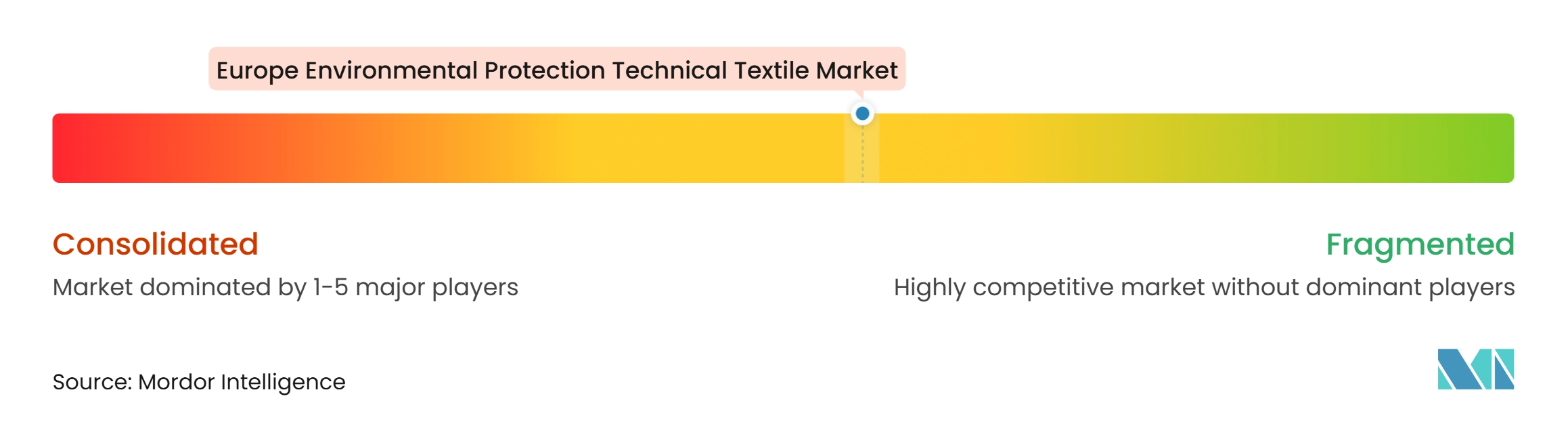
The Europe environmental protection technical textile market exhibits a medium level of market concentration. Freudenberg Performance Materials, Ahlstrom, and MANN+HUMMEL benefit from vertical integration across fiber, fabric, coating, and conversion processes. This structure supports quality consistency for demanding filtration and environmental control uses. Freudenberg discontinued new product development that uses PFAS and completed ISO 14001 certification at 11 global manufacturing locations. This action positions the company for material changes that may follow the REACH PFAS process. Donaldson’s patent portfolio exceeded 2,800 assets by mid-2026, indicating continued emphasis on proprietary separation technologies.
Solmax launched its Performance Materials platform in June 2025, bringing the TenCate Geosynthetics and Propex heritage into one performance-textile division. The move consolidates research, product development, and commercial activity in geosynthetics used for environmental protection applications. HUESKER completed investments at Dülmen and acquired Sineco International during 2025, expanding its environmental remediation portfolio. Its Tektoseal Active product combines ion-exchange resin and activated carbon for PFAS-contaminated site remediation. These moves show that technical capability and product scope are becoming important differentiators in containment, remediation, and water-related uses.
Ahlstrom expanded its ECO filtration-media capacity to Europe in June 2026, extending lignin-based fossil-resin-free cellulosic media to European plants. Testori acquired Tessitura Fratelli Fontana in April 2026 to expand its capacity and woven filter-cloth expertise for dust and liquid filtration. Testori also launched the Xtes filtration felt platform for industrial dust collection applications. Camfil Air Pollution Control introduced OmniPleat filter media in October 2025, stating that its pleat architecture delivers 30% longer filter life than standard pleated media. Opportunities remain in microplastic and fine-particle stormwater capture, sensor-integrated membranes, and reusable sorbents designed for circular end-of-life routes.
Europe Environmental Protection Technical Textile Industry Leaders
-
Solmax
-
HUESKER International
-
NAUE GmbH & Co. KG
-
Freudenberg Performance Materials
-
Fibertex Nonwovens A/S
- *Disclaimer: Major Players sorted in no particular order
Europe Environmental Protection Technical Textile Market Companies Covered in this Report
- Solmax
- HUESKER International
- NAUE GmbH & Co. KG
- Freudenberg Performance Materials
- Fibertex Nonwovens A/S
- BontexGeo
- Officine Maccaferri S.p.A.
- AFITEXINOV
- Thrace Nonwovens & Geosynthetics S.A.
- Berry Global, Inc.
- Ahlstrom
- Toray Industries, Inc.
- Asahi Kasei Corporation
- DuPont de Nemours, Inc.
- Sioen Industries NV
- Camfil Group
- Donaldson Company, Inc.
- MANN+HUMMEL
- Testori S.p.A.
Recent Industry Developments in Europe Environmental Protection Technical Textile Market
- April 2026: Testori Group acquires Tessitura Fratelli Fontana, an Italian specialist in technical textiles and industrial filtration solutions, expanding its European manufacturing capacity and deepening expertise in woven filter cloth production for industrial dust and liquid filtration applications.
- April 2026: Testori Group launches Xtes, a next-generation filtration felt platform designed to deliver superior particle separation efficiency, reduced pressure drop, and extended service life across industrial dust collection applications.
- January 2026: I-TEXGEO Horizon Europe project launches, a EUR-funded initiative developing IoT-supported, biodegradable carbon-impregnated geotextile sensor networks for soil monitoring in agriculture and environmental infrastructure, with 13 consortium partners from 7 countries.
Europe Environmental Protection Technical Textile Market Report Scope
The Europe Environmental Protection Technical Textiles Market is Segmented by Product Type (Oil and Chemical Spill-Control Textiles, and More), by Material Type (Polypropylene, Polyester, and More), by End-Use Application (Municipal Water and Wastewater Utilities, Industrial and Manufacturing Facilities, and More), and by Geography (Germany, France, Italy, and More). The Market Forecasts are Provided in Terms of Value (USD).
Segmentation Overview
| Air Pollution-Control Textiles | Particulate Emission-Control Filter Textiles |
| Catalytic and Multifunctional Emission-Control Textiles | |
| Other Specialized Air Pollution-Control Textiles | |
| Water and Wastewater Treatment Textiles | Water Purification and Fine-Filtration Textile Media |
| Wastewater and Effluent Filtration Textiles | |
| Wastewater Sludge Dewatering Textiles | |
| Oil and Chemical Spill-Control Textiles | Flat-Form Absorbent Textiles |
| Shaped Absorbent Textile Products | |
| Textile-Based Spill Containment Products | |
| Other Specialized Spill-Control Textiles | |
| Stormwater and Surface Runoff Pollution-Control Textiles | Drain-Inlet and Catch-Basin Textile Filter Bags |
| Stormwater Filter Mats and Textile Inserts | |
| Textile Media for Stormwater Filter Cartridges | |
| Other Dedicated Runoff Pollution-Removal Textiles | |
| Other Specialized Environmental Protection Textiles (Contaminant Remediation Products, etc.) |
| Polypropylene |
| Polyester |
| Polyamide |
| Polyethylene and Other Polyolefins |
| High-Performance Synthetic Fibers (Polyphenylene Sulfide, Aramid, etc.) |
| Fluoropolymer Textile Media |
| Glass and Other Inorganic Fibers |
| Natural and Regenerated Cellulosic Fibers |
| Other Materials |
| Municipal Water and Wastewater Utilities | Drinking Water Treatment |
| Municipal Wastewater Treatment | |
| Industrial and Manufacturing Facilities | Chemicals and Petrochemicals |
| Metals, Mining, and Mineral Processing | |
| Cement and Building Materials Manufacturing | |
| Other Industrial Manufacturing | |
| Power Generation and Energy Facilities | |
| Municipal Solid Waste and Recycling Facilities | |
| Oil and Gas, Marine, and Spill Response Operations | |
| Urban Stormwater and Drainage Infrastructure | |
| Environmental Remediation and Emergency Response Services | |
| Other Environmental Protection End Users |
| Germany |
| United Kingdom |
| France |
| Italy |
| Spain |
| Netherlands |
| Belgium |
| Poland |
| Sweden |
| Rest of Europe |
| By Product Type | Air Pollution-Control Textiles | Particulate Emission-Control Filter Textiles |
| Catalytic and Multifunctional Emission-Control Textiles | ||
| Other Specialized Air Pollution-Control Textiles | ||
| Water and Wastewater Treatment Textiles | Water Purification and Fine-Filtration Textile Media | |
| Wastewater and Effluent Filtration Textiles | ||
| Wastewater Sludge Dewatering Textiles | ||
| Oil and Chemical Spill-Control Textiles | Flat-Form Absorbent Textiles | |
| Shaped Absorbent Textile Products | ||
| Textile-Based Spill Containment Products | ||
| Other Specialized Spill-Control Textiles | ||
| Stormwater and Surface Runoff Pollution-Control Textiles | Drain-Inlet and Catch-Basin Textile Filter Bags | |
| Stormwater Filter Mats and Textile Inserts | ||
| Textile Media for Stormwater Filter Cartridges | ||
| Other Dedicated Runoff Pollution-Removal Textiles | ||
| Other Specialized Environmental Protection Textiles (Contaminant Remediation Products, etc.) | ||
| By Material Type | Polypropylene | |
| Polyester | ||
| Polyamide | ||
| Polyethylene and Other Polyolefins | ||
| High-Performance Synthetic Fibers (Polyphenylene Sulfide, Aramid, etc.) | ||
| Fluoropolymer Textile Media | ||
| Glass and Other Inorganic Fibers | ||
| Natural and Regenerated Cellulosic Fibers | ||
| Other Materials | ||
| By End-Use Application | Municipal Water and Wastewater Utilities | Drinking Water Treatment |
| Municipal Wastewater Treatment | ||
| Industrial and Manufacturing Facilities | Chemicals and Petrochemicals | |
| Metals, Mining, and Mineral Processing | ||
| Cement and Building Materials Manufacturing | ||
| Other Industrial Manufacturing | ||
| Power Generation and Energy Facilities | ||
| Municipal Solid Waste and Recycling Facilities | ||
| Oil and Gas, Marine, and Spill Response Operations | ||
| Urban Stormwater and Drainage Infrastructure | ||
| Environmental Remediation and Emergency Response Services | ||
| Other Environmental Protection End Users | ||
| By Geography | Germany | |
| United Kingdom | ||
| France | ||
| Italy | ||
| Spain | ||
| Netherlands | ||
| Belgium | ||
| Poland | ||
| Sweden | ||
| Rest of Europe | ||
Key Questions Answered in the Report
What is the projected value of Europe environmental protection technical textile market by 2032?
Europe environmental protection technical textile market is projected to reach USD 2.01 billion by 2032, growing at a 6.03% CAGR from 2027 to 2032.
Which product category holds the largest share in Europe?
Air pollution-control textiles lead with a 34.0% share in 2026, reflecting demand from regulated industrial filtration systems.
Which material category is growing fastest?
High-Performance Synthetic Fibers are forecast to grow at a 7.8% CAGR through 2032, supported by high-temperature and chemically demanding filtration uses.
What is driving wastewater textile demand in Europe?
The recast Urban Wastewater Treatment Directive supports treatment upgrades, including filtration and sludge-handling investments at utilities.
Which country is growing fastest in Europe?
Poland is forecast to grow at a 7.1% CAGR through 2032, supported by environmental infrastructure programs and industrial compliance spending.
How concentrated is the Europe environmental protection technical textile market?
The report describes moderate concentration, with integrated suppliers competing alongside regional converters and specialty producers.