
Europe Bulk Cargo Shipping Market Size and Share
Market Overview
| Study Period | 2020 - 2031 |
|---|---|
| Forecast Data Period | 2026 - 2031 |
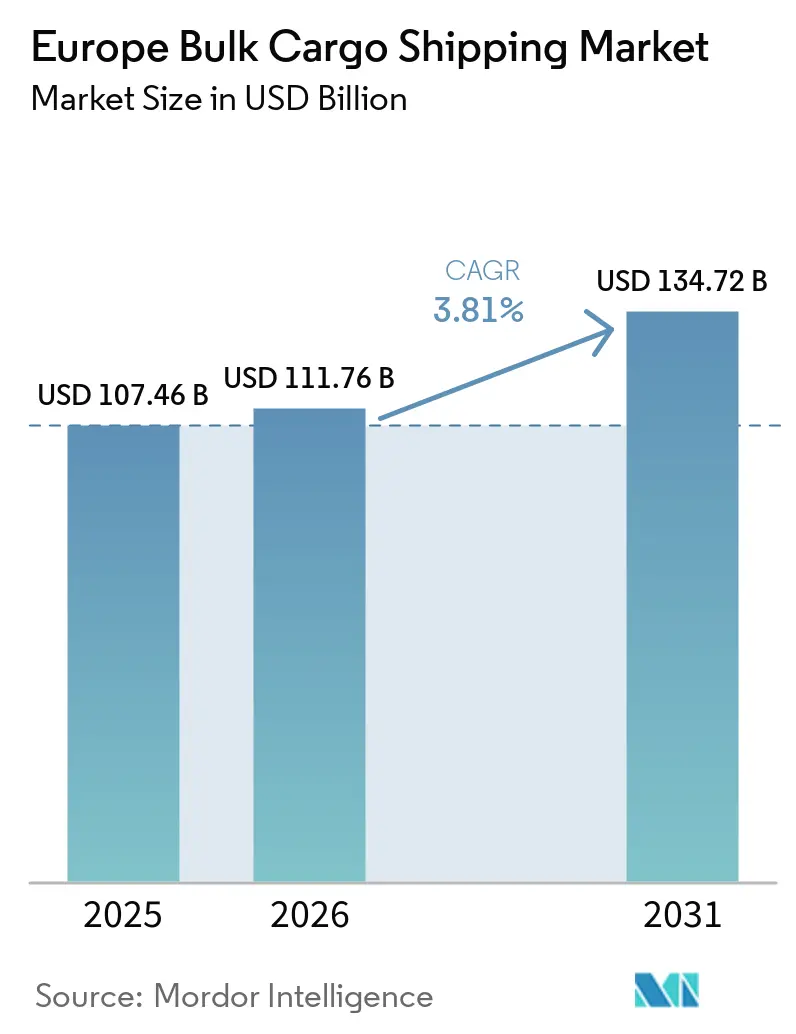
| Base Year Market Size (2025) | USD 107.46 Billion |
| Market Size (2026) | USD 111.76 Billion |
| Market Size (2031) | USD 134.72 Billion |
| Growth Rate (2026 - 2031) | 3.81 % |
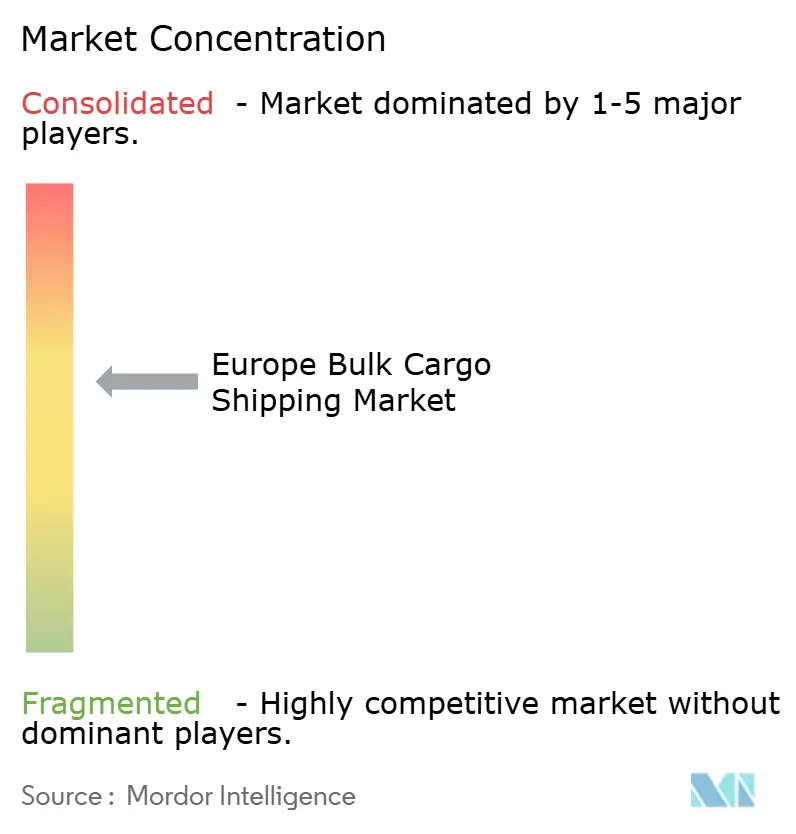
| Market Concentration | Medium |
Major Players *Disclaimer: Major Players sorted in no particular order Image © Mordor Intelligence. Reuse requires attribution under CC BY 4.0. | |
Europe Bulk Cargo Shipping Market Analysis by Mordor Intelligence
The European bulk cargo shipping market size was valued at USD 107.46 billion in 2025 and is estimated to grow from USD 111.76 billion in 2026 to reach USD 134.72 billion by 2031, at a CAGR of 3.81% during the forecast period (2026-2031).
The European bulk cargo shipping market is shaped by changing energy supplies, fleet compliance requirements, and industrial sourcing routes. Cargo flows are becoming more varied as LNG, biomass, fertilizers, and specialized liquid products gain importance. Operators need to manage higher reporting requirements while maintaining dependable service through busy ports. Investment opportunities center on cleaner vessels, terminal upgrades, and better use of berth capacity. These conditions support demand, but they also increase the cost and operational discipline required to compete.
Key Report Takeaways
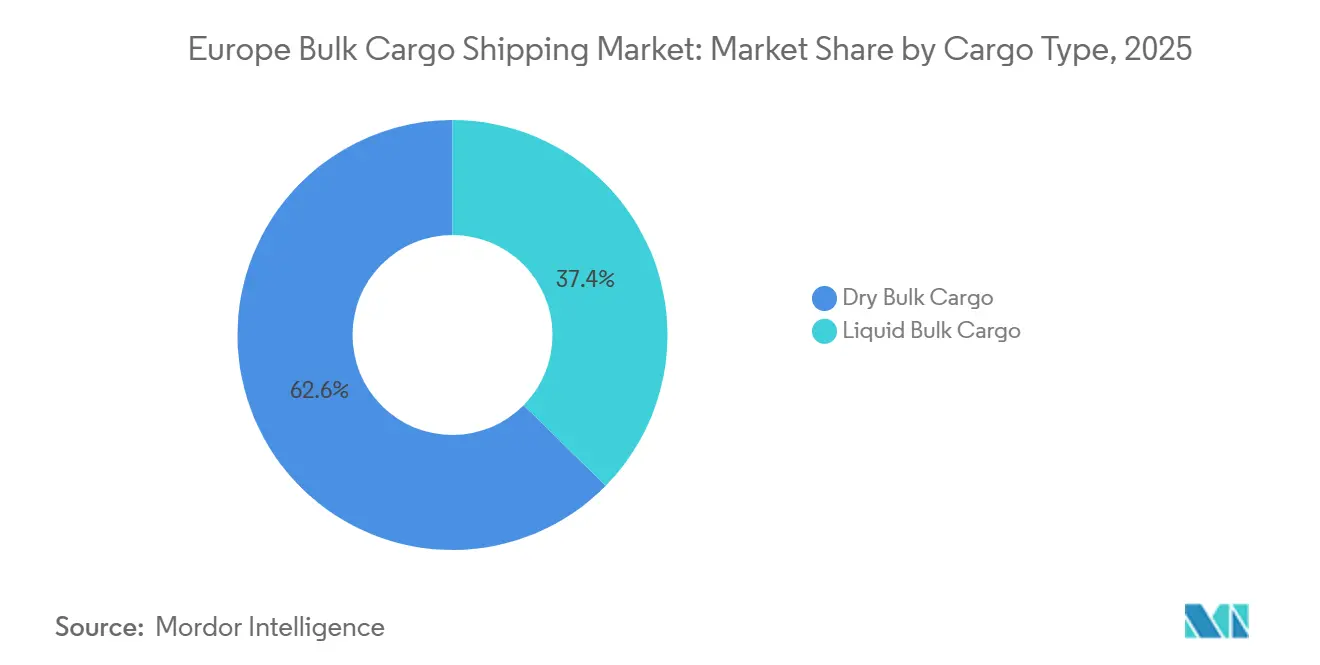
- By cargo type, dry bulk cargo held 62.63% of the Europe bulk cargo shipping market share in 2025, while liquid bulk cargo is forecast to grow at a 5.23% CAGR through 2031.
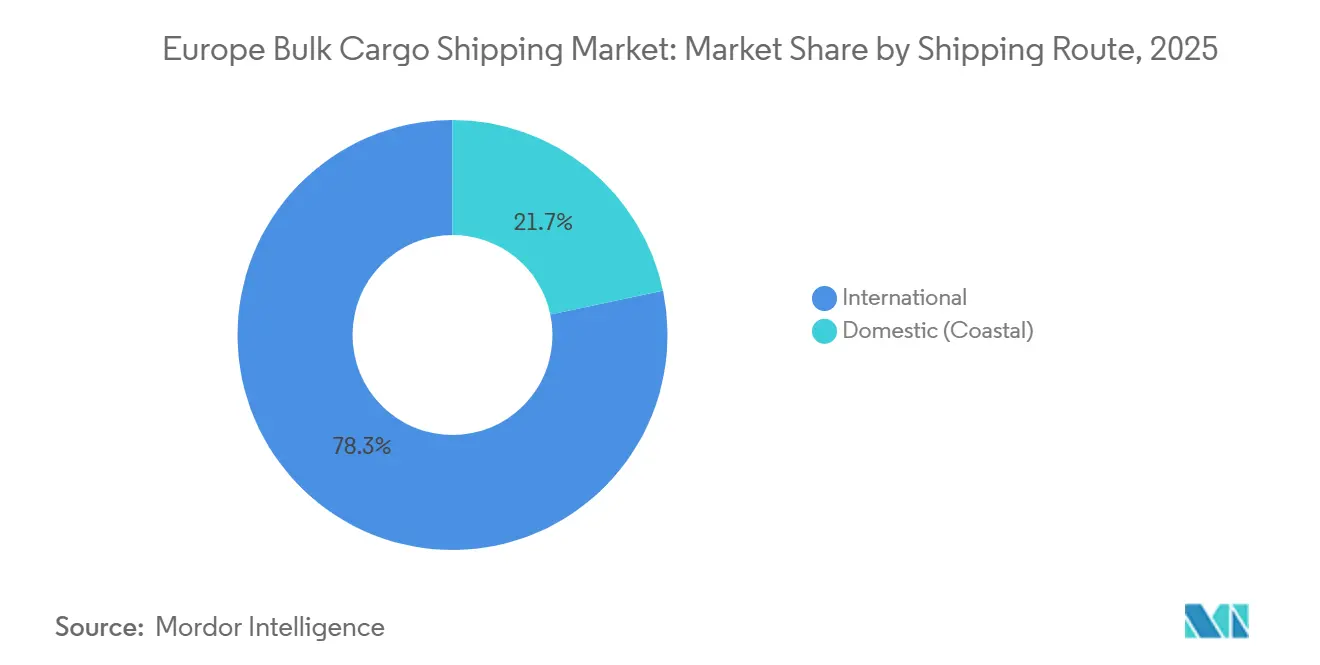
- By shipping route, international services accounted for 78.29% of the Europe bulk cargo shipping market size in 2025, while domestic (coastal) routes are forecast to grow at a 4.90% CAGR through 2031.
- By end-use industry, mining and metals accounted for 27.91% of the Europe bulk cargo shipping market share in 2025, while chemicals and petrochemicals are forecast to grow at a 5.67% CAGR through 2031.
- By country, the Netherlands held 14.09% of the Europe bulk cargo shipping market revenue in 2025, while Belgium is forecast to grow at a 6.44% CAGR through 2031.
Note: Market size and forecast figures in this report are generated using Mordor Intelligence’s proprietary estimation framework, updated with the latest available data and insights as of January 2026.
Market Trends and Insights
Drivers Impact Analysis of Europe Bulk Cargo Shipping Market*
| Driver | (~) % Impact on CAGR Forecast | Geographic Relevance | Impact Timeline |
|---|---|---|---|
| Energy Transition Cargo Rebalancing | +1.2% | Global, with core effects on the North Sea, Baltic, and Mediterranean corridors | Medium term (2-4 years) |
| Nearshoring Through European Bulk Corridors | +0.9% | Central and Eastern Europe, Benelux, Baltic Sea, and Rhine-delta gateways | Short term (≤ 2 years) |
| Inland-Waterway and Short-Sea Modal Shift | +0.7% | Netherlands, Belgium, Germany, the Rhine-Scheldt basin, and the Nordic routes | Medium term (2-4 years) |
| Port Incentives for Cleaner Bulk Vessels | +0.5% | Rotterdam, Antwerp, Hamburg, and Mediterranean ports | Medium term (2-4 years) |
| Replacement Demand for Aging Short-Sea Fleets | +0.4% | European short-sea network, Nordic routes, and Baltic Sea routes | Long term (≥ 4 years) |
| Digital Berth Scheduling and Cargo Visibility | +0.3% | Northern European ports, Benelux terminals, and the Rhine corridor | Short term (≤ 2 years) |
| Source: Mordor Intelligence | |||
Energy Transition Cargo Rebalancing, Especially Biomass, LNG, Fertilizers, and Steel Inputs
European energy supply changes have altered the cargo mix used by major bulk routes. Rotterdam handled 13 million tons of LNG in 2025, a 15.1% increase from 2024, as regional buyers rebuilt gas stocks. Biomass, green-hydrogen feedstocks, and fertilizers are increasingly relevant cargoes as coal volumes decline. The European Commission states that the Alternative Fuels Infrastructure Regulation supports the deployment of alternative-fuel infrastructure in transport networks.[1] The European bulk cargo shipping market, therefore, needs vessel capacity that can serve different cargo specifications and changing trade lanes. Open-hatch bulkers, smaller LNG carriers, and combination vessels can address parts of this shifting demand.
Nearshoring of Industrial Input Flows through European Bulk Corridors
European manufacturers are placing more attention on shorter and more resilient sourcing routes. This approach supports cargo movements between industrial hubs, ports, and inland distribution points across Europe. The European bulk cargo shipping market benefits when relocated production requires regular deliveries of iron ore, fertilizers, aggregates, and chemicals. Poland and other Central and Eastern European locations can receive more industrial inputs through Baltic and North Sea connections. More intra-European freight can raise the value of reliable short-sea schedules and connected terminal operations. This creates an opening for carriers that can coordinate sea, rail, and inland-waterway services.
Inland-Waterway and Short-Sea Modal Shift to Reduce Truck Congestion and Emissions
The European Commission’s Sustainable and Smart Mobility Strategy supports greater use of short-sea shipping and inland waterways. EU inland-waterway freight reached 118 billion ton-kilometers in 2025, down 3% from the previous year, showing that progress has not been consistent.[2] The European bulk cargo shipping market can gain when bulk cargo shifts from congested roads to waterways and coastal vessels. Industry organizations identified at least 11 million tons of goods that could move from roads to European waterways, eliminating more than 300,000 truck trips each year. Higher road freight costs under carbon pricing can improve the business case for waterborne alternatives. Port, barge, and carrier coordination will be needed before this potential converts into sustained volumes.
Port Decarbonization Incentives Favoring Cleaner Bulk Vessel Deployment
European ports are using environmental programs and port-charge structures to encourage lower-emission vessels. The Mediterranean became a Sulphur Emission Control Area in May 2025, extending sulfur rules across Southern European shipping routes. Rotterdam’s 2025 results showed LNG throughput rising 15.1% while coal throughput fell 6.5%. The European bulk cargo shipping market favors operators that can make compliance a practical service advantage for cargo owners. Port incentives can offset part of the cost of cleaner equipment for qualifying vessels. Long-term freight contracts may increasingly favor vessels with credible emissions performance and reliable fuel documentation.
Restraints Impact Analysis of Europe Bulk Cargo Shipping Market*
| Restraint | (~) % Impact on CAGR Forecast | Geographic Relevance | Impact Timeline |
|---|---|---|---|
| High Compliance Cost from EU Emissions Rules | -0.6% | EU and EEA port-calling vessels above 5,000 GT, with global route effects | Short term (≤ 2 years) |
| Port Congestion and Labor Intermittency | -0.4% | Rotterdam, Antwerp, Hamburg, and Mediterranean ports | Short term (≤ 2 years) |
| Cyclical Steel, Fertilizer, and Power Demand | -0.3% | Germany, Belgium, the Netherlands, and Nordic industrial hubs | Medium term (2-4 years) |
| Limited Terminal and Transshipment Capacity | -0.2% | Baltic and Mediterranean secondary ports and inland hubs | Long term (≥ 4 years) |
| Source: Mordor Intelligence | |||
High Compliance Cost from EU Emissions, Fuel, and Reporting Rules
The EU Emissions Trading System began covering maritime transport in January 2024. FuelEU Maritime applied from January 2025 to ships above 5,000 GT calling at European Economic Area ports.[3] The regulation required a 2% reduction in greenhouse-gas intensity in 2025, with a more stringent pathway through 2050. Operators need fuel records, emissions information, and reporting systems that satisfy both regulatory and commercial requirements. Smaller short-sea operators can face a heavier administrative burden because they have fewer resources to spread these fixed costs. The European bulk cargo shipping market may consequently place a higher premium on fleets with established compliance processes.
Port Congestion and Labor Intermittency Disrupting Voyage Reliability
Rotterdam handled 428.4 million tons in 2025, down 1.7%, with weather events and strikes affecting throughput. Antwerp-Bruges handled 266.5 million tons in 2025, down 4.1%, while its bulk traffic declined 12.8%. Belgian seaports also reported lower loaded goods during 2025.[4] The European bulk cargo shipping market remains exposed when congestion shifts cargo toward road transport instead of waterways. Antwerp-Bruges reported a 2.4% year-over-year throughput decline in the first half of 2026, while noting continued trade and operational uncertainty. Better berth planning, labor coordination, and terminal capacity can reduce these pressures.
*Our forecasts treat driver/restraint impacts as directional, not additive. The impact forecasts reflect baseline growth, mix effects, and variable interactions.
Europe Bulk Cargo Shipping Market Segment Analysis
By Cargo Type:
LNG and Specialty Liquid Flows Diversifying the Fleet MixDry bulk cargo was the core of the Europe bulk cargo shipping market size in 2025, accounting for 62.63% of the market share, with industrial and agricultural supply chains depending on iron ore, grain, fertilizers, cement, and steel products. Northern European steelmakers still require iron ore and coking coal even as steel demand changes. EU apparent steel consumption declined 0.2% in 2025, following weakness in manufacturing and construction. EUROFER projected a 3.1% recovery by the end of 2026, subject to stronger industrial output and less geopolitical pressure. Rotterdam recorded a 17.8% increase in coal throughput during the first half of 2026 as higher gas prices affected energy purchasing. Biomass pellets, offshore-wind aggregates, and sustainable raw materials provide a partial offset to lower coal volumes. Carriers need flexible stowage, cargo-handling methods, and route planning because these cargoes have different loading and discharge needs. These supply chains continue to make dry bulk a broad operational base for European ports. Cargo owners also depend on predictable discharge windows when industrial plants and storage sites run close to scheduled inventory levels. Terminal operators must retain equipment and workforce capability for dense cargoes, seasonal agricultural volumes, and specialized minor bulks. The combination makes fleet deployment less uniform across ports, even when the underlying cargo demand is stable.
Liquid bulk cargo is projected to be the fastest-growing cargo category through 2031, expanding at a 5.23% CAGR, supported by LNG trade, refined petroleum products, and expanding chemical manufacturing across Europe. Rotterdam’s LNG throughput rose 15.1% to 13 million tons in 2025. This increase reflects the need for gas import capacity as European energy sourcing changes. Liquid cargo also needs specialized tanks, terminals, safety systems, and cargo documentation. Van Moer Logistics opened 63 polymer silos at Waaslandhaven in June 2026 as the first phase of a EUR 185 million (USD 217.62 million) program. The investment showed continued confidence in chemical-cluster storage and handling capacity. Diversified food imports also sustain traffic in edible oils and molasses. The wider mix gives terminal operators more opportunities, but it requires closer control of product quality, storage, and vessel turnaround. Dedicated infrastructure can reduce handling conflicts between cargoes with different contamination, temperature, and safety requirements. Commercial success, therefore, depends on matching vessel calls with storage availability and downstream customer demand.

By Shipping Route:
Coastal Short-Sea Lanes Compelling Infrastructure InvestmentInternational services formed the main volume base of the Europe bulk cargo shipping market in 2025, accounting for 78.29% of the market size, connecting European terminals with the Americas, the Black Sea region, and the Middle East. Norwegian and United States LNG have become important sources in the regional gas supply mix. Rotterdam reported dry bulk growth of 1.7% in the first half of 2026. The same period brought a 17.8% increase in Rotterdam coal throughput. These figures point to renewed demand on international routes despite weaker 2025 port volumes. International traffic remains sensitive to energy prices, trade disruption, and industrial output. Operators that combine owned and chartered tonnage can adjust capacity more readily when cargo demand changes. This flexibility is valuable when disrupted origins, energy prices, or seasonal crop movements change the timing of import demand. It also helps carriers maintain service coverage when individual vessels are delayed by congestion or maintenance.
Domestic (coastal) shipping is projected to be the fastest-growing route segment through 2031, expanding at a 4.90% CAGR, supported by fleet renewal, decarbonization requirements, and growing demand for reliable short-sea and coastal connections. North Sea Port handled 67 million tons in 2025, an increase of 0.4%, with bulk cargo contributing to the gain. Trade between the United Kingdom and Benelux supports these coastal movements. The European bulk cargo shipping market needs modern vessels on these routes because many ships are old and face increasing emissions expectations. A DNV and Royal Swedish Institute study found that limited incentives for vessels below 5,000 GT slow decarbonization in the short-sea dry-bulk fleet. Fleet renewal can improve fuel performance and enable carriers to meet cargo-owner requirements. Coastal carriers can also benefit when ports and inland waterways offer dependable intermodal connections. The result is a route segment where asset quality and schedule reliability have growing commercial value. Regular short-sea services need to fit with road, rail, and barge transfers at the destination. A delay at one stage can reduce the benefit of moving freight away from congested roads. Operators that coordinate these connections can offer a more dependable service to industrial customers.
By End-Use Industry:
Chemicals Growth Emerges as the Fastest-Expanding Demand AnchorMining and metals were the leading end-use anchor for the Europe bulk cargo shipping market share in 2025, accounting for 27.91%, with steel production in Germany, Belgium, France, and Sweden supporting demand for iron ore, coking coal, scrap, bauxite, and alumina movements. EU apparent steel consumption fell 0.2% in 2025, reflecting pressure from manufacturing, construction, and tariff uncertainty. The forecasted 3.1% recovery by the end of 2026 can support a partial improvement in raw-material flows. This end-use group remains linked closely to the health of European industry. Deep-sea operators serving Atlantic routes need to balance this cyclicality against stable long-term trade relationships. Inland waterway and short-sea carriers also depend on regular deliveries to the Ruhr and Rhine-Main industrial areas. Mining and metals will continue to shape vessel deployment and terminal design across the region. These cargoes often require high-capacity terminals, stockpile areas, and efficient links to inland production sites. Their importance also means that a recovery in European industrial output can affect several connected shipping routes at the same time.
Chemicals and petrochemicals are projected to be the fastest-growing end-use sector through 2031, expanding at a 5.67% CAGR, supported by refining, chemical manufacturing, and LNG-based feedstock supply chains. Euroports began redevelopment at Kaai 168 in Antwerp in March 2026, including a warehouse of more than 32,000 square meters for fertilizer and mineral storage. Energy and utilities are changing from coal-centered demand toward LNG and biomass. Agriculture supports consistent grain, fertilizer, and oilseed imports that follow planting and harvest cycles. Construction activity needs aggregates, cement, and steel for road, rail, and offshore-wind projects. Food processing and manufacturing also use smaller bulk flows such as molasses, edible oils, and agrochemicals. Together, these end uses broaden terminal revenue sources and reduce dependence on any single cargo category. Different cargoes can use the same port region at different points in the year, which can support more balanced asset use. However, operators need sufficient storage, segregation, and handling capability to serve this mix without slowing vessel turnaround.
Geography Analysis
Northwestern Europe Bulk Cargo Shipping Market
The Netherlands was the largest national market in the European bulk cargo shipping market in 2025, accounting for 14.09% of the market, while Belgium is projected to be the fastest-growing geography through 2031, expanding at a 6.44% CAGR, with Rotterdam handling 428.4 million tons in 2025. Its throughput fell 1.7% during the year because of weather disruptions and strikes. Rotterdam recorded 212 million tons during the first half of 2026, a 0.4% increase from the same period of 2025. Dry bulk increased 1.7%, coal increased 17.8%, and oil-product throughput increased 11.5% in that period. Belgium is adding capacity through investments around Antwerp-Bruges. The Flemish Government approved the Left Bank Container Cluster project in May 2026, with a target of 7 million additional TEU and connected intermodal upgrades. Germany is a critical cargo destination because Rhine shipping supplies the Ruhr and Rhine-Main industrial regions.
Nordics and Western Europe Bulk Cargo Shipping Market
The Nordic countries serve as both origins and destinations for European bulk cargo. Norway’s gas supply role makes it important to the regional energy cargo network. Coal flows into Nordic power systems are changing as biomass and green-hydrogen inputs gain relevance. The United Kingdom remained an important bilateral trading partner for Rotterdam during 2025. Spain is developing LNG bunkering capability as Iberian ports build alternative-fuel infrastructure. France and Italy maintained demand for grain, fertilizers, crude oil, and LNG through Mediterranean entry points. The European bulk cargo shipping market across these geographies depends on connections between energy terminals, industrial users, and inland transport systems. Port infrastructure and fuel availability will influence where specialized vessel capacity is deployed.
Central and Eastern Europe Bulk Cargo Shipping Market
Central and Eastern Europe is a developing corridor for nearshoring-related bulk flows. Polish infrastructure around Gdansk can receive steel inputs, construction materials, and agricultural intermediates for manufacturing sites. This activity reinforces Baltic short-sea connections with North European distribution systems. The Danube corridor faces constraints from regional conflict effects and variable water levels. The Port of Liège reported that 97% of available land was committed and requested adjacent waterway areas for expansion. It also added 10 weekly rail freight services and connections to Slovakia, Romania, and Italy. Capacity pressure at inland hubs can make coordinated terminal, rail, and waterway investment more important for reliable cargo movement.
Competitive Landscape
The European bulk cargo shipping market is moderately concentrated, with diversified operators, short-sea specialists, and traders all serving different cargo and route needs. The market comprises operators with varying geographic and cargo-specific strengths across dry bulk, liquid bulk, and European route categories. MOL completed its acquisition of a 72% stake in Gearbulk in 2025, adding 60 open-hatch bulk carriers and taking its dry-bulk fleet to 338 vessels. The transaction expanded the company’s specialty-bulk network in Europe. Star Bulk continued its energy-saving device program during 2025, completing 55 of 80 planned installations. It also received 3 of the 8 scheduled Kamsarmax newbuildings in the second quarter of 2026. These actions show that fleet efficiency and compliance readiness have become important competitive measures. The European bulk cargo shipping market rewards companies that can invest in vessels while preserving service flexibility.
The aging short-sea fleet is an important opportunity for carriers with access to financing and modern vessel designs. More than 50% of the European short-sea fleet operating now is over 20 years old. Operators with FuelEU-aligned tonnage can respond to cargo tenders that include emissions criteria. Oldendorff Carriers installed Starlink low-earth-orbit connectivity on more than 80 owned bulk carriers in June 2026. The project supports real-time data exchange and operating visibility across its fleet. Cuxport introduced Kaleris Navis Mixed Cargo Terminal Operating System in January 2025 to digitize billing and improve cargo handling. Digital vessel and terminal tools are becoming practical requirements for efficient port calls. Larger operators can spread technology and compliance costs across more ships and contracts.
EU emissions rules can encourage consolidation because scale helps companies manage technology investment and compliance pools. Smaller operators can remain relevant when they serve specialized routes, cargoes, or customer relationships. Fleet quality, terminal access, and dependable scheduling are more important than a single standardized operating model. Commodity traders that integrate freight capacity can also manage exposure to supply-chain disruption. Port congestion and labor interruptions may favor companies with broader network options and stronger customer communication. Competition will remain multi-tiered because the region requires different vessel classes and cargo-handling capabilities.
Europe Bulk Cargo Shipping Industry Leaders
-
Oldendorff Carriers
-
Ultrabulk A/S
-
Star Bulk Carriers
-
Golden Ocean Group
-
Berge Bulk
- *Disclaimer: Major Players sorted in no particular order
Europe Bulk Cargo Shipping Market Companies Covered in this Report
- Oldendorff Carriers
- Ultrabulk A/S
- Star Bulk Carriers
- Golden Ocean Group
- Berge Bulk
- Gearbulk
- Fednav
- Spliethoff Group
- Wagenborg Shipping
- Western Bulk
- SAL Heavy Lift
- Torvald Klaveness
- NORDEN
- Wilson ASA
- Grieg Maritime Group
- Briese Group
- AAL Shipping
- VARAMAR
- MACS Maritime Carrier Shipping
- SMT Shipping
- Diana Shipping
- Cobelfret
Recent Industry Developments in Europe Bulk Cargo Shipping Market
- August 2026: Star Bulk Carriers and Diana Shipping terminated their conditional agreement for Star Bulk to acquire 16 vessels, 1.8 million DWT, following Diana's failure to complete its antecedent Genco acquisition. Star Bulk's fleet stands at 138 owned vessels with 5 Kamsarmax newbuildings on track through Q4 2026.
- June 2026: Oldendorff Carriers deployed Starlink LEO connectivity across more than 80 owned bulk carriers in partnership with Marlink, integrating LEO with existing VSAT and MSS systems to enable real-time operational data sharing and dynamic bandwidth allocation.
- June 2026: Van Moer Logistics inaugurated 63 polymer silos at Waaslandhaven, Port of Antwerp, phase 1 of a EUR 185 million (USD 217.62 million) program targeting 450 silos, positioning the site as one of Europe's largest polymer bulk hubs and expanding chemical cluster storage capacity.
- May 2026: The Flemish Government approved the draft project decision for the Left Bank Container Cluster at Port of Antwerp-Bruges, targeting 7 million additional TEU of capacity with intermodal rail integration. Lock upgrades at Zeebrugge will also benefit bulk vessel access, with construction scheduled to begin at the end of 2026.
Europe Bulk Cargo Shipping Market Report Scope
Segmentation Overview
| Dry Bulk Cargo | Iron Ore |
| Coal | |
| Grain (Wheat, Corn, Soybeans, etc.) | |
| Fertilizers | |
| Cement & Clinker | |
| Bauxite & Alumina | |
| Steel Products | |
| Other Minor Dry Bulk Commodities | |
| Liquid Bulk Cargo | Crude Oil |
| Refined Petroleum Products | |
| Liquefied Natural Gas (LNG) | |
| Liquefied Petroleum Gas (LPG) | |
| Chemicals | |
| Edible & Vegetable Oils | |
| Molasses | |
| Other Liquid Bulk Commodities |
| Domestic (Coastal) |
| International |
| Mining & Metals |
| Energy & Utilities |
| Agriculture |
| Chemicals & Petrochemicals |
| Construction & Infrastructure |
| Food Processing |
| Manufacturing (General Industrial) |
| Others |
| United Kingdom |
| Germany |
| France |
| Spain |
| Italy |
| Belgium |
| Netherlands |
| NORDICS (Denmark, Finland, Iceland, Norway, and Sweden) |
| Rest of Europe |
| By Cargo Type | Dry Bulk Cargo | Iron Ore |
| Coal | ||
| Grain (Wheat, Corn, Soybeans, etc.) | ||
| Fertilizers | ||
| Cement & Clinker | ||
| Bauxite & Alumina | ||
| Steel Products | ||
| Other Minor Dry Bulk Commodities | ||
| Liquid Bulk Cargo | Crude Oil | |
| Refined Petroleum Products | ||
| Liquefied Natural Gas (LNG) | ||
| Liquefied Petroleum Gas (LPG) | ||
| Chemicals | ||
| Edible & Vegetable Oils | ||
| Molasses | ||
| Other Liquid Bulk Commodities | ||
| By Shipping Route | Domestic (Coastal) | |
| International | ||
| By End-Use Industry | Mining & Metals | |
| Energy & Utilities | ||
| Agriculture | ||
| Chemicals & Petrochemicals | ||
| Construction & Infrastructure | ||
| Food Processing | ||
| Manufacturing (General Industrial) | ||
| Others | ||
| By Country | United Kingdom | |
| Germany | ||
| France | ||
| Spain | ||
| Italy | ||
| Belgium | ||
| Netherlands | ||
| NORDICS (Denmark, Finland, Iceland, Norway, and Sweden) | ||
| Rest of Europe | ||
Key Questions Answered in the Report
What is the value of the European bulk cargo shipping market in 2026?
The European bulk cargo shipping market size was USD 111.76 billion in 2026 and is forecast to reach USD 134.72 billion by 2031 at a 3.81% CAGR.
Which cargo category leads European bulk shipping?
Dry bulk led in 2025, supported by iron ore, grain, fertilizers, cement, and steel products.
Why is LNG important to European bulk cargo shipping?
Rotterdam handled 13 million tons of LNG in 2025, up 15.1% from 2024, reflecting changes in European energy supply.
Which routes are important for bulk cargo movements in Europe?
International routes form the main volume base, while short-sea and inland-waterway routes can gain from modal-shift policies and fleet renewal.
What is slowing European shipping operations?
Emissions compliance costs, congestion, labor interruptions, cyclic demand, and limited terminal capacity can affect cost and schedule reliability.
How are companies responding to new requirements?
Companies are investing in cleaner fleets, vessel efficiency, digital connectivity, berth planning, and terminal upgrades.