
Europe Agriculture Technical Textile Market Size and Share
Market Overview
| Study Period | 2021 - 2032 |
|---|---|
| Forecast Data Period | 2027 - 2032 |
| Base Year Market Size (2026) | USD 3.30 Billion |
| Market Size (2027) | USD 3.46 Billion |
| Market Size (2032) | USD 4.27 Billion |
| Growth Rate (2027 - 2032) | 4.30 % |
| Market Concentration | Medium |
Major Players *Disclaimer: Major Players sorted in no particular order Image © Mordor Intelligence. Reuse requires attribution under CC BY 4.0. | |
Europe Agriculture Technical Textile Market Analysis by Mordor Intelligence
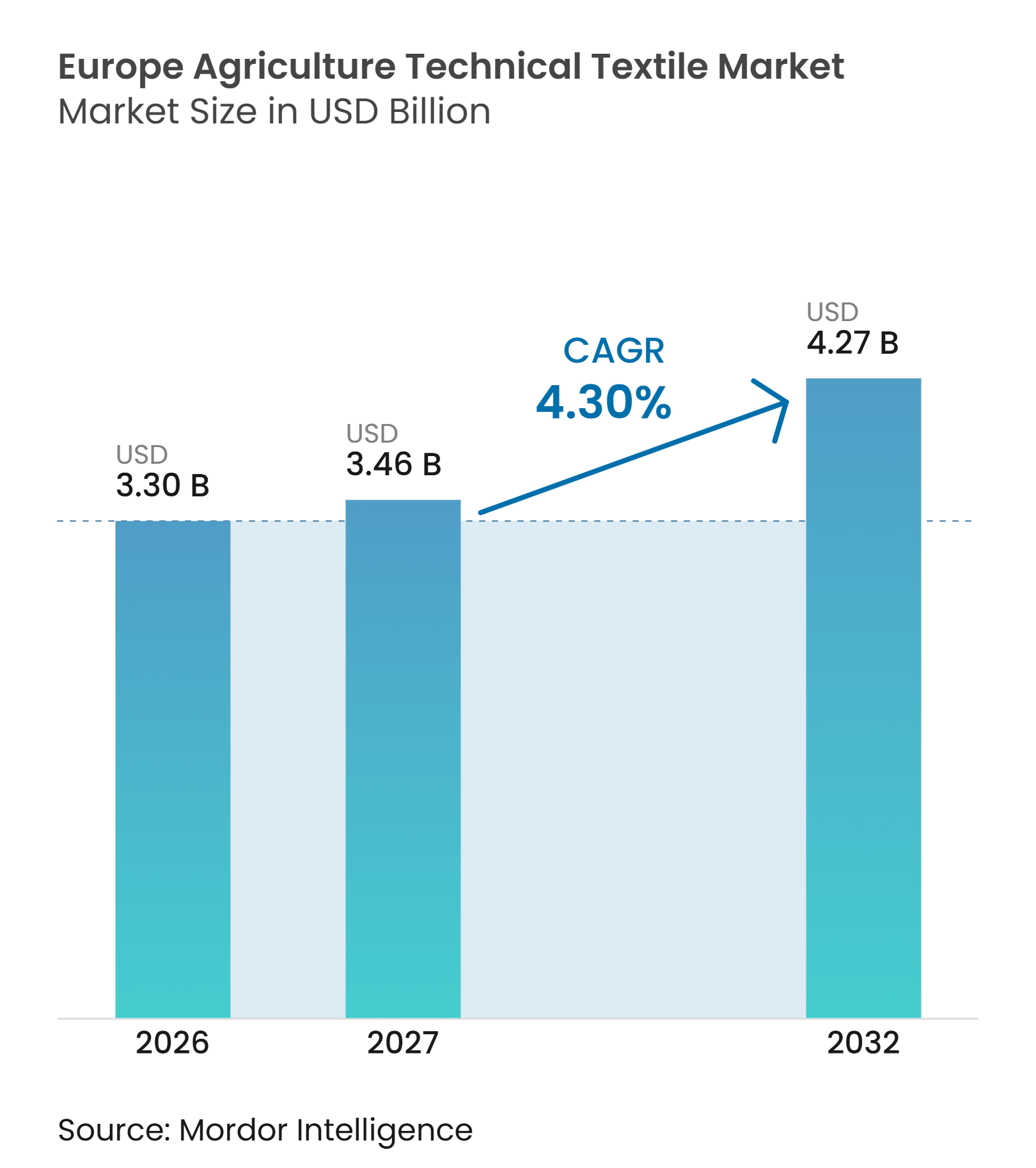
The Europe Agriculture Technical Textile Market size is expected to grow from USD 3.30 billion in 2026 to USD 3.46 billion in 2027 and is forecast to reach USD 4.27 billion by 2032 at 4.30% CAGR over 2027-2032.
The wider use of protected cultivation beyond Mediterranean production centers supports the Europe agricultural technical textile market. Weather volatility is increasing the value of physical barriers that limit heat, hail, insects, and water-related crop damage. Policy support for integrated pest management and climate-resilient farming favors nonchemical protection methods across the region. Producers are also developing screens, covers, and nets with longer lifetimes, recycled content, or biodegradable materials to respond to circularity requirements. The Europe agricultural technical textile market continues to face pressure from polymer input costs and from the capital required to modernize older greenhouse systems.
Key Report Takeaways
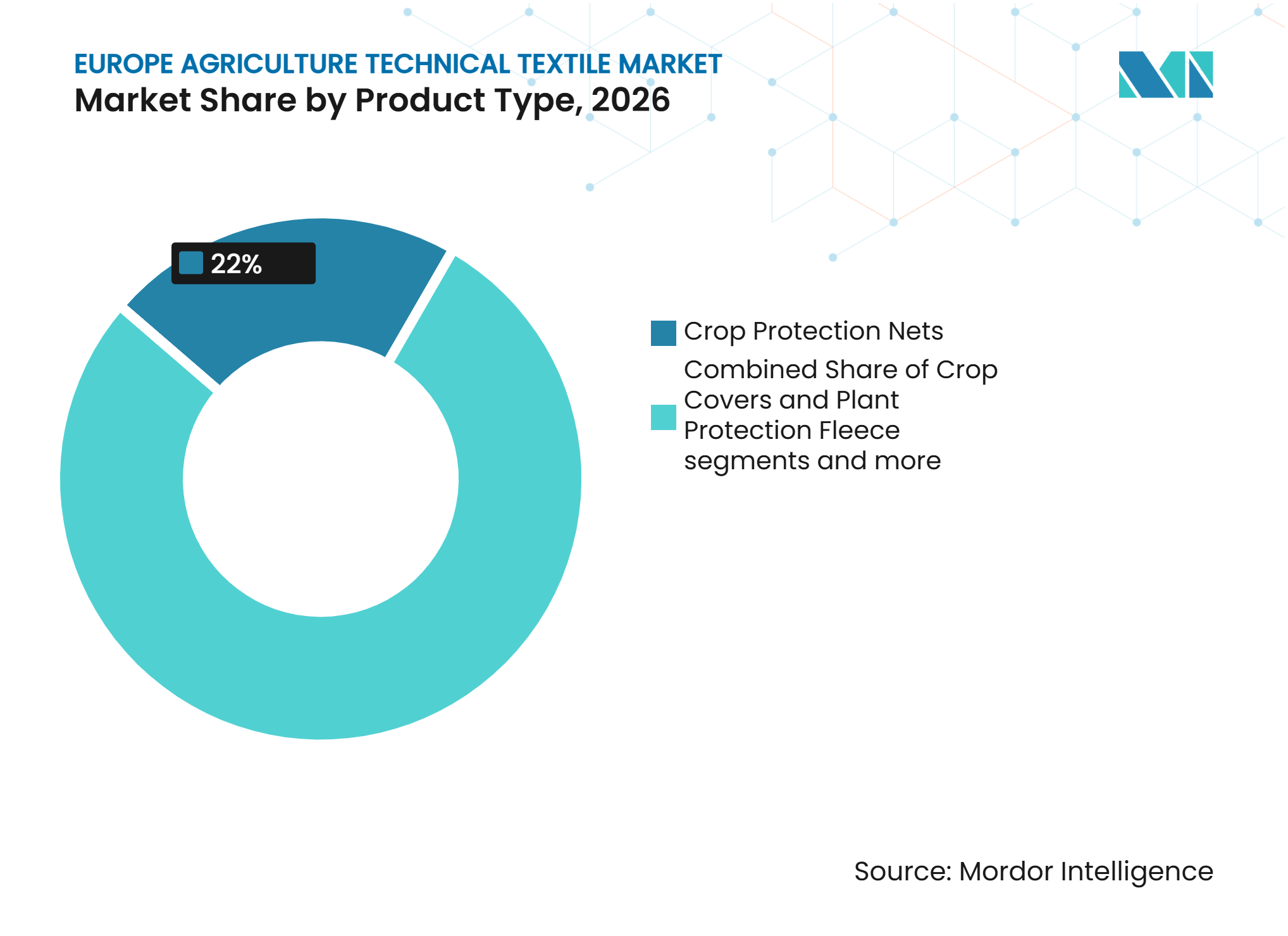
- By product type, crop protection nets held 22% of the Europe agricultural technical textile market share in 2026, while agricultural shade nets and greenhouse climate screens are projected to grow at a 6.8% CAGR through 2032.
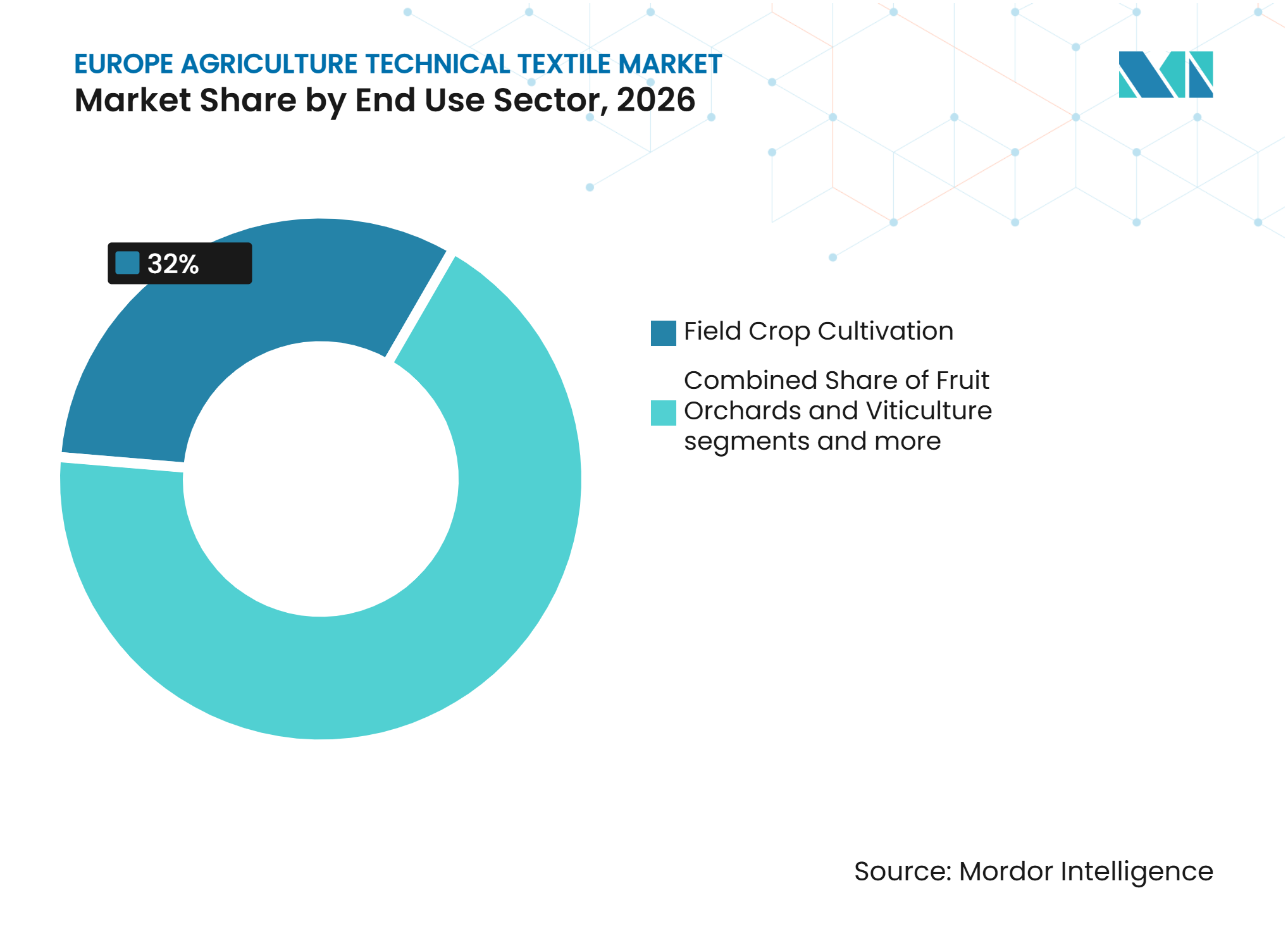
- By end-use sector, field crop cultivation accounted for 32% of the Europe agricultural technical textile market size in 2026, while vegetable, floriculture, and nursery cultivation are projected to expand at a 6.5% CAGR through 2032.
- By geography, Spain held 18% of revenue in 2026, while the Netherlands is projected to grow at a 6.5% CAGR through 2032.
Note: Market numbers in this report are based on Mordor Intelligence's proprietary estimation framework, which combines nine months of actuals with Q4 projections for base year 2026.
Market Trends and Insights
Drivers Impact Analysis of Europe Agriculture Technical Textile Market*
| Driver | (~) % Impact on CAGR Forecast | Geographic Relevance | Impact Timeline |
|---|---|---|---|
| Expansion of Protected and Controlled-Environment Agriculture | +1.4% | Spain, Italy, France, Netherlands, Poland | Long term (≥ 4 years) |
| Increasing Climate Variability and Crop-Protection Requirements | +1.0% | Mediterranean core, Central Europe, and Northern Europe | Short term (≤ 2 years) |
| Regulatory Pressure to Reduce Pesticide Exposure | +0.8% | EU-wide, with early gains in Germany, France, and the Netherlands | Medium term (2-4 years) |
| EU CAP Eco-Scheme Subsidies and Agri-Environment Payments | +0.5% | EU-wide, with strong relevance in France, Germany, Spain, and Poland | Medium term (2-4 years) |
| Dual-Use Agro-Photovoltaic and Solar-Shading Applications | +0.4% | Germany, France, Italy, and Netherlands | Long term (≥ 4 years) |
| Integration With Digital Greenhouse Climate Control | +0.3% | Netherlands, Belgium, and Germany | Medium term (2-4 years) |
| Source: Mordor Intelligence | |||
Expansion of Protected and Controlled-Environment Agriculture
Protected cultivation is widening the addressable demand base for the Europe agricultural technical textile market beyond established Mediterranean horticulture. Greenhouse and tunnel systems require several textile layers, including climate screens, thermal covers, light-diffusing nets, and crop barriers. Operators that grow throughout the year often use more textile products per hectare than seasonal open-field farms. High-technology greenhouse clusters in the Netherlands, Belgium, and northern France are also replacing older systems with energy-saving equipment. Larger growers can concentrate purchasing decisions and specify premium screens that offer longer service life or better climate control. This shift gives suppliers an opportunity to compete on performance and operating savings rather than on the lowest initial price.
Increasing Climate Variability and Crop-Protection Requirements
Climate disruption is making protective textile investment more necessary for commercial growers across Europe. The European Commission Joint Research Centre reported severe drought conditions across parts of central, northern, and eastern Europe and the eastern Mediterranean in June 2025.[1] The same institution introduced an artificial intelligence tool in 2025 to help identify growing climate hazards for EU agriculture.[2] Research published in 2025 found that more than 30% of European harvested cereal area could face severe heat stress under a 4°C warming scenario. Nets, covers, and screens help growers reduce damage from hail, heat, insects, heavy rain, and wind without relying only on chemical treatments. Texinov’s LIFE VinoShield project began field installations in April 2025 and targets a reduction in vineyard climate-related damage from 30% to 5% across 16,500 hectares by 2032.
Regulatory Pressure to Reduce Pesticide Exposure
European pesticide policy supports the use of nonchemical crop-protection methods in the Europe agricultural technical textile market. Although the proposed Sustainable Use Regulation was withdrawn in 2024, Directive 2009/128/EC remains in force and requires member states to support integrated pest management. Insect-proof nets, windbreak fabrics, and physical exclusion systems can meet this need while allowing growers to maintain crop protection practices. A 2025 response to the European Parliament stated that CAP eco-schemes, agri-environment commitments, and revisions to Regulation 1107/2009 would continue to support reduced use of chemical plant-protection products.[3] This policy setting supports demand for barrier systems even when individual legislative proposals change. Suppliers with tested products for pest exclusion and disease management are therefore better placed to serve growers seeking practical compliance options.
EU CAP Eco-Scheme Subsidies and Agri-Environment Payments
The 2023 to 2027 Common Agricultural Policy gives member states a framework to reward farming practices that lower pesticide use and improve climate resilience. Eco-schemes are a core part of the policy and are funded from direct-payment budgets. Spain includes plant-cover management and biodiversity practices in its eco-scheme framework. Germany provides annual support for eligible eco-scheme areas through its national direct-payment system. Novamont stated in November 2025 that its Mater-Bi mulch film is included in CAP national plans in Spain, Portugal, and Italy as a qualifying measure. These pathways can lower the effective cost of qualifying products for smaller farms that would otherwise defer purchases.
Restraints Impact Analysis of Europe Agriculture Technical Textile Market*
| Restraint | (~) % Impact on CAGR Forecast | Geographic Relevance | Impact Timeline |
|---|---|---|---|
| Volatility in Polyethylene and Polypropylene Feedstock Costs | -0.7% | EU-wide, with acute exposure in Spain, Italy, and Germany | Short term (≤ 2 years) |
| High Upfront Cost for High-Performance Greenhouse Textile Systems | -0.5% | Western and Northern Europe, including the Netherlands, Germany, Belgium, and France | Medium term (2-4 years) |
| Fragmented Smallholder Farm Structure Limiting Technology Adoption and Scale Economics | -0.4% | Southern and Eastern Europe, including Italy, Spain, Greece, Poland, and Romania | Long term (≥ 4 years) |
| Contaminated and Mixed-Polymer End-of-Life Waste Streams | -0.3% | EU-wide, with greatest regulatory pressure in Germany, France, and the Netherlands | Medium term (2-4 years) |
| Source: Mordor Intelligence | |||
Volatility in Polyethylene and Polypropylene Feedstock Costs
Polyethylene and polypropylene are core inputs for crop-protection nets, shade nets, crop covers, and mulch films. Changes in polymer prices can quickly affect manufacturing costs and margins for European agrotextile converters. The British Plastics Federation reported that polypropylene prices declined again in August 2025 because of weak demand and high Asian import volumes. However, prices can reverse quickly when energy costs, shipping disruptions, or supply constraints affect regional polymer availability. Raw materials account for 50% to 65% of production costs for commodity net and cover products, which limits suppliers’ ability to absorb sudden increases. This volatility makes multi-season pricing agreements harder to manage and can delay purchasing decisions by growers.
High Upfront Cost for High-Performance Greenhouse Textile Systems
High-performance greenhouse textile systems require greater initial spending than conventional single-layer crop covers. Energy-saving screens, light-diffusing thermal covers, and multilayer climate-control systems also require investment in hardware, installation, and greenhouse-control integration. Wageningen University research published in 2025 found that a triple-screen system with optimized properties and mechanical dehumidification can reduce heating demand by up to 75%. However, growers in the Netherlands, Belgium, Germany, and France may delay upgrades when capital budgets are constrained, even when the long-term energy savings are clear. Older greenhouse facilities can face higher retrofit costs because screens must work with existing structures and control equipment. This cost barrier is most significant for smaller businesses that cannot access low-cost financing or leasing arrangements.
*Our forecasts treat driver/restraint impacts as directional, not additive. The impact forecasts reflect baseline growth, mix effects, and variable interactions.
Europe Agriculture Technical Textile Market Segment Analysis
By Product Type:
Crop Protection Nets Support Volume, Screens Lead Premium GrowthCrop protection nets held 22% of the market share in 2026, making them the largest product group. Their broad use in orchards, vineyards, berry farms, and commercial vegetable operations supports high sales volume in the Europe agricultural technical textile market. Anti-insect nets are closely aligned with integrated pest management because they physically exclude pests without replacing all crop protection activity. Anti-hail, anti-bird, and windbreak systems also protect exposed production areas. Arrigoni introduced Protecta Ultra and Dili Ultra for kiwifruit and cherry production in 2025, combining rain control, hail protection, insect barriers, and light management.
Agricultural shade nets and greenhouse climate screens are the fastest-growing product group, with a projected 6.8% CAGR through 2032. This part of the European agricultural technical textile industry benefits from its role in greenhouse energy management, humidity control, and light management. Thermal screens have high unit values because growers use them to lower heating needs in heated facilities. Phormium’s Noctis Thermo screen recorded 72% energy savings and a 99% shade factor in Dutch greenhouse trials. Mulch mats and ground covers are also gaining attention as biodegradable alternatives become commercially available, and Novamont’s Mater-Bi film received certification under EU Fertilizer Regulation 2019/1009 in November 2025.



By End-Use Sector:
Field Crops Provide Scale, Horticulture Drives GrowthField crop cultivation accounted for 32% of the Europe agricultural technical textile market size in 2026. Cereal, oilseed, and root vegetable acreage creates steady demand for mulch mats, windbreak nets, and crop covers across major arable areas. Textile use per hectare is lower than in intensive horticulture, but the large cultivated area keeps the segment important to the Europe agricultural technical textile market. Europe has close to 100 million hectares of arable land, which supports the segment’s volume role. Livestock and forage operations use round bale nets and silage covers, while fishing and aquaculture use containment nets and remain important for broad-portfolio suppliers.
Vegetable, floriculture, and nursery cultivation is projected to grow at a 6.5% CAGR through 2032. High-value output, strict quality expectations, and year-round supply contracts support greater spending on shade, exclusion, and climate-control systems in the Europe agricultural technical textile market. The segment requires reliable pest management because cosmetic or quality damage can reduce product value quickly. Fruit orchards and viticulture are a related high-value opportunity for multifunctional protective nets. LIFE VinoShield has a EUR 4.1 million (USD 4.8 million) budget and targets 16,500 hectares of vineyards by 2032, showing formal investment interest in vineyard protection.

Geography Analysis
Spain held 18% of the revenue in 2026. Its position in the Europe agricultural technical textile market is supported by protected horticulture in Almeria, where greenhouse area exceeds 33,500 hectares, and by extensive fruit, citrus, and viticulture production. These systems use anti-hail, anti-insect, and shade-management products across both protected and open-field operations. Italy is another large demand center because fruit and protected-cultivation operations require rain protection, shade screens, and climate covers. France completes the Mediterranean core through its vineyards, cereal areas, and vegetable production, and its first LIFE VinoShield field installations started in 2025.
The Netherlands is projected to grow at a 6.5% CAGR through 2032. Its high-technology greenhouse base drives demand for thermal screens, blackout screens, and advanced light-management systems within the Europe agricultural technical textile market. Wageningen University research confirms that screen design and dehumidification can materially reduce heating requirements in greenhouse operations. Belgium has a similar greenhouse cluster in Flanders and a supplier base focused on sustainability-led product development. Germany is a major demand center for horticulture, fruit, viticulture, and cereals, while its eco-scheme framework supports nonchemical crop-protection practices.
The United Kingdom remains relevant through protected vegetables in East Anglia and Scotland, soft-fruit production, and commercial nursery and forestry applications. Poland is an emerging demand center as greenhouse investment develops alongside food-export ambitions. Russia has a separate profile centered on covered vegetable production and frost-protection needs for extensive field operations. Scandinavia, Austria, the Baltics, and the Balkans add incremental demand as protected cultivation becomes more viable at higher latitudes. These countries extend the Europe agricultural technical textile market beyond its traditional Mediterranean and northwestern European centers.
Competitive Landscape
Market Concentration
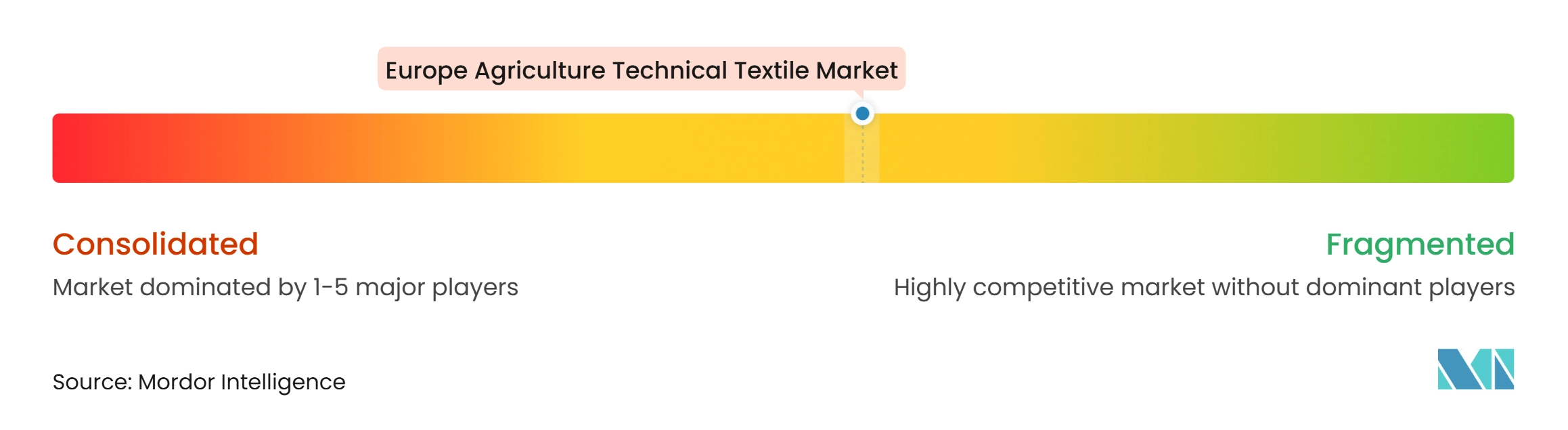
The Europe agricultural technical textile market exhibits a medium level of market concentration, with European specialists competing alongside regional producers and import-dependent distributors. Arrigoni Group, RKW Group, AB Ludvig Svensson, and Freudenberg Performance Materials are among the established companies. Their main areas of competition are product life, ultraviolet stability, light control, polymer composition, and environmental credentials. Vertically integrated manufacturers have an advantage when polymer costs change because they can better coordinate yarn extrusion and fabric conversion. Mediterranean suppliers hold strong positions in crop-protection textiles, while Nordic companies have a well-established role in greenhouse climate screens.
Product development is a central competitive strategy in the Europe agricultural technical textile market. Arrigoni introduced V-Agro Air Cool in June 2025, a greenhouse covering film designed to reduce near-infrared thermal energy by 30.8% compared with standard LDPE films. Freudenberg launched binder-free PLA and wood-pulp wetlaid nonwovens in October 2025 for horticulture and plant propagation uses. RKW merged RKW Agri GmbH & Co. KG into RKW SE in February 2025 to bring its agricultural segment under one corporate entity. These moves show that material innovation, portfolio simplification, and sustainability claims are part of competitive positioning.
Commercial opportunities remain in recyclable mono-material products, screens that can be installed in older greenhouses, and covers that work with agro-photovoltaic structures. The Europe agricultural technical textile market can also benefit when suppliers connect crop protection with renewable-energy infrastructure. Texinov and Novamont show how public innovation programs and regulatory certification can support smaller specialists. Suppliers in Dutch and Belgian greenhouse ecosystems are ahead in linking climate screens with digital control systems, increasing the need for other manufacturers to strengthen their technology offer.
Europe Agriculture Technical Textile Industry Leaders
-
Beaulieu Technical Textiles
-
Freudenberg Performance Materials
-
Arrigoni Group
-
Groupe Barbier
-
Diatex SAS
- *Disclaimer: Major Players sorted in no particular order
Europe Agriculture Technical Textile Market Companies Covered in this Report
- Beaulieu Technical Textiles
- Freudenberg Performance Materials
- Arrigoni Group
- Groupe Barbier
- Diatex SAS
- RKW Group
- AB Ludvig Svensson
- TenCate Protective Fabrics
- Fibertex Nonwovens A/S
- Hy-Tex (UK) Limited
- Bonar Technical Fabrics
- Don & Low Limited
- Plastextil
- Texinov
- Phormium
- Ginegar Plastic Products Ltd.
- Tama Group
- Novamont S.p.A.
- Armando Alvarez Group
- Mogul Co. Ltd.
Recent Industry Developments in Europe Agriculture Technical Textile Market
- March 2026: Arrigoni Group Italian agrotextile manufacturer announced that it would showcase its BIORETE AIR PLUS insect-protection netting at GreenTech Amsterdam 2026. The range uses high-tenacity ARLENE HT monofilament to combine protection against small insect pests with improved airflow.
- January 2026: Fraunhofer FEP announced the launch of the EU-funded CELLAGRI project, coordinating nine partners across seven European countries to develop cellulose-based biodegradable mulch films with water-management structures. The project targets at least a 30% reduction in environmental impact compared with conventional plastic mulch films.
- October 2025: Freudenberg Performance Materials launched 100% bio-based binder-free PLA/wood pulp wetlaid nonwovens for horticulture and plant propagation applications, designed to balance water absorption, rooting properties, and tensile strength without synthetic binders.
Europe Agriculture Technical Textile Market Report Scope
The Europe Agriculture Technical Textile Market Report is segmented by Product Type (Crop Protection Nets, Fishing and Aquaculture Textiles, and more), by End-Use Sector (Field Crop Cultivation, Fruit Orchards and Viticulture, and more), and by Geography (Germany, France, United Kingdom, Italy, Spain, Netherlands, Belgium, Poland, Russia, and Rest of Europe). The Market Forecasts are Provided in Terms of Value (USD).
Segmentation Overview
| Crop Protection Nets | Anti-Insect and Pest Protection Nets |
| Anti-Hail and Weather Protection Nets | |
| Anti-Bird and Wildlife Protection Nets | |
| Agricultural Windbreak Nets | |
| Agricultural Shade Nets and Greenhouse Climate Screens | Agricultural Shade Nets |
| Thermo-Reflective and Light-Diffusion Screens | |
| Thermal and Energy-Saving Greenhouse Screens | |
| Greenhouse Blackout and Light-Control Screens | |
| Crop Covers and Plant Protection Fleece | Nonwoven Floating Row Covers |
| Frost and Thermal Protection Textiles | |
| Other Woven and Knitted Crop Covers | |
| Fishing and Aquaculture Textiles | Commercial Fishing Nets |
| Aquaculture Cage and Containment Nets | |
| Specialized Aquaculture Protection Nets | |
| Mulch Mats and Agricultural Ground Covers | |
| Nursery, Plant Support and Forestry Textiles | |
| Harvesting and Forage Management Textiles | |
| Other Agricultural Technical Textiles |
| Field Crop Cultivation |
| Vegetable, Floriculture and Nursery Cultivation |
| Fruit Orchards and Viticulture |
| Forestry and Landscape Cultivation |
| Livestock and Forage Operations |
| Fisheries and Aquaculture |
| Germany |
| France |
| United Kingdom |
| Italy |
| Spain |
| Netherlands |
| Belgium |
| Poland |
| Russia |
| Rest of Europe |
| By Product Type | Crop Protection Nets | Anti-Insect and Pest Protection Nets |
| Anti-Hail and Weather Protection Nets | ||
| Anti-Bird and Wildlife Protection Nets | ||
| Agricultural Windbreak Nets | ||
| Agricultural Shade Nets and Greenhouse Climate Screens | Agricultural Shade Nets | |
| Thermo-Reflective and Light-Diffusion Screens | ||
| Thermal and Energy-Saving Greenhouse Screens | ||
| Greenhouse Blackout and Light-Control Screens | ||
| Crop Covers and Plant Protection Fleece | Nonwoven Floating Row Covers | |
| Frost and Thermal Protection Textiles | ||
| Other Woven and Knitted Crop Covers | ||
| Fishing and Aquaculture Textiles | Commercial Fishing Nets | |
| Aquaculture Cage and Containment Nets | ||
| Specialized Aquaculture Protection Nets | ||
| Mulch Mats and Agricultural Ground Covers | ||
| Nursery, Plant Support and Forestry Textiles | ||
| Harvesting and Forage Management Textiles | ||
| Other Agricultural Technical Textiles | ||
| By End-Use Sector | Field Crop Cultivation | |
| Vegetable, Floriculture and Nursery Cultivation | ||
| Fruit Orchards and Viticulture | ||
| Forestry and Landscape Cultivation | ||
| Livestock and Forage Operations | ||
| Fisheries and Aquaculture | ||
| By Geography | Germany | |
| France | ||
| United Kingdom | ||
| Italy | ||
| Spain | ||
| Netherlands | ||
| Belgium | ||
| Poland | ||
| Russia | ||
| Rest of Europe | ||
Key Questions Answered in the Report
What is the projected value of Europe agricultural technical textiles by 2032?
The Europe agricultural technical textile market is projected to reach USD 4.27 billion by 2032, growing at a 4.30% CAGR from 2027-2032. The forecast reflects wider use of protected cultivation and demand for physical crop-protection products.
Which product category leads European agricultural technical textiles?
Crop protection nets lead with a 22% share in 2026 because orchards, vineyards, berry farms, and vegetable growers use them for insect, hail, bird, and wind protection. Their broad range of uses supports steady demand across different farm types.
Which agricultural technical textile product is growing fastest in Europe?
Agricultural shade nets and greenhouse climate screens are projected to grow at a 6.8% CAGR through 2032 as greenhouse operators invest in energy and light management. Their value comes from managing indoor climate conditions in high-value production.
Which end-use has the greatest demand for agricultural technical textiles in Europe?
Field crop cultivation holds a 32% share in 2026, supported by demand for mulch mats, windbreak nets, and crop covers across broad arable areas. The segment benefits from scale even though textile use per hectare is lower than in horticulture.
Which country is expected to grow fastest through 2032?
The Netherlands is projected to record a 6.5% CAGR through 2032, supported by its advanced greenhouse sector and demand for energy-saving screens. Thermal, blackout, and light-management systems are important purchase categories for local growers.
What are the main constraints on adoption of advanced agricultural textiles?
Polymer price volatility, high upfront system costs, fragmented farm structures, and mixed-polymer waste management can delay purchases and reduce margins. These constraints are most significant where growers have limited capital or suppliers rely on commodity polymers.