
EU AI Audit Trail Software Market Size and Share
Market Overview
| Study Period | 2020 - 2031 |
|---|---|
| Forecast Data Period | 2026 - 2031 |
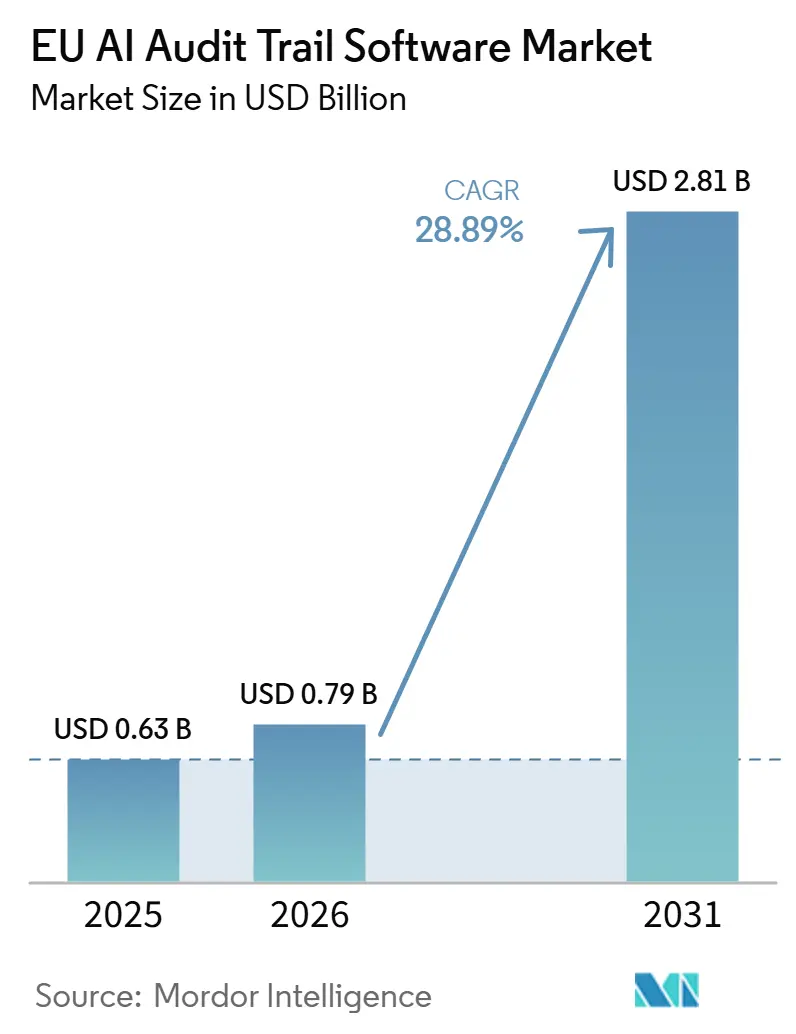
| Base Year Market Size (2025) | USD 0.63 Billion |
| Market Size (2026) | USD 0.79 Billion |
| Market Size (2031) | USD 2.81 Billion |
| Growth Rate (2026 - 2031) | 28.89% CAGR |
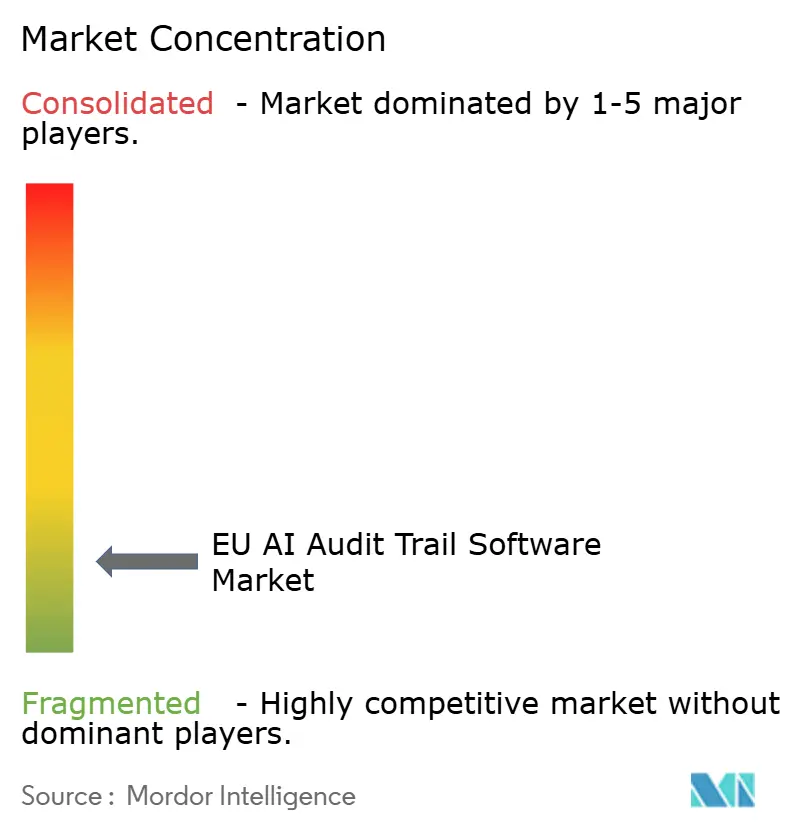
| Market Concentration | Low |
Major Players *Disclaimer: Major Players sorted in no particular order Image © Mordor Intelligence. Reuse requires attribution under CC BY 4.0. | |
EU AI Audit Trail Software Market Analysis by Mordor Intelligence
The EU AI Audit Trail Software Market was valued at USD 0.63 billion in 2025, USD 0.79 billion in 2026, and is forecast to reach USD 2.81 billion by 2031, at a CAGR of 28.89% over 2026-2031. The phased requirements of Regulation (EU) 2024/1689 have made logging, technical documentation, and post-market monitoring central requirements for covered organizations. Obligations for general-purpose AI models applied on August 2, 2025, while high-risk AI system requirements are scheduled to apply from August 2, 2026. Penalties of up to EUR 35 million (USD 39.8 million) or 7% of global annual turnover have raised the importance of compliance planning at the board level. Procurement teams increasingly assess multi-framework coverage, EU-hosted data residency, and the ability to produce usable lifecycle evidence. These factors support demand for software and associated implementation support.
Key Report Takeaways
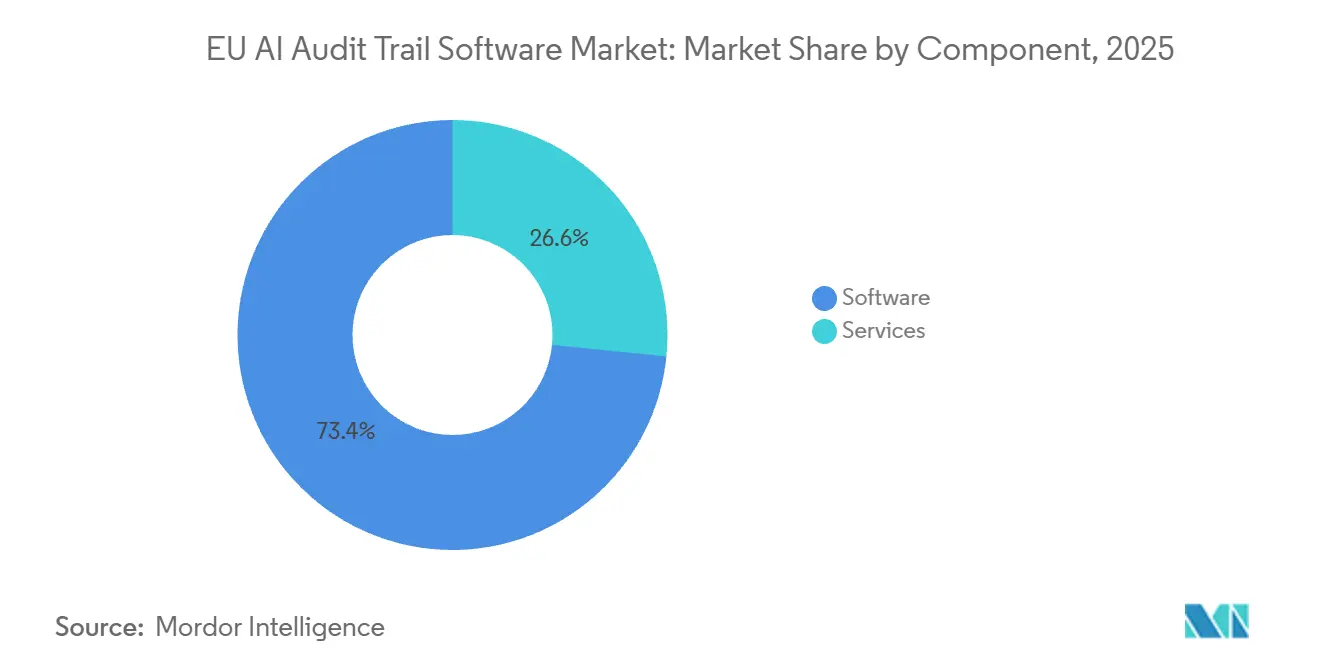
- By component, software held 73.41% share in the EU AI Audit Trail Software Market 2025, while services are projected to expand at a 30.82% CAGR from 2026 to 2031.
- By compliance function, compliance evidence and reporting held 27.74% share in the EU AI Audit Trail Software Market 2025, while incident investigation and post-market monitoring are projected to expand at a 29.94% CAGR from 2026 to 2031.
- By deployment model, cloud held 69.19% share in 2025, while hybrid deployment is projected to expand at a 30.61% CAGR from 2026 to 2031.
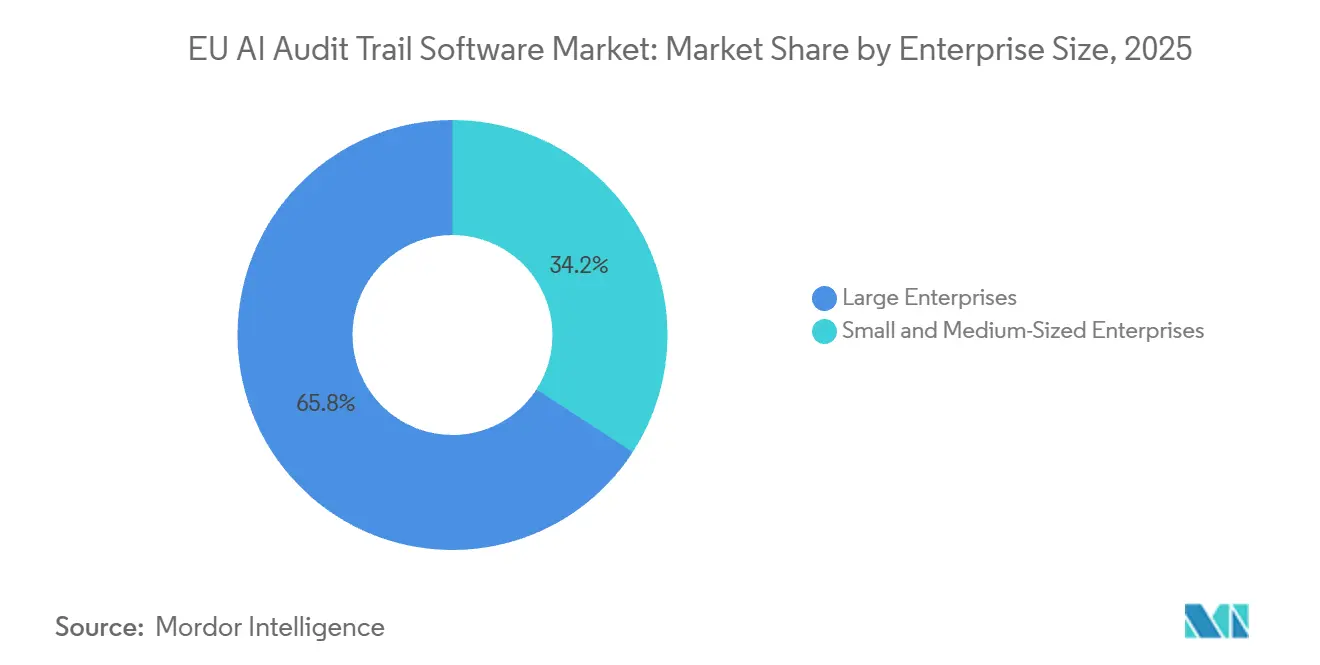
- By enterprise size, large enterprises held a 65.83% share of the EU AI Audit Trail Software Market in 2025, while small and medium-sized enterprises are projected to expand at a 31.14% CAGR from 2026 to 2031.
- By end user, IT and telecommunication held 18.36% share in 2025, while healthcare and life sciences are projected to expand at a 29.73% CAGR from 2026 to 2031.
- By geography, Germany held a 29.42% share of the EU AI Audit Trail Software Market in 2025, while France is projected to expand at a 30.46% CAGR from 2026 to 2031.
Note: Market size and forecast figures in this report are generated using Mordor Intelligence’s proprietary estimation framework, updated with the latest available data and insights as of January 2026.
EU AI Audit Trail Software Market Trends and Insights
Drivers Impact Analysis*
| Driver | (~) % Impact on CAGR Forecast | Geographic Relevance | Impact Timeline |
|---|---|---|---|
| Phased EU AI Act Enforcement and Near-Term Compliance Deadlines | +8.5% | Global, with greatest intensity in Germany, France, UK, and Spain | Short term (≤ 2 years) |
| Extraterritorial Reach and EU Market-Access Exposure | +5.5% | Global, primarily North America and Asia-Pacific multinationals | Short term (≤ 2 years) |
| Expansion of High-Risk AI Use Cases in Regulated Industries | +4.2% | EU core, with strongest pull in Germany, France, and UK | Medium term (2-4 years) |
| Need for Continuous Evidence Across the AI Lifecycle | +3.5% | Global | Medium term (2-4 years) |
| Convergence of EU AI Act, ISO/IEC 42001, and NIST AI RMF Controls | +2.8% | Global, with early traction in enterprise procurement markets | Long term (≥ 4 years) |
| Procurement and Board-Level Demand for Demonstrable Responsible AI | +2.1% | Global | Long term (≥ 4 years) |
| Source: Mordor Intelligence | |||
Phased EU AI Act Enforcement and Near-Term Compliance Deadlines
The EU AI Audit Trail Software Market is responding to a clear sequence of legal deadlines under Regulation (EU) 2024/1689. Rules for general-purpose AI models applied from August 2, 2025, and the European AI Office gained related enforcement responsibilities from August 2, 2026. Article 50 transparency requirements also apply from August 2, 2026, while the Digital Omnibus defers Annex III obligations until December 2, 2027. Germany’s Cabinet approved the KI-MIG on February 11, 2026, which designates Bundesnetzagentur as the national AI supervisory authority and sets national sanction provisions. These dates require organizations to maintain time-stamped records, technical documentation, model cards, conformity assessment materials, and post-market monitoring reports, rather than relying solely on policy documents.[1]European Commission, “AI Act,” Digital Strategy, European Commission, digital-strategy.ec.europa.eu
Extraterritorial Reach and EU Market-Access Exposure
The EU AI Act applies when an AI system is placed on the EU market, even when the provider is based outside the EU. This exposure places EU compliance requirements within global product, contracting, and governance decisions. The regulation allows fines of up to EUR 35 million (USD 38.1 million) or 7% of worldwide annual turnover for certain violations. Microsoft signed the EU AI Pact in January 2025 and aligned product configurations and contracts with prohibited-use provisions before the Commission's later guidance was finalized. This response shows why global providers are building EU-ready controls into their operating models instead of treating the rules as a regional add-on. The EU AI Audit Trail Software Market benefits when multinational providers need a common evidence architecture across products sold in several jurisdictions.[2]European Commission, “EU Rules on General-Purpose AI Models Start to Apply, Bringing More Transparency, Safety and Accountability,” Digital Strategy, European Commission, digital-strategy.ec.europa.eu
Expansion of High-Risk AI Use Cases in Regulated Industries
Annex III identifies uses in biometric identification, critical infrastructure, employment, financial services, healthcare triage, and law enforcement as high-risk. These uses are common in sectors that already have formal records, review, and oversight processes. Financial institutions must align AI controls with DORA, which applies from January 17, 2025, as well as EU AI Act requirements and existing supervisory frameworks. Medical AI manufacturers face a combined documentation task under the AI Act and the Medical Device Regulation or In Vitro Diagnostic Regulation. The June 2025 MDCG 2025-6/AIB 2025-1 guidance set out a combined evidence-file approach that connects AI Act Annex IV material with MDR Annex II and III documentation. This overlap makes consistent data lineage, system logging, and documentation controls more valuable for regulated organizations.[3]Microsoft, “The EU AI Act,” Microsoft Security, microsoft.com
Need for Continuous Evidence Across the AI Lifecycle
Article 72 requires high-risk AI providers to establish post-market monitoring, and Article 73 sets a 48-hour notification period for serious incidents after classification. A follow-up report is required within 15 days, which increases the value of records created during normal system operation. Article 12 logging requirements require operational input and output records to help identify the source of a risk or incident. Policy documents can support Article 17 quality management, but they do not replace production evidence. Fiddler AI raised USD 30 million in January 2026 to develop its AI control plane for standardized telemetry and auditable governance across compound AI systems. As use of agentic systems grows, the EU AI Audit Trail Software Market favors automated controls that can retain verifiable evidence at the pace of system execution.[4]Fiddler AI, “Fiddler Raises USD 30M Series C to Deliver the First Control Plane for AI,” Fiddler AI Press Releases, fiddler.ai
Restraints Impact Analysis*
| Restraint | (~) % Impact on CAGR Forecast | Geographic Relevance | Impact Timeline |
|---|---|---|---|
| Unsettled Technical Standards and Moving Interpretive Guidance | -3.2% | EU core, particularly Germany and France | Medium term (2-4 years) |
| Fragmented Accountability Across Providers, Deployers, and Third-Party Model Vendors | -2.5% | Global | Medium term (2-4 years) |
| Limited Availability of AI Governance and Conformity-Assessment Expertise | -1.8% | Global | Short term (≤ 2 years) |
| Integration Friction Across Shadow AI, Legacy MLOps, and Multi-Cloud Estates | -1.2% | Global | Long term (≥ 4 years) |
| Source: Mordor Intelligence | |||
Unsettled Technical Standards and Moving Interpretive Guidance
The EU AI Audit Trail Software Market faces uncertainty due to the ongoing development of the detailed standards environment. Draft guidance on high-risk AI classification was published on May 19, 2026, and consultation ran through June 23, 2026. Buyers may need to revise configurations when guidance or harmonized standards become final. Only 12 of the 27 Member States had designated national competent authorities by mid-2026, which can create different enforcement expectations across countries. Organizations also face a shortage of staff who understand both AI system design and EU regulatory interpretation. These conditions can delay buying decisions and increase the need for services during implementation.
Fragmented Accountability Across Providers, Deployers, and Third-Party Model Vendors
The regulation separates duties among providers, deployers, importers, and distributors. A high-risk deployment can involve a foundation model provider, a fine-tuning provider, an application deployer, and enterprise users. Each party can present different evidence, making it difficult to assemble a complete record. Article 25 permits some contractual changes in responsibility, but it does not remove the need for independent evidence from each party. The Act also does not provide a standard protocol for sharing evidence across organizations. This fragmentation makes provenance, accountability metadata, and cross-company record collection central requirements for the EU AI Audit Trail Software Market.
*Our forecasts treat driver/restraint impacts as directional, not additive. The impact forecasts reflect baseline growth, mix effects, and variable interactions.
Segment Analysis
By Component: Software Platforms Anchor Compliance Spending While Services Scale
Software accounted for 73.41% of revenue in 2025, making it the primary spending category for AI audit trail capabilities. SaaS governance platforms allow organizations to start classification, evidence collection, and reporting workflows without major capital expenditure. IBM watsonx.governance, Credo AI, Holistic AI, and Saidot offer tools for risk classification, evidence creation, and audit-ready reports. Their platforms map controls to the EU AI Act, ISO/IEC 42001, and the NIST AI Risk Management Framework. Microsoft reported that Azure AI Foundry Models and Microsoft Security Copilot achieved ISO/IEC 42001:2023 certification in 2025. IBM announced Sovereign Core in early 2026, with general availability targeted for mid-2026, to keep AI audit logs and telemetry within national boundaries. These features show why data residency and third-party assurance have become important in software selection.
Services are projected to grow at a 30.82% CAGR through 2031, the fastest rate in this segmentation. The work includes configuring logging pipelines, mapping data lineage, and preparing material for notified-body reviews. Organizations also need support in connecting ISO/IEC 42001 management system controls with AI Act requirements. This requirement is particularly pronounced when several suppliers contribute to a single AI deployment. IBM and Credo AI announced an OEM collaboration in April 2025 that incorporated Credo AI Policy Packs as IBM Compliance Accelerators within watsonx. governance. The arrangement demonstrates how specialized policy content can be brought into a larger platform offering. The EU AI Audit Trail Software Market industry, therefore, supports both reusable platform software and specialized implementation work.


By Compliance Function: Incident Monitoring Outpaces Evidence Management in Growth
Compliance evidence and reporting accounted for 27.74% of revenue in 2025, the largest functional category. Demand began with documentary obligations under Annex IV and Article 17 because many organizations needed structured records before the August 2026 deadlines. Model and data lineage are another established area, as Article 10 requires data governance. Runtime decision logging supports Article 12 requirements for operational records. Bias, fairness, and explainability audit supports Article 9 risk-management work. These functions reflect a move from general policy statements to controls that can be examined during assurance activity. Their continued use makes evidence reporting an important foundation for the EU AI Audit Trail Software Market.
Incident investigation and post-market monitoring are projected to grow at a 29.94% CAGR through 2031. Article 72 requires a monitoring framework, while Article 73 requires rapid reporting of serious incidents. The need is particularly strong in healthcare, as device manufacturers must maintain active post-market surveillance under both MDR Articles 83-86 and the AI Act Article 72. The MDCG guidance connects the documentation and surveillance expectations of these frameworks. A 2026 article in Frontiers in Digital Health stated that healthcare facilities using high-risk AI have mandatory deployment obligations for comprehensive audit log maintenance. This environment increases demand for records that remain usable after systems are deployed. It also favors platforms that integrate alerts, investigations, corrective actions, and reporting into a single control process.
By Deployment Model: Hybrid Architectures Reflect Sovereignty Pressures
Cloud deployment held 69.19% of revenue in 2025, supported by preconfigured policy libraries and automated evidence dashboards. Cloud delivery helps organizations establish controls faster than many on-premises alternatives. Saidot’s Finnish SaaS offering and IBM Sovereign Core address data residency requirements within cloud-based architectures. These capabilities maintain cloud relevance for regulated buyers that need EU-hosted data. On-premises deployment remains important in defense, intelligence, and public-sector settings that require an air gap. In those cases, Article 26's human oversight and logging obligations can limit system design. The EU AI Audit Trail Software Market, therefore, includes both scalable cloud systems and private infrastructure for sensitive use cases.
Hybrid deployment is projected to grow at a 30.61% CAGR through 2031, the fastest rate among deployment models. Financial institutions must address DORA third-party risk controls, AI Act transparency and logging duties, and GDPR data localization constraints. These requirements can make a fully cloud-hosted model difficult in strict data residency environments. Healthcare manufacturers face a similar split between controlled patient-data environments and cloud-accessible governance dashboards. Hybrid systems can retain sensitive information in controlled infrastructure while allowing broader access to compliance workflows. Article 26 deployer duties and DORA ICT risk frameworks reinforce this model in regulated procurement. This design need creates a distinct opportunity for platforms that can keep evidence consistent across environments.
By Enterprise Size: SME Demand Accelerates on Self-Serve Platform Economics
Large enterprises captured 65.83% of revenue in 2025. Their exposure is higher in recruitment, credit scoring, insurance underwriting, and critical infrastructure applications. Large buyers often require a single supplier to support several compliance frameworks and existing MLOps tools. Credo AI reported 30-plus integrations across Microsoft, IBM, and Databricks in 2025. IBM and Credo AI’s OEM arrangement also reflects a preference for deeper supplier relationships to address multiple compliance needs. These buyers place value on broad deployment support, policy coverage, and integration with current platforms. Their purchasing behavior remains a key driver of demand in the EU AI Audit Trail Software Market.
Small and medium-sized enterprises are projected to grow at a 31.14% CAGR through 2031. Purpose-built self-serve products, simplified documentation provisions under Article 55, and greater use of AI tools support this growth. Many smaller organizations act as deployers rather than developers, but they still need AI inventories, risk classification, and Article 4 AI-literacy records. The AI-literacy obligation has applied since February 2, 2025. The Digital Omnibus defers Annex III obligations until December 2027, giving smaller organizations more time to prepare. Specialist suppliers are using freemium and lower-cost subscription models during this preparation period. These conditions broaden the potential customer base without removing the need for reliable evidence controls.
By End User: Healthcare Compliance Complexity Drives the Fastest Sector Growth
IT and telecommunications accounted for 18.36% of revenue in 2025, the largest end-user segment. These organizations use AI in network optimization, workforce management, and customer operations. They also provide managed-service infrastructure for AI used by other regulated sectors. BFSI has a major compliance burden because high-risk credit scoring, insurance underwriting, and biometric verification can overlap with DORA and supervisory review expectations. Automotive, retail, and e-commerce organizations face different timing under Annex I for embedded products and Annex III for standalone systems. The wide range of systems makes standard control templates useful, but it also requires each organization to map its own responsibilities. The EU AI Audit Trail Software Market serves this group by providing tools that apply common requirements across many AI use cases.
Healthcare and life sciences are projected to grow at a 29.73% CAGR through 2031. The main reason is the combined burden of the AI Act and MDR/IVDR requirements. The June 19, 2025, MDCG 2025-6/AIB 2025-1 guidance formalized a single evidence-file approach for MDR Annex II and III and AI Act Annex IV. Notified Bodies began incorporating AI Act considerations into MDR conformity assessments from mid-2026. Manufacturers that delayed platform investment may face more complex documentation and surveillance. DataRobot offers a life sciences governance module that produces research traceability documentation for regulated research and development. The EU AI Audit Trail Software Market has room for vertical products that understand both medical-device evidence and AI governance requirements.
Geography Analysis
Germany accounted for 29.42% of revenue in 2025, the largest share. The country has a high concentration of industrial, automotive, and manufacturing AI deployments. The EU AI Audit Trail Software Market share in Germany also reflects its early national enforcement structure. The February 11, 2026, KI-MIG Cabinet approval named Bundesnetzagentur as the central AI supervisory authority and introduced national sanction provisions. German automotive manufacturers must prepare for both Annex III standalone-system obligations and the August 2, 2028, Annex I deadline for embedded products. This creates a longer demand period for evidence, documentation, and monitoring tools. The UK remains relevant because UK-based providers selling into the EU must comply with the EU AI Act even though the country is outside the EU.
France is projected to grow at a 30.46% CAGR through 2031, the fastest growth rate among geographies. Its compliance preparation cycle started later, but is now expanding quickly. CNIL was designated as a national competent authority for compliance with the AI Act in areas involving personal data processing. This role links existing GDPR experience with oversight of the AI Act. French organizations also need staff who can interpret the rules and implement technical controls. This supports demand for implementation services alongside platform subscriptions. Naaia represents an EU-native supplier that competes on its knowledge EU the EU AI Act in France and French-speaking markets.
Spain adds demand through digital services and fintech use cases, including employment and financial services AI that are listed as high-risk under Annex III. Russia has a minor and constrained position because EU sanctions and restrictions on EU-origin software exports limit practical commercial activity. The rest of Europe includes the Netherlands, Belgium, Scandinavia, and other EU Member States where the AI Act applies across borders. Saidot, based in Finland, states that its platform can collect compliance evidence once and reuse it across multiple AI systems and more than 110 policies. Belgium also has public-sector demand because EU institutions operate there and need governance for their own AI use. This regional mix supports suppliers that can adapt common controls to country-level enforcement and infrastructure needs. It also gives EU-native providers a role alongside larger global vendors.
Competitive Landscape
The EU AI Audit Trail Software Market has two main competitive groups. Full-stack enterprise governance platforms manage multi-framework compliance across different deployment environments. Specialized suppliers focus on runtime observability, bias detection, or cryptographic decision evidence. IBM watsonx X Governance and Microsoft Purview compete on broad coverage of the EU AI Act, ISO/IEC 42001, and the NIST AI Risk Management Framework. They also compete through hybrid deployment flexibility, sovereign options, and MLOps integrations. IBM and Credo AI announced an April 2025 OEM agreement that brought Credo AI Policy Packs into watsonx. governance as Compliance Accelerators. Microsoft’s 2025 ISO/IEC 42001 certification for Azure AI Foundry Models adds independent validation of its management system to its offer.
Arize AI, Fiddler AI, Arthur AI, WhyLabs, and Aporia Technologies compete through runtime evidence, agentic AI observability, and low-latency guardrails. Their capabilities are relevant to Article 12 logging and Article 72 monitoring. Fiddler AI raised USD 30 million in January 2026 to expand its control-plane offering for compound AI systems. HiddenLayer launched Agentic Runtime Security in March 2026 and joined the Databricks Unity AI Gateway ecosystem in June 2026. These moves show the growing connection between AI security controls and compliance logging. Holistic AI, Saidot, Naaia, and Fairly AI use their EU focus and regulatory knowledge as differentiators. Their positioning is relevant where buyers seek local policy interpretation and EU-hosted data practices.
The EU AI Audit Trail Software Market remains open in hybrid tooling for mid-market BFSI and healthcare buyers. These organizations may find large enterprise platforms complex and require capabilities beyond those provided by basic self-service products. EVE NeuroSystems is a newer entrant with EVE AI Core, which generates cryptographically signed decision-evidence records. Competitive success depends on combining policy mapping with operational evidence that works across provider, deployer, and model-vendor boundaries. It also depends on helping buyers meet data-residency and integration requirements without creating separate records for each framework. The available information does not disclose a combined top-player share, so a precise concentration score cannot be derived from revenue-share data. The competitive picture is therefore consistent with a market where platform leaders and specialized providers both remain relevant.
EU AI Audit Trail Software Industry Leaders
Credo AI, Inc.
IBM Corporation
Microsoft Corporation
DataRobot, Inc.
Fiddler Labs, Inc.
- *Disclaimer: Major Players sorted in no particular order

Recent Industry Developments
- June 2026: HiddenLayer joined the Databricks Unity AI Gateway ecosystem, integrating AI-native security and detection into Databricks' centralized AI governance layer to apply runtime AI security controls within enterprise AI build-and-scale workflows.
- June 2026: HiddenLayer and Cohere announced a collaboration combining Cohere's North sovereign AI platform with HiddenLayer's AI Security Platform to protect agent, model, and tool interactions against AI-native threats in enterprise agentic deployments.
- June 2026: Arthur AI released its June 2026 platform update introducing cross-workspace governance views, enabling compliance teams to maintain a single governance posture across multiple organizational workspaces, directly relevant to Article 17 quality management and Article 12 logging obligations.
- March 2026: HiddenLayer unveiled Agentic Runtime Security capabilities for its AI Runtime Security module, giving security and compliance teams visibility into autonomous AI agent decision behavior and enabling threat containment in multi-tenant agentic workflows.


EU AI Audit Trail Software Market Report Scope
The EU AI audit trail software market comprises the ecosystem of software solutions and associated services that automatically capture, log, and monitor the comprehensive lifecycle, data flows, and decision-making processes of artificial intelligence systems. This market specifically addresses the stringent transparency and traceability requirements of the European Union's AI Act by providing tools for runtime decision logging, model and data lineage tracking, algorithmic bias and fairness auditing, and post-market incident investigation. Deployed via cloud, hybrid, or on-premises models, these solutions cater to organizations of all sizes across highly regulated industries, including IT, BFSI, automotive, and healthcare. By creating immutable, tamper-proof records of how AI models operate, evolve, and arrive at specific outcomes, EU AI audit trail software enables businesses to ensure algorithmic explainability, generate concrete compliance evidence for regulatory audits, rapidly investigate anomalies or failures, and maintain continuous governance over their AI deployments.
The EU AI Audit Trail Software Market Report is Segmented by Component (Software and Services), Compliance Function (Compliance Evidence and Reporting, Model and Data Lineage, Runtime Decision Logging, Bias, Fairness and Explainability Audit, and Incident Investigation and Post-Market Monitoring), Deployment Model (Cloud, Hybrid, and On-Premises), Enterprise Size (Large Enterprises and Small and Medium-Sized Enterprises), End User (IT and Telecommunication, BFSI, Automotive and Transportation, Healthcare and Life Sciences, Retail and E-Commerce, and Others), and Geography (Germany, United Kingdom, France, Russia, Spain, and Rest of Europe). The Market Forecasts are Provided in Terms of Value (USD).
| Software |
| Services |
| Compliance Evidence and Reporting |
| Model and Data Lineage |
| Runtime Decision Logging |
| Bias, Fairness and Explainability Audit |
| Incident Investigation and Post-Market Monitoring |
| Cloud |
| Hybrid |
| On-Premises |
| Large Enterprises |
| Small and Medium-Sized Enterprises |
| IT and Telecommunication |
| BFSI |
| Automotive and Transportation |
| Healthcare and Life Sciences |
| Retail and E-Commerce |
| Other End Users |
| Germany |
| United Kingdom |
| France |
| Russia |
| Spain |
| Rest of Europe |
| By Component | Software |
| Services | |
| By Compliance Function | Compliance Evidence and Reporting |
| Model and Data Lineage | |
| Runtime Decision Logging | |
| Bias, Fairness and Explainability Audit | |
| Incident Investigation and Post-Market Monitoring | |
| By Deployment Model | Cloud |
| Hybrid | |
| On-Premises | |
| By Enterprise Size | Large Enterprises |
| Small and Medium-Sized Enterprises | |
| By End User | IT and Telecommunication |
| BFSI | |
| Automotive and Transportation | |
| Healthcare and Life Sciences | |
| Retail and E-Commerce | |
| Other End Users | |
| By Geography | Germany |
| United Kingdom | |
| France | |
| Russia | |
| Spain | |
| Rest of Europe |


Key Questions Answered in the Report
What is the EU AI Audit Trail Software Market size?
The EU AI Audit Trail Software Market is projected to increase from USD 0.81 billion in 2026 to USD 2.81 billion by 2031, at a 28.89% CAGR. The estimate reflects demand for technical records and ongoing monitoring under the EU AI Act.
What is driving demand for AI audit trail software in the EU?
EU AI Act duties for logging, technical documentation, transparency, and post-market monitoring are increasing demand for structured evidence systems. The rules affect organizations that provide or deploy covered AI systems in the EU.
Which component is growing fastest in AI audit trail software?
Services are projected to grow at a 30.82% CAGR through 2031 because organizations need help configuring controls and preparing compliance documentation. This work can include evidence design, data lineage mapping, and notified-body preparation.
Which deployment model is growing fastest?
Hybrid deployment is projected to expand at a 30.61% CAGR through 2031 as regulated buyers balance data residency needs with cloud-based governance workflows. It can keep sensitive data in controlled environments while supporting centralized reporting.
Which end-user sector is growing fastest?
Healthcare and life sciences are projected to grow at a 29.73% CAGR through 2031 because organizations must meet both EU AI Act and MDR or IVDR requirements. Combined evidence and post-market surveillance requirements add to the need for dedicated controls.
Which EU country is expected to grow fastest?
France is projected to grow at a 30.46% CAGR through 2031, supported by expanding compliance preparation and its AI Act oversight structure. CNILs role provides a link between personal-data oversight and AI compliance.
Page last updated on:






