
Ethylene Market Size and Share
Market Overview
| Study Period | 2021 - 2031 |
|---|---|
| Market Size (2026) | USD 198.21 Billion |
| Market Size (2031) | USD 264.84 Billion |
| Growth Rate (2026 - 2031) | 5.97 % |
| Fastest Growing Market | Asia-Pacific |
| Largest Market | Asia-Pacific |
| Market Concentration | Medium |
Major Players *Disclaimer: Major Players sorted in no particular order Image © Mordor Intelligence. Reuse requires attribution under CC BY 4.0. | |
Ethylene Market Analysis by Mordor Intelligence
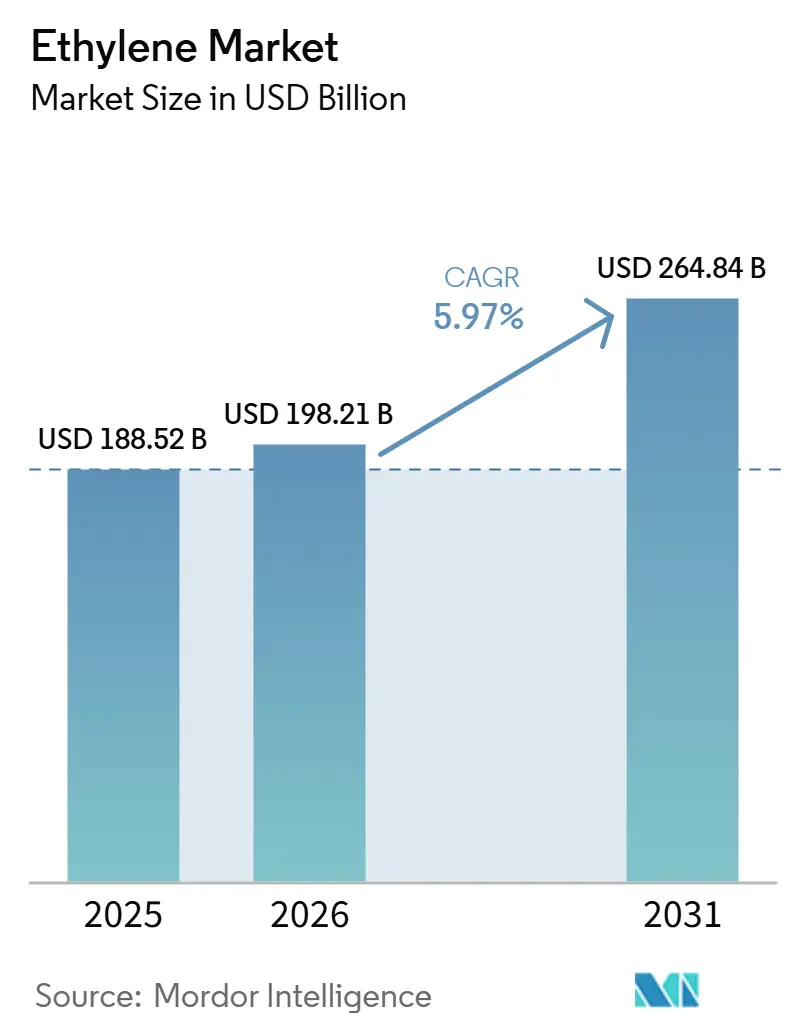
The Ethylene Market was valued at USD 188.52 billion in 2025 and is estimated to grow from USD 198.21 billion in 2026 to reach USD 264.84 billion by 2031, at a CAGR of 5.97% during the forecast period (2026–2031). Ethylene is a basic input for polyethylene, ethylene oxide, ethyl benzene, ethylene dichloride, and vinyl acetate monomer. Demand is closely tied to packaging, consumer goods, construction, and chemical manufacturing, which makes the ethylene market sensitive to changes in downstream industrial activity. Investment is shifting toward integrated sites with secure feedstock supply and lower emissions. The gap between ethane-based production in the United States and naphtha-based production in Europe is also changing trade patterns and investment decisions.
Key Report Takeaways
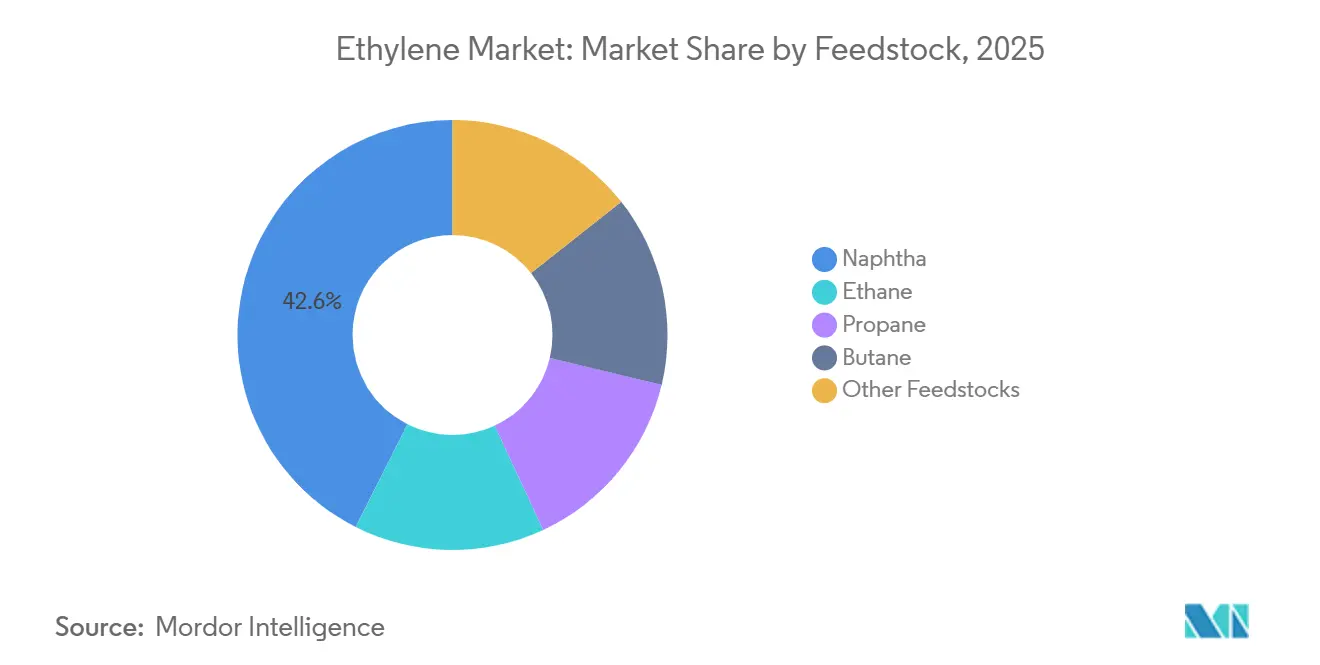
- By feedstock, naphtha held 42.57% of the ethylene market share in 2025, while ethane is forecast to grow at a 6.84% CAGR through 2031.
- By application, polyethylene accounted for 52.68% of the ethylene market share in 2025, while ethylene oxide is forecast to grow at a 6.71% CAGR through 2031.
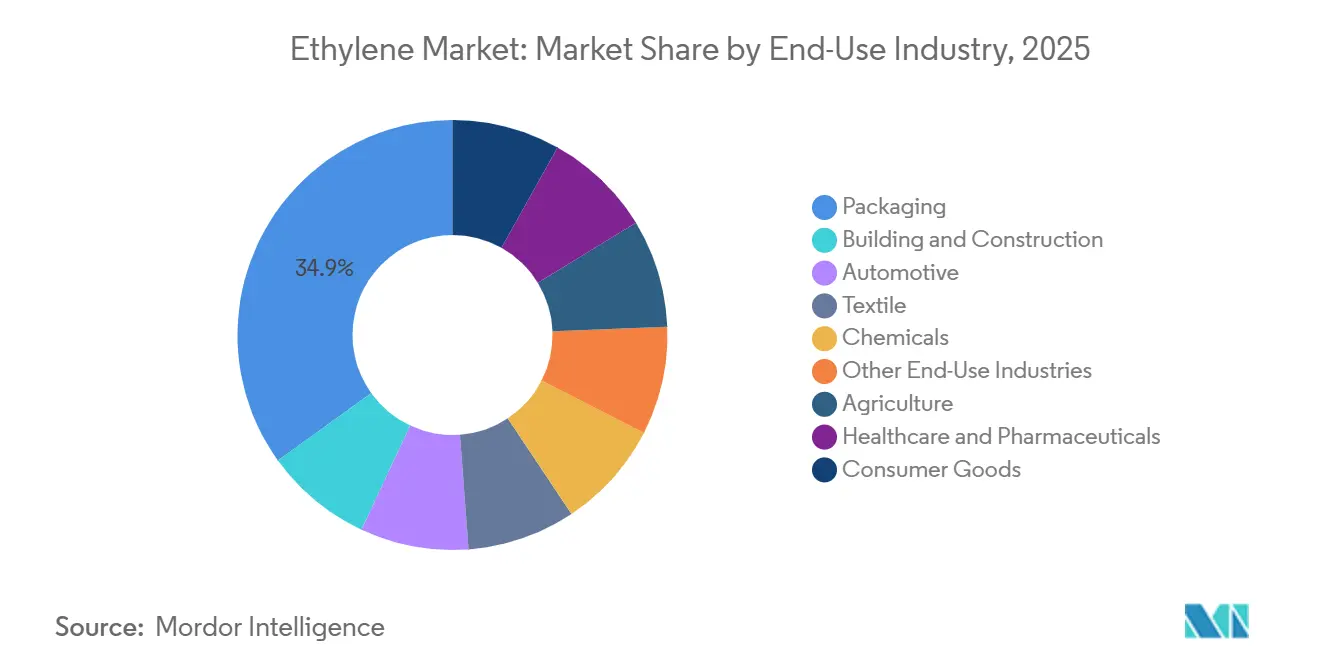
- By end-use industry, packaging held 34.91% of the ethylene market share in 2025 and is forecast to grow at a 6.77% CAGR through 2031.
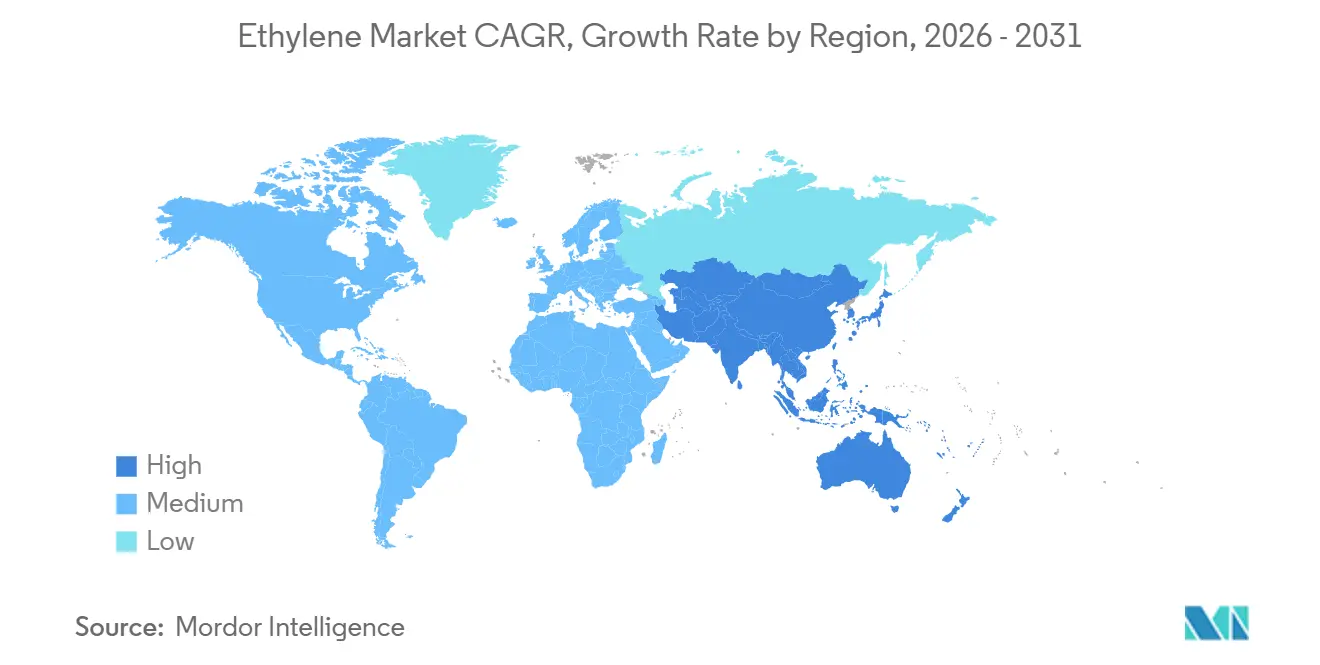
- By geography, Asia-Pacific held 46.72% of the ethylene market share in 2025 and is forecast to grow at a 6.81% CAGR through 2031.
Note: Market size and forecast figures in this report are generated using Mordor Intelligence’s proprietary estimation framework, updated with the latest available data and insights as of January 2026.
Market Trends and Insights
Drivers Impact Analysis of Ethylene Market*
| Driver | (~) % Impact on CAGR Forecast | Geographic Relevance | Impact Timeline |
|---|---|---|---|
| Growing Demand for Polyethylene in Packaging Applications | +2.2% | Global | Short term (≤ 2 years) |
| Rising Focus on Circular Economy and Low-Carbon Ethylene Production | +0.9% | Global, EU core | Medium term (2-4 years) |
| Advancements in Feedstock Flexibility and Digital Optimization of Steam Cracking Operations | +0.8% | Global, US, APAC | Medium term (2-4 years) |
| Increasing Demand for Ethylene Glycol in Electric Vehicle Cooling and Thermal Management Systems | +0.6% | China, EU, US | Medium term (2-4 years) |
| Increasing Investments in Integrated Petrochemical Complexes Across Asia-Pacific and the Middle East | +1.5% | APAC, Middle East | Short term (≤ 2 years) |
| Source: Mordor Intelligence | |||
Growing Demand for Polyethylene in Packaging Applications
Packaging demand continues to support the ethylene market because polyethylene is widely used in flexible films, containers, pallet wrap, and protective materials. E-commerce distribution requires more stretch film and pallet wrap, which raises polyethylene use in logistics. Food safety rules also support demand for materials that limit moisture transfer and protect packaged goods. The EU Packaging and Packaging Waste Regulation supports recyclable designs and can increase the use of mono-material polyethylene packaging. Borealis introduced Borcycle M CWT120CL in March 2025 for flexible non-food packaging, showing continued commercial activity in recycled linear low-density polyethylene. These changes support polyethylene demand while requiring producers to improve recycled-content and recyclability credentials.
Rising Focus on Circular Economy and Low-Carbon Ethylene Production
Low-carbon production is becoming more relevant to the ethylene market as customers assess emissions across their supply chains. China National Petroleum Corporation launched its full-chain green and low-carbon ethylene project in Korla in July 2026[1]“CNPC Launches China’s First Full-Chain Green, Low-Carbon Ethylene Project,” CNPC, prnewswire.com. The project combines photovoltaic electricity, carbon capture from cracker furnace flue gas, and hydrogen recycling. CNPC stated that the project uses 1 billion kWh of photovoltaic electricity each year and can reduce carbon emissions by 1.37 million metric tons annually. The Renewable Electrochemical Advanced Conversion of CO₂ to Target products (REACT) program began in May 2026 to develop an electrolyzer that converts recycled carbon dioxide into ethylene. These projects show that producers are pursuing lower-emission routes alongside conventional cracking rather than treating them as separate businesses.
Advancements in Feedstock Flexibility and Digital Optimization of Steam Cracking Operations
Steam cracking accounts for much of the energy use and direct emissions in ethylene production. A 2025 study in Engineering described a physically consistent machine-learning framework that reduced optimization time from 19.2 hours to 77 seconds. The study identified operating conditions that could reduce annual carbon dioxide emissions by as much as 42.9%. Borouge used AspenTech's Generic Dynamic Optimization Technology (GDOT) platform across more than 3,000 process variables to optimize operating conditions in olefins production. Digital control can help operators respond faster to changes in furnace conditions, steam ratios, and feedstock availability. Crackers that can use naphtha, ethane, propane, and butane can also manage input-price swings more effectively than fixed-feedstock assets.
Increasing Demand for Ethylene Glycol in Electric Vehicle Cooling and Thermal Management Systems
Ethylene glycol supports the ethylene market through its role in battery coolant systems. China issued GB 29743.2-2025 in 2025, setting technical requirements for electric vehicle coolants. The standard includes conductivity limits and material compatibility requirements for electric vehicle coolant products. Water-ethylene glycol mixtures are used because they provide freeze protection across a wide operating range. Demand for these fluids links vehicle electrification with ethylene oxide and monoethylene glycol consumption. This route adds demand beyond traditional polymer use in automobiles. The connection is most relevant in China, Europe, and North America, where electric vehicle cooling specifications are becoming more formalized.
Restraints Impact Analysis of Ethylene Market*
| Restraint | (~) % Impact on CAGR Forecast | Geographic Relevance | Impact Timeline |
|---|---|---|---|
| Volatility in Crude Oil and Natural Gas Liquid (NGL) Feedstock Prices | -0.7% | Global | Short term (≤ 2 years) |
| Stringent Carbon Emission Regulations for Naphtha-Based Ethylene Production | -0.5% | EU, Global | Medium term (2-4 years) |
| Lengthy Regulatory Approval and Permitting Processes for New Ethylene Production Facilities | -0.3% | North America, EU | Long term (≥ 4 years) |
| Source: Mordor Intelligence | |||
Volatility in Crude Oil and Natural Gas Liquid Feedstock Prices
Feedstock volatility can compress cracker margins even when downstream demand remains stable. Naphtha-based plants are particularly exposed when crude oil prices rise faster than polymer prices. Producers that rely on Middle Eastern cargoes also face greater risk when regional shipping routes are disrupted. The resulting margin changes can delay maintenance, reduce operating rates, or postpone new capacity decisions. Multi-feed crackers offer a practical response, but they require capital investment and suitable logistics. The ethylene market, therefore, benefits when operators can diversify supply arrangements and adjust feedstock use without interrupting production.
Stringent Carbon Emission Regulations for Naphtha-Based Ethylene Production
Naphtha-based cracking emits 1.135 kg of carbon dioxide per kg of ethylene, compared with 0.840 kg for ethane-based cracking. The European Commission set the steam-cracking benchmark at 0.638 allowances per metric ton for 2026 through 2030[2]“Commission Implementing Regulation (EU) 2026/1412,” EUR-Lex, eur-lex.europa.eu. Carbon costs increase the operating burden on European naphtha crackers relative to ethane-based plants in the United States. The same study projected that EU Emissions Trading System costs could exceed 10% of naphtha-based variable production costs by 2030. Ethylene and its derivatives remain outside the Carbon Border Adjustment Mechanism scope, leaving European producers exposed to imports from regions without equivalent carbon costs. This pressure favors more efficient crackers, circular feedstocks, and lower-carbon integrated production sites.
*Our forecasts treat driver/restraint impacts as directional, not additive. The impact forecasts reflect baseline growth, mix effects, and variable interactions.
Ethylene Market Segment Analysis
By Feedstock:
Ethane Gains Ground on Cost and Carbon PerformanceNaphtha accounted for 42.57% of the ethylene market share in 2025, reflecting the established naphtha cracker base in Europe and much of Asia. Ethane is the fastest-growing feedstock and is expected to expand at a 6.84% CAGR through 2031. United States Gulf Coast producers benefit from a substantial natural gas liquids supply and established ethane infrastructure. This gives ethane-based crackers a durable feedstock advantage when crude oil prices are elevated. The ethylene market size for ethane-based output is supported by growing import capacity in Asia and Europe. Ethane also has a lower reported production-emissions intensity than naphtha, which adds to its appeal where carbon compliance costs are material.
The cost difference between United States ethane cracking and European naphtha cracking was USD 123 per metric ton and USD 792 per metric ton, respectively. This difference encourages Asian and European buyers to secure longer-term ethane supplies. Naphtha remains necessary where refinery integration and legacy infrastructure favor oil-derived feedstocks. Propane and butane are also important for Middle Eastern producers with access to associated gas. Flexible crackers can choose among these feedstocks when relative prices change. This flexibility improves resilience, but it does not remove exposure to logistics limits and regional supply risks.



By Application:
Polyethylene Retains Scale While Ethylene Oxide ExpandsPolyethylene held 52.68% of the ethylene market share in 2025, making it the largest application. Its uses span high-density polyethylene pipes, low-density polyethylene films, linear low-density polyethylene wrap, and ethylene-vinyl acetate materials. This broad end-use base reduces dependence on a single downstream customer group. Packaging remains the largest source of demand, while construction and consumer goods drive additional demand. The ethylene market size linked to polyethylene benefits from the continuing use of films, containers, pipes, and protective formats. Recycled-content targets are also encouraging investment in circular polyethylene grades.
Ethylene oxide is expected to grow at a 6.71% CAGR through 2031, the fastest rate among the applications provided. Its downstream uses include ethylene glycol for coolants and polyester value chains, as well as inputs for personal care formulations. BASF’s Zhanjiang integrated complex became fully operational in March 2026 and includes a 1 million metric ton-per-year ethylene cracker. The site produces more than 70 products, showing the value of linking basic ethylene production with a broader downstream portfolio. Ethyl benzene and styrene remain exposed to surplus supply in China. Ethylene dichloride and vinyl acetate monomer continue to serve construction, adhesives, and coatings applications.
By End-Use Industry:
Packaging Leads in Scale and GrowthPackaging accounted for 34.91% of the ethylene market share in 2025 and is expected to grow at a 6.77% CAGR through 2031. The same segment leads in present scale and projected growth. E-commerce shipping increases the use of stretch films, protective wraps, and other flexible packaging materials. Food safety requirements support demand for packaging that protects products during storage and transport. The ethylene market size associated with packaging also benefits from demand for recyclable mono-material formats. Regulations on packaging waste are encouraging materials that can move through established recycling systems.
Building and construction remains an important end-use area for high-density polyethylene pipes and linear low-density polyethylene geomembranes. Infrastructure projects in Asia-Pacific and the Middle East support pipe and civil engineering applications. Automotive demand is changing as ethylene glycol becomes more relevant for electric vehicle battery cooling. Textile producers use ethylene glycol in polyethylene terephthalate value chains and are increasing their focus on recycled content. Healthcare, consumer goods, agriculture, and chemicals add diversity to end-use demand. Agricultural films and greenhouse covers support polyethylene consumption in food-production programs, especially in the Asia-Pacific region.
Geography Analysis
APAC Ethylene Market
Asia-Pacific accounted for 46.72% of the ethylene market share in 2025 and is projected to grow at a 6.81% CAGR through 2031. BASF’s Zhanjiang complex entered full operation in March 2026 and added a 1 million metric ton-per-year ethylene cracker. The region combines large demand centers with substantial new supply. India’s packaging and construction activity supports further ethylene consumption. South Korea faces an uneven outlook because older naphtha crackers are under pressure while major new projects enter service.
APAC and North America Ethylene Market
S-OIL’s Shaheen Project reached mechanical completion in July 2026 and is designed to produce 1.8 million metric tons of ethylene per year. The project uses crude-to-chemicals technology and is expected to begin commercial operations in 2027. Singapore is strengthening its logistics role after Aster’s May 2026 investment decision to expand export capacity at Bukom. North America remains cost-competitive because shale production supports ethane supply. Canada is integrated with the United States supply chains, while Mexico is seeking to reactivate ethylene derivative production. Pemex allocated USD 4.2 billion in its 2025 to 2035 plan to revive output at the Cangrejera and Morelos complexes.
Europe, Middle East and South America Ethylene Market
Europe is affected by high naphtha costs, carbon compliance, and utility costs. A weaker cost position constrains the ethylene market size in Europe more than in ethane-based regions. The European Commission’s revised benchmark makes emissions performance more important for local assets. The Middle East has a more favorable feedstock position because Saudi Arabia, the United Arab Emirates, and Qatar can use competitively priced gas. Tasnee completed its Saudi Ethylene and Polyethylene Company expansion in July 2026, adding capacity at Al Jubail. South America has higher feedstock costs, but Braskem approved BRL 4.2 billion, USD 740 million, for a 220,000 metric tons-per-year expansion in Rio de Janeiro.

Competitive Landscape
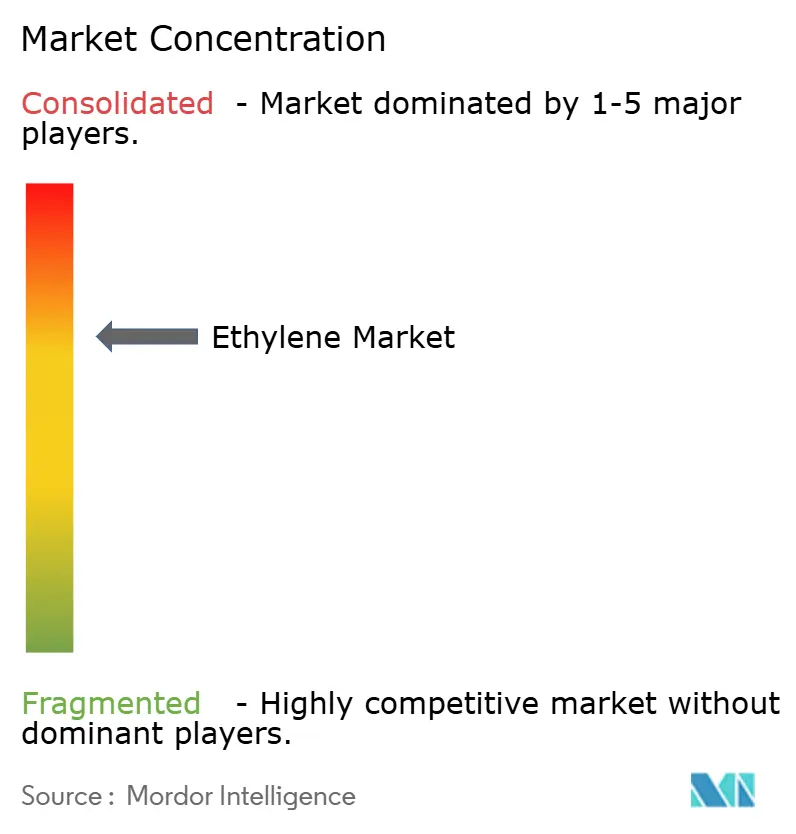
The ethylene market is moderately consolidated among major integrated producers, including SABIC, LyondellBasell, ExxonMobil, Dow, and Chevron Phillips Chemical Company LLC. These companies compete through feedstock access, cracker scale, downstream integration, and regional logistics. United States and Middle Eastern producers are expanding their positions where ethane and gas costs are favorable. European companies are responding through consolidation, portfolio changes, and efficiency measures.
Low-carbon certified ethylene is becoming a strategic area for producers that need to address customer emissions requirements. CNPC’s Korla project is an example of a company combining renewable power, carbon capture, and hydrogen recycling in an ethylene project. The REACT program offers a separate technology route based on carbon dioxide conversion. Borouge’s use of digital optimization illustrates another competitive approach focused on operating performance. S-OIL’s Shaheen facility provides a third example through commercial-scale crude-to-chemicals production. These actions show that competitive advantage is increasingly based on the design and operating model of integrated assets.
European consolidation reflects the pressure on high-cost sites. AEQUITA agreed in January 2026 to acquire SABIC’s European Olefins and Polyolefins portfolio, covering sites in the Netherlands, Germany, Belgium, and the United Kingdom. The acquired business generated USD 3.5 billion in revenue and employed 1,900 people. This transaction follows earlier consolidation in European olefins and polyolefins operations. Producers with efficient furnaces, flexible feedstocks, and established downstream outlets are better placed to manage margins.
Ethylene Industry Leaders
LyondellBasell Industries Holdings B.V.
Exxon Mobil Corporation
SABIC
Dow
Chevron Phillips Chemical Company LLC
- *Disclaimer: Major Players sorted in no particular order
Ethylene Market Companies Covered in this Report
- SABIC
- Borealis AG
- Braskem
- Chevron Phillips Chemical Company LLC
- China Petrochemical Corporation
- Exxon Mobil Corporation
- Formosa Plastics Corporation
- INEOS Group Limited
- LG Chem Ltd.
- Lotte Chemical Corporation
- LyondellBasell Industries Holdings B.V.
- Mitsubishi Chemical Corporation
- NOVA Chemicals Corporation
- PetroChina Company Limited
- PTT Global Chemical Public Company Limited
- Reliance Industries Limited
- Sasol Limited
- Shell plc
- TotalEnergies

Recent Industry Developments in Ethylene Market
- July 2026: China National Petroleum Corporation (CNPC) launched the Tarim 1.2 MTA Phase II Ethylene Project in Korla, Xinjiang, which is China's first full-chain green and low-carbon ethylene project. CNPC also completed construction of the world's second and China's first domestically developed electric-driven system for the three major ethylene compressors, transitioning from thermal to electric power.
- July 2026: National Industrialization Company (Tasnee) completed construction of a USD 500 million capacity expansion at the Saudi Ethylene and Polyethylene Company cracker in Al Jubail Industrial City and commenced pilot production. The project is expected to increase olefins output by 18%, boosting ethylene nameplate capacity to 1 million metric tons per year.


Global Ethylene Market Report Scope
Ethylene is a colorless, flammable gas with a faint, sweet and musky odor. It is the simplest alkene, a hydrocarbon containing a carbon-carbon double bond, with the chemical formula C₂H₄. Ethylene serves as both a fundamental chemical building block in industrial manufacturing and a naturally occurring growth hormone in plants.
The Ethylene Market is segmented by feedstock, application, end-use industry, and geography. By feedstock, the market is segmented into naphtha, ethane, propane, butane, and other feedstocks. By application, the market is segmented into polyethylene, ethylene oxide, ethyl benzene, ethylene dichloride (EDC), vinyl acetate monomer (VAM), and other applications. By end-use industry, the market is segmented into packaging, building & construction, automotive, textile, chemicals, agriculture, healthcare & pharmaceuticals, consumer goods, and other end-use industries. The report also covers the market size and forecasts for ethylene in 16 countries across major regions. For each segment, the market sizing and forecasts have been done on the basis of value (USD).
| Naphtha |
| Ethane |
| Propane |
| Butane |
| Other Feedstocks |
| Polyethylene |
| Ethylene Oxide |
| Ethyl Benzene |
| Ethylene Dichloride (EDC) |
| Vinyl Acetate Monomer (VAM) |
| Other Applications |
| Packaging |
| Building & Construction |
| Automotive |
| Textile |
| Chemicals |
| Agriculture |
| Healthcare & Pharmaceuticals |
| Consumer Goods |
| Other End-Use Industries |
| Asia-Pacific | China |
| India | |
| Japan | |
| South Korea | |
| Rest of Asia-Pacific | |
| North America | United States |
| Canada | |
| Mexico | |
| Europe | Germany |
| United Kingdom | |
| France | |
| Italy | |
| Russia | |
| Rest of Europe | |
| South America | Brazil |
| Argentina | |
| Rest of South America | |
| Middle-East and Africa | Saudi Arabia |
| South Africa | |
| Rest of Middle-East and Africa |
| By Feedstock | Naphtha | |
| Ethane | ||
| Propane | ||
| Butane | ||
| Other Feedstocks | ||
| By Application | Polyethylene | |
| Ethylene Oxide | ||
| Ethyl Benzene | ||
| Ethylene Dichloride (EDC) | ||
| Vinyl Acetate Monomer (VAM) | ||
| Other Applications | ||
| By End-Use Industry | Packaging | |
| Building & Construction | ||
| Automotive | ||
| Textile | ||
| Chemicals | ||
| Agriculture | ||
| Healthcare & Pharmaceuticals | ||
| Consumer Goods | ||
| Other End-Use Industries | ||
| By Geography | Asia-Pacific | China |
| India | ||
| Japan | ||
| South Korea | ||
| Rest of Asia-Pacific | ||
| North America | United States | |
| Canada | ||
| Mexico | ||
| Europe | Germany | |
| United Kingdom | ||
| France | ||
| Italy | ||
| Russia | ||
| Rest of Europe | ||
| South America | Brazil | |
| Argentina | ||
| Rest of South America | ||
| Middle-East and Africa | Saudi Arabia | |
| South Africa | ||
| Rest of Middle-East and Africa | ||


Key Questions Answered in the Report
What is the size of the ethylene market?
The ethylene market stands at USD 198.21 billion in 2026 and is projected to reach USD 264.84 billion by 2031.
What is driving ethylene demand through 2031?
Packaging, ethylene oxide demand, electric vehicle coolant use, and integrated petrochemical investment are key demand factors.
Which feedstock is expected to grow through 2031?
Ethane is projected to grow at a 6.84% CAGR through 2031, supported by its cost and emissions advantages.
Which application led the market demand in 2025?
Polyethylene led the market demand with a 52.68% share in 2025.
Page last updated on:





