
ESG Communications Services Market Size and Share
Market Overview
| Study Period | 2020 - 2031 |
|---|---|
| Market Size (2026) | USD 10.15 Billion |
| Market Size (2031) | USD 19.85 Billion |
| Growth Rate (2026 - 2031) | 14.36 % |
| Fastest Growing Market | Europe |
| Largest Market | North America |
| Market Concentration | Medium |
Major Players *Disclaimer: Major Players sorted in no particular order Image © Mordor Intelligence. Reuse requires attribution under CC BY 4.0. | |
ESG Communications Services Market Analysis by Mordor Intelligence
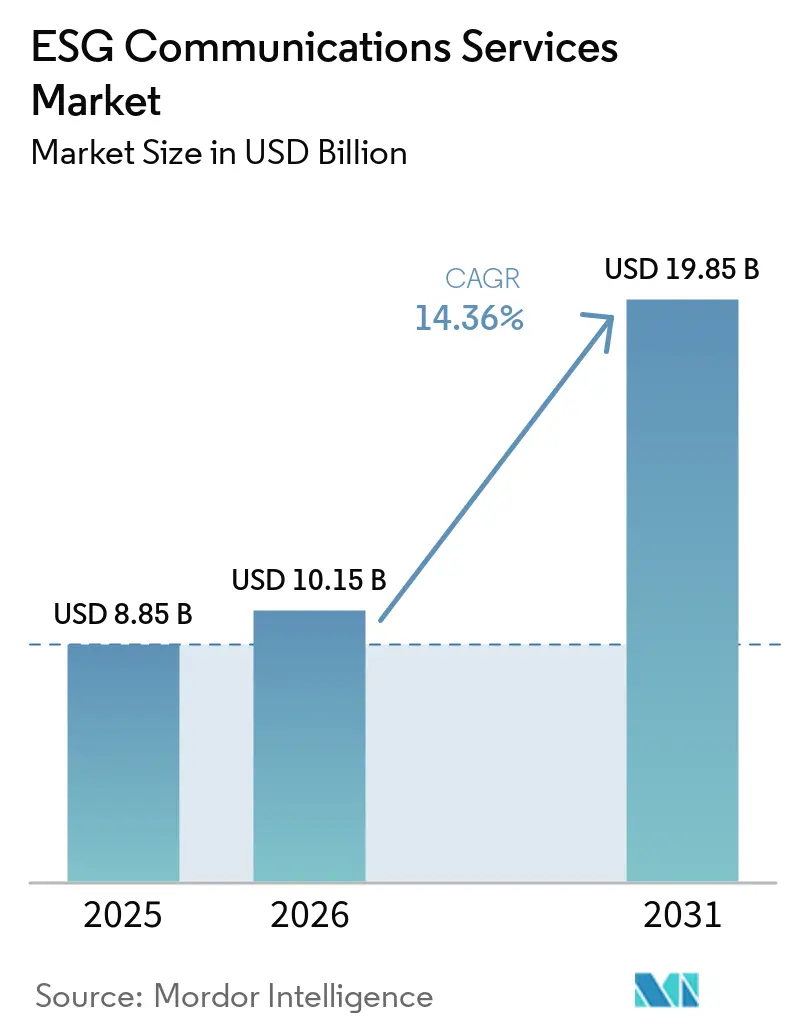
The ESG communications services market size was valued at USD 8.85 billion in 2025 and is estimated to grow from USD 10.15 billion in 2026 to reach USD 19.85 billion by 2031, at a CAGR of 14.36% during the forecast period 2026-2031. The ESG communications services market is moving from voluntary reputation work toward regulated reporting, evidence management, and assurance-ready communication. Mandatory disclosure rules are increasing the need for services that connect sustainability data, governance controls, and clear corporate reporting. Providers are responding by combining reporting platforms, advisory support, and communication capabilities rather than offering isolated services. The February 2026 EU simplification narrowed the reporting population, but it also retained limited assurance obligations for companies that remain in scope. This places more importance on defensible source data, review processes, and reporting narratives that can withstand investor and regulatory scrutiny.
Key Report Takeaways
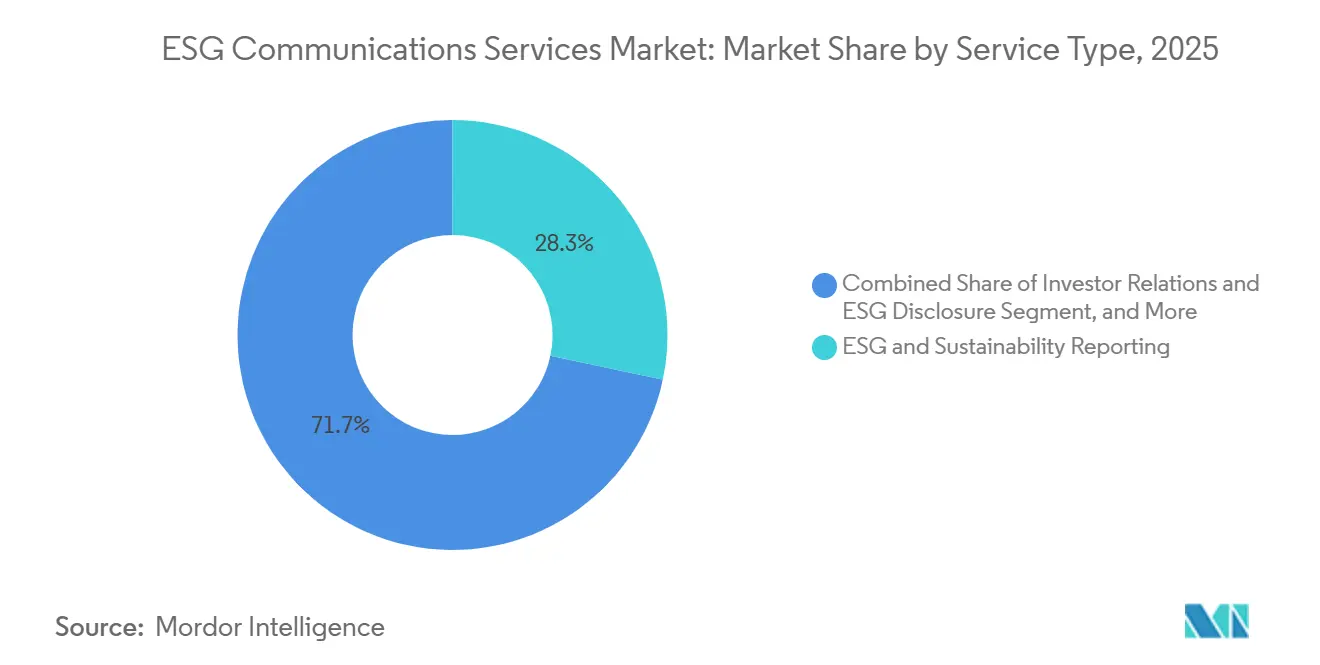
- By service type, ESG and Sustainability Reporting held 28.32% share of the ESG communications services market size in 2025, while Investor Relations and ESG Disclosure is projected to expand at a 14.95% CAGR through 2031.
- By organization size, Large Enterprises accounted for 68.72% revenue share in 2025, while Small and Medium-sized Enterprises are projected to expand at a 15.17% CAGR through 2031.
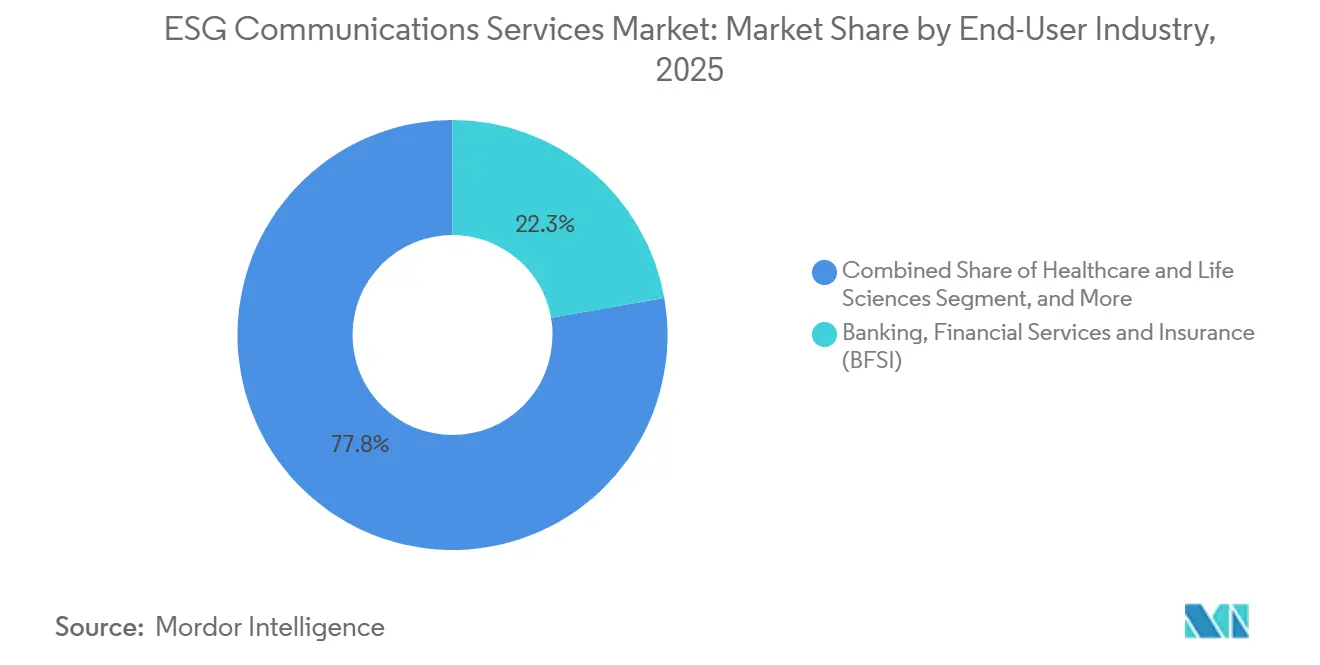
- By end-user industry, BFSI held 22.25% share of the ESG communications services market size in 2025, while Energy and Utilities is projected to expand at a 15.34% CAGR through 2031.
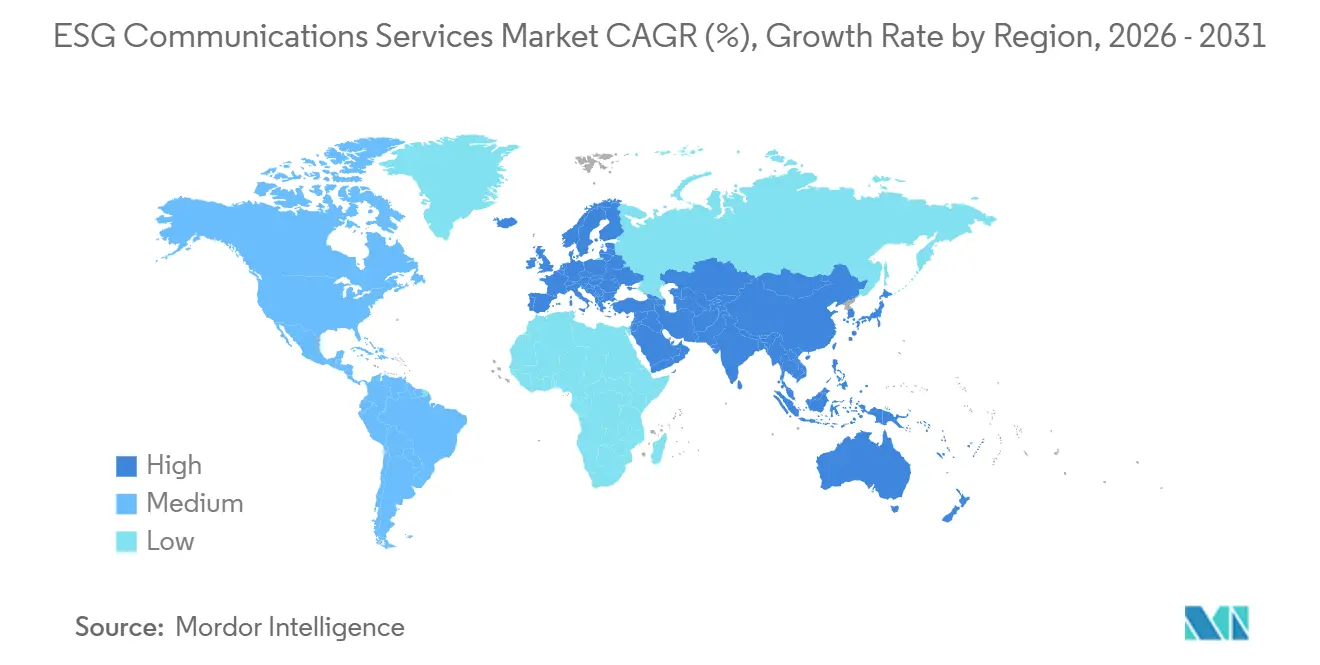
- By geography, North America accounted for 35.37% of revenue in 2025, while Europe is projected to expand at a 15.67% CAGR through 2031 in the ESG communications services market.
Note: Market size and forecast figures in this report are generated using Mordor Intelligence’s proprietary estimation framework, updated with the latest available data and insights as of January 2026.
Market Trends and Insights
Drivers Impact Analysis of ESG Communications Services Market*
| Driver | (~) % Impact on CAGR Forecast | Geographic Relevance | Impact Timeline |
|---|---|---|---|
| Expanding Mandatory Sustainability Disclosure Regimes | +4.5% | Global, with peak impact in the European and Asia-Pacific early adopters | Medium term (2-4 years) |
| Investor Demand for Comparable, Assured ESG Narratives | +3.0% | Global, with leadership in North America and Europe, Middle East and Africa (EMEA) institutional markets | Short term (≤ 2 years) |
| Growth in Third-Party Assurance Requirements | +2.5% | European Union, Australia, California, with spillover to Asia-Pacific and the Middle East and Africa | Medium term (2-4 years) |
| Enterprise Adoption of AI-Enabled Reporting Workflows | +2.0% | Global, concentrated in North America and Europe initially | Short term (≤ 2 years) |
| Consumer Protection Rules Bringing ESG Content Into Marketing Review | +1.2% | European Union core, expanding to European Union-27 by Q3 2026 | Short term (≤ 2 years) |
| California Revenue-Nexus Rules Expanding the Buyer Base | +0.8% | United States, with spillover to multinationals operating across state borders | Medium term (2-4 years) |
| Source: Mordor Intelligence | |||
Expanding Mandatory Sustainability Disclosure Regimes
Mandatory reporting frameworks are making the ESG communications services market a compliance-led service category rather than a discretionary brand activity. The CSRD entered its second reporting wave in 2026 and brought additional large companies into the reporting process. European enforcement attention on greenwashing is also leading companies to route sustainability statements through legal and compliance review before publication.[1]International Federation of Accountants, “The State of Play in Sustainability Assurance,” International Federation of Accountants, ifac.org Japan added another demand source through cabinet office ordinance amendments published on February 20, 2026. These amendments require phased Sustainability Standards Board of Japan disclosures for Tokyo Stock Exchange Prime Market companies from fiscal year 2027. The ESG communications services market therefore favors providers that can build standardized reporting structures that work across more than 1 jurisdiction.
Investor Demand for Comparable, Assured ESG Narratives
Institutional investors increasingly expect the ESG communications services market to support disclosures with evidence and comparability standards similar to financial reporting. This expectation changes the role of investor relations teams because environmental, social, and governance information must be tied to governance oversight and underlying operating data. ISSA 5000 provides an international assurance benchmark for sustainability information for periods beginning on or after December 15, 2026.[2]International Federation of Accountants, “International Standard on Sustainability Assurance 5000,” International Federation of Accountants, ifac.org The standard raises the importance of documented evidence and consistent assurance processes. The ESG communications services market benefits when companies need support to align carbon information, governance explanations, and investor-facing messages. Demand is strongest for services that help companies present a coherent disclosure across major capital markets.
Growth in Third-Party Assurance Requirements
Third-party assurance is becoming a core requirement for clients in the ESG communications services market across major jurisdictions. An International Federation of Accountants benchmarking study found that 73% of large companies in G20 countries obtained sustainability assurance in 2023, compared with 51% 5 years earlier. EU rules require limited assurance for European Sustainability Reporting Standards disclosures, and the Commission must adopt limited assurance standards by July 2027. California SB 253 requires limited assurance on Scope 1 and Scope 2 emissions from 2026 and will phase in reasonable assurance for those scopes from 2030.[3]California Air Resources Board, “California Corporate Greenhouse Gas Reporting and Climate-Related Financial Risk Disclosure,” California Air Resources Board, arb.ca.gov These requirements create work across data validation, evidence trails, report drafting, and assurance preparation. The ESG communications services market is consequently rewarding firms that can translate operational information into auditable public disclosures.
Enterprise Adoption of AI-Enabled Reporting Workflows
AI-enabled reporting tools are reshaping the ESG communications services market by shortening reporting tasks and increasing governance needs. SAP announced its Sustainability Regulatory Readiness Agent in May 2026, with general availability planned by the end of 2026. SAP stated that the tool maps materiality to reporting scope and aligns data to metrics for CSRD reporting. Workiva launched 3 purpose-built AI agents on July 29, 2026, including a Sustainability Disclosure Agent for ESRS and ISSB-aligned drafting, gap assessments, and compliance scorecards. Automation does not remove the need for review because assurance providers must trace each reported claim to reliable source information. The ESG communications services market therefore has room for human verification services alongside reporting automation.
Restraints Impact Analysis of ESG Communications Services Market*
| Restraint | (~) % Impact on CAGR Forecast | Geographic Relevance | Impact Timeline |
|---|---|---|---|
| Fragmented Standards and Cross-Jurisdiction Complexity | -1.5% | Global, most acute for multinationals operating across the EU, United States, Asia-Pacific, and the Middle East and Africa | Long term (≥ 4 years) |
| Weak Source Data and Scope 3 Evidence Gaps | -1.0% | Global, with highest severity in emerging-market supply chains and industrial sectors | Medium term (2-4 years) |
| ESG Backlash Driving Message Retrenchment and Budget Scrutiny | -0.8% | United States predominantly, with spillover to select corporate clients in Canada and Australia | Short term (≤ 2 years) |
| AI-Generated Narrative Hallucination and Evidence Traceability Risk | -0.5% | Global, concentrated among early adopters of generative AI in reporting | Short term (≤ 2 years) |
| Source: Mordor Intelligence | |||
Fragmented Standards and Cross-Jurisdiction Complexity
The ESG communications services market faces added complexity because CSRD, ESRS, ISSB, US, SSBJ, and Australian standards coexist. Each framework can use different materiality concepts, data classifications, and assurance practices. Companies listed in both the EU and the United States must reconcile the EU's double materiality approach with the investor-materiality focus of the ISSB standards. This can require separate narratives that remain consistent under regulatory review. EFRAG proposed simplifying the ESRS in December 2025, including reducing mandatory data points, but the revised standards are not expected to apply until fiscal year 2027. The ESG communications services market can face delayed client decisions while companies wait for greater alignment between reporting frameworks.
Weak Source Data and Scope 3 Evidence Gaps
Weak supply-chain data remains a practical limitation on quality across the ESG communications services market. Scope 3 emissions can account for more than 75% of a company’s total emissions footprint, making supplier information material to many disclosures. Companies cannot confidently publish or assure claims that depend heavily on unverified activity-factor estimates. Peer-reviewed research in npj Climate Action identified legal uncertainty, inconsistent measurement practices, and concerns about sharing sensitive supply chain information as barriers to primary data exchange. These constraints limit the scope of claims that can be supported with reliable evidence. They also make data collection and validation an important part of the ESG communications services market.
*Our forecasts treat driver/restraint impacts as directional, not additive. The impact forecasts reflect baseline growth, mix effects, and variable interactions.
ESG Communications Services Market Segment Analysis
By Service Type:
Reporting Leads While Investor Disclosure Expands FastestESG and Sustainability Reporting held 28.32% of the ESG communications services market share in 2025. Mandatory European reporting and wider ISSB adoption across Asia-Pacific and South America supported demand for this service category. Investor Relations and ESG Disclosure is projected to expand at a 14.95% CAGR from 2026 to 2031. Investors increasingly expect sustainability information to be supported by controls, evidence, and governance explanations. Corporate Reputation and Brand Communication now requires closer verification of sustainability claims before consumer use.
The boundary between reporting and investor relations is becoming less distinct. ISSA 5000 requires assurance providers to obtain evidence from value-chain entities, which connects corporate narrative with supplier and customer information. Employee Engagement and Internal ESG Communication remains the smallest service category but is gaining relevance as companies align external commitments with employee expectations. Technology and financial services companies face this need particularly often because internal stakeholders expect consistent explanations of corporate commitments. The ESG communications services industry increasingly needs providers that can support data collection, drafting, assurance preparation, and investor presentation in one workflow.



By Organization Size:
Large Enterprises Lead While SMEs Gain from Value-Chain DemandLarge Enterprises accounted for 68.72% revenue share in 2025. Their position reflects early adoption under initial reporting requirements and the presence of established compliance functions. Small and Medium-sized Enterprises are projected to expand at a 15.17% CAGR from 2026 to 2031. Large companies subject to sustainability rules increasingly request primary emissions and ESG information from smaller suppliers. Many suppliers do not have internal disclosure teams or mature reporting systems.
California rules add to the buyer base for companies with at least USD 1 billion in annual revenue that do business in the state. Those companies must report Scope 1 and Scope 2 emissions under the state’s climate accountability legislation, with the first deadline in late 2026. SMEs may need lower-complexity packages instead of the customized work used by larger enterprises. These packages can include gap assessments, Scope 3 data collection tools, and investor-ready sustainability summaries. The ESG communications services market size for SMEs is supported by value-chain requests from larger customers.
By End-User Industry:
BFSI Leads While Energy and Utilities Faces the Fastest ExpansionBFSI held 22.25% revenue share in 2025. Financial institutions are reporting entities and institutional investors, so they face disclosure needs on both sides of capital allocation. Energy and Utilities is projected to expand at a 15.34% CAGR from 2026 to 2031. Carbon transition plans and assurance requirements for Scope 1 and Scope 2 emissions are increasing communication needs in this sector. Carbon border adjustment documentation also adds information that needs validation and explanation.
Automotive and Consumer Goods and Retail companies face more product-level reporting expectations. Lifecycle assessment reporting and supply-chain transparency are broadening the definition of a supported sustainability claim. Healthcare and Life Sciences is emerging because clinical supply-chain traceability and biodiversity disclosures require scientific-grade evidence. IT and Telecommunications, Real Estate and Construction, and Public Sector and Education add demand as purchased-goods and services disclosures become more common. Bureau Veritas reported double-digit organic expansion in sustainability-related solutions in its 2025 results, with environmental and carbon services and ESG supply-chain audits contributing to demand.
Geography Analysis
North America ESG Communications Services Market
North America accounted for 35.37% of the ESG communications services market share in 2025. Mature voluntary disclosure practices among S&P 500 and Russell 1000 companies supported regional demand. California approved initial implementation rules for SB 253 and SB 261 in February 2026. The initial Scope 1 and Scope 2 reporting deadline was later deferred to November 10, 2026 for entities with USD 1 billion or more in revenue that do business in California. This approach reaches multinational companies that are not domiciled in California.
Europe and South America ESG Communications Services Market
Europe is projected to expand at a 15.67% CAGR from 2026 to 2031. CSRD obligations and continued use of ESRS sustainability statements support this regional position. The EU adopted Directive 2026/470 in February 2026, which narrowed CSRD scope to companies with more than 1,000 employees and more than EUR 450 million (USD 519.5 million) in net annual turnover while retaining limited assurance obligations. Germany requires sustainability advertising claims to be evidence-based and verifiable from September 27, 2026. South America is emerging as Brazil and Chile introduce reporting requirements for larger listed companies.
APAC and MEA ESG Communications Services Market
Asia-Pacific is becoming another demand center for ESG communications services. Japan’s phased SSBJ requirement begins in fiscal year 2027 for Tokyo Stock Exchange Prime Market listed companies. Australia began its Australian Sustainability Reporting Standards rollout in January 2025, while South Korea revised its roadmap. China is advancing green corporate reporting guidance, while the Middle East and Africa is creating local reporting demand through UAE and Saudi initiatives.

Competitive Landscape
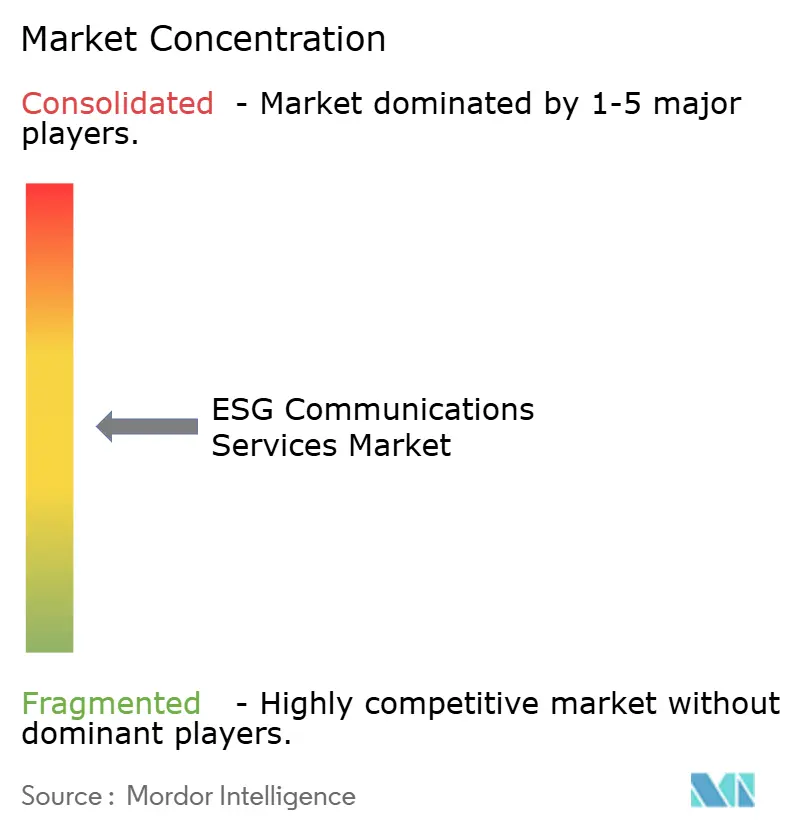
The ESG communications services market is moderately fragmented. Global professional services firms, including Accenture, Deloitte, PwC, EY, and KPMG, have advantages because they combine assurance, advisory, and technology integration. Technology providers such as Workiva, SAP SE, and Diligent Corporation compete for multiyear platform contracts through integrated reporting workflows. Their platforms seek to make reporting processes repeatable and increase the cost of switching providers. Workiva launched 3 AI agents in July 2026, including the Sustainability Disclosure Agent, to support high-stakes reporting workflows.
EcoVadis and Workiva announced a May 2026 integration between the EcoVadis Carbon Data Network and Workiva’s carbon data management solution. The partnership aims to help customers replace industry-average Scope 3 estimates with primary supplier emissions data. Bureau Veritas expanded its Climate Bonds Approved Verifier status to offices in China, Japan, India, and France in March 2026. It also acquired Italian sustainability specialist SPIN360 in January 2026 to add lifecycle assessment, carbon footprint, and ESG reporting capabilities. These moves show that specialist assurance providers are extending into adjacent advisory and data services.
Position Green, Novisto, and Cority serve mid-market clients with dedicated disclosure platforms. Limited assurance requirements and ISSA 5000 may encourage consolidation because clients increasingly need reporting, evidence controls, and communication support. Potential openings remain for AI-native tools that map multiple frameworks and support multilingual content in Germany, Japan, and Brazil. The ESG communications services market will favor providers that combine governed data, assurance readiness, and usable reporting workflows.
ESG Communications Services Industry Leaders
Deloitte Touche Tohmatsu Limited
PricewaterhouseCoopers International Limited
Ernst & Young Global Limited
KPMG International Limited
Accenture plc
- *Disclaimer: Major Players sorted in no particular order
ESG Communications Services Market Companies Covered in this Report
- Accenture plc
- Deloitte Touche Tohmatsu Limited
- PricewaterhouseCoopers International Limited
- Ernst & Young Global Limited
- KPMG International Limited
- Workiva Inc.
- SAP SE
- IBM Corporation
- Salesforce, Inc.
- S&P Global Inc.
- MSCI Inc.
- Morningstar, Inc. (Sustainalytics)
- EcoVadis SAS
- Cority Software Inc.
- Diligent Corporation
- Position Green AS
- Wolters Kluwer N.V.
- Novisto Inc.
- The ERM International Group Limited
- Bureau Veritas SA

Recent Industry Developments in ESG Communications Services Market
- July 2026: Workiva Inc. launched 3 purpose-built AI agents, Tie-Out, Benchmarking, and Sustainability Disclosure, alongside Workiva Knowledge, a persistent intelligence layer grounded in organizational data and past filings. The Sustainability Disclosure Agent drafts, checks, and improves ESRS and ISSB-aligned disclosures with gap assessments and compliance scorecards, representing a step-change in the platform's ESG communications capability. Workiva's platform is used by over 6,700 organizations, including over 85% of Fortune 1,000 companies, and the company has guided for USD 1 billion in fiscal 2026 revenue.
- May 2026: SAP SE announced new Sustainability AI Agents at SAP Sapphire, including the Sustainability Regulatory Readiness Agent, planned for general availability by end of 2026, which automates materiality-to-disclosure-scope mapping for CSRD and reduces scenario simulation time from 1 day to 20 minutes. The agents are embedded within SAP Sustainability Control Tower and designed to convert sustainability data into governed, audit-ready disclosures directly from SAP ERP systems.
- May 2026: EcoVadis and Workiva announced a strategic partnership to integrate EcoVadis's Carbon Data Network directly into Workiva's carbon data management solution, enabling mutual customers to replace industry-average Scope 3 estimates with primary supplier emissions data in a single audit-grade reporting environment. The partnership directly addresses the Scope 3 data-quality gap, 1 of the most cited constraints on ESG communications credibility.
- March 2026: Bureau Veritas expanded its Climate Bonds Approved Verifier status to offices in China, Japan, India, and France, strengthening its independent assurance footprint across the fastest-growing ESG disclosure markets in Asia-Pacific and Western Europe.


Global ESG Communications Services Market Report Scope
The Global ESG Communications Services Market encompasses professional consulting, strategy, reporting, stakeholder engagement, public relations, content development, digital communications, and disclosure support services that help organizations communicate their environmental, social, and governance (ESG) commitments, performance, risks, and sustainability initiatives to investors, regulators, customers, employees, communities, and other stakeholders.
The Global ESG Communications Services MArket Report is Segmented by Service Type (ESG and Sustainability Reporting, Investor Relations and ESG Disclosure, Corporate Reputation and Brand Communication, and Employee Engagement and Internal ESG Communication), Organization Size (Large Enterprises and Small and Medium-sized Enterprises), End-user Industry (Banking, Financial Services and Insurance (BFSI), Automotive, Energy and Utilities, Consumer Goods and Retail, Healthcare and Life Sciences, IT and Telecommunications, Real Estate and Construction, Public Sector and Education, and Other End-user Industries), and Geography (North America, South America, Europe, Asia-Pacific, and Middle East and Africa). The Market Forecasts are Provided in Terms of Value (USD).
| ESG and Sustainability Reporting |
| Investor Relations and ESG Disclosure |
| Corporate Reputation and Brand Communication |
| Employee Engagement and Internal ESG Communication |
| Large Enterprises |
| Small and Medium-sized Enterprises |
| Banking, Financial Services and Insurance (BFSI) |
| Automotive |
| Energy and Utilities |
| Consumer Goods and Retail |
| Healthcare and Life Sciences |
| IT and Telecommunications |
| Real Estate and Construction |
| Public Sector and Education |
| Other End-user Industries |
| North America | United States |
| Canada | |
| Mexico | |
| South America | Brazil |
| Argentina | |
| Chile | |
| Rest of South America | |
| Europe | Germany |
| United Kingdom | |
| France | |
| Italy | |
| Spain | |
| Rest of Europe | |
| Asia-Pacific | China |
| Japan | |
| India | |
| South Korea | |
| Australia | |
| Rest of Asia-Pacific | |
| Middle East and Africa | United Arab Emirates |
| Saudi Arabia | |
| South Africa | |
| Rest of Middle East and Africa |
| By Service Type | ESG and Sustainability Reporting | |
| Investor Relations and ESG Disclosure | ||
| Corporate Reputation and Brand Communication | ||
| Employee Engagement and Internal ESG Communication | ||
| By Organization Size | Large Enterprises | |
| Small and Medium-sized Enterprises | ||
| By End-user Industry | Banking, Financial Services and Insurance (BFSI) | |
| Automotive | ||
| Energy and Utilities | ||
| Consumer Goods and Retail | ||
| Healthcare and Life Sciences | ||
| IT and Telecommunications | ||
| Real Estate and Construction | ||
| Public Sector and Education | ||
| Other End-user Industries | ||
| By Geography | North America | United States |
| Canada | ||
| Mexico | ||
| South America | Brazil | |
| Argentina | ||
| Chile | ||
| Rest of South America | ||
| Europe | Germany | |
| United Kingdom | ||
| France | ||
| Italy | ||
| Spain | ||
| Rest of Europe | ||
| Asia-Pacific | China | |
| Japan | ||
| India | ||
| South Korea | ||
| Australia | ||
| Rest of Asia-Pacific | ||
| Middle East and Africa | United Arab Emirates | |
| Saudi Arabia | ||
| South Africa | ||
| Rest of Middle East and Africa | ||


Key Questions Answered in the Report
What is the ESG communications services market size?
The ESG communications services market size is USD 10.15 billion in 2026 and is forecast to reach USD 19.85 billion by 2031, growing at a 14.36% CAGR.
What services are included in the ESG communications services market?
The service scope includes ESG and Sustainability Reporting, Investor Relations and ESG Disclosure, Corporate Reputation and Brand Communication, and Employee Engagement and Internal ESG Communication.
Which service type leads ESG communications services?
ESG and Sustainability Reporting led the market with a 28.32% share in 2025, while Investor Relations and ESG Disclosure is expected to record the fastest growth at a 14.95% CAGR through 2031.
Which organizations are creating demand in the ESG communications services market?
Large Enterprises held a 68.72% share in 2025, while Small and Medium-sized Enterprises (SMEs) are projected to grow at a 15.17% CAGR as suppliers respond to value-chain data requests.
Which region is expanding fastest in the ESG communications services market?
Europe is projected to be the fastest-growing region with a 15.67% CAGR through 2031, supported by CSRD obligations and ongoing ESRS reporting requirements.
Why is assurance important in sustainability communications?
Assurance supports reliable disclosures by linking published claims to source data, documented controls, and verifiable evidence that can be reviewed by investors and regulators.
Page last updated on:


 Your data is secure and never sold or shared.


