
Environmental Protection Technical Textiles Market Size and Share
Market Overview
| Study Period | 2021 - 2032 |
|---|---|
| Market Size (2027) | USD 4.52 Billion |
| Market Size (2032) | USD 6.19 Billion |
| Growth Rate (2027 - 2032) | 6.49 % |
| Fastest Growing Market | Middle East and Africa |
| Largest Market | Asia-Pacific |
| Market Concentration | Medium |
Major Players *Disclaimer: Major Players sorted in no particular order Image © Mordor Intelligence. Reuse requires attribution under CC BY 4.0. | |
Environmental Protection Technical Textiles Market Analysis by Mordor Intelligence
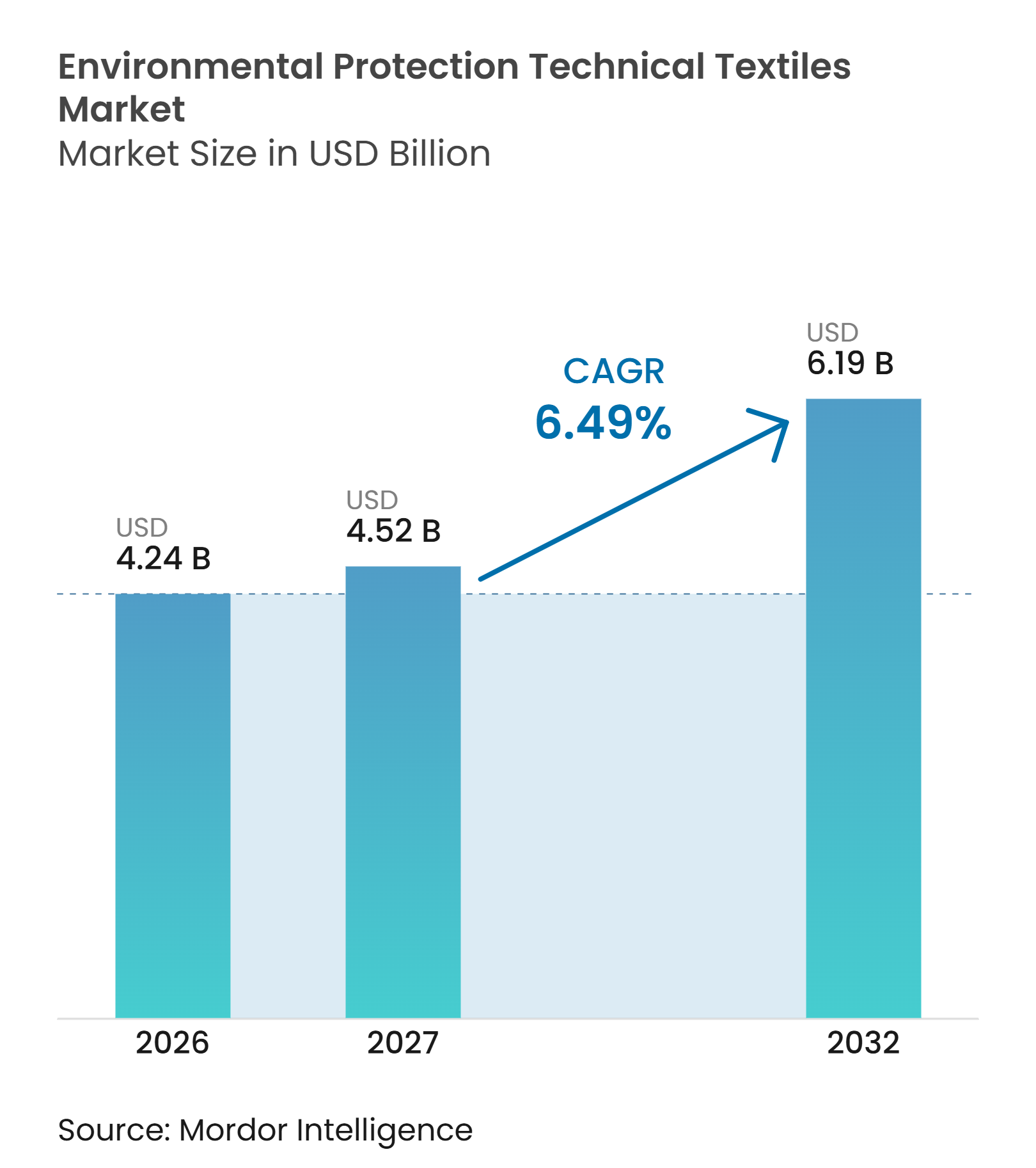
The Environmental Protection Technical Textiles Market size was valued at USD 4.24 billion in 2026 and is estimated to grow from USD 4.52 billion in 2027 to reach USD 6.19 billion by 2032, at a CAGR of 6.49% during the forecast period (2027-2032).
Regulatory requirements for industrial emissions, wastewater treatment, and spill preparedness are widening the demand base for the environmental protection technical textiles market. Procurement is no longer dependent mainly on power-sector filter replacements because municipal utilities, chemical plants, metal producers, and stormwater projects are also buying filtration and containment products. This broader customer base can reduce exposure to a downturn in any single end-use area of the environmental protection technical textiles market. Suppliers are responding through specialty materials, portfolio acquisitions, and products that meet tighter operating conditions. Input-cost swings, non-textile alternatives, energy use, and infrastructure financing constraints still affect purchasing decisions in the environmental protection technical textiles market.
Key Report Takeaways
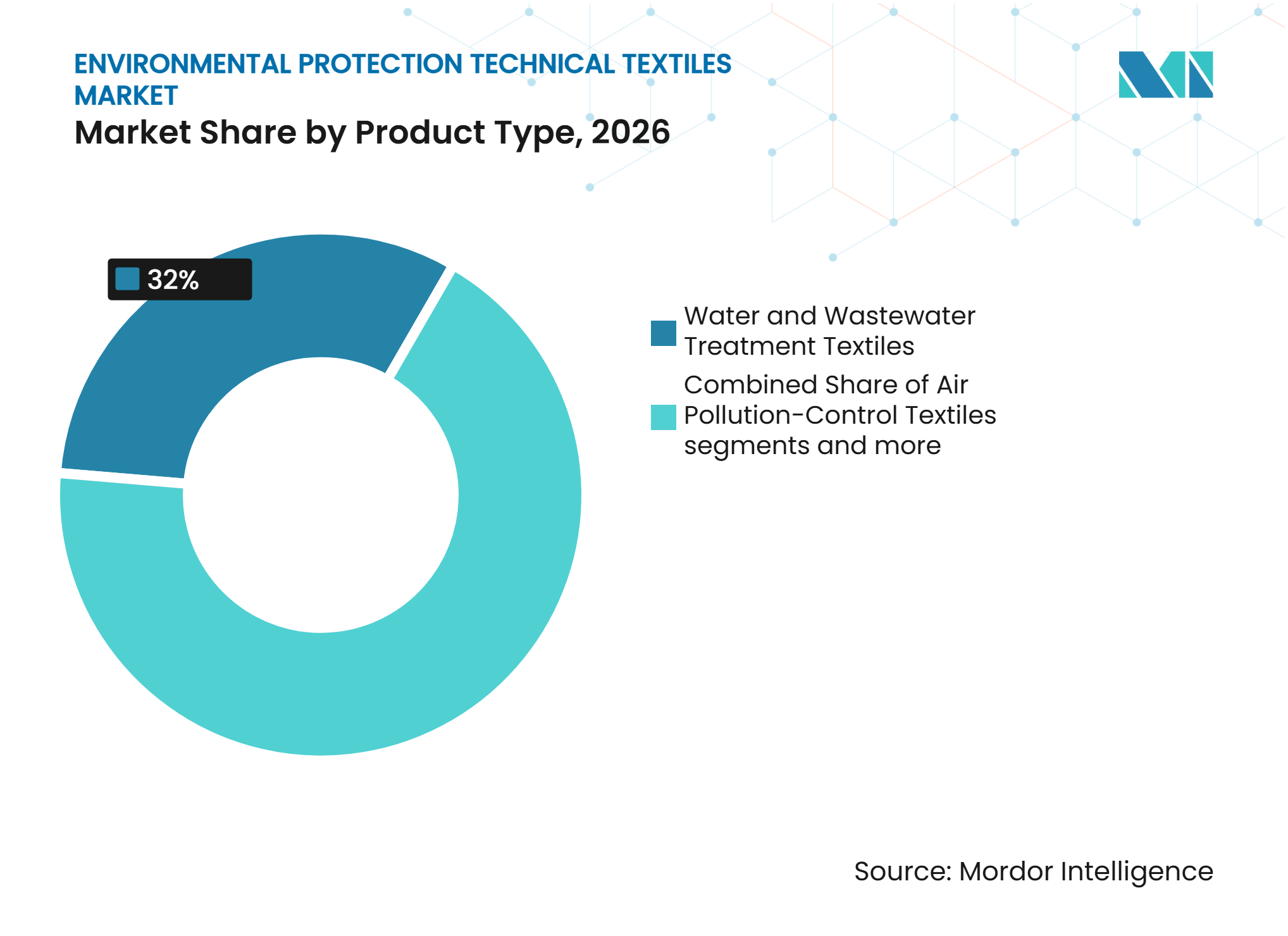
- By product type, water and wastewater treatment textiles held 32% of the environmental protection technical textiles market share in 2026 and are projected to record the highest CAGR at 7.6% through 2032.
- By material type, polypropylene held 27% of environmental protection technical textiles market size in 2026, while high-performance synthetic fibers are projected to record the highest CAGR at 8.2% through 2032.
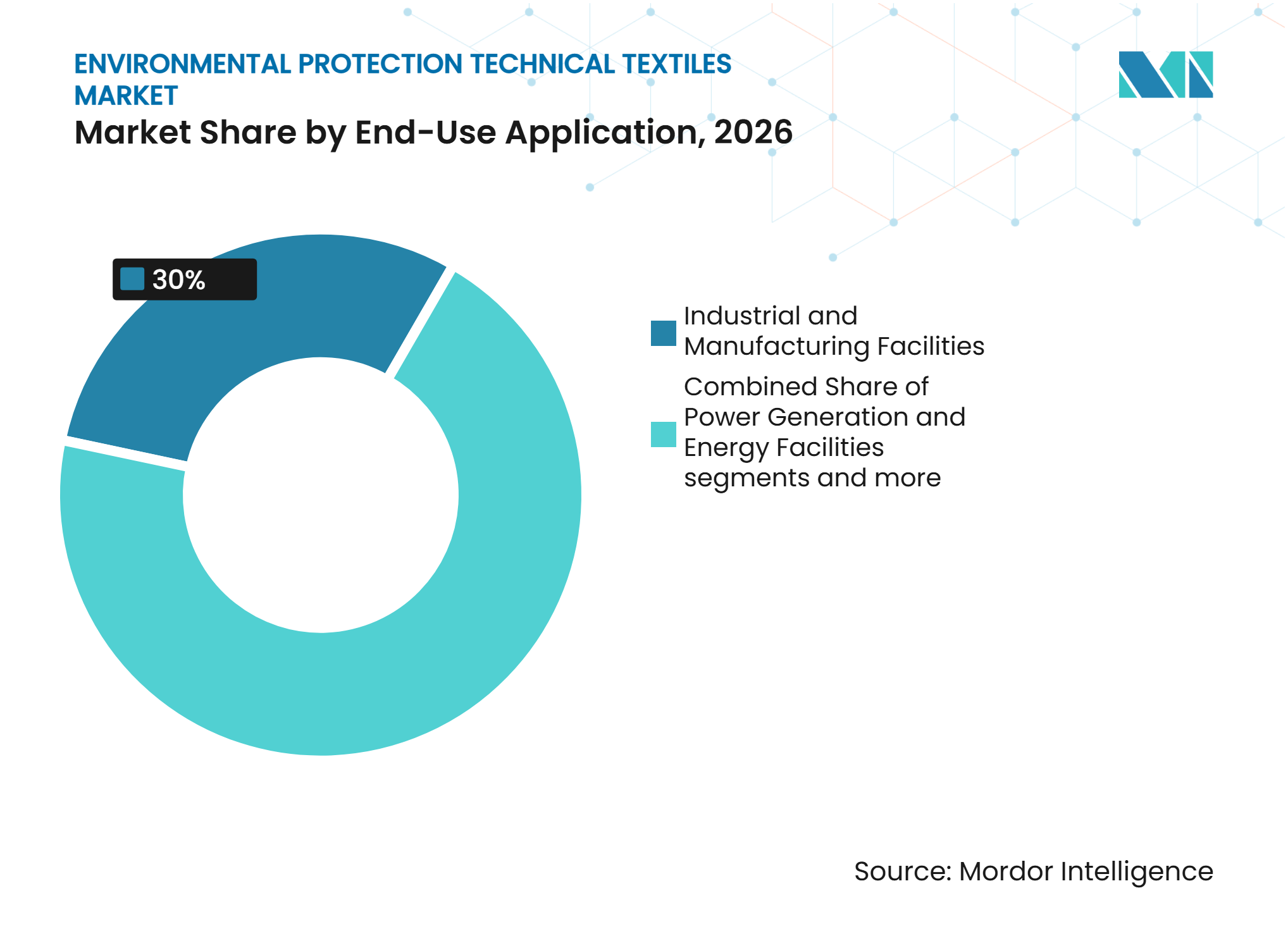
- By end-use application, industrial and manufacturing facilities held 30% of revenue in 2026, while municipal water and wastewater utilities are projected to record the highest CAGR at 7.8% through 2032.
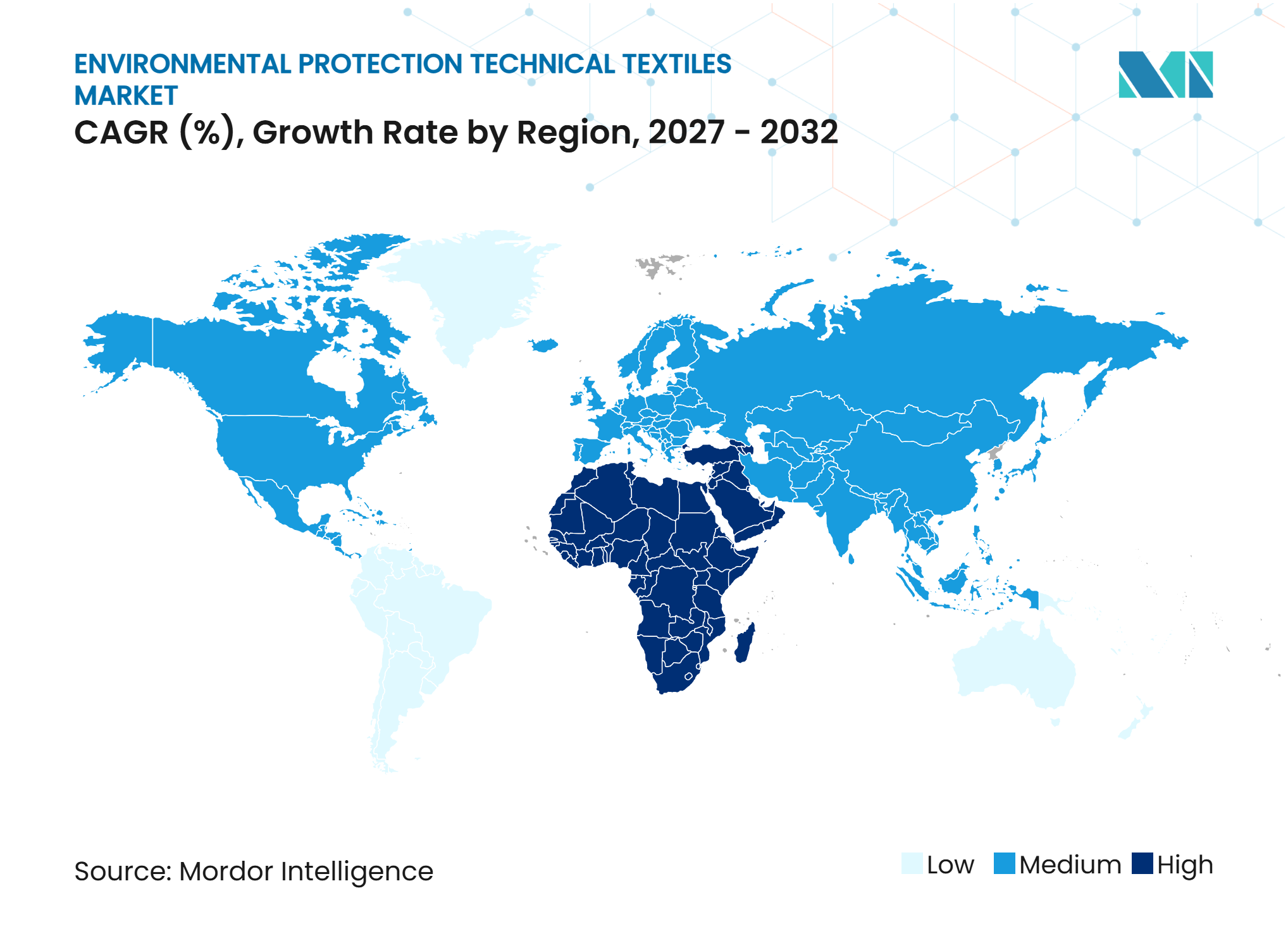
- By geography, Asia-Pacific held 33% of revenue in 2026, while the Middle East and Africa recorded the highest projected CAGR at 9.9% through 2032.
Note: Market numbers in this report are based on Mordor Intelligence's proprietary estimation framework, which combines nine months of actuals with Q4 projections for base year 2026.
Market Trends and Insights
Drivers Impact Analysis of Environmental Protection Technical Textiles Market*
| Driver | (~) % Impact on CAGR Forecast | Geographic Relevance | Impact Timeline |
|---|---|---|---|
| Industrial Air Emission Standards and Particulate Pollution Control | +1.8% | Global, with stronger intensity in China, the EU, and North America | Medium term (2-4 years) |
| Municipal and Industrial Wastewater Treatment Infrastructure Expansion | +1.5% | Global, with stronger investment in Asia-Pacific and North America | Medium term (2-4 years) |
| Water Scarcity and Wastewater Reuse Requirements | +1.1% | Global, with acute pressure in MENA, Southern Europe, and South Asia | Long term (≥ 4 years) |
| Oil Spill Prevention and Environmental Response Preparedness | +0.7% | Global, with emphasis on coastal North America, the Middle East, and sub-Saharan Africa | Short term (≤ 2 years) |
| Urban Stormwater Pollution and Runoff Treatment Requirements | +0.6% | North America, Western Europe, and urbanizing Asia-Pacific cities | Medium term (2-4 years) |
| Waste Incineration and Energy-from-Waste Emission Control | +0.5% | EU, East Asia, and parts of the Middle East, Africa, and South America | Long term (≥ 4 years) |
| Source: Mordor Intelligence | |||
Industrial Air Emission Standards and Particulate Pollution Control
Industrial air standards make fabric filtration a compliance requirement for many facilities in the environmental protection technical textiles market. United States rules for relevant new sources require fabric filters to reach at least 99.5% particulate control efficiency or an outlet concentration of 0.023 g/dscm, while existing sources face a 99% standard or 0.034 g/dscm.[1] The revised EU Industrial Emissions Directive requires large industrial installations to apply Best Available Techniques, which identify bag filters as a reference technology for dust control, and Member States were required to transpose the directive by July 1, 2026.[2] China has also applied ultra-low-emission upgrade schedules to steel, cement, and chemical processing, shifting orders from polyester toward PPS, P84, and membrane-laminated media. These overlapping compliance schedules support demand across major filtration regions in the environmental protection technical textiles market at the same time. The shift toward higher-grade filter media creates an opening for producers that can validate performance in hot and chemically demanding flue-gas conditions.
Municipal and Industrial Wastewater Treatment Infrastructure Expansion
Municipal and industrial treatment projects are expanding the demand for environmental protection technical textiles in dewatering, polishing, and sludge management. The Alabama Department of Environmental Management allocated USD 14.3 million to expand and upgrade the Ardmore wastewater treatment plant in November 2025. The City of Tampa committed nearly USD 280 million to overhaul its Howard F. Curren Advanced Wastewater Plant, which serves more than 630,000 residents. In December 2025, Peru awarded a USD 150 million, 24-year concession for the Puerto Maldonado wastewater treatment plant, including 192 kilometers of sewer rehabilitation and new dewatering infrastructure. Globally, 155 billion m³ of the 268 billion m³ of household wastewater generated in 2022 was safely treated, leaving a significant treatment gap.[3]
Water Scarcity and Wastewater Reuse Requirements
Water scarcity and reuse rules require more consistent filtration before treated water moves to later purification stages. UN-Water states that targeted investment and enabling regulations could increase potable and industrial water reuse eightfold by 2040 to 430 million m³ per day. This transition requires multi-stage filtration to remove suspended solids and biological matter before membrane treatment. The EU Urban Wastewater Treatment Directive, the Water Reuse Regulation, and Spain’s Royal Decree 1085/2024 set requirements for reclaimed water uses. These standards support demand for higher-performance textile media because reuse applications require finer and more reliable filtration than basic discharge compliance.
Oil Spill Prevention and Environmental Response Preparedness
Oil spill preparedness requirements support the environmental protection technical textiles market through regular purchases of sorbent textiles and containment products. The United States Coast Guard issued its revised Marine Environmental Response and Preparedness policy in April 2025, with planning, preparedness, response, and investigation as its operating pillars. United States regulations require oil removal methods that use sorbents able to expedite removal while limiting secondary pollution. South Africa’s Marine Oil Pollution Preparedness, Response and Cooperation Act 8 of 2025 requires site-specific pollution contingency plans for marine facilities and installations. Inventory maintenance and response exercises can make environmental protection technical textiles market purchasing steadier than event-driven procurement. This favors suppliers that can provide documented product performance, dependable replenishment, and support for coastal operators.
Restraints Impact Analysis of Environmental Protection Technical Textiles Market*
| Restraint | (~) % Impact on CAGR Forecast | Geographic Relevance | Impact Timeline |
|---|---|---|---|
| Volatility in Polypropylene, Polyester, and Specialty Polymer Prices | -1.2% | Global, with greater exposure in Europe and North America | Short term (≤ 2 years) |
| High Costs of Advanced Filtration and Functional Textile Materials | -0.9% | Global, with greater limits in price-sensitive Asia-Pacific and Middle East and Africa markets | Medium term (2-4 years) |
| Competition from Ceramic, Metallic, and Non-Textile Filtration Technologies | -0.7% | High-temperature industrial applications globally | Long term (≥ 4 years) |
| Filtration Efficiency versus Pressure Drop and Energy Consumption | -0.5% | Global, with greater impact on cost-sensitive power and municipal users | Medium term (2-4 years) |
| Source: Mordor Intelligence | |||
Volatility in Polypropylene, Polyester, and Specialty Polymer Prices
Polypropylene and polyester costs affect margins and tender pricing because they are primary inputs across the environmental protection technical textiles market. The International Energy Agency identifies recurring petrochemical price cycles as a supply-chain risk for downstream producers that depend on commodity polymer inputs. China’s technical textile sector reported an 11.8% decline in total profits during January through October 2025, partly reflecting feedstock cost pressure for manufacturers operating under long-term procurement contracts. Premium products such as PTFE laminates, PPS felts, fluoropolymer-coated media, and nanofiber composites can cost 3 to 5 times more than standard polyester or polypropylene alternatives. This difference can favor lower-cost products in markets where environmental rules do not demand advanced performance. Financing gaps for fit-for-purpose water treatment systems also delay uptake of specialty media in lower-income countries.
High Costs of Advanced Filtration and Functional Textile Materials
PTFE membrane laminates, PPS needlepunched felts, fluoropolymer-coated media, and nanofiber composites can deliver stronger emission performance and longer service life than standard products. Their cost can be 3 to 5 times higher than polyester or polypropylene alternatives. This difference can lead buyers to select lower-cost media when existing compliance requirements do not require advanced materials. Financing gaps for fit-for-purpose water treatment systems also delay specialty-media adoption in lower-income countries. Public agencies in developing economies often specify minimum-performance sorbents for spill response, which can limit demand for higher-selectivity materials.
*Our forecasts treat driver/restraint impacts as directional, not additive. The impact forecasts reflect baseline growth, mix effects, and variable interactions.
Environmental Protection Technical Textiles Market Segment Analysis
By Product Type:
Water Treatment Anchors the Largest SegmentWater and wastewater treatment textiles accounted for 32% of the environmental protection technical textiles market share in 2026 and are forecast to expand at a CAGR of 7.6% through 2032. Filter cloths for sludge presses, membrane-laminated media for effluent polishing, and woven monofilament fabrics for gravity belt thickening address different stages of plant operation. Their demand is tied to municipal treatment expansion, industrial effluent compliance, and the need to replace consumable filtration components. The global gap between household wastewater generated and safely treated indicates a long project pipeline for treatment infrastructure. Each plant can generate textile purchases at installation, commissioning, and later replacement intervals.
Air pollution-control textiles remain the second-largest product category, centered on baghouse filter bags used in power generation, cement, steel, and waste incineration. Particulate-control filter textiles form the core of the category, while catalytic and multifunctional products are used where dust and nitrogen oxide removal are needed from one filter stage. Germany, Japan, and South Korea have applications for this more specialized equipment. Oil and chemical spill-control textiles include absorbent pads, booms, and shaped products that support marine and industrial preparedness programs. Stormwater and surface runoff pollution-control textiles include drain-inlet bags, filter mats, and catch-basin inserts. Other specialized environmental protection textiles include soil-remediation geotextiles and contaminant-sorption products. Together, these applications broaden demand across the environmental protection technical textiles market.



By Material Type:
Specialty Fibers Outpace Commodity MaterialsHigh-performance synthetic fibers are projected to grow at a CAGR of 8.2% through 2032, making them the fastest-growing material segment in the environmental protection technical textiles market. PPS, aramid, and polyimide variants are used where ordinary polymers cannot withstand thermal stress or chemical exposure. PPS can maintain integrity at continuous temperatures of up to 200°C and in acidic flue-gas environments. This makes the material relevant to cement, steel, chemical processing, and waste-incineration baghouses. China’s ultra-low-emission requirements have encouraged substitution toward PPS, P84, and membrane-laminated media in sectors previously served by polyester filter bags. Yanpai received a 2025 utility model patent for a PPS laminated filter bag device that combines carbon-capture separation and PTFE filtration membrane functions.
Polypropylene held 27% of revenue in 2026 and remained the largest material group for liquid filtration, oil sorbents, and stormwater products. Its cost and chemical resistance suit applications with moderate service temperatures. Polyester is widely used in air-filtration bags for food processing, pharmaceutical production, and light manufacturing. Fluoropolymer textile media, including PTFE membranes, are used in ultra-low-emission surface filtration that requires very low dust concentrations. Glass and other inorganic fibers serve power-generation and waste-to-energy conditions that exceed the operating range of PPS. Polyamide remains relevant to precision liquid filtration, while natural and regenerated cellulosic fibers are attracting attention as spill-sorbent alternatives. Product scaling and performance standardization remain barriers to wider use of those bio-based materials in the environmental protection technical textiles market.
By End-Use Application:
Industrial Demand Leads, Municipal Growth AcceleratesIndustrial and manufacturing facilities represented 30% of revenue in 2026, making them the largest end-use application. Chemicals, petrochemicals, metals and mining, cement, and building-material producers operate continuous filtration systems with established maintenance schedules. Permit conditions can require planned replacement of filter components and support high-volume purchasing. The regulatory influence of EU Directive 2024/1785 and China’s ultra-low-emission policies raises minimum performance requirements in many industrial applications. These requirements can support longer supplier relationships in the environmental protection technical textiles market because buyers must qualify media against technical and compliance criteria. Cement upgrades in China and India are supporting demand for PPS and aramid filter bags as air-quality requirements tighten.
Municipal water and wastewater utilities are projected to grow at a CAGR of 7.8% through 2032, the highest rate among end-use applications. Their environmental protection technical textiles market size expands with treatment-plant construction, sludge management upgrades, and periodic replacements. The difference between wastewater generation and safely treated volumes points to lasting municipal infrastructure needs. Power generation and energy facilities also require filtration products for older coal-plant upgrades in Asia and biomass combustion in Europe. Municipal solid waste and recycling facilities use high-performance bags across waste-to-energy flue-gas treatment. Oil and gas, marine, urban drainage, remediation, and emergency-response services add specialized demand and limit reliance on any one end-use sector.

Geography Analysis
Asia-Pacific: The Largest Regional Market
Asia-Pacific held 33% of revenue in 2026. China is a major source of demand because its emission upgrades cover steel, cement, chemicals, and other non-electric sectors. The China Association of Industrial Textiles reported filtration and separation textile output above CNY 22 billion (USD 3.14 billion) in 2025, with growth exceeding 5.5%. China processed 22.79 million tons of technical textile fiber in 2025, while nonwovens output reached 9.21 million tons. Demand has shifted toward steel, cement, and waste incineration, which together accounted for more than 55% of China’s filter fabric consumption, favoring PPS and membrane-laminated products. India’s water infrastructure, Japan’s precision filtration capabilities, and Southeast Asia’s industrial growth broaden the regional base. These conditions support suppliers that can pair higher-performance materials with regional production and service capacity.
Europe: Regulatory Depth Sustaining Premium Demand
Europe’s environmental protection technical textiles market demand rests on an extensive industrial-emissions framework and a large installed base of regulated facilities. EU Directive 2024/1785 expands Best Available Techniques obligations and environmental permit requirements, affecting around 50,000 large industrial installations. The directive also strengthens monitoring requirements for waste-incinerator emissions, including PCDD/F and dioxin-like polychlorinated biphenyls. Germany, France, the Netherlands, and the United Kingdom retain substantial demand from chemicals, power, cement, and waste-to-energy operations. Germany also has an integrated supply base that includes BWF Envirotec and Freudenberg Filtration Technologies. Their presence supports the development of catalytic media, PTFE membrane laminates, and advanced needlepunched felts.
Structural Divergence Shapes Remaining Markets
The Middle East and Africa is forecast to grow fastest among regions, at a CAGR of 9.9% through 2027 - 2032. North America is a mature but active market, supported by wastewater funding, Clean Water Act permitting, and stormwater compliance. The United States National Pollutant Discharge Elimination System regulates stormwater discharges from municipal, construction, and industrial sources, and United States Coast Guard policy in 2025 reinforced preparedness requirements for oil and hazardous-substance incidents. In the Middle East and Africa, desalination, industrial reuse, and South Africa’s marine spill law create more targeted demand. South America is driven by mining, petrochemicals, and municipal projects, including Peru’s USD 150 million Puerto Maldonado treatment concession. Because procurement conditions differ across these markets, local partnerships and careful product selection are important for suppliers.
Competitive Landscape
Market Concentration
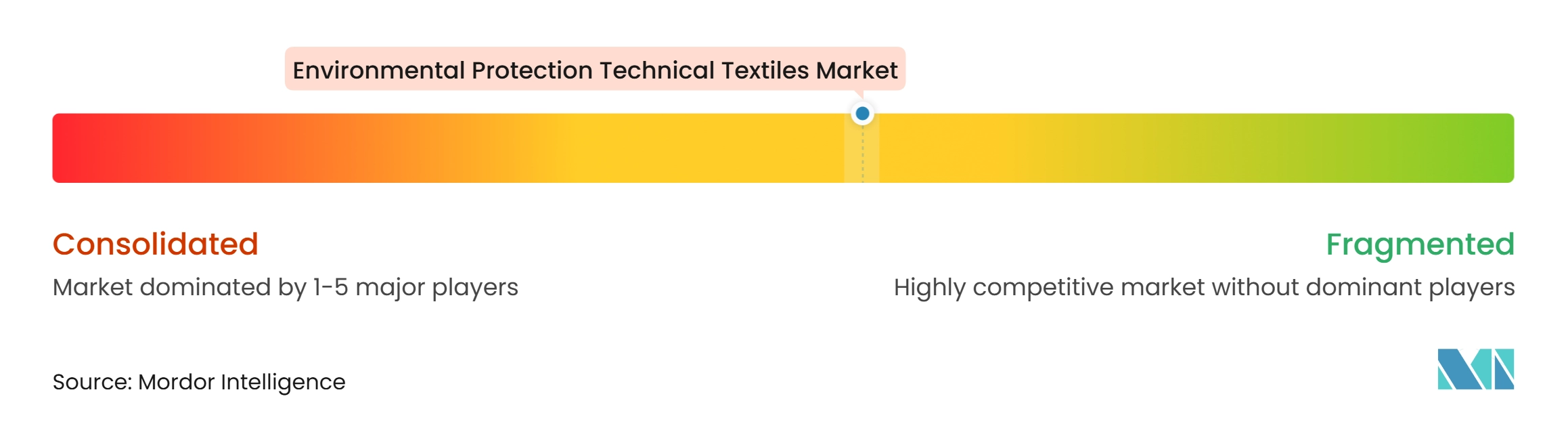
The environmental protection technical textiles market exhibits a medium level of market concentration. Air filtration has leading companies including BWF Envirotec, W.L. Gore & Associates, Freudenberg Filtration Technologies, and Donaldson Company. Liquid filtration, spill sorbents, and stormwater products have more regional specialists. PTFE membrane lamination, PPS fiber processing, and proprietary needlepunching are important areas of product differentiation. ISO 11057 filter-bag test methods and related standards can raise qualification requirements for new suppliers. This structure favors established companies in technically demanding applications while leaving openings in narrower product categories.
As of November 9, 2026, the acquisition has been completed. Japan Vilene Company's official corporate information lists Freudenberg SE as its sole shareholder. The transaction consolidates a 15-site Asian network serving nonwovens and filtration applications. Donaldson completed the acquisition of Facet Filtration on May 4, 2026, in an all-cash transaction valued at USD 829 million, strengthening its fuel and fluid filtration capabilities and expanding its exposure to the aerospace, defense, and power generation industries. Camfil acquired Bioconservación in March 2026 to expand its molecular contamination-control capabilities. These actions show that large companies are adding technology, manufacturing, and customer reach through acquisitions.
Bio-based sorbents, microplastic-capture media, and stormwater inserts remain areas where smaller firms can compete. New Pig, Evolution Sorbent Products, Fabco Industries, and Stormwater360 have positions in these more specialized categories. Yanpai reported 2025 revenue of RMB 897 million (USD 128.1 million), and reported growth of 14.28%. Its PPS laminated filter-bag patent combines carbon-capture separation with PTFE filtration, linking emission control and decarbonization needs. Competitive activity in the environmental protection technical textiles market therefore spans consolidation among larger groups and specialized product development by regional manufacturers. Buyers may favor firms that can document compliance, offer replacement supply, and adapt media to local operating conditions.
Environmental Protection Technical Textiles Industry Leaders
-
BWF Group (BWF Envirotec)
-
W. L. Gore & Associates Inc.
-
Freudenberg Group (Filtration Technologies)
-
Ahlstrom
-
Donaldson Company Inc.
- *Disclaimer: Major Players sorted in no particular order
Environmental Protection Technical Textiles Market Companies Covered in this Report
- BWF Group (BWF Envirotec)
- W. L. Gore & Associates Inc.
- Freudenberg Group (Filtration Technologies)
- Ahlstrom
- Donaldson Company Inc.
- Camfil AB
- Sefar AG
- GKD - Gebr. Kufferath AG
- Valmet Oyj
- ANDRITZ AG
- Clear Edge Filtration (Filtration Group)
- Micronics Engineered Filtration Group (Cleanova)
- New Pig Corporation
- Brady Corporation (SPC Absorbents)
- FyterTech Nonwovens LLC
- Evolution Sorbent Products
- Chemtex Inc.
- Fabco Industries Inc.
- Stormwater360 Ltd.
- Advanced Drainage Systems Inc. (FLEXSTORM)
Recent Industry Developments in Environmental Protection Technical Textiles Market
- March 2026: Camfil acquired Bioconservación, a Spain-based provider of air filtration solutions and adsorbents for industrial and commercial applications. The deal expands Camfil's Molecular contamination control capabilities by adding complementary expertise in chemical filtration, adsorbent technologies, and customer relationships for critical clean environments.
- February 2026: Donaldson Company entered into a definitive agreement to acquire Facet Filtration from Filtration Group in an all-cash transaction valued at approximately USD 820 million.
- December 2025: Camfil acquired F.C.R., an Italian air filtration company, effective January 1, 2026, expanding Camfil's local manufacturing capabilities and enhancing service coverage across Italy's industrial and commercial air filtration sectors, including clean rooms, power generation, and food processing.
Global Environmental Protection Technical Textiles Market Report Scope
The Environmental Protection Technical Textiles Market is segmented by Product Type (Oil and Chemical Spill-Control Textiles, and more), by Material Type (Polypropylene, Polyester, and more), by End-Use Application (Municipal Water and Wastewater Utilities, Industrial and Manufacturing Facilities, and more), and by Geography (North America, Europe, and More). The Market Forecasts are Provided in Terms of Value (USD).
Segmentation Overview
| Air Pollution-Control Textiles | Particulate Emission-Control Filter Textiles |
| Catalytic and Multifunctional Emission-Control Textiles | |
| Other Specialized Air Pollution-Control Textiles | |
| Water and Wastewater Treatment Textiles | Water Purification and Fine-Filtration Textile Media |
| Wastewater and Effluent Filtration Textiles | |
| Wastewater Sludge Dewatering Textiles | |
| Oil and Chemical Spill-Control Textiles | Flat-Form Absorbent Textiles |
| Shaped Absorbent Textile Products | |
| Textile-Based Spill Containment Products | |
| Other Specialized Spill-Control Textiles | |
| Stormwater and Surface Runoff Pollution-Control Textiles | Drain-Inlet and Catch-Basin Textile Filter Bags |
| Stormwater Filter Mats and Textile Inserts | |
| Textile Media for Stormwater Filter Cartridges | |
| Other Dedicated Runoff Pollution-Removal Textiles | |
| Other Specialized Environmental Protection Textiles (Contaminant Remediation Products, etc.) |
| Polypropylene |
| Polyester |
| Polyamide |
| Polyethylene and Other Polyolefins |
| High-Performance Synthetic Fibers (Polyphenylene Sulfide, Aramid, etc.) |
| Fluoropolymer Textile Media |
| Glass and Other Inorganic Fibers |
| Natural and Regenerated Cellulosic Fibers |
| Other Materials |
| Municipal Water and Wastewater Utilities | Drinking Water Treatment |
| Municipal Wastewater Treatment | |
| Industrial and Manufacturing Facilities | Chemicals and Petrochemicals |
| Metals, Mining, and Mineral Processing | |
| Cement and Building Materials Manufacturing | |
| Other Industrial Manufacturing | |
| Power Generation and Energy Facilities | |
| Municipal Solid Waste and Recycling Facilities | |
| Oil and Gas, Marine, and Spill Response Operations | |
| Urban Stormwater and Drainage Infrastructure | |
| Environmental Remediation and Emergency Response Services | |
| Other Environmental Protection End Users |
| North America | United States |
| Canada | |
| Mexico | |
| Europe | Germany |
| United Kingdom | |
| France | |
| Italy | |
| Spain | |
| Netherlands | |
| Belgium | |
| Poland | |
| Sweden | |
| Rest of Europe | |
| Asia-Pacific | China |
| India | |
| Japan | |
| South Korea | |
| Taiwan | |
| Indonesia | |
| Thailand | |
| Vietnam | |
| Australia | |
| Rest of Asia-Pacific | |
| Middle East and Africa | Saudi Arabia |
| United Arab Emirates | |
| South Africa | |
| Egypt | |
| Rest of Middle East and Africa | |
| South America | Brazil |
| Argentina | |
| Rest of South America |
| By Product Type | Air Pollution-Control Textiles | Particulate Emission-Control Filter Textiles |
| Catalytic and Multifunctional Emission-Control Textiles | ||
| Other Specialized Air Pollution-Control Textiles | ||
| Water and Wastewater Treatment Textiles | Water Purification and Fine-Filtration Textile Media | |
| Wastewater and Effluent Filtration Textiles | ||
| Wastewater Sludge Dewatering Textiles | ||
| Oil and Chemical Spill-Control Textiles | Flat-Form Absorbent Textiles | |
| Shaped Absorbent Textile Products | ||
| Textile-Based Spill Containment Products | ||
| Other Specialized Spill-Control Textiles | ||
| Stormwater and Surface Runoff Pollution-Control Textiles | Drain-Inlet and Catch-Basin Textile Filter Bags | |
| Stormwater Filter Mats and Textile Inserts | ||
| Textile Media for Stormwater Filter Cartridges | ||
| Other Dedicated Runoff Pollution-Removal Textiles | ||
| Other Specialized Environmental Protection Textiles (Contaminant Remediation Products, etc.) | ||
| By Material Type | Polypropylene | |
| Polyester | ||
| Polyamide | ||
| Polyethylene and Other Polyolefins | ||
| High-Performance Synthetic Fibers (Polyphenylene Sulfide, Aramid, etc.) | ||
| Fluoropolymer Textile Media | ||
| Glass and Other Inorganic Fibers | ||
| Natural and Regenerated Cellulosic Fibers | ||
| Other Materials | ||
| By End-Use Application | Municipal Water and Wastewater Utilities | Drinking Water Treatment |
| Municipal Wastewater Treatment | ||
| Industrial and Manufacturing Facilities | Chemicals and Petrochemicals | |
| Metals, Mining, and Mineral Processing | ||
| Cement and Building Materials Manufacturing | ||
| Other Industrial Manufacturing | ||
| Power Generation and Energy Facilities | ||
| Municipal Solid Waste and Recycling Facilities | ||
| Oil and Gas, Marine, and Spill Response Operations | ||
| Urban Stormwater and Drainage Infrastructure | ||
| Environmental Remediation and Emergency Response Services | ||
| Other Environmental Protection End Users | ||
| By Geography | North America | United States |
| Canada | ||
| Mexico | ||
| Europe | Germany | |
| United Kingdom | ||
| France | ||
| Italy | ||
| Spain | ||
| Netherlands | ||
| Belgium | ||
| Poland | ||
| Sweden | ||
| Rest of Europe | ||
| Asia-Pacific | China | |
| India | ||
| Japan | ||
| South Korea | ||
| Taiwan | ||
| Indonesia | ||
| Thailand | ||
| Vietnam | ||
| Australia | ||
| Rest of Asia-Pacific | ||
| Middle East and Africa | Saudi Arabia | |
| United Arab Emirates | ||
| South Africa | ||
| Egypt | ||
| Rest of Middle East and Africa | ||
| South America | Brazil | |
| Argentina | ||
| Rest of South America | ||
Key Questions Answered in the Report
What is the projected value of environmental protection technical textiles by 2032?
The environmental protection technical textiles market is projected to reach USD 6.19 billion by 2032, growing at a CAGR of 6.49% from 2027.
Which product category leads environmental protection technical textiles?
Water and wastewater treatment textiles led with 32% of revenue in 2026 and are forecast to grow at a CAGR of 7.6% through 2032.
Which material is growing fastest in environmental protection technical textiles?
High-performance synthetic fibers are forecast to grow at a CAGR of 8.2% through 2032 because they suit demanding thermal and chemical conditions.
Which end-use application has the highest growth outlook?
Municipal water and wastewater utilities are projected to grow at a CAGR of 7.8% through 2032 as treatment infrastructure and reuse needs expand.
Which region leads environmental protection technical textiles?
Asia-Pacific held 33% of revenue in 2026, while the Middle East and Africa is forecast to grow at a CAGR of 9.9% through 2032.
What factors limit adoption of advanced filtration textiles?
Polymer-price volatility, the cost of advanced materials, alternative filters, and the energy effects of pressure drop can constrain adoption.