
Enumerated Microbial Reference Materials Market Size and Share
Market Overview
| Study Period | 2020 - 2031 |
|---|---|
| Market Size (2026) | USD 177.60 Million |
| Market Size (2031) | USD 263.01 Million |
| Growth Rate (2026 - 2031) | 8.17 % |
| Fastest Growing Market | Asia-Pacific |
| Largest Market | North America |
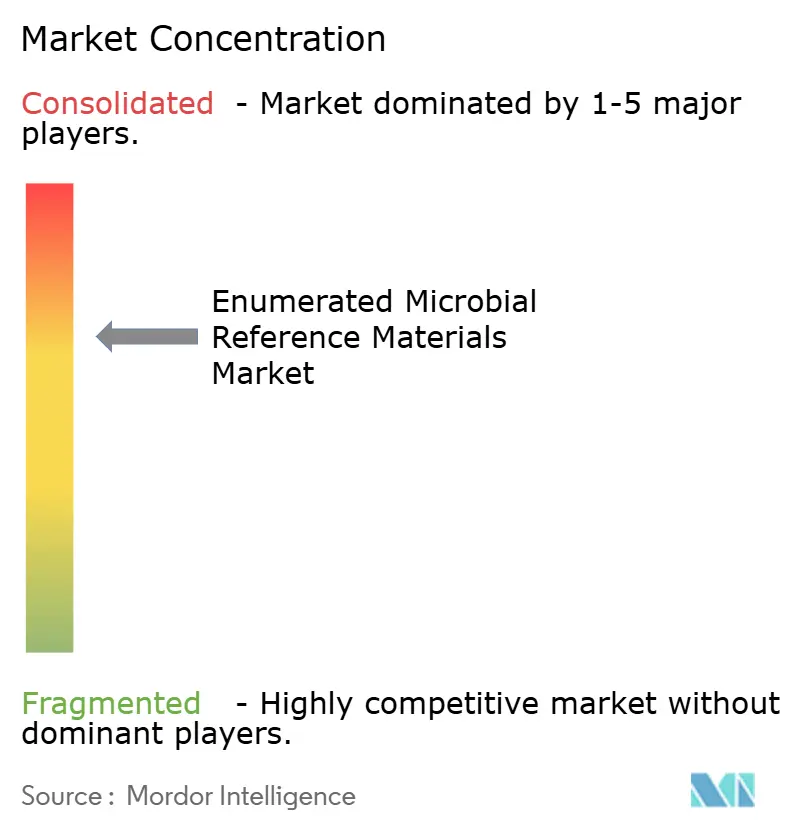
| Market Concentration | Medium |
Major Players
*Disclaimer: Major Players sorted in no particular order Image © Mordor Intelligence. Reuse requires attribution under CC BY 4.0. |
|
Enumerated Microbial Reference Materials Market Analysis by Mordor Intelligence
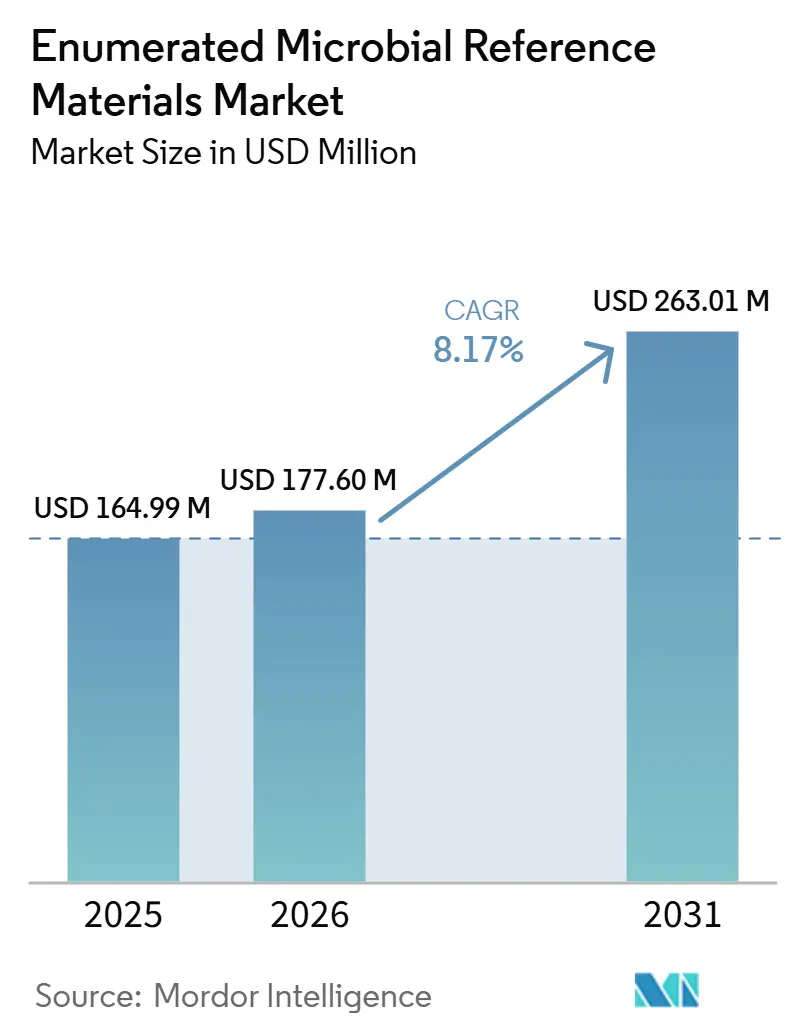
The enumerated microbial reference materials market is projected to be USD 164.99 million in 2025, USD 177.60 million in 2026, and reach USD 263.01 million by 2031, growing at a CAGR of 8.17% from 2026 to 2031. The enumerated microbial reference materials market is expanding because pharmaceutical quality teams now face tighter microbiology controls across both routine release testing and newer rapid methods. Updated USP notices on rapid microbial methods and bioburden monitoring have pushed laboratories to refresh validation packages, requalify controls, and document traceable organism use more carefully across regulated workflows. The enumerated microbial reference materials market also benefits from format innovation, since buyers increasingly value pre-quantified preparations that reduce handling time and improve repeatability in environmental monitoring and bioburden programs. The enumerated microbial reference materials market still faces friction from cross-border cold-chain control, uneven pharmacopoeial acceptance, and slow supplier onboarding at regulated sites, which keeps purchasing concentrated among accredited suppliers with strong documentation systems. Competition therefore centers less on strain novelty and more on delivery format, lot traceability, workflow speed, and the strength of validation evidence that supports use in GMP quality control settings.
Key Report Takeaways
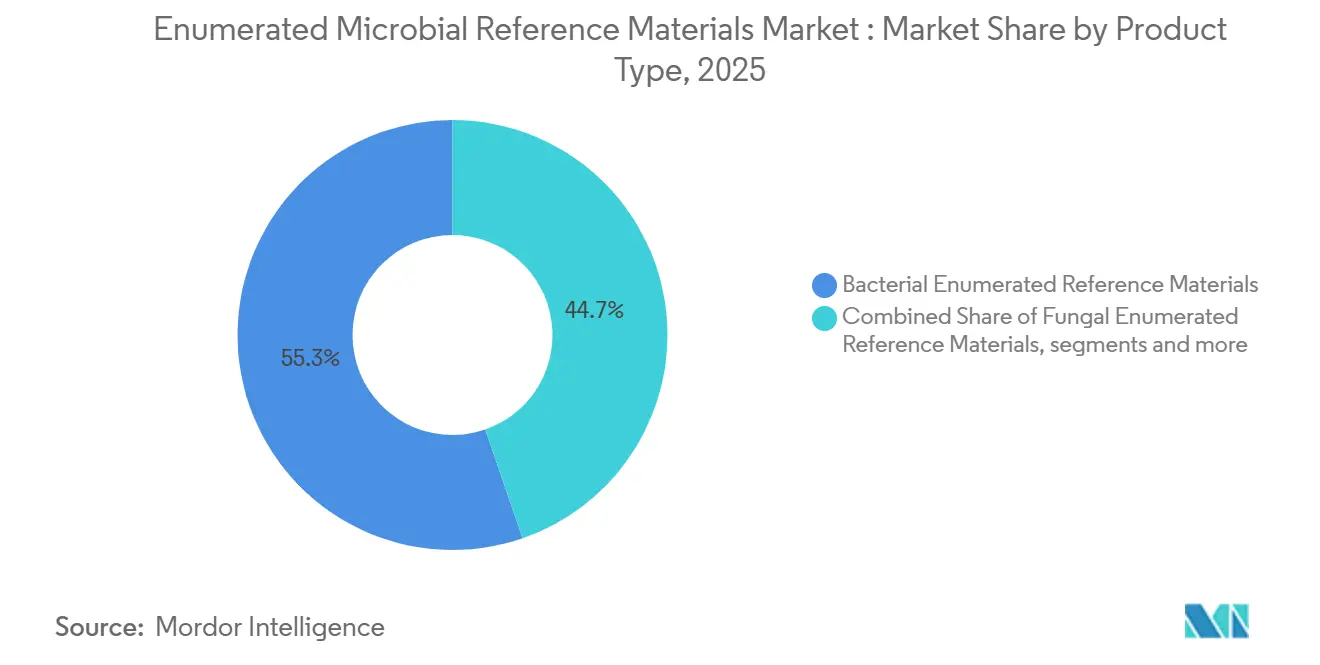
- By product type, bacterial enumerated materials led with 55.33% revenue share in 2025, while mixed microbial enumerated materials are forecasted to expand at 8.24% CAGR through 2031.
- By form, lyophilized formats held 40.11% share in 2025, while liquid formats are projected to grow at 8.76% CAGR through 2031.
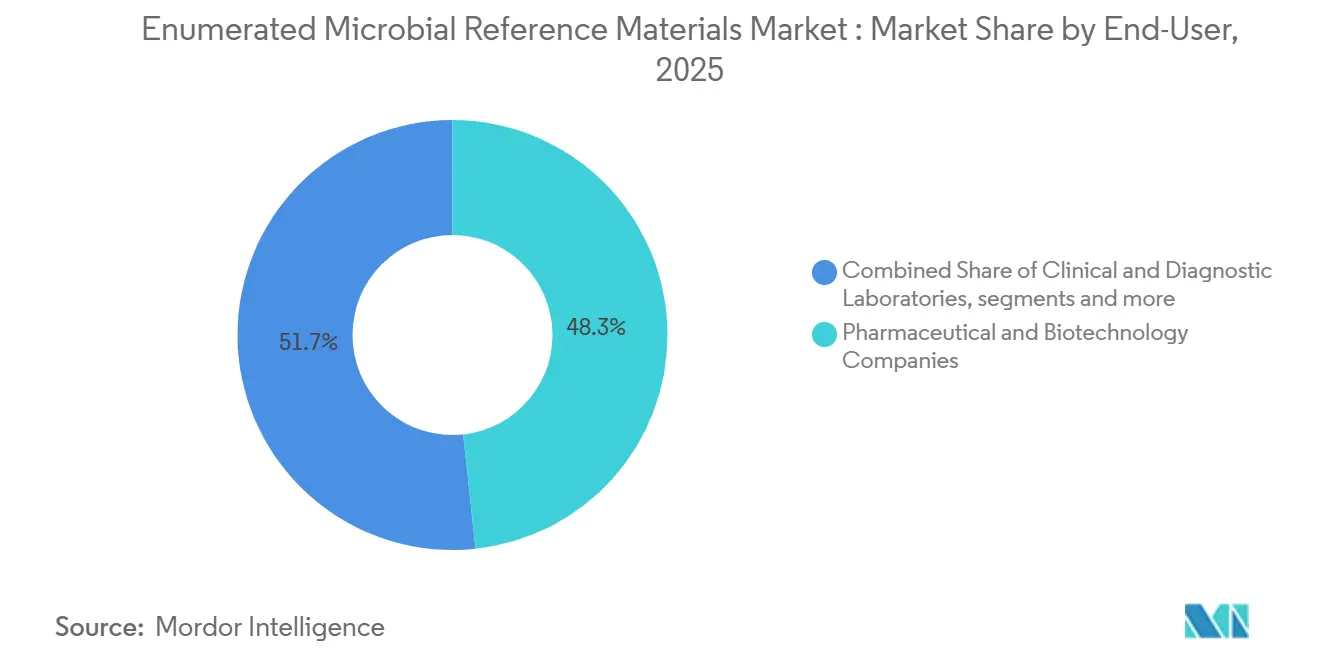
- By end-user, pharmaceutical and biotechnology companies accounted for 48.26% share in 2025, while clinical and diagnostics are expected to record the highest CAGR at 9.13% through 2031.
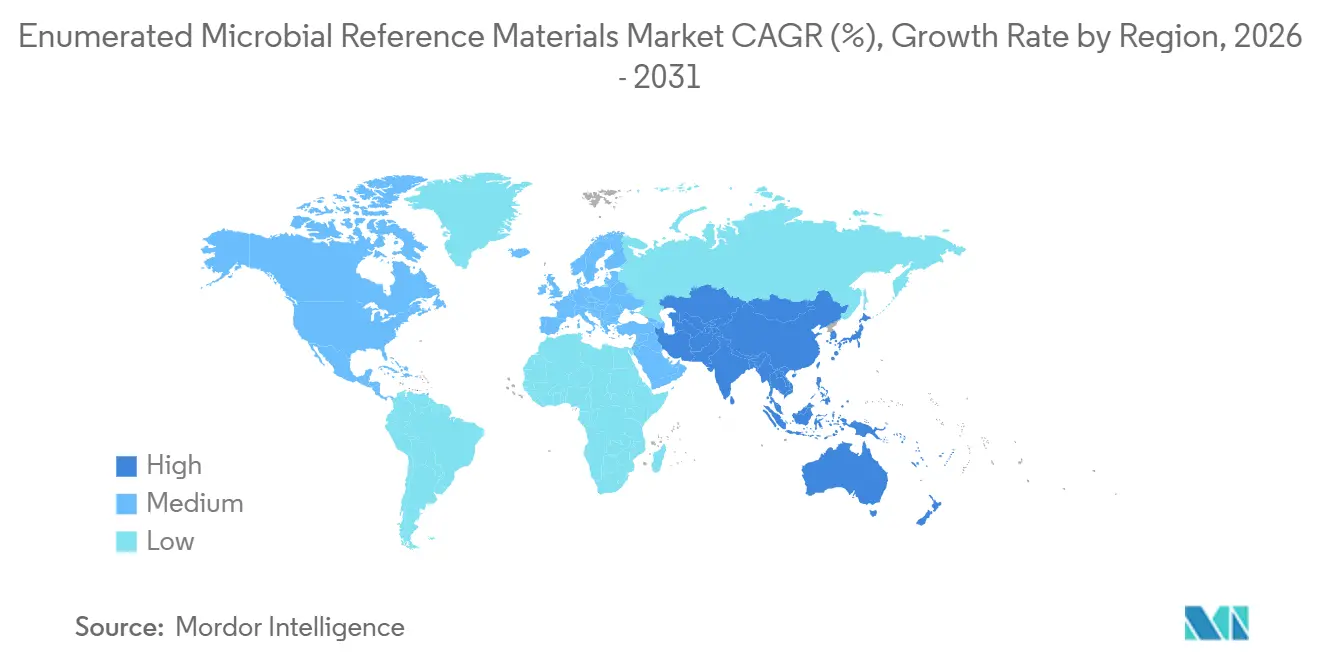
- By geography, North America held 46.32% share in 2025, while Asia-Pacific is forecasted to advance at 10.21% CAGR through 2031.
Note: Market size and forecast figures in this report are generated using Mordor Intelligence’s proprietary estimation framework, updated with the latest available data and insights as of January 2026.
Market Trends and Insights
Drivers Impact Analysis of Enumerated Microbial Reference Materials Market *
| Driver | (~) % Impact on CAGR Forecast | Geographic Relevance | Impact Timeline |
|---|---|---|---|
| Expanding Biopharmaceutical Release and Method-Validation Workflows | +2.4% | Global, with strongest relevance in North America, Europe, China, India, and South Korea | Long term (≥ 4 years) |
| Tightening Pharmacopoeial and ISO Traceability Requirements | +2.0% | Global, especially North America and Europe | Medium term (2-4 years) |
| Rising Use of Rapid Microbial Methods in Routine QC | +1.4% | North America and Europe first, with Asia-Pacific accelerating | Medium term (2-4 years) |
| Growth in Outsourced Microbiology Testing and Reference Lab Networks | +1.0% | Global, especially large CDMO hubs | Long term (≥ 4 years) |
| Regulatory Push for Digital Certificates of Analysis and Audit-Ready Lot Traceability | +0.5% | Global, with stronger near-term relevance in North America and Europe | Short term (≤ 2 years) |
| Regionalization of Qualified Reference Material Supply Chains | +0.6% | Global, with strongest impact in North America, Europe, China, and India | Medium to long term (3-5 years) |
| Source: Mordor Intelligence | |||
Expanding Biopharmaceutical Release and Method-Validation Workflows
The enumerated microbial reference materials market is gaining support from the way biologics manufacturing raises the frequency and criticality of microbiology checks. Cell therapies, gene therapies, antibody-drug conjugates, and other high-value products require tighter environmental monitoring, stronger in-process control, and faster release support than many traditional operations. Short-life products also leave less time for extended contamination testing, which makes validated rapid methods more relevant in release workflows. [1]Charles River Laboratories, “USP <73> and USP <1071> Accelerating Contamination Detection in Short-Life Products with Celsis®,” Charles River Laboratories, criver.comThat shift does not reduce the need for quantified challenge organisms, because each method qualification still depends on defined positive controls and repeatable organism loads. The same facility can therefore continue its legacy compendial testing while also validating new platforms, which creates overlapping points of consumption for the enumerated microbial reference materials market. Each added GMP site or added biologics line also acts as a separate procurement node, so demand expands through new testing locations rather than only through larger wallet share at existing accounts.
Tightening Pharmacopoeial and ISO Traceability Requirements
The enumerated microbial reference materials market is also being lifted by a broad compliance refresh across microbiology standards. USP posted the official revision notice for rapid microbiological methods in 2025, and that change gave laboratories a clearer compendial path for contamination detection in short-life products.[2]United States Pharmacopeia, “Monographs Affected by Revision to <1229.3> Monitoring of Bioburden,” USP-NF, uspnf.com Charles River also described how USP formalized the use of ATP-bioluminescence methods and linked those workflows to validated reference microorganism preparations. The practical effect is a steady renewal cycle in which the enumerated microbial reference materials market benefits from repeat qualification work, stronger traceability expectations, and growing demand for audit-ready certificates that can move across internal quality systems with less manual reconciliation.
Rising Use of Rapid Microbial Methods in Routine QC
The enumerated microbial reference materials market gains further momentum from the fact that rapid methods still depend on culture-based reference standards during validation. Laboratories may move toward ATP-bioluminescence, automated imaging, or other alternatives, but they still need quantified organisms to prove equivalence against accepted microbiological procedures. ATCC’s 2026 publication on MicroQuant showed how ready-to-use commercial reference preparations can be evaluated directly on the Growth Direct system for bioburden and environmental monitoring use cases.[3]J. Rowe et al., “Alternative Methods in Microbial QC Evaluating the Use of the ATCC MicroQuant™ as a Ready-To-Use Commercial Reference Microorganism Preparation on the Growth Direct® System,” PDA Journal of Pharmaceutical Science and Technology, doi.org That is important because buyers are not only purchasing an organism, they are purchasing a preparation format that reduces variability during a validation program. Once a lab adopts a rapid platform, it also tends to keep using the same validated material types across retraining, lot changes, and follow-on method work. This makes the enumerated microbial reference materials market a recurring input to modernization, not a one-time procurement tied only to the first platform installation.
Growth in Outsourced Microbiology Testing and Reference Lab Networks
The enumerated microbial reference materials market is also supported by the way outsourced testing creates duplicate qualification needs across sponsors and contract labs. A CDMO or external microbiology laboratory may run similar tests for many customers, but documentation often has to remain sponsor specific. That means separate lots, separate qualification records, and tighter control of traceability, even when the same organism types are used across programs. When several clients rely on the same lab, consistency becomes commercially important as well as technically important. That favors the enumerated microbial reference materials market because external networks usually prefer standardized, accredited materials that help them reduce deviations and defend results during sponsor or regulator review.
Restraints Impact Analysis of Enumerated Microbial Reference Materials Market *
| Restraint | (~) % Impact on CAGR Forecast | Geographic Relevance | Impact Timeline |
|---|---|---|---|
| High Cold-Chain and Stability Assurance Costs | -0.8% | Asia-Pacific periphery, Middle East and Africa, South America, and parts of Eastern Europe | Long term (≥ 4 years) |
| Fragmented Pharmacopoeial and National Acceptance Requirements | -0.6% | Global, especially multi-jurisdiction supply chains | Medium term (2-4 years) |
| Limited Availability of Truly Quantified Multi-Organism Reference Panels | -0.4% | Global, especially advanced therapy and RMM validation use cases | Short term (≤ 2 years) |
| Slow Customer Qualification Cycles for Regulated Manufacturing Sites | -0.3% | Global, with strongest effect in North America and Europe | Long term (≥ 4 years) |
| Source: Mordor Intelligence | |||
High Cold-Chain and Stability Assurance Costs
The enumerated microbial reference materials market remains exposed to basic logistics risk because viability and quantitative accuracy can fall quickly when storage conditions drift. Frozen and liquid formats often need continuous low-temperature control from production through delivery, which raises shipping complexity for global customers. That issue becomes more visible in regions where import handling is slower or ultra-cold infrastructure is less dependable. As a result, the enumerated microbial reference materials market can lose some speed when product format, freight reliability, and destination infrastructure do not align with the buyer’s validation needs.
Fragmented Pharmacopoeial Acceptance, Limited Panel Availability, and Slow Qualification Cycles
The enumerated microbial reference materials market also faces a structural drag from fragmented compliance pathways across major jurisdictions. Suppliers that can satisfy several compendial expectations therefore gain an advantage, while smaller regional producers often struggle to cross into global contracts. The problem is sharper in multi-organism panels, where buyers want truly quantified and easy-to-deploy preparations for newer validation needs, but commercial availability is still thinner than demand suggests. Even when a technically suitable supplier is identified, regulated manufacturers often need long internal review cycles before a new source can enter routine use. This slows competitive turnover in the enumerated microbial reference materials market and keeps a larger share of regulated demand with suppliers that already sit inside approved quality systems.
*Our forecasts treat driver/restraint impacts as directional, not additive. The impact forecasts reflect baseline growth, mix effects, and variable interactions.
Enumerated Microbial Reference Materials Market Segment Analysis
By Product Type:
Bacterial Enumerated Strains Anchor Compliance While Mixed Panels Expand FasterBacterial enumerated materials held 55.33% of the enumerated microbial reference materials market share in 2025, which reflects their central role in routine compendial microbiology programs. Species such as Bacillus subtilis, Staphylococcus aureus, and Pseudomonas aeruginosa remain embedded in everyday method suitability and quality control work across established USP-linked workflows. In this part of the enumerated microbial reference materials market, differentiation comes more from format, enumeration accuracy, and speed of use than from organism novelty.
Mixed microbial enumerated materials are forecasted to grow at 8.24% CAGR from 2026 to 2031, making them the fastest-expanding product type in the enumerated microbial reference materials market. Their growth reflects wider use of multi-organism challenges in rapid method validation, environmental monitoring qualification, and broader surveillance settings. Buyers increasingly want panels that better match real testing conditions instead of validating each step with single-organism preparations only. ISO 17034 readiness also matters across the product mix, because it helps established suppliers defend share when regulated buyers narrow approved vendor lists in the enumerated microbial reference materials industry.



By Form:
Lyophilized Leads Current Adoption While Liquid Formats Gain with Modern QC WorkflowsLyophilized forms accounted for 40.11% of the enumerated microbial reference materials market size in 2025, making them the leading format for routine pharmaceutical quality control use. That lead rests on practical operating advantages, including longer shelf life, simpler refrigerated handling, and lower dependence on deep cold-chain transport. The format also fits distributed manufacturing and testing networks better, because validated material can move more reliably across regions with mixed logistics quality. In the enumerated microbial reference materials market, this gives lyophilized products a strong fit for routine labs that prioritize supply continuity and lower handling risk over the freshest possible presentation format.
Liquid forms are projected to grow at 8.76% CAGR through 2031, the fastest pace among form segments in the enumerated microbial reference materials market. Their momentum is tied closely to rapid microbial method validation, where defined liquid suspensions are often easier to integrate into automated or signal-based workflows. Laboratories using optical, luminescent, or other non-traditional detection approaches typically want challenge materials that can be introduced with minimal preparation variability. Frozen materials still keep a specialized role for buyers that want cryopreserved, low-passage stocks, while swab, disc, and related formats continue to serve narrower microbiology applications.
By End-User:
Pharmaceutical and biotech Remain the Core Base, While Diagnostics Advances FasterPharmaceutical and biotech represented 48.26% of the enumerated microbial reference materials market size in 2025, which confirms that regulated drug production remains the main demand center. Batch release, environmental monitoring, and in-process microbial checks all rely on trusted controls, and those workflows became more sensitive as USP updates sharpened expectations around method suitability and contamination detection. This segment also carries a dual structure, because some large manufacturers keep substantial testing in house while others place growing volumes with CDMOs and external labs. It broadens the buying base, because both originators and outsourced partners need traceable materials that can stand up to audits, deviations, and review across commercial production programs.
Clinical and diagnostics are forecasted to expand at 9.13% CAGR from 2026 to 2031, the fastest pace among end users in the enumerated microbial reference materials market. Growth here reflects rising laboratory automation, broader internal quality control design, and the need to benchmark instrument performance with reliable organism preparations. Diagnostic labs also face pressure to handle multiplex detection and antimicrobial resistance work with tighter consistency across instruments and shifts. Academic and research users remain smaller in revenue terms, but they still matter because validation studies and proof-of-concept work can shape later commercial demand. That keeps the enumerated microbial reference materials industry linked not only to routine testing volume, but also to the development path of newer microbiology workflows.
Geography Analysis
North America and Europe Enumerated Microbial Reference Materials Market
North America held 46.32% of the enumerated microbial reference materials market share in 2025, which kept it in the leading regional position. That position rests on the density of FDA-regulated pharmaceutical production and the close link between laboratory practice and USP notices that became official in 2025. When microbiology chapters are revised, laboratories in this region usually have to update validation files, retrain staff, and confirm that reference materials still fit their approved procedures. The enumerated microbial reference materials market therefore benefits from recurrent documentation work, not only from rising production volume. Europe remained the second-largest regional block, supported by large biopharmaceutical manufacturing centers and a strong compliance culture in pharmaceutical quality systems.
Broader European Markets
European demand is shaped by both established production clusters and active pharmacopoeial governance. France’s updated good manufacturing practice guidance published by ANSM in June 2024 reinforced the role of pharmacopoeial reference expectations in pharmaceutical compounding and related quality activities. That matters because the region often moves early on documentation discipline and validation formalization, which supports steady demand for traceable organism preparations. The enumerated microbial reference materials market in Europe therefore remains anchored by buyers that prioritize lot traceability, qualified suppliers, and evidence that can support inspections across several countries.
APAC, MEA and South America Enumerated Microbial Reference Materials Market
Asia-Pacific is forecasted to grow at 10.21% CAGR from 2026 to 2031, making it the fastest-growing regional segment in the enumerated microbial reference materials market. The region’s momentum comes from expanding biologics capacity, stronger quality infrastructure, and a broader shift from basic production toward more demanding therapies and testing workflows. As a result, the enumerated microbial reference materials market in Asia-Pacific is expanding through both sophistication gains and wider manufacturing scale. The Middle East and Africa and South America remain smaller in absolute terms, but both add incremental opportunities for the enumerated microbial reference materials market. Gulf manufacturing investment is lifting the need for GMP-aligned microbiology controls, while South Africa continues to act as a regional testing anchor. In South America, Brazil and Argentina continue to matter because established pharmaceutical production creates recurring demand for qualified microbiology inputs. The Eurasian Economic Union’s 2024 pharmacopoeial update on microbiological purity requirements also points to gradual convergence with broader international practice, which may ease market entry over time for suppliers serving that wider region.

Competitive Landscape
The enumerated microbial reference materials market is moderately concentrated, with a small group of global suppliers holding most regulated pharmaceutical and clinical demand. Buyers in this space usually prefer vendors that can support multi-jurisdiction documentation, stable lot release, and recognized accreditation standards. That gives established suppliers a durable advantage, even though many smaller regional collections and microbiology specialists remain active below the top tier. In the enumerated microbial reference materials market, pricing pressure is strongest in standard bacterial preparations, while premium positioning is more realistic in ready-to-use, pre-quantified, and workflow-saving formats. Competitive advantage therefore depends less on owning a long strain list and more on proving that the product reduces handling steps, supports reproducibility, and fits inspection-ready quality systems.
ATCC’s 2026 MicroQuant publication is a useful example of how product strategy is evolving in the enumerated microbial reference materials market. The company did not rely on strain novelty alone. It emphasized a preparation format that could be evaluated directly with the Growth Direct system in bioburden and environmental monitoring workflows. That kind of scientific disclosure matters because buyers in regulated settings often trust peer-reviewed or association-linked technical evidence more than broad marketing claims. It also shows why product format, passage control, and ease of use now sit close to the center of competition.
Thermo Fisher Scientific’s April 2026 agreement to divest its microbiology business to Astorg for USD 1.1 billion offers a second clear strategic signal for the enumerated microbial reference materials market. That move may create more room for category specialists that can sharpen their position in pharmaceutical and clinical quality control. The enumerated microbial reference materials market also continues to reward suppliers that can win long approval cycles, because once a vendor is qualified, customers are slow to switch unless service, documentation, or supply performance breaks down. This keeps competition active, but it also preserves meaningful stickiness around incumbent suppliers that already meet the buyer’s regulatory and technical expectations.
Enumerated Microbial Reference Materials Industry Leaders
-
ATCC
-
Microbiologics, Inc.
-
Thermo Fisher Scientific Inc.
-
Merck KGaA
-
bioMérieux SA
- *Disclaimer: Major Players sorted in no particular order
Enumerated Microbial Reference Materials Market Companies Covered in this Report
- ATCC
- Beckton Dickinson
- bioMérieux
- Bio-Rad Laboratories
- Charles River
- Danaher
- Fera Science Limited
- Hardy Diagnostics
- HyServe GmbH and Co. KG
- LGC Group
- Liofilchem S.r.l.
- Merck
- Microbiologics, Inc.
- R-Biopharm
- Revvity, Inc.
- Sartorius
- Southern Group Laboratory Ltd.
- TCS Biosciences Ltd.
- Thermo Fisher Scientific

Recent Industry Developments in Enumerated Microbial Reference Materials Market
- May 2026: Pro-Lab Diagnostics USA launched Pro-Cult, a line of freeze-dried QC organisms manufactured exclusively from NCTC and NCPF authenticated strains under a UKHSA Culture Collections manufacturing license. The 86-strain catalog spanning 30 genera supports USP, Ph. Eur., CLSI M100, and EUCAST applications, providing a documented first-generation alternative to incumbent suppliers and addressing supply-continuity risk in pharmaceutical and clinical QC laboratories across the US market.
- April 2026: Thermo Fisher Scientific signed a definitive agreement to divest its microbiology business to Astorg for approximately USD 1.1 billion. The business generated USD 645 million in revenue in 2025, and the transaction is expected to close in the second half of 2026.
- March 2026: The European Pharmacopeia Commission (EPC), at its 184th Session, approved the creation of a dedicated working party to develop the cMEP (Certified Microbiological Examination Procedure) concept, a harmonized scientific review framework for rapid microbiological method validation under Ph. Eur. The initiative arose from two major stakeholder consultations in 2024 and will generate new demand for certified enumerated reference organisms in European laboratories adopting RMM platforms.


Global Enumerated Microbial Reference Materials Market Report Scope
According to the report’s scope, the enumerated microbial reference materials market refers to the industry focused on the development, production, and supply of reference materials containing a certified number of viable microorganisms used to validate, calibrate, and verify microbiological testing methods. These materials support quality control, method validation, proficiency testing, and regulatory compliance across pharmaceutical, food and beverage, clinical, environmental, and water testing laboratories.
The enumerated microbial reference materials market is segmented into product type, form, end-user, and geography. By product type, the market is segmented into bacterial enumerated reference materials, fungal enumerated reference materials, mixed microbial enumerated reference materials, and other microbial enumerated reference materials. By form, the market is segmented into lyophilized, frozen, liquid, and other forms. By end-user, the market is segmented into pharmaceutical and biotechnology companies, clinical and diagnostic laboratories, academic and research institutes, and other end users. By geography, the market is segmented into North America, Europe, Asia-Pacific, the Middle East and Africa, and South America. The report also covers the estimated market sizes and trends for 17 countries across major regions globally. The report offers values (USD) for all the above segments.
| Bacterial Enumerated Reference Materials |
| Fungal Enumerated Reference Materials |
| Mixed Microbial Enumerated Reference Materials |
| Other Microbial Enumerated Reference Materials |
| Lyophilized |
| Frozen |
| Liquid |
| Other Forms |
| Pharmaceutical and Biotechnology Companies |
| Clinical and Diagnostic Laboratories |
| Academic and Research Institutes |
| Other End Users |
| North America | United States |
| Canada | |
| Mexico | |
| Europe | Germany |
| United Kingdom | |
| France | |
| Italy | |
| Spain | |
| Rest of Europe | |
| Asia-Pacific | China |
| Japan | |
| India | |
| Australia | |
| South Korea | |
| Rest of Asia-Pacific | |
| Middle East and Africa | GCC |
| South Africa | |
| Rest of Middle East and Africa | |
| South America | Brazil |
| Argentina | |
| Rest of South America |
| By Product Type | Bacterial Enumerated Reference Materials | |
| Fungal Enumerated Reference Materials | ||
| Mixed Microbial Enumerated Reference Materials | ||
| Other Microbial Enumerated Reference Materials | ||
| By Form | Lyophilized | |
| Frozen | ||
| Liquid | ||
| Other Forms | ||
| By End-User | Pharmaceutical and Biotechnology Companies | |
| Clinical and Diagnostic Laboratories | ||
| Academic and Research Institutes | ||
| Other End Users | ||
| By Geography | North America | United States |
| Canada | ||
| Mexico | ||
| Europe | Germany | |
| United Kingdom | ||
| France | ||
| Italy | ||
| Spain | ||
| Rest of Europe | ||
| Asia-Pacific | China | |
| Japan | ||
| India | ||
| Australia | ||
| South Korea | ||
| Rest of Asia-Pacific | ||
| Middle East and Africa | GCC | |
| South Africa | ||
| Rest of Middle East and Africa | ||
| South America | Brazil | |
| Argentina | ||
| Rest of South America | ||


Key Questions Answered in the Report
What is the current outlook for enumerated microbial reference materials?
The enumerated microbial reference materials market was valued at USD 164.99 million in 2025, reached USD 177.60 million in 2026, and is forecasted to reach USD 263.01 million by 2031 at an 8.17% CAGR.
Which product type leads current revenue?
Bacterial enumerated reference materials led with 55.33% share in 2025 because they remain central to routine compendial microbiology and batch-release support.
Which form is expanding fastest?
Liquid forms are expected to grow fastest at 8.76% CAGR through 2031 because they fit well with automated and rapid validation workflows that need defined challenge concentrations.
Which region offers the strongest growth potential?
Asia-Pacific shows the strongest growth outlook, with a Projected 10.21% CAGR through 2031, driven by expanding biologics capacity and improving microbiology validation frameworks.
Page last updated on:





