
Enterprise Resource Planning Customization Market Size and Share
Market Overview
| Study Period | 2020 - 2031 |
|---|---|
| Market Size (2026) | USD 5.27 Billion |
| Market Size (2031) | USD 8.17 Billion |
| Growth Rate (2026 - 2031) | 9.16 % |
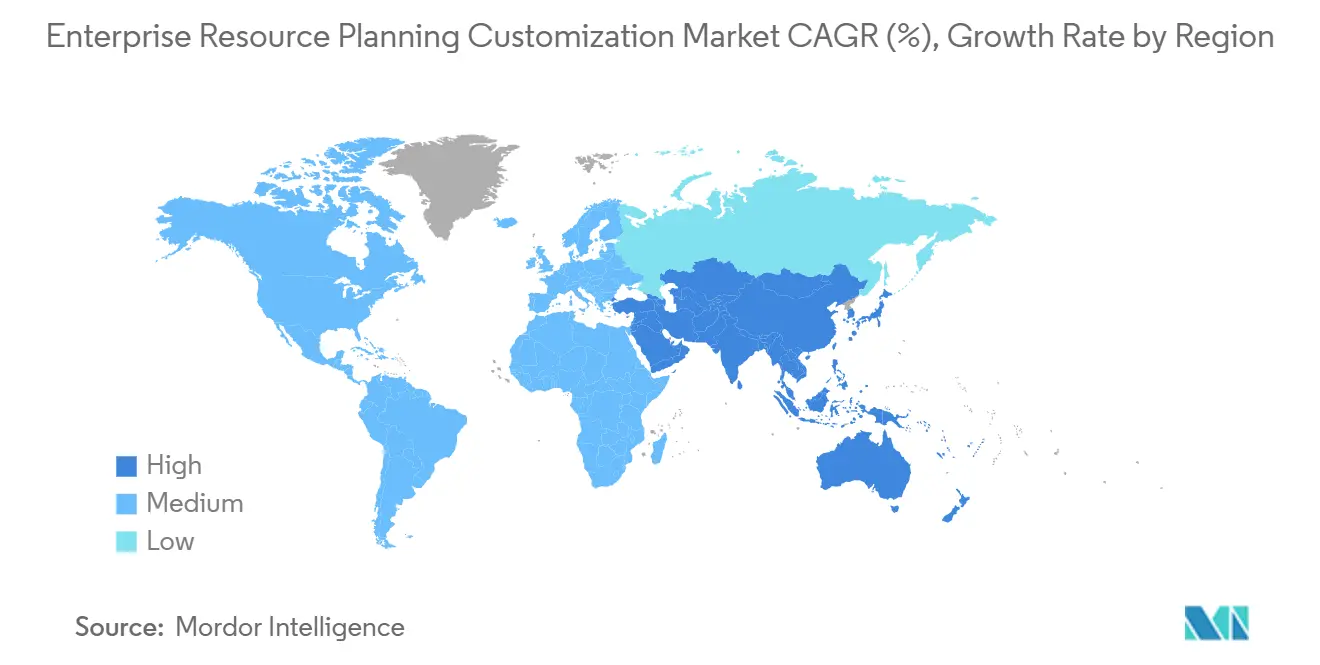
| Fastest Growing Market | Asia Pacific |
| Largest Market | North America |
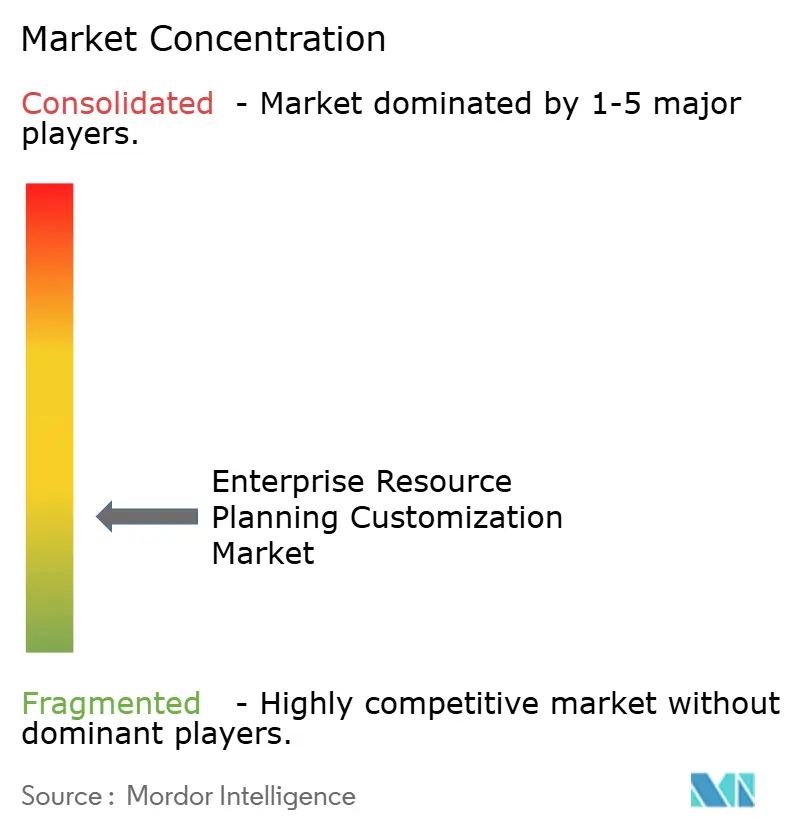
| Market Concentration | Low |
Major Players *Disclaimer: Major Players sorted in no particular order Image © Mordor Intelligence. Reuse requires attribution under CC BY 4.0. | |
Enterprise Resource Planning Customization Market Analysis by Mordor Intelligence
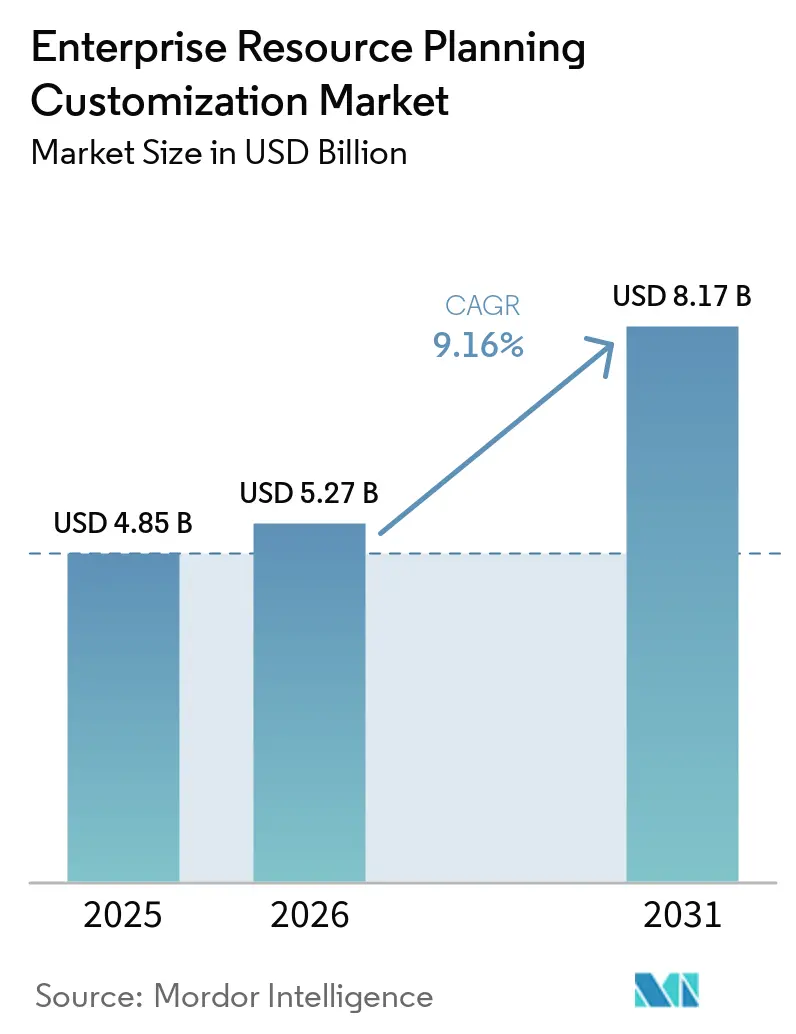
The Enterprise Resource Planning Customization Services market size is projected to be USD 4.85 billion in 2025, USD 5.27 billion in 2026, and reach USD 8.17 billion by 2031, growing at a CAGR of 9.16% from 2026 to 2031. Rising cloud-first mandates, the integration of agentic AI into core ERP workflows, and a shift from episodic to continuous optimization models are redefining service demand. Enterprises are prioritizing modular, API-first architectures that support rapid industry-specific extensions and low-code workflow automation, while cost pressure and talent shortages are tilting the delivery mix toward managed services and outcome-based contracts. Heightened data-residency requirements in Asia-Pacific and Europe are further expanding opportunities for region-specific customization, especially for sovereign-cloud deployments. At the same time, high switching costs and legacy technical debt remain structural headwinds that slow wholesale platform migrations.
Key Report Takeaways
- By deployment mode, cloud led the Enterprise Resource Planning Customization Services market with 59% market share in 2025 and is advancing at a 14.10% CAGR through 2031.
- By enterprise size, large enterprises accounted for 61.50% of the Enterprise Resource Planning Customization Services market share in 2025, whereas small and medium enterprises are expanding at a 13.90% CAGR to 2031.
- By end-use industry, manufacturing accounted for 23.20% of the Enterprise Resource Planning Customization Services market in 2025, while healthcare is projected to grow at a 17.00% CAGR through 2031.
- By geography, North America held 35.70% of the Enterprise Resource Planning Customization Services market share in 2025, while Asia-Pacific is forecast to record a 14.80% CAGR to 2031.
Note: Market size and forecast figures in this report are generated using Mordor Intelligence’s proprietary estimation framework, updated with the latest available data and insights as of January 2026.
Market Trends and Insights
Drivers Impact Analysis of Enterprise Resource Planning Customization Market*
| Driver | (~) % Impact on CAGR Forecast | Geographic Relevance | Impact Timeline |
|---|---|---|---|
| Rising Demand for Industry-Specific ERP Modules | +2.1% | Global, concentrated in major manufacturing hubs | Medium term (2-4 years) |
| Acceleration of Cloud-First Digital Transformation Strategies | +2.5% | Global, led by North America and Europe, rapid uptake in Asia-Pacific | Short term (≤ 2 years) |
| Growing SME Adoption of Subscription-Based ERP Suites | +1.8% | Global, strongest in Asia-Pacific and South America | Medium term (2-4 years) |
| Demand for Post-Implementation Hyper-Care Services | +1.2% | Global, emphasis in North America and Europe | Short term (≤ 2 years) |
| Shift Toward Composable ERP Architecture | +0.9% | North America and Europe early adopters, Asia-Pacific following | Long term (≥ 4 years) |
| Increasing Use of Low-Code Platforms for Tailored Workflows | +1.3% | Global, rapid uptake in North America and Europe | Medium term (2-4 years) |
| Source: Mordor Intelligence | |||
Rising Demand for Industry-Specific ERP Modules
Enterprises are moving away from generic suites toward vertical capabilities that embed shop-floor telemetry, regulatory reporting engines, and patient data workflows. Manufacturing adopters seek predictive maintenance and supply-chain visibility, while healthcare providers require seamless interoperability with electronic health records. Financial institutions demand real-time risk dashboards and compliance automation. This push toward specialization accelerates the adoption of modular, API-first designs that keep the ERP core clean and shift heavy customization to loosely coupled extensions.[1]
Acceleration of Cloud-First Digital Transformation Strategies
Cloud-first mandates convert capital expenditure into operating expenditure, enable evergreen upgrades, and shorten deployment cycles. Government agencies and large enterprises increasingly stipulate 99.95% service-level agreements, bundled security tooling, and unified identity management, prompting partnerships between hyperscalers and ERP vendors. As enterprises offload infrastructure management, customization requirements pivot toward integration governance, FinOps visibility, and proactive regression testing for biannual cloud releases.[2]
Growing SME Adoption of Subscription-Based ERP Suites
Subscription pricing lowers entry barriers for SMEs, allowing phased rollouts aligned with cash flow. Mid-market firms, particularly in Asia-Pacific, pair core financials with lightweight CRM, e-commerce, and engineering design plug-ins. Although up-front costs fall, integration complexity rises as best-of-breed SaaS tools proliferate, fueling demand for low-code connectors and fixed-price implementation bundles.
Demand for Post-Implementation Hyper-Care Services
Organizations now budget dedicated hyper-care phases of up to 90 days, covering stabilization, role-based training, and release-preview cycles. Twice-yearly vendor updates can break custom code, so hyper-care teams perform automated regression testing, govern enhancement backlogs, and enforce template discipline. The model improves user adoption, safeguards customization investments, and reduces unplanned downtime, transforming what was once a short warranty window into an extended managed-services revenue stream.
Restraints Impact Analysis of Enterprise Resource Planning Customization Market*
| Restraint | (~) % Impact on CAGR Forecast | Geographic Relevance | Impact Timeline |
|---|---|---|---|
| High Switching Costs Limiting Vendor Migration | -1.4% | Global, highest in North America and Europe | Medium term (2-4 years) |
| Shortage of Certified ERP Functional Consultants | -1.7% | Europe and North America most affected, emerging in Asia-Pacific | Short term (≤ 2 years) |
| Rising Concerns Around Data Residency Compliance | -0.8% | Asia-Pacific (Australia, India, Singapore) and Europe | Medium term (2-4 years) |
| Technical Debt From Legacy Customizations | -1.1% | Global, concentrated in manufacturing and BFSI | Long term (≥ 4 years) |
| Source: Mordor Intelligence | |||
High Switching Costs Limiting Vendor Migration
Organizations with heavily customized on-premises landscapes face data-egress fees, reimplementation costs, and potential business disruption. The December 2027 end-of-support for a major ERP release magnifies urgency, but talent scarcity and consulting rate inflation complicate large-scale moves. Enterprises are therefore cataloging legacy extensions, quantifying realized benefits, and choosing to retire, retrofit, or rebuild only the highest-value custom objects.[3]
Shortage of Certified ERP Functional Consultants
A 100,000-person skills gap across Europe, coupled with tighter visa rules, stretches time-to-hire for roles such as FI/CO and supply-chain specialists beyond 90 days.[4] Labor scarcity inflates project costs, elongates timelines, and forces blended onshore-offshore staffing models. Clients mitigate risk through early contractor engagement, accelerated interview cycles, and cross-training programs for adjacent IT talent.
*Our forecasts treat driver/restraint impacts as directional, not additive. The impact forecasts reflect baseline growth, mix effects, and variable interactions.
Enterprise Resource Planning Customization Market Segment Analysis
By Deployment Mode – Cloud Uptake Redefines Customization Economics
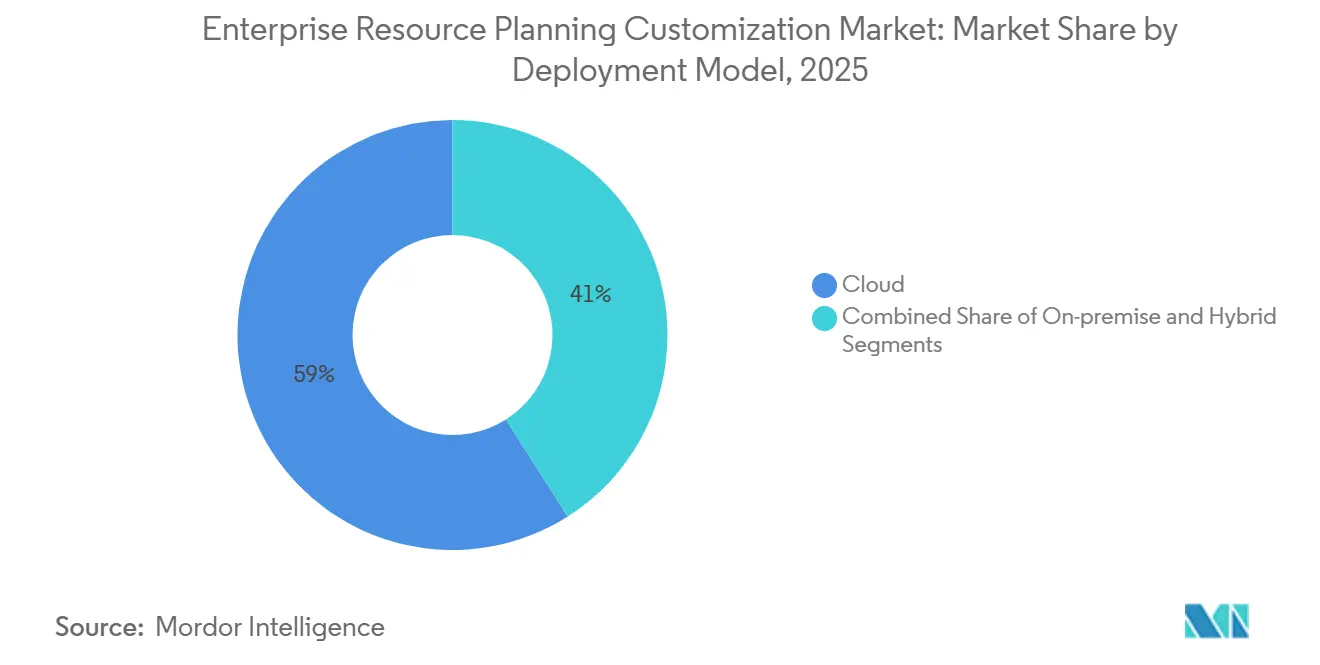
Cloud deployments accounted for 59% of the Enterprise Resource Planning Customization Services market share in 2025 and are on track for a 14.10% CAGR through 2031. The shift reflects demand for evergreen functionality, built-in AI, and consumption-based pricing that lowers total cost of ownership. Enterprises integrate low-code platforms within cloud ecosystems, trimming development cycles by up to 70% and freeing scarce developer capacity. However, hybrid estates persist where latency-sensitive operations or data-sovereignty mandates require local hosting, adding integration overhead.
Across industries, organizations adopting cloud ERP treat custom code as a liability, pushing extensions to platform-as-a-service layers that preserve upgrade paths. This approach reduces technical debt but introduces multi-vendor licensing complexity, prompting the rise of FinOps centers that forecast, monitor, and optimize spend. The Enterprise Resource Planning Customization Services market size for cloud-related services is therefore expanding faster than for on-premise work, even as clients demand stricter service-level guarantees and automated regression testing ahead of each biannual release.

By Enterprise Size – Subscription Economics Fuel SME Momentum
Large enterprises accounted for 61.50% of the Enterprise Resource Planning Customization Services market in 2025, reflecting multi-entity environments and deep customization backlogs. Their optimization committees now prioritize business-value scoring to curb customization sprawl and direct investment toward AI-driven process automation. In contrast, SMEs are forecast to register a 13.90% CAGR, driven by subscription ERP bundles that pair core financials with plug-and-play industry verticals.
SMEs often run lightweight CRM, e-commerce, or CAD applications outside the ERP core, making integration services a critical revenue pool. Service providers capture demand through fixed-price starter packs that bundle data migration, low-code connectors, and 90-day hyper-care. Meanwhile, large enterprises negotiate outcome-based contracts that tie fees to business-process key-performance indicators, signaling a maturing buyer appetite across the Enterprise Resource Planning Customization Services market.
By End-Use Industry – Healthcare Surges on Interoperability Mandates
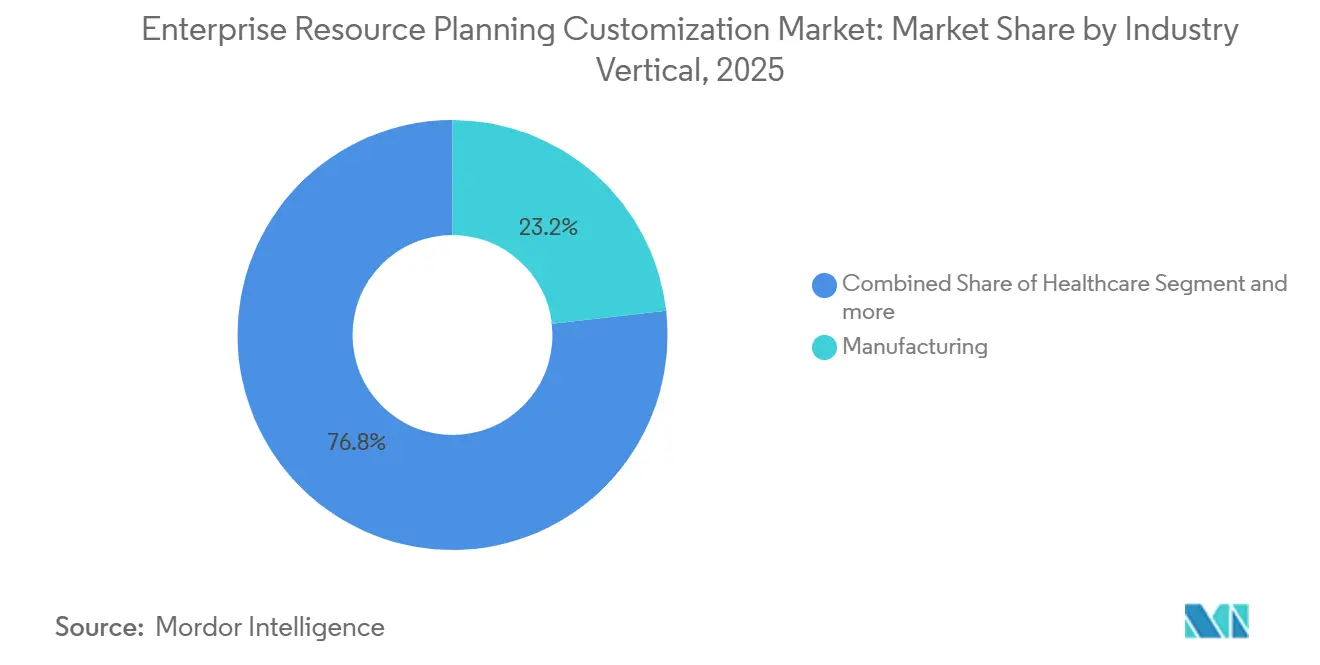
Manufacturing retained the largest slice, 23.20%, of the Enterprise Resource Planning Customization Services market share in 2025 as companies embed predictive maintenance and supply-chain visibility into core transactional flows. Yet healthcare is the fastest-growing vertical, with a forecast 17.00% CAGR, underpinned by electronic health record interoperability, patient privacy regulations, and workforce planning complexity. A federal healthcare modernization program covering more than 9 million veterans exemplifies demand for large-scale ERP-EHR integration and AI-enabled clinical workflows.
The financial services, retail, and telecom sectors are also accelerating spending, seeking real-time risk analytics, omnichannel inventory insights, and subscription billing engines. Public-sector entities emphasize data-residency compliance, FedRAMP accreditation, and zero-trust security architectures. Collectively, these dynamics diversify revenue streams and cement industry specialization as a cornerstone strategy for vendors competing within the Enterprise Resource Planning Customization Services market.
Geography Analysis
North America Enterprise Resource Planning Customization Market
North America accounted for 35.70% of the Enterprise Resource Planning Customization Services market in 2025, supported by mature cloud adoption, stringent federal modernization mandates, and a dense ecosystem of global systems integrators. Federal agencies evaluate business-case economics, enforce shared-responsibility security models, and require continuous monitoring of cloud-hosted ERP systems. Contract wins surrounding national health-record modernization and defense logistics confirm the region’s appetite for large-scale, AI-enabled customizations.
APAC Enterprise Resource Planning Customization Market
Asia-Pacific is projected to expand at a 14.80% CAGR to 2031 as sovereign-cloud policies in Australia, India, and Singapore spur localized hosting, encryption, and compliance tooling. Rapid growth in public-cloud revenue, manufacturing offshoring, and digital banking adoption fuels spending on tailored workflows and integration accelerators. Nevertheless, legacy entanglement and specialist talent shortages often trigger hybrid rollouts that phase core-system migrations across multiple budget cycles.
EMEA and South America Enterprise Resource Planning Customization Market
Europe shows steady, if moderated, growth driven by GDPR alignment, industrial automation, and impending end-of-support deadlines for incumbent ERP releases. A significant consultant shortfall inflates labor rates and lengthens project timelines, especially in Germany, France, and the United Kingdom. Northern markets emphasize cloud-native extensions and analytics, while Southern Europe leans on phased, budget-constrained transformations. Emerging regions such as South America, the Middle East, and Africa generate incremental demand, though infrastructure gaps and currency volatility temper near-term scale.
Competitive Landscape
The Enterprise Resource Planning Customization Services market remains moderately fragmented. Global systems integrators, including Accenture, Deloitte, Tata Consultancy Services, Infosys, and Capgemini, compete on AI enablement, industry specialization, and breadth of managed services. Capgemini’s USD 3.3 billion acquisition of WNS created a combined platform for agentic-AI-powered intelligent operations, targeting EUR 100-140 million in revenue synergies by 2027.
Tata Consultancy Services’ five-year agreement with a leading ERP vendor to overhaul internal IT illustrates a pivot toward co-innovation hubs focused on generative AI, data clouds, and customer experience. Strategic themes center on outcome-based pricing, low-code accelerators, and proprietary migration frameworks that automate up to 70% of code remediation. Indian heritage firms derive roughly 35% of revenue from custom application maintenance across hybrid estates, solidifying their role in cost-optimized delivery.
Niche entrants such as Legacyleap leverage generative AI to modernize legacy applications within days, raising competitive intensity in the technical-debt remediation niche. Overall, technology differentiation and vertical IP outweigh pure labor-arbitrage plays, signaling the maturation of the Enterprise Resource Planning Customization Services market.
Enterprise Resource Planning Customization Industry Leaders
-
Accenture plc
-
Deloitte Touche Tohmatsu Limited
-
Tata Consultancy Services Limited
-
Capgemini SE
-
International Business Machines Corporation
- *Disclaimer: Major Players sorted in no particular order
Enterprise Resource Planning Customization Market Companies Covered in this Report
- Accenture plc
- Deloitte Touche Tohmatsu Limited
- Capgemini SE
- Tata Consultancy Services Limited
- Infosys Limited
- International Business Machines Corporation
- Cognizant Technology Solutions Corporation
- Wipro Limited
- HCL Technologies Limited
- Atos SE
- DXC Technology Company
- Tech Mahindra Limited
- NTT DATA Corporation
- CGI Inc.
- Larsen and Toubro Infotech Ltd (LTI Mindtree)
- EPAM Systems Inc.
- Rackspace Technology Inc.
- Hitachi Consulting Co., Ltd.
- Syntax Systems Ltd.
- Vision33 Inc.
Recent Industry Developments in Enterprise Resource Planning Customization Market
- March 2026: Accenture Federal Services secured a 4.5-year contract to modernize U.S. Department of Veterans Affairs health records, replacing legacy VistA with Oracle Health EHR for over 9 million veterans.
- November 2025: Tata Consultancy Services signed a five-year agreement with SAP to streamline SAP’s IT operations and expand AI capabilities through four dedicated centers of excellence.
- October 2025: Capgemini closed its USD 3.3 billion cash acquisition of WNS, forming a global leader in agentic-AI-powered intelligent operations with targeted EUR 50-70 million cost synergies by 2027.
- October 2025: Infosys won a GBP 1.2 billion, 15-year contract to implement the Future NHS Workforce Solution for 1.9 million employees, embedding AI-driven workforce planning tools.
Global Enterprise Resource Planning Customization Market Report Scope
The ERP Customization Services market comprises specialized services that tailor, configure, and extend standard Enterprise Resource Planning (ERP) systems to meet the unique operational, functional, and industry-specific requirements of organizations.
The Enterprise Resource Planning Customization Market Report is Segmented by Deployment Mode (On-Premise, Cloud, Hybrid), Enterprise Size (Large Enterprises, Small and Medium Enterprises), End-Use Industry (Manufacturing, Retail and E-Commerce, Banking Financial Services and Insurance, Healthcare, Information Technology and Telecom, Government and Public Sector, Other End-Use Industries), and Geography (North America, South America, Europe, Asia-Pacific, Middle East, Africa). The Market Forecasts are Provided in Terms of Value (USD).
Segmentation Overview
| On-Premise |
| Cloud |
| Hybrid |
| Large Enterprises |
| Small and Medium Enterprises |
| Manufacturing |
| Retail and E-Commerce |
| Banking, Financial Services and Insurance (BFSI) |
| Healthcare |
| Information Technology and Telecom |
| Government and Public Sector |
| Other End-Use Industries |
| North America | United States |
| Canada | |
| Mexico | |
| South America | Brazil |
| Argentina | |
| Rest of South America | |
| Europe | Germany |
| United Kingdom | |
| France | |
| Italy | |
| Spain | |
| Russia | |
| Rest of Europe | |
| Asia-Pacific | China |
| India | |
| Japan | |
| South Korea | |
| Australia | |
| Rest of Asia-Pacific | |
| Middle East | Saudi Arabia |
| United Arab Emirates | |
| Turkey | |
| Rest of Middle East | |
| Africa | South Africa |
| Nigeria | |
| Kenya | |
| Rest of Africa |
| By Deployment Mode | On-Premise | |
| Cloud | ||
| Hybrid | ||
| By Enterprise Size | Large Enterprises | |
| Small and Medium Enterprises | ||
| By End-Use Industry | Manufacturing | |
| Retail and E-Commerce | ||
| Banking, Financial Services and Insurance (BFSI) | ||
| Healthcare | ||
| Information Technology and Telecom | ||
| Government and Public Sector | ||
| Other End-Use Industries | ||
| By Geography | North America | United States |
| Canada | ||
| Mexico | ||
| South America | Brazil | |
| Argentina | ||
| Rest of South America | ||
| Europe | Germany | |
| United Kingdom | ||
| France | ||
| Italy | ||
| Spain | ||
| Russia | ||
| Rest of Europe | ||
| Asia-Pacific | China | |
| India | ||
| Japan | ||
| South Korea | ||
| Australia | ||
| Rest of Asia-Pacific | ||
| Middle East | Saudi Arabia | |
| United Arab Emirates | ||
| Turkey | ||
| Rest of Middle East | ||
| Africa | South Africa | |
| Nigeria | ||
| Kenya | ||
| Rest of Africa | ||
Key Questions Answered in the Report
What is the forecast size of the Enterprise Resource Planning Customization Services market by 2031?
It is projected to reach USD 8.17 billion by 2031, reflecting sustained demand for cloud-centric and AI-enabled customization.
Which deployment mode is growing fastest?
Cloud deployments are advancing at a 14.10% CAGR through 2031, far outpacing on-premise alternatives.
Why are healthcare organizations investing heavily in ERP customization?
Interoperability mandates with electronic health records and evolving patient-privacy regulations require tailored workflows and integrations, driving a 17.00% CAGR in healthcare spend.
How are SMEs affecting market growth?
Subscription-based ERP suites lower entry barriers, helping SMEs drive a 13.90% CAGR segment expansion while fueling demand for low-code integrations.
What is the biggest restraint facing enterprises planning ERP migration?
High switching costs and legacy technical debt combine to slow platform changes, subtracting an estimated 1.4 percentage points from forecast CAGR.
Which region offers the highest growth potential?
Asia-Pacific is forecast to post a 14.80% CAGR as sovereign-cloud mandates and manufacturing expansion accelerate investment in customized ERP solutions.