
Enterprise OTT Market Size and Share
Market Overview
| Study Period | 2020 - 2031 |
|---|---|
| Market Size (2026) | USD 16.69 Billion |
| Market Size (2031) | USD 24.97 Billion |
| Growth Rate (2026 - 2031) | 8.38 % |
| Fastest Growing Market | Asia-Pacific |
| Largest Market | North America |
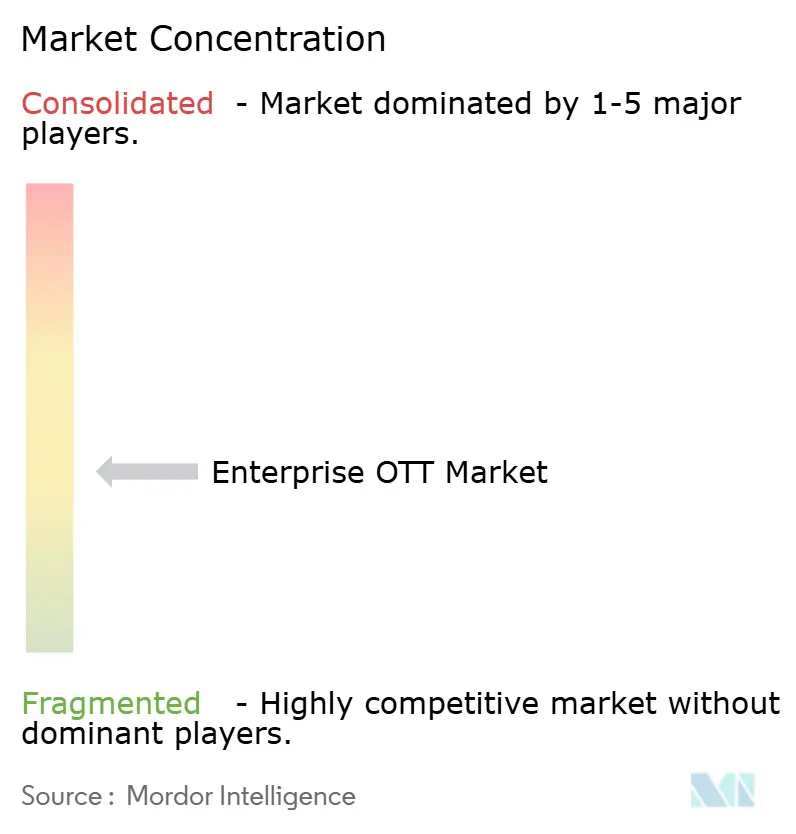
| Market Concentration | Medium |
Major Players *Disclaimer: Major Players sorted in no particular order Image © Mordor Intelligence. Reuse requires attribution under CC BY 4.0. | |
Enterprise OTT Market Analysis by Mordor Intelligence
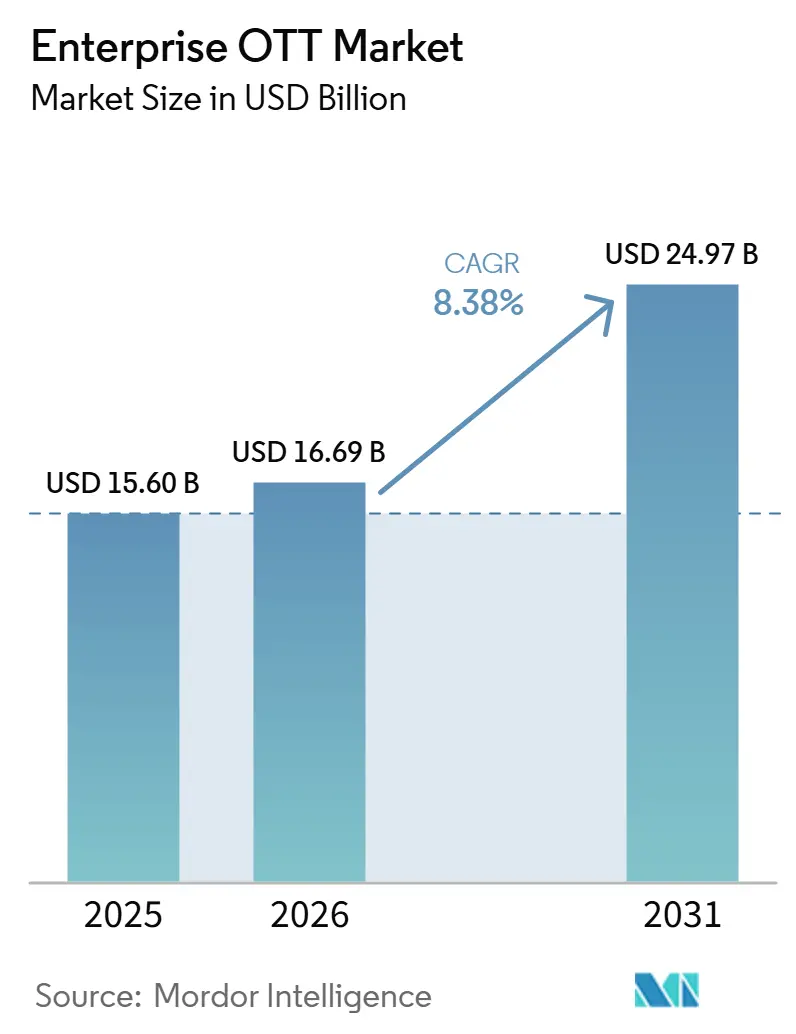
The enterprise OTT market size is projected to be USD 15.60 billion in 2025, USD 16.69 billion in 2026, and reach USD 24.97 billion by 2031, growing at a CAGR of 8.38% from 2026 to 2031. The market is moving deeper into core enterprise operations as organizations in education, healthcare, financial services, and retail treat managed video delivery as part of daily infrastructure. The enterprise OTT market is also increasingly distinct from consumer streaming, as buyers now place greater weight on identity integration, access control, governance workflows, and audit readiness. Product competition is tightening as specialized video platforms add AI tools and broader workflow support, while unified communications suites keep adding stronger live-broadcast features within existing enterprise software environments. This keeps budgets active for upgrades, but it also shortens the time vendors have to defend feature gaps with narrow point solutions. The enterprise OTT market still faces friction from integration work and data governance demands, yet those same barriers are raising qualification standards and creating space for vendors with deeper compliance and regional delivery capabilities.
Key Report Takeaways
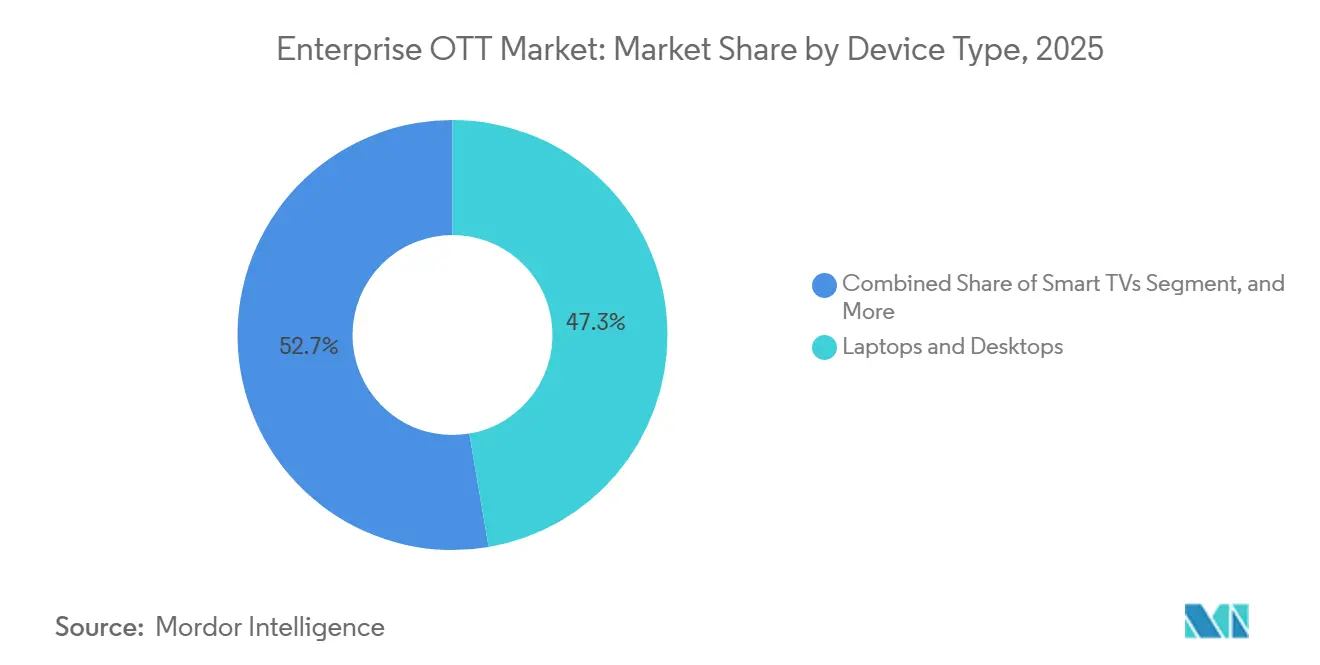
- By device type, laptops and desktops accounted for 47.31% of the enterprise OTT market share in 2025, while smart TVs are projected to grow at 8.82% through 2031.
- By streaming type, live streaming led the enterprise over-the-top (OTT) market with a 64.76% share in 2025 and is projected to record the highest growth at a 9.48% CAGR through 2031.
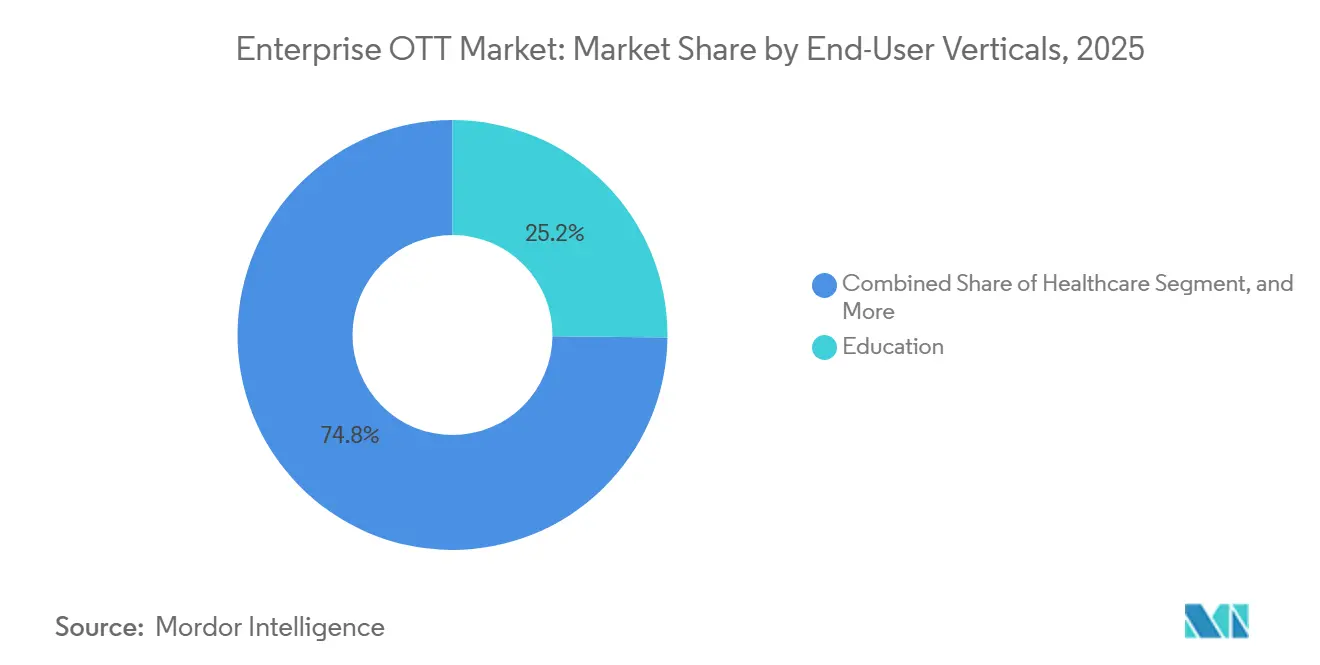
- By end-user vertical, education accounted for 25.19% of the market in 2025, while healthcare is expected to expand at an 8.91% CAGR through 2031.
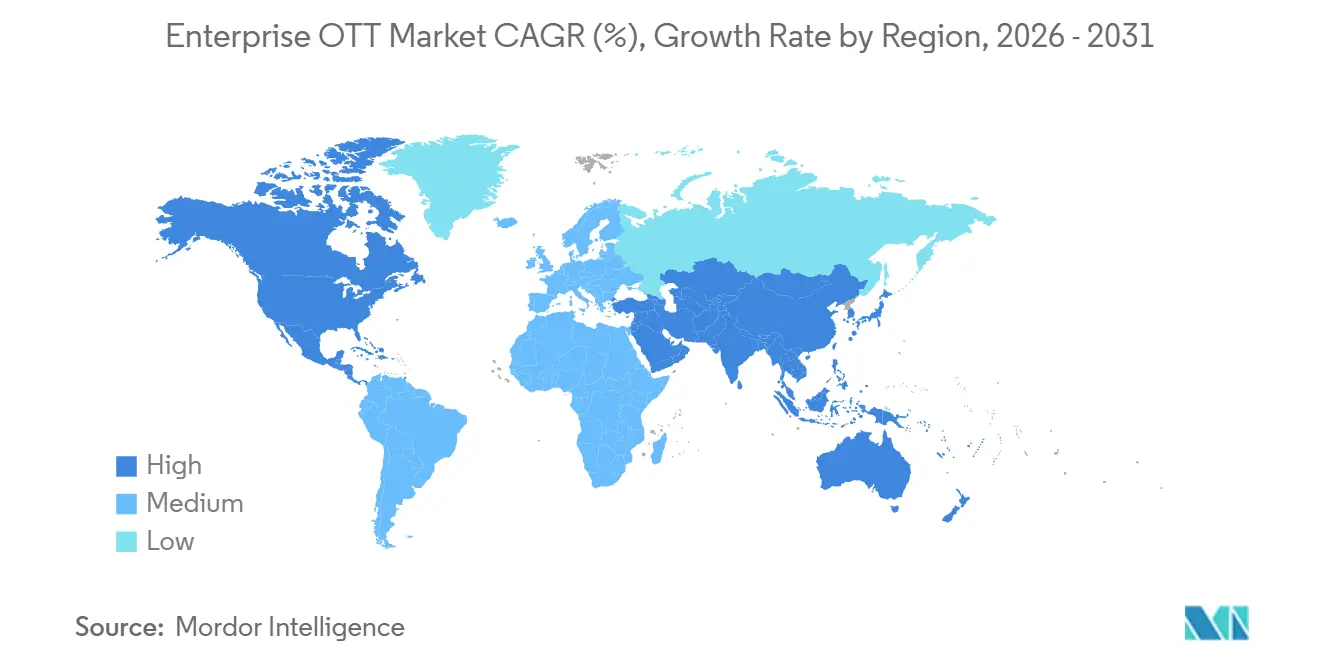
- By geography, North America held 38.62% of the market in 2025, while Asia-Pacific is projected to grow at a 9.24% CAGR through 2031.
Note: Market size and forecast figures in this report are generated using Mordor Intelligence’s proprietary estimation framework, updated with the latest available data and insights as of January 2026.
Market Trends and Insights
Drivers Impact Analysis of Enterprise OTT Market*
| Driver | (~) % Impact on CAGR Forecast | Geographic Relevance | Impact Timeline |
|---|---|---|---|
| Rising Demand for Secure Internal Video Communications | +2.4% | Global, with strongest concentration in North America and Europe | Medium term (2-4 years) |
| Growing Adoption of Cloud-Based Employee Training Platforms | +1.7% | Global, particularly North America, Europe, and Asia-Pacific | Medium term (2-4 years) |
| Higher Monetization of Premium Corporate Content | +1.1% | North America and Europe | Long term (≥ 4 years) |
| Expansion of Hybrid Work and Distributed Workforce Models | +1.0% | Global, with concentrated early gains in North America and Western Europe | Short term (≤ 2 years) |
| Rising Use of OTT Platforms in Regulated Verticals | +0.9% | North America, Europe, and growing Asia-Pacific markets | Medium term (2-4 years) |
| AI-Powered Personalization and Searchable Video Libraries | +0.6% | Global, early gains in North America and Western Europe | Long term (≥ 4 years) |
| Source: Mordor Intelligence | |||
Rising Demand for Secure Internal Video Communications
The enterprise OTT market is benefiting from a sharper security gap between purpose-built enterprise video systems and consumer-grade streaming or conferencing tools. Buyers handling executive updates, sensitive internal announcements, compliance communication, and confidential operational briefings are asking for stronger encryption, single sign-on integration, role-based permissions, and durable audit trails. That requirement makes enterprise video procurement less about convenience and more about risk control across large user populations. Healthcare has become a strong example because the 2026 HIPAA Security Rule update raised the baseline for encryption and multifactor authentication in systems that process protected health information, which pushes video deployments toward platforms with stronger compliance architecture.[1]Medcurity, “HIPAA Compliance for Telehealth 2026: A Provider's Playbook,” Medcurity, MEDCURITY.COM Similar pressures are evident in financial services, legal environments, and public sector settings, where recordkeeping, access discipline, and zero-trust design matter as much as stream quality. As a result, the enterprise over-the-top (OTT) market is seeing security shift from a supporting feature to the primary factor shaping vendor selection.
Growing Adoption of Cloud-Based Employee Training Platforms
The enterprise OTT market continues to gain momentum as employee learning programs shift to cloud-based video delivery models. Training teams are using video for onboarding, compliance modules, product education, and recurring internal certification because those formats scale more easily across locations and work schedules. This pattern has become more durable as enterprises try to deliver searchable learning content that employees can access across devices without weakening access controls. Kaltura’s launch of Avatar Video Production Studio in May 2026 demonstrated how AI-assisted production can reduce content creation time and enable learning teams to expand output without matching increases in staff or studio resources. That shift does not reduce platform spending because larger content libraries still need storage, transcoding, delivery, and management features at enterprise scale. The enterprise OTT market therefore benefits not only from more users but also from more video assets passing through each deployment.
Higher Monetization of Premium Corporate Content
The enterprise OTT market is also expanding as organizations now treat proprietary video content as a revenue source rather than a support expense. Professional services firms, certification bodies, associations, and specialized training providers are building subscription, gated-access, and premium-event models around content that already resides in enterprise knowledge systems. This changes the purchase logic because platform spending can now be linked to direct commercial return, not only to internal communications efficiency. Brightcove’s 2025 strategic reset under Bending Spoons reflected that direction by placing stronger emphasis on AI-supported engagement and a renewed platform roadmap for enterprise and media customers. As monetization features improve, some enterprise video deployments begin to resemble light media distribution environments rather than closed internal portals. That overlap is expanding the addressable scope of the enterprise OTT market across sectors that host valuable expert content and recurring training demand.
Expansion of Hybrid Work and Distributed Workforce Models
The enterprise OTT market has gained further support from hybrid work patterns that now shape how internal communication is planned and delivered. Enterprises need live and recorded video that can reach office staff, remote workers, field teams, and international operations without creating uneven access or confusing user journeys. This makes asynchronous playback, searchable archives, and reliable live-event distribution more important than they were when communication stayed within physical sites. Cisco’s InfoComm 2026 updates showed how workplace hardware and collaboration systems are being tuned for this environment across Microsoft Teams, Zoom, and Google Meet, which confirms that video is now expected to work across a broader enterprise device and room footprint.[2]Cisco Systems, “Extending the Agentic Workplace to Every Meeting Platform,” Webex Blog, WEBEX.COM The pressure on standalone vendors rises as bundled platforms improve, but the overall need for stronger enterprise video infrastructure becomes more evident. In that setting, the enterprise OTT market continues to grow as distributed work increases both the frequency and the strategic importance of managed video communication.
Restraints Impact Analysis of Enterprise OTT Market*
| Restraint | (~) % Impact on CAGR Forecast | Geographic Relevance | Impact Timeline |
|---|---|---|---|
| Data Privacy and Content Security Compliance Burden | -1.5% | Global, strongest in Europe (GDPR) and North America (HIPAA, CCPA) | Medium term (2-4 years) |
| Integration Complexity With Enterprise IT and Identity Systems | -0.9% | Global, more acute in mid-sized enterprise segments | Short term (≤ 2 years) |
| Low Video Governance Maturity Across Mid-Sized Enterprises | -0.5% | Global, particularly pronounced in Asia-Pacific and South America | Long term (≥ 4 years) |
| Content Production and Platform Management Cost Pressure | -0.3% | Global, most pronounced in budget-constrained verticals | Medium term (2-4 years) |
| Source: Mordor Intelligence | |||
Data Privacy and Content Security Compliance Burden
The enterprise OTT market is helped by compliance pressure, but it is also slowed by the cost and complexity of meeting that pressure across multiple frameworks. Enterprises in healthcare, finance, education, and government often need a combination of encryption controls, residency options, access policies, logging, and internal review processes before a deployment can expand. Large organizations can usually fund that effort, but smaller and regional buyers may postpone platform migration because legal review, IT validation, and policy mapping take longer than the budget cycle allows. Europe remains especially sensitive because data residency expectations continue to shape vendor choice and narrow the set of acceptable hosting models for many enterprise buyers. In practice, this creates a two-speed pattern in which larger institutions move toward purpose-built platforms, while smaller ones keep older or less well-governed tools in place for longer. The enterprise OTT market, therefore, grows more slowly in parts of the mid-market where compliance obligations rise faster than implementation readiness.
Integration Complexity With Enterprise IT and Identity Systems
The enterprise OTT market also faces delays when platforms must integrate into complex identity, learning, content, and collaboration environments before procurement can proceed. Enterprises often expect video systems to work smoothly with identity providers, learning management systems, content repositories, and communication suites from the first phase of deployment. That expectation increases the amount of configuration, API work, testing, and long-term maintenance required for each rollout. Kaltura’s April 2026 native integrations for Adobe Experience Manager, WordPress, and Drupal reflected how important this issue has become, as vendors seek to reduce friction by connecting video intelligence directly into the systems enterprises already use. Even so, fragmented IT stacks still cause delays, especially in organizations that combine legacy applications with newer cloud layers across multiple business units. This means the enterprise OTT market can face slower conversion from demand to signed deployment even when budget and use cases are already in place.
*Our forecasts treat driver/restraint impacts as directional, not additive. The impact forecasts reflect baseline growth, mix effects, and variable interactions.
Enterprise OTT Market Segment Analysis
By Device Type:
Managed Workstations Stay Central While Smart TVs Expand Internal Broadcast UseLaptops and desktops accounted for 47.31% of the market in 2025, keeping this category at the center of enterprise video consumption. That position reflected the fact that most secure internal viewing still happens on managed workstations tied to enterprise identity, browser policy, and network controls. The enterprise OTT market has long relied on this device base because it aligns with the governance and access requirements that drive procurement in regulated, large-scale corporate settings. For many organizations, the desktop environment remains the easiest place to enforce authentication, logging, and policy compliance without changing user behavior too sharply. This also helps explain why the enterprise OTT industry still relies on the corporate workstation as the primary viewing layer, even as device diversity expands.
Smartphones and tablets remain important because field teams, retail staff, and mobile healthcare workers increasingly need access to training and internal updates outside the traditional desk environment. Other device types, including conferencing hardware and dedicated media players, hold a smaller share but are well-suited to settings where ambient communication supports operations across physical sites. Smart TVs are projected to grow at an 8.82% CAGR through 2031, making them the fastest-growing device segment in the enterprise OTT market. Cisco’s 2026 workplace hardware updates and Panopto’s certified PTZ camera launch both point to a broader shift toward room-based and large-format enterprise viewing that supports training, events, and internal broadcasting without the need for heavy studio setups.[3]Panopto, “Panopto and Epiphan Video Launch First PTZ Camera Certified as a Panopto Remote Recorder,” Panopto, PANOPTO.COM As that hardware ecosystem matures, the enterprise OTT market is likely to see greater demand from meeting rooms, briefing centers, classrooms, and operational facilities that use video as a shared-screen experience rather than a personal one.



By Streaming Type:
Live Delivery Anchors Current Demand While On-Demand Depth Builds Long-Term UtilityLive streaming was the leading format with a share of 64.76% in 2025 and is projected to expand at a 9.48% CAGR through 2031, making it both the largest and the fastest-growing stream type. That pattern is notable because the enterprise OTT market is not only growing from archived content libraries; real-time communication needs are also driving it. Executive town halls, internal product launches, compliance briefings, and clinical or technical training sessions often require synchronous participation, keeping live delivery at the core of deployment planning. The enterprise OTT market size for live workflows continues to benefit from the fact that organizations want secure, high-quality broadcast experiences without relying on public consumer tools. This keeps investment focused on low-latency delivery, audience controls, analytics, and scalable access across large internal events.
On-demand streaming still holds strong strategic value because it turns each event or training module into a reusable knowledge asset that can be indexed, searched, and redistributed. That slower-burn value matters in onboarding, compliance education, internal knowledge transfer, and professional development, where content remains useful long after the first viewing window ends. Kaltura’s content management integrations in April 2026 show how vendors are trying to embed on-demand video intelligence directly into existing publishing systems, rather than asking buyers to rebuild their content environment from scratch. Other streaming formats remain smaller, but they show how the enterprise OTT industry is blurring the line between live participation and archived access. Over time, the enterprise OTT market is likely to reward platforms that treat live and on-demand content as connected parts of a single, managed workflow rather than separate products.
By End-User Verticals:
Education Holds The Largest Position While Healthcare Advances On Compliance NeedsEducation accounted for 25.19% of the market in 2025, which made it the largest end-user vertical. That leadership reflects a long history of lecture capture, asynchronous learning, professional certification, and internal learning channels that already fit the logic of managed video delivery. The enterprise OTT market has therefore found a stable base in institutions that need recurring video production, broad audience access, and searchable archives across semesters, training cycles, and continuing education programs. Religious organizations remain smaller in revenue terms, but their needs are more advanced than the segment size suggests because large congregations and distributed communities often require high-reliability live streaming, multilingual support, and member access control. Retail and e-commerce also form a recurring demand pool because training needs are closely tied to store networks, employee turnover, and product education, rather than solely to technology refresh cycles.
Healthcare is projected to grow at a 8.91% CAGR through 2031, making it the fastest-growing vertical in the enterprise OTT market. The growth stems from tighter security requirements for protected health information, along with broader use of video for staff education, compliance communication, and institutional knowledge transfer. Gakken Medical Support’s July 2026 launch of Gakken Movie Share in Japan demonstrated how hospital training sessions are being converted into managed e-learning modules with viewership tracking and testing, broadening healthcare use beyond direct patient-facing video. Banking, financial services, and insurance remain strategically active as well because internal communication and compliance learning require protected content delivery and clear viewer control in large organizations. In that sense, the enterprise OTT market is widening across verticals where governance is as important as content reach.
Geography Analysis
North America Enterprise OTT Market
North America accounted for 38.62% of the enterprise OTT market in 2025, maintaining its leading position. The United States accounted for most of that demand because large enterprises there continue to require video systems that connect cleanly with major workplace software, identity environments, and internal training stacks. Procurement in the region still favors vendors that can deliver mature cloud infrastructure, reliable compliance support, and broad deployment experience across complex organizations. Canada adds demand through bilingual communication requirements and institutional use cases that place value on controlled enterprise delivery. Mexico remains relevant through manufacturing and retail networks that require workforce training across distributed sites, making adaptive streaming and dependable access especially important.
Europe Enterprise OTT Market
Europe ranked second in the enterprise over-the-top (OTT) market in 2025. The region is shaped heavily by data residency and privacy expectations, which have pushed buyers to look more closely at local hosting options, sovereign cloud models, and demonstrable governance controls. Germany, the United Kingdom, and France lead adoption because of their large enterprise bases and stronger concentration of regulated industries that depend on training, recordkeeping, and internal communication at scale. Smaller European markets are also opening up as digitalization spreads into more mid-sized organizations and broadens the reachable buyer base for managed video platforms.
APAC, MEA and South America Enterprise OTT Market
Asia-Pacific is projected to grow at a 9.24% CAGR through 2031, which makes it the fastest-growing regional segment in the enterprise OTT market. Growth in the region is supported by broad enterprise digitalization across China, India, Japan, and South Korea, with different countries moving at different speeds and under different compliance conditions. Japan stands out because domestic hosting expectations are becoming more visible in video procurement, and the April 2026 partnership between Sakura Internet and J-Stream demonstrated how government-certified cloud infrastructure can serve as a practical entry requirement in regulated environments. South Korea is also active in enterprise video adoption across banking and large business groups, particularly where AI-enhanced internal media workflows are being layered into secure communication systems. The Middle East is growing through smart economy programs and workplace modernization, while Africa and South America are expanding from smaller bases as broadband reach and enterprise digitalization improve. Across all three areas, the enterprise OTT market is becoming increasingly attractive as regional buyers shift from occasional streaming use to governed, repeatable enterprise deployments.

Competitive Landscape
The enterprise OTT market is moderately fragmented, with specialized vendors competing against larger enterprise software incumbents that bundle video into broader suites. Pure-play providers such as Brightcove, Kaltura, Panopto, Haivision, and Wowza remain relevant because they offer deeper video-specific capabilities in governance, delivery, search, recording, and workflow control. At the same time, Microsoft Teams and Cisco Webex continue to narrow the feature gap by extending higher-quality broadcasting and room-based collaboration into software estates that many enterprises already license. This leaves the enterprise OTT market in a position where product depth and procurement simplicity are constantly pulling buyers in different directions. Vendors that can support enterprise-grade compliance while reducing deployment friction are in the strongest position.
Kaltura has been one of the clearest examples of strategic expansion in the enterprise OTT market. In March 2026, the company signed a definitive agreement to acquire PathFactory for approximately USD 22 million, which extended its position from video delivery into AI-driven content intelligence and engagement automation. Its May 2026 launch of Avatar Video Production Studio pushed that direction further by helping enterprises produce more video content from internal knowledge and presentation material. These moves show how the enterprise OTT market is moving beyond storage and playback toward broader knowledge workflow support.
Infrastructure and hardware partnerships are also shaping competition across the enterprise over-the-top (OTT) market. Panopto’s certified camera partnership with Epiphan in May 2026 reduced recording complexity in education and professional environments, while Haivision’s 2026 Makito launch reinforced its role in mission-critical live video transport.[4]Haivision Systems, “Haivision Makito ONE Redefines Video Contribution,” Haivision, HAIVISION.COM Akamai’s July 2026 recognition of edge distribution platforms also underscored that delivery quality remains a durable differentiator when audiences are spread across sites and regions. Together, these developments suggest that the enterprise OTT market will continue rewarding vendors that combine secure workflow control with strong infrastructure performance and practical deployment ease.
Enterprise OTT Industry Leaders
Brightcove Inc.
Vimeo, Inc.
Kaltura, Inc.
Panopto, Inc.
Haivision Systems Inc.
- *Disclaimer: Major Players sorted in no particular order
Enterprise OTT Market Companies Covered in this Report
- Brightcove Inc.
- Vimeo, Inc.
- Kaltura, Inc.
- Panopto, Inc.
- Haivision Systems Inc.
- IBM Corporation
- Microsoft Corporation
- Cisco Systems, Inc.
- Dacast, Inc.
- Wowza Media Systems, LLC
- Muvi LLC
- JW Player, Inc.
- Akamai Technologies, Inc.
- Wistia, Inc.
- Salesforce, Inc.
- Dailymotion SA
- SproutVideo LLC
- Kollective Technology, Inc.
- YouTube LLC
- Adobe Inc.

Recent Industry Developments in Enterprise OTT Market
- July 2026: Akamai was named a Customers' Choice in the 2026 Gartner Peer Insights Voice of the Customer for Edge Distribution Platforms, validating its Adaptive Media Delivery stack as a leading infrastructure layer for enterprise OTT providers requiring globally distributed, AI-enhanced video delivery.
- July 2026: Gakken Medical Support in Japan launched Gakken Movie Share on July 1, 2026, a cloud-based video streaming service enabling hospitals to convert in-house training sessions into e-learning modules with viewership history management and compliance testing, targeting healthcare enterprise OTT in the Asia-Pacific institutional training segment.
- June 2026: Kaltura was named a Leader in the 2026 Aragon Research Globe for Enterprise Video following acquisitions of eSelf.ai and PathFactory and multiple 2026 product launches, including the Avatar Video Production Studio, Avatar SDK, and Agentic Revenue Engagement suite, advancing Kaltura's positioning as an agentic digital experience platform.
- May 2026: Brightcove launched Prism, its most significant platform interface redesign in years, developed with input from more than 100 customers, and followed it with AI Contextual Ads and Smart Ad Breaks capabilities targeting enterprise video monetization, all within a 12-month product acceleration cycle under Bending Spoons ownership.


Global Enterprise OTT Market Report Scope
The Enterprise OTT Market comprises platforms, software, and services that enable organizations to deliver video and multimedia content directly to audiences over the internet, bypassing traditional broadcast, cable, or satellite distribution channels. Enterprise over-the-top (OTT) solutions support live and on-demand streaming for applications such as corporate communications, virtual events, employee training, customer engagement, digital marketing, education, telehealth, and religious services, while providing content management, analytics, security, and monetization capabilities.
The Enterprise OTT Market Report is Segmented by Device Type (Smartphones and Tablets, Smart TVs, Laptops and Desktops, and Other Device Types), Streaming Type (Live Streaming, On-demand Streaming, and Other Streaming Types), End-User Verticals (Education, Healthcare, Religious Organizations, Retail and E-Commerce, BFSI, and Other End-User Verticals), and Geography (North America, Europe, Asia-Pacific, Middle East, Africa, and South America). The Market Forecasts are Provided in Terms of Value (USD).
| Smartphones and Tablets |
| Smart TVs |
| Laptops and Desktops |
| Other Device Types |
| Live Streaming |
| On-demand Streaming |
| Other Streaming Types |
| Education |
| Healthcare |
| Religious Organizations |
| Retail and E-Commerce |
| BFSI |
| Other End-User Verticals |
| North America | United States |
| Canada | |
| Mexico | |
| Europe | United Kingdom |
| Germany | |
| France | |
| Spain | |
| Italy | |
| Rest of Europe | |
| Asia-Pacific | China |
| Japan | |
| India | |
| South Korea | |
| Australia | |
| Rest of Asia-Pacific | |
| Middle East | Israel |
| Saudi Arabia | |
| United Arab Emirates | |
| Rest of Middle East | |
| Africa | South Africa |
| Egypt | |
| Rest of Africa | |
| South America | Brazil |
| Argentina | |
| Rest of South America |
| By Device Type | Smartphones and Tablets | |
| Smart TVs | ||
| Laptops and Desktops | ||
| Other Device Types | ||
| By Streaming Type | Live Streaming | |
| On-demand Streaming | ||
| Other Streaming Types | ||
| By End-User Verticals | Education | |
| Healthcare | ||
| Religious Organizations | ||
| Retail and E-Commerce | ||
| BFSI | ||
| Other End-User Verticals | ||
| By Geography | North America | United States |
| Canada | ||
| Mexico | ||
| Europe | United Kingdom | |
| Germany | ||
| France | ||
| Spain | ||
| Italy | ||
| Rest of Europe | ||
| Asia-Pacific | China | |
| Japan | ||
| India | ||
| South Korea | ||
| Australia | ||
| Rest of Asia-Pacific | ||
| Middle East | Israel | |
| Saudi Arabia | ||
| United Arab Emirates | ||
| Rest of Middle East | ||
| Africa | South Africa | |
| Egypt | ||
| Rest of Africa | ||
| South America | Brazil | |
| Argentina | ||
| Rest of South America | ||


Key Questions Answered in the Report
What is the current and forecast value of enterprise OTT?
The enterprise OTT market size is projected at USD 15.60 billion in 2025, USD 16.69 billion in 2026, and USD 24.97 billion by 2031, growing at an 8.38% CAGR.
Which streaming format is growing fastest in enterprise OTT?
Live streaming is the fastest-growing format, with a projected 9.48% CAGR through 2031, while it also remains the leading streaming type by current demand.
Which end-user vertical leads enterprise OTT adoption?
Education held the largest share at 25.19% in 2025 because lecture capture, training libraries, and recurring learning workflows already align closely with managed video deployment.
Why are healthcare organizations increasing investment in enterprise video platforms?
Healthcare is projected to grow at an 8.91% CAGR through 2031 because security, encryption, authentication, and auditable training workflows have become more important in video environments.
Which region leads revenue and which region grows fastest?
North America led with 38.62% share in 2025, while Asia-Pacific is projected to record the fastest growth at a 9.24% CAGR through 2031.
What is shaping competition among platform vendors?
Competition is being shaped by deeper AI features, stronger compliance tools, broader integrations, and pressure from bundled suites such as Microsoft Teams and Cisco Webex.
Page last updated on:





