
Energy Sector Marketing Services Market Size and Share
Market Overview
| Study Period | 2020 - 2031 |
|---|---|
| Market Size (2026) | USD 6.05 Billion |
| Market Size (2031) | USD 9.02 Billion |
| Growth Rate (2026 - 2031) | 8.32 % |
| Fastest Growing Market | Asia-Pacific |
| Largest Market | North America |
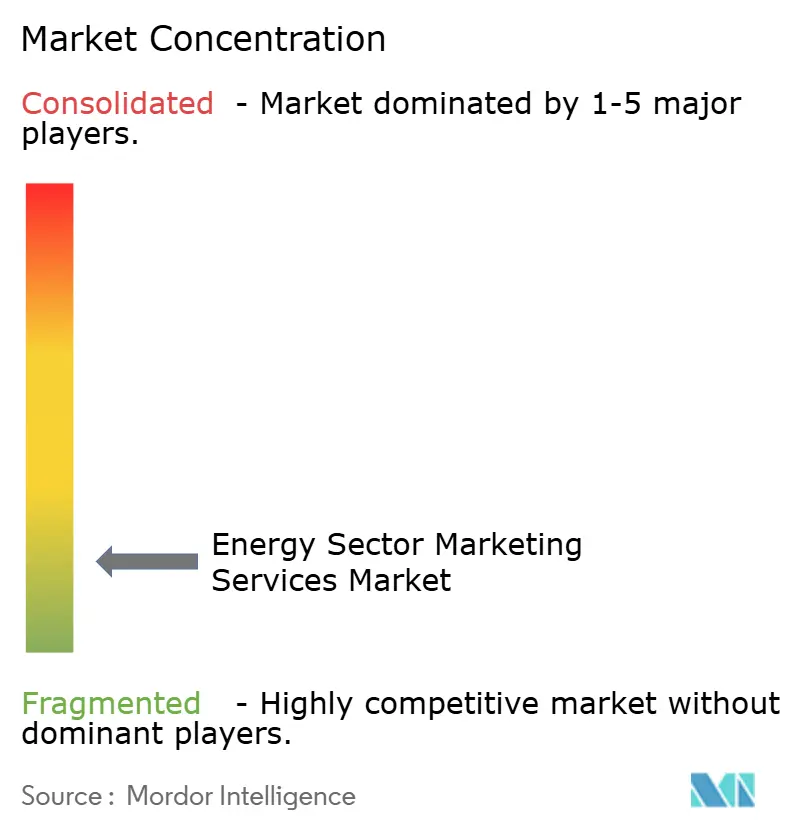
| Market Concentration | Low |
Major Players *Disclaimer: Major Players sorted in no particular order Image © Mordor Intelligence. Reuse requires attribution under CC BY 4.0. | |
Energy Sector Marketing Services Market Analysis by Mordor Intelligence
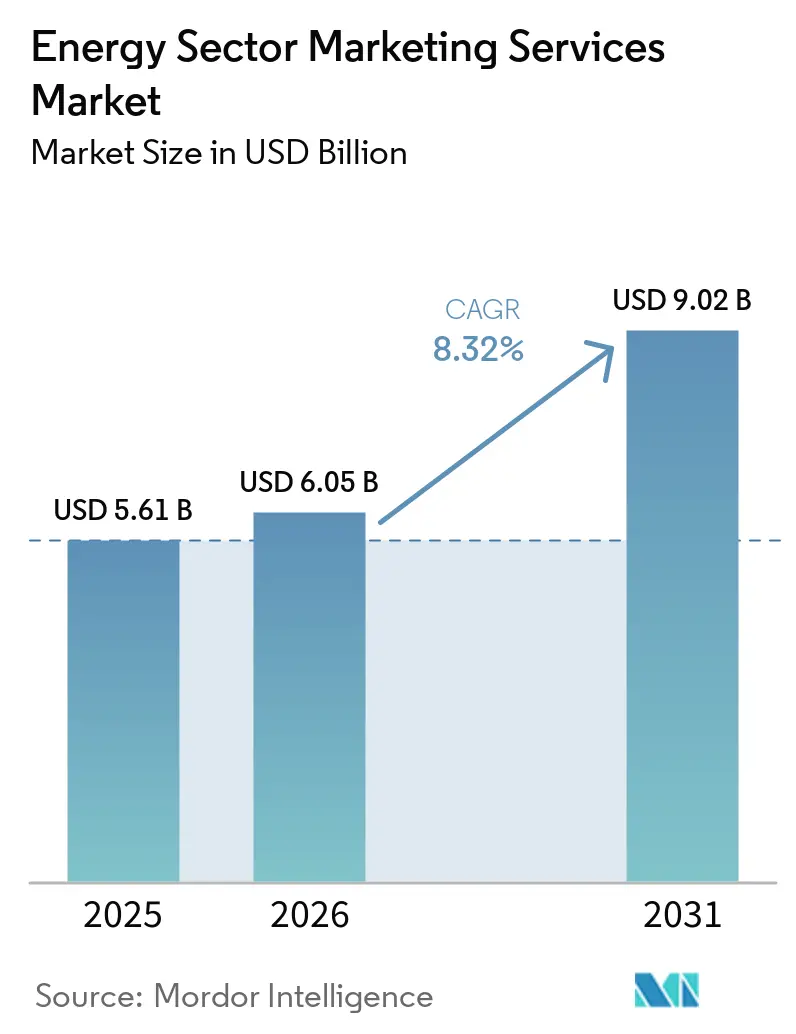
The Energy Sector Marketing Services Market size was valued at USD 5.61 billion in 2025 and estimated to expand from USD 6.05 billion in 2026 to reach USD 9.02 billion by 2031, at a CAGR of 8.32% during the forecast period 2026-2031. The market is shaped by higher investment in grids, storage, renewable generation, and customer-facing energy programs, which require sustained communication with regulators, investors, communities, and customers who may assess the same project from different perspectives. Energy companies are placing more value on clear messages that support rate cases, permit applications, project acceptance, and trust in transition plans, particularly when investment decisions affect customer costs, local land use, or the timing of infrastructure delivery. Marketing providers are also adapting their work for digital customer engagement, demand response enrollment, public discussions that develop quickly on social platforms, and information needs that arise when a customer moves between a utility website, mobile account, call center, and direct campaign. The Energy Sector Marketing Services Market is fragmented because specialist firms compete on sector knowledge, long-standing utility relationships, and regulatory literacy, while larger providers combine communications with consulting, technology, creative production, and campaign delivery. Tighter rules for environmental claims and slower utility procurement processes raise delivery costs, but they also favor providers that can document evidence, manage approvals, coordinate several internal client teams, and maintain long-term client relationships.
Key Report Takeaways
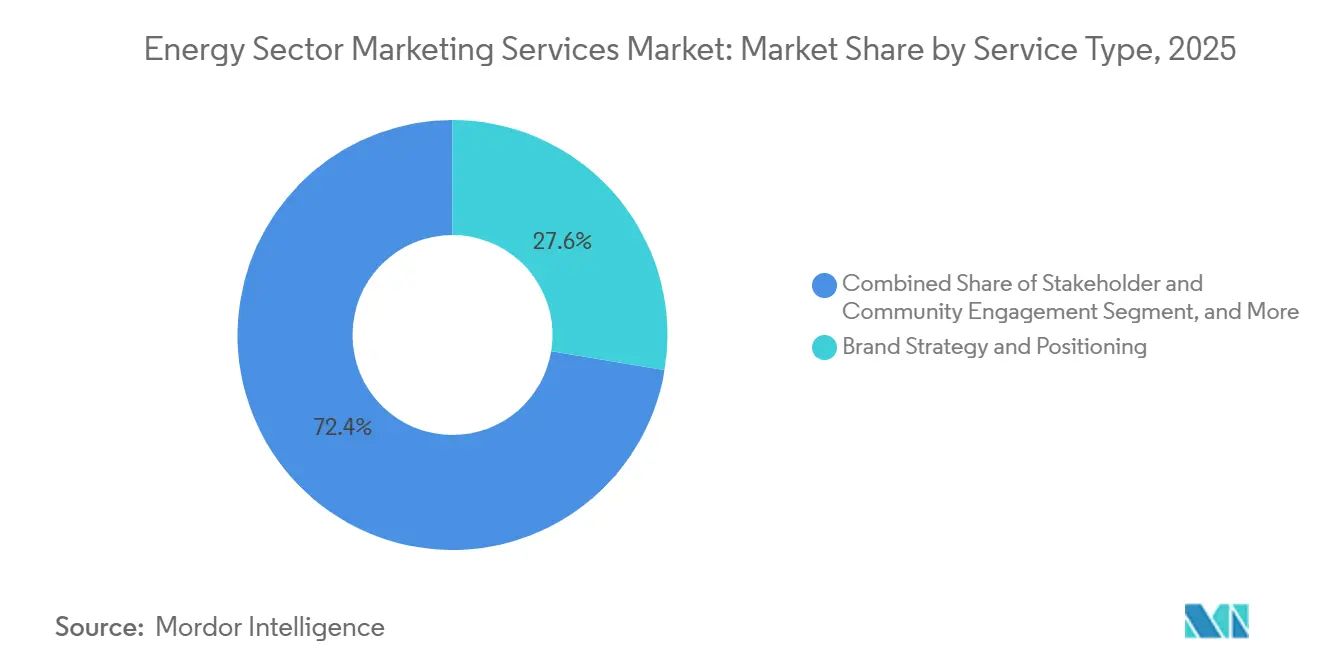
- By service type, Brand Strategy and Positioning held 27.61% of the Energy Sector Marketing Services Market in 2025, while Social Media Marketing is projected to expand at a 9.22% CAGR through 2031.
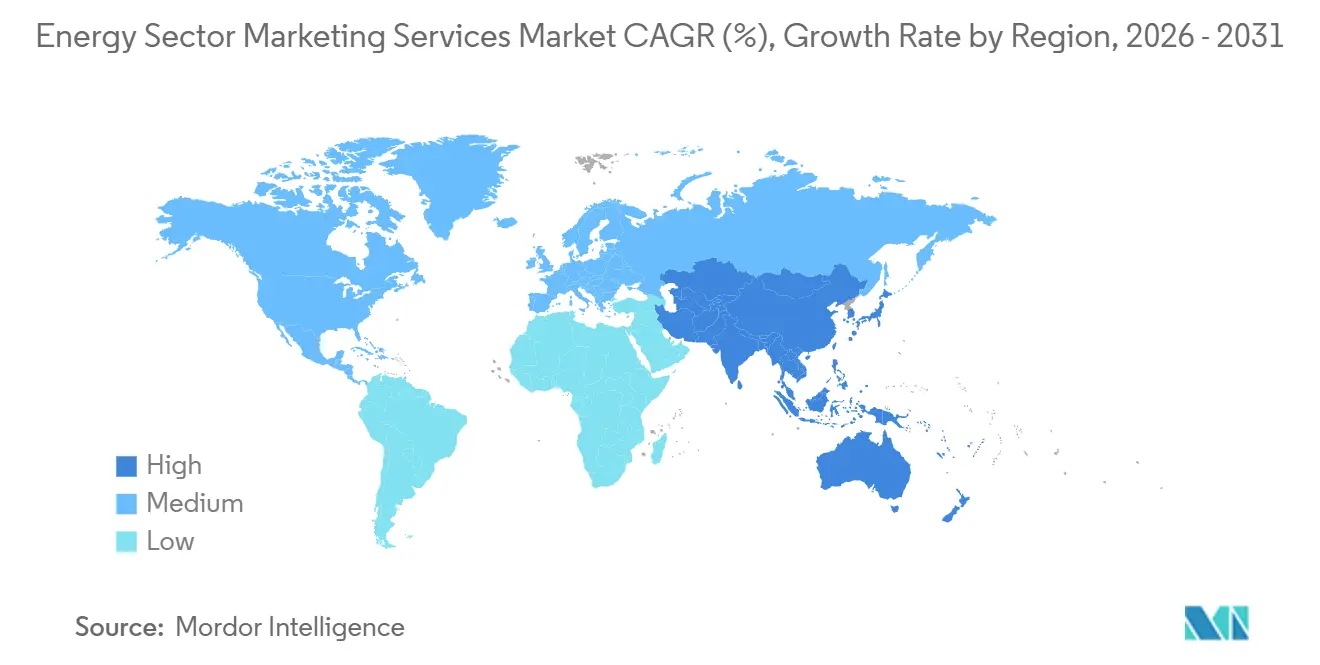
- By geography, North America held 46.80% of the global Energy Sector Marketing Services Market in 2025, while Asia-Pacific is projected to expand at a 9.31% CAGR through 2031.
Note: Market size and forecast figures in this report are generated using Mordor Intelligence’s proprietary estimation framework, updated with the latest available data and insights as of January 2026.
Market Trends and Insights
Drivers Impact Analysis of Energy Sector Marketing Services Market*
| Driver | (~) % Impact on CAGR Forecast | Geographic Relevance | Impact Timeline |
|---|---|---|---|
| Grid Modernization and Energy Transition Spending Expands Need for Specialized Narratives | +2.1% | Global, with highest intensity in North America and Europe | Medium term (2-4 years) |
| Utilities' Customer Experience Overhaul Raises Demand for Journey-Led Engagement Programs | +1.7% | North America and Europe, with spillover to Asia-Pacific | Short term (≤ 2 years) |
| Rising Demand Response and Electrification Program Enrollment Requires Performance Marketing and Education | +1.3% | North America core, with spillover to Europe and Asia-Pacific | Short term (≤ 2 years) |
| Sustainability and Transition Storytelling Becomes Core to Investor and Community Trust | +1.1% | Global, concentrated in Europe and North America | Medium term (2-4 years) |
| Generative Search Visibility Becomes a New Procurement Gatekeeper for Energy Brands | +0.8% | Global | Short term (≤ 2 years) |
| Permitting Timelines Depend Increasingly on Community Trust Architecture and Benefits Communication | +0.6% | North America, Europe, and Asia-Pacific renewable corridors | Long term (≥ 4 years) |
| Source: Mordor Intelligence | |||
Grid Modernization and Energy Transition Spending Expands Need for Specialized Narratives
Grid and energy transition spending is making communications a more central operating requirement for utilities and developers. Utilities for the Net Zero Alliance members announced plans to mobilize substantial transition investment over the coming years. Their planned spending places greater emphasis on grids and storage than on renewable generation.[1] The change increases the number of projects that require an explanation of costs, timing, reliability, local effects, and expected customer benefits. It also broadens the audience for energy communications beyond retail customers to include regulators, policymakers, landowners, investors, and local communities. The Energy Sector Marketing Services Market benefits when permitting, rate-case support, and transmission-corridor communication shift from isolated projects to multi-year programs.
Utilities' Customer Experience Overhaul Raises Demand for Journey-Led Engagement Programs
The Energy Sector Marketing Services Market is supported as utilities are treating digital engagement as a regulatory and service-performance issue rather than a secondary customer service feature. Rising household energy costs have increased customer scrutiny of infrastructure plans, service reliability, payment support, and utility explanations of why a program is being funded. Organizations need communication that explains investment programs in plain language, identifies the customer action that may be required, and helps households understand the services already available to them. Digital channels also provide a way to connect outage information, payment support, energy efficiency, electrification programs, and account guidance within a consistent customer journey instead of delivering unrelated messages from separate utility teams. This need supports the Energy Sector Marketing Services Market because utilities often require help coordinating customer data, content, media, call-center information, and outreach across several channels while maintaining an approved message. Providers that understand utility approval processes can link program communications to participation and satisfaction measures that matter in regulatory proceedings, which makes the work more durable than a single promotional campaign.
Rising Demand Response and Electrification Program Enrollment Requires Performance Marketing and Education
The Energy Sector Marketing Services Market is also supported because demand response and electrification programs require customers to understand a new service before they decide to participate. A Smart Energy Consumer Collaborative survey found that 66% of U.S. consumers were open to or already enrolled in behavioral demand response programs.[2] One utility program described by ICF exceeded its participation target and enrolled a substantial number of devices through connected television, paid search, direct mail, and in-app outreach. A second program also exceeded its target with a significant number of devices through a similar coordinated approach, showing why the sequence and combination of contact channels matter as much as the individual message.[3] These programs require attribution across digital and direct channels, follow-up when customers stop partway through enrollment, and coordination with the utility systems that confirm eligibility and device activation. The Energy Sector Marketing Services Market gains from the need for specialized education, enrollment design, customer data coordination, and reporting that allows utilities to understand which outreach approach led to completed participation.
Sustainability and Transition Storytelling Becomes Core to Investor and Community Trust
Energy companies need credible transition communications because investors, regulators, and communities evaluate claims against project activity, published evidence, and the effect of operations in the areas where projects are proposed. Messages about renewable generation, networks, nuclear assets, and emissions plans require clear documentation before they are used in customer, community, investor, or procurement campaigns. The European consumer organization BEUC identified misleading environmental claims by energy companies in a June 2026 alert to the Consumer Protection Cooperation Network and the European Commission.[4] The related legal study examined environmental claims in the EU energy sector and described the evidence needed to assess them, which makes broad statements harder to use without an established factual basis. Providers that connect campaign language with verifiable corporate data, approved internal sources, and review procedures are more useful to clients than providers focused only on creative execution. This requirement supports the Energy Sector Marketing Services Market by making claim review, stakeholder materials, evidence management, and coordination with legal and sustainability teams part of regular campaign work.
Restraints Impact Analysis of Energy Sector Marketing Services Market*
| Restraint | (~) % Impact on CAGR Forecast | Geographic Relevance | Impact Timeline |
|---|---|---|---|
| Tightening Anti-Greenwashing Rules Raise Review Costs and Claim Approval Times | -1.5% | Global, with highest burden in the EU and United Kingdom | Short term (≤ 2 years) |
| Long Sales Cycles and Multi-Stakeholder Buying Committees Slow Revenue Realization for Agencies | -1.1% | Global | Medium term (2-4 years) |
| Weak Utility Data and Digital Foundations Reduce Personalization Return on Investment | -0.8% | North America and Asia-Pacific developing markets | Medium term (2-4 years) |
| Local Opposition and Litigation Risk Can Freeze Campaigns Around Contested Projects | -0.6% | North America and Europe, project-specific | Short term (≤ 2 years) |
| Source: Mordor Intelligence | |||
Tightening Anti-Greenwashing Rules Raise Review Costs and Claim Approval Times
The Energy Sector Marketing Services Market faces added friction because campaigns that include environmental claims require more legal review and evidence before publication. Directive 2024/825 requires EU member states to transpose the rules by March 2026, and the requirements apply fully from September 2026. The directive restricts generic environmental claims when they are not supported by recognized, verifiable performance, so agencies must consider whether the wording, supporting record, and audience context are all defensible. The European Commission updated its guidance in May 2026, including clarification relevant to business-to-business communications. These rules can extend approval cycles, create more documentation work, and delay campaign launches when evidence is incomplete, review responsibilities are unclear, or claims need to be revised late in the process. They restrain the Energy Sector Marketing Services Market when clients defer or reduce campaigns, although they also increase the value of providers with formal verification processes and an established way to manage approvals.
Long Sales Cycles and Multi-Stakeholder Buying Committees Slow Revenue Realization for Agencies
Energy-sector buying decisions typically involve legal, regulatory affairs, communications, procurement, and executive teams, and each function may review a proposal through a different operating or risk lens. Each group may have different requirements for a campaign, customer program, or stakeholder engagement plan, including standards for evidence, data use, delivery timing, contract terms, and brand approval. This structure can delay contract decisions even when a client recognizes the need for communications support and has already identified a business problem that needs attention. The delay compresses billable work into a smaller part of the annual budget cycle, can raise the cost of pursuing new accounts, and can make it harder for a provider to schedule specialist teams. It is especially difficult for providers that rely on single project assignments and do not have established utility relationships, because the time spent qualifying and aligning the account may not become paid work. The Energy Sector Marketing Services Market therefore favors account models that support early engagement, framework agreements, advisory work, and ongoing relationship investment before a formal request for proposals begins.
*Our forecasts treat driver/restraint impacts as directional, not additive. The impact forecasts reflect baseline growth, mix effects, and variable interactions.
Energy Sector Marketing Services Market Segment Analysis
By Service Type:
Brand Strategy Anchors Revenue While Social Channels Accelerate GrowthBrand Strategy and Positioning held 27.61% of the Energy Sector Marketing Services Market share in 2025. Its position reflects the need for energy companies to present consistent messages to regulators, institutional investors, communities, and customers, even when those groups focus on different elements of the same investment plan. Infrastructure plans can involve rate-base expansion, offshore wind siting, transmission projects, or nuclear license extensions, and each setting brings audiences with different concerns about costs, timing, reliability, community effects, and expected benefits. Providers must align the public explanation of a project with its regulatory record, investor materials, customer communications, community engagement plans, and the technical information that supports the claims being made. Brand work is therefore tied to the credibility of an investment plan and the company’s ability to explain the practical tradeoffs involved without creating inconsistencies across channels. In the Energy Sector Marketing Services industry, it provides a foundation for campaign, content, public relations, and stakeholder engagement work, rather than acting only as a visual or advertising exercise.
Social Media Marketing is projected to expand at a 9.22% CAGR from 2026 to 2031, the fastest rate among the listed services. The Energy Sector Marketing Services Market size for this service is supported by the need to respond quickly to public discussion and reach customers through platform-native content that is timely, understandable, and relevant to a specific customer group. Utilities can use social channels to communicate with electric vehicle owners, customers eligible for demand response, and households seeking assistance information, while also addressing questions that emerge during a project, a service event, or a period of public attention. Technology-specific content gives energy companies a way to explain complex projects in accessible terms, but it must be supported by evidence because platform content can face the same environmental-claim scrutiny as other campaign materials. Creative and Content Production supports this work through detailed material for regulatory audiences and short-form content for digital audiences, while Public Relations and Communications, Stakeholder and Community Engagement, Email and Lifecycle Marketing, and Events and Experiential Marketing support permitting, customer journeys, investor meetings, and industry events. The Energy Sector Marketing Services industry is increasingly organized around connected services rather than a single campaign channel, because customers and stakeholders often receive information from several sources before they form a view of a company or project.

Geography Analysis
North America Energy Sector Marketing Services Market
North America held 46.80% of the global Energy Sector Marketing Services Market share in 2025. The United States supports this position through continued grid modernization, demand-side management programs, and customer experience initiatives that require clear explanation to several stakeholder groups. Investor-owned utilities were projected to make substantial investments in grid modernization during the forecast period. FirstEnergy announced a major capital plan, including significant transmission investment. Such capital programs create ongoing needs for customer materials, grid communications, program enrollment work, and engagement with regulators, landowners, and investors. Canada adds offshore wind communication needs, while Mexico contributes to distributed solar and electrification program marketing.
Europe and South America Energy Sector Marketing Services Market
Europe was the second-largest geography and operated under the most demanding environmental claim requirements in the Energy Sector Marketing Services Market. The September 2026 application of the Empowering Consumers rules has made evidence review central to sustainability-related campaign planning. The European Commission published a July 2026 toolbox to help member states increase public participation in renewable energy projects, making community involvement more central to project planning and permitting. Germany’s grid expansion and the United Kingdom’s offshore wind pipeline sustain community and investor communications needs, while Brazil and Chile are creating related first-generation brand-building work for developers in South America.
APAC and MEA Energy Sector Marketing Services Market
Asia-Pacific is projected to expand at a 9.31% CAGR through 2031, making it the fastest-growing regional part of the Energy Sector Marketing Services Market. India’s target of 500 GW of non-fossil capacity by 2030 creates communications needs across states and language groups, while the region’s digital audiences support project communication, education, and brand building. A 2026 study of 10 East Asia and Pacific economies found that social media engagement influenced residential energy behavior. Japan and South Korea need investor communication as integrated energy companies reposition legacy fossil portfolios, while the Middle East and Africa remain earlier-stage areas for diversification and independent power project engagement.
Competitive Landscape
The Energy Sector Marketing Services Market is fragmented, and sector experience can matter more than agency size when clients select a provider. Larger professional services firms compete through integrated consulting, communications, creative production, technology-enabled delivery, and the ability to work across several client functions. Specialist agencies compete through knowledge of utility regulation, renewable permitting, rate cases, and infrastructure investor communications, where established relationships and an understanding of formal approvals are valuable. ICF secured significant new European contracts in early 2026 to design and deliver public communication campaigns across EU member states, using technology to monitor sentiment, address misinformation, and optimize campaign performance. This work illustrates how scale, technology, and public-sector delivery capability can distinguish a provider in the Energy Sector Marketing Services Market.
Acquisitions are helping larger groups add capabilities that would take time to build internally. Accenture agreed in February 2026 to acquire Verum Partners, an infrastructure and capital projects management firm with energy expertise in South America, combining digital and AI capabilities with on-site execution leadership for energy clients. Publicis Groupe announced a definitive agreement in April 2026 to acquire 160over90 and integrate it with Publicis Sports, adding sports and culture-focused capabilities to a broader marketing platform. ICF acquired Applied Energy Group from Ameresco in January 2025, adding utility management, demand-side energy specialists, and a demand-side management platform. These moves show competition for sector knowledge, data, and the operational capabilities used in customer-program work.
Demand-side management performance marketing remains an opportunity because utilities need stronger links between outreach and customer enrollment across connected television, paid search, direct mail, and in-app channels, together with a clear process for following customers through the path from awareness to completed enrollment. Providers also have room to improve the information that energy buyers can find through AI-supported discovery tools, although energy contracting still requires detailed human review across legal, procurement, regulatory, and executive functions. Compliance creates another line of competition because utility and government requests increasingly seek structured claim verification, data handling controls, and quality processes that can be demonstrated during provider selection. New entrants may struggle when they lack documented utility references, regulatory knowledge, formal delivery processes, or experience working across the long approval cycles attached to energy infrastructure and customer programs. The Energy Sector Marketing Services Market therefore remains low in concentration despite the presence of global platforms and established specialists, and providers compete through a combination of sector expertise, evidence discipline, technology capability, and the ability to work as an embedded client partner.
Energy Sector Marketing Services Industry Leaders
-
Accenture plc
-
ICF International, Inc.
-
Publicis Groupe S.A.
-
Edelman, Inc.
-
Stagwell Inc.
- *Disclaimer: Major Players sorted in no particular order
Energy Sector Marketing Services Market Companies Covered in this Report
- Accenture plc
- ICF International, Inc.
- Publicis Groupe S.A.
- Stagwell Inc.
- Edelman, Inc.
- APCO Worldwide LLC
- FTI Consulting, Inc.
- Brunswick Group LLP
- Borshoff, LLC
- Communications Strategy Group, Inc.
- Lee Andrews Group, Inc.
- Copper Consultancy Ltd
- Freshfield Communications Ltd
- Motion Marketing Ltd
- Tamarindo Group
- KEEWest Associates
- Silverline Communications
- 97th Floor LLC
Recent Industry Developments in Energy Sector Marketing Services Market
- July 2026: The European Commission published a toolbox to support EU member states in promoting public participation in renewable energy projects, formalizing community engagement as a planning prerequisite for siting and permitting and directly expanding the billable scope for stakeholder communications agencies across the EU-27. This toolbox was foreseen in the European Grids Package of December 2025.
- June 2026: BEUC published a legal study on misleading environmental claims in the EU energy sector in partnership with KU Leuven and issued an enforcement alert to the Consumer Protection Cooperation Network and the European Commission citing green marketing claims by ENGIE, TotalEnergies, ENI Plenitude, and Shell under the Empowering Consumers Directive. The action signaled the claim-verification requirements embedded in campaign production from September 2026.
- April 2026: Publicis Groupe announced a definitive agreement to acquire 160over90, a global sports and culture-first agency, integrating it with Publicis Sports alongside its 2025 acquisitions of Adopt and Bespoke, building an expanded platform for energy companies’ sponsorship-led and culture-driven brand programs.
- February 2026: Accenture agreed to acquire Verum Partners, an infrastructure and capital projects management firm with energy-sector expertise in South America, to combine digital and advanced AI capabilities with on-site execution leadership for energy clients in Brazil and across the region.
Global Energy Sector Marketing Services Market Report Scope
Energy Sector Marketing Services Market refers to agencies, consultancies, and technology providers that deliver specialized marketing solutions for oil and gas, utilities, renewables, power, and energy-transition companies. It includes brand strategy, digital marketing, public relations, content creation, media planning, lead generation, customer engagement, and reputation management.
The Energy Sector Marketing Services Market Report is Segmented by Service Type (Brand Strategy and Positioning, Creative and Content Production, Email and Lifecycle Marketing, Events and Experiential Marketing, Public Relations and Communications, Social Media Marketing, and Stakeholder and Community Engagement) and Geography (North America, South America, Europe, Asia-Pacific, Middle East, and Africa). The Market Forecasts are Provided in Terms of Value (USD).
| Brand Strategy and Positioning |
| Creative and Content Production |
| Email and Lifecycle Marketing |
| Events and Experiential Marketing |
| Public Relations and Communications |
| Social Media Marketing |
| Stakeholder and Community Engagement |
| North America | United States |
| Canada | |
| Mexico | |
| South America | Brazil |
| Argentina | |
| Chile | |
| Colombia | |
| Rest of South America | |
| Europe | United Kingdom |
| Germany | |
| France | |
| Italy | |
| Spain | |
| Nordics | |
| Russia | |
| Rest of Europe | |
| Asia-Pacific | China |
| Japan | |
| India | |
| Australia | |
| South Korea | |
| Southeast Asia | |
| Rest of Asia-Pacific | |
| Middle East | Saudi Arabia |
| United Arab Emirates | |
| Qatar | |
| Israel | |
| Turkey | |
| Rest of Middle East | |
| Africa | South Africa |
| Nigeria | |
| Egypt | |
| Rest of Africa |
| By Service Type | Brand Strategy and Positioning | |
| Creative and Content Production | ||
| Email and Lifecycle Marketing | ||
| Events and Experiential Marketing | ||
| Public Relations and Communications | ||
| Social Media Marketing | ||
| Stakeholder and Community Engagement | ||
| By Geography | North America | United States |
| Canada | ||
| Mexico | ||
| South America | Brazil | |
| Argentina | ||
| Chile | ||
| Colombia | ||
| Rest of South America | ||
| Europe | United Kingdom | |
| Germany | ||
| France | ||
| Italy | ||
| Spain | ||
| Nordics | ||
| Russia | ||
| Rest of Europe | ||
| Asia-Pacific | China | |
| Japan | ||
| India | ||
| Australia | ||
| South Korea | ||
| Southeast Asia | ||
| Rest of Asia-Pacific | ||
| Middle East | Saudi Arabia | |
| United Arab Emirates | ||
| Qatar | ||
| Israel | ||
| Turkey | ||
| Rest of Middle East | ||
| Africa | South Africa | |
| Nigeria | ||
| Egypt | ||
| Rest of Africa | ||
Key Questions Answered in the Report
What is the Energy Sector Marketing Services Market size?
The Energy Sector Marketing Services Market was valued at USD 5.61 billion in 2025, is estimated at USD 6.05 billion in 2026, and is projected to reach USD 9.02 billion by 2031.
What is the forecast CAGR for energy-sector marketing services?
The sector is projected to expand at an 8.32% CAGR from 2026 to 2031.
Which service type held the largest share in 2025?
Brand Strategy and Positioning held 27.61% in 2025, reflecting the need for consistent communications across regulatory, investor, community, and customer audiences.
Which service is expected to expand the fastest through 2031?
Social Media Marketing is projected to expand at a 9.22% CAGR through 2031, supported by real-time engagement and targeted customer outreach.
Which region led in 2025 and which region is projected to expand fastest?
North America held 46.80% in 2025, while Asia-Pacific is projected to expand at a 9.31% CAGR through 2031.
How do environmental-claim rules affect energy communications providers?
The EU rules applying from September 2026 increase the need for documented evidence, legal review, and controlled approval processes for environmental claims.