
Employee Self-Service Portal Market Size and Share
Market Overview
| Study Period | 2020 - 2031 |
|---|---|
| Market Size (2026) | USD 6.94 Billion |
| Market Size (2031) | USD 10.55 Billion |
| Growth Rate (2026 - 2031) | 8.75 % |
| Fastest Growing Market | Asia-Pacific |
| Largest Market | North America |
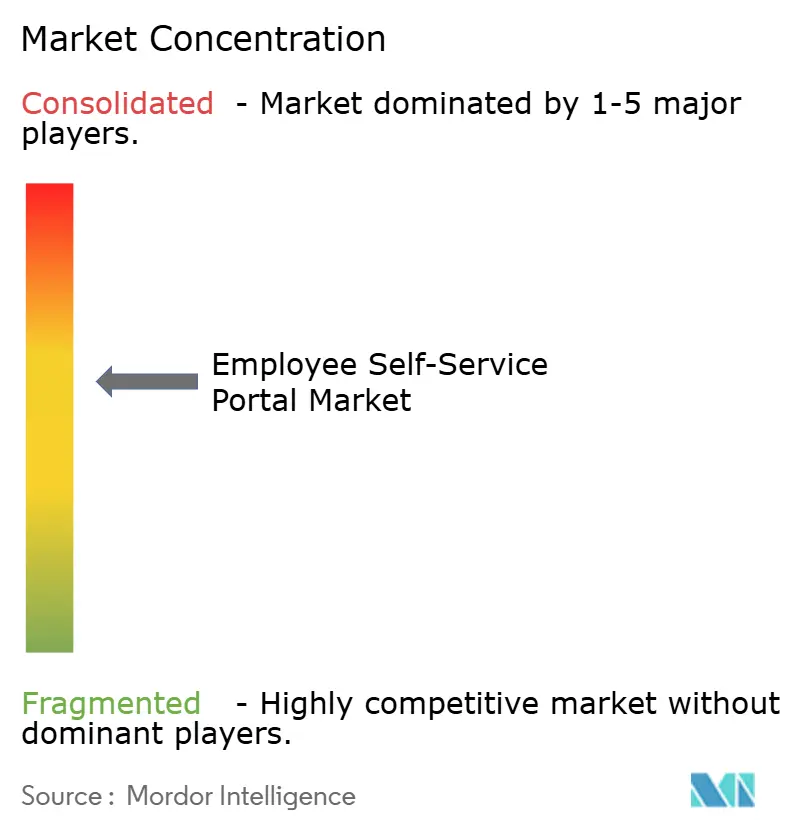
| Market Concentration | Medium |
Major Players *Disclaimer: Major Players sorted in no particular order Image © Mordor Intelligence. Reuse requires attribution under CC BY 4.0. | |
Employee Self-Service Portal Market Analysis by Mordor Intelligence
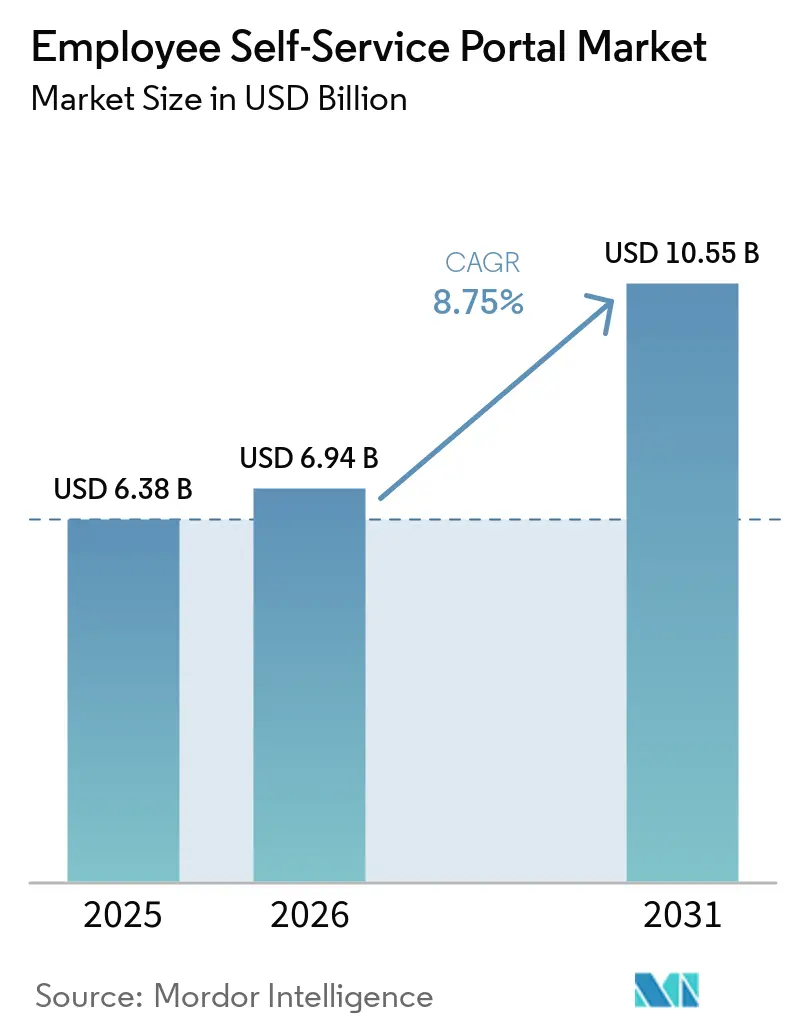
The employee self-service portal market size is expected to be USD 6.38 billion in 2025, USD 6.94 billion in 2026, and reach USD 10.55 billion by 2031, growing at a CAGR of 8.75% from 2026 to 2031. Enterprises are replacing legacy desktop applications with cloud-native, AI-enabled portals that let employees initiate payroll changes, book leave, and retrieve documents without involving HR desks. Early adopters report that generative AI chatbots now resolve more than 90% of routine questions, redirecting HR effort toward talent programs. Capital is flowing into this shift, as shown by Workday’s USD 1.1 billion purchase of Sana in 2025 and Thoma Bravo’s USD 12.3 billion take-private of Dayforce in 2026, each framed around embedding AI inside the portal experience. The resulting demand has encouraged vendors to expand language support, strengthen data-privacy controls, and package real-time payroll as a core service, reshaping buyer expectations across every region and company size.
Key Report Takeaways
- By deployment mode, on-premises commanded 65.44% of the employee self-service portal market share in 2025, while cloud implementations are advancing at an 11.67% CAGR through 2031.
- By function, payroll management led with 45.12% revenue share in 2025; leave and attendance tracking is projected to expand at a 10.56% CAGR to 2031.
- By organization size, large enterprises held 67.89% of 2025 revenue, yet small and medium-sized enterprises are growing at an 11.21% CAGR through 2031.
- By end-use industry, IT and telecom contributed 28.07% of 2025 revenue, whereas healthcare and life sciences is forecast to post the fastest growth at 9.81% CAGR to 2031.
- By geography, North America accounted for 36.40% of 2025 revenue, and Asia-Pacific is set to record a 10.05% CAGR over 2026-2031.
Note: Market size and forecast figures in this report are generated using Mordor Intelligence’s proprietary estimation framework, updated with the latest available data and insights as of January 2026.
Global Employee Self-Service Portal Market Trends and Insights
Drivers Impact Analysis*
| Driver | (~) % Impact on CAGR Forecast | Geographic Relevance | Impact Timeline |
|---|---|---|---|
| Accelerating Digital HR Transformation Across Enterprises | +2.8% | Global, led by North America and Western Europe | Medium term (2-4 years) |
| Rapid Adoption of Cloud-Based HR Solutions by SMEs | +2.3% | Asia-Pacific, Middle East and Africa, South America | Short term (≤2 years) |
| Expansion of Remote and Hybrid Work Models Requiring Anytime Self-Service Access | +1.9% | Global knowledge-worker hubs | Short term (≤2 years) |
| Integration of Generative AI Chatbots Enhancing ESS ROI | +1.4% | North America and Europe, spreading to Asia-Pacific | Medium term (2-4 years) |
| Growing Demand for Multilingual, Compliance-Localized ESS in Emerging Markets | +0.8% | Asia-Pacific, Middle East and Africa, South America | Long term (≥4 years) |
| Rise of Hyper-Personalized Employee Experience Platforms Driving ESS Upsell | +0.6% | North America and Europe, early Asia-Pacific | Long term (≥4 years) |
| Source: Mordor Intelligence | |||
Accelerating Digital HR Transformation Across Enterprises
Organizations are retiring mainframe HR software and moving to adaptable cloud stacks that expose APIs for payroll, benefits, and learning systems. California’s Employment Development Department, which supports 90,000 users, projects USD 150 million in 10-year savings after launching its multi-language myEDD portal on Salesforce. A federal agency that rolled out ServiceNow HR Service Delivery consolidated 286 workflows in five months and uncovered more than 200 process bottlenecks. Similar makeovers are taking hold in finance, where Bajaj Finance digitized every HR activity with TCS Chroma to keep pace with rapid hiring. Because such overhauls involve multi-year procurement, the boost to the employee self-service portal market arrives steadily rather than overnight.
Rapid Adoption of Cloud-Based HR Solutions by SMEs
Small and midsize companies in Southeast Asia, Africa, and South America favor subscription portals that avoid upfront hardware expenses. Darwinbox raised USD 140 million in 2025 and released localized payroll in Singapore, Malaysia, and the Philippines to court firms that still outsource payslips. Across Kenya and Nigeria, lightweight progressive-web apps now let staff pull pay data through basic smartphones that lack high-bandwidth plans. In Bahrain, cloud portals sync with labor-ministry APIs to automate permit renewals, proving that compliance can be delivered as a service. The sub-30-day deployment cycle illustrates why SME momentum delivers a short-term lift to global demand.
Expansion of Remote and Hybrid Work Models Requiring Anytime Self-Service Access
Hybrid schedules mean workers log in from homes, stores, and shared offices well beyond the reach of a 9-to-5 help desk. Belk equipped 300 locations with Workday mobile ESS to ramp seasonal hiring by 40% without extra HR staff.[1]Workday, “Workday Signs Definitive Agreement to Acquire Sana,” INVESTOR.WORKDAY.COM Manufacturer Essentra combined global time, pay, and benefits reporting in Dayforce so managers could approve leave while traveling. Vendors such as Rippling now embed PTO balances inside recruitment calendars and integrate mobile expense claims with Apple Pay, reflecting the expectation of frictionless, round-the-clock support. This shift keeps the driver’s impact concentrated in the immediate horizon.
Integration of Generative AI Chatbots Enhancing ESS ROI
IBM’s AskHR bot now solves 94% of basic questions, slashing ticket volumes and improving satisfaction. Workday’s Sana acquisition allows employees to query policies across SharePoint and Google Drive, then trigger automated workflows from a single prompt. Darwinbox’s Super Agent and Oracle’s AI assistants perform similar duties, while isolved serves benefits advice that accounts for age, dependents, and health goals. Governance, privacy, and change management lengthen rollout times, so the upside materializes over two to four years.
Restraints Impact Analysis*
| Restraint | (~) % Impact on CAGR Forecast | Geographic Relevance | Impact Timeline |
|---|---|---|---|
| Persistent Data Security and Privacy Concerns Over Employee Records | -1.6% | Global, highest in Europe and California | Short term (≤2 years) |
| Integration Complexity With Legacy HR and ERP Systems | -1.2% | North America and Europe | Medium term (2-4 years) |
| Low Digital Literacy Among Frontline Workforce Limiting ESS Utilization | -0.7% | Manufacturing, retail, hospitality worldwide | Long term (≥4 years) |
| Vendor Lock-In Risks Due to Proprietary Workflows and Customizations | -0.5% | Enterprises with multiyear contracts | Long term (≥4 years) |
| Source: Mordor Intelligence | |||
Persistent Data Security and Privacy Concerns Over Employee Records
Portals store social-security numbers, direct-deposit details, and medical data that attract ransomware groups. Oracle HCM Cloud faced a 2025 handling incident that drew close GDPR scrutiny. California’s Consumer Privacy Act forces granular consent controls, prompting vendors such as Sympa to market role-based access, audit trails, and ISO 27001 certification. Multinationals delay go-lives until providers guarantee local data residency, especially in healthcare and banking, keeping the restraint immediate and material.
Integration Complexity With Legacy HR and ERP Systems
Companies that rely on SAP R/3 or PeopleSoft must knit modern portals into decades-old records. Taleo recruiting data still requires middleware to sync with Oracle HCM Cloud, risking mismatches that frustrate new hires. Karnataka Bank invested months of regression testing to preserve payroll accuracy when adopting PeopleSoft Fluid UI. Even ADP’s 2025 payroll bridge to SAP SuccessFactors acknowledges that point-to-point links often cost six figures and demand continuous API upkeep. The result is a two-to-four-year drag on conversions in mature markets.
*Our forecasts treat driver/restraint impacts as directional, not additive. The impact forecasts reflect baseline growth, mix effects, and variable interactions.
Segment Analysis
By Deployment Mode: Cloud Adoption Reduces Ownership Costs
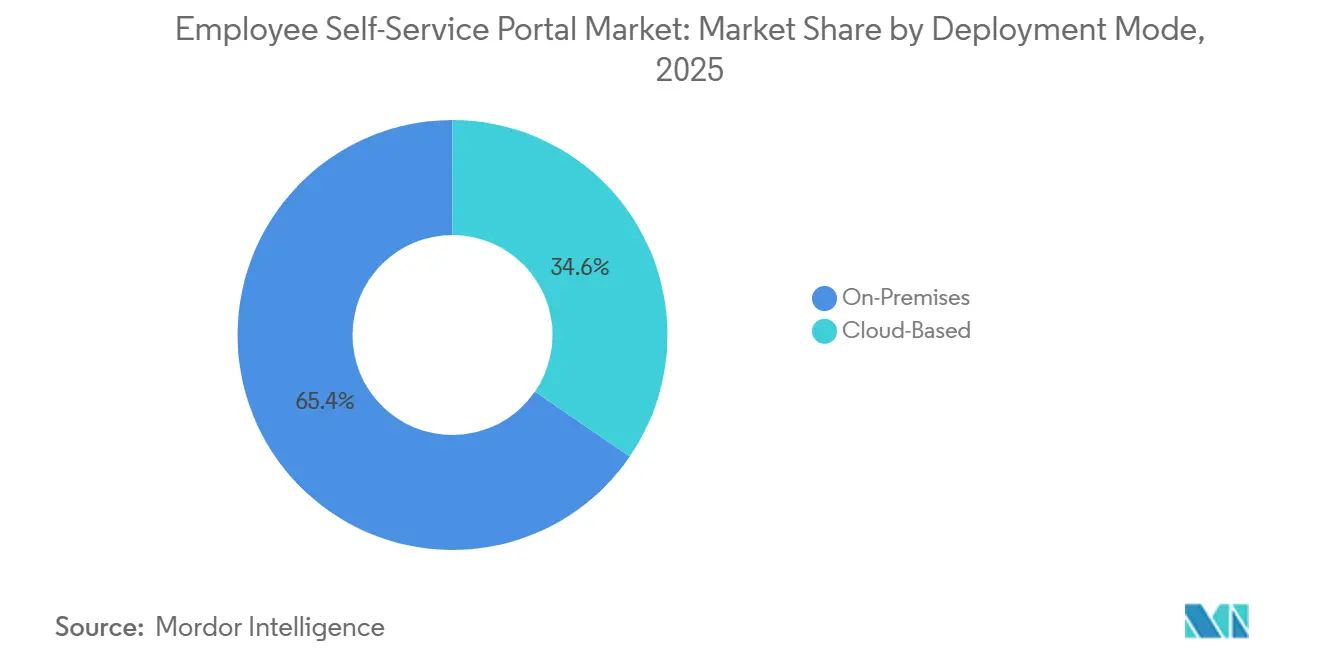
On-premises deployments represented 65.44% of the employee self-service portal market in 2025, reflecting the sunk costs of data centers, perpetual licenses, and specialized IT labor. Major government bodies that once insisted on air-gapped systems now pivot to hybrid models that keep sensitive records on site while hosting the portal tier in public clouds for faster patches. Vendors that operate exclusively in the cloud, such as Darwinbox and Beisen, each posted revenue growth above 30% during 2025 as enterprises pursued elastic capacity during seasonal hiring.
Cloud implementations, expanding at an 11.67% CAGR, attract SMEs that cannot fund server refreshes every three years. Subscription pricing converts fixed capital payments into predictable monthly charges, and built-in disaster recovery limits downtime risk. The employee self-service portal market size for cloud solutions is projected to capture an increasing share of incremental spending to 2031. Yet certain defense contractors and intelligence agencies still require on-premises control, illustrating why a hybrid path will prevail rather than a sudden shift.


By Function: Payroll Dominance Meets Leave-Management Momentum
Payroll accounted for 45.12% of 2025 revenue, making it the anchor for every new portal. Platforms such as ADP Workforce Now let employees preview gross-to-net pay before finalizing benefit choices, which raises satisfaction scores.[2]ADP, “ADP Workforce Now,” ADP.COM Real-time payroll in Dayforce further differentiates vendors that handle multiple daily pay cycles.
Leave and attendance tracking is growing at 10.56% CAGR as predictive-scheduling laws in Oregon, New York City, and Seattle levy stiff fines for last-minute shift changes. UKG Pro’s fatigue algorithms alert managers when staff approach overtime caps. The employee self-service portal market share for leave and attendance modules is therefore advancing faster than any other function. Benefits administration, performance management, and core employee-data editing fill the remainder as firms push decision-support engines that cut open-enrollment questions by 60%.
By Organization Size: SME Acceleration Challenges Enterprise Lead
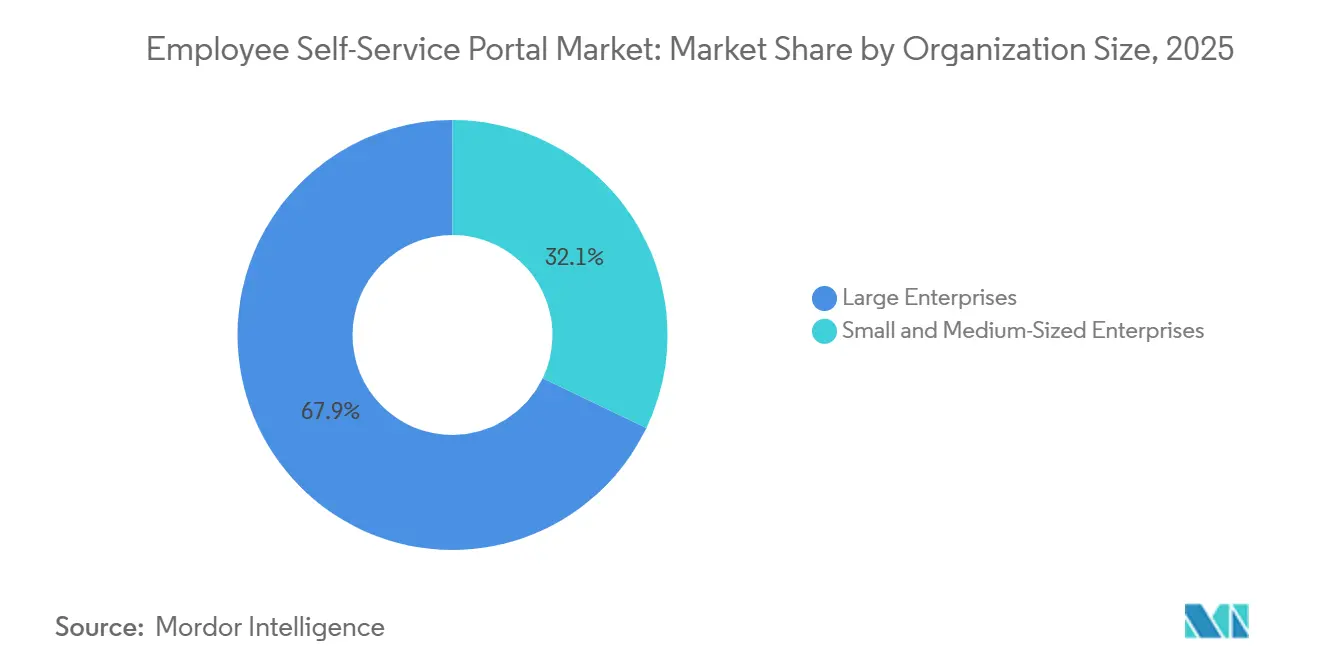
Large enterprises generated 67.89% of 2025 revenue, leveraging portals to unify HR practices across dozens of countries. Essentra’s single Dayforce instance lets 7,500 staff see time, pay, and benefits data in one dashboard. Consolidation drives governance, but long change cycles keep cost per user higher than in smaller firms.
SMEs, expanding at 11.21% CAGR, often adopt portal technology as their first HR system, skipping on-premises servers entirely. Rippling raised USD 450 million in 2025 to scale an all-in-one platform that triggers IT and finance workflows the moment HR events occur. The employee self-service portal market size for SMEs is therefore expected to narrow the gap with enterprise spending by 2031 as mobile-first designs resonate with deskless workers.
By End-Use Industry: Tech Share, Healthcare Growth
IT and telecom contributed 28.07% of 2025 revenue through early adoption and high staff turnover, which amplifies self-service savings. Continuous onboarding and offboarding routines make portals indispensable and justify ongoing investments in AI chatbots.
Healthcare and life sciences, forecast to grow at 9.81% CAGR, implement portals that digitize credential checks and automate continuing-education logs for clinicians. Hospitals shifting from paper to mobile status views now close payroll cutoffs two days faster. The employee self-service portal market size for healthcare will therefore outpace most verticals, while retail and manufacturing remain underpenetrated but represent future upside once offline-capable apps spread.
Geography Analysis
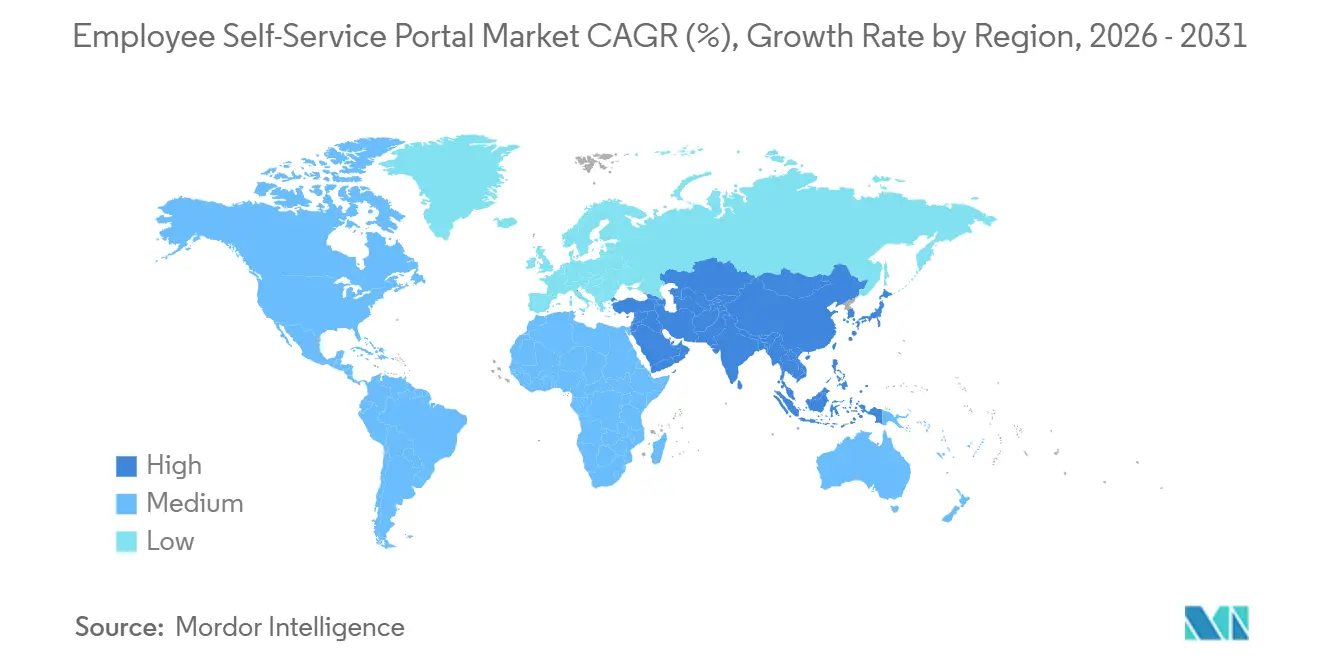
North America delivered 36.40% of global revenue in 2025, buoyed by Fortune 500 clients that standardized on early SaaS HCM suites and now layer AI assistants on top. Thoma Bravo’s take-private of Dayforce indicates investors view the region as a cash-rich base for cross-sell and consolidation.
Asia-Pacific is forecast to grow at a 10.05% CAGR, led by India, China, and Southeast Asia, where localized payroll engines and 25+ language interfaces meet compliance and cultural requirements. Darwinbox opened payroll modules across ASEAN, while Beisen reported RMB 945.1 million (USD 130 million) revenue in 2025 and more than 6,000 customers.[3]Beisen, “Beisen Cloud Computing Co. Ltd.,” BEISEN.COM The employee self-service portal market size advantage in the region will widen as governments push digital labor codes and SME digitization grants.
Europe shows steady growth, centered on GDPR-ready features such as consent dashboards and right-to-be-forgotten workflows. South America, the Middle East, and Africa trail in absolute numbers but post high double-digit portal adoption within SMEs that rely on mobile money and USSD to reach deskless staff.

Competitive Landscape
The market remains moderately concentrated. The top five vendors, Workday, SAP, Oracle, ADP, and UKG, together hold about 45% revenue. Their scale funds security audits and global data centers, while mid-market challengers such as BambooHR, Paylocity, and Rippling win deals on ease of use and 90-day rollout guarantees.
Workday’s USD 1.1 billion Sana deal reframes the portal as a proactive knowledge agent that spans HR, finance, and the wider information stack. Rippling’s unified data model automates laptop provisioning and payroll in one flow, cutting new-hire setup from hours to minutes. Regional specialists such as Ramco and Unit4 Prosoft compete on local rules. Ramco’s Workday-certified Payce supports multi-country payroll in Asia and the Middle East.
Private equity shapes future structure. Thoma Bravo intends to plug Dayforce AI into its broader HCM portfolio, while Gusto’s Guideline buy promises bundled retirement plans for over 400,000 small businesses. White-space remains among deskless staff: 80% of the global workforce still submits requests on paper, which keeps the opportunity open for offline-capable apps to serve manufacturing, logistics, and retail teams.
Employee Self-Service Portal Industry Leaders
Workday Inc.
Oracle Corporation
SAP SE
UKG Inc.
Automatic Data Processing Inc.
- *Disclaimer: Major Players sorted in no particular order

Recent Industry Developments
- April 2026: Gusto acquired Mosey to embed real-time compliance alerts inside its payroll and HR suite.
- February 2026: UKG partnered with HR Crowd, integrating leave and benefits self-service for mid-market clients.
- February 2026: Thoma Bravo completed its USD 12.3 billion Dayforce acquisition, delisting the firm from NYSE and TSX.
- September 2025: Workday agreed to buy Sana for USD 1.1 billion, bringing AI knowledge tools into its platform.


Global Employee Self-Service Portal Market Report Scope
Digital platforms in the Employee Self-Service (ESS) Portal market empower employees to independently access and manage their HR information. These portals facilitate tasks like updating personal details, requesting leave, viewing payslips, accessing benefits, and submitting HR queries. By streamlining these processes, ESS systems not only lighten the administrative load on HR teams but also enhance transparency and convenience for employees. The market's growth is fueled by the digitalization of the workforce, mobile-centric HR strategies, and a rising demand for user-friendly experiences akin to consumer standards.
The Employee Self-Service Portal Market Report is Segmented by Deployment Mode (Cloud-Based, and On-Premises), Function (Payroll Management, Leave and Attendance Management, Benefits Administration, Employee Data Management, and Performance and Appraisal Management), Organization Size (Small and Medium-Sized Enterprises, and Large Enterprises), End-Use Industry (IT and Telecom, BFSI, Healthcare and Life Sciences, Manufacturing, Retail and E-commerce, Government and Public Sector, and Other End-Use Industries), and Geography (North America, South America, Europe, Asia-Pacific, Middle East, and Africa). The Market Forecasts are Provided in Terms of Value (USD).
| Cloud-Based |
| On-Premises |
| Payroll Management |
| Leave and Attendance Management |
| Benefits Administration |
| Employee Data Management |
| Performance and Appraisal Management |
| Small and Medium-Sized Enterprises |
| Large Enterprises |
| IT and Telecom |
| BFSI |
| Healthcare and Life Sciences |
| Manufacturing |
| Retail and E-commerce |
| Government and Public Sector |
| Other End-Use Industries |
| North America | United States |
| Canada | |
| Mexico | |
| South America | Brazil |
| Argentina | |
| Rest of South America | |
| Europe | Germany |
| United Kingdom | |
| France | |
| Italy | |
| Spain | |
| Russia | |
| Rest of Europe | |
| Asia-Pacific | China |
| Japan | |
| India | |
| South Korea | |
| Australia and New Zealand | |
| Rest of Asia-Pacific | |
| Middle East | Saudi Arabia |
| United Arab Emirates | |
| Turkey | |
| Rest of Middle East | |
| Africa | South Africa |
| Nigeria | |
| Rest of Africa |
| By Deployment Mode | Cloud-Based | |
| On-Premises | ||
| By Function | Payroll Management | |
| Leave and Attendance Management | ||
| Benefits Administration | ||
| Employee Data Management | ||
| Performance and Appraisal Management | ||
| By Organization Size | Small and Medium-Sized Enterprises | |
| Large Enterprises | ||
| By End-Use Industry | IT and Telecom | |
| BFSI | ||
| Healthcare and Life Sciences | ||
| Manufacturing | ||
| Retail and E-commerce | ||
| Government and Public Sector | ||
| Other End-Use Industries | ||
| By Geography | North America | United States |
| Canada | ||
| Mexico | ||
| South America | Brazil | |
| Argentina | ||
| Rest of South America | ||
| Europe | Germany | |
| United Kingdom | ||
| France | ||
| Italy | ||
| Spain | ||
| Russia | ||
| Rest of Europe | ||
| Asia-Pacific | China | |
| Japan | ||
| India | ||
| South Korea | ||
| Australia and New Zealand | ||
| Rest of Asia-Pacific | ||
| Middle East | Saudi Arabia | |
| United Arab Emirates | ||
| Turkey | ||
| Rest of Middle East | ||
| Africa | South Africa | |
| Nigeria | ||
| Rest of Africa | ||


Key Questions Answered in the Report
What is the current employee self-service portal market size and growth outlook?
The employee self-service portal market size reached USD 6.94 billion in 2026 and is forecast to climb to USD 10.55 billion by 2031, reflecting an 8.75% CAGR, according to Mordor Intelligence.
Which deployment model is expanding fastest?
Cloud-based portals are advancing at an 11.67% CAGR through 2031 as organizations switch from capital-intensive servers to subscription SaaS offerings.
Which function holds the largest revenue share?
Payroll management remains the anchor, accounting for 45.12% of 2025 spend because employees demand accurate, on-time pay visibility.
Why is Asia-Pacific the fastest-growing region?
Enterprises in India, China, and Southeast Asia are digitizing HR at speed, helped by multilingual interfaces and country-specific payroll integrations that satisfy diverse compliance rules.
How are AI chatbots affecting HR service desks?
Deployments such as IBM’s AskHR demonstrate 90%-plus containment of tier-one queries, enabling HR teams to cut ticket volumes by nearly half.
Page last updated on:





