
Emergency Contraceptive Pills Market Size and Share
Market Overview
| Study Period | 2020 - 2031 |
|---|---|
| Market Size (2026) | USD 1.34 Billion |
| Market Size (2031) | USD 1.69 Billion |
| Growth Rate (2026 - 2031) | 4.85 % |
| Fastest Growing Market | Asia Pacific |
| Largest Market | North America |
| Market Concentration | Medium |
Major Players *Disclaimer: Major Players sorted in no particular order Image © Mordor Intelligence. Reuse requires attribution under CC BY 4.0. | |
Emergency Contraceptive Pills Market Analysis by Mordor Intelligence
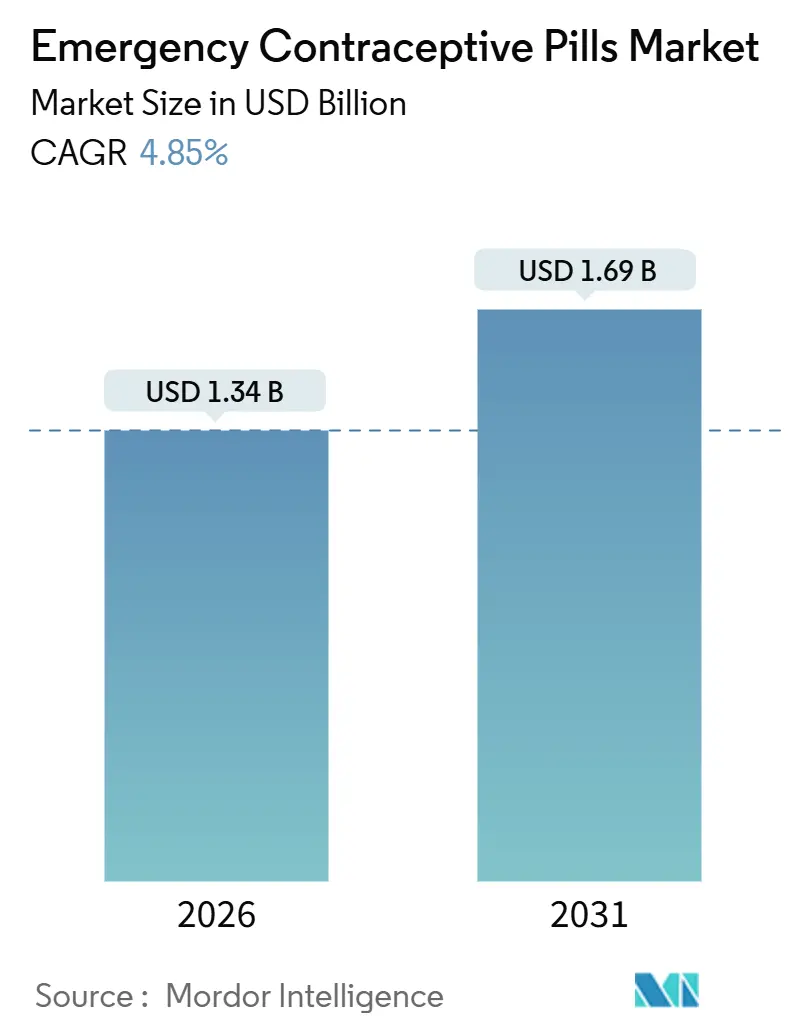
The Emergency Contraceptive Pills Market size is estimated at USD 1.34 billion in 2026, and is expected to reach USD 1.69 billion by 2031, at a CAGR of 4.85% during the forecast period (2026-2031).
Regulatory liberalization in more than 90 countries, expanding reimbursement in Australia and Europe, and BMI-targeted clinical guidelines are supporting demand. At the same time, conscience-clause refusals, patchy rural stocking, and misinformation that equates emergency contraception with abortion temper the growth trajectory. Digital-first tele-pharmacy businesses are widening access through discreet home-delivery subscriptions, while government family-planning subsidies in Asia-Pacific and Latin America expand the public-sector footprint. Supply-chain realignment spurred by tariff risks and the 2024 BIOSECURE Act creates both margin pressure and long-term security benefits as manufacturers diversify active-ingredient sources[1].
Key Report Takeaways
- By active ingredient, levonorgestrel commanded 82.55% of the Emergency Contraceptive Pills market share in 2025, whereas ulipristal acetate is advancing at a 6.25% CAGR through 2031.
- By dose regimen, single-dose formats captured 62.53% share of the Emergency Contraceptive Pills market size in 2025, while two-dose kits are expanding at a 6.85% CAGR.
- By distribution channel, retail and chain pharmacies held a 55.23% share in 2025, yet e-commerce and telepharmacy channels are posting an 8.55% CAGR through 2031.
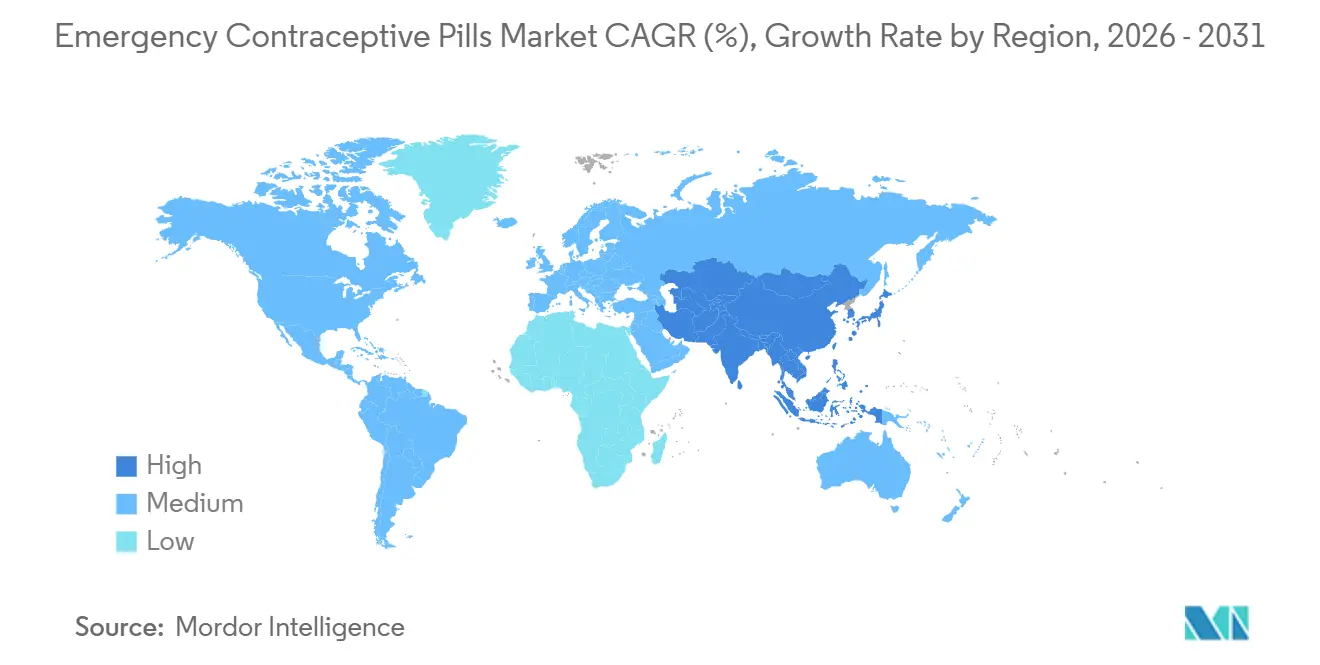
- By geography, North America led with 42.13% revenue share in 2025; Asia-Pacific is forecast to record the fastest 7.81% CAGR through 2031.
Note: Market size and forecast figures in this report are generated using Mordor Intelligence’s proprietary estimation framework, updated with the latest available data and insights as of January 2026.
Market Trends and Insights
Drivers Impact Analysis of Emergency Contraceptive Pills Market*
| Driver | (~) % Impact on CAGR Forecast | Geographic Relevance | Impact Timeline |
|---|---|---|---|
| Rapid Switch of Ulipristal & Levonorgestrel to OTC Status | +1.2% | Global, with accelerated adoption in Europe, Australia, select APAC markets | Medium term (2-4 years) |
| Rising Telehealth & E-Pharmacy Fulfillment for Discreet Access | +1.0% | North America, Europe, urban APAC hubs | Short term (≤ 2 years) |
| Government Family-Planning Subsidies in APAC & Latin America | +0.8% | APAC (Philippines, India, Australia), Latin America (Argentina, Chile, Mexico) | Medium term (2-4 years) |
| BMI-Targeted Clinical Guidelines Favoring Ulipristal / IUD | +0.6% | North America, Europe, Australia | Long term (≥ 4 years) |
| API On-Shoring to Offset Tariff Risks & Ensure Supply Security | +0.3% | North America, Europe | Long term (≥ 4 years) |
| AI-Powered Demand-Forecasting Adopted by NGOs & Public Buyers | +0.2% | Global, pilot programs in UNFPA procurement networks | Long term (≥ 4 years) |
| Source: Mordor Intelligence | |||
Rapid Switch of Ulipristal & Levonorgestrel to OTC Status
Over-the-counter reclassification removes prescription bottlenecks that once delayed time-sensitive use, and April 2024 WHO guidance endorses unrestricted pharmacy access for both 1.5 mg levonorgestrel and 30 mg ulipristal acetate. France’s 2023 rule abolishing all age and prescription requirements led to a 22% volume jump within 9 months. By 2025, more than 30 U.S. states had adopted pharmacist-prescribing statutes, though conscience-clause exemptions in 11 states still permit refusals. India reaffirmed levonorgestrel’s Schedule K status in October 2024, while adding BMI-related labeling to balance access with informed consent. Ulipristal remains prescription-only in Japan and many Middle Eastern markets, creating cross-border e-commerce opportunities that capital-light platforms can exploit.
Rising Telehealth & E-Pharmacy Fulfillment for Discreet Access
Digital platforms capitalize on post-Dobbs anxiety and pandemic-era comfort with virtual care. Nurx, backed by USD 193 million in venture funding, ships emergency contraception nationwide within 6 days, while Hims & Hers embeds pills in subscription bundles priced at USD 12 to USD 15 after a USD 15 asynchronous consultation. A February 2025 University of California study confirmed that telehealth outcomes are equivalent to in-clinic safety, prompting several Medicaid programs to reimburse virtual visits. Home delivery bypasses pharmacist refusals and rural stock-outs; plain packaging mitigates stigma for adolescents, the highest-incidence user group. These dynamics explain the channel's 8.55% CAGR, outpacing the broader emergency contraceptive pills market.
Government Family-Planning Subsidies in APAC & Latin America
Public procurement is driving volume even when revenue contribution stays modest due to negotiated price ceilings. Australia’s 2025-26 budget reduced out-of-pocket costs to AUD 7.70 (USD 5) and added ulipristal to the Pharmaceutical Benefits Scheme. UNFPA cash-and-voucher programs distributed 1.2 million emergency kits across Bangladesh, Myanmar, and the Philippines in 2024-25. Indian states such as Uttar Pradesh and Bihar expanded levonorgestrel distribution through community health workers in 2024, cementing the country’s position as the third-largest emergency contraceptive pills market. Argentina’s Law 25,673 guarantees free access to its public health system, while Chile expanded municipal distribution in 2024.
BMI-Targeted Clinical Guidelines Favoring Ulipristal / IUD
A 2024 Lancet randomized trial involving 836 participants ≥80 kilograms showed ulipristal reduces pregnancy risk by 64% versus levonorgestrel 1.5 mg. ACOG’s 2024 bulletin and parallel UK and Australian guidelines now recommend ulipristal or a copper IUD for users with a BMI > 25[2]. As a result, national formularies in Australia, Canada, and several EU states added ulipristal, nudging procurement toward higher-margin products. Copper IUDs remain underutilized because insertion requires trained clinicians. Yet, telehealth firms increasingly package same-day referrals with emergency-contraception consultations, an innovation likely to lift demand over the long term.
Restraints Impact Analysis of Emergency Contraceptive Pills Market*
| Restraint | (~) % Impact on CAGR Forecast | Geographic Relevance | Impact Timeline |
|---|---|---|---|
| Patchy Pharmacist Stocking & Conscience-Clause Refusals | -0.5% | North America (rural areas), select European markets, parts of MEA | Short term (≤ 2 years) |
| Stigma-Driven Misinformation Equating ECPs with Abortion | -0.6% | Global, acute in conservative regions of North America, Latin America, MEA | Medium term (2-4 years) |
| Weight-Related Effectiveness Drop for Levonorgestrel | -0.3% | Global, higher impact in North America, Europe, Australia with rising obesity prevalence | Medium term (2-4 years) |
| API Export Tariffs Raising COGS In Low-income Markets | -0.2% | APAC, Latin America, MEA sourcing from China and India | Short term (≤ 2 years) |
| Source: Mordor Intelligence | |||
Patchy Pharmacist Stocking & Conscience-Clause Refusals
Eleven U.S. states permit pharmacists to refuse to dispense emergency contraception without referral, creating access deserts in which a single pharmacy serves entire counties[3]. A 2024 ACLU audit logged 47 denials in rural Idaho, South Dakota, and Missouri, underscoring the severity of the barrier[4]. Corporate mandates from CVS and Walgreens obligate stores in underserved areas to carry Plan B, yet compliance varies and monitoring remains spotty. Ulipristal inventory is even scarcer in small-format outlets due to higher wholesale costs and shorter shelf life, limiting patient choice at the point of care.
Stigma-Driven Misinformation Equating ECPs with Abortion
Despite FDA and EMA statements clarifying that emergency contraception prevents fertilization rather than disrupting implanted embryos, a 2024 Kaiser Family Foundation survey reported that 38% of U.S. adults still conflate levonorgestrel with abortion[5]. Social-media misinformation lowers purchase intent and emboldens restrictive legislation. Educational campaigns by the International Consortium for Emergency Contraception increased understanding of the mechanism of action by 19 percentage points in randomized outreach, but scaling such interventions remains resource-intensive.
*Our forecasts treat driver/restraint impacts as directional, not additive. The impact forecasts reflect baseline growth, mix effects, and variable interactions.
Emergency Contraceptive Pills Market Segment Analysis
By Active Ingredient:
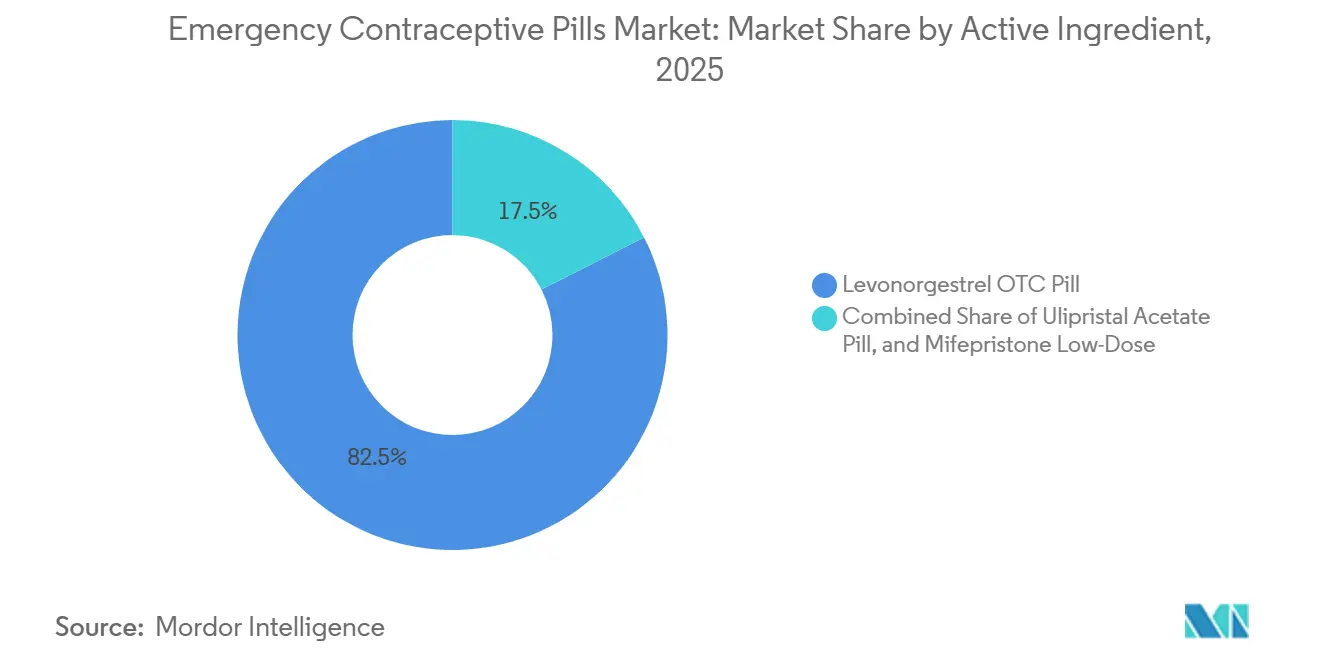
Ulipristal Gains on Weight-Efficacy EvidenceLevonorgestrel pills held 82.55% Emergency Contraceptive Pills market share in 2025, supported by three decades of generic scale and retail prices as low as INR 75 (USD 0.90) in India. However, a 2024 JAMA Network Open meta-analysis showed that efficacy falls to 52% in users with a BMI > 30, prompting formulary managers to re-evaluate options. Ulipristal acetate is growing at a 6.25% CAGR, buoyed by national guideline updates and its demonstrated superiority in higher-BMI cohorts, as evidenced by The Lancet trial. Organon’s acquisition of the ellaOne franchise accelerated global rollout, and the compound’s patent expiry in key territories between 2023-25 sets the stage for future generic entry. Mifepristone low-dose products remain mainly confined to China, where the compound enjoys OTC status, yet Western regulators retain reservations due to association with abortion protocols.
The cost dynamic favors levonorgestrel. Piramal manufactures the API at roughly USD 0.30 per 1.5 mg dose, allowing unbranded generics to retail for INR 25 (USD 0.30). Ulipristal’s complex synthesis and smaller volume keep unit costs higher, but the 2025 Australian formulary addition narrowed patient co-pays to AUD 7.70 (USD 5) and showcased the potential for volume-driven price relief. As more payers adopt BMI-targeted coverage criteria, ulipristal’s share should rise, yet levonorgestrel’s entrenched supply chain ensures it remains the volume leader in the emergency contraceptive pills market.

By Dose Regimen:
Compliance Versus Cost Trade-OffsSingle-dose formats captured 62.53% of 2025 volume because one-tablet administration eliminates the risk of missed second doses and aligns with pharmacy counseling preferences. Ulipristal 30 mg and levonorgestrel 1.5 mg are both packaged as single tablets, simplifying tele-pharmacy fulfillment and supporting stock-and-go retail models. Two-dose kits are expanding at a 6.85% CAGR, driven by public-sector tenders in price-sensitive countries; splitting levonorgestrel into two 0.75 mg tablets lowers production cost by 18% and stretches a tight procurement budget. The Philippines distributed 2.3 million two-dose kits in 2024, illustrating how public buyers weigh lower per-patient costs against the trade-off in adherence.
A 2024 Cochrane review found no efficacy gap when users complete both doses within 12 hours, but real-world Indian data show 23% of two-dose users miss or delay the second tablet. Retailers prefer single-dose SKUs due to faster turnover, while telehealth platforms exclusively stock one-step products to avoid follow-up compliance burdens. These opposing forces will maintain both formats in the Emergency Contraceptive Pills market through 2031.
By Distribution Channel:
E-Commerce Disrupts Pharmacy IncumbencyRetail and chain pharmacies retained a 55.23% share in 2025, benefiting from insurance infrastructure and immediate pickup options. Yet online channels are growing at 8.55% CAGR as Hims & Hers, Amazon Pharmacy, and Nurx deliver discreetly packaged pills nationwide. Hims & Hers disclosed 1.7 million subscribers in Q3 2024, with contraceptives contributing 18% of sales. Subscription bundles price levonorgestrel at USD 12 and ulipristal at USD 30-50, undercutting many brick-and-mortar offerings even after shipping fees.
Hospital and clinic pharmacies serve sexual-assault care pathways and advance-provision scripts during gynecologic visits endorsed by ACOG in 2024. Conscience-clause exemptions, rural stock-outs, and stigma accelerate consumer migration online, making e-commerce the fastest-rising channel in the broader emergency contraceptive pills market.

Geography Analysis
North America Emergency Contraceptive Pills Market
North America accounted for 42.13% of 2025 revenue, driven by high per-capita contraceptive spending and widespread OTC availability of levonorgestrel. More than 30 U.S. states allow pharmacists to prescribe emergency contraception, yet conscience-clause refusals persist in 11 jurisdictions, sustaining regional access gaps. Canada’s provincial plans in British Columbia, Ontario, and Quebec fully reimburse levonorgestrel and ulipristal for residents under 25, lowering the price barrier.
APAC Emergency Contraceptive Pills Market
Asia-Pacific, projected to grow at a 7.81% CAGR, benefits from India’s Schedule K reaffirmation and Australia’s 2025–26 budget expansion, which cut ulipristal co-pays to AUD 7.70 (USD 5). India’s 2024 acquisition of Bharat Serums by Mankind Pharma expands rural reach through a combined network of 10,000-plus stockists. China remains the second-largest national market; unique OTC availability of low-dose mifepristone accounts for an estimated 15-20% of local volume.
EMEA and LATAM Emergency Contraceptive Pills Market
Europe, the Middle East, and Africa display a wide range of regimes. France’s 100% reimbursement policy spurred a 22% volume jump post-2023. South Africa offers free levonorgestrel at public clinics, yet rural stock-outs hinder consistent access. GCC states maintain prescription requirements, channeling demand to cross-border e-commerce. Latin America’s growth hinges on Argentina’s universal contraceptive law and Brazil’s Unified Health System, though procurement lags in smaller municipalities create regional disparities.
Competitive Landscape
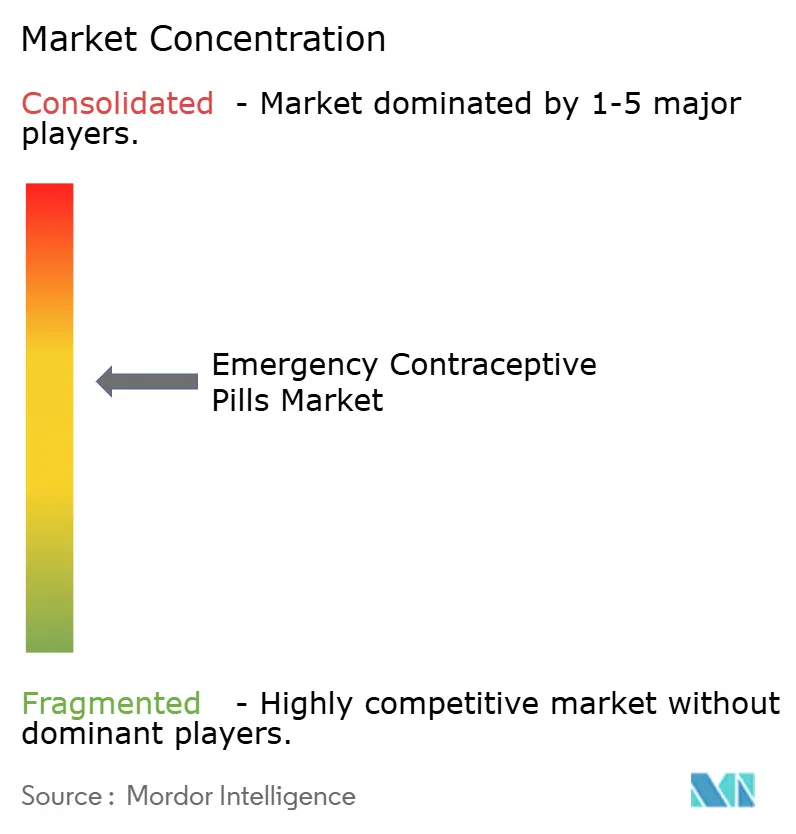
Market concentration is moderate. Perrigo’s Plan B One-Step remains the U.S. brand leader, helping drive the company's revenue to USD 1.39 billion in Q3 2024. Organon’s acquisition of HRA Pharma boosted women’s health revenue to USD 1.6 billion in the same quarter, and the firm is expanding ulipristal distribution where BMI-adjusted guidelines favor the compound. Bayer AG, Teva Pharmaceutical Industries Ltd., Lupin Ltd., and Mankind Pharma battle for share with generics, while China Resources Zizhu Pharmaceutical and Zhejiang Xianju Pharmaceutical Co. dominate API supply in cost-sensitive tiers.
Telehealth disruptors wield subscription economics. Hims & Hers reported 1.7 million subscribers and leverages asynchronous consultations to issue same-day prescriptions in all 50 states. At the same time, Nurx pre-positions emergency pills in user homes for USD 12 per month. On-shoring of APIs under the BIOSECURE Act is raising capital needs; Perrigo and Teva Pharmaceutical Industries Ltd. disclosed new U.S. synthesis projects that may tighten gross margins until economies of scale emerge.
White-space opportunities include post-patent ulipristal generics, mifepristone low-dose filings outside Asia, and pharmacy-based copper IUD insertion services. Companies that secure domestic API sources and integrate tele-pharmacy distribution stand to outperform in the evolving emergency contraceptive pills market.
Emergency Contraceptive Pills Industry Leaders
-
Bayer AG
-
Teva Pharmaceutical Industries Ltd.
-
Perrigo Company plc (HRA Pharma)
-
Gedeon Richter
-
Mankind Pharma
- *Disclaimer: Major Players sorted in no particular order
Emergency Contraceptive Pills Market Companies Covered in this Report
- Bayer
- China Resources Zizhu Pharmaceutical
- Cooper Pharma
- Foundation Consumer Healthcare
- Gedeon Richter Nyrt
- HLL Lifecare
- Lupin
- Mankind Pharma
- Organon
- Paladin Labs Inc.
- Perrigo Company plc (HRA Pharma)
- Piramal Enterprises Ltd.
- Sun Pharmaceuticals Industries
- Teva Pharmaceutical Industries
- Wockhardt Ltd.
- Zhejiang Xianju Pharmaceutical Co.
Recent Industry Developments in Emergency Contraceptive Pills Market
- December 2025: India’s Drugs Consultative Committee voted to add levonorgestrel 0.75 mg/1.5 mg strengths under Schedule K, cementing OTC status and easing rural distribution.
- October 2025: ASKA Pharmaceutical and Daiichi Sankyo Healthcare obtained Japanese authorization to switch NORLEVO (levonorgestrel) to OTC status, expanding non-prescription access.
Global Emergency Contraceptive Pills Market Report Scope
As per the report's scope, emergency contraceptive pills (ECPs) are oral medications used to prevent pregnancy after unprotected sex or contraceptive failure. They work mainly by delaying or inhibiting ovulation, thereby preventing fertilization. ECPs are most effective when taken within 72 hours, though some formulations remain effective up to 120 hours. They are intended for occasional, emergency use only, not as a regular contraceptive method.
The emergency contraceptive pills market segmentation includes active ingredient, dose regimen, distribution channel, and geography. By active ingredient, the market is segmented into levonorgestrel OTC pills, ulipristal acetate pills, and low-dose mifepristone. By dose regimen, the market is segmented into single-dose and two-dose. By distribution channel, the market is segmented into retail & chain pharmacies, hospital & clinic pharmacies, and e-commerce/telepharmacy. By geography, the global market is segmented into North America, Europe, Asia-Pacific, the Middle East and Africa, and South America. The market report also covers the estimated market sizes and trends for 17 countries across major regions globally. The report offers the value (in USD) for the above segments.
Segmentation Overview
| Levonorgestrel OTC Pill |
| Ulipristal Acetate Pill |
| Mifepristone Low-Dose |
| Single-Dose |
| Two-Dose |
| Retail & Chain Pharmacies |
| Hospital & Clinic Pharmacies |
| E-commerce / Tele-pharmacy |
| North America | United States |
| Canada | |
| Mexico | |
| Europe | Germany |
| United Kingdom | |
| France | |
| Italy | |
| Spain | |
| Rest of Europe | |
| Asia-Pacific | China |
| India | |
| Japan | |
| Australia | |
| South Korea | |
| Rest of Asia-Pacific | |
| Middle East and Africa | GCC |
| South Africa | |
| Rest of Middle East and Africa | |
| South America | Brazil |
| Argentina | |
| Rest of South America |
| By Active Ingredient | Levonorgestrel OTC Pill | |
| Ulipristal Acetate Pill | ||
| Mifepristone Low-Dose | ||
| By Dose-Regimen | Single-Dose | |
| Two-Dose | ||
| By Distribution Channel | Retail & Chain Pharmacies | |
| Hospital & Clinic Pharmacies | ||
| E-commerce / Tele-pharmacy | ||
| By Geography | North America | United States |
| Canada | ||
| Mexico | ||
| Europe | Germany | |
| United Kingdom | ||
| France | ||
| Italy | ||
| Spain | ||
| Rest of Europe | ||
| Asia-Pacific | China | |
| India | ||
| Japan | ||
| Australia | ||
| South Korea | ||
| Rest of Asia-Pacific | ||
| Middle East and Africa | GCC | |
| South Africa | ||
| Rest of Middle East and Africa | ||
| South America | Brazil | |
| Argentina | ||
| Rest of South America | ||
Key Questions Answered in the Report
What is the projected value of the Emergency Contraceptive Pills market by 2031?
The Emergency Contraceptive Pills market is forecast to reach USD 1.69 billion by 2031.
Which active ingredient is growing fastest through 2031?
Ulipristal acetate posts the fastest 6.25% CAGR on the back of BMI-targeted clinical recommendations.
How quickly are e-commerce channels expanding?
E-commerce and tele-pharmacy platforms are growing at 8.55% CAGR, nearly double the overall market rate.
Why does levonorgestrel still dominate volume?
Decades of generic production keep prices under USD 1 in many markets, sustaining an 82.55% share despite efficacy concerns in higher-BMI users.
Which region is expected to record the highest growth?
Asia-Pacific is projected to grow at a 7.81% CAGR, fueled by Indian and Australian policy support and large population bases.