
Electric Rice Cooker Market Size and Share
Market Overview
| Study Period | 2021 - 2031 |
|---|---|
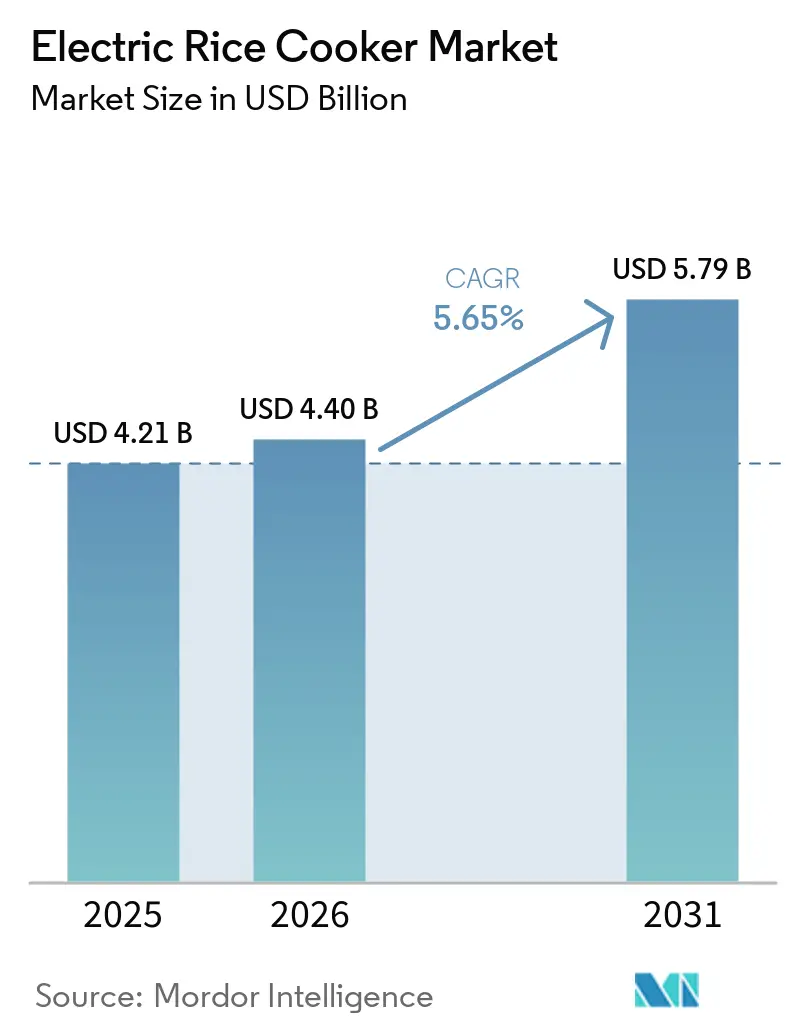
| Market Size (2026) | USD 4.40 Billion |
| Market Size (2031) | USD 5.79 Billion |
| Growth Rate (2026 - 2031) | 5.65 % |
| Fastest Growing Market | Asia-Pacific |
| Largest Market | Asia-Pacific |
| Market Concentration | Medium |
Major Players *Disclaimer: Major Players sorted in no particular order Image © Mordor Intelligence. Reuse requires attribution under CC BY 4.0. | |
Electric Rice Cooker Market Analysis by Mordor Intelligence
The electric rice cooker market size was valued at USD 4.20 billion in 2025 and is forecast to reach USD 5.8 billion by 2031, growing at a CAGR of 5.7% over 2026-2031. The category is benefiting from smaller urban households, growing demand for convenient cooking, and replacement purchases of higher-value appliances. Demand is strongest where rice remains a daily staple and households are replacing basic appliances with models that provide more consistent results. Product upgrades are also changing the value mix because induction heating, pressure control, and connected functions carry higher prices than conventional models. Manufacturers are balancing affordable products for first-time buyers with premium models designed for households seeking automated preparation and cooking consistency. The electric rice cooker market also has room to grow in regions where rice consumption is increasing, and appliance ownership remains limited.
Key Report Takeaways
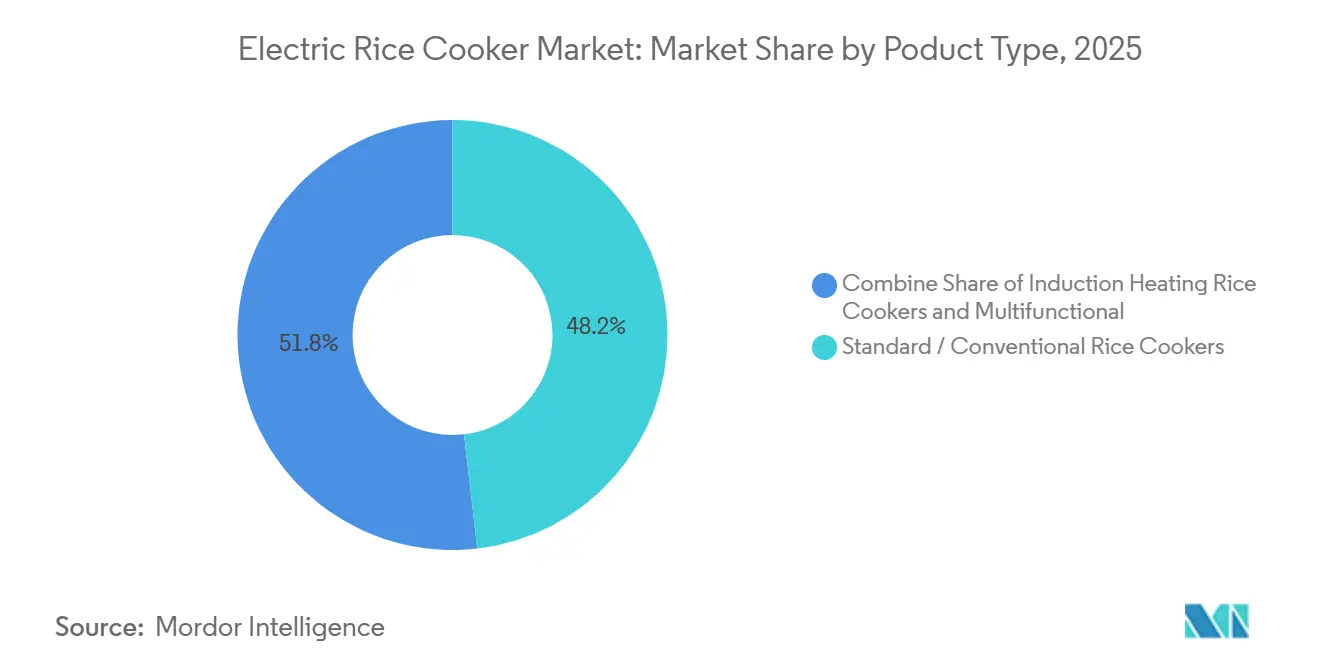
- By product type, Standard/Conventional rice cookers held 48.2% of the electric rice cooker market share in 2025, while Multifunctional/Smart models are forecast at a 7.7% CAGR through 2031.
- By capacity, 1 Liter to 1.9 Liter appliances accounted for 34.3% of the electric rice cooker market share in 2025, while Above 4 Liters appliances are forecast at a 6.9% CAGR through 2031.
- By price range, Mid-Range appliances captured 53.2% of value in 2025, while Premium appliances are forecast at a 7.5% CAGR through 2031.
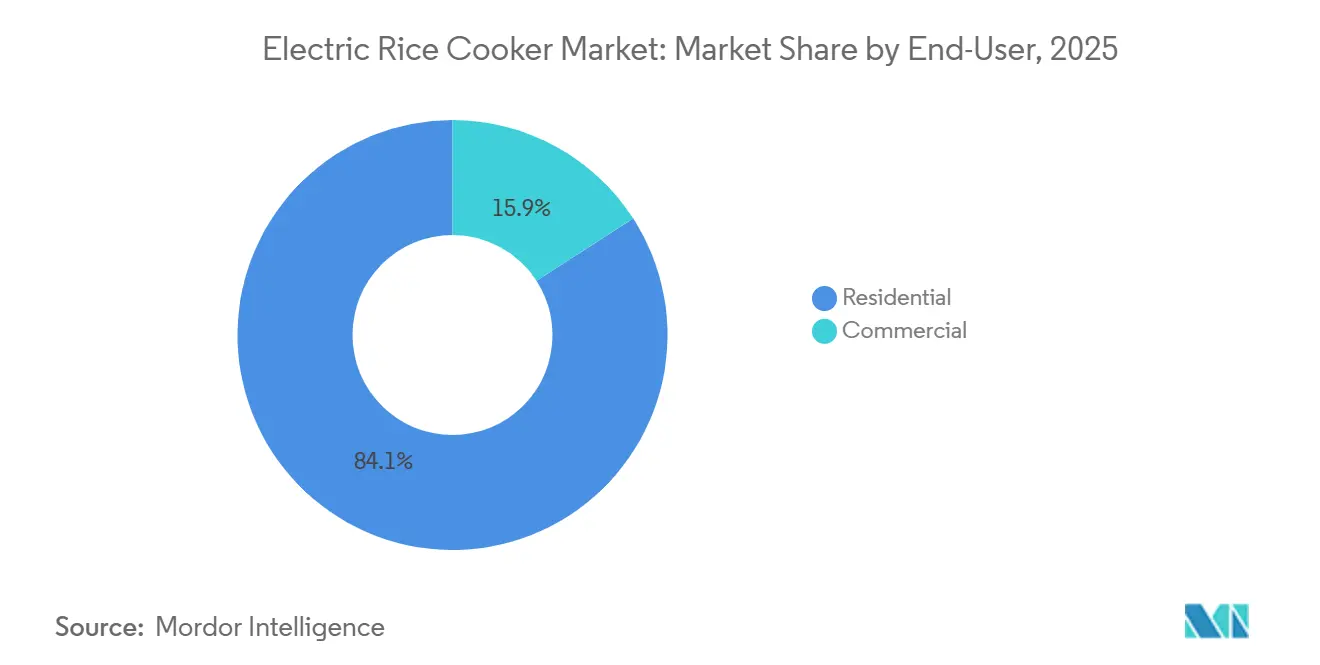
- By end-user, Residential users held 84.1% of the electric rice cooker market share in 2025, while Commercial users are forecast at a 7.1% CAGR through 2031.
- By distribution channel, B2C/Retail held 88.5% of the electric rice cooker market share in 2025 and is forecast at an 8.2% CAGR through 2031.
- By geography, Asia-Pacific held 46.7% of the value in 2025 and is forecast at a 6.7% CAGR through 2031.
Note: Market size and forecast figures in this report are generated using Mordor Intelligence’s proprietary estimation framework, updated with the latest available data and insights as of January 2026.
Market Trends and Insights
Drivers Impact Analysis of Electric Rice Cooker Market*
| Driver | (~) % Impact on CAGR Forecast | Geographic Relevance | Impact Timeline |
|---|---|---|---|
| Rising Demand for Time-Saving Cooking Appliances | +1.2% | Global, concentrated in urban Asia-Pacific, North America, and Europe | Short term (≤ 2 years) |
| Expansion of Multifunctional and Smart Kitchen Appliances | +1.6% | Asia-Pacific core (China, South Korea, Japan), spill-over to North America and the EU | Medium term (2–4 years) |
| Growth of Rice-Based and Asian Cuisine Consumption Outside Asia-Pacific | +0.8% | North America, Europe, Middle East and Africa | Medium term (2–4 years) |
| E-Commerce and Direct-to-Consumer Appliance Access | +0.7% | Asia-Pacific, South America, MEA (urban centres) | Short term (≤ 2 years) |
| Smaller Urban Kitchens and Compact-Capacity Demand | +0.5% | Japan, South Korea, urban China, Western Europe | Medium term (2–4 years) |
| Electricity-LPG Cost Parity and Clean-Cooking Transition | +0.5% | India, Southeast Asia, sub-Saharan Africa, South America | Long term (≥ 4 years) |
| Source: Mordor Intelligence | |||
Rising Demand for Time-Saving Cooking Appliances
Urban households are placing more value on appliances that reduce active cooking time and provide dependable results. This supports the electric rice cooker market because the appliance allows rice to cook without frequent supervision. Panasonic linked its September 2026 launch of the SR-C306E compact pressure induction heating model to Japan’s changing household structure. The company noted provisional 2025 Census figures showing an average household size of 2.15 people and single-person households at 34% of all households. Small households can favor compact appliances that fit limited kitchen space and prepare modest portions. In mature markets, replacement purchases can therefore move toward compact models with higher cooking precision rather than simply adding more units.
The same demand pattern can influence markets such as Seoul, Shanghai, and Bengaluru as urban living becomes more common. A hands-off appliance can address everyday meal preparation needs without requiring a large kitchen or complex cooking process. The category benefits when consumers view dependable timing and automatic cooking as practical features rather than optional extras. Manufacturers can use this demand to position improved heating control, delayed-start settings, and easy cleaning as useful household features. The electric rice cooker market gains value when consumers trade basic models for products that reduce routine preparation work. This pattern is most relevant in cities where household schedules are tight and kitchen space is limited.
Expansion of Multifunctional and Smart Kitchen Appliances
Multifunctional/Smart rice cookers are forecast to grow at a 7.7% CAGR through 2031, the highest rate among product types. The segment reflects demand for appliances that combine rice preparation with steaming, slow cooking, and other kitchen functions. Connected features can also offer scheduled cooking and recipe support for households that use several rice types. Panasonic’s compact pressure induction heating launch shows that advanced heating technology is increasingly available in smaller formats. This broadens the addressable customer base beyond large households that traditionally bought high-end appliances. The electric rice cooker market is therefore becoming more differentiated by cooking outcome and convenience, not capacity alone.
Product development is increasingly centered on heat control, pressure management, and programs that adapt to different grain textures. These capabilities allow manufacturers to offer clearer product differences within the premium and mid-range tiers. They also reduce the reliance on a long list of generic functions that may not matter to every buyer. IEC 63399:2024 gives the category a recognized framework for measuring cooking uniformity and energy use[1]. The standard can support competition based on measured performance when retailers and procurement buyers seek comparable specifications. It can also make durable components and coating quality more relevant to product choice.
Growth of Rice-Based and Asian Cuisine Consumption Outside Asia-Pacific
Rice consumption trends are widening the geographic opportunity for the electric rice cooker market. The OECD-FAO Agricultural Outlook projects African per-capita rice consumption to increase by 1.0% each year through 2035. It projects consumption to rise from 26.0 kilograms per person per year in 2023-25 to 29.6 kilograms by 2035. Population growth, urbanization, and rice affordability support this outlook. Higher rice use can increase the relevance of affordable and durable dedicated cooking appliances in households that do not yet own them. Product design and price remain important because rising food consumption does not automatically translate into premium appliance demand.
North America and Europe have established demand among Asian diaspora households, where rice cookers are already familiar kitchen appliances. A broader interest in sushi, rice bowls, and South Asian cuisine can also introduce the appliance to first-time buyers. The OECD-FAO outlook projects North American per-capita rice consumption to grow by 0.5% annually through 2035. Growth in these regions does not eliminate the need for entry-level products because buyers may compare rice cookers with multipurpose kitchen appliances. Manufacturers can address this by offering straightforward models alongside specialized premium products. This approach allows the electric rice cooker market to reach new consumers without relying only on high-price offerings.
E-Commerce and Direct-to-Consumer Appliance Access
Digital retail is increasing product visibility and purchase access in the electric rice cooker market. Online channels can give consumers more model choices than local stores, especially in cities with fragmented appliance retail. Product videos and live demonstrations can make it easier for buyers to compare capacity, heating methods, and cooking programs. Direct-to-consumer sales can also give manufacturers faster feedback on consumer preferences and product concerns. This feedback can inform updates to recipes, controls, and product formats. B2C/Retail remains the largest channel at 88.5% of value in 2025, which shows the central role of consumer-facing distribution.
The channel is also forecast to grow at 8.2% CAGR through 2031, the highest rate among the distribution channels. Online sales do not replace every store-led purchase because many consumers still want to inspect size, finish, and controls before buying. However, digital channels can lower the cost of reaching buyers in areas that lack dedicated appliance stores. They can also help brands present several capacity and price options without requiring each retailer to stock every model. The electric rice cooker market is likely to reward manufacturers that maintain reliable after-sales support as online purchases increase. Clear product information and service availability are important when buyers cannot test an appliance before purchase.
Restraints Impact Analysis of Electric Rice Cooker Market*
| Restraint | (~) % Impact on CAGR Forecast | Geographic Relevance | Impact Timeline |
|---|---|---|---|
| Price Sensitivity and High Upfront Cost of Premium Models | -0.60% | South America, sub-Saharan Africa, price-sensitive APAC (Vietnam, Indonesia, Philippines) | Medium term (2–4 years) |
| Substitution by Multicookers, Pressure Cookers and Air Fryers | -0.90% | North America, Europe, urban Australia; spill-over to affluent urban APAC | Long term (≥ 4 years) |
| Unreliable Power Supply in Rural Africa and South America | -0.40% | Rural sub-Saharan Africa (Nigeria, DRC, Ethiopia), rural South America (Brazil interior, Peru, Bolivia) | Long term (≥ 4 years) |
| Counterfeit Products and Weak Repairability of Connected Electronics | -0.30% | Southeast Asia (Vietnam, Indonesia, Philippines), MEA informal retail hubs, South America | Long term (≥ 4 years) |
| Source: Mordor Intelligence | |||
Price Sensitivity and High Upfront Cost of Premium Models
Premium induction heating and smart models can face affordability constraints outside high-income markets. Their higher prices can be difficult to justify for households that need basic, reliable rice preparation. This is especially relevant in rural Southeast Asia, sub-Saharan Africa, and parts of South America. Indonesia’s household rice cooker distribution program shows that access can depend on assisted purchase routes in some settings[2]. Manufacturers need clear differences between economy, mid-range, and premium products if they want to serve several income groups. Cosmetic changes without practical value can weaken trust among price-sensitive consumers.
Advanced components can raise product cost, particularly where models include connected controls and more complex heating systems. Households that value dependable cooking over digital features may instead select standard appliances or unbranded alternatives. This can keep price pressure high at the entry level of the electric rice cooker market. Tiered product lines can protect both affordability and premium positioning when features are matched to actual buyer needs. Financing, retailer partnerships, and durable basic products can also help address the initial cost barrier. The constraint remains material because many expansion regions are also the most price-sensitive.
Substitution by Multicookers, Pressure Cookers, and Air Fryers
Multicookers, pressure cookers, and air fryers can limit dedicated rice cooker purchases in markets where rice is not an everyday staple. The concern is strongest in North America, Western Europe, and urban Australia. Consumers with limited counter space may prefer one appliance that performs several tasks. A buyer who already owns a multipurpose cooker may defer the purchase of a dedicated rice cooker even when rice quality differs. This makes category education more important in markets where buyers are less familiar with dedicated rice preparation. It also explains why rice consumption growth may not translate directly into equal appliance growth in every region.
Manufacturers are responding by adding steaming, slow-cooking, and pressure-cooking functions to dedicated rice cookers. This can make the product more versatile, but can also make category positioning less distinct. Strong rice-cooking results, dependable capacity, and easy maintenance remain important points of difference. The electric rice cooker market has a clearer advantage where rice is prepared frequently, and consumers place a high value on texture consistency. In mature Western markets, the category must compete against appliance convenience rather than against a lack of awareness. Product positioning must therefore reflect local cooking habits and available kitchen space.
*Our forecasts treat driver/restraint impacts as directional, not additive. The impact forecasts reflect baseline growth, mix effects, and variable interactions.
Electric Rice Cooker Market Segment Analysis
By Product Type:
Standard Models Retain Scale While Smart Models Gain ValueStandard/Conventional appliances held 48.2% of the electric rice cooker market share in 2025. Their position reflects accessible pricing, simple controls, and broad availability in mass-market retail. These products remain the first rice cookers purchased by many households in Southeast Asia, South Asia, the Middle East, and Latin America. Their appeal is based on dependable everyday use rather than advanced features. This makes standard products important for first-time buyers and households with limited budgets. The segment also provides a practical option where local service networks for complex electronics are limited. Its continued scale means premiumization is occurring alongside, not instead of, demand for basic cooking appliances.
Multifunctional/Smart rice cookers are forecast to expand at a 7.7% CAGR through 2031. This product type is supported by demand for connected functions, adjustable cooking programs, and greater convenience. Induction heating products sit between basic resistance-plate models and fully connected appliances in both technical capability and price. They can offer more even heating and can support replacement purchases in quality-focused markets. IEC 63399:2024 provides a common framework for comparing cooking uniformity, energy consumption, and inner-pot coating durability across product types. This may help consumers and buyers judge performance claims as product choices become more complex.

By Capacity:
Compact Appliances Lead Value While Large Models Gain DemandThe 1 Liter to 1.9 Liters segment accounted for 34.3% of the electric rice cooker market size in 2025. Compact capacity is well aligned with small households and individual consumers in urban areas. Panasonic’s SR-C306E launch was positioned for Japan’s smaller households and single-person living patterns[3]. Products below 1 liter serve narrow use cases such as dormitory living, travel, and small individual portions. Compact appliances can also bring pressure induction heating technology to consumers who do not want a large kitchen device. Their relevance extends beyond low-price entry products because premium brands are also investing in small formats.
Above 4 Liters appliances are forecast to grow at a 6.9% CAGR through 2031. Large capacities address both large-family residential demand and commercial food preparation needs. This creates a different demand profile from compact household appliances, even within the same electric rice cooker market. The 2 Liters to 4 Liters range serves a broad global family-size requirement and supports steady mid-market sales. Larger models need consistent batch performance, durable components, and controls that can handle regular high-volume use. Commercial kitchens may also prioritize maintenance support and capacity reliability over connected functions. These needs create room for differentiated large-format product lines.
By Price Range:
Mid-Range Appliances Form the Core of Value DemandMid-Range appliances captured 53.2% of the electric rice cooker market share in 2025. This tier is the main replacement option in Asia-Pacific and a practical upgrade path in emerging markets. It can provide better cooking control than economy models without the price of premium products. The segment benefits when heating technology moves from high-end models into more accessible products. It also serves consumers who want dependable quality but do not need extensive smart functions. In the electric rice cooker market, this balance makes the mid-range tier central to overall value demand. Manufacturers need to protect this position through clear quality, warranty, and performance differences.
Premium rice cookers are forecast to grow at a 7.5% CAGR through 2031. Premium products are associated with induction heating, pressure functions, and more specialized cooking controls. Their growth reflects consumer willingness to pay for better cooking outcomes and convenience in higher-income urban households. Health-related rice preparation features can also strengthen premium positioning where buyers seek a distinct household benefit. The tier must still show a clear practical advantage over mid-range products. In price-sensitive regions, premium demand is likely to remain concentrated in large cities and higher-income households. The segment can grow without displacing economy and mid-range appliances from their core roles.
By End-User:
Residential Demand Remains Dominant While Commercial Use ExpandsResidential end-users held 84.1% of the electric rice cooker market size in 2025. Household demand remains the foundation of the category because rice preparation is a routine domestic activity across major Asian markets. Replacement purchases are increasingly important in mature markets with high household penetration. Consumers may replace standard appliances with induction heating or smart models when their existing product reaches the end of its useful life. Compact formats also support residential demand among smaller households. This combination of first-time purchasing and replacement activity sustains the residential base. The electric rice cooker market remains closely tied to household cooking routines and changing home sizes.
Commercial end-users are forecast to grow at a 7.1% CAGR through 2031. Hotels, restaurants, caterers, institutional kitchens, and corporate cafeterias require consistent preparation at higher volumes. Their purchasing criteria differ from household criteria because reliability, maintenance costs, warranty coverage, and bulk procurement terms carry more weight. Southeast Asia and the Middle East are important areas because food-service expansion can increase demand for high-capacity equipment. Large employer campuses and hospitals can also support institutional demand where kitchen operations are being formalized. Manufacturers with commercial product lines and service infrastructure can address these requirements more directly. This segment gives the electric rice cooker market a growth path beyond household replacement cycles.
By Distribution Channel:
B2C/Retail Remains the Main Route to ConsumersB2C/Retail accounted for 88.5% of the electric rice cooker market share in 2025. This channel includes multi-brand stores, brand outlets, online marketplaces, and other consumer-facing routes. Its scale reflects the household-led nature of demand and the importance of retail visibility. The channel is also forecast to grow at an 8.2% CAGR through 2031. Online shopping can make a wider range of capacities and price points available to consumers. It can also enable direct relationships between brands and buyers. B2C/Retail will remain the principal arena for product discovery and consumer comparison.
B2B/Direct from Manufacturers held 11.5% of the value in 2025. It primarily serves commercial accounts, institutional buyers, government procurement, and other high-volume customers. This route can provide more predictable unit demand and lower customer acquisition costs per unit than individual retail transactions. It also requires different selling capabilities, including account management, service support, and bulk supply planning. Direct distribution can complement online consumer sales in markets where commercial kitchens are expanding. Manufacturers need to keep these channel needs distinct because household and institutional buyers evaluate products differently. A balanced route-to-market strategy can support both consumer reach and commercial growth.
Geography Analysis
APAC Electric Rice Cooker Market
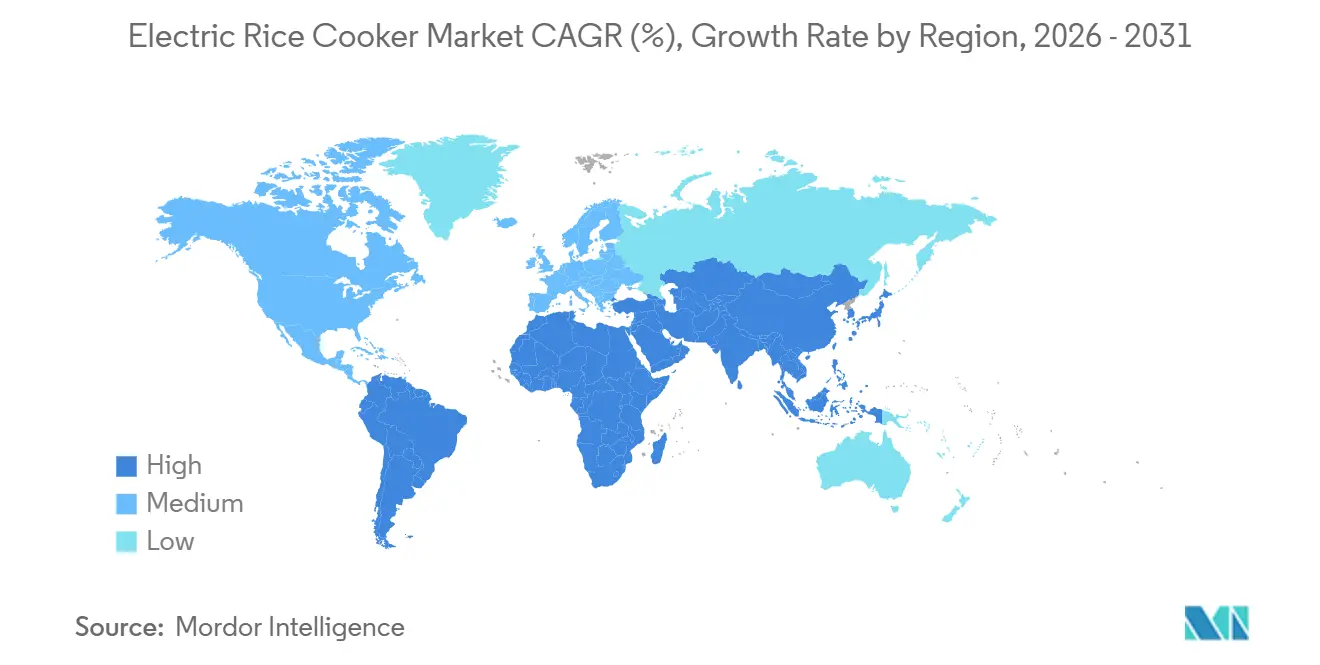
Asia-Pacific held 46.7% of the electric rice cooker market share in 2025 and is forecast to grow at a 6.7% CAGR through 2031. The region combines entrenched rice consumption with active replacement demand and growing interest in appliance upgrades. China provides a large volume base, while Japan and South Korea support higher average selling prices for advanced products. Panasonic’s compact pressure induction heating launch for Japan reflects the importance of small-household demand in the region. Southeast Asia combines a strong rice culture, a growing urban middle class, and expanding digital retail. India’s move toward electric cooking can add another source of demand where appliance access, affordability, and power conditions allow.
North America and Europe Electric Rice Cooker Market
North America and Europe represent a different opportunity for the electric rice cooker market. Established Asian diaspora communities support a steady demand for rice-specific appliances. Wider interest in rice bowls, sushi, and South Asian cooking can also bring new buyers into the category. North American per-capita rice consumption is projected to rise by 0.5% annually through 2035. Buyers in these regions may compare dedicated rice cookers with multicookers and air fryers, making product differentiation important. Higher-income households in selected European markets can support demand for premium appliances. Certified products and established after-sales support can also strengthen brand positioning where safety and compliance expectations are high.
MEA and South America Electric Rice Cooker Market
South America and Middle East and Africa offer a longer-term demand opportunity for the electric rice cooker market. Brazil, Peru, and Chile can support adoption as urban consumer demand and retail access improve. Africa’s share of global rice imports is projected to rise from 35% to 45% by 2035. Rising rice demand can increase the relevance of affordable household appliances in markets with low penetration. GCC hospitality investment can also support demand for commercial, high-capacity equipment. Nigeria and South Africa remain important consumer markets, although value-tier products and informal retail channels are significant. Durable products, voltage resilience, accessible pricing, and regional service partners are necessary for broader development across these regions.
Competitive Landscape
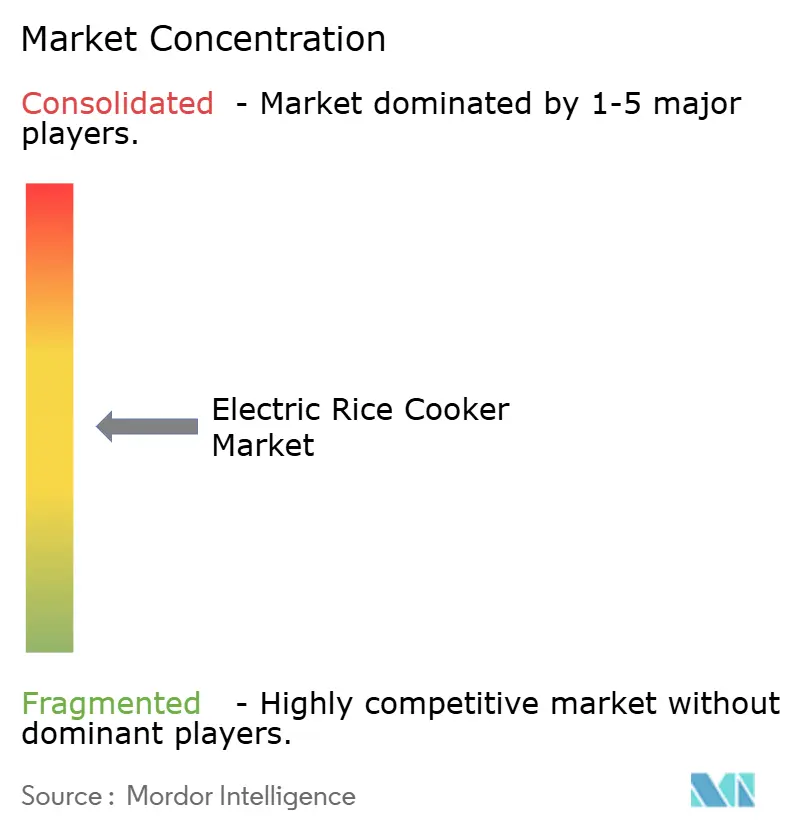
The electric rice cooker market has moderate concentration, with competition varying by geography and price tier. Midea, Zhejiang Supor, and Joyoung are important volume competitors in mass-market and mid-range products. Their positions are supported by manufacturing scale, broad distribution, and access to China’s large consumer base. Zojirushi, Tiger, Panasonic, and Cuckoo have established positions in premium appliances. These brands compete through pressure induction heating, cooking control, product reliability, and brand reputation. Their products are particularly relevant in markets where consumers place high value on rice texture and specialized preparation. The competitive picture is therefore not uniform across the category.
Panasonic announced the SR-C306E as its smallest Odori-daki pressure induction heating model for a September 2026 launch in Japan. The move addresses smaller households while maintaining a premium technology position. Tiger released the JRI-S100, JRI-S180, and JRI-C060 pressure induction heating models in 2026, covering compact and standard capacities[4]. Zojirushi also launched its NX-AB pressure induction heating model in June 2026 with a 3D rotation induction heating structure and 1,400W output. These moves show how leading manufacturers are expanding technology across different capacity and product formats.
Competitive strategies also include health-related functions, smart-home integration, and geographic expansion through locally relevant cooking programs. Brands must decide how far to extend advanced features into mid-range products without losing clear price-tier distinctions. Large-capacity commercial appliances remain an opportunity where consumer brands have limited dedicated product lines or service networks. The Middle East and Africa mid-range space also requires attention because price accessibility and voltage resilience remain important. TTK Prestige, Bajaj Electricals, and Groupe SEB have relevance in transitional markets where local distribution and brand familiarity matter. Competition will remain shaped by the ability to combine product quality, accessible service, and appropriate price positioning.
Electric Rice Cooker Industry Leaders
-
Midea Group Co., Ltd.
-
Panasonic Holdings Corporation
-
Zojirushi Corporation
-
Cuckoo Electronics Co., Ltd.
-
Zhejiang Supor Co., Ltd.
- *Disclaimer: Major Players sorted in no particular order
Electric Rice Cooker Market Companies Covered in this Report
- Midea Group Co., Ltd.
- Panasonic Holdings Corporation
- Zojirushi Corporation
- Cuckoo Electronics Co., Ltd.
- Zhejiang Supor Co., Ltd.
- Tiger Corporation
- Koninklijke Philips N.V.
- Joyoung Co., Ltd.
- Breville Group Limited
- Hamilton Beach Brands Holding Company
- Toshiba Corporation
- Aroma Housewares Company
- TTK Prestige Limited
- Bajaj Electricals Limited
- Groupe SEB
- Electrolux AB
- Xiaomi Corporation
- Hitachi Global Life Solutions, Inc.
- Conair Corporation
- Spectrum Brands, Inc.
Recent Industry Developments in Electric Rice Cooker Market
- September 2026: Panasonic released two variable-pressure IH rice cookers in Japan, the flagship X9E Series, SR-X910E 5.5-gō and SR-X918E 1-shō, with enhanced W-Odori-daki technology improving grain texture by 6% and grain softness by 7% versus the prior model, and the SR-C306E, 3.5-gō and 0.63L, the brand’s smallest-ever Odori-daki compact model priced at JPY 34,600, targeting single-person households
- September 2026: Zojirushi released the NV-KA type IH rice cooker, NV-KA10 1L and NV-KA18 1.8L, incorporating the high-power heating unit structure previously reserved for higher-end models into a broader product tier. The structure enables consistent high-heat cooking that prevents temperature reduction during the boiling-maintenance phase.
- June 2026: Zojirushi launched the NX-AB type Flame Dance Cooking pressure IH rice cooker with a patented 3D rotation IH structure using 2 distinct bottom IH heaters to generate multidirectional convection. The appliance uses 1,400W high-output heating for improved grain sweetness.
- June 2026: Tiger Corporation released the JRI-S100, 1L, JRI-S180, 1.8L, and JRI-C060, 0.63L, pressure induction heating rice cookers under the Freshly Cooked brand, covering compact-to-standard capacity ranges with pressure IH technology.
Global Electric Rice Cooker Market Report Scope
Segmentation Overview
| Standard / Conventional Rice Cookers |
| Induction Heating Rice Cookers |
| Multifunctional / Smart Rice Cookers |
| Below 1 Liter |
| 1 Liter to 1.9 Liters |
| 2 Liters to 4 Liters |
| Above 4 Liters |
| Economy |
| Mid-Range |
| Premium |
| Residential | |
| Commercial | HoReCa (Hotels, Restaurants and Cafes/Catering) |
| Institutional Kitchens | |
| Corporate and Office Cafeterias | |
| Other Commercial Applications, including Transportation, Retail and Healthcare |
| B2B / Direct from Manufacturers | |
| B2C / Retail | Multi-Brand Stores |
| Exclusive Brand Outlets | |
| Online | |
| Other Distribution Channels |
| North America | Canada |
| United States | |
| Mexico | |
| South America | Brazil |
| Peru | |
| Chile | |
| Argentina | |
| Rest of South America | |
| Europe | United Kingdom |
| Germany | |
| France | |
| Spain | |
| Italy | |
| BENELUX (Belgium, Netherlands, and Luxembourg) | |
| NORDICS (Denmark, Finland, Iceland, Norway, and Sweden) | |
| Rest of Europe | |
| Asia-Pacific | India |
| China | |
| Japan | |
| Australia | |
| South Korea | |
| South East Asia (Singapore, Malaysia, Thailand, Indonesia, Vietnam, and the Philippines) | |
| Rest of Asia-Pacific | |
| Middle East and Africa | United Arab Emirates |
| Saudi Arabia | |
| South Africa | |
| Nigeria | |
| Rest of the Middle East and Africa |
| By Product Type | Standard / Conventional Rice Cookers | |
| Induction Heating Rice Cookers | ||
| Multifunctional / Smart Rice Cookers | ||
| By Capacity | Below 1 Liter | |
| 1 Liter to 1.9 Liters | ||
| 2 Liters to 4 Liters | ||
| Above 4 Liters | ||
| By Price Range | Economy | |
| Mid-Range | ||
| Premium | ||
| By End-User | Residential | |
| Commercial | HoReCa (Hotels, Restaurants and Cafes/Catering) | |
| Institutional Kitchens | ||
| Corporate and Office Cafeterias | ||
| Other Commercial Applications, including Transportation, Retail and Healthcare | ||
| By Distribution Channel | B2B / Direct from Manufacturers | |
| B2C / Retail | Multi-Brand Stores | |
| Exclusive Brand Outlets | ||
| Online | ||
| Other Distribution Channels | ||
| By Geography | North America | Canada |
| United States | ||
| Mexico | ||
| South America | Brazil | |
| Peru | ||
| Chile | ||
| Argentina | ||
| Rest of South America | ||
| Europe | United Kingdom | |
| Germany | ||
| France | ||
| Spain | ||
| Italy | ||
| BENELUX (Belgium, Netherlands, and Luxembourg) | ||
| NORDICS (Denmark, Finland, Iceland, Norway, and Sweden) | ||
| Rest of Europe | ||
| Asia-Pacific | India | |
| China | ||
| Japan | ||
| Australia | ||
| South Korea | ||
| South East Asia (Singapore, Malaysia, Thailand, Indonesia, Vietnam, and the Philippines) | ||
| Rest of Asia-Pacific | ||
| Middle East and Africa | United Arab Emirates | |
| Saudi Arabia | ||
| South Africa | ||
| Nigeria | ||
| Rest of the Middle East and Africa | ||
Key Questions Answered in the Report
What is the forecast for the electric rice cooker market?
The category was valued at USD 4.20 billion in 2025 and is forecast to reach USD 5.89 billion by 2031, at a 5.7% CAGR.
Which electric rice cooker product type is growing fastest?
Multifunctional/Smart products are forecast to grow at a 7.7% CAGR through 2031, the fastest rate among product types.
Why do compact electric rice cookers have strong demand?
The 1 Liter to 1.9 Liters category held 34.3% of value in 2025, supported by smaller households and limited urban kitchen space.
Which region leads demand for electric rice cookers?
Asia-Pacific held 46.7% of value in 2025 and is forecast to grow at a 6.7% CAGR through 2031.
What is driving commercial electric rice cooker demand?
Hotels, restaurants, caterers, institutional kitchens, and corporate cafeterias need consistent preparation at higher volumes.