
Elderly Walker Market Size and Share
Market Overview
| Study Period | 2020 - 2031 |
|---|---|
| Market Size (2026) | USD 1.84 Billion |
| Market Size (2031) | USD 2.59 Billion |
| Growth Rate (2026 - 2031) | 7.11 % |
| Fastest Growing Market | North America |
| Largest Market | Asia Pacific |
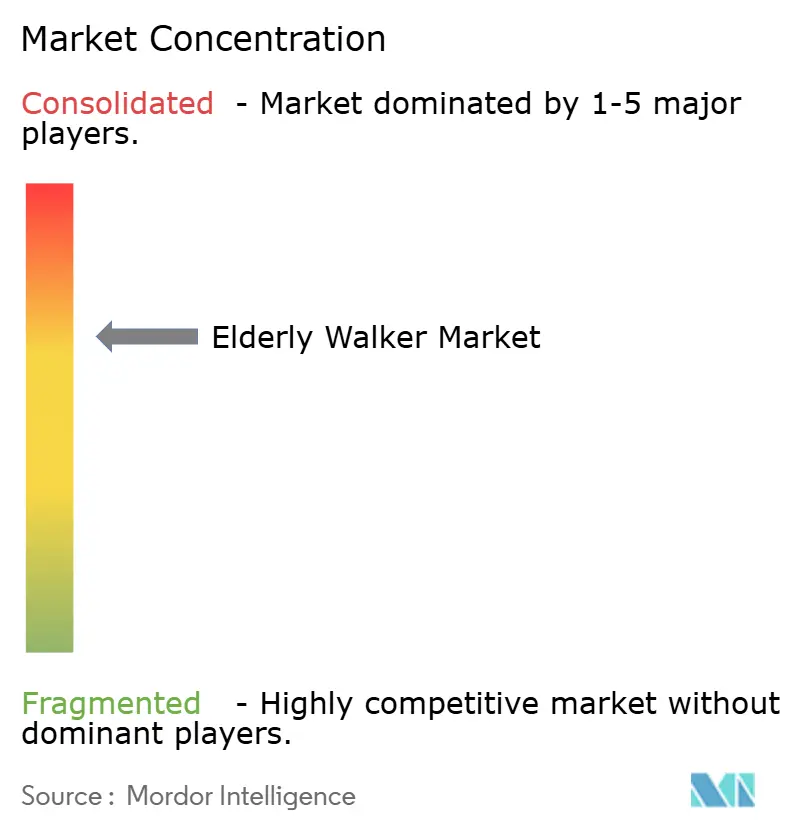
| Market Concentration | Medium |
Major Players *Disclaimer: Major Players sorted in no particular order Image © Mordor Intelligence. Reuse requires attribution under CC BY 4.0. | |
Elderly Walker Market Analysis by Mordor Intelligence
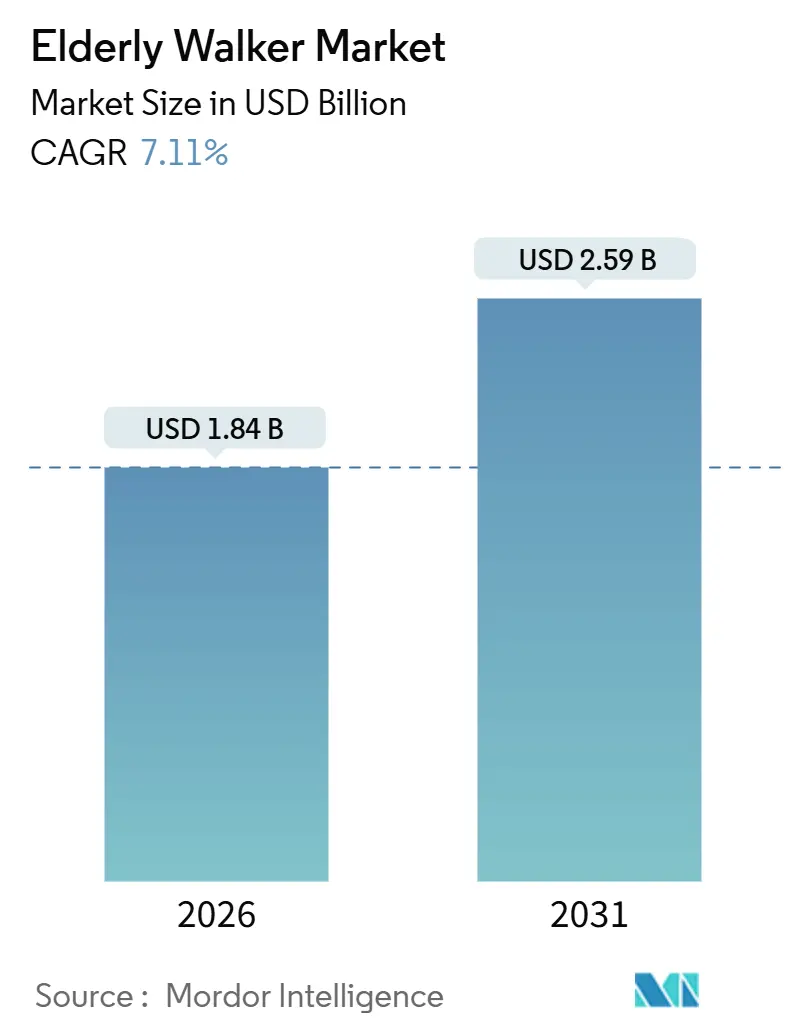
The Elderly Walker Market size is estimated at USD 1.84 billion in 2026, and is expected to reach USD 2.59 billion by 2031, at a CAGR of 7.11% during the forecast period (2026-2031).
Structural demand shifts stem from rapid population aging, a higher burden of chronic musculoskeletal conditions, and policy incentives that prioritize fall prevention. Japan entered the super-aged category in 2024, with 29.1% of its residents aged 65 or older, while South Korea is on course to reach that level in 2025, creating significant demand for mobility-assistive devices. Coverage expansion for durable medical equipment under Medicare Part B in 2025 removed several prior-authorization hurdles, directly lifting U.S. retail volumes of rollators and knee walkers. Material innovation is also reshaping competitive positioning, as carbon-fiber and titanium frames reduce average product weight to below 5 kg while meeting ISO 11199-2 load standards. E-commerce growth outpaces brick-and-mortar sales as digitally native brands pair telehealth consultations with device delivery, an approach that resonates with value-based care programs seeking early discharge and remote monitoring outcomes.
Note: Market size and forecast figures in this report are generated using Mordor Intelligence’s proprietary estimation framework, updated with the latest available data and insights as of January 2026.
Market Trends and Insights
Drivers Impact Analysis of Elderly Walker Market*
| Driver | (~) % Impact on CAGR Forecast | Geographic Relevance | Impact Timeline |
|---|---|---|---|
| Global demographic shift toward super-aged societies | +2.1% | Japan, South Korea, Germany, Italy, global spillover | Long term (≥ 4 years) |
| Rising incidence of chronic musculoskeletal disorders | +1.8% | North America, Europe | Medium term (2-4 years) |
| Expansion of home healthcare infrastructure | +1.5% | North America, Western Europe, urban China | Medium term (2-4 years) |
| Policy incentives for fall-prevention programs | +0.9% | North America, Nordics, Australia | Short term (≤ 2 years) |
| Technological convergence with digital-health platforms | +0.7% | North America, select EU markets, Japan | Medium term (2-4 years) |
| Increasing availability of lightweight high-strength materials | +0.4% | North America, Europe, global | Long term (≥ 4 years) |
| Source: Mordor Intelligence | |||
Global Demographic Shift Toward Super-Aged Societies
A worldwide rise in the share of people aged 65 and above reached 10% in 2024, but disparities are stark. Japan, Italy, and Germany each exceed 28%, whereas sub-Saharan Africa remains below 4%[1]. South Korea’s elderly dependency ratio doubled between 2010 and 2025, compressing the adaptation window for healthcare infrastructure. China reported 297 million citizens aged 60-plus in 2025, yet walker penetration is still one-fifth of Japan’s level. Regulatory pressure rises in parallel; new EU guidance requires all walkers sold after 2027 to meet EN ISO 11199-2, escalating the cost of non-compliant SKUs.
Rising Incidence of Chronic Musculoskeletal Disorders
Osteoarthritis prevalence among adults aged 65-plus climbed to 34% in high-income countries in 2024, up from 28% in 2019. Hip fracture incidence stabilized at 300,000 cases per year in the United States in 2025, yet mobility-aid prescriptions jumped 18% as discharge protocols shifted toward home-based rehabilitation. Knee walkers are displacing crutches for below-knee injuries because they reduce upper-body strain, a trend amplified by a 12% rise in outpatient knee-replacement procedures in 2025. Manufacturers embedding device selection into electronic health records are achieving preferred-vendor status with hospital groups.
Expansion of Home Healthcare Infrastructure
U.S. home health care spending reached USD 139 billion in 2025, up 9.2% from the previous year. Caregivers now prize foldable, lightweight designs, while payers bundle walker provision with telehealth check-ins. Japan raised rental reimbursement rates by 15% in 2025, spurring fleet refresh cycles favoring GPS-enabled walkers. China’s “15-Minute Elderly Care Circle” created 5,000 new distribution points, widening community access.
Policy Incentives for Fall-Prevention Programs
Falls caused 38,000 deaths among U.S. seniors in 2024, yet only 42% consistently used mobility aids. A U.S. Preventive Services Task Force Grade B rating secured Medicare coverage for multifactorial prevention measures, linking walker prescriptions to reimbursable care plans. Australia and the Nordic countries adopted outcome-based contracts in 2025, under which suppliers share savings from lower hospitalization costs.
Restraints Impact Analysis of Elderly Walker Market*
| Restraint | (~) % Impact on CAGR Forecast | Geographic Relevance | Impact Timeline |
|---|---|---|---|
| Pricing pressure in low-income markets | -1.2% | Southeast Asia, Latin America, Sub-Saharan Africa | Short term (≤ 2 years) |
| Inconsistent reimbursement policies | -0.9% | United States, European Union | Medium term (2-4 years) |
| Supply-chain vulnerability for key materials | -0.6% | North America, Europe | Short term (≤ 2 years) |
| Social stigma around assistive-device adoption | -0.5% | Asia-Pacific, Middle East | Long term (≥ 4 years) |
| Source: Mordor Intelligence | |||
Pricing Pressure in Low-Income Markets
Median household income in Indonesia, the Philippines, and Vietnam falls between USD 3,800 and USD 7,200, making a USD 150 aluminum rollator unattainable without subsidy[2]. Local assemblers retail uncertified units for USD 40-60, but quality issues limit hospital acceptance. India caps reimbursement at INR 3,000 (USD 36), forcing global brands to choose between thin margins or strategic withdrawal. NGO programs in Kenya and Uganda specify wide-base walkers for unpaved terrain, carving out niches for specialty suppliers.
Inconsistent Reimbursement Policies Across Regions
Medicare covers 80% of walker costs after a USD 240 deductible, yet Medicare Advantage plans restrict coverage to basic frames, excluding models with seats or baskets[3]. Germany’s public insurance pays 100%, while private insurers cap benefits at EUR 100. France requires a gait speed test, whereas Italy relies on the Barthel Index, resulting in 27 distinct EU reimbursement criteria.
*Our forecasts treat driver/restraint impacts as directional, not additive. The impact forecasts reflect baseline growth, mix effects, and variable interactions.
Elderly Walker Market Segment Analysis
By Type:
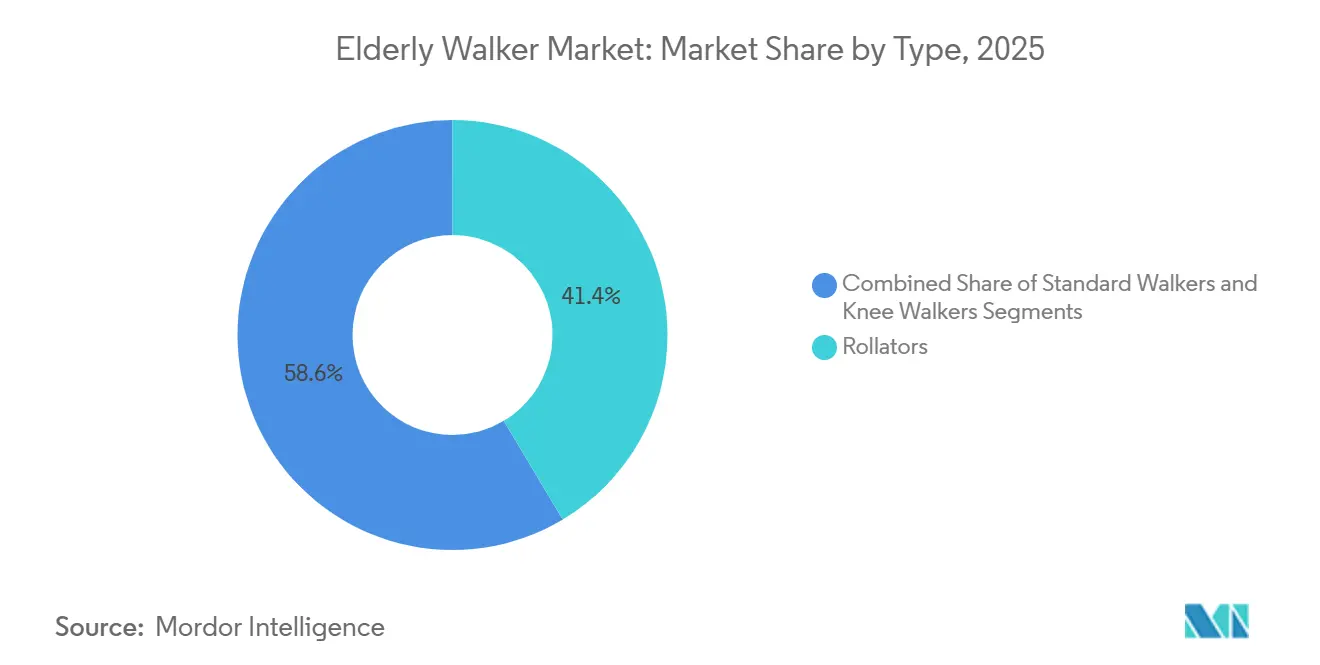
Knee Walkers Outpace Rollators in GrowthRollators accounted for 41.43% elderly walker market share in 2025 thanks to outdoor versatility and integrated seats. Knee walkers, however, are poised to clock a 9.65% CAGR through 2031 as surgeons increasingly prescribe them for post-operative ankle and foot rehabilitation, enabling quicker return to activities. Standard walkers are fading, with a negative 1.2% growth rate, as users shift to wheeled options that reduce upper-body strain.
Demand is further stimulated by national pharmacy chains expanding knee-walker rental programs, which lower acquisition friction and normalize the category. Modular frames that convert between standard and rollator formats address space constraints and airline regulations, a boon for the 18% of seniors who travel abroad each year. Regulatory lag in Europe is slowing knee-walker launches due to MDR Class I requirements, extending time-to-market by up to 18 months.

By Material:
Composites Gain Traction Despite Cost PremiumAluminum retained 34.56% share of the elderly walker market size in 2025, prized for its cost-performance ratio. Carbon-fiber and composite frames, although only 8% mix, are growing at a 9.43% CAGR as prices per kilogram fell to USD 28 in 2025, narrowing the gap with aluminum.
Hybrid designs pairing aluminum legs with carbon-fiber crossbars reduce overall weight by 20% while staying under the USD 200 price ceiling in cost-sensitive regions. Sunrise Medical’s Gemino 30 captured 6% of the European rollator market share within 9 months of launch. Titanium, enabled by additive manufacturing, is starting to appear in premium knee walkers, signaling a pending bifurcation between high-end lightweight models and mass-market aluminum units.
By Distribution Channel:
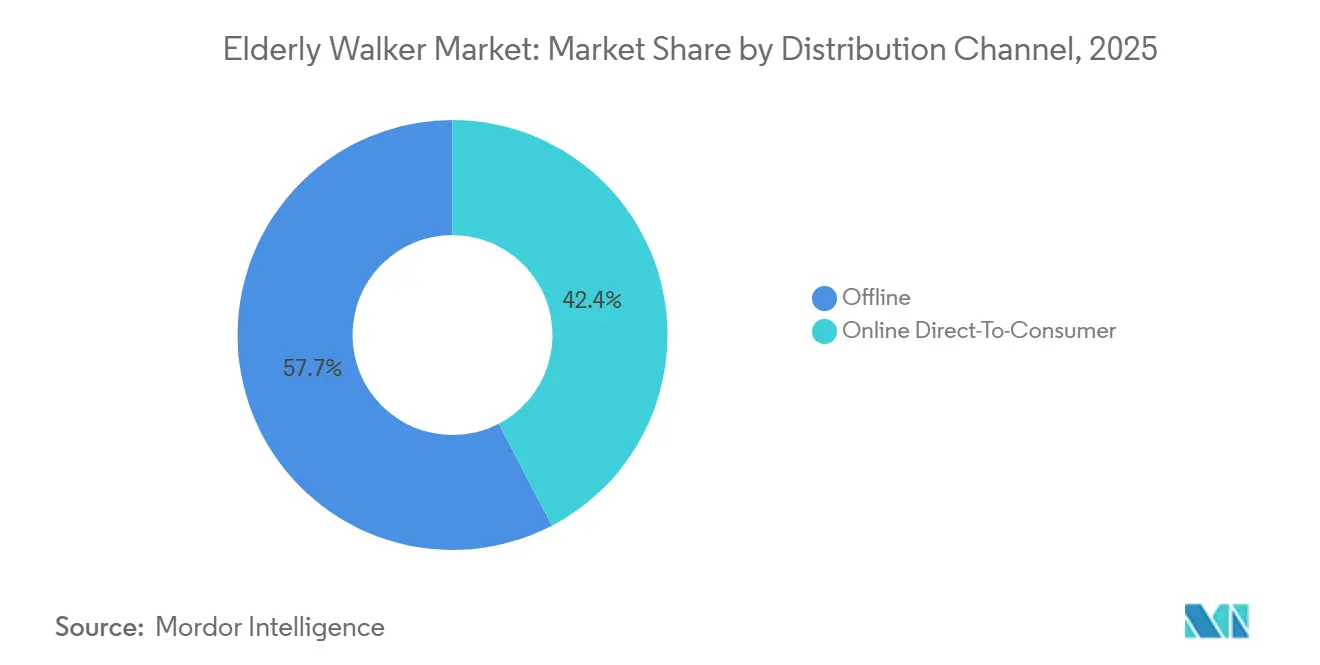
E-Commerce Disrupts Traditional RetailOffline retailers still accounted for 57.65% of revenue in 2025, but online platforms are forecast to log a 10.65% CAGR through 2031, more than twice the growth of brick-and-mortar. Seniors increased online purchasing by 34% between 2020 and 2024, validating the direct-to-consumer model.
Amazon lists more than 200 walker SKUs with same-day delivery across 15 U.S. metros, squeezing retail margins by 15-25%. Digitally native brands like Vive Health coupled product sales with virtual physical-therapy visits, reaching USD 42 million in 2025 sales. Hybrid strategies persist: 62% of first-time buyers still try devices in-store before completing online purchases. Medicare’s requirement for an in-person assessment restricts pure-play e-commerce until telehealth guidelines broaden in 2027.
By End-User:
Home Care Surges as Value-Based Models ExpandHospitals and rehabilitation centers led with 62.45% share in 2025 through bulk procurement and fall-risk protocols. Home-care settings, however, are projected to grow at a 10.43% CAGR through 2031 as payers reward early discharge. Medicare’s Readmissions Reduction Program penalizes facilities with high 30-day bounce-backs, encouraging walker provision at discharge.
Design priorities now center on foldability, 32-inch doorway clearance, and aesthetics suited to residential spaces. Japan boosted rental reimbursement by 15% in 2025, prompting providers to refresh fleets with GPS-equipped walkers. Rental economics favor durable, modular construction, compelling manufacturers to shift engineering focus from planned obsolescence to multi-year serviceability.
Geography Analysis
North America Elderly Walker Market
North America commanded 43.43% of global revenue in 2025, anchored by Medicare’s USD 1.2 billion annual walker budget and an 18,000-location durable-medical-equipment network. Fragmented reimbursement policies limit premium uptake, with Medicare Advantage plans paying only for basic frames. Canada’s provincial disparities complicate market access as maximum benefits range from CAD 200 to CAD 500. Outcome-based procurement pilots in California showed a 19% drop in emergency visits tied to fall incidents, positioning value contracts as a growth lever.
Europe Elderly Walker Market
Europe generated 28% of 2025 sales. MDR enforcement lengthened product-refresh cycles by up to 24 months, inflating compliance costs to EUR 120,000 per SKU. While Germany, France, and the UK account for 60% of regional revenue, Nordic regions are early adopters of sensor-equipped rollators under savings-sharing contracts. Southern Europe leans toward budget models after assistive-device budgets fell 12% in 2024, allowing Eastern European entrants to gain share.
APAC Elderly Walker Market
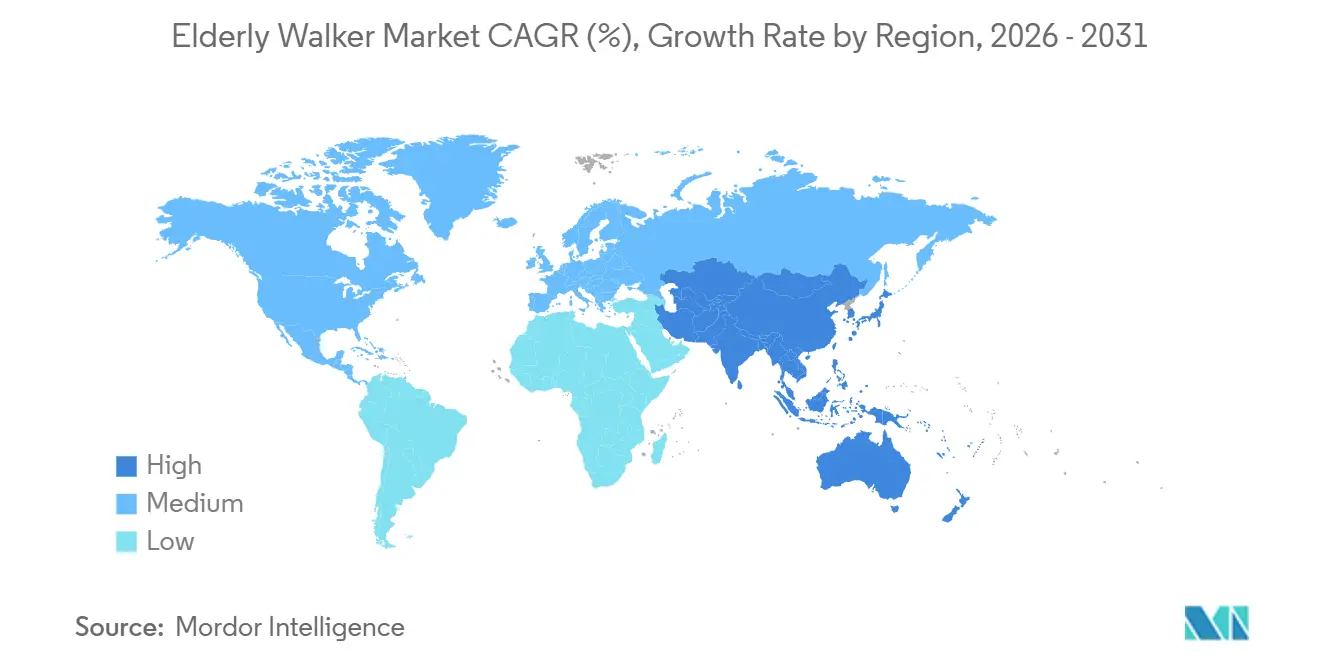
Asia-Pacific is the fastest-growing region, with a 8.54% CAGR to 2031. Japan’s super-aged demographics generated USD 380 million in walker sales in 2025, with 68% funded via LTCI rental programs. China earmarked RMB 15 billion (USD 2.1 billion) for community elder-care infrastructure in 2025, signaling latent growth as penetration rates lag Japan’s by 80%. India’s INR 3,000 reimbursement ceiling pressures suppliers to localize production. Price sensitivity prevails in Southeast Asia, where incomes make imported devices prohibitive without subsidy.
Competitive Landscape
The elderly walker market shows moderate concentration: the top five firms—Drive DeVilbiss, Invacare, Medline, Cardinal Health, and Sunrise Medical—held 38% of 2025 revenue. Competitive edges form around mastery of reimbursement codes, lightweight materials, and smart-sensor integration. Patent filings for IoT-enabled fall detection jumped 42% year over year in 2025. New entrants leverage Europe’s MDR compliance delay to launch agile designs, while established players expand U.S. and EU production footprints to hedge against Asian supply shocks.
Technology bifurcates offerings. Premium lines feature cloud-linked gait analytics, as illustrated by Invacare’s TDX SP2, whereas mass-market segments trim costs through optimized aluminum extrusion. Interoperability remains a bottleneck until IEEE-backed standards are adopted. Price pressure in Southeast Asia and Latin America, where local assemblers source low-cost Chinese aluminum, pushes multinationals toward regionalized supply chains or niche premium positions.
Elderly Walker Industry Leaders
-
Drive DeVilbiss Healthcare
-
Invacare Corporation
-
GF Health Products
-
Medline Industries
-
Sunrise Medical
- *Disclaimer: Major Players sorted in no particular order
Elderly Walker Market Companies Covered in this Report
- Access Rehab Equipment
- Benmor Medical
- Bischoff & Bischoff
- Briggs Healthcare
- Cardinal Health
- Carex
- Compass Health
- Drive DeVilbiss Healthcare
- GF Health Products
- Human Care HC AB
- Invacare
- Kaiyang Medical Tech
- Karman Healthcare
- Medline Industries
- Meyra
- Nova Medical Products
- Sunrise Medical
- Thuasne Group
- TOPRO AS
- Trionic Sverige
- TrustCare AB
Recent Industry Developments in Elderly Walker Market
- July 2025: Zeal Lifestyle launched the 'Zeal' walker. This innovative product aims to redefine mobility aids by combining functionality with modern, luxury design and sustainability.
- June 2025: BOSEGROW (Xiamen Bosegrow Medical Equipment Co., Ltd.), one of the global leaders in orthopedic rehabilitation devices, launched its new Long Air Walker Boot (Model WK-002). Designed with innovative features and superior performance, this medical walking boot redefines ankle rehabilitation standards, offering stability, comfort, and customization for patients with ankle injuries, post-operative recovery needs, and medical professionals worldwide.
Global Elderly Walker Market Report Scope
As per the scope of the report, an elderly walker is a mobility aid designed to assist older adults with walking and maintaining balance. It typically features a frame with four legs, often with wheels, handles, and adjustable height. It helps enhance stability, safety, and independence for seniors with mobility challenges.
The Elderly Walker Market is Segmented by Type (Standard Walkers, Knee Walkers, and Rollators), Material (Aluminum, Steel, and Carbon Fiber & Composites), Distribution Channel (Offline and Online Direct-To-Consumer), End-User (Hospitals & Rehabilitation Centers, Home Care / Aging-In-Place, and Long-Term Care Facilities), and Geography (North America, Europe, Asia-Pacific, Middle East & Africa, and South America). The market report also covers the estimated market sizes and trends for 17 countries across major regions globally. The report offers the value (in USD million) for the above segments.
Segmentation Overview
| Standard Walkers |
| Knee Walkers |
| Rollators |
| Aluminum |
| Steel |
| Carbon Fiber & Composites |
| Offline |
| Online Direct-To-Consumer |
| Hospitals & Rehabilitation Centers |
| Home Care / Aging-In-Place |
| Long-Term Care Facilities |
| North America | United States |
| Canada | |
| Mexico | |
| Europe | Germany |
| United Kingdom | |
| France | |
| Italy | |
| Spain | |
| Rest Of Europe | |
| Asia-Pacific | China |
| Japan | |
| India | |
| Australia | |
| South Korea | |
| Rest Of Asia-Pacific | |
| Middle East & Africa | GCC |
| South Africa | |
| Rest Of Middle East & Africa | |
| South America | Brazil |
| Argentina | |
| Rest Of South America |
| By Type | Standard Walkers | |
| Knee Walkers | ||
| Rollators | ||
| By Material | Aluminum | |
| Steel | ||
| Carbon Fiber & Composites | ||
| By Distribution Channel | Offline | |
| Online Direct-To-Consumer | ||
| By End-User | Hospitals & Rehabilitation Centers | |
| Home Care / Aging-In-Place | ||
| Long-Term Care Facilities | ||
| Geography | North America | United States |
| Canada | ||
| Mexico | ||
| Europe | Germany | |
| United Kingdom | ||
| France | ||
| Italy | ||
| Spain | ||
| Rest Of Europe | ||
| Asia-Pacific | China | |
| Japan | ||
| India | ||
| Australia | ||
| South Korea | ||
| Rest Of Asia-Pacific | ||
| Middle East & Africa | GCC | |
| South Africa | ||
| Rest Of Middle East & Africa | ||
| South America | Brazil | |
| Argentina | ||
| Rest Of South America | ||
Key Questions Answered in the Report
How big is the elderly walker market in 2026?
The elderly walker market size is USD 1.84 billion in 2026 and is projected to reach USD 2.59 billion by 2031.
Which product type is growing fastest?
Knee walkers are expected to record a 9.65% CAGR through 2031, the fastest among all product categories.
What is the main growth driver in Asia-Pacific?
Demographic aging combined with large public subsidies, such as China's RMB 15 billion elder-care program, is propelling Asia-Pacific growth at an 8.54% CAGR.
Why are carbon-fiber walkers gaining popularity?
Carbon-fiber frames cut device weight below 5 kg while meeting international load standards, meeting user demand for portability despite higher prices.
How are online channels influencing competition?
Direct-to-consumer sales are rising at a 10.65% CAGR, pressuring traditional retailers and enabling digitally native brands to gain share through bundled telehealth services.