
Egypt Wire and Cable Market Size and Share
Market Overview
| Study Period | 2020 - 2031 |
|---|---|
| Forecast Data Period | 2026 - 2031 |
| Base Year Market Size (2025) | USD 1.35 Billion |
| Market Size (2026) | USD 1.43 Billion |
| Market Size (2031) | USD 1.91 Billion |
| Growth Rate (2026 - 2031) | 5.96 % |
| Market Concentration | Medium |
Major Players *Disclaimer: Major Players sorted in no particular order Image © Mordor Intelligence. Reuse requires attribution under CC BY 4.0. | |
Egypt Wire and Cable Market Analysis by Mordor Intelligence
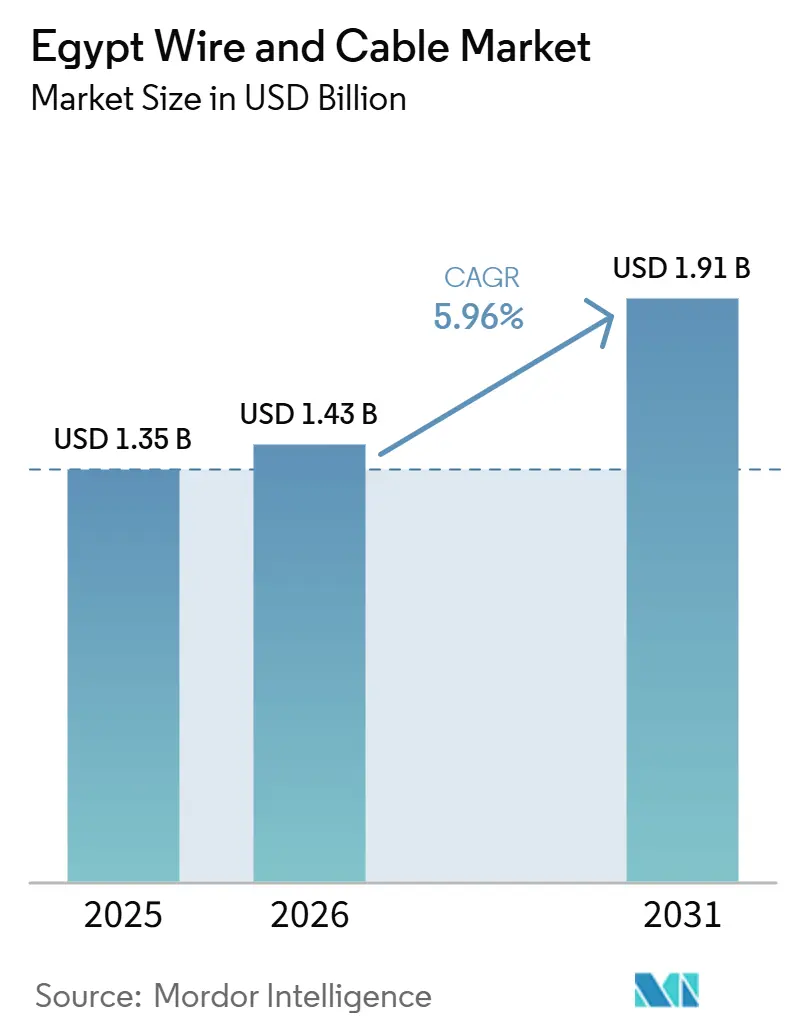
The Egypt wire and cable market size is projected to expand from USD 1.35 billion in 2025 and USD 1.43 billion in 2026 to USD 1.91 billion by 2031, registering a CAGR of 5.96% between 2026 to 2031. Public spending on electricity and renewable energy supports a long pipeline of generation, transmission, and distribution work. The FY2025/2026 electricity and renewable energy capital budget reached EGP 136.3 billion (USD 2.67 billion), compared with EGP 72.6 billion (USD 1.42 billion) in the previous year. Renewable capacity reached 9.3 GW by the end of 2025, with 1.5 GW added that year. This expansion increases demand for high-voltage evacuation links, optical ground wire, and distribution equipment. Export-oriented manufacturing is also changing the Egypt wire and cable market, as local producers add capability for advanced cable grades and pursue demand in Europe, the Gulf Cooperation Council, and Africa.
Key Report Takeaways
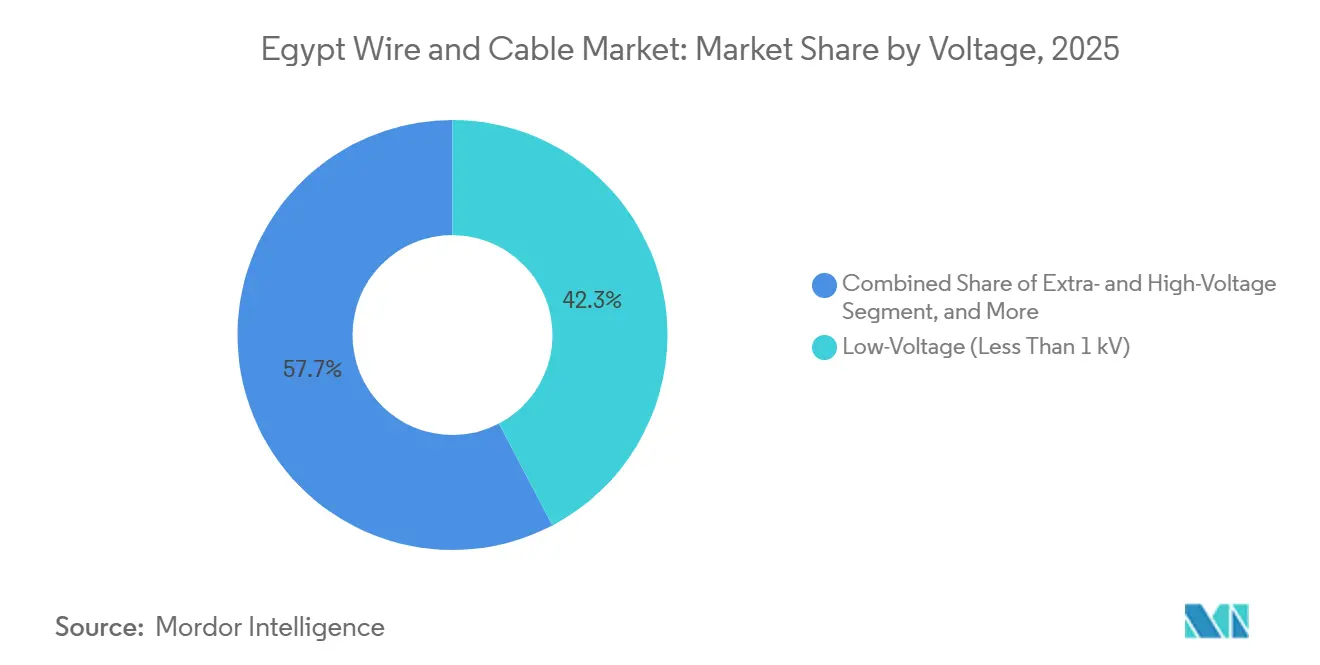
- By voltage, low-voltage cables held 42.31% of the Egypt wire and cable market share in 2025, while extra- and high-voltage cables are projected to expand at a 7.54% CAGR through 2031.
- By cable type, power cables accounted for 40.19% of the Egypt wire and cable market share in 2025, while fiber-optic cable is projected to grow at a 6.54% CAGR through 2031.
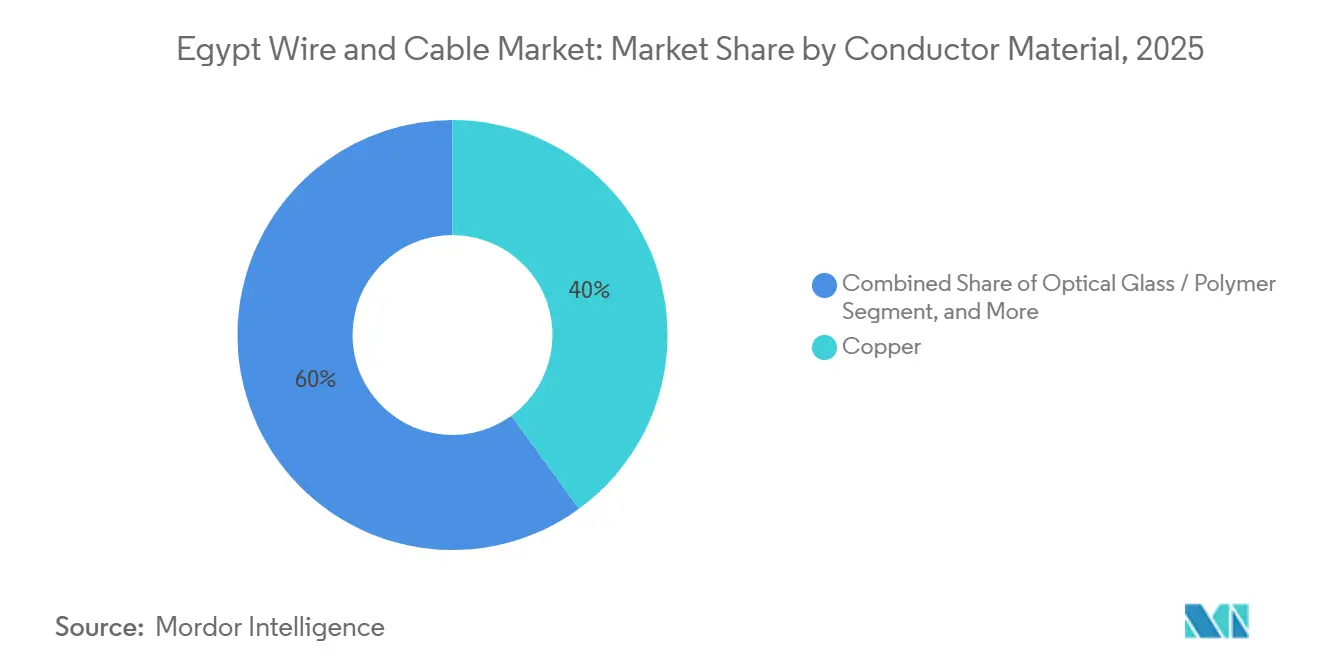
- By conductor material, copper conductors held 39.98% share in 2025, while aluminum conductors are expected to expand at a 7.38% CAGR through 2031 in the Egypt wire and cable market.
- By installation, underground systems accounted for 43.12% share in 2025, while submarine cables are projected to advance at a 6.77% CAGR through 2031 in the Egypt wire and cable market.
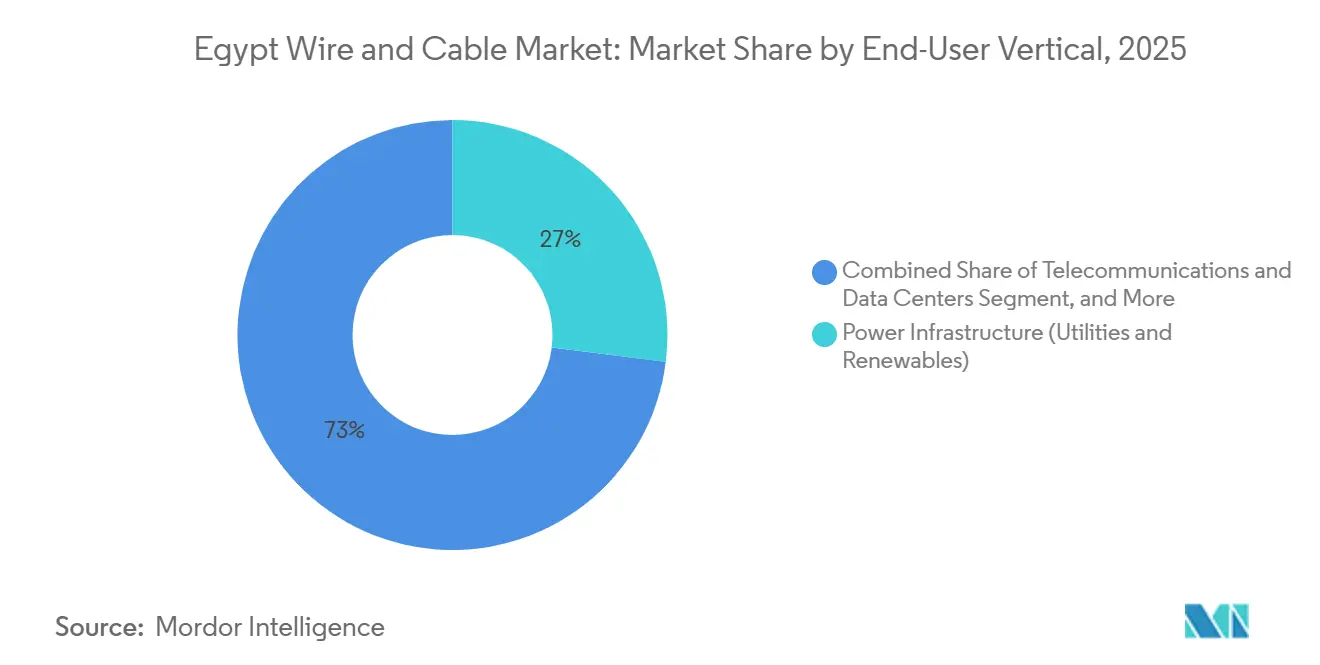
- By end-user vertical, power infrastructure, utilities, and renewables held a 26.98% share in 2025, while telecommunications and data centers are projected to grow at a 7.99% CAGR through 2031 in the Egypt wire and cable market.
- By insulation, insulated cables held 79.80% share in 2025 and are projected to expand at a 6.89% CAGR through 2031 in the Egypt wire and cable market.
Note: Market size and forecast figures in this report are generated using Mordor Intelligence’s proprietary estimation framework, updated with the latest available data and insights as of January 2026.
Egypt Wire and Cable Market Trends and Insights
Drivers Impact Analysis*
| DRIVER | (~) % IMPACT ON CAGR FORECAST | GEOGRAPHIC RELEVANCE | IMPACT TIMELINE |
|---|---|---|---|
| Grid Modernization and Renewable Energy Evacuation | +1.8% | National, concentrated in the Gulf of Suez, the Red Sea, and the Aswan corridors | Medium term (2-4 years) |
| New Cities and Utility Networks | +1.3% | Greater Cairo, New Administrative Capital, New Heliopolis, and New Cairo | Short term (≤ 2 years) |
| Telecom Fiberization and Data Center Connectivity | +1.0% | National, rural Decent Life villages, urban FTTH, and data center clusters | Short term (≤ 2 years) |
| Industrial and Special Economic Zone Expansion | +0.7% | Suez Canal Economic Zone, 10th of Ramadan City, Belbeis, and Borg El Arab | Medium term (2-4 years) |
| Local Manufacturing and Export Substitution | +0.5% | Damietta, Suez, and 10th of Ramadan City | Long term (≥ 4 years) |
| Advanced Conductors and OPGW for Renewable Integration | +0.4% | Gulf of Suez, Red Sea, Aswan, and Upper Egypt solar belt | Medium term (2-4 years) |
| Source: Mordor Intelligence | |||
Grid Modernization and Renewable Energy Evacuation
Egypt’s grid investment cycle centers on a multi-lot 500 kV overhead transmission program between the Orascom and El Hawamdeya substations. The wider 350 km network is estimated to require an investment of EGP 12 billion to EGP 14 billion (USD 231 million to USD 269 million). Lots 1 and 3 were awarded to the Korra Energi-HIDELECO consortium for USD 58 million, while Lot 2 covered a 61.6 km section. The contracts specify All-Aluminum Alloy Conductors, with 506×4 mm² cross-sectional areas, and optical ground wire fiber-optic cables. These requirements link aluminum conductors, overhead systems, and signal cables within the same procurement cycle. The program supports Egypt’s 22 GW renewable energy integration target for 2030 and maintains a defined technical baseline through IEC 61089 and IEC 60794 specifications.
Construction of New Cities and Utility Networks
More than 30 new urban communities continue to support low- and medium-voltage cable requirements. The New Administrative Capital has required contributions from Energya Cables, BICC Cables, and Egypt Cable across its electrical network. Its smart-city design requires fiber-to-the-building connections, building management system control cables, and data cables in government buildings. These requirements add digital connectivity needs to conventional power wiring. The rerouting of existing lines also results in duplicate procurement in areas that already have electricity service. Madkour Projects completed the diversion of 220 kV and 66 kV overhead lines in New Cairo’s southern extension to clear road and transit corridors.[1]
Telecom Fiberization and Data Center Connectivity
Fixed broadband subscriptions grew 36% in 2026, adding 1 million users as fiber infrastructure expanded. Public investment in the ICT sector totaled EGP 13 billion (USD 0.25 billion) in FY2025/2026, including EGP 9 billion (USD 0.02) from the state budget. The funds support fiber rollout under the Decent Life initiative across more than 1,250 villages. Telecom Egypt is replacing legacy copper household connections with fiber, which raises optical cable volumes. The SEA-ME-WE-6 system also landed at Port Said and Ras Ghareb, requiring terrestrial connections between the landing sites. The National Telecommunications Regulatory Authority’s 410 MHz spectrum expansion requires fiber backhaul for new base stations and supports demand for outdoor armored fiber.[2]
Industrial and Special Economic Zone Expansion
The Suez Canal Economic Zone recorded FY revenue of USD 314.73 million and contracted 117 projects with a combined investment of USD 7.26 billion. Industrial expansion requires medium-voltage distribution cables, instrumentation cables, control cables, and fire-resistant products. New technology manufacturing agreements at Ain Sokhna included electrical and power systems facilities expected to begin operations in early 2027. The Sokhna projects involving Kemet Industries and Al Qalaa Red Flag include a fiber-optic cable facility. This investment increases both demand for cable-grade optical fiber preforms and domestic fiber cable capacity. Elsewedy Electric also plans to double capacity at its 10th of Ramadan City complex over the next 3 years.[3]
Restraints Impact Analysis*
| RESTRAINT | (~) % IMPACT ON CAGR FORECAST | GEOGRAPHIC RELEVANCE | IMPACT TIMELINE |
|---|---|---|---|
| Copper and Aluminum Price Volatility | -1.2% | Nationwide, all manufacturers are dependent on imported copper rods and primary aluminum | Short term (≤ 2 years) |
| High Financing Costs and Imported Input Exposure | -0.9% | National, with greater pressure in Upper Egypt and non-metropolitan zones | Medium term (2-4 years) |
| Skilled Installation and Testing Capacity Gaps | -0.6% | Outside Greater Cairo, new-city corridors, Upper Egypt, and Sinai zones | Medium term (2-4 years) |
| Fragmented Procurement and Payment Cycle Risk | -0.4% | National, particularly housing authority and municipal utility contracts | Short term (≤ 2 years) |
| Source: Mordor Intelligence | |||
Copper and Aluminum Price Volatility
Copper prices exceeded USD 13,000 per ton on the London Metal Exchange in 2025 after a surge of more than 30%. Egyptian cable prices increased by 15% to 40%, depending on the copper content in the finished product. Egypt Aluminum raised product prices by EGP 3,000-5,000 per ton (USD 58.74 - 97.91 per ton) in May 2026. The gap between primary ingot prices and finished-sector costs widened from EGP 30,000 per ton (USD 587.45 per ton) at the end of 2024 to more than EGP 100,000 per ton (USD 1,958.16 per ton) by mid-2026. Larger integrated producers can manage the exposure through copper rod and aluminum drawing operations. Smaller producers buying imported rod on the spot market face tighter margins and more difficult contract pricing.
High Financing Costs and Imported Input Exposure
High benchmark lending rates increase working capital needs for manufacturers that must hold inventory of copper rod, aluminum rod, and specialty polymers. Imported copper cathode, specialty cross-linked polyethylene compounds, and optical fiber preforms add foreign-currency exposure. Supply dependence on a single low-cost source geography also heightens resilience risks during freight disruptions or trade friction. CIB signed a financing agreement in February 2026 to support Elsewedy Electric’s Hungary power project. The EUR 58 million facility was equivalent to USD 62.7 million at 2025 rates. Smaller factories do not have comparable access to export finance and may face a widening difference in financial resilience.
*Our forecasts treat driver/restraint impacts as directional, not additive. The impact forecasts reflect baseline growth, mix effects, and variable interactions.
Segment Analysis
By Voltage: Renewable Evacuation Supports Extra- and High-Voltage Demand
Low-voltage cables held 42.31% of the Egypt wire and cable market size in 2025. The segment remains the largest volume category because it serves residential, commercial, and light-industrial wiring. New buildings and urban communities continue to require extensive low-voltage internal networks. Medium-voltage cables serve distribution grids, industrial zones, and internal renewable collection networks. Secondary substations across new communities support their demand. The New Administrative Capital has a 66 kV and 22 kV distribution backbone that requires these systems.
Extra- and high-voltage cables above 35 kV are projected to grow at a 7.54% CAGR through 2031. This growth reflects the priority given to the development of renewable energy and to large transmission corridors. The 500 kV Orascom-Hawamdeya program covers three lots that were awarded in mid-2026. The program specifies 500 kV AAAC overhead conductors and OPGW ground wires across 160 km of new corridor. Cross-border interconnection plans with Saudi Arabia, Libya, and potentially Cyprus could support further demand for submarine and underground high-voltage systems. Procurement requirements remain governed by IEC 62067 for cables above 150 kV and IEC 60840 for 30 kV to 150 kV cables.[4]

By Cable Type: Power Cables Lead While Fiber-Optic Cable Scales
Power cables accounted for 40.19% of the Egypt wire and cable market size in 2025. Grid expansion and new-city construction keep power systems at the center of domestic demand. This category includes cables required for generation, transmission, distribution, and building networks. Signal and control cables serve industrial automation, oil and gas activity, and smart-city systems. Demand for these products rises as buildings add management and process-control equipment. Coaxial and data cables remain relevant for structured cabling and existing television networks.
Fiber-optic cable is projected to grow at a 6.54% CAGR through 2031 in the Egypt wire and cable market. Elsewedy Communications Cables opened a facility at 10th of Ramadan City in February 2025 with an annual capacity of 4 million km of fiber-optic cable. The EGP 2 billion investment was equivalent to USD 38.5 million. The facility also has the capacity to produce 200,000 km of copper telecommunications cable each year. Hengtong planned a second Egyptian footprint with 3 million km of annual fiber-optic cable capacity and 40% of output targeted for export. These investments position the Egypt wire and cable market for demand in the Middle East and Africa as well as domestic rollout.
By Conductor Material: Cost Conditions Support Aluminum in Transmission
Copper conductors are expected to account for 39.98% of the Egypt wire and cable market share in 2025. Copper remains important in low-voltage power products and telecommunications cables. Established termination systems continue to support their use in building and specialty applications. Optical glass and polymer conductors form the basis of fiber-optic cable products, and their use is rising as broadband networks shift toward fiber connections. Hengtong is expected to demonstrate the commercial deployment of hollow-core fiber in November 2025, indicating the direction of development in advanced optical conductors.
Aluminum conductors are projected to expand at a CAGR of 7.38% through 2031. Transmission specifications often require AAAC and ACSR products for overhead routes. Utilities prefer these conductors at high voltages due to their weight and cost characteristics. Elsewedy Electric is investing in aluminum rod production lines through 2027 and 2028, reflecting continued demand for conductors across the Middle East and Africa. Copper price volatility also supports substitution toward aluminum in medium-voltage applications where regulations permit it.
By Installation: Underground Networks Lead While Submarine Capacity Emerges
Underground installation is expected to account for 43.12% of the Egypt wire and cable market size in 2025. Egypt’s urban utility approach favors buried distribution systems in planned cities. Underground networks improve reliability and meet visual requirements in dense development corridors. Overhead systems continue to play an important role in long-distance transmission routes, particularly in renewable energy areas where underground construction is less practical. Active 500 kV programs in the Gulf of Suez show that both installation formats can grow together.
Submarine cables are projected to grow at a CAGR of 6.77% through 2031. Prysmian manufactured cables for the Egypt-Saudi Arabia interconnector, a EUR 221 million project equivalent to USD 239.5 million at 2024 rates. The project included 127.5 km of HVDC ±500 kV mass-impregnated submarine cables and 43.5 km of 36 kV XLPE submarine cables. Elsewedy Electric signed an agreement for a USD 500 million submarine cable factory at Damietta Port. The facility covers 500,000 m² and plans to direct all production for export. The project indicates a shift from importing submarine products to developing local manufacturing capability.
By End-User Vertical: Power Infrastructure Leads While Telecom Accelerates
Power infrastructure, utilities, and renewables are expected to account for 26.98% of the Egypt wire and cable market size in 2025. Grid modernization, renewable construction, and new-city electrification support this leading position. The segment purchases high-voltage, medium-voltage, low-voltage, overhead, and control cable products. Renewable sites require collection systems, evacuation lines, and communications links. Grid projects also create demand for optical ground wire. This combination gives utilities an important role across several cable categories.
Telecommunications and data centers are projected to grow at a CAGR of 7.99% through 2031. The segment benefits from 36% growth in fixed broadband subscribers in 2026. The FY2025/2026 ICT allocation of EGP 13 billion (USD 0.25 billion) supports fiber rollout. Residential and commercial construction remains a substantial driver of demand across the New Administrative Capital, North Coast projects, and other cities. Oil and gas, and petrochemicals, require armored, flame-retardant, low-smoke, zero-halogen cable products. Industrial manufacturing and automotive activity add requirements for control, harness, and battery cable systems.
By Insulation: Insulated Cables Lead Through Safety Requirements
Insulated cables are expected to account for 79.80% of the Egypt wire and cable market share in 2025. The segment is also projected to grow at a CAGR of 6.89% through 2031. New urban and industrial sites require insulated products across most internal networks. XLPE is gaining use in medium- and high-voltage systems because it provides thermal performance and lower dielectric losses. EETC specifications require XLPE for underground medium-voltage cables in new grid projects. PVC remains important in low-voltage building products under Egyptian Standard ES 318 and ES 2178.
Non-insulated conductors are expected to represent 20.2% of the Egypt wire and cable market in 2025. Their use is concentrated in overhead extra-high-voltage transmission lines that use ACSR or AAAC conductors. Air clearance acts as the dielectric medium in these systems. Their role is more limited in distribution networks and indoor applications. Insulated underground and aerial bundled systems are expanding as the grid replaces exposed low-voltage lines in rural and peri-urban locations. EETC loss-reduction and electrification programs support this shift toward more protected networks.
Geography Analysis
Greater Cairo and the New Administrative Capital account for the largest concentration of cable demand in Egypt. The capital corridor requires systems ranging from 500 kV substations to fiber-to-the-building networks. The city’s smart-city program drives demand for building automation, intelligent lighting control, and data-center fiber connections. KAHRABA/Valmore Holding is expected to commission two new 66 kV substations, each with 80 MVA capacity, in Belbeis and Borg El Arab in 2026. The substations are expected to serve 10th of Ramadan City, Madinaty, the New Administrative Capital, and New Heliopolis. This work indicates how distribution demand is spreading outward from the Greater Cairo area.
The Gulf of Suez and the Suez Canal Economic Zone form Egypt’s main corridor for renewable energy and industrial demand. The 500 kV Gulf of Suez transmission program is expected to integrate more than 2 GW of renewable capacity through a single axis. Hengtong operates a fiber-optic cable factory in the TEDA Industrial Park in Suez. Hengtong’s announced expansion and the Kemet Industries-Al Qalaa Red Flag facility are expected to deepen this manufacturing base. The co-location of factories and industrial users can reduce logistics requirements across the Egypt wire and cable market. Port Said and Ras Ghareb also provide SEA-ME-WE-6 landings that require terrestrial fiber crossings.
Upper Egypt and the North Delta-Damietta coast have distinct requirements. Aswan’s solar belt requires medium-voltage collection cables, high-voltage evacuation links, and OPGW-equipped lines. Hengtong is expected to supply the full power cable package for the 500 MW Kang Ombo Photovoltaic Power Station, which is scheduled to launch in December 2025. Damietta is developing as a specialist manufacturing location through the proposed USD 500 million submarine cable factory. Alexandria and the Western Delta continue to support demand from oil, gas, refinery, petrochemical, and LNG activities. Borg El Arab’s industrial zone also adds cable demand from expanding production facilities.
Competitive Landscape
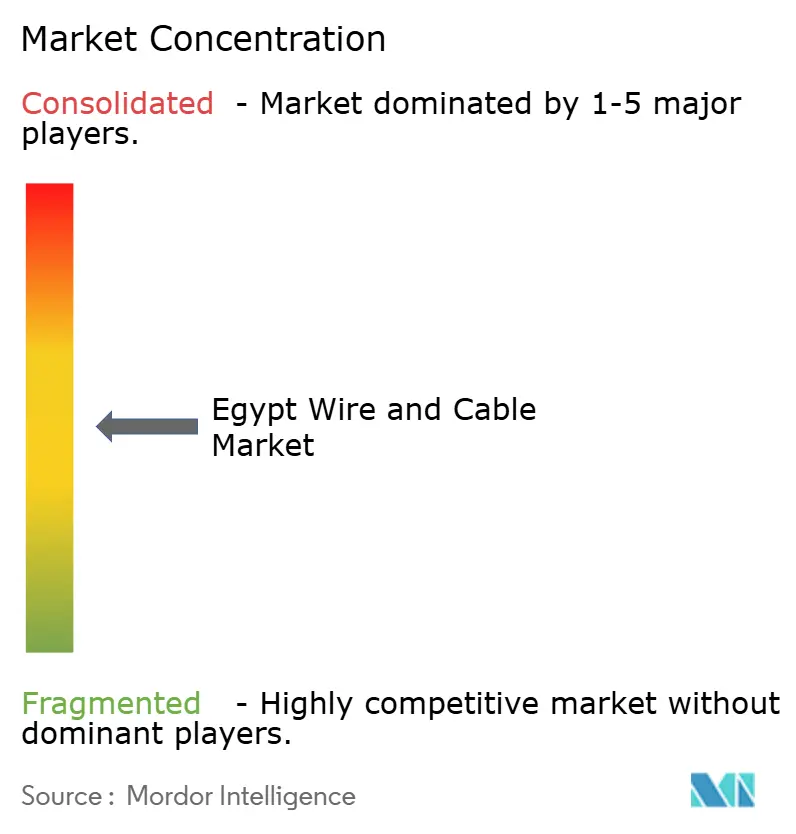
The Egypt wire and cable market has a moderately concentrated premium and high-voltage tier. Elsewedy Electric is the leading local participant, while lower-tier low-voltage products remain more fragmented. The company operates 26 cable and wire factories worldwide. Cables account for 55% to 60% of its total sales.
Hengtong Optic-Electric Egypt is increasing its role in fiber-optic cable supply through its TEDA Suez factory and Telecom Egypt-related work. The company is expected to renew its ISO 9001:2015 certification in December 2025, supporting its qualification for procurement programs. Prysmian maintains a strong position in submarine and high-voltage direct-current cable products. The Egypt-Saudi Arabia interconnector work demonstrates the high technical barriers in this category. Elsewedy Electric’s proposed Damietta plant represents a major strategic move into submarine cable production. The company also expanded communications cable capacity at 10th of Ramadan City to support domestic and export demand.
Giza Cable Industries, Cairo Cables Company, Arab Cables, and Electro Cable Egypt compete in the local mid-tier product segment. These companies compete primarily on price, delivery performance, and relationships with EETC and public housing contractors. Local manufacturing incentives support investment in fiber-optic preform drawing and aluminum rod production. This approach can improve eligibility for government tenders compared with import-only distribution. Data centers and metro rail projects require low-smoke, zero-halogen, and halogen-free specialty cables, where certified local supply remains limited. Desert-rated medium-voltage photovoltaic collection products represent another area where suppliers can differentiate. No combined market share for the leading companies is available; therefore, a market concentration score cannot be assigned using the stated methodology.
Egypt Wire and Cable Industry Leaders
-
Nexans
-
Prysmian S.p.A.
-
Corning Incorporated
-
Elsewedy Electric Company
-
Electro Cable Egypt Co. SAE
- *Disclaimer: Major Players sorted in no particular order
Recent Industry Developments
- May 2026: Elsewedy Electric reported Q1 2026 consolidated revenues of EGP 75.3 billion (USD 1.42 billion), a 26.78% increase year-on-year. The Wires, Cables and Accessories segment contributed 60% of total revenue at EGP 45.4 billion (USD 857.54 million), up 25.8% year-on-year, with a backlog of EGP 52.6 billion (USD 1.03) at quarter end.
- December 2025: Hengtong Optic-Electric Egypt Co., S.A.E. supplied the full power cable package for the 500 MW Kang Ombo Photovoltaic Power Station in Aswan Province, whose official launch was presided over by Egypt's Prime Minister on December 14, 2025. The station, covering 10 km² in area, is expected to reduce approximately 760 tons of CO₂ per year.
- March 2025: Elsewedy Electric signed a USD 500 million memorandum of understanding with Egypt's Holding Company for Maritime and Land Transport to establish a submarine cable factory at Damietta Port. The facility, spanning 500,000 m², will be the first submarine cable factory in the Middle East and the sixth globally, with 100% of production designated for export to Europe, the Middle East, and Africa.
- February 2025: Elsewedy Communications Cables inaugurated Egypt's largest communications cable factory in the Middle East at Industira East, 10th of Ramadan City, with an investment of EGP 2 billion (USD 38.5 million). The 70,000 m² facility has an annual capacity of 4 million km of fiber-optic cables and 200,000 km of copper telecommunications cables, utilizing European production technology. Phase 2 will expand capacity and localize fiber network manufacturing technology through global partnerships.
Egypt Wire and Cable Market Report Scope
The Egypt Wire and Cable Market Report is Segmented by Voltage (Extra-and High-Voltage [Greater Than 35 kV], Medium-Voltage [1-35 kV], and Low-Voltage [Less Than 1 kV]), Cable Type (Power Cable, Fiber-Optic Cable, Signal and Control Cable, and Coaxial and Data Cable), Conductor Material (Copper, Aluminum, and Optical Glass / Polymer), Installation (Overhead, Underground, and Submarine), End-User Vertical (Residential Construction, Commercial Construction, Power Infrastructure, Telecommunications and Data Centers, Oil and Gas and Petrochemicals, Automotive and Mobility, and Industrial Manufacturing), and Insulation (Insulated, and Non-Insulated). The Market Forecasts are Provided in Terms of Value (USD).
| Extra- and High-Voltage (Greater Than 35 kV) |
| Medium-Voltage (1-35 kV) |
| Low-Voltage (Less Than 1 kV) |
| Power Cable |
| Fiber-Optic Cable |
| Signal and Control Cable |
| Coaxial and Data Cable |
| Copper |
| Aluminum |
| Optical Glass / Polymer |
| Overhead |
| Underground |
| Submarine |
| Residential Construction |
| Commercial Construction |
| Power Infrastructure (Utilities and Renewables) |
| Telecommunications and Data Centers |
| Oil and Gas and Petrochemicals |
| Automotive and Mobility |
| Industrial Manufacturing |
| Insulated |
| Non-Insulated |
| By Voltage | Extra- and High-Voltage (Greater Than 35 kV) |
| Medium-Voltage (1-35 kV) | |
| Low-Voltage (Less Than 1 kV) | |
| By Cable Type | Power Cable |
| Fiber-Optic Cable | |
| Signal and Control Cable | |
| Coaxial and Data Cable | |
| By Conductor Material | Copper |
| Aluminum | |
| Optical Glass / Polymer | |
| By Installation | Overhead |
| Underground | |
| Submarine | |
| By End-User Vertical | Residential Construction |
| Commercial Construction | |
| Power Infrastructure (Utilities and Renewables) | |
| Telecommunications and Data Centers | |
| Oil and Gas and Petrochemicals | |
| Automotive and Mobility | |
| Industrial Manufacturing | |
| By Insulation | Insulated |
| Non-Insulated |
Key Questions Answered in the Report
What is the Egypt wire and cable market size?
The Egypt wire and cable market was valued at USD 1.43 billion in 2026 and is projected to reach USD 1.91 billion by 2031, at a 5.96% CAGR.
What is driving demand for wire and cable products in Egypt?
Grid modernization, renewable energy evacuation, new cities, fiber deployment, and industrial zone investment are the main drivers of demand.
Which voltage category is growing fastest in Egypt?
Extra- and high-voltage cables above 35 kV are projected to grow at a 7.54% CAGR through 2031, supported by transmission projects.
Which cable type is expected to grow fastest?
Fiber-optic cable is projected to grow at a 6.54% CAGR through 2031 as broadband and data infrastructure expand.
Which end-user sector offers the strongest growth outlook?
Telecommunications and data centers are projected to grow at a 7.99% CAGR through 2031, the highest rate among end-user sectors.
Who are the leading companies in Egypt's wire and cable sector?
Elsewedy Electric leads the local market, while Hengtong Optic-Electric Egypt and Prysmian are active in fiber-optic and advanced submarine-cable segments.