
Egypt Table Grapes Market Size and Share
Egypt Table Grapes Market Analysis by Mordor Intelligence
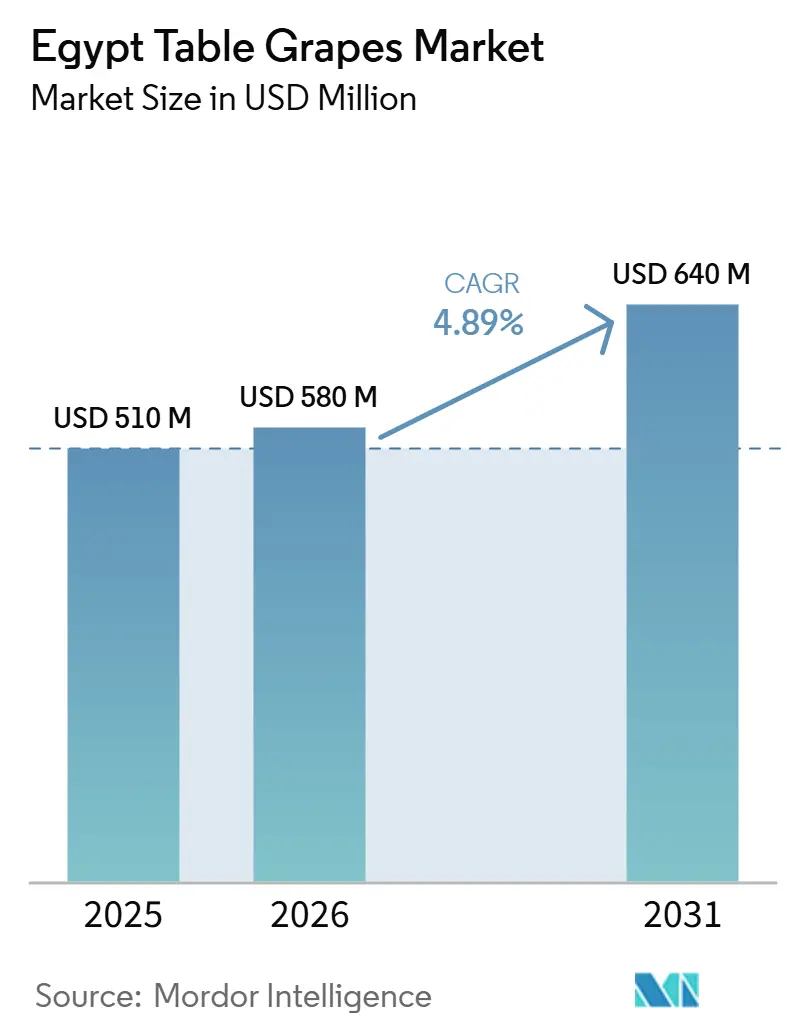
The Egypt table grapes market is projected to be valued at USD 510 million in 2025 and USD 580 million in 2026. It is anticipated to reach USD 640 million by 2031, growing at a CAGR of 4.89% during the forecast period 2026 to 2031. According to the United States Department of Agriculture Foreign Agricultural Service (USDA FAS) data published in 2025, Egypt is among the major global producers of table grapes, with production reaching 1.67 million metric tons in 2025-26. Domestic fresh consumption stood at 1.45 million metric tons in 2025-26, supporting a broad and stable local revenue base[1]Source: United States Department of Agriculture Foreign Agricultural Service Data, "Production, Supply and Distribution Data," apps.fas.usda.gov. Exports of 0.22 million metric tons in 2025 indicate that the Egypt table grapes market relies on both domestic demand and overseas sales, rather than on a single outlet. The market is supported by an early harvest window, reclaimed-land production, and a shift toward seedless and premium varieties that serve higher-value channels. Competitive conditions remain moderate, as grower activity is fragmented, while access to premium export programs is concentrated among certified operators with stronger variety, packing, and compliance capabilities.
Key Report Takeaways
- By geography, Nubaria, the main reclaimed-desert production zone in the west of the Nile Delta, is the largest producing area and accounted for 65% of Egypt's total table grape output in the marketing year 2024/25.
Note: Market size and forecast figures in this report are generated using Mordor Intelligence’s proprietary estimation framework, updated with the latest available data and insights as of January 2026.
Egypt Table Grapes Market Trends and Insights
Drivers Impact Analysis*
| Driver | (~) % Impact on CAGR Forecast | Geographic Relevance | Impact Timeline |
|---|---|---|---|
| Strong export demand during off-season windows | +1.2% | Global, strongest in Europe and the United Kingdom | Short term (≤ 2 years) |
| Expansion of seedless and premium varieties | +0.9% | West Delta, New Desert Reclamation Zones, Europe, Middle East | Medium term (2-4 years) |
| Strong irrigated production base | +0.7% | West Delta, Upper Egypt, New Reclamation Zones | Medium term (2-4 years) |
| Rising domestic preference for higher-value fresh fruit | +0.5% | Greater Cairo, Alexandria, Delta governorates | Long term (≥ 4 years) |
| Improved packhouse sorting, traceability, and export compliance | +0.8% | Egypt-wide, highest relevance to European export channels | Short term (≤ 2 years) |
| Access to premium export channels in Europe and the Middle East | +0.9% | Europe and GCC (Gulf Cooperation Council) markets | Medium term (2-4 years) |
| Source: Mordor Intelligence | |||
Strong Export Demand During Off-Season Windows
Egypt's early export window remains the most durable advantage for the Egypt table grapes market. The main shipment season runs from May to August, when major Southern European suppliers have not yet reached full commercial volumes, giving Egyptian fruit a stronger negotiating position with buyers. The USDA FAS (United States Department of Agriculture Foreign Agricultural Service) reported that exports reached 220,000 metric tons in 2025-26, up from 215,000 metric tons in 2024-25. This timing helps the Egypt table grapes market secure shelf space before seasonal competition intensifies and price pressure increases. New reclaimed-land farms in areas such as Minya and Ismailia are also helping extend the national season, reducing the revenue risk associated with a narrow harvest peak. The Ro-Ro (roll-on roll-off) ferry link between Damietta and Trieste further supports the Egypt table grapes market by shortening delivery time to Italy to 3 days and improving freshness on arrival.
Expansion of Seedless and Premium Varieties
The Egypt table grapes market is also being shaped by a steady shift toward licensed seedless and club varieties. Varieties such as Arra, Sweet Globe, Sweet Sensation, Ivory, and Midnight Beauty are increasingly associated with stronger shelf life, better berry uniformity, and better retail fit compared to older commodity lines. This shift is creating more value through varietal mix and channel positioning rather than simple land expansion. The transition is widening the gap between farms that can meet premium buyer requirements and those focused on standard domestic trade. It also raises the strategic importance of protected genetics, formal license structures, and export documentation for growers seeking stable access to higher-paying accounts. As a result, the market is moving toward a more quality-led structure where certification and variety access matter as much as yield.
Improved Packhouse Sorting, Traceability, and Export Compliance
Improved packhouse sorting, traceability, and export compliance are strengthening the competitiveness of the Egypt table grapes market by enabling exporters to consistently meet international quality standards. Commercial growers are increasingly adopting automated sorting, grading, and packing systems to improve product uniformity, reduce post-harvest losses, and preserve fruit quality during long-distance transportation. As table grapes are highly perishable, efficient packhouse operations help maintain appearance, firmness, and shelf life while ensuring export readiness. In addition, compliance with the Central Administration of Plant Quarantine (CAPQ) export protocols and international traceability requirements is improving access to premium retail programs. These capabilities enhance buyer confidence, support long-term supply agreements, and enable Egyptian exporters to compete on quality and reliability rather than solely on price.
Access to Premium Export Channels in Europe and the Middle East
Access to premium export channels in Europe and the Middle East continues to support the growth of the Egypt table grapes market. According to the World Integrated Trade Solution (WITS), the Netherlands and the United Kingdom were Egypt's largest export destinations for fresh grapes in 2024, importing grapes valued at USD 62.5 million and USD 61.3 million, respectively[2]Source: World Integrated Trade Solution, "Egypt, Arab Rep. Fresh grapes exports by country in 2024," wits.worldbank.org. These premium markets require strict compliance with quality, traceability, and phytosanitary standards, thereby encouraging exporters to invest in certified production, modern packhouse operations, and cold-chain infrastructure. At the same time, demand from Gulf Cooperation Council (GCC) countries provides an additional export outlet with shorter transit times, enabling exporters to diversify destination markets and reduce dependence on a single export region.
Restraints Impact Analysis*
| Restraint | (~) % Impact on CAGR Forecast | Geographic Relevance | Impact Timeline |
|---|---|---|---|
| Weather volatility in key producing regions | -0.3% | Nile Delta, Upper Egypt, West Delta | Short term (≤ 2 years) |
| High labor dependence during harvest and packing peaks | -0.2% | Egypt-wide, most acute in reclaimed land packhouses | Medium term (2-4 years) |
| Freight, transit, and port disruptions affecting export economics | -0.3% | Long-haul routes to Europe and Gulf corridors | Short term (≤ 2 years) |
| Pest and disease pressure in warm production zones | -0.2% | Upper Egypt, Fayoum, southern Nile Valley | Medium term (2-4 years) |
| Source: Mordor Intelligence | |||
Weather Volatility in Key Producing Regions
Weather remains a major operating risk for the Egypt table grapes market. Flowering and early berry development in highly sensitive stages, and shocks in March and April, can reduce the share of fruit that qualifies for export programs. Unseasonal rainfall can weaken total soluble solids and increase berry splitting, both of which reduce acceptance in premium retail channels. OIV (International Organization of Vine and Wine) data showed meaningful year-to-year variation in global table grape output in 2024, supporting the view that climate irregularity remains a live constraint for producers, including Egypt. Older Nile Delta farms are more exposed due to their greater reliance on flood surface irrigation and older variety mixes, which offer less protection against heat and water stress. This keeps the Egypt table grapes market uneven, with modern reclaimed-land farms better positioned to absorb weather pressure than fragmented legacy holdings.
Freight, Transit, and Port Disruptions Affecting Export Economics
Logistics disruptions pose a direct restraint on the Egypt table grapes market. Table grapes require transport at approximately -0°C, meaning any break in the cold chain, port delay, or vessel rescheduling can rapidly increase decay rates and raise the risk of rejection at destination markets. According to the United Nations Conference on Trade and Development (UNCTAD), average daily vessel transits through the Suez Canal were 57% below their previous peak by mid-October 2024 as geopolitical tensions in the Red Sea disrupted global shipping routes[3]Source: UNCTAD, "Suez and Panama Canal disruptions threaten global trade and development," unctad.org. These disruptions have increased freight costs and extended transit times on key export routes, compressing exporter margins and reducing the competitiveness of time-sensitive fresh produce shipments. Congestion at major Egyptian ports, including Alexandria and Damietta, further compounds the challenge, as delays during the early export season can erode the price premium associated with early market arrivals. Consequently, the Egypt table grapes market remains highly dependent on reliable cold chain logistics, efficient port operations, and uninterrupted maritime connectivity to maintain export quality and profitability.
*Our forecasts treat driver/restraint impacts as directional, not additive. The impact forecasts reflect baseline growth, mix effects, and variable interactions.
Geography Analysis
In 2025, West Delta, particularly Nubaria, held the largest concentration in the Egypt table grapes market and has become the center for export-grade production. Farms in this region are larger, more integrated, and better equipped for compliance-focused trade. This region has seen the most visible market changes, as reclaimed-land operators have combined licensed varieties, modern irrigation, and packhouse control into a single system. In contrast, the mature Nile Delta belt remains a high-volume base characterized by smaller holdings, traditional irrigation methods, and a stronger domestic market orientation. This divide means geography now reflects two distinct commercial models within the Egypt table grapes market, one built around scale and certification, and one built around established domestic production.
New desert reclamation zones are supported by ongoing land reclamation initiatives that are expanding grape cultivation beyond traditional river-linked production areas. Minya has gained strategic importance because earlier spring warming helps extend the national harvest window, while Fayoum is attracting attention for its potential for later-season production. These developments strengthen the Egypt table grapes market by diversifying production across multiple growing regions, extending harvest availability, and reducing dependence on a concentrated seasonal production window.
Domestic demand is also significant, as Cairo and Alexandria continue to anchor fresh fruit sales in the Egypt table grapes market. The Cairo-Alexandria corridor supports both consumption and distribution, making nearby production belts commercially important even when they are not the primary export engine. Export geography remains centered on Europe, while the GCC serves as a shorter-haul outlet and selected Asian markets remain at an earlier stage of development. The Egypt table grapes market therefore combines concentrated export quality zones with broad domestic demand zones, rather than relying on a single production cluster. This layered geographic structure provides greater market resilience, while reinforcing the advantage of operators that can manage production, packing, and destination access across multiple locations.
Competitive Landscape
The Egypt table grapes market is supported by a well-established value chain comprising breeding companies, commercial growers, exporters, packhouse operators, and marketing firms that collectively serve domestic and international markets. Magrabi Agriculture S.A.E. is among the leading integrated producers, with operations spanning cultivation, post-harvest handling, packing, and exports to Europe, the Middle East, and other international destinations. Other prominent exporters, including PICO Modern Agriculture, El Marwa for Agricultural Development, and Arafa for Export and Development, have strengthened Egypt's position in premium export markets through investments in large-scale production, GlobalG.A.P. certification, and modern packhouse facilities.
Breeding and variety licensing companies play an increasingly important role in shaping the competitive landscape by supplying protected seedless grape varieties that meet evolving consumer preferences and retailer requirements. International Fruit Genetics (IFG), SNFL Group, and Grapa Varieties collaborate with Egyptian growers through licensed cultivation programs to introduce premium cultivars with improved flavor, shelf life, berry size, and harvesting windows. In 2025, Grapa Varieties expanded the commercial cultivation of its ARRA seedless grape portfolio with selected Egyptian growers, supporting the adoption of export-oriented varieties and enhancing product differentiation in international markets.
Competition in the Egypt table grapes market is increasingly influenced by investments in post-harvest infrastructure, cold chain logistics, grading, packaging, and traceability systems. Exporters continue to upgrade packhouse operations and quality management practices to comply with the stringent phytosanitary and food safety requirements of European and Middle Eastern buyers. The adoption of licensed varieties, internationally recognized certifications, and modern post-harvest technologies is enabling Egyptian suppliers to improve product quality, strengthen long-term relationships with global retailers, and enhance the country's competitiveness in premium export markets.
Recent Industry Developments
- May 2026: Egypt expanded export opportunities for table grapes after Panama approved imports of Egyptian grapes, strengthening market access in Central America. The development reflects the country's continued efforts to diversify export destinations and support growth in its table grape industry.
- March 2026: Grapa Varieties introduced its ARRA trio (Honey Pop, Fire Kiss, and Mystic Charm) into semi-commercial cultivation with selected Egyptian growers, targeting earlier harvest timing and differentiated flavor and appearance profiles for European retail premium segments.
- March 2026: Food and Agricultural Organization (FAO) Investment Centre and European Bank for Reconstruction and Development (EBRD) published a joint study (European Union-funded) finding targeted investments could boost Egypt's horticultural exports to Europe by up to 50% and globally by up to 60%, with table grapes identified as a key value chain.


Egypt Table Grapes Market Report Scope
Table grapes are varieties of grapes cultivated primarily for fresh consumption, rather than for wine, juice, or raisin production. They are typically characterized by large, firm berries, thin skins, and a sweet flavor, often seedless, and are marketed for their freshness, appearance, and eating quality.
The Egypt Table Grapes Market Report Includes Production Analysis (Volume), Consumption Analysis (Value and Volume), Export Analysis (Value and Volume), Import Analysis (Value and Volume), Wholesale Price Trend Analysis and Forecast, List of Key Players, and More. The Market Forecasts are Provided in Terms of Value (USD) and Volume (Metric Tons).
| Production Volume | Area Harvested and Yield | |
| Consumption Analysis, Value and Volume | ||
| Trade Analysis, Value and Volume | Import Market Analysis | Import Value and Volume |
| Key Supplying Markets | ||
| Export Market Analysis | Export Value and Volume | |
| Key Destinations Markets | ||
| Wholesale Price Trend Analysis and Forecast | ||
| Regulatory Framework | ||
| Logistics and Infrastructure | ||
| Seasonality Analysis | ||
| Production Analysis | Production Volume | Area Harvested and Yield | |
| Consumption Analysis, Value and Volume | |||
| Trade Analysis, Value and Volume | Import Market Analysis | Import Value and Volume | |
| Key Supplying Markets | |||
| Export Market Analysis | Export Value and Volume | ||
| Key Destinations Markets | |||
| Wholesale Price Trend Analysis and Forecast | |||
| Regulatory Framework | |||
| Logistics and Infrastructure | |||
| Seasonality Analysis | |||


Key Questions Answered in the Report
What is the 2031 value outlook for Egypt table grapes?
The Egypt table grapes market is forecasted to reach USD 640 million by 2031, rising from USD 580 million in 2026 at a 4.89% CAGR between 2026 and 2031.
What is driving growth in Egyptian table grape exports?
The main support comes from Egypt’s early export season, which runs from May to August, along with improved compliance, stronger packhouse capability, and better access to premium channels.
Why are premium seedless varieties becoming more important?
They support better shelf life, more uniform fruit, and better fit for premium retailer programs, which helps exporters capture stronger value than standard commodity varieties.
What are the main risks for suppliers and exporters?
Weather stress during flowering, freight and port disruption, and the need to maintain strict cold-chain and compliance standards remain the main operating risks for the Egypt table grapes market .
Page last updated on:





