
EEG Electrodes Market Size and Share
Market Overview
| Study Period | 2020 - 2031 |
|---|---|
| Market Size (2026) | USD 343.18 Million |
| Market Size (2031) | USD 468.81 Million |
| Growth Rate (2026 - 2031) | 6.44% CAGR |
| Fastest Growing Market | Asia-Pacific |
| Largest Market | North America |
| Market Concentration | Medium |
Major Players *Disclaimer: Major Players sorted in no particular order Image © Mordor Intelligence. Reuse requires attribution under CC BY 4.0. | |
EEG Electrodes Market Analysis by Mordor Intelligence
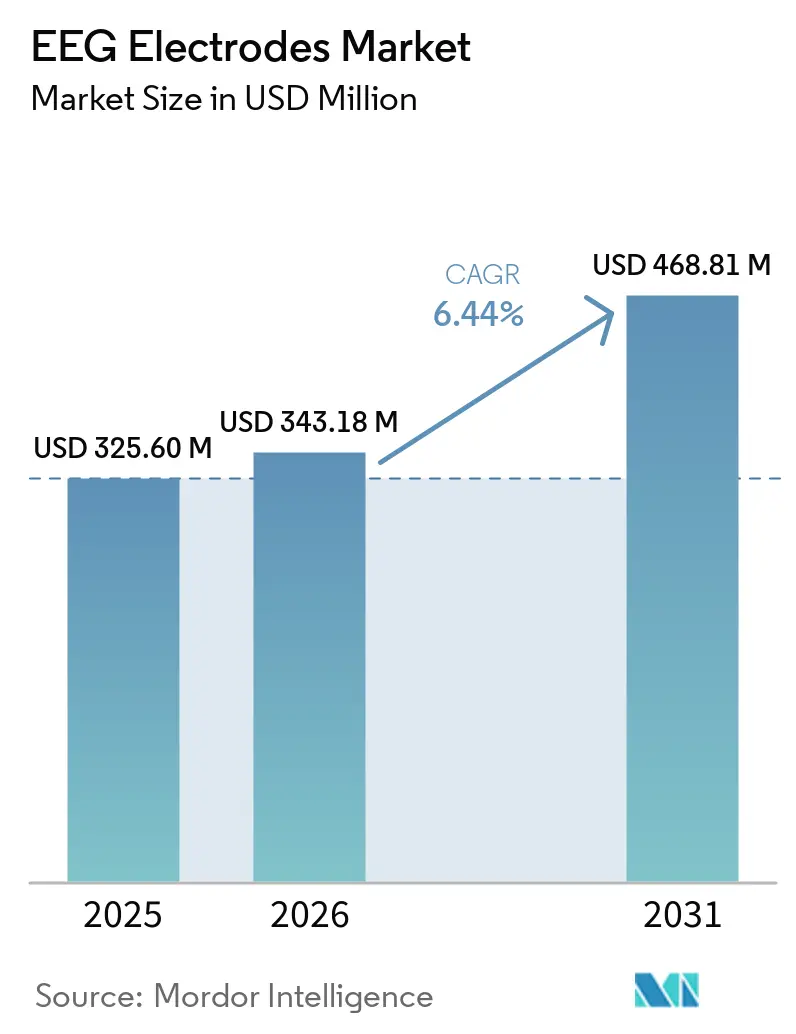
The EEG Electrodes Market size was valued at USD 325.60 million in 2025 and is estimated to grow from USD 343.18 million in 2026 to reach USD 468.81 million by 2031, at a CAGR of 6.44% during the forecast period (2026-2031).
Rising neurological disease prevalence is increasing the need for diagnosis, monitoring, and follow-up care across hospital and home settings. Demand is shifting toward disposable products, portable systems, and formats that can be applied with less specialist support. AI-supported interpretation is raising the value placed on signal quality and consistent electrode performance. Brain-computer interface, neurofeedback, and neuromodulation programs are widening the uses for scalp and specialized electrode systems.
Key Report Takeaways
- By product offering, disposable EEG electrodes held 38.36% of the EEG electrodes market share in 2025, while EEG caps & headsets are forecast to grow at a 10.86% CAGR through 2031.
- By technology offering, wet electrodes accounted for 48.12% of the EEG electrodes market share in 2025, while semi-dry electrodes are projected to advance at an 11.81% CAGR through 2031.
- By application, epilepsy and seizure monitoring held 28.36% of revenue in 2025, while brain stimulation monitoring is forecast to expand at an 11.54% CAGR through 2031.
- By end user, hospitals and neurology clinics accounted for 52.16% of revenue in 2025, while pharmaceutical and contract research organizations are forecast to grow at a 10.36% CAGR through 2031.
- By geography, North America held 41.78% of revenue in 2025, while Asia-Pacific is projected to grow at an 11.32% CAGR through 2031.
Note: Market size and forecast figures in this report are generated using Mordor Intelligence’s proprietary estimation framework, updated with the latest available data and insights as of January 2026.
Global EEG Electrodes Market Trends and Insights
Drivers Impact Analysis*
| Driver | (~) % Impact on CAGR Forecast | Geographic Relevance | Impact Timeline |
|---|---|---|---|
| Rising Neurological Disorder Burden | +1.80% | Global, with highest impact in Asia-Pacific and Middle East and Africa | Long term (≥ 4 years) |
| Disposable Electrode Adoption for Infection-Control Workflows | +1.20% | North America and Europe, with spillover to Asia-Pacific | Medium term (2-4 years) |
| Expansion of Portable and Home-Based EEG Monitoring | +1.00% | North America, Europe, and core Asia-Pacific markets | Medium term (2-4 years) |
| Commercialization of BCI and Neurofeedback Applications | +0.90% | North America and Europe, with early gains in South Korea and Japan | Medium term (2-4 years) |
| Integration With AI-Enabled EEG Interpretation | +0.80% | Global, concentrated in high-income markets | Short term (≤ 2 years) |
| In-Ear, Hair-Strand, and Conductive-Textile Development | +0.60% | North America, Europe, and Asia-Pacific research hubs | Long term (≥ 4 years) |
| Source: Mordor Intelligence | |||
Rising Neurological Disorder Burden Sustains Long-Cycle EEG Electrode Demand
More than 3 billion people live with neurological conditions, and the related health burden rose 18% between 1990 and the 2024 report period[1]World Health Organization, “Global Status Report on Neurology,” World Health Organization, who.int. Epilepsy affects 50 million people globally, with 2.4 million new diagnoses each year[2]World Health Organization, “Epilepsy,” World Health Organization, who.int. The EEG electrodes market benefits when these conditions require diagnosis, seizure assessment, or repeated monitoring. Low-income countries have up to 82 times fewer neurologists per 100,000 people than high-income countries. This gap increases the value of point-of-care solutions that can support faster clinical decisions. Aging populations in Europe and East Asia also increase demand related to dementia, sleep disorders, and Parkinson’s disease.
The need is not limited to conventional hospital testing. Repeated assessment is becoming more relevant as patients move between acute care, outpatient care, and home monitoring. This pattern supports electrodes that are easier to apply and less dependent on extensive preparation. It also favors systems that can produce reliable recordings for remote review.
Disposable EEG Electrodes Adoption Reflects Systemic Infection-Control Requirements
Disposable products support infection-control practices and reduce the reprocessing work associated with reusable electrodes. A published cost-effectiveness study found an average saving of USD 1.45 per patient for single-use EEG cup electrodes. It also reported that single-use electrodes eliminated the modeled sepsis risk, compared with 33 cases per 100,000 procedures for reusable electrodes[3]Palle Merete Lindhard Tørring et al., “Cost-Effectiveness Analysis of Single-Use EEG Cup Electrodes Compared with Reusable EEG Cup Electrodes,” PharmacoEconomics Open, pmc.ncbi.nlm.nih.gov. The study noted positive bacterial cultures on 25% of cleaned reusable electrodes. These findings strengthen the case for disposable EEG Electrodes in acute-care environments. They also support consistent procurement policies where infection prevention is a priority.
Single-use products remove cleaning cycles that require staff time and documentation. Hospital group purchasing organizations can extend this advantage by standardizing purchasing across multiple sites. Such contracts favor suppliers with dependable production capacity and regulatory documentation.
Expansion of Portable and Home-Based EEG Monitoring Opens New Care Settings
Portable monitoring extends EEG use to patients who cannot attend frequent clinic visits. A 2026 study found that people with mild Alzheimer’s disease dementia could independently use EEG headsets at home after one in-clinic training session. The study collected longitudinal data across 52 weeks[4]Shannon Diggin et al., “A Real-World Feasibility Study: At Home Longitudinal Use of the Cumulus NeuLogiq® Platform for Electrophysiological and Neurocognitive Measures in Patients With Mild Alzheimer’s Disease Dementia,” Frontiers in Digital Health, frontiersin.org. This evidence supports the practicality of repeated home recordings in the EEG electrodes market. It also increases the potential electrode use per patient because monitoring occurs across multiple sessions. The EEG electrodes market can benefit from this recurring use model.
Cumulus Neuroscience and Muse by Interaxon announced the integration of at-home sleep EEG into clinical trial workflows in July 2026. The companies reported 88.00-96.00% agreement with gold-standard polysomnography for the wearable system. Zeto also received FDA 510(k) clearance for its New Wave outpatient EEG system in April 2026. These moves indicate that the EEG electrodes market is becoming more accepted outside hospitals.
BCI and Neurofeedback Commercialization Creates Additional Electrode Demand
Brain-computer interface systems require electrode solutions with stable signal quality across repeated use. They are creating demand beyond traditional neurodiagnostic testing. CorTec received FDA Breakthrough Device Designation for its Brain Interchange System for stroke motor rehabilitation in April 2026. Motif Neurotech received FDA approval to begin a clinical trial for its therapeutic BCI for treatment-resistant depression that same month. These programs increase attention on high-quality scalp and cortical interfaces.
Noninvasive platforms particularly support demand for EEG Caps & Headsets and active arrays. Rehabilitation, gaming, neurofeedback, and wellness applications require simple and repeatable use. Many neurofeedback devices follow Class II FDA pathways, which can support commercial introductions. The EEG electrodes market has an opportunity in products that balance comfort with consistent signal acquisition. In-ear, hair-strand, and textile formats could further improve usability in longer sessions. A 2025 study demonstrated bioadhesive hairlike electrodes for chronic human EEG recording.
Restraints Impact Analysis*
| Restraint | (~) % Impact on CAGR Forecast | Geographic Relevance | Impact Timeline |
|---|---|---|---|
| Electrode-Skin Impedance and Motion-Artifact Variability | -0.70% | Global, most acute in ambulatory and wearable applications | Medium term (2-4 years) |
| High Total Cost of Ownership for Advanced EEG Workflows | -0.60% | Emerging markets and smaller institutions globally | Long term (≥ 4 years) |
| Limited Interoperability Across Electrode, Cap, and Amplifier Ecosystems | -0.40% | Global, concentrated in fragmented mid-tier hospital segments | Medium term (2-4 years) |
| Disposal Burden and Sustainability Concerns From Single-Use Electrodes | -0.30% | Europe and North America, with growing relevance in Asia-Pacific | Long term (≥ 4 years) |
| Source: Mordor Intelligence | |||
Electrode-Skin Impedance and Motion Artifacts Constrain Ambulatory EEG Reliability
Electrode-skin impedance variation reduces recording quality in ambulatory and real-world settings. A 2024 study found that vertical electrode movement introduced substantial out-of-phase artifacts. It also showed that cap systems differed in artifact susceptibility because of cable-routing design. Clinical impedance practices often require scalp preparation and conductive gel. These steps are difficult to reproduce in independent home use. This limits adoption where clinical-grade accuracy is necessary.
Wet Ag/AgCl electrodes can lose function after 5 hours as the gel dehydrates. This limitation affects long recordings and repeated-use applications. Semi-dry and dry designs seek to reduce this burden, but signal quality tradeoffs remain. Material research is improving the outlook for semi-dry designs. A 2025 study reported a semi-dry hydrogel electrode with contact impedance below 400 Ω over 12 hours. The EEG electrodes market will depend on designs that preserve comfort and stability while reducing preparation requirements.
High Total Cost of Ownership Limits Advanced EEG Uptake
Advanced EEG workflows combine high-density arrays, amplifiers, interpretation software, trained technologists, and specialist review. These costs can be difficult for smaller hospitals and emerging-market institutions to absorb. Equipment purchases alone do not resolve the need for application, calibration, and artifact management skills. Neurologist shortages can create a further operating constraint. Shorter product refresh cycles can add to the cost when specifications evolve quickly. The EEG electrodes market faces this challenge most clearly in Asia-Pacific, the Middle East and Africa, and South American mid-tier hospital networks.
Limited interoperability adds practical procurement complexity across electrodes, caps, and amplifiers from different suppliers. Buyers may avoid systems that limit future equipment choices or require proprietary accessories. Disposal requirements for single-use products add a separate compliance and environmental consideration. Manufacturers can respond through compatible hardware, clear validation data, and accessible service models. Bundled systems with AI-assisted software may improve the value proposition when priced for local budgets. These factors will influence which suppliers gain share as advanced workflows become more common.
*Our forecasts treat driver/restraint impacts as directional, not additive. The impact forecasts reflect baseline growth, mix effects, and variable interactions.
Segment Analysis
By Product Offering: Disposable Volumes Lead While EEG Caps & Headsets Expand Format Options
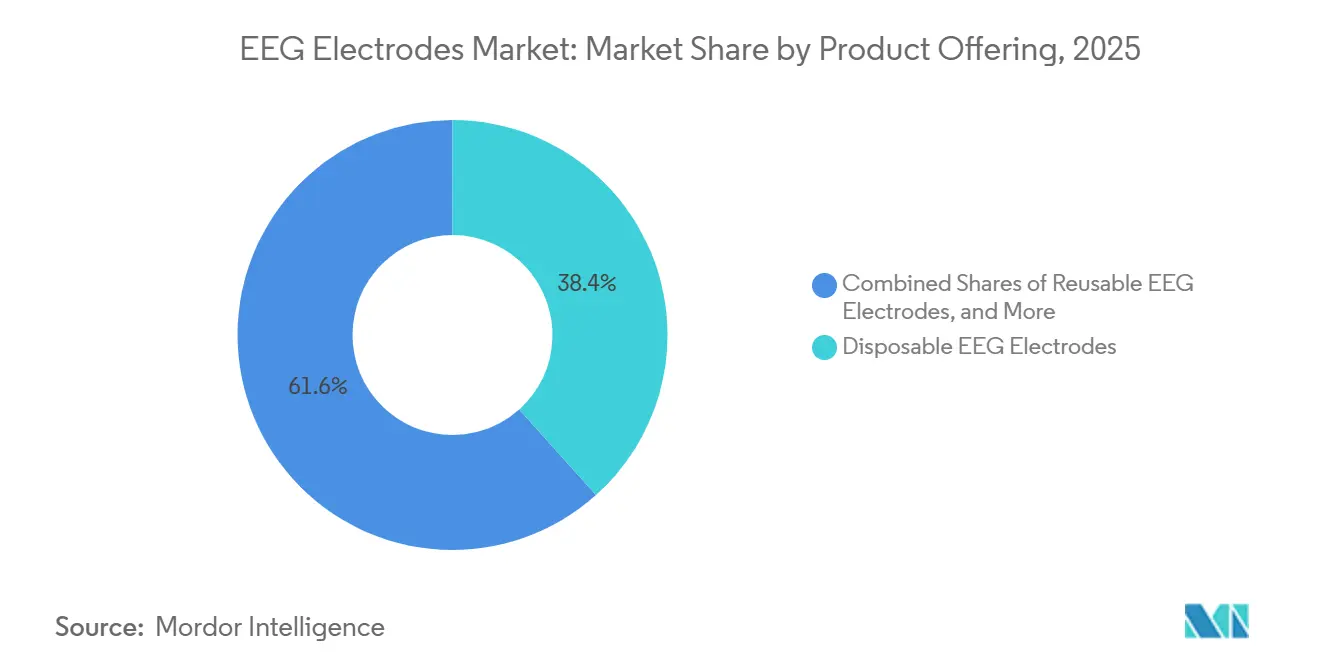
Disposable EEG Electrodes held 38.36% of revenue in 2025. Institutional purchasing, infection prevention, and rapid deployment supported this position. Point-of-care headband systems have reduced electrode preparation from more than 30 minutes to less than 5 minutes. Ceribell’s Instant EEG Headcap and Nihon Kohden’s CerebBand illustrate this approach. Faster placement can reduce the need for specialized staff during urgent assessment. These products are particularly relevant in intensive care and emergency settings.
EEG Caps & Headsets are forecast to grow at a 10.86% CAGR from 2026 to 2031. Their role is expanding across BCI, home monitoring, and neurofeedback use. Emotiv offers semi-dry polymer sensor caps designed for immediate BCI interaction. This places the cap within a broader digital platform rather than treating it as only a consumable.



By Technology Offering: Wet Electrodes Retain Scale While Semi-Dry Designs Gain Momentum
Wet Electrodes held 48.12% of revenue in 2025. Their position reflects extensive clinical validation and familiar workflows. Gel dehydration can reduce their reliability in monitoring that extends beyond 5 hours. This creates limitations for continuous and repeated recordings. Wet formats nevertheless remain widely used where established equipment and protocols are in place. Their low cost and compatibility continue to support routine clinical use.
Semi-Dry Electrodes are projected to grow at an 11.81% CAGR from 2026 to 2031. The EEG electrodes market size for this technology is supported by material designs that aim to improve impedance, durability, and hygiene. The 2025 hydrogel study found stable acquisition over 21 consecutive days at 2 hours per session.
By Application: Epilepsy Monitoring Anchors Demand While Brain Stimulation Extends Use
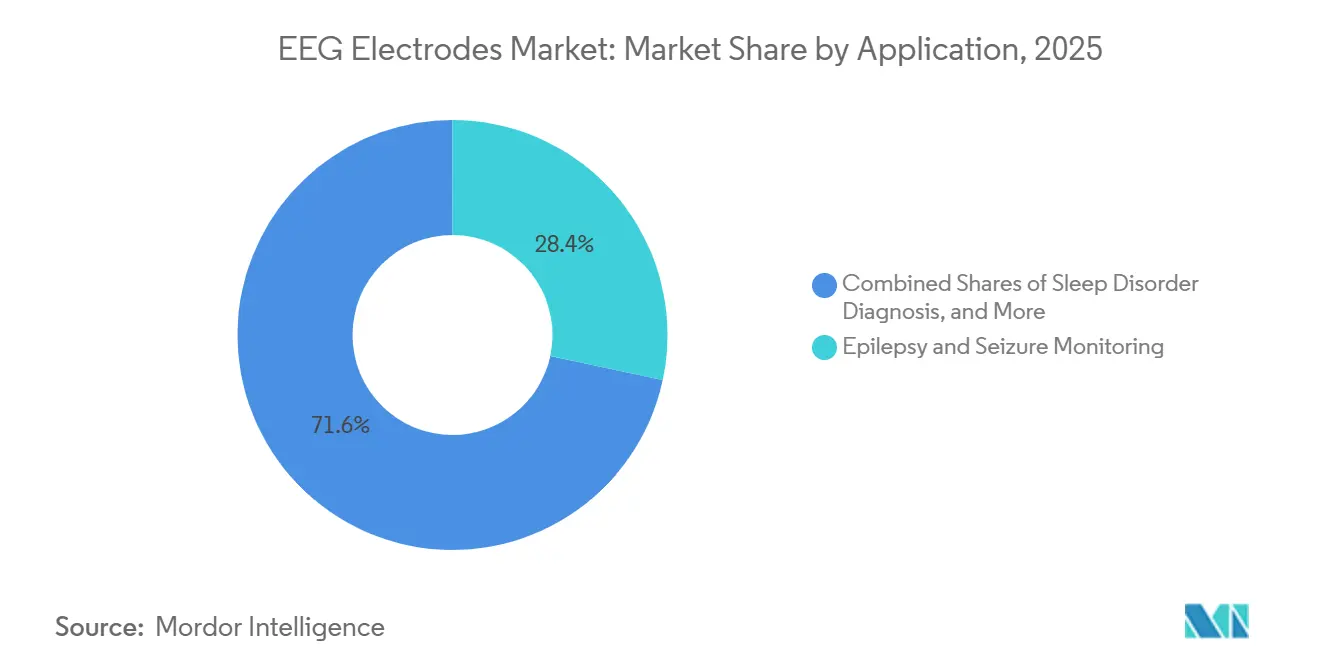
Epilepsy and Seizure Monitoring held 28.36% of application revenue in 2025. The segment benefits from established diagnostic need and continuing regulatory activity. Ceribell received FDA 510(k) clearance for its neonatal seizure detection algorithm in November 2025. The company also expanded its status epilepticus indication in December 2025. Sleep disorder diagnosis and intensive care monitoring represent other established sources of procedure volume.
Brain Stimulation Monitoring is forecast to grow at an 11.54% CAGR from 2026 to 2031. TMS-EEG protocols require specialized active and semi-dry arrays that can manage stimulation artifacts. Neurofeedback and neuromodulation are adding adjacent demand as device clearances expand. Pediatric neurology, traumatic brain injury and stroke assessment, and presurgical mapping require high-quality electrodes and involve limited brand substitution. Universal Brain received FDA 510(k) clearance for an EEG-based psychiatric brain-function platform in July 2026. This development points to a potential new use in psychiatric assessment.
By End User: Hospitals Lead Purchases While Pharmaceutical and CRO Demand Rises
Hospitals and Neurology Clinics accounted for 52.16% of revenue in 2025. Acute care procedures, epilepsy monitoring units, and outpatient neurology support their continued leadership. Hospital systems are consolidating purchasing through group purchasing organizations. This approach favors standardized and vendor-certified electrode systems. Ambu, Natus, and Nihon Kohden have scale advantages in such buying structures. Diagnostic and sleep centers remain stable users as pre-gelled disposable arrays reduce preparation time.
Pharmaceutical and Contract Research Organizations are projected to grow at a 10.36% CAGR from 2026 to 2031. These groups need longitudinal EEG data for central nervous system drug trials, biomarker assessment, therapeutic response, and safety monitoring. Multi-site trials increase the need for consistent impedance performance and compatible data systems. Cumulus Neuroscience reported that its NeuLogiq platform was feasible for at-home EEG assessment in a 52-week Alzheimer’s study.
Geography Analysis
North America held 41.78% of revenue in 2025. The United States leads regional demand through healthcare spending, epilepsy monitoring units, and established acute-care EEG infrastructure. FDA clearance activity is also broadening the use of neurotechnology products. Ceribell received FDA Breakthrough Device Designation for its large-vessel-occlusion stroke detection and monitoring solution in January 2026. Europe is the second-largest regional area for the EEG electrodes market. Germany, France, the United Kingdom, Italy, and Spain form the core of demand. More than 23.00% of Germany’s population is aged 65 and above in 2026, supporting neurological monitoring needs.
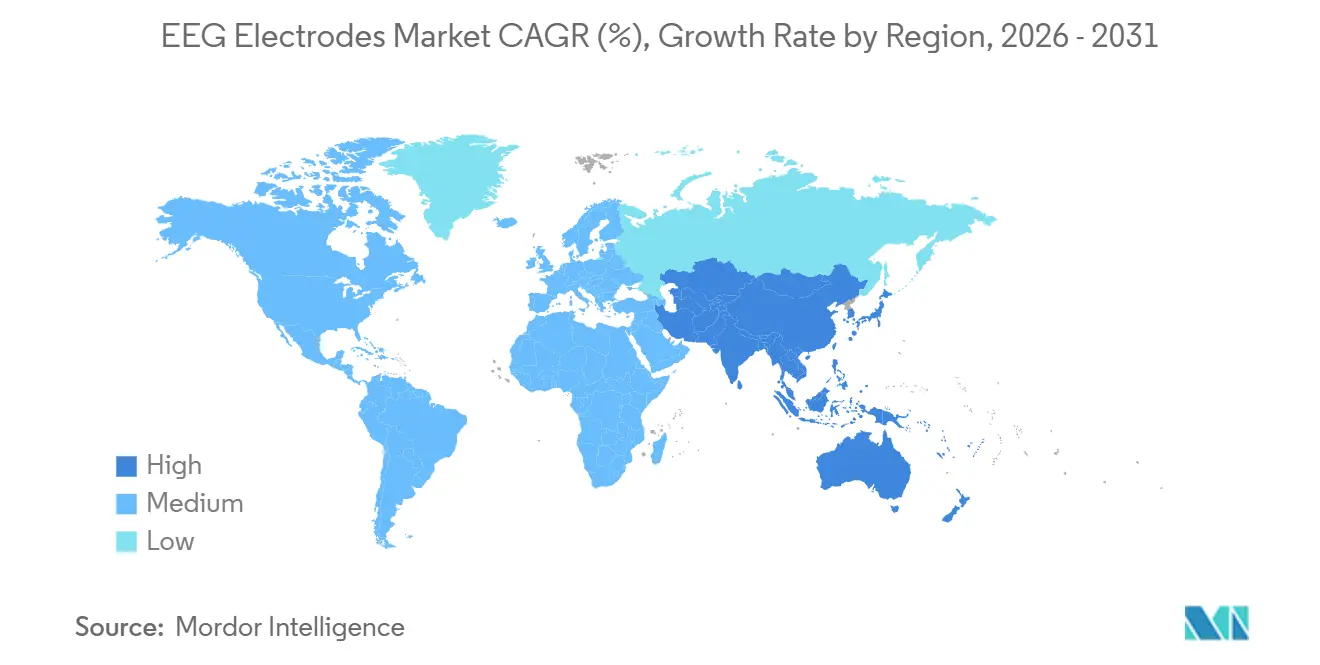
Asia-Pacific is forecast to grow at an 11.32% CAGR from 2026 to 2031. China, India, Japan, and South Korea form the regional growth base. China supports the EEG electrodes market through hospital expansion and investment in neurological diagnostic capacity. India is growing through metropolitan centers in Mumbai, Delhi, and Bangalore, although rural access remains limited. Japan and Australia have tightened electromagnetic compatibility expectations for wearable brain-monitoring products. South Korea gained attention after Ybrain’s 2025 distribution agreement with Korea Pharma for its psychiatric EEG diagnostic system.

Competitive Landscape
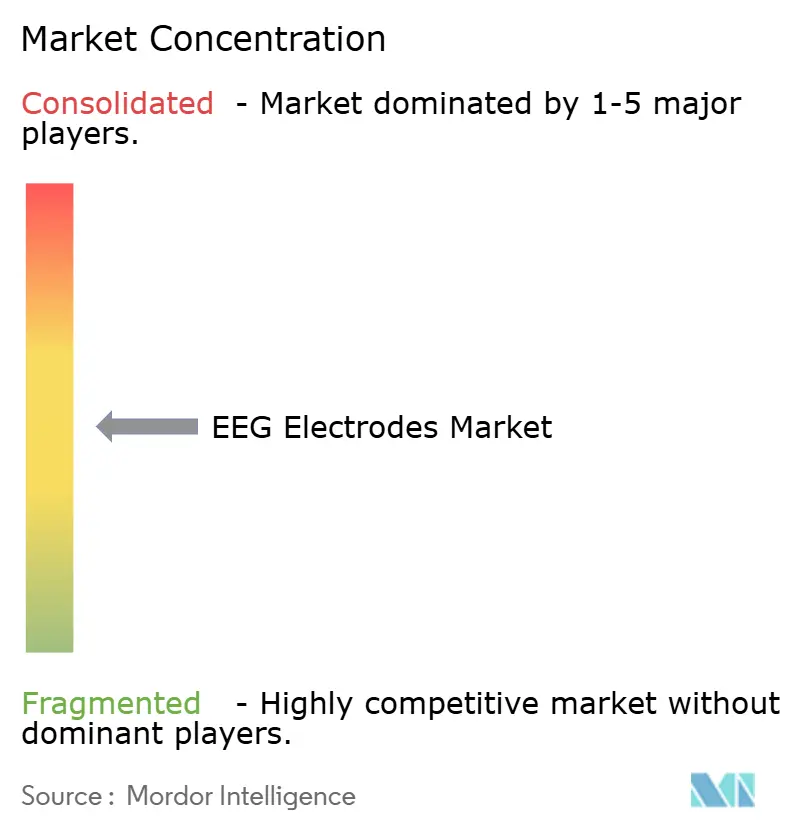
The EEG electrodes market is moderately concentrated among Natus Medical Incorporated, Ambu A/S, and Nihon Kohden Corporation. Competition becomes more fragmented across specialist applications, formats, and regional channels. Product performance, workflow integration, and distribution coverage matter alongside scale. Natus completed full ownership of Holberg EEG in September 2025. The transaction added the autoSCORE model, which was trained on 30,000 expert-labeled EEG recordings. Natus globally launched autoSCORE in March 2026 and integrated it into BRAIN QUICK Software in July 2026.
Nihon Kohden acquired a majority stake in NeuroAdvanced Corp., the parent of Ad-Tech Medical Instrument Corporation, in early 2025. The acquisition added specialty depth, strip, and grid electrodes used in epilepsy surgery and intraoperative monitoring. These actions show that suppliers in the EEG electrodes market are adding software and specialist hardware to their electrode portfolios.
EEG Electrodes Industry Leaders
Natus Medical Incorporated
Ambu A/S
CONMED Corporation
Rhythmlink International, LLC
Nihon Kohden Corporation
- *Disclaimer: Major Players sorted in no particular order

Recent Industry Developments
- July 2026: Cumulus Neuroscience and Muse by Interaxon announced a collaboration integrating at-home sleep EEG into the NeuLogiq platform for CNS clinical trials. Muse's wearable EEG headset demonstrated 88.00-96.00% agreement with gold-standard polysomnography, validating at-home electrode systems for regulatory-grade longitudinal CNS studies.
- May 2026: RhythmLink International inaugurated a new manufacturing facility in Alajuela, Costa Rica, with 3,100 square meters of production space dedicated to EEG electrodes, sensors, and accessories for neurodiagnostic procedures. The facility is expected to create up to 300 jobs over 2 years and significantly expand production capacity for global distribution.


Global EEG Electrodes Market Report Scope
As per the scope of the market, EEG electrodes are medical sensors used in electroencephalography (EEG) to record the brain's electrical activity for diagnostic, monitoring, research, and neurotechnology applications. EEG electrodes are placed on the scalp, integrated into caps/headsets, or configured as specialized electrode arrays to capture neurological signals. They are widely used in epilepsy diagnosis, sleep studies, ICU monitoring, brain-computer interface (BCI) research, neurofeedback, and neuromodulation applications.
The EEG electrodes market report segments the market by product offering, including disposable EEG electrodes, reusable EEG electrodes, EEG caps & headsets, electrode arrays & high-density sets, and others (ear-EEG & in-ear electrodes, textile & wearable EEG systems). The market is also segmented by technology offering, comprising wet electrodes, dry electrodes, semi-dry electrodes, active electrodes, passive electrodes, and others (high-density EEG electrodes and hybrid electrodes).
Based on application, the market is categorized into epilepsy and seizure monitoring, sleep disorder diagnosis, ICU monitoring, traumatic brain injury (TBI) & stroke assessment, pediatric neurology, pre-surgical mapping, neurofeedback, neuromodulation therapies, brain stimulation monitoring, and others. By end user, the market is segmented into hospitals & neurology clinics, diagnostic & sleep centers, academic & research institutes, pharmaceutical and contract research organizations (CROs), and others (home healthcare providers and consumer & wellness providers). Geographically, the market is segmented into North America, Europe, Asia-Pacific, the Middle East & Africa, and South America. The market report also covers the estimated market sizes and trends for 17 countries across major regions globally. For each segment, the market size and forecast are provided in terms of value (USD).
| Disposable EEG Electrodes |
| Reusable EEG Electrodes |
| EEG Caps & Headsets |
| Electrode Arrays & High-Density Sets |
| Others (Ear-EEG & In-Ear Electrodes, Textile & Wearable EEG Systems) |
| Wet Electrodes |
| Dry Electrodes |
| Semi-Dry Electrodes |
| Active Electrodes |
| Passive Electrodes |
| Other (High-Density EEG Electrodes, Hybrid Electrodes) |
| Epilepsy and Seizure Monitoring |
| Sleep Disorder Diagnosis |
| ICU Monitoring |
| TBI & Stroke Assessment |
| Pediatric Neurology |
| Pre-Surgical Mapping |
| Neurofeedback |
| Neuromodulation therapies |
| Brain stimulation monitoring |
| Others |
| Hospitals & Neurology Clinics |
| Diagnostic & Sleep Centers |
| Academic & Research Institutes |
| Pharmaceutical and Contract Research Organizations |
| Others (Home Healthcare Providers, Consumer and Wellness Providers) |
| North America | United States |
| Canada | |
| Mexico | |
| Europe | Germany |
| United Kingdom | |
| France | |
| Italy | |
| Spain | |
| Rest of Europe | |
| Asia-Pacific | China |
| India | |
| Japan | |
| Australia | |
| South Korea | |
| Rest of Asia-Pacific | |
| Middle East and Africa | GCC |
| South Africa | |
| Rest of Middle East and Africa | |
| South America | Brazil |
| Argentina | |
| Rest of South America |
| By Product Offering | Disposable EEG Electrodes | |
| Reusable EEG Electrodes | ||
| EEG Caps & Headsets | ||
| Electrode Arrays & High-Density Sets | ||
| Others (Ear-EEG & In-Ear Electrodes, Textile & Wearable EEG Systems) | ||
| By Technology Offering | Wet Electrodes | |
| Dry Electrodes | ||
| Semi-Dry Electrodes | ||
| Active Electrodes | ||
| Passive Electrodes | ||
| Other (High-Density EEG Electrodes, Hybrid Electrodes) | ||
| By Application | Epilepsy and Seizure Monitoring | |
| Sleep Disorder Diagnosis | ||
| ICU Monitoring | ||
| TBI & Stroke Assessment | ||
| Pediatric Neurology | ||
| Pre-Surgical Mapping | ||
| Neurofeedback | ||
| Neuromodulation therapies | ||
| Brain stimulation monitoring | ||
| Others | ||
| By End User | Hospitals & Neurology Clinics | |
| Diagnostic & Sleep Centers | ||
| Academic & Research Institutes | ||
| Pharmaceutical and Contract Research Organizations | ||
| Others (Home Healthcare Providers, Consumer and Wellness Providers) | ||
| By Geography | North America | United States |
| Canada | ||
| Mexico | ||
| Europe | Germany | |
| United Kingdom | ||
| France | ||
| Italy | ||
| Spain | ||
| Rest of Europe | ||
| Asia-Pacific | China | |
| India | ||
| Japan | ||
| Australia | ||
| South Korea | ||
| Rest of Asia-Pacific | ||
| Middle East and Africa | GCC | |
| South Africa | ||
| Rest of Middle East and Africa | ||
| South America | Brazil | |
| Argentina | ||
| Rest of South America | ||


Key Questions Answered in the Report
What is the forecast growth rate for EEG electrodes?
The EEG electrodes market is forecast to grow at a 6.44% CAGR from 2026 to 2031, reaching USD 468.81 million by 2031.
Which EEG electrode product category is growing fastest?
EEG Caps & Headsets are forecast to grow at a 10.86% CAGR through 2031, supported by BCI, home monitoring, and neurofeedback use.
Why are disposable EEG electrodes widely used?
Disposable EEG Electrodes held 38.36% share in 2025 because they support infection control, faster setup, and reduced reprocessing work.
Which technology is expected to grow fastest?
Semi-Dry Electrodes are projected to grow at an 11.81% CAGR through 2031 as they address the limits of gel-based monitoring.
Which application is expanding most quickly?
Brain Stimulation Monitoring is projected to grow at an 11.54% CAGR through 2031, supported by neuromodulation and BCI development.
Which region has the strongest growth outlook?
Asia-Pacific is forecast to grow at an 11.32% CAGR through 2031, led by China, India, Japan, and South Korea.
Page last updated on:






