
Edge Streaming Infrastructure For OTT Market Size and Share
Market Overview
| Study Period | 2020 - 2031 |
|---|---|
| Market Size (2026) | USD 3.75 Billion |
| Market Size (2031) | USD 8.03 Billion |
| Growth Rate (2026 - 2031) | 16.45 % |
| Fastest Growing Market | Asia-Pacific |
| Largest Market | North America |
| Market Concentration | Medium |
Major Players *Disclaimer: Major Players sorted in no particular order Image © Mordor Intelligence. Reuse requires attribution under CC BY 4.0. | |
Edge Streaming Infrastructure For OTT Market Analysis by Mordor Intelligence
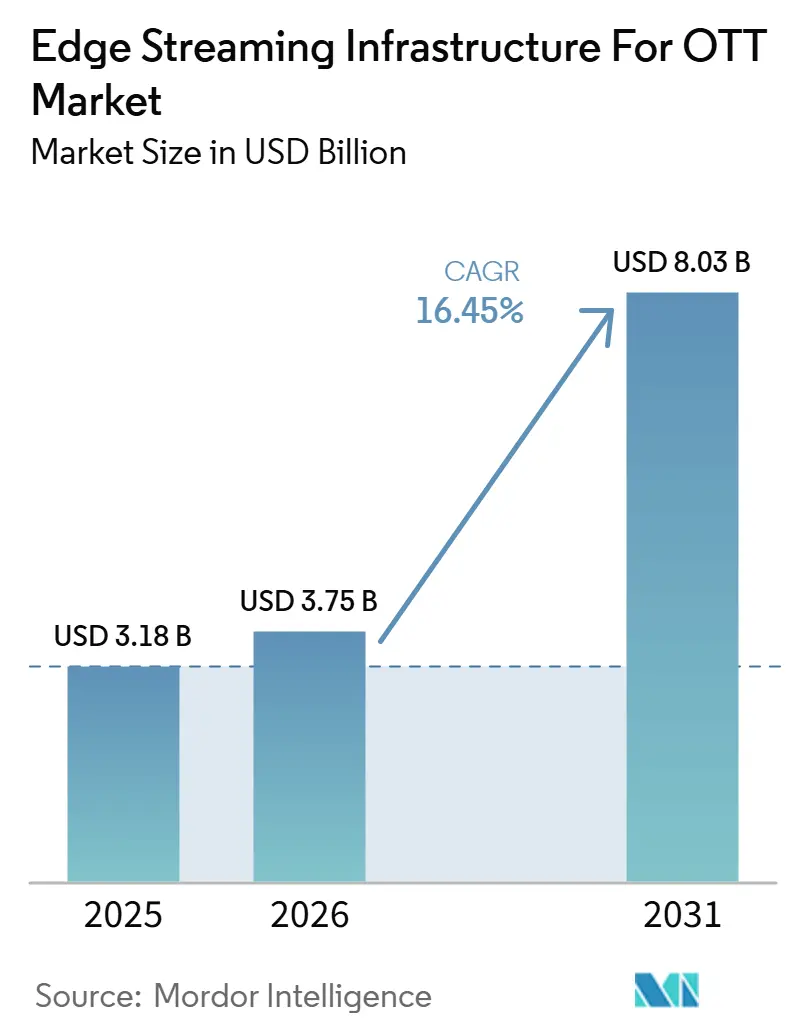
The edge streaming infrastructure for OTT market size is expected to increase from USD 3.18 billion in 2025 to USD 3.75 billion in 2026 and reach USD 8.03 billion by 2031, growing at a CAGR of 16.45% over 2026-2031. Rising video consumption is increasing the need for distributed delivery capacity, especially when many viewers watch the same program at once. Higher-resolution formats, live sports, and advertising that is tailored to each viewer are moving more processing closer to viewers. Providers are also combining delivery, security, compute, and monitoring tools in a single platform. This approach can help content operators reduce delays, protect streams, and manage traffic without relying on one distant data center. Competition is increasingly based on these capabilities rather than on bandwidth pricing alone.
Key Report Takeaways
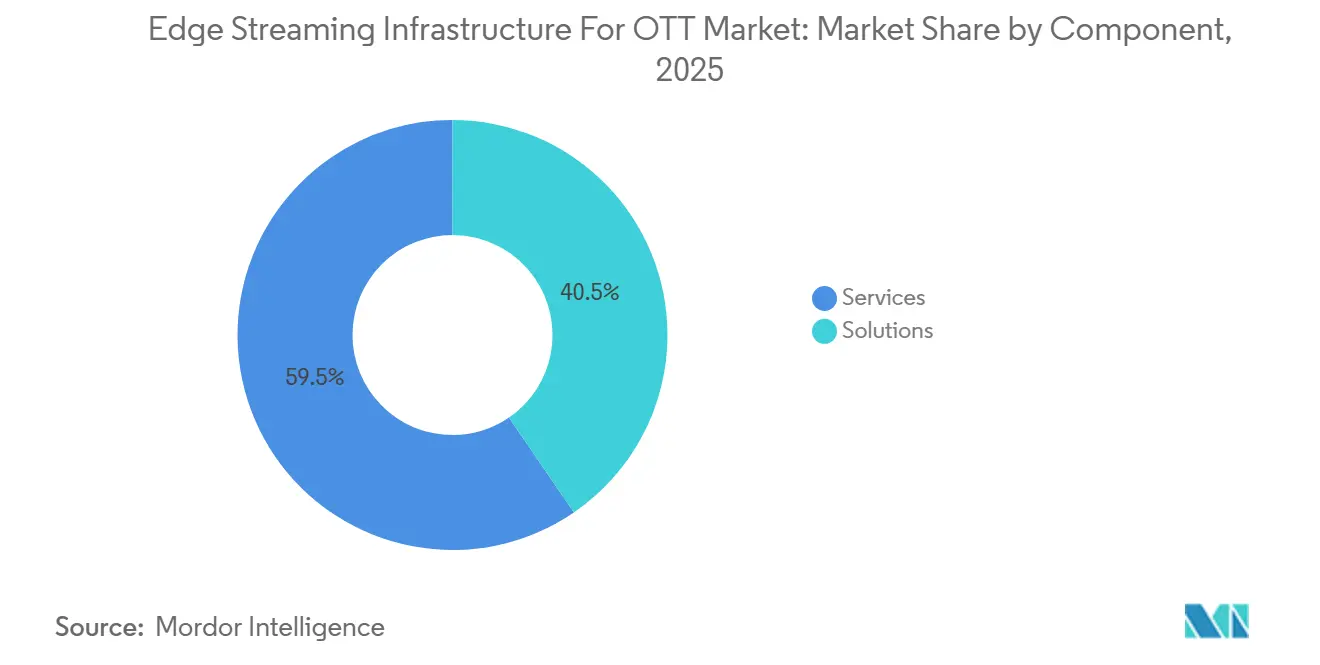
- By component, solutions held 40.45% of the edge streaming infrastructure for OTT market share in 2025 and are projected to expand at a 17.01% CAGR through 2031.
- By streaming type, video on demand held 41.47% of the edge streaming infrastructure for OTT market share in 2025, while live event streaming is projected to expand at a 16.93% CAGR through 2031.
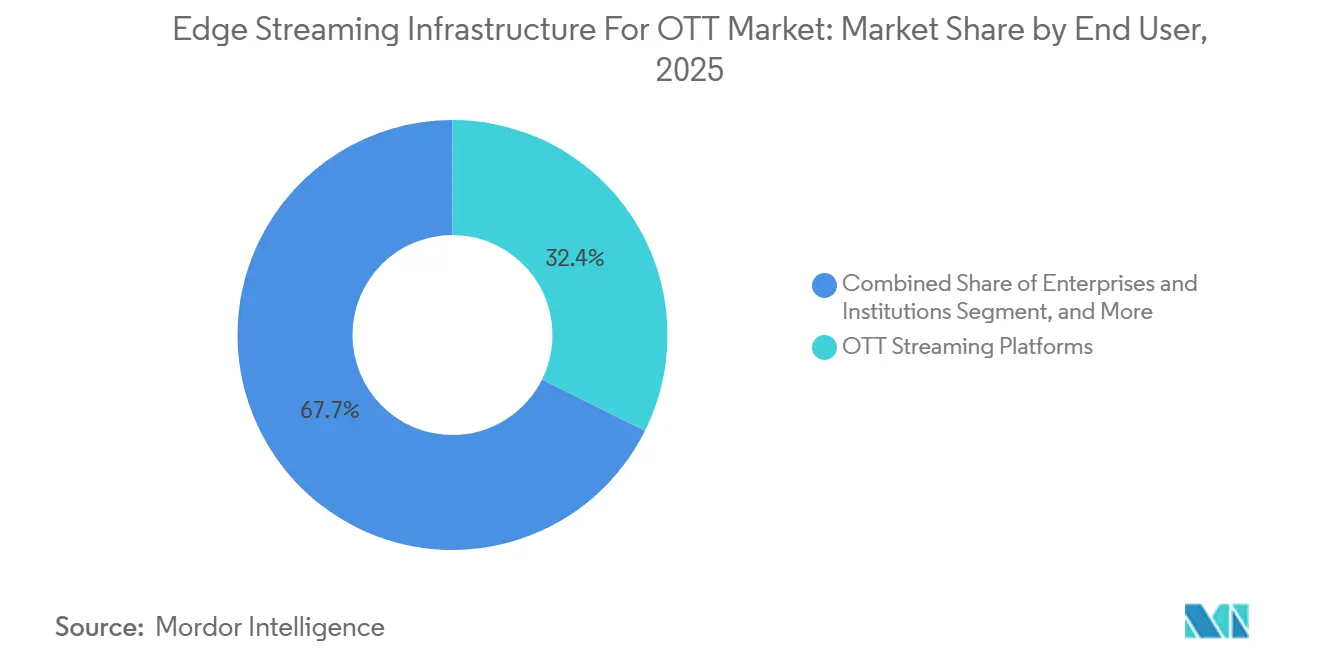
- By end user, OTT platforms held 32.35% of revenue in 2025, while sports rights holders and live-event organizations are projected to grow at a 16.88% CAGR through 2031.
- By geography, North America held 37.40% of revenue in 2025, while Asia-Pacific is projected to grow at a 16.81% CAGR through 2031.
Note: Market size and forecast figures in this report are generated using Mordor Intelligence’s proprietary estimation framework, updated with the latest available data and insights as of January 2026.
Market Trends and Insights
Drivers Impact Analysis of Edge Streaming Infrastructure For OTT Market*
| Driver | (~) % Impact on CAGR Forecast | Geographic Relevance | Impact Timeline |
|---|---|---|---|
| OTT Video Traffic and 4K/8K Adoption | +3.5% | Global | Short term (≤ 2 years) |
| Live Sports and Interactive Streaming Latency Needs | +2.8% | Global, concentrated in North America and Europe | Short term (≤ 2 years) |
| Edge-Native Traffic Steering and Origin Offload | +2.2% | North America and Europe, spill-over to Asia-Pacific | Medium term (2–4 years) |
| Integrated Security and Delivery Bundles | +1.8% | Global | Medium term (2–4 years) |
| 5G and Telecom-Edge Expansion | +2.5% | Asia-Pacific core, spill-over to Middle East and Africa | Medium term (2–4 years) |
| Edge-Assisted Dynamic Ad Insertion and Personalization | +1.5% | North America and Europe | Medium term (2–4 years) |
| Source: Mordor Intelligence | |||
OTT Video Traffic and 4K/8K Adoption
The edge streaming infrastructure for OTT market benefits when higher video quality raises the bandwidth needed for every viewing session. Good-quality 4K streaming requires at least 20 Mbps of sustained bitrate, while 8K delivery requires 60-90 Mbps per session. A centralized origin can become costly and difficult to scale when large audiences request these streams at the same time. Amazon Prime Video launched its first true 8K interactive series in January 2026, with 33 decision points per episode and an average session time of 94 minutes. This indicates that leading platforms are preparing 8K production and delivery workflows before displays become widely adopted. Nokia reported that video streaming accounted for 73% of total consumer mobile traffic, showing why providers are building edge capacity for continued video growth.[1]Nokia, “Global Network Traffic Report,” Nokia, nokia.com.
A 4K stream stored at a metro edge node avoids 4-5 times more origin bandwidth than a 1080p stream. That difference makes cache placement more valuable as the video format becomes heavier. Connected television devices also shift video-on-demand viewing toward higher-bitrate streams than many mobile sessions. The combination of higher resolution in mature markets and broadband growth in emerging economies supports demand for distributed capacity. Edge networks can keep frequently requested segments close to viewers and reduce pressure on central origins. This makes the edge streaming infrastructure for OTT market relevant to both established subscription services and newer streaming platforms.
Live Sports and Interactive Streaming Require Lower Latency
Live sports delivery creates sharp and predictable peaks that are difficult to manage through ordinary video-on-demand delivery systems. A delay becomes more visible when viewers use in-play betting, social features, or second-screen applications during a match. Tubi reported that its February 2025 Super Bowl LIX broadcast reached 15.5 million concurrent viewers and served more than 24 million unique viewers in 4K. The company stated that it delivered the event with sub-second latency, which shows the operating standard expected for major free-to-view events. A delivery failure during a final can damage a broadcaster’s brand and put contractual obligations at risk. These requirements increase interest in multiple content delivery networks, automated failover, and local capacity.
Low-Latency HLS and chunked CMAF can reduce mainstream sports latency to 2-5 seconds by allowing players to request partial segments before encoding is complete. The ETSI Multi-access Edge Computing framework supports moving processing and delivery functions closer to users.[2]European Telecommunications Standards Institute, “Multi-access Edge Computing,” European Telecommunications Standards Institute, etsi.org. Local processing can reduce first-frame delay and rebuffering when traffic increases rapidly. Sports agreements therefore influence how providers design edge locations and capacity reserves. The edge streaming infrastructure for OTT market can also support concerts, news, interactive programs, and other live formats. This creates an opportunity for the edge streaming infrastructure for OTT market beyond sports-only workloads.
5G and Telecom-Edge Expansion
5G densification is moving the practical boundary for streaming compute from large cloud regions to metro and carrier-edge sites. This can lower both delay and network transport costs for interactive video. Nokia and Saudi Telecom Company completed a commercial 5G NSA Cloud RAN deployment in Makkah in 2025, demonstrating a telecom-edge design in a dense, live-event setting. Telefónica also completed Europe’s first 5G Standalone call using a hybrid Nokia Cloud RAN and AWS architecture in March 2025. These deployments support the technical case for processing selected streaming tasks at the carrier edge. They also make telecom operators more important partners for media delivery providers.
In a 5G MEC design, transcoding, manifest generation, and caching can occur 10-20 milliseconds from the viewer. This can be important for live sports, interactive programming, and local advertising decisions. AWS and Verizon designed a Private MEC offering that combines AWS Outposts with Verizon private 5G networks for enterprise and media workloads.[3]Amazon Web Services, “Architecting Operational Models for Private MEC Using AWS Hybrid and Edge Services with Verizon Private 5G Networks,” AWS Industries Blog, aws.amazon.com.The model allows customers to use edge services without building proprietary hardware systems. It also favors providers with strong local points of presence or telecom partnerships. As more 5G capacity becomes available, the edge streaming infrastructure for OTT market can address lower-latency uses that centralized systems serve less effectively.
Edge-Assisted Dynamic Ad Insertion and Personalization
Server-side ad insertion is widely used for connected television, FAST channels, and live streaming because it can make advertising part of the video stream. Moving this activity closer to the user can reduce the time needed to create and return a playback manifest. Centralized systems may create delays when requests cross several network regions. AWS MediaTailor supported Sony Pictures Networks India with per-session advertising decisions using viewer parameters passed in playback authorization tokens. The approach selected and inserted advertising without contaminating shared cache content. It demonstrates how advertising systems are becoming part of the delivery architecture rather than a separate back-end function.
Edge-side advertising can help providers make local decisions without repeatedly returning to a central system. It can also support device-based and audience-based targeting where consent and local rules permit it. Broadpeak offers an edge-side dynamic ad insertion platform that uses a distributed origin layer at content delivery network edges. This model gives specialized providers a way to earn revenue from advertising workflow support as well as delivery. The requirement for reliable advertising insertion increases the value of traffic management, security, and observability. It also expands the range of work served by the edge streaming infrastructure for OTT market.
Restraints Impact Analysis of Edge Streaming Infrastructure For OTT Market*
| Restraint | (~) % Impact on CAGR Forecast | Geographic Relevance | Impact Timeline |
|---|---|---|---|
| CDN Commoditization and Multi-CDN Price Erosion | -2.8% | Global | Short term (≤ 2 years) |
| Large OTT Platforms In-Sourcing Delivery Capacity | -2.0% | North America and Europe | Medium term (2–4 years) |
| Last-Mile Bandwidth and Power Constraints in Underserved Markets | -1.2% | Africa and South Asia | Long term (≥ 4 years) |
| Fragmented Low-Latency Ad-Insertion and Measurement Standards | -0.8% | Global | Medium term (2–4 years) |
| Source: Mordor Intelligence | |||
CDN Commoditization and Multi-CDN Price Erosion
Content delivery pricing is under pressure because large providers can package delivery with broader cloud services. Akamai’s delivery segment faced a 5% year-over-year decline in 2025, while security and cloud compute represented nearly 70% of its revenue. This change reflects the company’s move away from dependence on bandwidth-only sales. Large OTT services are reducing their typical multi-CDN stacks from 4-6 suppliers to 2-3 suppliers. Traffic is increasingly allocated at the country or individual internet service provider level. This can weaken the volume commitments on which traditional CDN pricing depends.
Akamai introduced a 3% monthly client surcharge in the second quarter of 2026 to help address hardware and power costs. The change shows that standalone delivery margins remain difficult at current prices. Local delivery costs are also uneven because internet service provider charges in South America and some Asia-Pacific markets exceed North American benchmarks. Providers must therefore manage price pressure while keeping capacity where local network fees are high. The edge streaming infrastructure for OTT market remains exposed when delivery is viewed as an interchangeable service. Providers that combine delivery with security, processing, and operational support have more room to protect revenue.
Large OTT Platforms In-Sourcing Delivery Capacity
Netflix, YouTube, and TikTok run on proprietary delivery infrastructure, while Amazon has shifted more Prime Video traffic to CloudFront. This reduces the potential third-party delivery spend of the largest streaming companies. Self-building becomes more attractive at 1-2 Tbps of sustained capacity because interconnection, colocation, and hardware costs can be lower than commercial delivery charges at that scale. North America and Europe are most affected because they have many large services with high average revenue per user. Commercial suppliers lose some demand as mid-tier platforms cross the self-build threshold. The shift limits the portion of the edge streaming infrastructure for OTT market available to independent providers.
Many second-tier operators use a hybrid delivery model rather than taking all traffic in-house. They retain commercial suppliers for peak demand, international delivery, and functions that are not economical to operate themselves. This arrangement provides flexibility while preserving some external infrastructure demand. Mid-market operators, emerging-market broadcasters, and sports rights holders are therefore important contributors to future spending. Their operating needs differ from those of the largest global platforms. They often need managed implementation as well as capacity. This leaves a substantial role for commercial edge providers despite in-sourcing among the largest customers.
*Our forecasts treat driver/restraint impacts as directional, not additive. The impact forecasts reflect baseline growth, mix effects, and variable interactions.
Edge Streaming Infrastructure For OTT Market Segment Analysis
By Component:
Solutions Lead Revenue as Compute and Security ConvergeSolutions accounted for 40.45% of the edge streaming infrastructure for OTT market share in 2025 and are projected to advance at a 17.01% CAGR through 2031. The category includes edge delivery and caching, media processing, traffic management, security, and quality-of-experience tools. Operators are replacing delivery-only systems with platforms that can manage several of these functions together. This reduces the need to coordinate separate tools during high-traffic events. Akamai launched AI Grid Intelligent Orchestration across 4,400 edge locations in March 2026. The company stated that the deployment supports distributed inference below 50 milliseconds for work such as real-time transcoding, dubbing, and personalized delivery. The example shows that delivery networks are being used for more than content transfer.
Streaming observability and quality-of-experience analytics are receiving more attention within solutions spending. Operators need real-time visibility into buffering, rebuffering, playback failures, and latency, especially when service-level commitments apply to sports. These tools can help teams locate whether an issue originated in encoding, the network, a device, or a delivery route. Security and access control also become more valuable as premium live content attracts piracy. Integrated platforms can bring these functions into the same operating environment. This supports recurring demand for the edge streaming infrastructure for OTT market as operators add services around delivery. It also gives suppliers a path away from selling bandwidth alone.
Services represented the remaining component revenue and are important for operators that do not have internal engineering teams for edge deployment. Managed delivery, professional services, and implementation support can help a broadcaster move from broadcast workflows to OTT delivery. Asia-Pacific, the Middle East, and South America contain many first-time or expanding IP-delivery projects. In these markets, suppliers often support design, tuning, security configuration, and ongoing operations. Telco-led OTT launches also create demand for local implementation support. The work can form a multi-year relationship when a provider manages new distribution infrastructure. Services thus complement solutions revenue and broaden the provider base serving the edge streaming infrastructure for OTT industry.


By Streaming Type:
VOD Commands Volume, Live Event Streaming Drives Architecture UpgradesVideo on demand commanded 41.47% of the edge streaming infrastructure for OTT market size in 2025, while live event streaming is forecast to grow at a 16.93% CAGR through 2031. Video on demand retains the largest share because global subscription services hold extensive content libraries. Its traffic is generally easier to predict and cache before demand begins. Live events require more capacity for the same peak audience because content becomes available in real time. Operators cannot preload the full event at edge locations before viewers arrive. This creates a greater need for rapid encoding, origin protection, and route selection during peak demand.
Live sports, news, concerts, and interactive broadcasts are raising the standard for delivery architecture. The requirements become stricter when viewers expect synchronized feeds and short delays. Cloudflare launched its Media over QUIC relay network across more than 330 cities in August 2025. The network uses an emerging IETF transport approach intended to support ingest, distribution, and interactive media through a QUIC-based system. Protocol changes can help simplify fragmented delivery arrangements that use separate tools for HLS, WebRTC, and RTMP. They may also support lower-latency services at scale. These developments keep the edge streaming infrastructure for OTT market closely tied to the modernization of live delivery.
Linear and FAST streaming sit between video on demand and live events in their size and growth characteristics. The category benefits as audiences move from scheduled broadcast channels to IP-delivered channels. FAST services also require stable ad insertion and linear-to-IP transcoding. Demand is strongest where traditional pay television is losing viewers. The European Union’s Audiovisual Media Services Directive affects how providers distribute and localize services across countries. Providers may need nationally distributed edge nodes and local routing rather than one centralized origin. That requirement gives regional delivery design an important role in the edge streaming infrastructure for OTT industry.
By End User:
OTT Platforms Anchor Volumes While Sports Rights Holders Pull Infrastructure Investment ForwardOTT platforms accounted for 32.35% of revenue in 2025, while sports rights holders and live-event organizations are projected to grow at a 16.88% CAGR through 2031. Regional and global subscription platforms purchase delivery capacity as their audiences expand. Many are not large enough to justify a proprietary network. They therefore remain a major source of demand for commercial solutions and managed services. Sports organizations require capacity for short, high-profile events with exceptionally high concurrency. This makes their infrastructure choices different from those of ordinary video-on-demand operators.
MainStreaming expanded DAZN’s private edge infrastructure for the FIFA Club World Cup 2025. The project added private points of presence across Europe, North America, Central America, South America, Asia, and the Middle East for all 63 matches. The deployment indicates why rights holders can favor dedicated infrastructure for marquee events. A private network can give a provider more control over capacity and operating procedures. It can also reduce reliance on public CDN burst capacity at the most critical time. This need supports spending across the edge streaming infrastructure for OTT market, particularly for events with global audiences.
Broadcasters, television networks, and FAST operators are moving from managed broadcast delivery toward IP distribution. Telecom, pay-TV, and internet service providers are building OTT capabilities to protect their subscriber relationships. Their 5G MEC investments can support differentiated low-latency delivery. Content owners, digital publishers, and enterprises form a broader group of customers with smaller spending per account. They use commercial edge platforms for product launches, live communications, and corporate broadcasts. Their combined demand can provide steady volume for providers that serve the middle of the market. The edge streaming infrastructure for OTT market therefore spans both large event buyers and a long tail of organizations with recurring video needs.

Geography Analysis
North America Edge Streaming Infrastructure for OTT Market
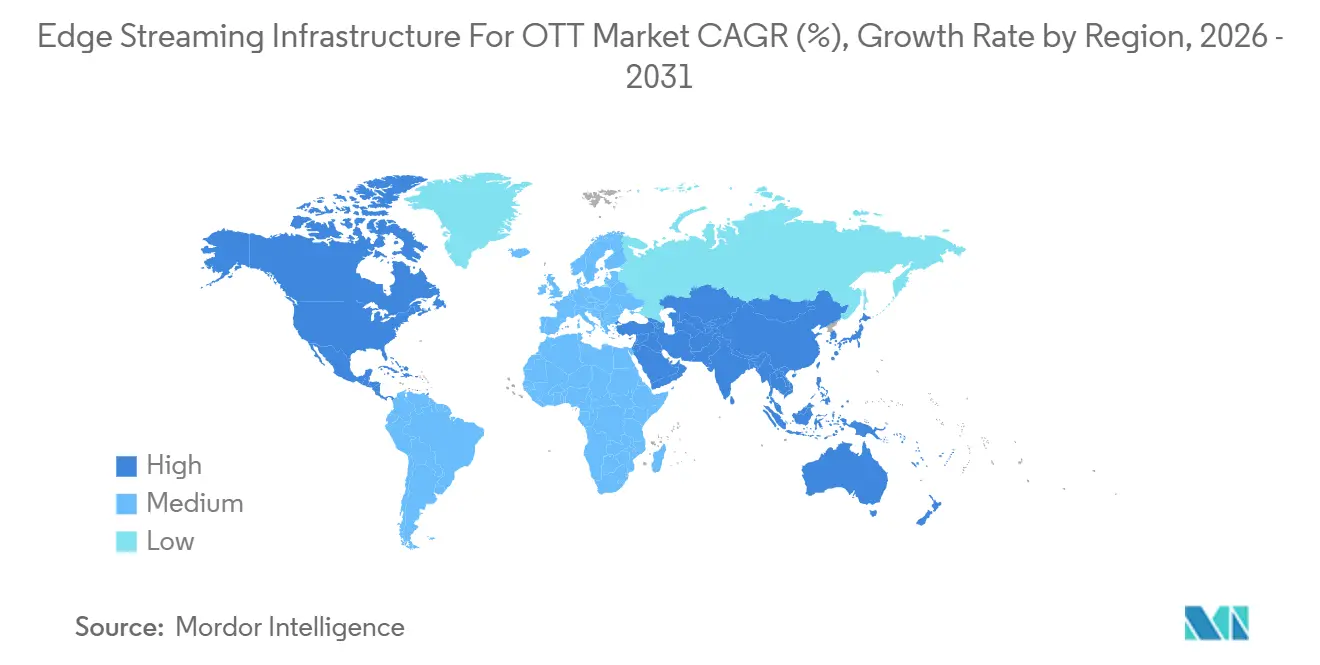
North America held 37.40% of the edge streaming infrastructure for OTT market share in 2025. The region contains major subscription platforms, sports broadcasters, and the largest FAST channel ecosystem. Proprietary delivery networks are more common here than in other regions. Netflix, YouTube, TikTok, and increasingly Amazon operate more of their delivery infrastructure internally. Commercial demand is therefore concentrated among regional services, broadcasters, and sports rights holders. Canada and Mexico add demand through telecom-edge deployment and Spanish-language OTT growth in the United States.
North America and Europe Edge Streaming Infrastructure for OTT Market
Federal Communications Commission broadband funding under the Infrastructure Investment and Jobs Act supports wider last-mile access in rural communities. Greater access can expand the addressable audience for streaming services. Europe is shaped by the AVMSD, the General Data Protection Regulation, and the AI Act. These rules encourage attention to data location, audience targeting, and algorithmic transparency. The United Kingdom, Germany, and France are important revenue contributors. BBC, TF1, and ProSiebenSat.1 are expanding IP delivery as linear viewing declines. Europe’s 5G MEC rollout also supports lower-latency streaming at the carrier edge.
APAC, South America and MEA Edge Streaming Infrastructure for OTT Market
Asia-Pacific is expected to record the fastest regional CAGR at 16.81% through 2031. India’s streaming demand is driven by subscriber volume and strong domestic competition. Japan’s growth is more closely linked to revenue per user, sports differentiation, and advertising-supported video. South Korea and Australia are mature markets with high infrastructure intensity per user. South America, the Middle East, and Africa remain smaller but are expanding. Brazil is adding FAST channel delivery through telecom-bundled OTT services, while the Middle East is adding capacity for sports and cultural events. Last-mile bandwidth and power constraints limit near-term scale in Africa, concentrating deployments in major urban centers such as those in South Africa, Nigeria, and Egypt.

Competitive Landscape
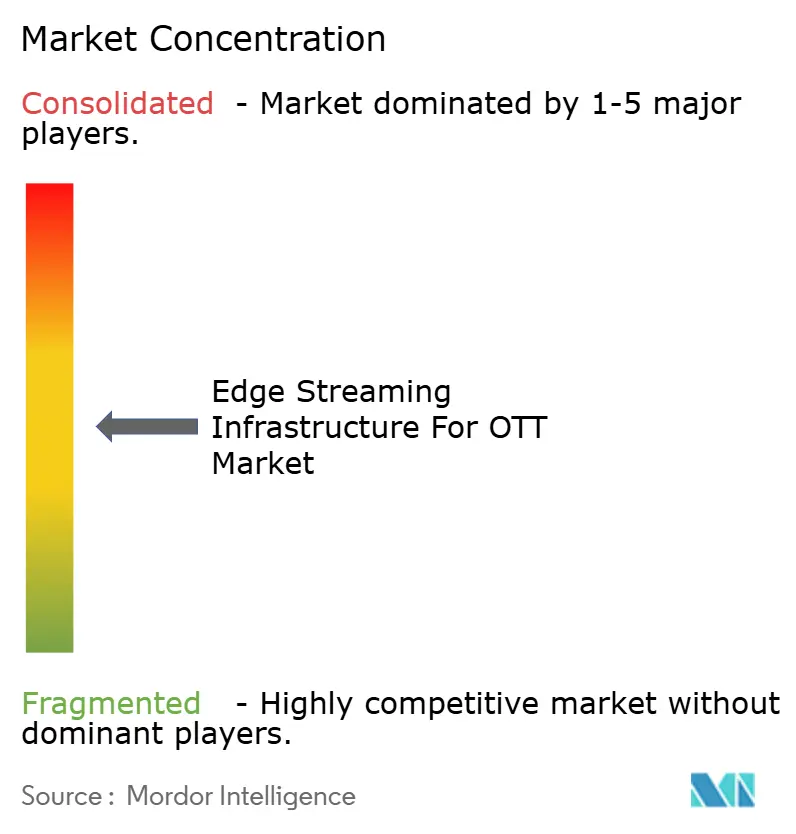
The edge streaming infrastructure for OTT market includes a leading group of Akamai Technologies, Amazon Web Services, Cloudflare, Google, and Microsoft. Specialist CDNs, telecom-edge providers, and media delivery platforms form a more fragmented middle tier. Providers increasingly differentiate through compute, security, operational tools, and protocol support. Delivery bandwidth alone offers less pricing power than it once did. Akamai launched AI Grid Intelligent Orchestration in March 2026 across 4,400 edge locations. The service is designed for distributed AI inference and supports media tasks such as transcoding and dubbing.
Cloudflare launched a production Media over QUIC relay network across more than 330 cities in August 2025. The move positions the company around real-time protocol infrastructure as well as content delivery. Fastly was named a Leader in an edge development platform evaluation in March 2026. The company highlighted WebAssembly-based performance and AI-assisted development as part of its strategy. These moves show how vendors are seeking to build customer relationships around developer tools and workload performance. They also reduce reliance on a bandwidth-only proposition. The edge streaming infrastructure for OTT market is therefore becoming more closely linked to software and security decisions.
Akamai reported a deployment of edge-resident common access token validation that exceeded 3 trillion EdgeWorkers invocations for a major streaming customer. The approach moves access checks closer to the user and can reduce origin load during high-concurrency events. Edgio, StackPath, and Lumen exited the CDN segment during 2024-2025, reducing delivery-only competition. Smaller suppliers such as Broadpeak, Qwilt, CDN77, and MainStreaming address private edge, carrier-CDN, and media-specific needs. The IETF’s Media over QUIC work involves engineers from Cloudflare, Meta, Google, and Cisco.
Edge Streaming Infrastructure For OTT Industry Leaders
Akamai Technologies, Inc.
Amazon Web Services, Inc.
Cloudflare, Inc.
Google LLC
Microsoft Corporation
- *Disclaimer: Major Players sorted in no particular order
Edge Streaming Infrastructure For OTT Market Companies Covered in this Report
- Akamai Technologies, Inc.
- Amazon Web Services, Inc.
- Cloudflare, Inc.
- Google LLC
- Microsoft Corporation
- Fastly, Inc.
- Edgio, Inc.
- CDNetworks Co., Ltd.
- Tencent Cloud Computing (Beijing) Co., Ltd.
- Alibaba Cloud Computing Ltd.
- Tata Communications Limited
- Verizon Communications Inc.
- AT&T Inc.
- Deutsche Telekom AG
- Lumen Technologies, Inc.
- G-Core Labs S.A.
- Huawei Technologies Co., Ltd.
- Broadpeak S.A.S.
- Qwilt, Inc.
- BunnyWay d.o.o.

Recent Industry Developments in Edge Streaming Infrastructure For OTT Market
- July 2026: Akamai published research documenting a major streaming customer scaling to over 3 trillion EdgeWorkers invocations following the deployment of edge-resident common access token validation for anti-piracy enforcement. The deployment shifts DRM-equivalent access control from origin servers to the CDN edge, reducing origin load during high-concurrency events and providing clearer visibility into streaming piracy patterns at scale.
- May 2026: Cloudflare launched Stream Bindings for Workers, enabling programmatic video management, including upload, signed URL generation, and metadata management, directly within Workers pipelines without authenticated API calls. The capability extends Cloudflare’s edge platform into AI-assisted and generative video workflows, tightening the integration between delivery infrastructure and media processing logic.
- May 2026: Amazon Web Services added WebSocket support for CloudFront VPC Origins, enabling streaming agents and real-time interactive applications to maintain persistent browser-to-edge-to-origin connections without exposing public endpoints. The feature was an expansion following cross-account VPC Origins support added in November 2025, deepening CloudFront’s utility for latency-sensitive streaming and AI agentic workloads.
- March 2026: Akamai launched AI Grid Intelligent Orchestration, the first global-scale implementation of NVIDIA AI Grid reference design, deploying thousands of NVIDIA RTX PRO 6000 Blackwell Server Edition GPUs across 4,400 edge locations. The platform delivers sub-50-millisecond AI inference for media and video use cases including real-time transcoding and dubbing, supported by a USD 200 million, 4-year service agreement validating commercial traction at launch.


Global Edge Streaming Infrastructure For OTT Market Report Scope
The Edge Streaming Infrastructure for OTT Market comprises hardware, software, platforms, and services that enable video content to be processed, cached, optimized, secured, and delivered from distributed edge locations closer to end users for over-the-top (OTT) streaming applications.
The Edge Streaming Infrastructure for OTT Market Report is Segmented by Component (Solutions [Edge Content Delivery and Caching Infrastructure, Edge Compute and Media Processing, Traffic Management and Delivery Orchestration, Edge Security and Access Control, and Streaming Observability and Quality-of-Experience Analytics], and Services), Streaming Type (Live Event Streaming, Linear and FAST Streaming, and Video on Demand), End User (OTT Streaming Platforms, Broadcasters, Television Networks, and FAST Operators, Telecom, Pay-TV, and Internet Service Providers, Sports Rights Holders and Live-Event Organizations, Content Owners and Digital Media Publishers, and Enterprises and Institutions), and Geography (North America, South America, Europe, Asia-Pacific, Middle East, and Africa). The Market Forecasts are Provided in Terms of Value (USD).
| Solutions | Edge Content Delivery and Caching Infrastructure |
| Edge Compute and Media Processing | |
| Traffic Management and Delivery Orchestration | |
| Edge Security and Access Control | |
| Streaming Observability and Quality-of-Experience Analytics | |
| Services |
| Live Event Streaming |
| Linear and FAST Streaming |
| Video on Demand |
| OTT Streaming Platforms |
| Broadcasters, Television Networks, and FAST Operators |
| Telecom, Pay-TV, and Internet Service Providers |
| Sports Rights Holders and Live-Event Organizations |
| Content Owners and Digital Media Publishers |
| Enterprises and Institutions |
| North America | United States |
| Canada | |
| Mexico | |
| South America | Brazil |
| Argentina | |
| Rest of South America | |
| Europe | United Kingdom |
| Germany | |
| France | |
| Russia | |
| Rest of Europe | |
| Asia-Pacific | China |
| India | |
| Japan | |
| South Korea | |
| Australia | |
| Rest of Asia-Pacific | |
| Middle East | United Arab Emirates |
| Saudi Arabia | |
| Israel | |
| Turkey | |
| Rest of Middle East | |
| Africa | South Africa |
| Nigeria | |
| Egypt | |
| Rest of Africa |
| By Component | Solutions | Edge Content Delivery and Caching Infrastructure |
| Edge Compute and Media Processing | ||
| Traffic Management and Delivery Orchestration | ||
| Edge Security and Access Control | ||
| Streaming Observability and Quality-of-Experience Analytics | ||
| Services | ||
| By Streaming Type | Live Event Streaming | |
| Linear and FAST Streaming | ||
| Video on Demand | ||
| By End User | OTT Streaming Platforms | |
| Broadcasters, Television Networks, and FAST Operators | ||
| Telecom, Pay-TV, and Internet Service Providers | ||
| Sports Rights Holders and Live-Event Organizations | ||
| Content Owners and Digital Media Publishers | ||
| Enterprises and Institutions | ||
| By Geography | North America | United States |
| Canada | ||
| Mexico | ||
| South America | Brazil | |
| Argentina | ||
| Rest of South America | ||
| Europe | United Kingdom | |
| Germany | ||
| France | ||
| Russia | ||
| Rest of Europe | ||
| Asia-Pacific | China | |
| India | ||
| Japan | ||
| South Korea | ||
| Australia | ||
| Rest of Asia-Pacific | ||
| Middle East | United Arab Emirates | |
| Saudi Arabia | ||
| Israel | ||
| Turkey | ||
| Rest of Middle East | ||
| Africa | South Africa | |
| Nigeria | ||
| Egypt | ||
| Rest of Africa | ||


Key Questions Answered in the Report
What is the projected size of the edge streaming infrastructure for OTT market?
The edge streaming infrastructure for OTT market is expected to reach USD 8.03 billion by 2031, up from USD 3.75 billion in 2026, growing at a 16.45% CAGR.
What is driving demand for edge streaming infrastructure?
Higher-resolution video streaming (4K/8K), live sports broadcasting, 5G edge deployments, and personalized advertising are increasing the need for localized processing, caching, and content delivery.
Which component leads revenue?
The Solutions segment led the market with 40.45% revenue share in 2025 and is projected to expand at a 17.01% CAGR through 2031.
Which streaming format is growing fastest?
Live event streaming is projected to grow at a 16.93% CAGR through 2031 due to its requirement for ultra-low latency and support for large concurrent audiences.
Which region is growing fastest?
Asia-Pacific is projected to be the fastest-growing region, registering a 16.81% CAGR through 2031, driven by subscriber growth and expanding 5G infrastructure.
How are major providers competing?
Leading providers are differentiating through edge computing, integrated security, AI-powered media processing, observability tools, and real-time media delivery protocols, rather than competing solely on content delivery bandwidth.
Page last updated on:





