
Eddy Current Array Imaging Systems Market Size and Share
Market Overview
| Study Period | 2020 - 2031 |
|---|---|
| Market Size (2026) | USD 145.26 Million |
| Market Size (2031) | USD 224.79 Million |
| Growth Rate (2026 - 2031) | 9.13 % |
| Fastest Growing Market | Asia-Pacific |
| Largest Market | Asia-Pacific |
| Market Concentration | Medium |
Major Players *Disclaimer: Major Players sorted in no particular order Image © Mordor Intelligence. Reuse requires attribution under CC BY 4.0. | |
Eddy Current Array Imaging Systems Market Analysis by Mordor Intelligence
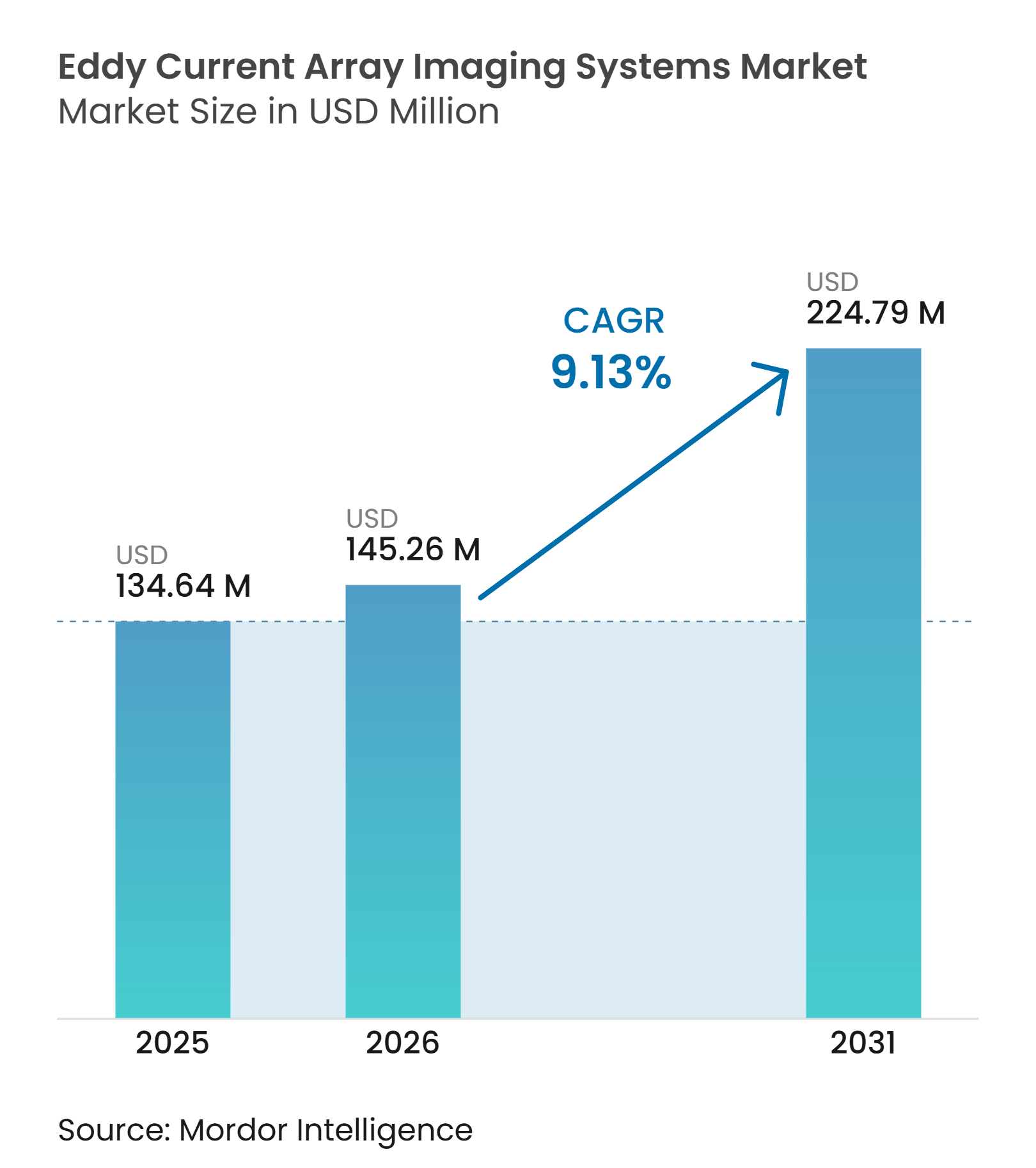
The eddy current array imaging systems market size was USD 134.64 million in 2025 and is expected to reach USD 224.79 million by 2031, registering a CAGR of 9.13% during 2026-2031. Demand is supported by recurring inspection work in aerospace, nuclear power, and other safety-critical operations. Required inspection intervals make a portion of spending less dependent on discretionary capital budgets. Manufacturers are also adopting real-time quality verification, which extends use beyond periodic field inspection. The eddy current array imaging systems market is therefore gaining traction among original equipment manufacturers, asset operators, and inspection service providers. Automation, digital records, and application-specific probes are shaping vendor strategies and purchase decisions.
Key Report Takeaways
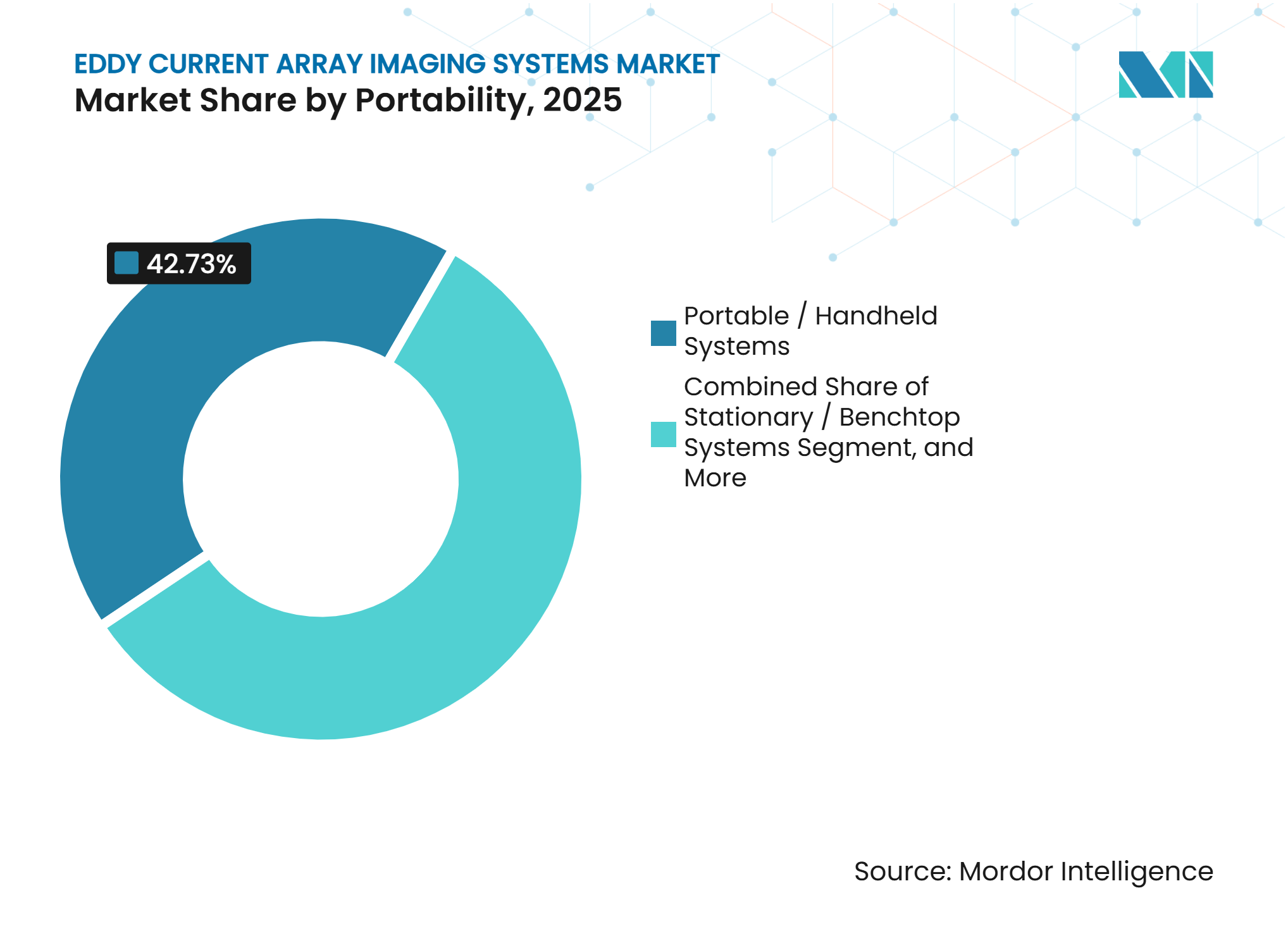
- By portability, portable and handheld systems held 42.73% of the eddy current array imaging systems market share in 2025, while automated and robotic systems are projected to expand at a 9.73% CAGR through 2031.
- By probe architecture, surface array probes held 34.87% revenue share in 2025, while flexible and conformable array probes are projected to expand at a 10.12% CAGR through 2031.
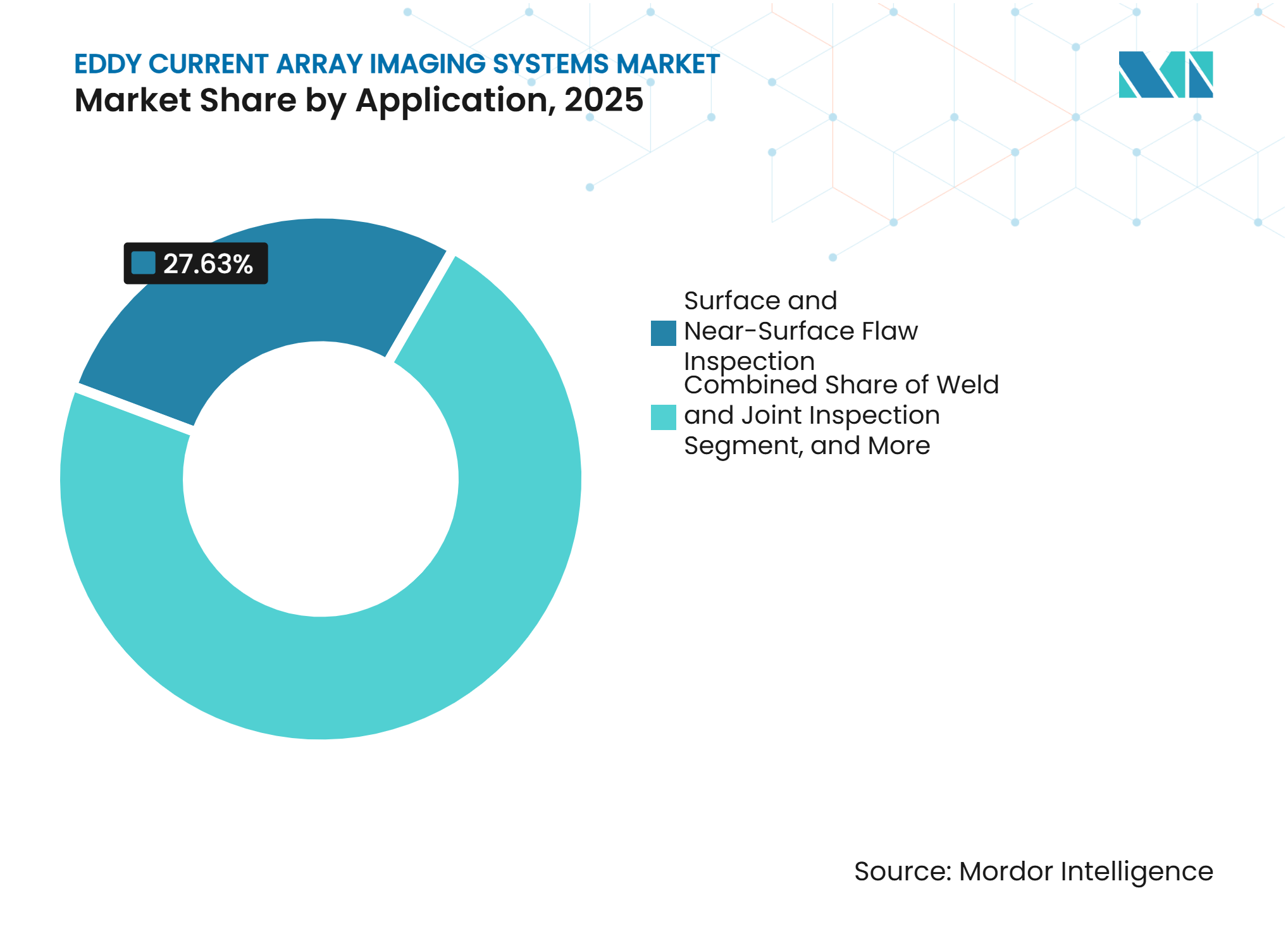
- By application, surface and near-surface flaw inspection accounted for 27.63% revenue share in 2025, while in-process and production-line inspection is projected to expand at a 10.54% CAGR through 2031.
- By end-user industry, aerospace and defense accounted for 28.47% of revenue in 2025, while power generation and nuclear are projected to expand at a 10.68% CAGR through 2031.
- By geography, Asia-Pacific accounted for 36.93% of revenue in 2025 and is projected to expand at a 10.11% CAGR through 2031.
Note: Market size and forecast figures in this report are generated using Mordor Intelligence’s proprietary estimation framework, updated with the latest available data and insights as of January 2026.
Market Trends and Insights
Drivers Impact Analysis of Eddy Current Array Imaging Systems Market*
| Driver | (~) % Impact on CAGR Forecast | Geographic Relevance | Impact Timeline |
|---|---|---|---|
| Aerospace MRO Inspection Backlog | +2.8% | North America, Europe, Asia-Pacific | Medium term (2-4 years) |
| Aging Nuclear and Power Generation Assets | +2.1% | North America, Europe, Asia-Pacific | Long term (≥ 4 years) |
| Automated Inline Quality Control | +1.7% | Global, with early leadership in North America and Europe | Medium term (2-4 years) |
| AI-Assisted Defect Classification and Digital Traceability | +1.3% | North America, Europe, with spillover to Asia-Pacific | Short term (≤ 2 years) |
| Oil and Gas Asset Life-Extension Programs | +1.1% | Middle East, North America, South America | Medium term (2-4 years) |
| Inspection of Complex Geometries Without Surface Preparation | +0.7% | Global, concentrated in aerospace manufacturing hubs in North America and Europe | Short term (≤ 2 years) |
| Source: Mordor Intelligence | |||
Aerospace MRO Inspection Backlog Sustains Structural ECA Demand
Commercial aerospace maintenance, repair, and overhaul activity faces extended pressure from high aircraft utilization and limited new-aircraft deliveries. Operators are keeping older airframes in service longer, which increases the volume of mandatory inspections and puts greater pressure on maintenance organizations to complete them during planned downtime. Eddy current array systems are well-suited to bolthole and fastener-area inspections, where single-coil raster scans can be slow and operator-dependent. The need for trained maintenance personnel also remains substantial, with Boeing estimating that global aviation will need 710,000 new maintenance technicians by 2044.[1] This workforce gap favors equipment capable of delivering repeatable scans and reducing manual inspection time. They also make repeatable, documented inspection results more valuable when maintenance schedules are under pressure.
Aging Nuclear and Power Generation Assets Drive Long-Cycle ECA Investment
Nuclear operators face a higher inspection workload as many reactor fleets move through later operating decades. The US Nuclear Regulatory Commission and the Electric Power Research Institute issued a performance-monitoring inspection plan for selected ASME Code examination items covering pressurized-water reactor steam generators and pressurizers, scheduled for late 2025 and early 2026. Steam-generator tube inspections use multi-element eddy-current configurations because each outage may require examination of many tubes, often under outage schedules that leave limited time for repeat testing or manual rescan work. A paper presented at ECNDT 2026 described the use of ECA for J-weld inspection on reactor vessel heads, including permanent inspection records, reduced chemical use, and robotic integration. An EPRI survey, cited by ASNT, found that 61% of 82 nuclear NDE professionals did not expect sufficient personnel to meet future requirements.[2] The eddy current array imaging systems market benefits as operators seek to retain inspection throughput with fewer experienced personnel.
Automated Inline Quality Control Extends ECA Beyond MRO Use
Eddy current array inspection has traditionally been used for maintenance and post-production integrity verification. Wire-arc additive manufacturing, battery electrode production, and composite fabrication are creating a role for defect detection during production. A 2026 study demonstrated a robotic system that combined phased-array ultrasonic testing with ECA for in-process inspection of Ti-6Al-4V wire-arc additive components. The system improved the contrast-to-noise ratio by up to 9.02 dB compared with single-sensor approaches, enabling earlier identification of defects in the build process before they affect later manufacturing stages. Fraunhofer IKTS uses its EddyCus Pro-II system for inline testing of flat materials, including battery foils and composite layers, with real-time conductivity and defect mapping up to 101 inches wide. This shift broadens the eddy current array imaging systems market beyond field inspections and brings advanced-production manufacturers into the potential customer base.
AI-Assisted Defect Classification and Digital Traceability Reshape Inspection Workflows
AI-supported signal interpretation is becoming more important as inspection volumes rise faster than the supply of certified interpreters. A 2026 ECNDT paper described an explainable AI inspection agent using 3D Grad-CAM for defect localization and a retrieval-augmented process for standards-aligned reporting. The approach included ISO 20601 real-time anomaly validation and digital audit trails. These functions can reduce false calls and make results easier to review across inspection teams, particularly when experienced specialists need to assess results from several sites or production lines. Digital records also support traceability in regulated aerospace, power, and manufacturing environments. The eddy current array imaging systems market is increasingly shaped by the ability to connect instruments, inspection results, and reporting workflows.
Restraints Impact Analysis of Eddy Current Array Imaging Systems Market*
| Restraint | (~) % Impact on CAGR Forecast | Geographic Relevance | Impact Timeline |
|---|---|---|---|
| High Capital Cost of Multi-Channel Imaging Systems | -1.9% | Global, particularly acute in South America, Southeast Asia, and Middle East and Africa | Long term (≥ 4 years) |
| Shortage of ET-Certified Inspection Personnel | -1.5% | Global, most severe in North America and Europe | Medium term (2-4 years) |
| Qualification Friction for AI-Enabled Inspection Workflows | -1.0% | North America and Europe | Medium term (2-4 years) |
| Material Conductivity and Geometry Limitations | -0.6% | Global | Short term (≤ 2 years) |
| Source: Mordor Intelligence | |||
High Capital Cost of Multi-Channel Imaging Systems Constrains Adoption
Multi-channel ECA instruments require multiplexed channels, high-speed data acquisition, imaging software, and application-specific probe libraries. This combination creates a high upfront cost for smaller service providers and manufacturers. Calibration, probe repair, and software updates can also increase ownership costs over time, especially when a service provider must maintain multiple probe types for separate customer applications and inspection procedures. The cost barrier is especially important in South America, Southeast Asia, the Middle East, and Africa, where inspection is often outsourced and access to capital is more limited. An ECNDT 2026 paper showed that a conventional dual-channel instrument could support an 8-element flexible array through an external controller and detect surface-breaking notches in carbon steel. Modular equipment and subscription models could improve access, but existing procurement patterns still limit deployment in price-sensitive settings.
Shortage of ET-Certified Inspection Personnel Caps Deployment Throughput
The workforce pipeline for eddy current testing remains under pressure at the entry, training, and retention stages. ASNT reported that 42% of the US NDT workforce was age 45 or older in 2025. The same ASNT publication cited a 2024 EPRI survey in which 37% of nuclear NDE professionals expected to retire by 2030, while another 24% expected to retire in the following decade. Experienced Level II and Level III personnel are particularly important for interpreting complex results and supervising qualified work, because their judgment supports procedure selection, signal review, and acceptance decisions in safety-critical applications. ASNT approved a National Apprenticeship Program in 2026 to help rebuild the workforce pipeline. Until this capacity improves, personnel availability will constrain the pace at which users can fully deploy eddy current array imaging systems market equipment.
*Our forecasts treat driver/restraint impacts as directional, not additive. The impact forecasts reflect baseline growth, mix effects, and variable interactions.
Eddy Current Array Imaging Systems Market Segment Analysis
By Portability:
Handheld Systems Support Field Inspection While Robotics Gains UsePortable and handheld systems accounted for 42.73% of the eddy current array imaging systems market in 2025. Their position reflects the need to inspect aircraft, pipelines, reactors, and other fixed assets at the point of use. Aerospace maintenance, oil and gas integrity work, and nuclear outage inspections depend on equipment that can travel to dispersed locations. Portable systems also fit inspection campaigns with limited time windows and changing site conditions. Established workflows and technician familiarity support their installed base across the eddy current array imaging systems market.
Automated and robotic systems are projected to expand at a 9.73% CAGR through 2031, making them the fastest-growing portability type. Stationary and benchtop systems remain relevant for fixed production lines in metal fabrication and automotive manufacturing. A University of Manchester study published in 2025 used a UR5 robotic arm equipped with a 16-coil ECA sensor to perform adaptive scanning of pipes with unknown geometry. It reported a reconstructed surface root-mean-square error of 0.51 mm without a CAD model. Robotic systems improve repeatability on complex shapes and help users address staffing shortages.



By Probe Architecture:
Surface Probes Lead While Flexible Types ExpandSurface array probes accounted for 34.87% of revenue in 2025 within the eddy current array imaging systems market. They are widely used on flat and gently curved components such as fuselage panels, weld seams, and pressure-vessel shells. Established calibration procedures and compatible instrument ecosystems support continued use in the eddy current array imaging systems market. Tubing array probes serve heat exchangers and steam generators in power, oil, and gas facilities. Tangential and custom-geometry probes address turbine-blade-root and bolted-joint work where standard surface probes may not provide adequate coupling for eddy current array imaging systems.
Flexible and conformable array probes are projected to expand at a 10.12% CAGR through 2031. Advances in flexible printed circuit board lithography support their use on tight radii and irregular surfaces. Eddyfi states that its P-Flex probes feature 32 coils on a 0.2 mm substrate with a minimum bending radius of 2 mm. This design supports inspection of turbine blade roots, curved weld toes, and fastener zones that are difficult to reach with rigid probes. A 2025 Communications Engineering study detected subsurface cracks 0.5-1.0 mm below a 20-30 μm zinc coating using 5 kHz excitation.
By Application:
Flaw Inspection Leads While Production-Line Use ExpandsSurface and near-surface flaw inspection accounted for 27.63% of the eddy current array imaging systems market size in 2025. Its leading position reflects recurring inspection requirements in aviation, nuclear operations, and pressure equipment. These programs create demand for methods that identify surface-related defects without extensive preparation. Weld and joint inspection covers critical connections in pipelines, pressure vessels, and structural components. Tubing, pipe, and heat exchanger inspections use multi-element probes to increase coverage during refinery and nuclear outages.
In-process and production-line inspection is projected to expand at a 10.54% CAGR through 2031. The application includes additive manufacturing quality assurance, composite layup inspection, and battery electrode monitoring. Eddy current methods provide high-speed, noncontact inspection in continuous production, where manual checks are difficult. Production users also need documented results that can be linked to individual components or batches. These requirements broaden the role of the eddy current array imaging systems market in manufacturing quality work and create a basis for more continuous verification.

By End-User Industry:
Aerospace and Defense Leads While Power and Nuclear AcceleratesAerospace and defense accounted for 28.47% of revenue in 2025. Airworthiness requirements, depot maintenance programs, and OEM quality procedures sustain demand in this end-user group. Aircraft structures contain fasteners, joints, and surface areas that require repeatable inspection across the eddy current array imaging systems market during both production and service. Military fleets also operate under inspection schedules that prioritize readiness and safety. These uses make aerospace and defense a stable source of demand for portable instruments, array probes, and related software.
Power generation and nuclear is projected to expand at a 10.68% CAGR through 2031. License renewals in North America and Europe can extend plant operations and retain ongoing inspection obligations. Asia-Pacific construction programs add pre-commissioning and early operating-cycle inspection requirements. Oil and gas remains a substantial user for pipeline assessment, heat-exchanger inspection, and corrosion mapping. Automotive, metal production, manufacturing, and infrastructure users add demand across the eddy current array imaging systems market as quality requirements extend across more production settings.
Geography Analysis
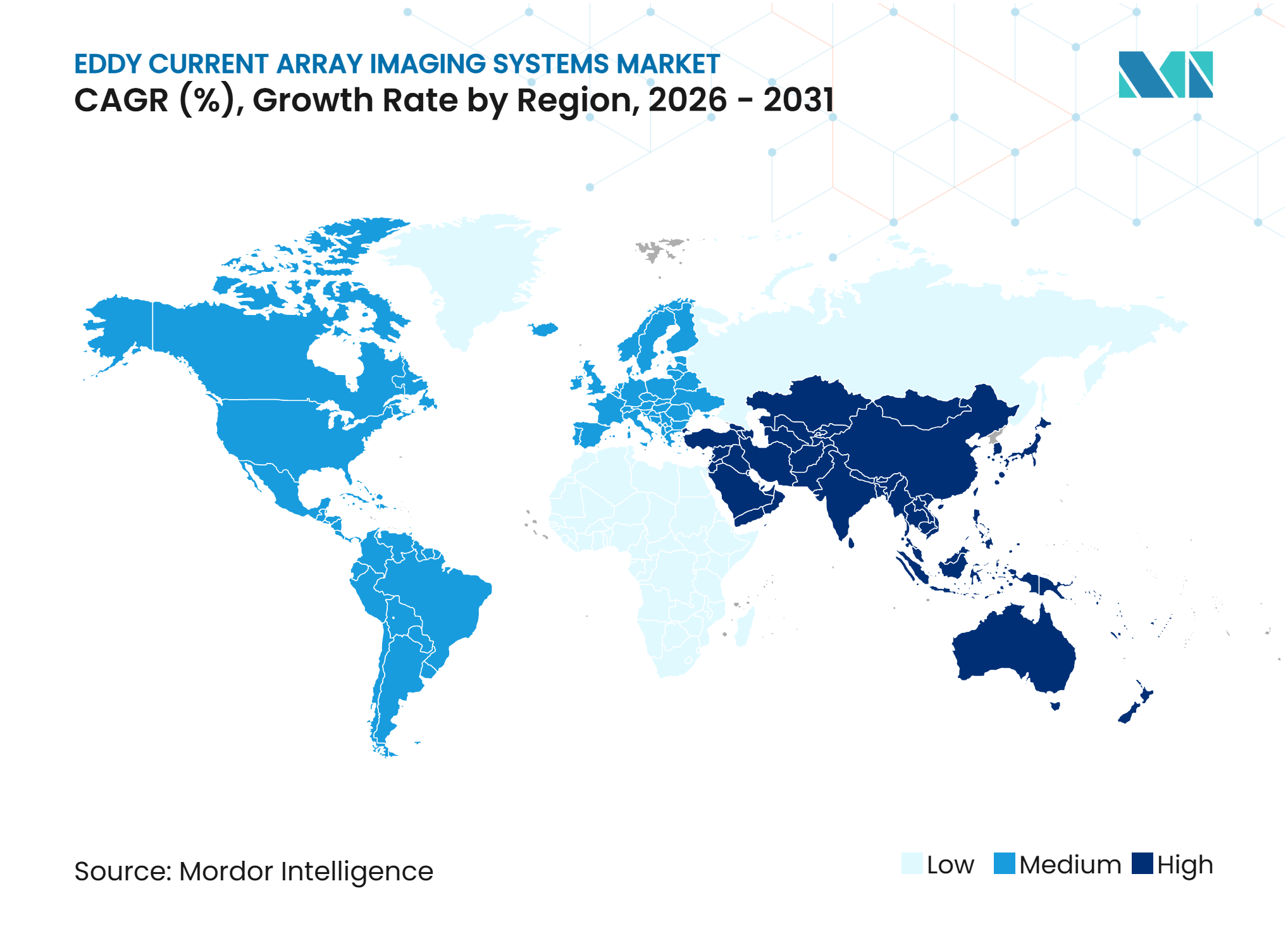
Asia-Pacific held 36.93% of the eddy current array imaging systems market share in 2025 and is projected to expand at a 10.11% CAGR through 2031. China supports regional demand through nuclear capacity additions, aerospace manufacturing, and a large industrial asset base. Japan and South Korea add demand from nuclear operations, electronics production, shipbuilding, and offshore integrity work. India is supported by infrastructure investment, early-stage aerospace manufacturing, and more formal NDT requirements. Vietnam, Thailand, and Indonesia drive demand for eddy current array imaging systems in heavy manufacturing and energy infrastructure.
North America and Europe are established markets for eddy current array imaging systems, with mature service networks and large installed bases. North American demand is supported by recurring requirements for aircraft and nuclear facilities, as well as ASME Boiler and Pressure Vessel Code compliance. These requirements make significant equipment use less sensitive to short-term economic cycles. Europe has a large industrial base in heavy engineering, power generation, and automotive manufacturing. Its nuclear fleet and alignment with aviation requirements sustain demand for qualified inspection services.
The Middle East and Africa have a smaller installed base but see demand tied to oil and gas asset life-extension programs. Saudi Aramco captures more than 10 million corrosion-monitoring readings each year across 63,000 static equipment items and 20,000 pipeline segments. This data environment supports tools that supply validated defect information. Applus+ renewed a 5-year offshore pipeline integrity contract in the United Arab Emirates during 2025, with an expanded inspection scope. South America, Brazil, Argentina, and Mexico add demand from pipeline, petrochemical, and manufacturing operations.
Competitive Landscape
Market Concentration
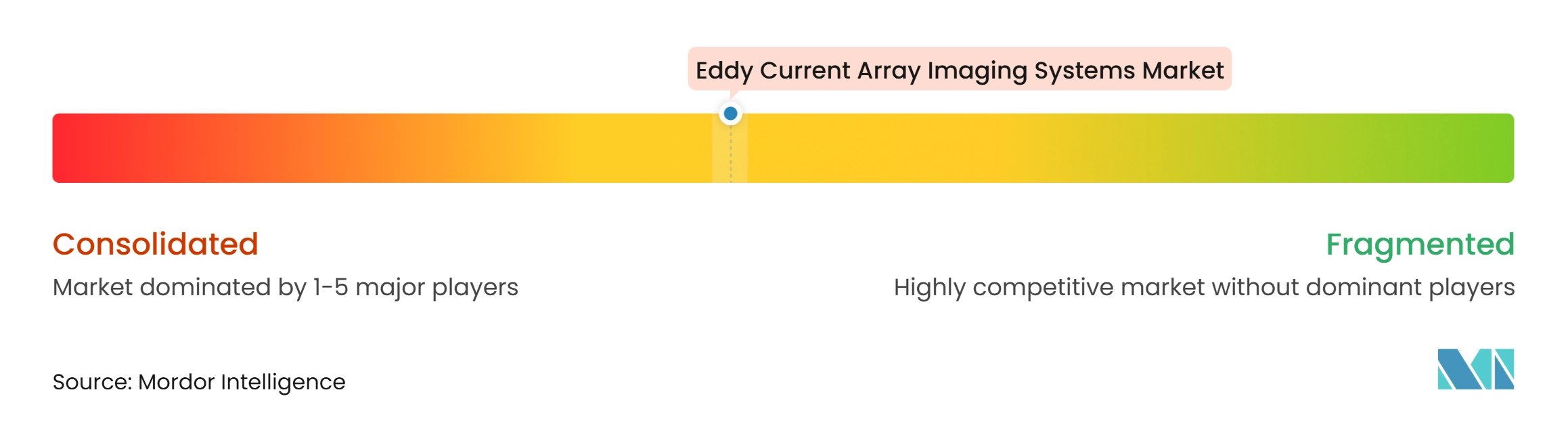
The eddy current array imaging systems market has moderate concentrated among technology-platform suppliers. The largest vendors compete through instrument capability, probe design, automation, and software integration. A small group of vendors designs multi-channel instruments, application-specific probes, and associated software. Inspection services remain decentralized because regional contractors often serve local asset owners and specialized applications. ESAB completed its acquisition of Eddyfi Technologies for USD 1.45 billion in June 2026.[3] The transaction added ECA instrumentation, robotic inspection platforms, and software to ESAB's workflow portfolio.
Wabtec finalized its acquisition of Evident's Inspection Technologies division for USD 1.78 billion in July 2025. Wabtec stated that the acquisition doubled its Digital Intelligence total addressable market from USD 8 billion to USD 16 billion. Hexagon signed an agreement in April 2026 to acquire Waygate Technologies from Baker Hughes for USD 1.45 billion. Hexagon planned to combine Waygate's NDT portfolio with its Volume Graphics CT software and precision measurement hardware. These transactions show that industrial groups value inspection data, analytics, and workflow integration alongside instrument sales.
Specialists, including Rohmann GmbH, KARL DEUTSCH, UniWest, OKOndt GROUP, and IBG NDT Systems, continue to have opportunities in automotive sorting, nuclear outages, and precision-machined component inspection. Institut Dr. Foerster expanded its eddy current instrumentation range by acquiring the Prüftechnik NDT business unit. Competition in the eddy current array imaging systems market centers on application knowledge, automation, and workflow integration.
Eddy Current Array Imaging Systems Industry Leaders
-
Eddyfi Technologies
-
Evident Corporation
-
Zetec Inc.
-
Waygate Technologies (Baker Hughes Company)
-
Institut Dr. Foerster GmbH & Co. KG
- *Disclaimer: Major Players sorted in no particular order
Eddy Current Array Imaging Systems Market Companies Covered in this Report
- Eddyfi Technologies
- Evident Corporation
- Zetec Inc.
- Waygate Technologies
- Institut Dr. Foerster GmbH & Co. KG
- Baker Hughes Company
- MISTRAS Group, Inc.
- Magnetic Analysis Corporation
- UniWest Corporation
- Rohmann GmbH
- Ashtead Technology Holdings plc
- Ether NDE Limited
- Centurion NDT
- Creaform Inc.
- KARL DEUTSCH Prüf- und Messgerätebau GmbH + Co KG
- OKOndt GROUP
- Nanjing BKN Automation System Co., Ltd.
- IBG NDT Systems Corporation
- Criterion NDT, Inc.
- Salem Design and Manufacturing, Inc.
- Applus+
- TÜV Rheinland AG
Recent Industry Developments in Eddy Current Array Imaging Systems Market
- September 2026: The ASNT Board of Directors approved a National Apprenticeship Program in summer 2026 to address the NDT workforce pipeline crisis, following the ASNT Foundation's 2025 Economic Impact of NDT report which found 42% of the US NDT workforce is now aged 45 or older.
- June 2026: ESAB Corporation completed its acquisition of Eddyfi Technologies for USD 1.45 billion. Eddyfi, projected to generate USD 270 million in revenue and USD 80 million in adjusted EBITDA in 2026, brings ECA instrumentation, remote monitoring robotics, and software serving nuclear, aerospace, defense, oil and gas, and transportation sectors in more than 110 countries. ESAB committed to maintaining Eddyfi's workforce and head office in Quebec City, Canada, while creating an end-to-end workflow that links fabrication, inspection, and asset monitoring.
- June 2026: Evident launched the NORTEC 700 Eddy Current Array Flaw Detector in 3 models, N700 for conventional ECT, N700D for dual-frequency and bolthole inspection, and N700i for ECT plus advanced ECA with up to 256 channels. The platform incorporates intelligent signal interpretation for automatic layer detection and defect discrimination. It targets aerospace MRO inspectors seeking to reduce false calls and rework in bolthole and surface-flaw applications.
- April 2026: Hexagon AB signed a definitive agreement to acquire Waygate Technologies from Baker Hughes for USD 1.45 billion in an all-cash transaction, expected to close in H2 2026. Waygate generated USD 630 million in FY2025 revenue across radiography, remote visual inspection, and phased-array ultrasonic technologies from 1,500 employees in 25 locations. Hexagon intended to integrate the acquisition with its Volume Graphics CT software and CMM portfolio to cover the full product lifecycle.
Global Eddy Current Array Imaging Systems Market Report Scope
The Eddy Current Array Imaging Systems Market comprises revenue generated from the sale, integration, software, maintenance, and inspection services associated with non-destructive testing systems that use multiple electronically driven eddy-current coils or sensors arranged within an array probe. These systems detect and image surface and near-surface discontinuities in electrically conductive materials by measuring changes in electromagnetic response caused by cracks, corrosion, material degradation, weld defects, and geometric variations. Compared with conventional single-coil eddy-current testing, array systems cover a wider inspection area in fewer passes and can generate encoded 2D or 3D inspection maps for improved defect location, sizing, and review.
The Eddy Current Array Imaging Systems Market Report is Segmented by Portability (Portable / Handheld Systems, Stationary / Benchtop Systems, and Automated / Robotic Systems), Probe Architecture (Surface Array Probes, Tubing Array Probes, Flexible and Conformable Array Probes, Tangential Array Probes, and Custom-Geometry Array Probes), Application (Surface and Near-Surface Flaw Inspection, Weld and Joint Inspection, Tubing, Pipe and Heat-Exchanger Inspection, Fastener-Hole and Geometric Feature Inspection, Corrosion and Material-Degradation Inspection, and In-Process and Production-Line Inspection, and Other Applications), End-User Industry (Aerospace and Defense, Power Generation and Nuclear, Oil and Gas, Automotive and Transportation, Metal Production and Fabrication, General Manufacturing and Heavy Engineering, Construction and Infrastructure, and Other End-User Industries), and Geography (North America, South America, Europe, Asia-Pacific, and Middle East and Africa). The Market Forecasts are Provided in Terms of Value (USD).
Segmentation Overview
| Portable / Handheld Systems |
| Stationary / Benchtop Systems |
| Automated / Robotic Systems |
| Surface Array Probes |
| Tubing Array Probes |
| Flexible and Conformable Array Probes |
| Tangential Array Probes |
| Custom-Geometry Array Probes |
| Surface and Near-Surface Flaw Inspection |
| Weld and Joint Inspection |
| Tubing, Pipe, and Heat-Exchanger Inspection |
| Fastener-Hole and Geometric Feature Inspection |
| Corrosion and Material-Degradation Inspection |
| In-Process and Production-Line Inspection |
| Other Applications |
| Aerospace and Defense |
| Power Generation and Nuclear |
| Oil and Gas |
| Automotive and Transportation |
| Metal Production and Fabrication |
| General Manufacturing and Heavy Engineering |
| Construction and Infrastructure |
| Other End-User Industries |
| North America | United States | |
| Canada | ||
| Mexico | ||
| South America | Brazil | |
| Argentina | ||
| Rest of South America | ||
| Europe | Germany | |
| United Kingdom | ||
| France | ||
| Italy | ||
| Spain | ||
| Rest of Europe | ||
| Asia-Pacific | China | |
| Japan | ||
| India | ||
| South Korea | ||
| ASEAN | ||
| Rest of Asia-Pacific | ||
| Middle East and Africa | Middle East | Saudi Arabia |
| United Arab Emirates | ||
| Turkey | ||
| Rest of the Middle East | ||
| Africa | South Africa | |
| Nigeria | ||
| Rest of Africa | ||
| By Portability | Portable / Handheld Systems | ||
| Stationary / Benchtop Systems | |||
| Automated / Robotic Systems | |||
| By Probe Architecture | Surface Array Probes | ||
| Tubing Array Probes | |||
| Flexible and Conformable Array Probes | |||
| Tangential Array Probes | |||
| Custom-Geometry Array Probes | |||
| By Application | Surface and Near-Surface Flaw Inspection | ||
| Weld and Joint Inspection | |||
| Tubing, Pipe, and Heat-Exchanger Inspection | |||
| Fastener-Hole and Geometric Feature Inspection | |||
| Corrosion and Material-Degradation Inspection | |||
| In-Process and Production-Line Inspection | |||
| Other Applications | |||
| By End-User Industry | Aerospace and Defense | ||
| Power Generation and Nuclear | |||
| Oil and Gas | |||
| Automotive and Transportation | |||
| Metal Production and Fabrication | |||
| General Manufacturing and Heavy Engineering | |||
| Construction and Infrastructure | |||
| Other End-User Industries | |||
| By Geography | North America | United States | |
| Canada | |||
| Mexico | |||
| South America | Brazil | ||
| Argentina | |||
| Rest of South America | |||
| Europe | Germany | ||
| United Kingdom | |||
| France | |||
| Italy | |||
| Spain | |||
| Rest of Europe | |||
| Asia-Pacific | China | ||
| Japan | |||
| India | |||
| South Korea | |||
| ASEAN | |||
| Rest of Asia-Pacific | |||
| Middle East and Africa | Middle East | Saudi Arabia | |
| United Arab Emirates | |||
| Turkey | |||
| Rest of the Middle East | |||
| Africa | South Africa | ||
| Nigeria | |||
| Rest of Africa | |||
Key Questions Answered in the Report
What is the size of the eddy current array imaging systems market?
The eddy current array imaging systems market was valued at USD 134.64 million in 2025 and is expected to reach USD 224.79 million by 2031, at a 9.13% CAGR. The forecast period runs from 2026 through 2031, with demand supported by regulated inspection, field maintenance, and production-quality use cases across several safety-critical sectors.
What is driving demand for eddy current array imaging systems?
Recurring aerospace and nuclear inspections, production-line quality control, and the need to address a shortage of certified personnel are key factors. Demand also benefits from requirements for documented, repeatable results in regulated inspection programs, including aerospace maintenance and nuclear equipment examinations.
Which portability type leads demand for ECA systems?
Portable and handheld systems led with 42.73% revenue share in 2025 because many inspection tasks must be performed at the asset location. The category is used in aircraft, pipelines, reactors, and other fixed assets where moving the component is impractical or would disrupt a planned inspection campaign.
Which ECA probe type is expected to expand fastest?
Flexible and conformable array probes are projected to expand at a 10.12% CAGR through 2031, supported by their ability to inspect curved and complex surfaces. Flexible printed circuit board designs allow probe arrays to follow tight radii and irregular component profiles that rigid probes may not inspect effectively.
Which application is projected to expand fastest through 2031?
In-process and production-line inspection is projected to expand at a 10.54% CAGR as manufacturers adopt real-time defect detection. The application includes additive manufacturing, composite layup, and battery electrode quality checks that help limit later rework and support recorded production verification.
Which region is expected to lead ECA system demand?
Asia-Pacific led with 36.93% revenue share in 2025 and is projected to expand at a 10.11% CAGR through 2031. The region combines nuclear investment, aerospace production, expanding industrial infrastructure, and demand from China, India, Japan, and South Korea, with additional demand from ASEAN manufacturing and energy projects.