
East Africa Forage Seed Market Size and Share
Market Overview
| Study Period | 2021 - 2031 |
|---|---|
| Forecast Data Period | 2026 - 2031 |
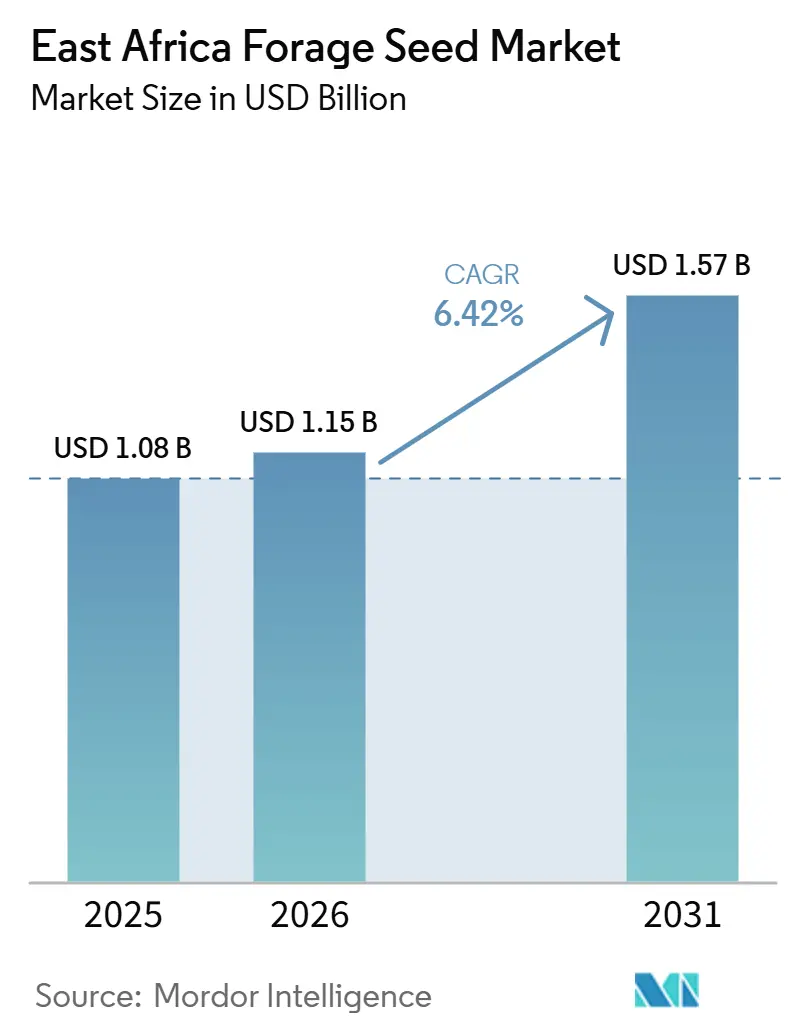
| Base Year Market Size (2025) | USD 1.08 Billion |
| Market Size (2026) | USD 1.15 Billion |
| Market Size (2031) | USD 1.57 Billion |
| Growth Rate (2026 - 2031) | 6.42 % |
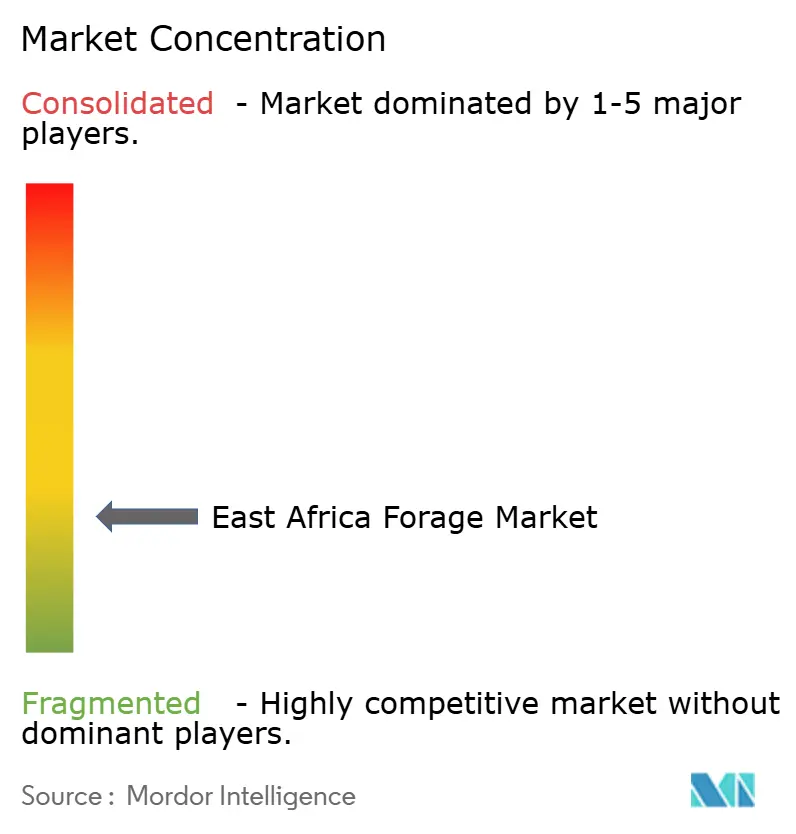
| Market Concentration | Low |
Major Players *Disclaimer: Major Players sorted in no particular order Image © Mordor Intelligence. Reuse requires attribution under CC BY 4.0. | |
East Africa Forage Seed Market Analysis by Mordor Intelligence
The East Africa Forage Seed Market size is projected to increase from USD 1.08 billion in 2025 to USD 1.15 billion in 2026 and reach USD 1.57 billion by 2031, growing at a CAGR of 6.42% over 2026-2031. The East Africa forage seed market is supported by long-term growth in demand for animal-source foods across the region. Per capita milk consumption in sub-Saharan Africa is projected to increase to around 64 liters by 2050, supporting sustained demand for improved forage seed, high-quality livestock feed, and more productive feeding systems. Program-led farmer training, local forage seed multiplication, and integrated forage development initiatives implemented by governments, research institutions, and development organizations are helping transition forage adoption from one-time demonstrations to regular purchases of improved seed, particularly in dairy and mixed crop-livestock systems. The East Africa forage seed market remains moderately fragmented, with multinational seed companies, regional suppliers, and domestic producers competing across different countries. Suppliers that combine improved genetics, consistent seed quality, and strong agronomic support are better positioned to expand their market presence. The market also continues to benefit from increasing commercial silage production, growing adoption of drought- and climate-resilient forage varieties, and wider recognition of the link between year-round forage availability, livestock productivity, and farm profitability, supporting sustained market growth over the medium to long term.
Key Report Takeaways
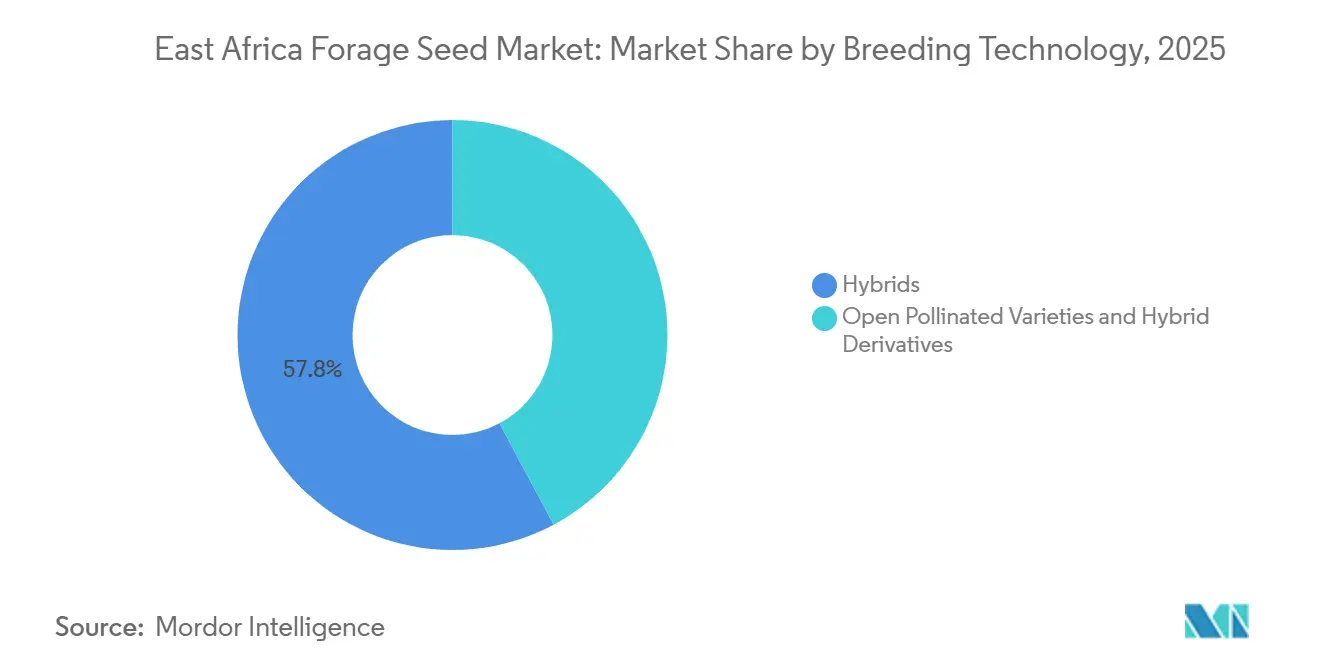
- By breeding technology, hybrids were the largest segment with 57.8% of the East Africa forage seed market size in 2025, while Open Pollinated Varieties and Hybrid Derivatives are the fastest segment with a 7.6% CAGR through 2031.
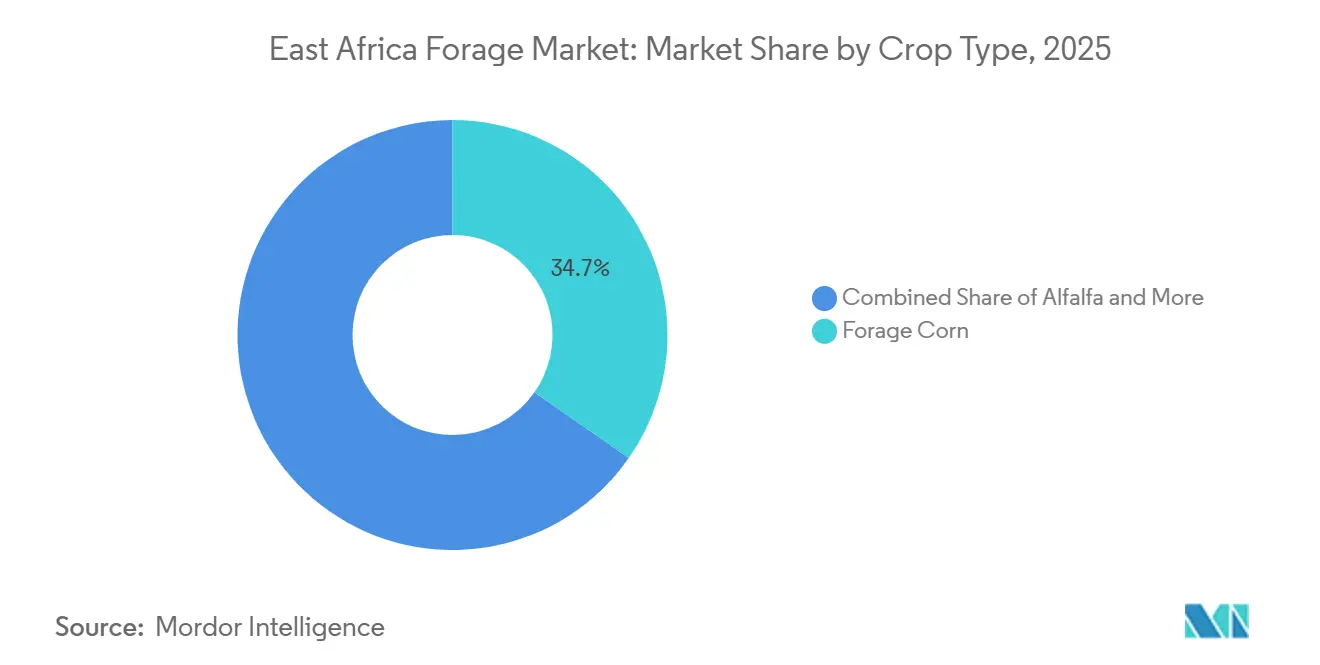
- By crop type, forage corn was the largest segment with 34.7% of the East Africa forage seed market size in 2025, while alfalfa is the fastest segment with a 7.8% CAGR through 2031.
- By geography, Kenya was the largest segment with 46% of the East Africa forage seed market share in 2025, while Ethiopia is the fastest segment with an 8.3% CAGR through 2031.
Note: Market size and forecast figures in this report are generated using Mordor Intelligence’s proprietary estimation framework, updated with the latest available data and insights as of January 2026.
East Africa Forage Seed Market Trends and Insights
Drivers Impact Analysis*
| Driver | (~) % Impact on CAGR Forecast | Geographic Relevance | Impact Timeline |
|---|---|---|---|
| Rising dairy feed deficit in Kenya and Ethiopia | 2.10% | Kenya and Ethiopia, Tanzania secondary | Short term (≤ 2 years) |
| Expansion of climate-resilient forage seed systems | 1.30% | East Africa wide, Tanzania and Uganda gaining momentum | Medium term (2-4 years) |
| Commercial silage and fodder contracting models | 1.00% | Kenya dominant, Ethiopia emerging | Short term (≤ 2 years) |
| Public and donor de-risking of early market development | 0.70% | Kenya proven, Ethiopia and Uganda scaling | Medium term (2-4 years) |
| Premiumization of certified forage for dairy and feed mills | 0.60% | Kenya and Ethiopia | Medium term (2-4 years) |
| Cross-border fodder trade from surplus highland zones | 0.40% | Kenya to Ethiopia corridor and Kenya arid lowlands | Long term (≥ 4 years) |
| Source: Mordor Intelligence | |||
Rising Dairy Feed Deficit in Kenya and Ethiopia
The East Africa forage seed market continues to grow because livestock systems still face a major structural feed shortage. According to the International Livestock Research Institute (ILRI) (2024), the regional annual feed demand reaches 353 million metric tons of dry matter, while current supply covers only 60% of this demand[1]Source: Salvatore Burkart et al., “Forage Seed Systems to Close the Ruminant Feed Deficit in Eastern Africa,” Grasses, mdpi.com. In Ethiopia, cultivated forage deficit exceeds 8.8 million metric tons of dry matter each year, and the forage seed system remains weak, with nearly 70% of seeds still moving through informal channels. This gap keeps forage demand tied to a real operating need rather than discretionary spending, which gives the East Africa forage seed market a durable base. The same shortage also raises the value of varieties that can deliver more biomass and more stable feed output from limited land.
Expansion of Climate-Resilient Forage Seed Systems
Climate variability is pushing farmers and seed suppliers to favor varieties that can withstand moisture stress, land pressure, and less-predictable growing conditions. The East Africa forage seed market is responding through greater interest in improved grasses and legumes that fit mixed farming systems and can perform more reliably under field stress. Research on improved forages in Uganda and broader Sub-Saharan Africa also shows that feed security and livestock productivity improve when resilient forage options are matched with the right extension and market support. This means the East Africa forage seed market is expanding not only through more seed sales but also through a gradual shift toward species and formats that reduce production risk. Over time, that improves adoption consistency and helps suppliers justify local multiplication and distribution investments.
Commercial Silage and Fodder Contracting Models
Commercial silage and fodder contracting is changing how improved forage enters smallholder systems. Instead of relying solely on individual seed purchases, this model ties seed demand to harvesting, storage, and feed planning services, giving farmers a clearer use case for better varieties. The East Africa forage seed market benefits from this because seed choice becomes linked to a more organized feed model rather than a stand-alone input decision. It also creates a stronger route to market for suppliers that can serve contractors, dairy clusters, and other volume buyers. As these service models spread, the East Africa forage seed market is likely to see better demand visibility and more repeat sales across commercial and semi-commercial farms. That shift matters because it turns improved forage from a seasonal trial into part of a broader feed management system.
Public and Donor De-Risking of Early Market Development
Early forage market development often struggled because many small farms were too small to attract private investment on a stand-alone basis. Experimental evidence from Meru County in Kenya showed that willingness to pay for improved forage varieties was below market prices for many farmers, which explains why early adoption needed outside support. The Nourishing Prosperity Alliance (NPA-FORAGE), implemented by Land O'Lakes Venture37 in partnership with Forage Genetics International, Corteva Agriscience, and the International Livestock Research Institute (ILRI), is strengthening commercial forage markets in Ethiopia by validating smallholder demand and improving market access for quality forage seed. The initiative aims to establish commercially viable and sustainable forage value chains that support dairy productivity and private-sector investment[2]Source: International Livestock Research Institute, “In Ethiopia, Bundled Forage Innovations Are Closing the Livestock Feed Gap,” ILRI News, ilri.org. The East Africa forage seed market gains from these programs because they reduce trial risk, improve farmer familiarity, and prepare the ground for private seed companies to scale into proven demand pockets. That sequencing remains important in a market where training, seed access, and on-farm results still need to move together.
Restraints Impact Analysis*
| Restraint | (~) % Impact on CAGR Forecast | Geographic Relevance | Impact Timeline |
|---|---|---|---|
| High seed and establishment costs for improved forages | -1.50% | East Africa wide, most acute in Kenya and Ethiopia | Short term (≤ 2 years) |
| Fragmented seed quality assurance and variety registration | -0.80% | Uganda, Ethiopia, and Tanzania | Medium term (2-4 years) |
| Land and water constraints in high-potential dairy corridors | -0.60% | Kenya dairy corridors and Ethiopia highlands | Medium term (2-4 years) |
| Dry-season logistics losses and weak cold or covered storage | -0.40% | Kenya arid lowlands and Ethiopia pastoral zones | Long term (≥ 4 years) |
| Source: Mordor Intelligence | |||
High Seed and Establishment Costs for Improved Forages
High seed cost remains one of the clearest barriers to faster adoption. In Kenya, Urochloa seed prices were reported at USD 40 to USD 50 per kg, compared with USD 15 to USD 30 per kg in South American supplier markets, which shows how limited local multiplication still raises costs in the East Africa forage seed market. The same pressure is visible in farmer behavior, since willingness to pay for improved forage varieties in Meru County remained below market prices for most products. Seed production costs also rose sharply in Kenya, with land cost for seed production plots moving from KES 4,000 (USD 26) to KES 20,000 (USD 130) per acre before the March 2025 planting season[3]Source: “Developments, Bottlenecks, and Opportunities in Seed Markets for Improved Forages in East Africa, The Case of Kenya,” Global Food Security, doi.org. This cost burden slows adoption most in smallholder systems, where the agronomic case for improved forage may be strong, but the upfront cash requirement remains difficult to absorb.
Fragmented Seed Quality Assurance and Variety Registration
The East Africa forage seed market is also slowed by fragmented regulation and uneven quality assurance. Work on improved forage seed markets in East Africa shows that national registration systems and certification processes still create delays between breeding progress and commercial availability. A broader analysis of seed market development in the region highlights the same challenge. Formal systems remain too narrow to serve the scale of latent demand across mixed livestock systems. When farmers cannot easily verify seed quality or access registered varieties, repeat purchasing weakens, and informal channels remain dominant. That problem is especially important in the East Africa forage seed market because the value of improved forage depends on visible field performance, so one poor seed experience can delay adoption for several seasons.
*Our forecasts treat driver/restraint impacts as directional, not additive. The impact forecasts reflect baseline growth, mix effects, and variable interactions.
Segment Analysis
By Breeding Technology: Hybrids Lead Revenue While Open Pollinated Varieties Broaden Access
Hybrids held the largest country segment, with a 46% share of the East Africa forage seed market in 2025. Their lead came from strong use in commercial maize silage systems and from the established distribution presence of large seed suppliers in Kenya and Ethiopia. Hybrids also meet the needs of dairy farms and commercial silage operators seeking higher biomass output, better disease tolerance, and more predictable field performance. In the East Africa forage industry, these traits matter because feed costs are judged against livestock output, not only seed price. That keeps hybrids well-positioned in higher-value dairy corridors, where consistent yield matters more than seed recycling.
Open Pollinated Varieties and Hybrid Derivatives are the fastest segment with a 7.6% CAGR from 2026 to 2031. Their growth is tied to lower unit cost, easier multiplication, and a better fit with smallholder systems that still dominate regional livestock production. In 2024, a Consultative Group on International Agricultural Research (CGIAR) publication found that Urochloa and Megathyrsus maximus are among the most widely traded improved forage varieties in Kenya and are projected to remain important over the next decade. The East Africa forage seed market is therefore developing along 2 lines at once, with hybrids anchoring commercial volume and open-pollinated options expanding reach. That balance matters because broad adoption in the East Africa forage seed market will depend on both premium yield segments and affordable seed formats that can move through local multiplication systems.



By Crop Type: Forage Corn Held the Largest Share While Alfalfa Expands the Fastest
Forage corn held the largest country segment, with a 34.7% share of the East Africa forage seed market in 2025. Its position reflects a familiar production model, since it serves as both a grain and silage crop and fits existing silage practices in Kenya and other organized dairy zones. Commercial supply is also supported by active breeding progress, with the 2026 International Maize and Wheat Improvement Center product announcement advancing 8 elite maize hybrids through Stage 5 trials for Eastern Africa. Forage sorghum continues to gain ground in drier areas because it handles moisture stress better than maize under tougher agro-ecological conditions. Other forage crops, including Napier grass, Urochloa, and leguminous species, remain important in cut-and-carry systems that still define much of smallholder dairy feeding.
Alfalfa was the fastest crop segment and is projected to grow at a 7.8% CAGR through 2031. Its growth is tied to premium feed demand from more commercial dairy operations that need high-protein and more standardized forage inputs. The International Livestock Research Institute included alfalfa, tree lucerne, desho grass, dual-purpose maize, and oat-vetch mixtures in bundled forage programs across Ethiopia in 2025, demonstrating that alfalfa is moving beyond narrow trial use into broader feeding systems. Product positioning also supports this trend, since alfalfa varieties are valued for higher protein levels, multiple annual harvests, and soil benefits from nitrogen fixation. The East Africa forage seed industry is therefore seeing a clear split, with forage corn leading scale and alfalfa gaining value where dairy producers are willing to pay more for better feed quality.
Geography Analysis
Kenya held the largest country segment, with a 46% share of the East Africa forage seed market in 2025. Kenya held this lead because it has a stronger smallholder dairy base, denser agro-dealer networks, and broader familiarity with commercial forage and silage systems. The country also remains central to the East Africa forage seed market because many route-to-market models, including contractor-led silage use and organized dairy feed programs, are most visible there. Kenya's position benefits suppliers by offering a more mature commercial environment for seed distribution, agronomy support, and repeat-farmer engagement. At the same time, the market is not fully mature, since affordability and seed quality still shape adoption speed in many dairy zones.
Ethiopia was the fastest country segment with an 8.3% CAGR from 2026 to 2031. The growth outlook is stronger there because formal forage systems are expanding from a lower base, while large mixed farming and livestock systems create wide room for commercial seed penetration. The International Livestock Research Institute reported in early 2026 that forage seed multiplication and commercialization in Ethiopia covered 98 hectares across North Shewa, Hadiya, and Kembata, suggesting a more organized seed pipeline than in earlier years. The same organization also reported broad 2025 farmer reach through bundled forage programs, which suggests that awareness, seed multiplication, and field use are now moving in the same direction. Ethiopia, therefore, offers the East Africa forage seed market its strongest medium-term expansion story, even though informal seed use still limits how much of that demand formal suppliers capture.
Tanzania and Uganda remain smaller but increasingly important parts of the East Africa forage seed market. Tanzania is moving through a policy-led path, where interest in resilient seed systems and local multiplication is gradually improving the commercial case for better forage varieties. Uganda has demonstrated practical adoption potential, with journal evidence linking improved use of forage grasses to stronger farm outcomes when seed access and support systems are in place. The rest of the region, including emerging livestock corridors, still represents a longer-horizon opportunity rather than an immediate scale. Over time, the East Africa forage seed market is likely to widen geographically as seed quality systems, local multiplication, and trade connections improve across a larger regional footprint.
Competitive Landscape
The East Africa forage seed market remains moderately fragmented in 2025, with global seed companies such as Corteva Agriscience, Bayer AG, Syngenta Limited, Land O’Lakes Inc., and Brookside Dairy Limited competing alongside regional and local suppliers, including East African Seed Company Limited and Balton CP Limited. Large multinational players tend to compete through proprietary hybrid genetics, stronger compliance capacity, and more structured agronomy support. Regional and local companies usually compete through price, availability, and closer access to local dealer networks. This mix keeps the East Africa forage seed market open to several business models rather than allowing one supplier group to dominate. It also means that scale is built through execution and local fit, not only through brand recognition.
A notable strategic development in the East Africa forage seed market is the decision by Land O'Lakes Venture37, Forage Genetics International, and Corteva Agriscience to collaborate with the International Livestock Research Institute through the Nourishing Prosperity Alliance model during the 2024–2027 implementation period. That approach focused on building farmer readiness, validating demand, and reducing entry risk before expecting normal commercial pull. Companies entering the East Africa forage seed market require more than product supply. They need evidence that farmers can use, value, and repurchase improved forage seed. A notable competitive development is the continued investment in hybrid development pipelines linked to Eastern Africa, with the International Maize and Wheat Improvement Center advancing 8 elite hybrids through late-stage trials in 2026. Another important competitive move is the continued investment in hybrid development pipelines linked to Eastern Africa, with the International Maize and Wheat Improvement Center advancing 8 elite hybrids through late-stage trials in 2026. That pipeline supports future commercial positioning for forage corn, which remains the region's largest crop category.
The next competitive opening may come from segments where repeat economics have historically been weaker, especially open-pollinated forage materials. Global majors have often focused more on hybrids, while affordable, locally produced options left more room for regional players and program-backed channels. That creates a practical opening for companies that can build trust in seed quality and maintain a steady last-mile supply. The East Africa forage seed market is also likely to reward firms that adapt genetics and support packages to local agroecologies rather than relying solely on broad catalog offerings. As the market matures, competition will be shaped less by simple presence in a country and more by how well each supplier connects seed performance, advisory support, and farmer economics.
East Africa Forage Seed Industry Leaders
Syngenta Limited
Bayer AG
Land O’Lakes Inc.
Brookside Dairy Limited (Brookside Holdings)
Corteva Inc.
- *Disclaimer: Major Players sorted in no particular order

Recent Industry Developments
- February 2026: Bayer East Africa launched a nationwide anti-counterfeit seed campaign in Kisii, encouraging farmers to verify KEPHIS certification labels and purchase seed only through licensed agro-dealers. The initiative aims to reduce the use of counterfeit seed, strengthen confidence in certified seed, and support the integrity of Kenya's formal seed market. The campaign directly addresses the erosion of commercial forage seed margins and farmer adoption rates due to counterfeit seed.
- January 2026: The International Livestock Research Institute (ILRI) published its First Quarter (January–March 2026) TAAT II project report, highlighting the establishment of 98 hectares of dedicated forage seed multiplication fields across the North Shewa Zone of the Amhara Region and the Hadiya and Kembata Tembaro zones of the Central Ethiopia Region. The report identified Eden Field Agri Seed Enterprise PLC as a key private-sector partner supporting forage seed multiplication and commercialization.
- February 2025: Ethiopian Investment Holdings, Ethiopian Agricultural Business Corporation, and Asset Green signed an agreement for a USD 600 million Integrated Dairy and Commercial Farming Project. Phase 1 dedicates 15,000 hectares to integrated feed farming to create a direct institutional demand anchor for certified forage seed at a commercial scale.


East Africa Forage Seed Market Report Scope
Forage can refer to the act of searching widely for food or supplies in the wild. It also describes plant materials, like grasses and hay, that are eaten by grazing livestock. The East Africa Forage Seed Market Report is segmented by breeding technology (Hybrids and Open Pollinated Varieties and Hybrid Derivatives), crop type (Alfalfa, Forage Corn, Forage Sorghum, and Other Forage Crops), and geography (Kenya, Ethiopia, Tanzania, Uganda, and the Rest of East Africa). The market forecasts are provided in terms of value (USD) and volume (metric tons).
| Hybrids | Non-Transgenic Hybrids | |
| Transgenic Hybrids | Herbicide Tolerant Hybrids | |
| Other Traits | ||
| Open Pollinated Varieties and Hybrid Derivatives | ||
| Alfalfa |
| Forage Corn |
| Forage Sorghum |
| Other Forage Crops |
| Kenya |
| Ethiopia |
| Tanzania |
| Uganda |
| Rest of East Africa |
| Breeding Technology | Hybrids | Non-Transgenic Hybrids | |
| Transgenic Hybrids | Herbicide Tolerant Hybrids | ||
| Other Traits | |||
| Open Pollinated Varieties and Hybrid Derivatives | |||
| Crop Type | Alfalfa | ||
| Forage Corn | |||
| Forage Sorghum | |||
| Other Forage Crops | |||
| By Country | Kenya | ||
| Ethiopia | |||
| Tanzania | |||
| Uganda | |||
| Rest of East Africa | |||


Key Questions Answered in the Report
What is the 2031 outlook for East Africa forage seed demand?
The East Africa forage seed market is forecast to reach USD 1.57 billion by 2031, rising at a 6.42% CAGR from 2026 to 2031.
Which country leads regional sales today?
Kenya is the largest country segment, with 46% share in 2025, supported by a stronger dairy base and broader commercial seed distribution.
Which country is expanding the fastest through 2031?
Ethiopia is the fastest country segment, with an 8.3% CAGR through 2031, helped by growing seed multiplication and wider forage program reach.
Which crop has the strongest current position?
Forage corn is the largest crop segment, with 34.7% share in 2025, because it fits both grain and silage use and already has a strong breeding pipeline.
Which crop is gaining momentum the quickest?
Alfalfa is the fastest crop segment, with a 7.8% CAGR through 2031, as demand grows for higher-protein and more standardized feed.
What is the main barrier to broader farmer adoption?
High seed cost remains the clearest barrier, especially for smallholders, since improved forage seed still carries a large upfront cash requirement in many markets.
Page last updated on:





